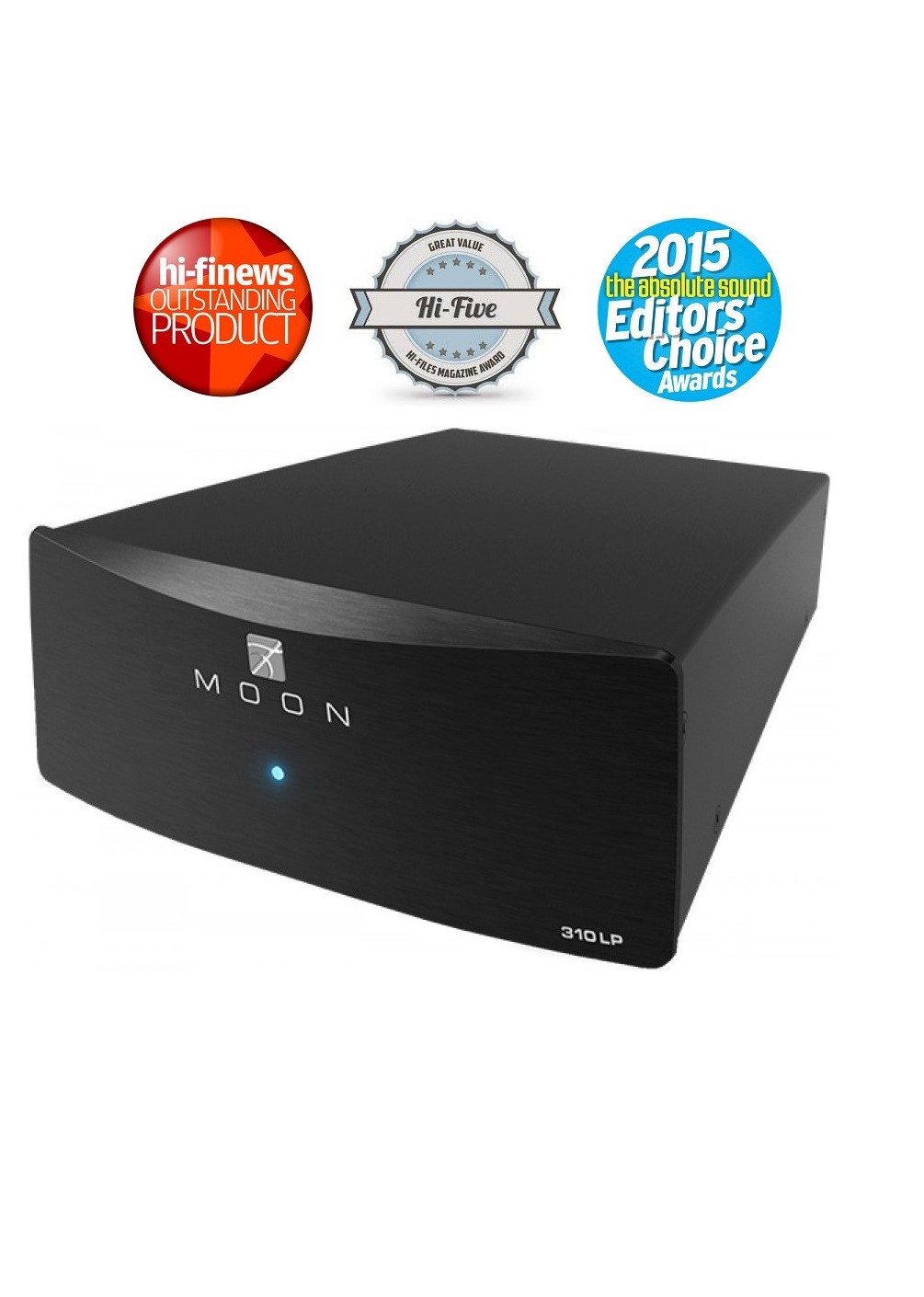
Simaudio Moon 310LP Phono Stage
Original price was: R68,000.00.R24,000.00Current price is: R24,000.00.
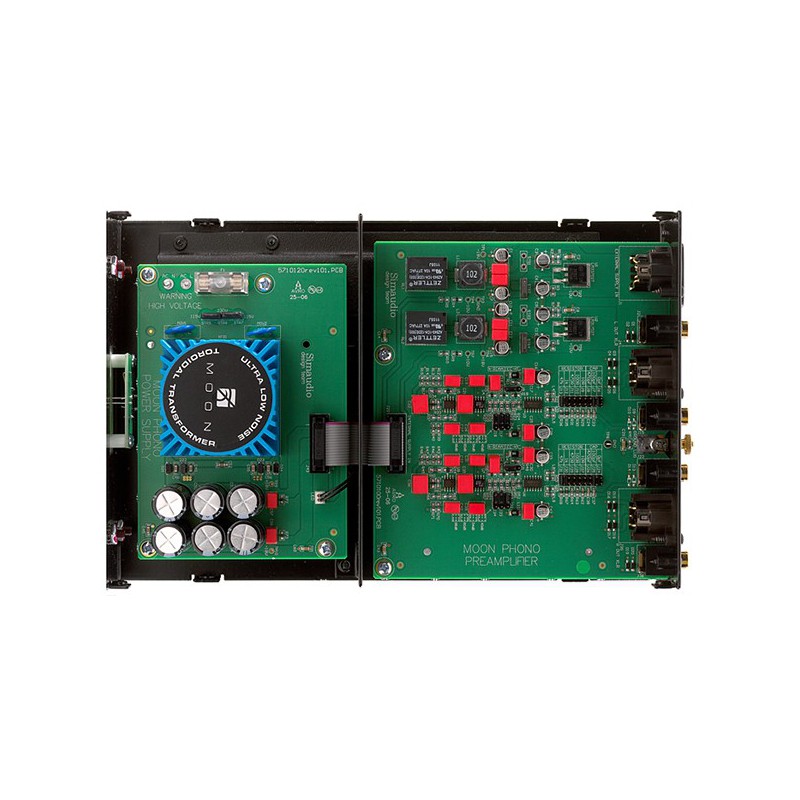
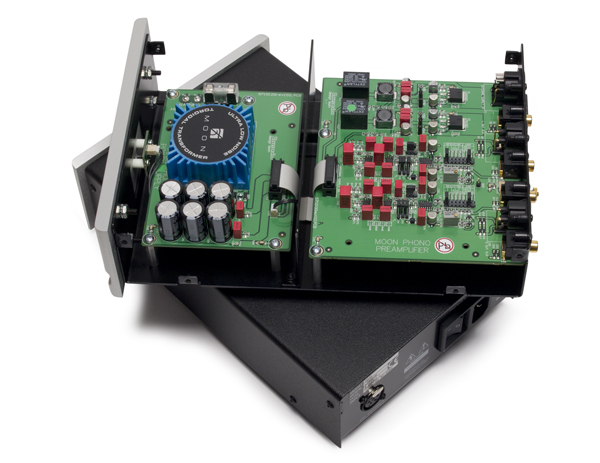
- Large isolated power supply on a separate circuit board using a toroidal transformer with 2 stages of voltage regulation.
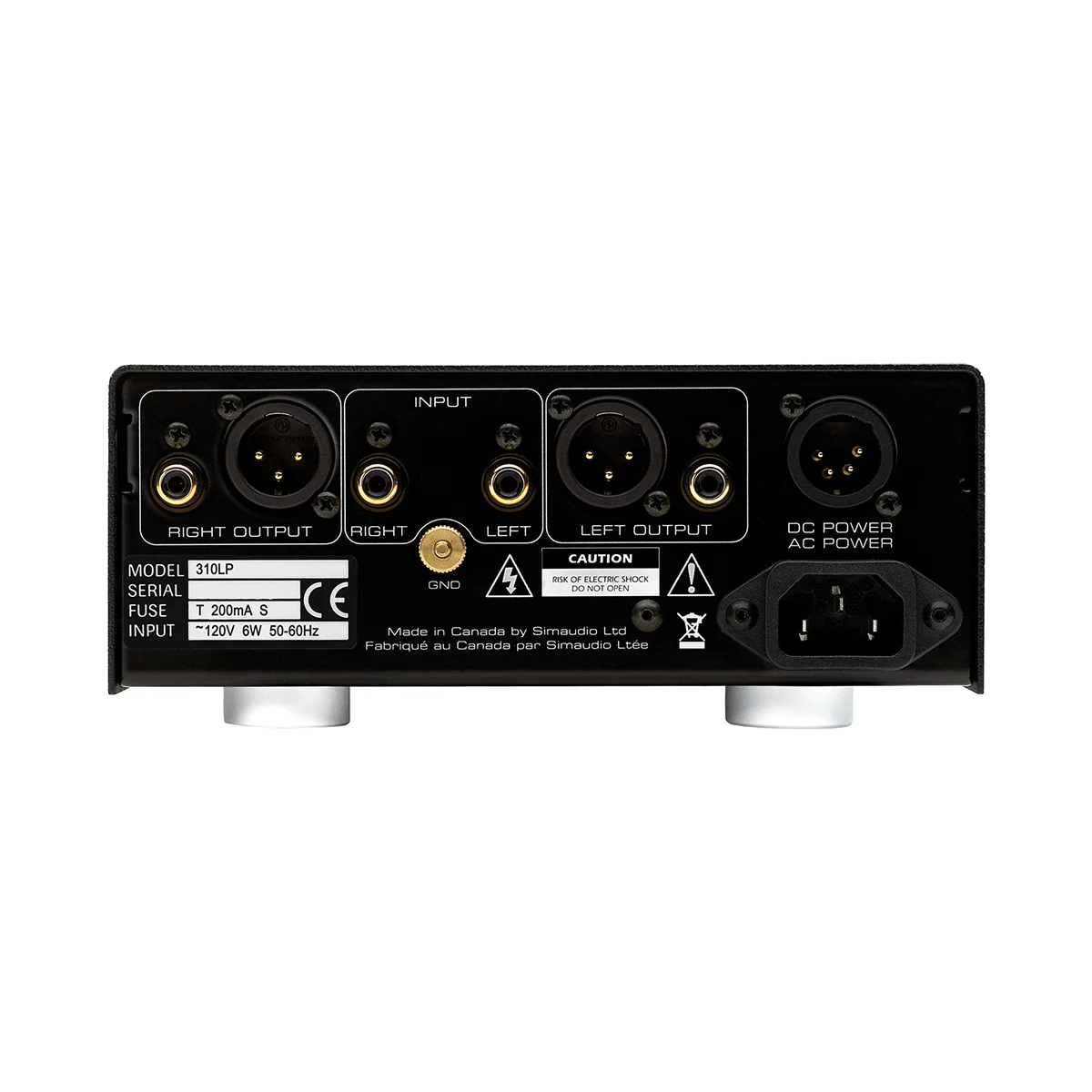
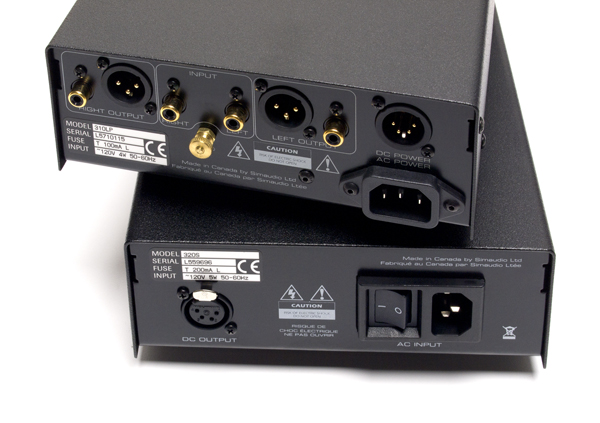
- Single-ended RCA and Balanced XLR output connectors.
- Can be driven with a compatible external power supply.
- Power supply voltage regulation includes i 2 DCf (Indepen dent Inductive DC Filtering); 1 inductor for each and every IC in the audio circuit’s signal path – 2 stages in all.
- Power supply features custom MOON electrolytic capacitors.
- 4-Layer printed circuit boards with pure copper tracings for a much shorter signal path; this results in greater sonic accuracy and dramatically improved signal-to-noise ratio.
- A symmetrical circuit design with accurate matching of the very finest high quality electronic components.
-
S/N Ratio (full scale @ 40dB gain)110dBr
-
S/N Ratio (full scale @ 66dB gain)88dBr
-
Frequency Response20Hz – 20kHz ±0.5dB
-
Crosstalk @ 1kHz-100dB
-
Output impedance50Ω
-
THD (20Hz – 20kHz)0.001%
-
Intermodulation distortion0.009%
-
Input overload @ 40dB gain58mV RMS @ 1kHz
-
Input overload @ 66dB gain3.0mV RMS @ 1kHz
-
Shipping weight7.0 lbs. / 3.1 Kgs
-
Dimensions (width x height x depth)7.0 x 3.0 x 11.0 in.
-
17,8 x 7,6 x 28,0 cm.
Description
- Details
- Written by SoundStage! Hi-Fi Editors
- Category: Components
- Created: 01 June 2022
 Simaudio’s Moon 310LP phono preamplifier has been on the market for more than ten years—it was introduced in 2010 in a smaller case than you see today, then updated in 2016 to its current form with some improvements to the circuitry and a new look. Like all of the Canadian company’s products, the 310LP is made in-house in Boucherville, Quebec.
Even though the Moon 310LP is not a new product, we decided to review it for a couple of reasons. Firstly, the technical requirements for phono preamplifiers were established decades ago and haven’t changed, so what was good ten years ago should still be good today. But the second reason was that the 310LP, which currently retails for $2300 (all prices in USD), is still in the company’s lineup and there’s no indication from the brand that it will be discontinued or replaced anytime soon.

Our first hunch was correct—Philip Beaudette’s review of the Moon 310LP appeared on this site in April, and the venerable Canadian phono stage received a Reviewers’ Choice award. Philip found the 310LP to be a topflight performer with “quiet operation” and a “neutral signature.” As you’ll see, he also learned it could compare favorably with the $2900 Saturn Audio 401 phono stage, a much newer design. The Saturn itself was good enough to receive a Reviewers’ Choice award when Jason Thorpe’s review was published on this site in March, and it went on to gain a Recommended Reference Component award the following month.
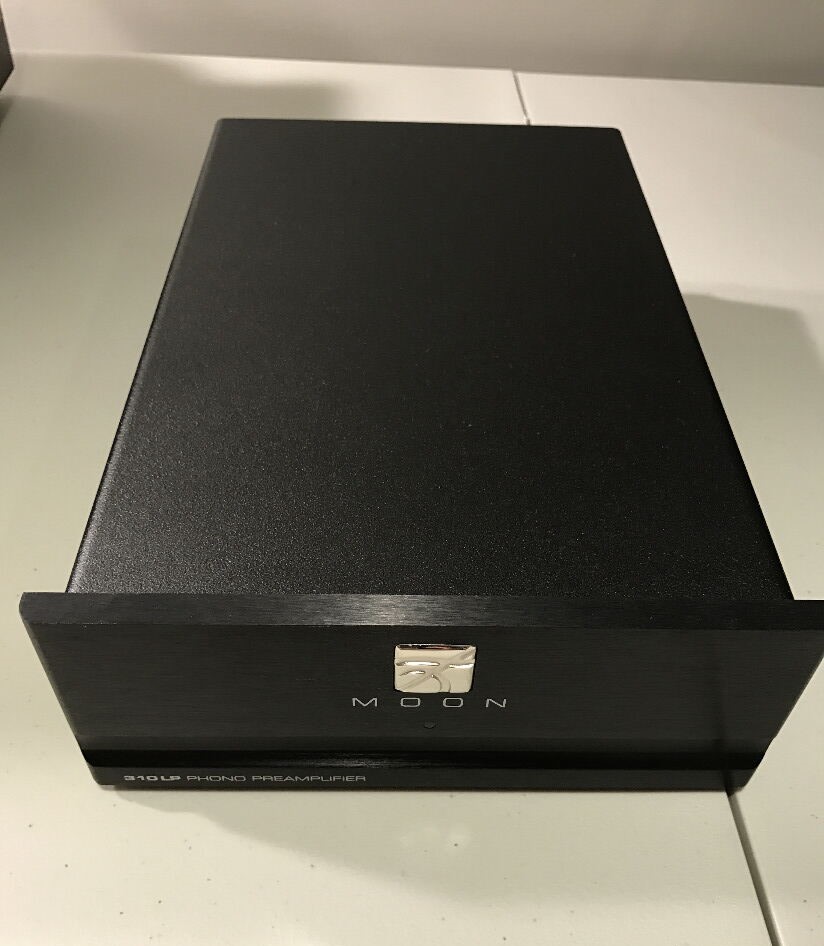
The 310LP has a compact case measuring 8.0″W × 3.25″H × 11.0″D. Philip wrote: “A simple brushed-aluminum faceplate displays some branding and the model name, and features a small blue LED in the center that turns on as soon as the unit is plugged in (there is no power switch).” He described the rear panel as having “a pair of single-ended RCA inputs, with a ground post located directly beneath them. Flanking them are single-ended RCA and balanced XLR outputs for the left and right channels.”

Philip also noted that “Simaudio strongly recommends using the XLR outputs if your preamplifier has balanced inputs, because they offer a higher signal-to-noise ratio and an additional 6dB of gain.” However, Philip couldn’t take advantage of this advice, because the Bryston B135 SST2 integrated amplifier he used with the 310LP only has single-ended inputs. But based on Philip’s high praise for the phono stage, it’s clear that the single-ended outputs on the 310LP work well, too.
The 310LP is compatible with both moving-magnet and moving-coil cartridges. To accommodate a range of cartridges, gain can be set at 40, 54, 60, or 66dB; input impedance can also be adjusted to 10, 100, 470, 1000, or 47k ohms; and capacitive loading to 0, 100, or 470pF. These are the company’s specifications; however, we also measured the 310LP in our lab, where we tested gain and input impedance, plus many other parameters, and found the 310LP’s published specs to be accurate. In some instances, they were a little conservative, meaning the unit’s performance exceeded some of Sim’s published specifications. An example of this is the signal-to-noise ratio (SNR) specification—our SNR numbers for the 40 and 60dB gain settings were higher than Simaudio’s, which means that the 310LP is less noisy than the company claims. Suffice it to say that the 310LP performed well on the test bench.
For many years now, Philip has been using a 20-year-old, German-made Lehmannaudio Black Cube phono preamplifier—which ended up being no match for the 310LP. Philip first listened to Radiohead’s In Rainbows (TBD Records TBD001) and wrote that “‘15 Step,’ the opening track from In Rainbows, came alive through the 310LP, making the Black Cube sound reticent, even veiled, by comparison. Through the Canadian phono preamplifier, Thom Yorke’s vocals popped forward in the mix, and the same was true of the drums. However, as I came to learn after spending some time with it, the 310LP isn’t really forward, it’s just quiet. Dead quiet, in fact.”

Philip then played Charles Mingus’s Ah Um (Columbia Records / Legacy Recordings 8697-33568) and stated: “The opening tune, ‘Better Git It in Your Soul,’ is explosive. . . . Through the 310LP, the alto and tenor saxophones were vibrant and shiny rather than bright or harsh. Combined with the rapid-fire drumming they pretty much demanded more volume, which I was happy to oblige. . . . Ah Um is a spacious album, and it was particularly so through the 310LP.”
Philip listened to many other songs through the 310LP, but confessed in his review that “the 310LP was challenging because it doesn’t really sound like anything at all.” He went on to state that “this phono preamplifier doesn’t really have any specific character,” so he “was left jotting down notes about the quality of the recordings themselves.” In other words, the 310LP passes music signals through it without adding colorations, which is what most people want their hi-fi components to do.
When Philip compared the 310LP to the Saturn Audio 401, it wasn’t a case of which one was better or worse; instead, he just found them to be slightly different. When he played “Medication,” from Spiritualized’s Pure Phase (Fat Possum Records FP1752-3), he determined that “the Saturn was rounder in its delivery of the bass line and the sound was a bit fuller overall,” and that “through both phono stages the organ notes hung suspended in space, but with the Saturn the music bloomed more, whereas the Moon seemed a bit drier and more precise.” Philip summed up his comparisons: “Both phono stages served up loads of detail and delivered outstanding clarity.”

With Mingus’s “Better Git It in Your Soul,” Philip penned: “The music popped out of the speakers through both phono preamps; their clarity revealed incredible detail, not the least of which was the location of each musician on the stage and their distances from my listening chair.” But here again he found that “the Saturn had a rounder character than the Moon, without managing to sound soft or indistinct, whereas the 310LP was a touch more incisive.”
Near the end of his review, Philip declared that the 310LP “sounds as nondescript as it looks” and that it is “an easy recommendation” for someone who is “happy” with their turntable and doesn’t want to “change anything” to do with its sound. But he also warned that the 310LP is “not ideal for someone looking to color the sonics of their system.” So for those who want a component that “vanishes sonically,” as Philip put it, we believe that the 310LP is an outstanding choice—and that’s why it received a Reviewers’ Choice award at the time the review was published, and it is being recognized as a Recommended Reference Component now.
REVIEW: Simaudio MOON 310LP and 320S
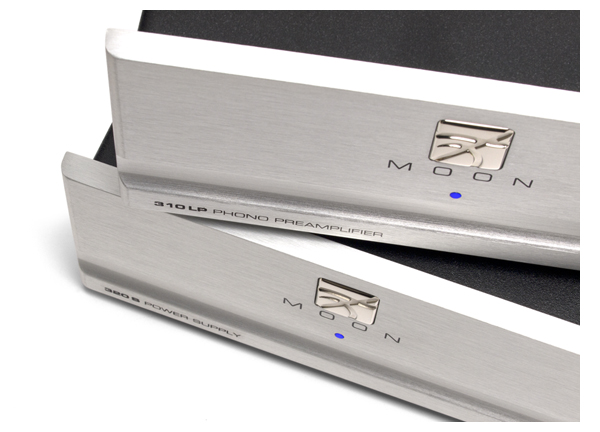 Since even the very best hi-fi systems rarely sound like real live music, the first question one might ask about the sound of any component immediately becomes: What does it add and what does it take away from the music?
Creating the perfect recreation of live music in the home may have yet to happen, but it’s not totally the fault of the hi-fi. Few recordings are made with the intention of capturing reality; artists, producers, and engineers are usually searching for the sound they think best suits the music. And since music is recorded in an endless variety of venues and recording chains, it’s no wonder that recordings all sound very different from each other.
That said, my favorite systems are those that reveal such differences between recordings every time you change a disc. The less a system adds or subtracts from the sound, the easier it is to really hear what’s going on in the recording. By this standard, Simaudio’s MOON 310LP phono preamp is a winner.
Surprises on the Inside
The MOON 310LP replaces Simaudio’s MOON LP5.3 phono preamp. The new model isn’t a radical rethink of the previous design, but it combines superior parts and a quieter power supply to achieve better performance. And for those that invest for the long haul,the MOON 310LP comes with a 10-year warranty.
Taking off the easily removable case cover reveals the MM and MC settings. MC gain has three options: 54, 60,and 66db through RCA outputs, with an additional 6db available through XLR outputs. Five impedance settings (10, 100, 470, 1K, and 47kΩ) are available for both MM and MC, meaning those with a Grado or SoundSmith moving-iron cartridge can take advantage of the higher-gain settings. Capacitive loading can be set at 0, 100, and 470pf—a bonus for MM users, as it offers more flexibility. The 310LP even offers a jumper setting for RIAA or IEC equalization. While not terribly convenient to access, such functionality isn’t often seen at this price point.
The unit’s rear panel hosts single-ended RCA inputs and outputs, plus balanced XLR outputs. The 310LP is nice and compact, just 7.5″ x 3.2″ x 11.2″ and weighing it at 7 pounds.
 Redefines Quiet
Usually, on most phonostages, associated noise occurs when lifting the stylus from the groove at a high volume level. I can often hear such noise from my listening position, which is about ten feet from my Magnepan 3.7 speakers. However, with the 310LP, I only detected the faintest of noise, and only when my ears were pressed right against the speakers—a good sign. Even more importantly, the 310LP sounds cleaner when the music is cranked up, meaning that the contrast between quiet and loud instruments is more apparent than what I’ve experienced from other phonostages in this range.
Richard Barone’s Cool Blue Halo was recorded live at the Bottom Line on May 31, 1987. I was at the show, so listening to the LP is like traveling back through time. I loved that club, and saw hundreds of shows there. Plus, the Bottom Line always had an above-average sound system. However, Barone’s live sound that late spring night wasn’t very good, and it comes through on the LP. Just like the actual concert, there’s too much reverb. But Barone’s vocals sound great, and the Bottom Line’s vibe is there. The 310LP brings it all back to life just as I remembered.
Emotional Rescue, one of the Rolling Stones’ last all-analog efforts, also lit up my speakers. On the title track, drummer Charlie Watts, bassist Bill Wyman, and singer Mick Jagger dominate the mix. Via the 310LP, their pounding groove instantly grabs my attention and connects me to the music. Similarly, “She’s So Cold” transfixes, as I love the way Keith Richards’ rhythm-guitar licks punctuate the beat. I’ve never enjoyed this record more than I do with the 310LP. Tom Petty and the Heartbreakers’ debut possesses even more analog richness than Emotional Rescue. Again, the 310LP helps portray the big soundstage present on this record with ease.
In the female vocal field, Linda Rondstadt’s Don’t Cry Now sounds tighter and more produced—like a recording where every musician is recorded in total isolation from one other. Her take on Neil Young’s “I Believe In You” is simply gorgeous on the 310LP. The latter is undoubtedly a high-resolution design, but one that doesn’t throw detail at you in a way that becomes fatiguing.
On the LP310, some of the better 1950s-era jazz recordings sound more natural to me, perhaps because they have little equalization or studio processing. Clarinetist Jimmy Giuffre’s LPs are so present and tonally accurate that the instruments seemingly appear in the room with me. I didn’t even notice at first that they’re mono recordings!
 Back to Basics
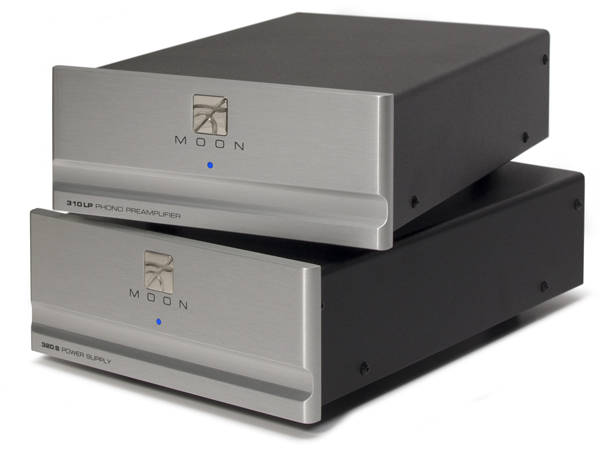
Initially, I used the 310LP with the optional 320S power supply, which looks nearly identical to the 310LP. A dedicated and optimized design that only works with the 310LP, it features four stages of DC voltage regulation in a dual-action configuration and a special “pi-type” filter in conjunction with a dual-voltage regulation system to further reduce the 310LP’s already low-noise level.
Fully acclimated to the sound of the 310LP/320S combo, I unhitched the power supply, a change that involves moving a couple of internal jumpers. Listening to the 310LP a la carte, the sound becomes a tad softer. And, in comparison to hearing them via the Simaudio duo, dynamics are blunted, with low-level resolution and air also somewhat diminished.
Those with fairly resolving systems will have a tough time living without the 320S. The device is well worth the money, yet it’s also nice that Simaudio gives you the option to buy into its phonostage one step at a time.
Turn Me On
A few months ago, I had the pleasure of reviewing the Red Wine Audio Ginevra LFP-V Edition phono preamp. It’s a battery-powered, hybrid tube/solid-state design. Yet, it’s very tubey in the sense that the sound is rich and velvety smooth, albeit never lacking in detail. It proved a great experience, but the 310LP turns me on in a very different way. The Ginevra’s beguiling sweetness softens the top- and bottom-end response, whereas in these areas, the 310LP is more neutral.
Dr John’s In the Right Place, arranged and produced by the great Allen Toussaint in 1979, yields pure thrills through the 310LP. The Doctor’s mojo fires on all cylinders, and the Sim unit simply lets be the yummy, bold, 3D, and oh-so funky sound. Sure, some of the better and vastly more expensive phono preamps can get you even closer to the music embedded in the grooves, but in its price class, the 310LP is as colorless a device as you’re going to find.
The TONEAudio staff agrees, and hails the 310LP/320S as a recipient of one of the magazine’s 2011 Exceptional Value Awards.

There’s a problem when you start getting into high fidelity sound. You begin at a point which you think is reasonably modest in terms of cost (but which most people outside of the high fidelity community would consider somewhat over the top). And pretty soon start to feel the need to go even further.
When I returned to listening to vinyl after a considerable break, I initially used a NAD PP 2 phono pre-amp that I’d bought in Singapore at some point in the early 2000s. But then I went on a hard search for a true audiophile phono preamplifier at a fairly reasonable price and came up with the Moon 110LP V2 (currently priced at $900.00). I should note, this was long before I started working here.) I used that with a range of turntables for a while and it was perfectly pleasing. But then, as so often happens, I decided that I should explore what more I could extract from my collection of vinyl.
So I upgraded the phono preamplifier, followed by the turntable, followed by the phono cartridge. Next thing I knew I was running a turntable source system priced at more than ten thousand dollars. The phono preamplifier element of that system was still a product from Moon by Simaudio. It’s the next step up, the Moon 310LP phono preamplifier. (Don’t worry, you can go even further on this journey. Pushing forwards, you can consider the Moon 610LP at $15,000.00, or even the Moon 810LP at $24,500.00.) But it’s the Moon 310LP that I’m living with, and looking at here.
A note of caution: remember, I bought this unit for my own use. I imagine that there are scientific studies showing that this kind of predisposes me to a psychological phenomenon in which I want to hear things which justify the expense. Against that, I’m very aware of this. Extremely aware.

In short
- The Simaudio Moon 310LP is a balanced-output phono preamplifier supporting both moving magnet and moving coil level cartridges
- Gain levels of 40, 54, 60 and 66dB (single-ended) and 46, 60, 66 and 72dB (balanced) selectable
- Input impedance of 47 ohms, 100 ohms, 470 ohms, 1 kiloohms and 47 kiloohms, selectable
- Input capacitance of 0, 100 and 470pF, selectable
- RIAA and IEC EQ curves, selectable
- 1 x single-ended stereo input (2 x RCA)
- 1 x single-ended stereo output (2 x RCA), 1 x balanced stereo output (2 x XLR)
- Signal to noise ratio: 110dBr @ 40dB gain, 88dBr @ 66dB gain
- Frequency response: 20-20,000 hertz ±0.5dB
- Crosstalk: -100dB @ 1000 hertz
- THD (20-20,000 hertz): 0.001%
- IMD: 0.009%
- Input overload: 58mV RMS @ 1kHz @ 40dB gain setting; 3.0mV RMS @ 1kHz @ 66dB gain setting
- Dimensions: 178mm wide by 76mm tall by 280mm deep
- Weight: 3.1kg
- Price: ($3,700.00) $2,599.00
- Available at fine high fidelity retail outlets, and direct from distributor’s retail division (Simaudio Moon 310LP phono preamplifier)
More about the Simaudio Moon 310LP
As you can see from the above section, the input loading section of the Moon 310LP is extremely versatile. You have four levels of gain, adjustable input impedance and even a choice of two EQ curves. The IEC curve is identical the RIAA curve except that it has a gentle infrasonic filter.
The balanced outputs are useful for reducing noise that might be picked up in the connections between the 310LP and the preamplifier it is feeding. I used these outputs for my listening.
There is no power switch. Moon envisages it being left on all the time, but you can just switch off at the power point if you’re going away for a while.
One somewhat backwards step from a user experience point of view in the upgrade from the 110LP to the 310LP is the method by which you change the input settings: gain, impedance, capacitance and EQ curve. On the 110LP these are controlled by DIP switches on the underside of the unit. On the 310LP you have to remove the lid and move jumpers on one of the circuit boards.

Don’t get me wrong, the procedure is straightforward and the instructions in the manual are clear. No, the only problem I had was getting the lid off the unit. It’s secured with four Phillips-head screws on each side which are easy enough to get out. But the casing, three planes of moderately thick-gauge steel, gripped the chassis rather tightly and simply didn’t want to move. Don’t worry if this happens to you. Just slip the tip of a flat screwdriver in between the case and the chassis in a couple of places – it’ll be pretty obvious where – and gently lever the case up. It takes but a moment. I did this a few times because of the cartridge switching – and doing this was trivially easy compared to the cartridge changes themselves – but most people will either never need to open it up to change the defaults, because they’ll be using a regular moving magnet cartridge, or do it only once to cater for a moving coil cartridge.
One of the nice things about this level of input flexibility is that you can try a range of settings with your cartridge to see whether one setting or another produces the best results. But a word of warning: don’t plug it in with the lid off to facilitate this process. There are spots on the power supply board which are 230 volts live.
You may notice a 4-pin socket on the back of the unit, labelled “DC Power”. For a while Simaudio sold an external power supply, the Moon 320S, as a performance upgrade. This was discontinued some years ago. This DC power input is not compatible with the Moon 820S optional external power supply available for some very high-end Moon devices, such as the 610LP and 810LP.
Listening with the Moon 310LP phono preamplifier
I used the Moon 310LP with the following equipment
- Thorens TD 1600 turntable (Thorens TD 1600 review)
- Grado Timbre Series Opus3 moving iron cartridge (Grado Timbre Series Opus3 review)
- Goldring E3 moving magnet cartridge (Goldring E3 review)
- Audio-Technica AT-VM95SH (Shibata stylus) moving magnet cartridge
- Goldring Ethos moving coil cartridge
- Schiit Audio Freya S preamplifier (Schiit Audio Freya S review)
- Schiit Audio Vidar power amplifier (Schiit Audio Vidar review)
- Lenehan Audio pure copper ribbon speaker cables with gold-plated spade lugs
- Dynaudio Contour 20i loudspeakers (Dynaudio Contour 20i review)

I held off from doing this review for quite a while because while I’d used the Moon 310LP with several cartridges, all of them were moving magnet or moving iron kinds with a regular output level: approximately 5mV for a 5cm/s groove modulation. For which there are many, many phono preamplifiers, including the majority built into amplifiers and preamplifiers. But in this review I wanted to go somewhere I’ve never been before: moving coil. Well, actually, for the 80s and 90s I did use a moving coil cartridge, but it was a high output Adcom model that produced around 2.5mV for that 5cm/s modulation. So where I really wanted to go was to low output, which is really why you choose moving coil. You see, the main criticism of moving magnet cartridges is that the weight of the magnet, sitting on the far end of the cantilever from the stylus, reduces the stylus’ responsiveness to groove modulations. Inertia, you see. Moving coil cartridges reduce this weight, and thus the inertia, by using coils on the cartridge and fixing the magnet to the cartridge body. A few loops of copper wire weighs considerably less than a lump of magnetised metal.
And that’s the norm for moving coil cartridges. A few loops. For a high output cartridge, you need a lot more loops, which pushes the weight on the far end of the cantilever up, closer and closer to the weight of a magnet. So, really to get the full benefit of moving coil cartridge technology, you need a regular low output model.
(Which makes me wonder: why aren’t there any low output moving magnet cartridges on the market? You could perhaps get the same results – without the complications of attaching electrical connections to a moving coil – by having lots of fixed coils surrounding a much smaller, lower-mass magnet on the end of the cantilever. I’m pretty sure that such things as neodymium magnets, characterised by a very strong magnetic field for their mass, didn’t exist back in the olden days in which I came into high fidelity. But what about now?)
So, moving on from that aside, I have never had a system with a truly low-output cartridge. And I confess I was a little worried. The Goldring Ethos MC cartridge is rated at 0.5mV for 5cm/s groove modulation. A 0.5mV to 5.0mV ratio is in decibel terms 20dB. That’s the additional boost required of a phono preamplifier compared to the typical real (ie. not my hypothetical) moving magnet cartridge. What would that mean in terms of noise? If any extraneous noise were picked up between turntable and phono preamplifier, it would be a lot louder. Would I hear it? Would my enjoyment of music be diminished by an audible noise floor?
No. No. Not at all. Not in the slightest. I was a bit amazed. I’d somehow managed to convince myself that the enormous additional boost must have some impact. But it didn’t.

With the Thorens TD-1600 turntable and the Goldring Ethos providing the signal, in terms of noise level I might as well have been listening to a CD (well, except from surface noise from LPs, but not much can be done about that.)
Whew! Throughout a lot of listening, there wasn’t the slightest hint of noise that I felt able to attribute to the additional gain. Indeed, I suspected that if there were such a thing as a perfect LP – no groove noise whatsoever – there’d have been no noise at all. It would have been, ahem, “digital black”. Of course, though, I could hear all the groove noise with utter clarity.
And with some actual records?
So, I span a lot of vinyl. Simaudio recommends a run-in period for the Moon 310LP. I’m not so sure such things are necessary for electronics, but I am convinced they are for electro-mechanical devices, such as phono cartridges. So after a fair bit of use with the other cartridges, I installed the Goldring Ethos and played, uncritically, nearly forty LP sides before starting to write up this review.

I started with King Crimson’s Starless and Bible Black from 1974. My pressing is a Japanese one I bought back in the day. None of this modern 180-gram stuff, just a pristine pressing with about a clean a surface as I’ve ever heard on any LP. I’m not going to attempt to disentangle the relative contributions of the cartridge and Moon 310LP. But just as it had worked with the other cartridges, the musical delivery was flawless. The powerful bass lines were captured from the vinyl and delivered with authority and clarity, even through the most frenetic sections of playing in “Lament”. Then on to “We’ll Let You Know”, in which the piece is built up from fragments, with Fripp’s weird guitar off to the right of the sound stage and chunks of percussion bouncing around the stage until final focus is achieved towards the end as Bill Bruford’s full drum kit kicks in. Instrument placement was perfect and stable and every little detail was present and accounted for. I found myself turning up the sound higher and higher, and even so the space around the instruments remained empty of unwanted noise.
There was unwanted noise on the next selection, Eumir Deodato’s rock/jazz fusion album, Deodato 2, his second US album release. But that was in the groove, not produced by my equipment. Someone had a low-level buzz in their amp, and of course this was faithfully delivered. The first track on this album is an astonishing cover of “Nights in White Satin”. I haven’t played this album for a while – I purchased it new in 1973 or 1974 for, I see from the price sticker, $6.99 – so I wasn’t expecting a whole lot. But despite the almost fifty years that have elapsed, the grooves are clean and undamaged, and the Moon 310LP was perfectly transparent in delivering all this to the amplifier. The powerful Latin groove was brought out beautifully, and as the lead guitar emerged from the breakdown and reconstruction in the middle of this version, it simply sang with clarity.
Deodato is actually a pianist, and his electric piano takes the lead in the next track, “Pavane for a Dead Princess”. The clarity was such that I would have had no difficulty in identifying the precise instrument he was using … had I that kind of knowledge, which I don’t.
Album after album it was all pretty much the same. The Moon 310LP just did its job perfectly, while doing nothing to draw attention to itself. That covered selections from Nick Cave, John Coltrane, The Police, the Berlin Philharmonic and even a touch Grand Funk Railroad, some original purchases, some new pressings on modern vinyl. To finish off, I span up the Glenn Gould Silver Jubilee album from 1981 (although most of the recordings date from the 1960s). On side 2 we find the iconoclastic pianist playing some Scriabin, then accompanying Elisabeth Schwarzkopf as she sings some Richard Strauss songs, then finishing of with Liszt’s piano transcription of the first movement of Beethoven’s Pastoral Symphony.

Thankfully Gould seemed to be able to restrain himself from humming through the lieder. Schwarzkopf’s precision and power were something to behold, but it was the Liszt/Beethoven that had me tapping my foot (and yes, despite the power of his playing, and CBS’s sometimes extreme efforts with regard to microphone placement, Gould could be heard at the odd moment, singing along). The piano tone was so sweet. Gould tends to be light on the sustain pedal, so every note was clearly delivered, even in the sections with a rolling build-up. And I hardly need say it, but all was all supplied to my system flawlessly by the Moon 310LP.
Conclusion
For this one I put my money where my mouth (or at least my typing fingers) are. After spending quite a few hours having the Moon 310P lift a minute signal generated by a few coils of wire to useable levels and restoring their frequency balance, I have to say I’m at a loss. That loss is how any other phono preamplifier could do a better job.
Related products
-
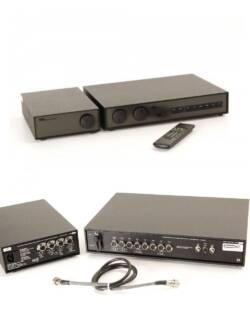
Naim NAC 102 Preamplifier + Remote + HiCap PSU
Original price was: R60,000.00.R16,000.00Current price is: R16,000.00. Add to cart -

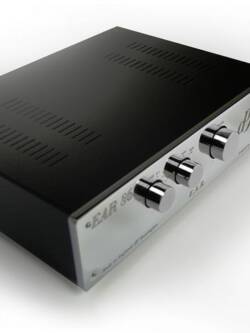
EAR 864 Preamplifier
Original price was: R118,000.00.R35,000.00Current price is: R35,000.00. Add to cart -
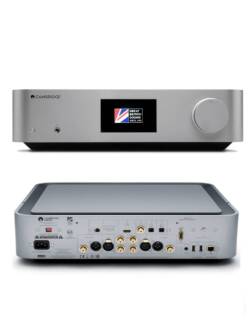
Cambridde Edge NQ DAC/Streamer/Preamplifier
Original price was: R129,000.00.R68,000.00Current price is: R68,000.00. Add to cart -
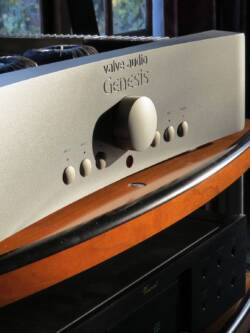
Valve Audio Genesis Preamplifier (NEW Model)
Original price was: R120,000.00.R59,000.00Current price is: R59,000.00. Add to cart