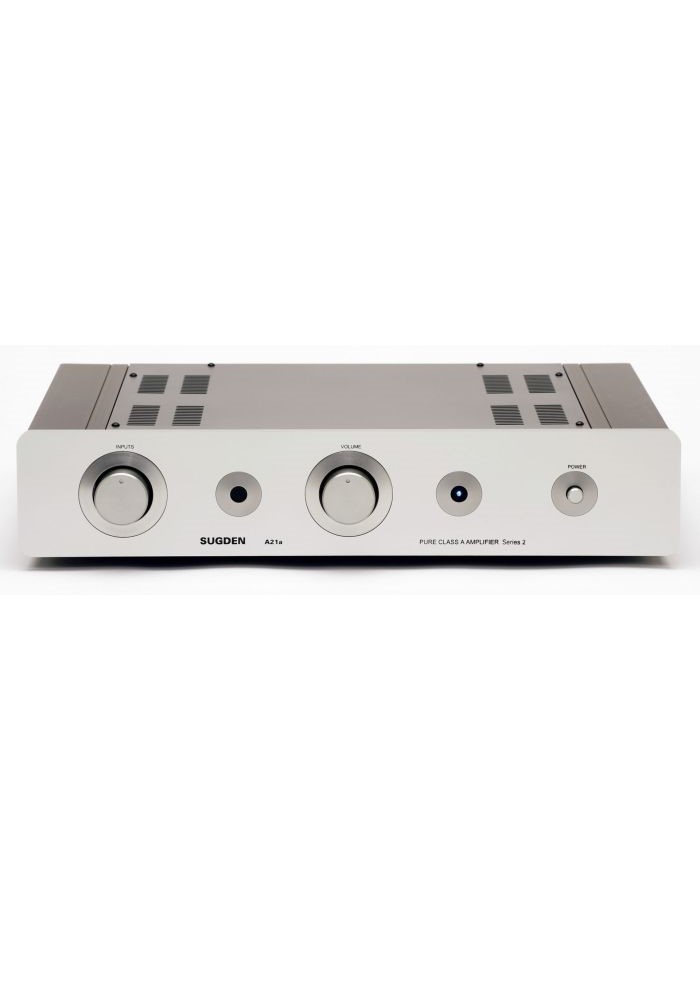
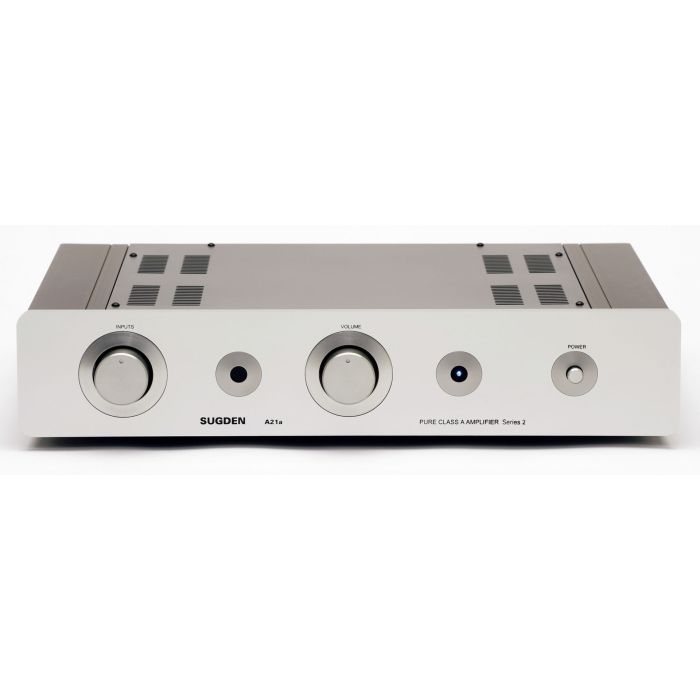
Sugden A21a Series 2 integrated amplifier
Original price was: R108,000.00.R35,000.00Current price is: R35,000.00.
Sugden A21a Class A Integrated Amplifier with Phono
The Sugden A21a Pure Class ‘A’ Integrated Amplifier has a lineage stretching back nearly 50 years.
James Sugden,widely accredited with producing the world’s first Class “A” amplifier under the name of Richard Allen,a most famous brand of English loudspeakers in the 1960’s,went on to bring his own name to his amplifiers after 3 years of production for Richard Allen.
The natural question here is what is a Class “A” amplifier?In simple terms a Class “A” amplifier has all output devices conducting at all times as against a Class A/B design which switches the conducting devices on and off as required.For the music listener this results in the Class “A” amplifier being available to reproduce the dynamics and nuances of the music more readily resulting in a more realistic musical performance.
This is only the beginning of the Sugden story.They have been creating Sugden amplifiers in the same Yorkshire factory for a long time,and their operation is reportedly so self sufficient that they still manufacture their own casework and solder their own circuit boards……in other words…..they are hand made.Sugden employees are well described as craftsmen and craftswomen.
There is absolutely no point in saying anything apart from……please listen to this most beautifully designed musical amplifier…….there are potentials of it taking you to cathartic places of relaxation and then surprise at what music can do for the soul.
The Sugden A21A Series 2 has lineage stretching back more than 50 years.It is an exceptional amplifier with a musical 3 dimensional sound stage.
At Stereophonic,we’d be pleased to demo a revealing sample of the passion that goes into making a Sugden amplifier that will bring your music to life.
Facilities:
Product Features and Specifications
- Inputs – Five line level or four line level with optional MM/MC phono board.
- Outputs – Pre-Amplifier Out (Variable), tape out (fixed) and one pair stereo multi-way binding posts.
- Remote Control – Volume up/down.
- Earth terminal.
- Line Level Sensitivity – 170mV for maximum output.
- Phono Input Sensitivity – 3mV/Moving Magnet, 0.2V/Moving Coil for maximum output.
- Phono Loading – Moving Magnet 47K, Moving Coil 100 ohm.
- Power Output – 23 watts per channel into 8 ohms both channels working.
- Frequency Response – 10Hz to 20kHz +/- 0.5dB.
- Bandwidth – 6Hz to 200kHz +/- 3db.
- Signal to Noise – >83db.
- Nett Weight – 11kg.
- Dimensions – 92mm x 430mm x 350mm (HWD).
Description


Now I’m happy just to stay at home, listening to music through my favorite class-A amplifiers: just as wasteful, I suppose, but on a small enough scale that I can squint and pretend I don’t see it. In a pure class-A amplifier, output devices are biased at a high enough negative voltage that current never ceases to flow across them, even when one device in a complementary pair hands off the signal to the other. This preserves the integrity of the waveform continuum and banishes so-called switching distortion. The amps stay nice and warm, too.
So it goes with the audio amplifiers designed and manufactured by J.E. Sugden & Co., Ltd., the English firm named for a founder who has long since retired. “Sugden’s,” in fact, suggests that they were the first company to produce a solid-state class-A amplifier for domestic use their original A21 model, introduced in the 1960s. Today, alongside various preamplifiers and CD players, J.E. Sugden & Co. offers a number of basic and integrated amplifiers, all solid-state, and all with output stages said to operate in class-A. Nice.
Description
The A21ai Series 2 ($2995), which has both line-level and phono inputs, was introduced at the same time as its stablemate, the A21al Series 2 ($2795), a line-only product upgradeable to line-plus-phono status whenever its owner pleases. Because in many fonts the numeral 1 and the lowercase l appear identical, and because poor eyesight makes the lowercase i look very much the same as the other two, I’ll spell it out: The one with the built-in phono preamp is the “ay twenty-one ay eye,” and the line-only version is the “ay twenty-one ay ell.” Owing to the mildly confusing nomenclature, and because I have difficulty pronouncing Sugden, my wife and daughter are under the impression that the product I’m reviewing this month is simply called the warm, silver amp.
The warm, silver amp is directly descended from the Sugden A21a integrated amplifier, which Sam Tellig reviewed in Stereophile in February 2005, and which also impressed John Marks and other reviewers. The new model has virtually the same output section as the old, using only NPN output transistors in what is said to be a single-ended topography, yielding about 25Wpc into an 8-ohm load. A key difference is that the Sugden A21ai Series 2 has a much sturdier power supply, with about 50% more current available to the output section. The result is that full or nearly full power is available under a greater range of operating conditions. Flat power response and low distortion are maintained through the use of current (not voltage) feedback, at about 50% of gain.
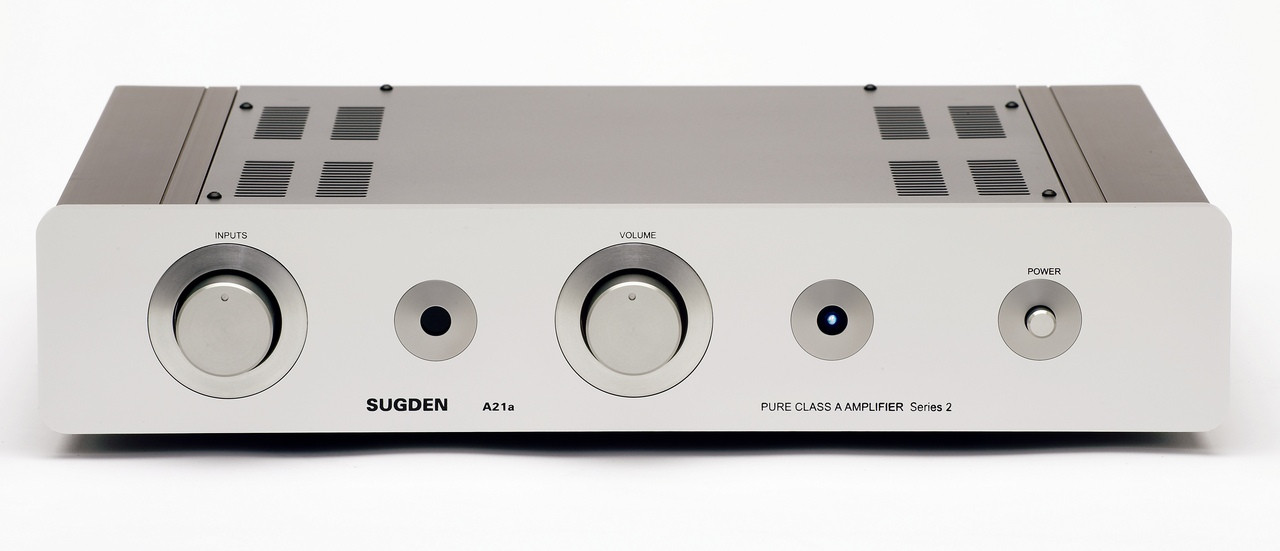
The active preamplifier section of the A21a has also been changed for the new model: In order to achieve a purer and, I dare say, straighter signal path, both the Balance knob and Mono switch of the older model have been eliminated. (You can guess how I feel about that.) Consequently, the front panel is more austere than it used to be, and arguably a good deal more attractive: thicker, heavier, and available in a choice of titanium (silver) or graphite (dark gray) finishes. From left to right are an unlabeled Inputs selector switch (you might have to count the number of clicks to know which source you’re hearing), a lens for the remote-control IR receiver, a Volume knob, a blue pilot light, and a Power switch.
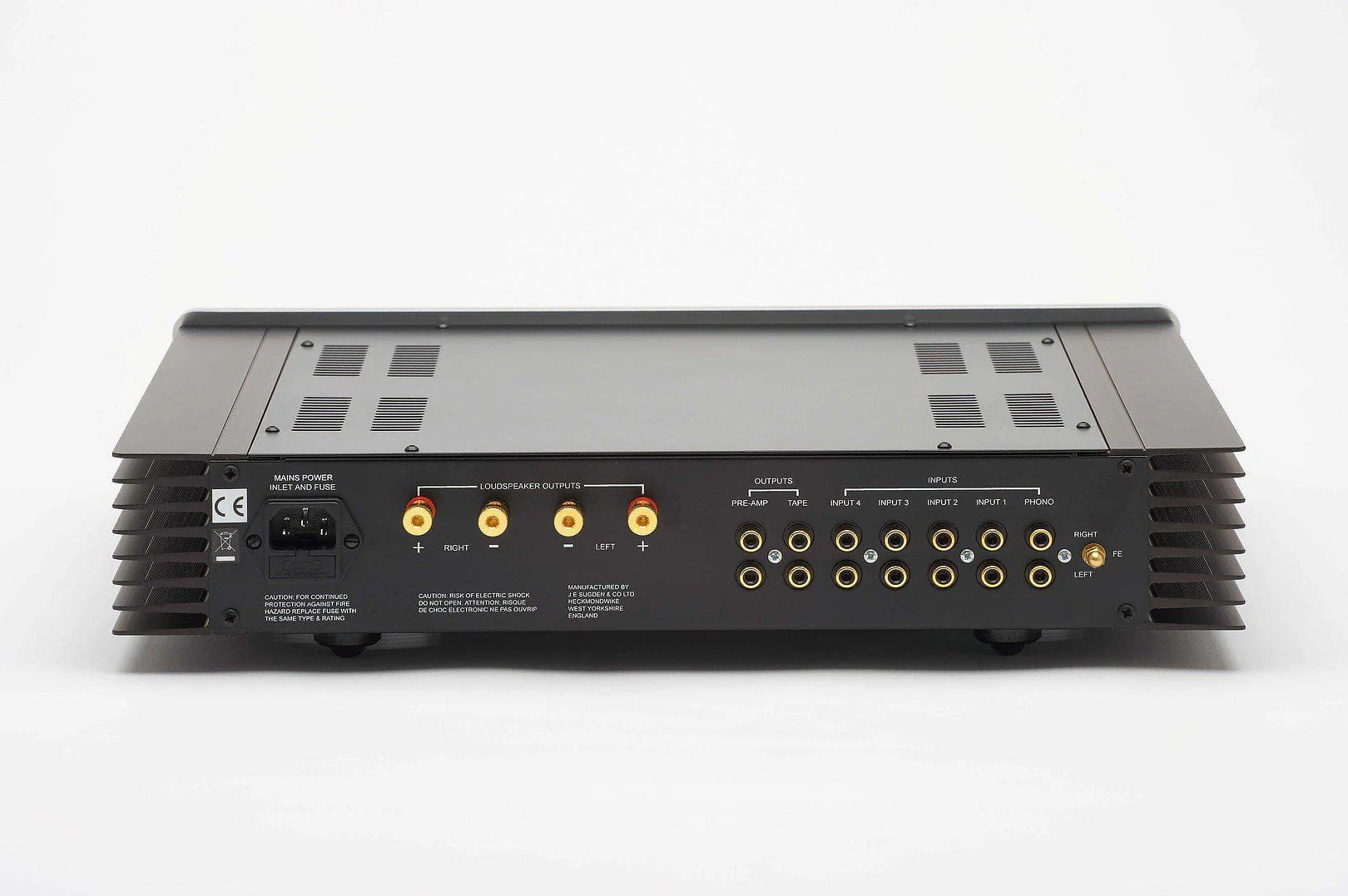
The rear panel is busier, with phono jacks for the inputs and the outputs—the latter including buffered tape-out and preamplifier-out jacks—and decent-looking gold-plated terminals for the speaker outputs. The AC cord is detachable, in case you want to use a fancier one. The Sugden A21ai Series 2 also betters its predecessor by including a remote handset, with which the user can adjust the amplifier’s motorized volume control—but nothing else.

The construction quality is superb—and here I must pause and tell you a bit more about Sugden & Co. itself. They’ve been in the same West Yorkshire building for a long time, and their operation is reportedly so self-sufficient that they still manufacture their own casework and stuff and solder their own circuit boards. Sugden employees are more valued craftsmen than assembly-line slaves; for that reason, and because the company’s product line has for so long remained so stable and so united in meeting a common design goal—as opposed to zigging and zagging from this idea to that and dropping products within one or two years of their introduction—I can’t help thinking of J.E. Sugden & Co. as the Morgan Motorcars of British audio. And that’s a compliment.
Installation and setup
My first observation on having set up the A21ai Series 2 is probably the most important: Since its output section is biased to run well into, if not all the way into, class-A, this amp runs hotter than hell’s kitchenette. I was never troubled by that, and had no reliability problems whatsoever with the Sugden, but the prospective owner absolutely must put it on a shelf where nothing will prevent its casework from shrugging off heat. Ignore that advice at the peril of your output devices.
Apart from that, the A21ai had nothing up its sleeve. It seemed more or less indifferent to choice of speaker cable—in whatever system the amp was used at a given time, cable changes made little audible difference—and while substituting a very expensive AC cord for the stock item made a subtle improvement, I don’t see much point in pairing an integrated amplifier with any accessory that costs more than half its own price. Placing three Ayre Myrtle Block isolation spacers between amp and shelf actually made the A21ai sound noticeably worse: It took on a hollow, ringy timbre that didn’t appeal to me at all. I assume that the Sugden’s chassis was tuned long ago to function quite well as is.
I took advantage of the Sugden’s preamp-out jacks, using them to drive my refurbished Quad II monoblocks. This worked well enough, although I observed that most of the Sugden’s very generous gain is apparently provided by its power-amp stage.
With its own output section back in play, the Sugden A21ai Series 2 did a fine job of driving my pair of refurbished Quad ESL loudspeakers in the larger (21′ by 27′) of my two listening rooms. With an impedance range that is, literally, exponentially wide, the ESL is a difficult load to manage, yet the Sugden pulled it off nicely. (Only after my time with the amplifier was up did I learn that the original Quad ESL is one of the references used by Sugden themselves. And Sugden importer George Stanwick, of Stanalog, Inc., is himself an ESL enthusiast.) In my smaller (12′ by 19′) room, the Sugden drove a much kinder load: a pair of Audio Note AN-e SPe HE speakers.
The gain of the phono section of the A21ai Series 2 can be set for either moving-magnet or low-output moving-coil cartridges simply by repositioning four tiny jumper blocks on the phono-preamp board. The former setting gives you a resistive load of 47k ohms, the latter a load of 100 ohms—sensible choices both.
Though the otherwise fine owner’s manual doesn’t mention it, it seemed to me that the A21ai inverted the absolute phase of input signals. Music seemed minutely louder and more present when both speaker leads were reversed, hot for ground. But I might’ve imagined it.
Listening
Because stories about setting up hi-fi equipment have little appeal for people who aren’t themselves merchants of tedium, I’ll cut to the chase: To sound its best, the Sugden A21ai Series 2 needed lots of run-in and warmup. Because my review sample had spent some time at the 2008 Rocky Mountain Audio Fest before arriving here in upstate New York, I assumed that it was ready to rock; nevertheless, I had to play several albums’ worth of music through it before its sound opened up. Even the simple act of turning it off and moving it from one system to another caused the amp to lose a little ground: Each time/day I used it, the A21 needed at least a half-hour of playing time before reaching its full performance potential—prior to which it sounded dull and overly thick, yet lacking in bass and treble extension.
A few days into my critical listening, the Sugden’s real strengths became apparent: It sounded consistently sweet and dependably comfortable, in the mold of the great class-A amps of the late 1970s and early 1980s—like an early Electrocompaniet Ampliwire, which was something I tended to admire.
Coupled with that characteristic was the manner in which the A21ai drew my attention more to some aspects of the music-making than others. Going back to the Gertler recording of the Berg Concerto: I found myself noticing how the brass instruments—especially the trombones—repeated the wide-interval note patterns played by the solo violin earlier in the piece. And listening to the great, emotionally charged performance of November 30, 1952 of Beethoven’s Symphony 9 by Wilhelm Furtwängler and the Vienna Philharmonic (LP, Fonit Cetra FE 33), I simply couldn’t pull my ears away from what was going on in the cellos and string basses, even when something ostensibly more “interesting” was going on elsewhere.
Those qualities also seemed associated with the A21ai’s very satisfying spatial performance: Recordings of virtually every type took on considerable substance, and had a generally very good sense of scale (again, forgive me for adding “for solid-state”).
Substantial though it was, however, the Sugden’s soundfield was not the sort in which I could hear into or around the instruments on an imaginary stage: Even warmed up, even with the cables it best liked, the A21ai sounded persistently thick, lacking in “air” and openness. Heard through the Sugden, and compared with my Quad, Fi, and Shindo amps, the xylophone in Scene II of Sir Adrian Boult and the London Symphony’s recording of Vaughan Williams’s Job (LP, EMI ASD 2673) lacked presence, seeming a good deal less separate from the other instruments. When I listened through the A21ai to another Boult recording, this time with the London Philharmonic, the densely scored main theme of Humphrey Searle’s Symphony 1 (LP, Decca/Speakers Corner SXL 2232), which follows that work’s comparatively spare and broadly paced introduction, wasn’t as sonically explicit as I wanted it to be. Yet, again, the A21ai focused on other things, drawing my attention to the sweetness of the strings, and bringing welcome substance to the sounds of all the instrument groups.
It would not be unfair to suggest that, with stereo recordings, the Sugden A21ai’s performance retained some of the characteristics of very good mono playback. That in itself may explain why I didn’t find that aspect of its performance particularly frustrating—although it’s equally fair to observe that others certainly will.
Even at their best, bass detail and drive were never among the A21ai’s strengths. In “You Got Yr. Cherry Bomb,” from Spoon’s Ga Ga Ga Ga Ga (LP, Merge MRG295), the lines of eighth notes played on the electric bass were rather flat and lacking in drama, snap, and timbral distinctiveness through the Sugden. The same was true of the nice bass-and-drum figure that opens that album’s “Don’t You Evah”—in addition to which, the audaciously loud guitar chords that comprise that track’s instrumental solo weren’t quite as audacious as through my usual electronics.
Conclusions
The Sugden A21ai Series 2 integrated amplifier has a distinctive, overarching strength and a similarly apparent shortcoming: Its warm, sweet, well-textured, downright chunky sound honors certain instruments and styles of music, while its top end is rather thick, opaque, and lacking in “air” compared with most other contemporary perfectionist amplifiers. No two ways about it: You’ll admire it or you won’t. This amp has a point of view, and it doesn’t try to please everyone.
So much for listener matching; even at its best, the Sugden A21ai will require careful system matching as well. Avoid CD players that are themselves lacking in air (I thoroughly admire Naim’s CD players, at every price point in their line, but I can’t help thinking they’d be poor matches for the Sugden), and tonearms and cartridges that aren’t sufficiently extended in the treble. Avoid thick- or dark-sounding speakers in favor of lighter, more open designs (eg, those from Triangle, Mission, Epos, and perhaps even ProAc and Audio Physic). And avoid flammable curtains (just kidding).
Considered as a piece of hardware, the Sugden represents good value for money. That’s a far sight truer when one considers its provenance—in which context the Sugden ceases to be a mere thing and takes on much the same value represented by any handmade audio component in this day and age. If not quite an heirloom amplifier in the sense of a Shindo or an Audio Note—two other class-A choices that also eschew audiophile universality in favor of a distinct musical point of view—the Sugden A21ai Series 2 is a solidly designed, solidly built thing that makes recorded music sound wonderful in its own way. Recommended, but for special tastes and systems.
Certain manufacturers have pre-empted Class-A operation as if they invented the technology, so it’s easy to forget that nearly-forgotten British brands went to market with Class-A designs 30 years ago. As this isn’t our classic hi-fi supplement and I’m not at present in a position to determine exactly brand was the first in the world to issue a shop-ready Class-A amplifier, it’s enough to point out that the Sugden (or, more precisely, Richard Allan) nameplate graced commercially-available products nearly a decade-and-a-half before any of the current practitioners.
This very magazine published James Sugden’s seminal articles as far back as our November 1967 issue, with his 10W/ch Richard Allan A21 appearing that year for £52. By 1969, for the princely £56*, one could purchase an updated, renamed version called the Sugden A21 Series Two, one of which the current Sugden firm loaned me for the purpose of putting the latest version into context. Rated at 10W/ch and running as hot as you’d expect, the A21 Series Two provided a deliciously prescient taste of high-end audio in the 1980s and 1990s, the magazine articles giving no clues as to Class-A’s eventual ascendancy.
They make amusing reading, though one referring back to them must accept that it was the tenor of the times which allowed a writer to describe the transistor as “the nigger in the woodpile”. The Forces of Darkness preferred Class-B or -AB with Sugden defending Class-A operation and its total avoidance of switching distortion. As we now know, after a decade-plus of high-end pure Class-A solid-state amplifiers from the USA and elsewhere, Class-A costs more, is less efficient and generates copious amounts of heat, but sounds a helluva lot better than Class-B amplification.
As it was succinctly described by Gordon J. King in , “Class-A working is achieved by biasing the push-pull output transistors to the middle of their working characteristics, so that the collector remains virtually the same whether signal is being handled or not.” What made the appearance of Class-A so novel back in the late Sixties was simply a matter of timing: King points out that the development of the A21 was possible because the germanium transistors of the day, which couldn’t handle the heat, were being replaced by far more suitable silicon types. By the late-1980s, Musical Fidelity was able to offer the A2, an integrated amplifier purporting to operate in Class-A mode, for under £300.
If the anachrophilic tone of this piece is starting to grate, note that it’s wholly appropriate. What I have before me is a made-in-1998 J.E.Sugden A21a integrated amplifier, a direct descendant of the A21 Series Two, still manufactured in West Yorkshire and still as unrelentingly British as you would want it to be. Better yet, I just learned that this amplifier has been around virtually unchanged for nine years. Which just might be (1) the longest we’ve waited between launch and review (although fellow HFN/RR contributor Eric Braithwaite reviewed it seven or eight years ago for another magazine…), and (2) it’s enough to mark the A21a as probably the “oldest” integrated amplifier in continuous production. But it sure doesn’t sound that way.
Unlike its large, funky, trad predecessor, the A21a measures a truly svelte 430x360x72mm (WDH) including the knobs, speaker terminals and substantial heat-sinkery. Those dimensions are what you’d allow for a conventional, cool-running, minimalist solid-state integrated, and yet the A21a lacks no functions; by design requires that horizontal heat dispersion running along its sides. And still it offers four line inputs, a proper phono stage and the basics. Across its front are a rotary source selector, buttons for tape monitoring and mono operation (yippee!!!), and a pair of rotaries for balance and volume. At the far right are a yellow LED and power-on button. My only ergonomic grumble? No centre detent for the balance setting. At the back, the A21a provides an IEC mains inlet, multi-way binding posts for a single pair of speakers, gold-plated phono sockets and an earthing post.
Inside, it’s dual-mono for the amp sections, each channel residing on a vertically-mounted PCB fixed directly to the heat-sinks. The pre-amp stage has its own PCB running the depth of the cabinet, with the optional phono section consisting of a daughter-board factory-fitted at the rear of the main PCB. And smack in the middle, adding to the unit’s substantial weight of 9kg, is the heart of the power supply, a massive toroidal with separate windings for each channel. Parts quality is top-rate, the A21a filled with capacitors, resistors and switches I’ve seen in far-costlier designs, and the finish and build-quality are confidence-inspiring.
A word of caution: an ostensibly clean and handsome design, the A21a is available in silver or black, but J.E.Sugden will finish it in other colours if your taste is of the non-existent variety. Whatever your own proclivities, try to resist the temptation to opt for what the company calls ‘gold’, the finish as seen on the review sample and one conceived for shops, hi-fi shows and, as Sugden’s Tony Miller put it, “Christmas.” Gold? I think not. Rather, it calls to mind the words ‘vial’ and ‘specimen’.
Rated at a modest 25W/ch, the A21a acts like a 75-watter – hardly what I expected of an amplifier with the built-in power restrictions caused by opting for Class-A circuitry. Any experience with other ‘baby’ Class-A amps will not prepare you for the sheer driving force the A21a possess…within reason, that is. But the A21a is merely reflecting a couple of decades’ worth of transistor evolution since the A21 Series Two, which it substantially outperforms as far as sheer grunt is concerned. Sugden has employed what it describes as “the latest multi-emitter bi-polar devices with low internal resistance, high gain and speed characteristics.” Other changes from old to new include gain stages in cascode configuration, increasing the bandwidth and minimising phase shift. And as much as the antique collector in me wants to play Luddite and claim that the old A21 is the one to own, the A21a is faster, more detailed, smoother and much more transparent. Hell, the only arguments I can still produce in favour of the oldie are almost entirely based on the look of the faceplate.
With the two Sugdens sandwiched in turns in-between a pair of New Audio Frontiers Reference speakers and sources including the Krell KAV-300cd and a Basis 2000 turntable with Rega arm and Grado Prestige cartridge, I set about assessing old-vs-new before attempting to position the A21a in the current market. Anachrophiles will be both pleased and dismayed, the latter response being elicited by the aforementioned list of gains. But pleasure comes when you discover just how commanding the oldster remains, even surrounded by modern ancillaries and digital sources.
Yes, the A21a’s extra headroom, courtesy of another 15W/ch, is substantial, but the oldie still drives some ornery speakers like Quad ESLs and LS3/5As with ease; the New Audio Frontiers speakers are so sensitive that the elder amp’s volume control never strayed past 11 o’clock. So ‘loud’ just ain’t an issue. But what the A21 Series Two has which will keep lucky owners from ever letting go of this thirtysomething is a sort of gentility, a breeding, a type ofwhich isn’t just a part of the original 1967 design; it’s redolent of the era.
Which is not to say that the A21a is brash or rude or vulgar. Quite simply, it’s . Which is a couple of characters too long to be a four-letter word. In this sense it means ‘analytical’, ‘matter-of-fact’ – almost cold-blooded. And that’s as it should be, if we’re true to the goals of accuracy, low-coloration and an absence of distortion. The A21a, nostalgia and valve prejudices and high-end leanings be damned, is absolutely faithful to its . At the risk of incurring a wave of wrath from across the pond from which I might never recover, I have to say that the A21a made me think continually of…Krell.
It possesses, on a far smaller scale, of course, the kind of virtues which make Krells THE choice for a large number of high-end customers of the solid-state persuasion. The Sugden’s sound is detailed, coherent, top-to-bottom consistent and cut into the air with a precision that suggests keyhole surgery. Even with bass-heavy recordings and while driving massive towers like the References, the bass never flubbed, never exhibited a teensy trace of overhang. Treble attack was ideal for listening to flurries of fast trumpet and guitar work, especially if coming from a system which made it impossible to separate the notes. And the A21a understands three-dimension soundstages.
Of course, the Sugden lacks the slam of a 3000-plus powerhouse. It will not crack plaster, though it will produce levels to earn you a place on if you own high-sensitivity speakers. Sorry, gang, but headbanging costs loadsamoney. Conversely, the Sugden will never place you in the invidious position familiar to NAD3020 masoch- er, owners, whose amps struggled to drive a pair of cans. The Sugden is like Goldilocks’ preferred porridge. Oops, there’s that subliminal gold message…
Sonically, then, there’s no downside unless you swear by single-ended triodes or push-pull EL34s, in which case Class-A solid state amp would prove to be an anathema. Rather, the A21a is a delightful stepping-stone toward Krell and the like, for those wa-a-ay short of the requisite dosh. At 749 in line level form, its adjusted-for-1998 pricing means that inflation has touched Sugden only a bit; the company says that working backwards, 749 is the equivalent of 72.50 circa 1967.
Then there’s the mm+mc phono stage for another 70. Alas, I preferred the smoother, quieter NAD PP-1 at 39.95, but that lacks moving-coil suitability. A competent Sugden dealer, however, will certainly allow you to hear a phono-equipped A21a against an A21a with an outboard phono section of your own choice.
But don’t let the question of the phono stage distract you. The Sugden A21a, now that the Musical Fidelity A1 is a memory, is the choice if you want affordable Class-A. Phrased that way, you might think I’m describing a victory by default. Not so: the Sugden has few rivals at or near its price; my personal shortlist features only the Audio Analogue Puccini SE and the Musical Fidelity X-A1.
Remember: we’re talking about an amp made by salt-of-the-earth Yorkshiremen who can’t be bothered with the nonsense attached to specialty audio. They’ll never shout about the A21a, any more than they boasted about their own pioneering efforts in making Class-A technology available to the masses. And this is behaviour which makes the Sugden A21a the best-kept secret in British hi-fi.
Bar none.
Related products
-
Perreaux 350 Stereo Amplifier (2nd Hand)
Original price was: R180,000.00.R68,000.00Current price is: R68,000.00. Add to cart -
Mark Levinson 331 Stereo Power Amplifier
Original price was: R120,000.00.R33,000.00Current price is: R33,000.00. Add to cart -
Ming Da MC 368-BSE
R39,000.00 Add to cart -
Plinius SA-103 Stereo Power Amplifier
Original price was: R180,000.00.R110,000.00Current price is: R110,000.00. Add to cart