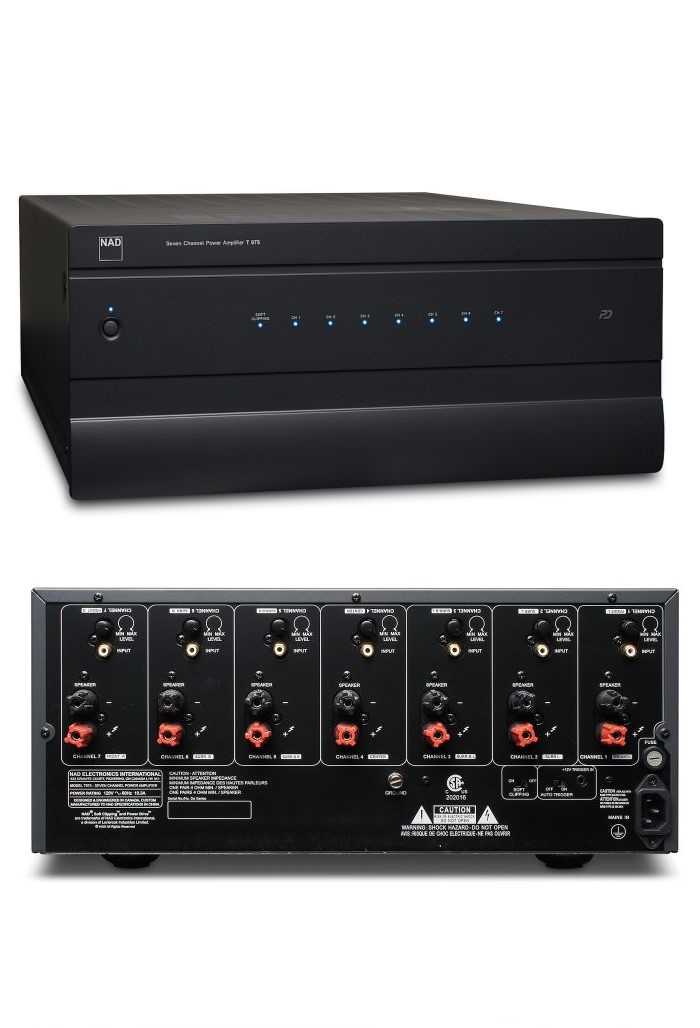
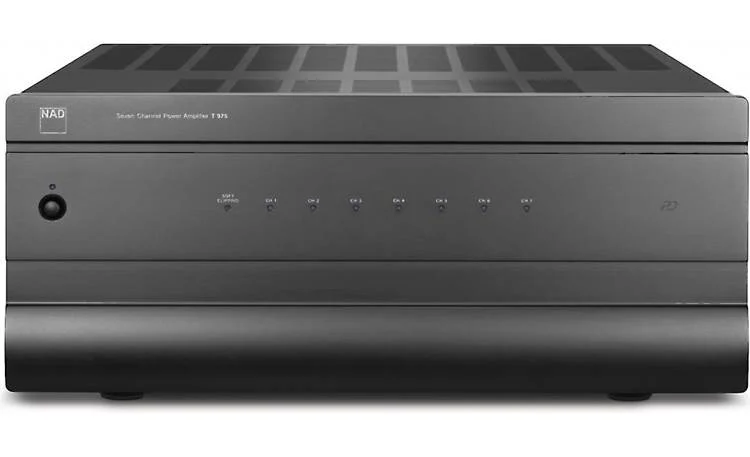
NAD T975 7ch Power Amplifier
Original price was: R55,000.00.R17,500.00Current price is: R17,500.00.
- T 975 Seven-Channel Power Amplifier
- Power Output: 7 x 140W (4/8 Ohms, 20 Hz – 20 kHz, at Rated Distortion)
- Maximum Continuous Power (FTC): 7 x 250W
- MFR: 20 Hz – 20 kHz, – 0.2 dB
- THD+N: 0.03%, 20 Hz – 20 kHz
- Dimensions: 7.1″ H x 17.1″ W x 17.7″ D
- Weight: 68 Pounds
- MSRP: $2,800 USD
Description
NAD Electronics T-975 Seven-Channel Amplifier Reviewed
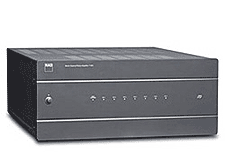
NAD Electronics T-975 Seven-Channel Amplifier Reviewed
Honestly, I am kinda sick of AV receivers. Yes, they are packed with features and loaded with almighty HDMI inputs, making them look oh-so-good on paper to consumers. Today’s HDMI receivers boast sponsorship from just about every surround sound format known to man and they tend to be first to market with all the hot new technologies but still I prefer a separate AV preamp and power amp. I know separates cost more money, but one of the major advantages of a separates system is that your amp has its own power supply and draws the needed power from the wall without affecting the preamp. I also like the idea of having an upgrade path, as receivers give you very little room to make your next move.
Even if you have a very good, feature-packed AV receiver, one way you can upgrade in a meaningful way is to add a ballsy seven-channel amplifier. This brings me to the NAD T-975. Priced at $2,499, I will put this NAD’s amp section up against any mass market receiver out there in terms of power, control and overall sonic heft. The NAD will kick it to the curb. NAD has loaded a lot of nice features into their seven-channel amp, including their soft clipping feature that I often used when I was teenager rocking out to Guns N’ Roses (along with my cherry-flame-top Les Paul and a 50-watt Marshall amp) in my room. Today’s crash-and-bang movies also keep this feature relevant, but NAD’s conservative power ratings mean you will likely never push the amp to that level. The NAD amplifier sound is one of control. This amp has massive reserves of headroom and a wonderfully open midrange. You have to look to the NAD Master Series M25 to improve on that and such a move is an extra $500 in retail cost.
Read the Low Points, High Points and Conclusion on Page 2
High Points
• The NAD T-975 seven-channel amp has a lot of power for the dollar, as any NAD fan would expect.
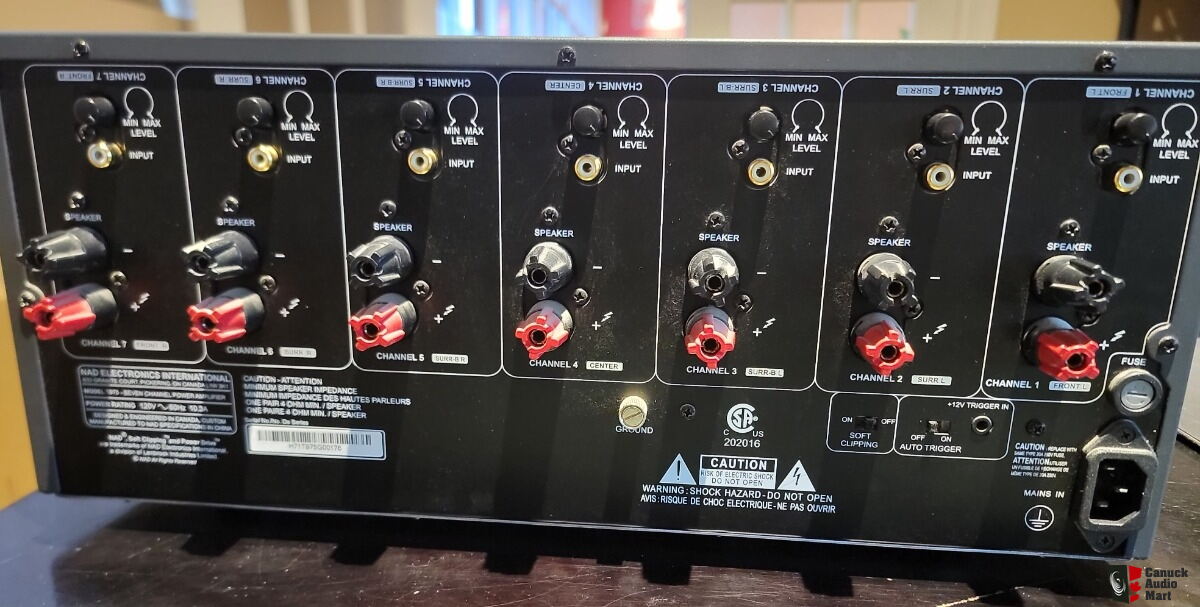
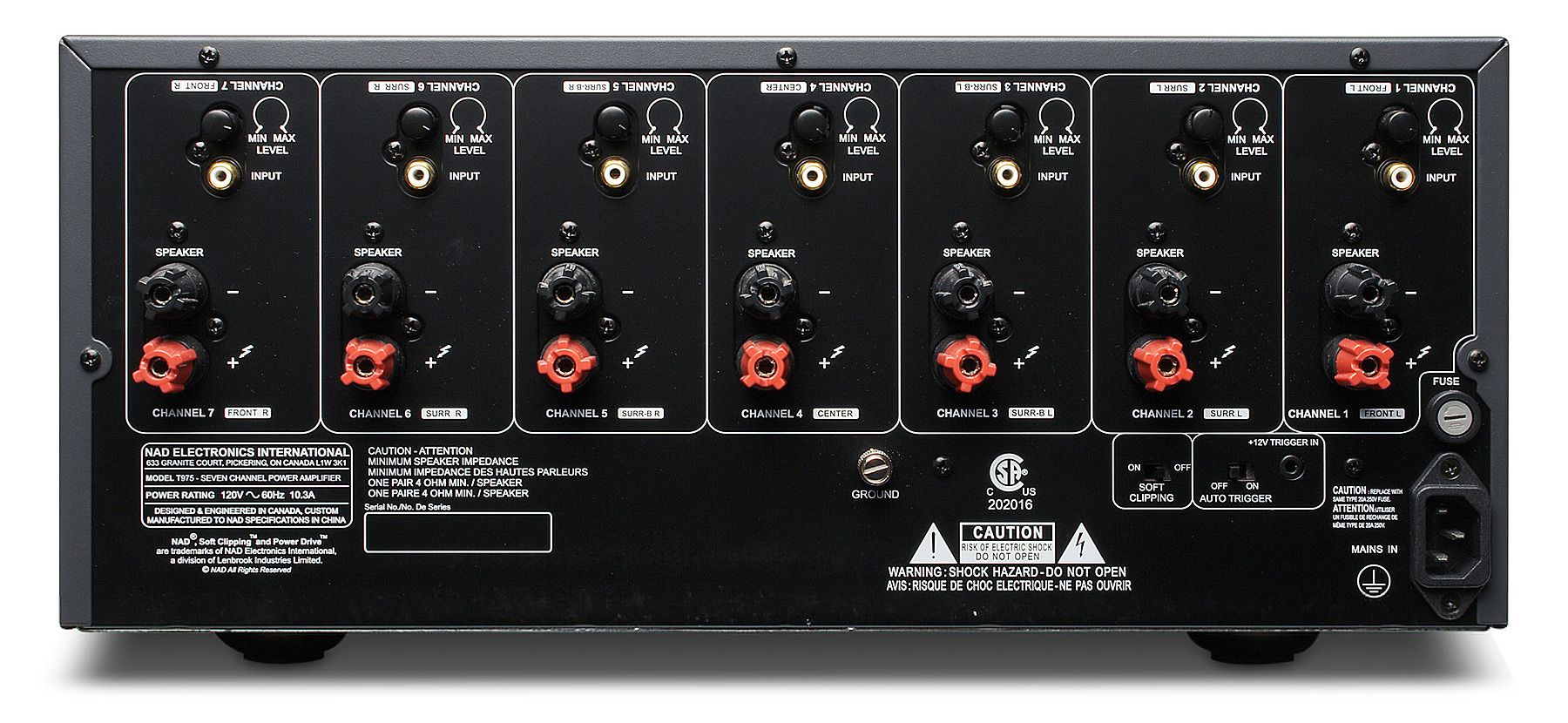
• The binding posts are great on the T-975, whereas many other amps in the lower price class (and especially AV receivers) have crappy speaker binding posts.
Low Points
• The look of the NAD T-975 is pretty plain Jane when you compare it to the slightly more expensive NAD Masters Series M25.
Conclusion
The NAD T-975 is a very strong performer. With a modest yet feature-packed AV preamp or as an upgrade to a receiver-based home theater, you can expect to add a lot of spank to your system and open yourself up to the wonders of better speakers, such as MartinLogan, PSB, Bowers and Wilkins, or even THIEL or Revel, which can be harder to drive. The NAD T-975 has the current to drive them with ease and the control to make your happy with the mids and highs for years to come.
I had a 3020 myself during my college days at the New England Conservatory. It was the first really good piece of gear I ever owned. I remember its clean pure sound and excellent dynamics, and how it wrung the most out of my record collection. Fast-forward to today and we welcome their latest entry, the T 187 processor and T 975 7-channel power amp. Surround sound is certainly more than a passing fad and NAD has risen to the challenge of providing a solution for reproducing movie soundtracks as well as a superb music system that will fit a wide variety of needs; and budgets.
Design of the NAD T 187 Surround Processor & T 975 7-channel Power Amplifier
NAD likes to take a purist approach not only in the sound and performance of their products but also their appearance. These brand-new components don’t look much different than the 3020 amp that delivered fantastic sound to my Boston dorm room back in the Eighties. The front of both boxes is a simple flat faceplate with a single groove cut into the top quarter. The T 975 adds a second wider groove near the bottom. The T 187’s display is large and easy to read from across the room. In addition to the blue-green lettering we’ve come to know and love, there are large red icons for the different surround codecs that let you know instantly what type of signal you’re hearing. Buttons are few with just power, source toggle, menu navigation and a few keys for tone control, tuner functions and listening mode. The right side is dominated by a large volume knob which has a nice mechanical feel. Below the power button is a headphone jack. On the right lower corner are the front inputs (HDMI, stereo RCA, composite & S-video) which you can use for a camcorder or game system.
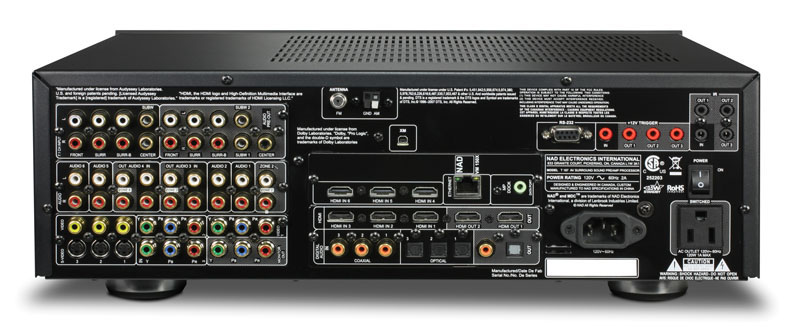
The back panel contains pretty much every connection type you could possibly need. There are six HDMI inputs and two outputs which send the same signal to two displays. Further digital inputs include three each of optical and coax and one output of each type. Analog inputs include a 7.1-channel RCA and six for stereo sources. In addition to the 7-channel RCA outputs for your power amp, there are two subwoofer outputs, also RCA. For analog video, there are three component inputs, three composite and three S-video. There are analog outputs of all types to feed the extra zones. For control, there is a single RS-232 port along with 12-volt triggers, in and out, and IR in and out jacks. Pretty much any control setup you can imagine is supported by the T 187.
In case you’re wondering about video processing, the T 187 has none. Video is a straight pass-through. It will transcode analog video to digital so you can hook up a single HDMI cable to your display for all sources. Otherwise, the signal is unaltered on its way from source to screen.

The T 975 7-channel amp has a no-surprises back panel with RCA inputs for all channels and an input signal attenuator. This can be used to balance speakers of different sensitivities or to allow greater use of the volume control from your processor. I left these turned all the way up and still enjoyed an extremely low noise floor. My speakers are pretty close in SPL with the front three matched exactly and the surrounds at 3dB higher. I let the T 187 take care of balancing this difference. The only thing I missed were XLR connections between the two components. I realize that at this price point you’re not going to get a truly balanced signal path but I like the higher-quality cabling and positive connections afforded by XLR.
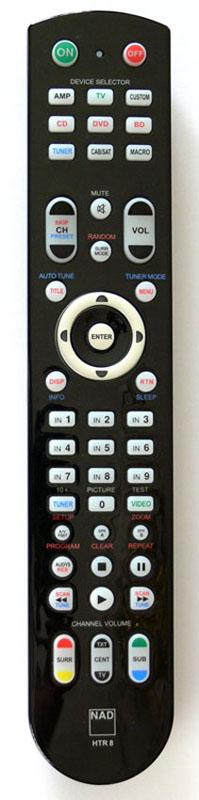
The HTR 8 remote is probably the best OEM wand I’ve ever seen included with any piece of electronics. Not only is it backlit, it has a motion sensor so it lights up when moved. The layout is pretty much perfect with some real thought put into its design. It can be programmed to control up to eight additional devices. Instead of entering codes for different brands, you teach the commands to the T 187’s clicker using the remote from the device you want to control; kind of like the Sony Remote Commander I used back in the Nineties. For controlling the processor, there is a set of discrete input keys, menu navigation, toggles for Audyssey modes and listening modes, and tuner controls. At the bottom are channel level rockers for the center, sub and surrounds. Another feature is the ability to program macros of up to 64 commands. You can even plug it into your computer through its USB port and create macros, save libraries, and clone other remotes. I really enjoyed using the HTR 8 and would probably consider using it to control my entire home theater system; it’s that good.
Setup of the NAD T 187 Surround Processor & T 975 7-channel Power Amplifier
Installation was pretty easy since I used only a single digital source, an Oppo BDP-93. I connected an HDMI cable to bring in Blu-ray and SACD signals and a coax cable for CD playback. I have found that the lower jitter inherent in a digital (coax or optical) signal does have an audible effect to the positive. To connect the T 187 to the T 975 amplifier, only single-ended RCA terminals are available. I used some beefy cables from Bluejeans to carry signals to the power amp. The input level controls were all left at their maximum setting.
Exploring the T 187’s menus revealed a simple and intuitive text-based system. Everything was easy to find and adjust. The main screen has just five options, Listening mode, DSP Options, Tone Controls, Zone Controls, and Setup Menu. The Listening mode menu lets you adjust the parameters of the various modes. Things like Center Image Width or Panorama are available here depending on the mode selected. You can also toggle the different modes with a remote key. This works nicely because it doesn’t actually switch the mode until you stop pressing the button. The end result is a much quicker switchover making A/B comparisons easier. I’ll talk more about the different modes in the In Use section.
DSP Options let you adjust the lip sync delay up to 120 milliseconds to adjust for delays in video transmission. Since the T 187 does no video processing, I was able to leave this at zero. Also in this menu are the Audyssey MultEQ options (NAD, Audyssey, Flat or Off) and settings for DynamicEQ and Dynamic Volume. I tried the different EQ curves and settled on Audyssey for movies and NAD for music. The main difference is NAD’s proprietary curve tightens up the bass a bit.
Tone Controls are just that; bass, treble and a center dialog slider that boosts only the midrange of the center channel. I set the Tone Defeat to On which bypasses that circuit entirely. Zone Controls lets you configure up to four zones. You can specify the source and the output volume independently for each zone. The included remote can control all four zones if you wish.
The final menu is Setup which is where I spent most of my time. The first thing I noticed is NAD does away with the convention of naming the different inputs. Rather, they are numbered 1 to 9 with the Tuner being source 10. Each source can be configured with whatever signal path you want based on available inputs. In my case, I set up Source 1 as Blu-ray utilizing the HDMI input for both audio and video. Source 2 became my CD input and used the coax digital connection coming from the same player. The remote has discrete buttons for each source so quick switching is easy. I prefer this system over the complicated routines used by most other receivers and processors. Honestly, do we really need an input named VCR any more?
After configuring my sources, I turned to the speaker level settings in the NAD’s menu but found I could not get the tones to play. After referring to the manual, I learned I had to press the “Test” button on the remote to actually set the levels. This was just an exercise as I planned to run the Audyssey MultEQ setup. I used my usual measurement layout of six locations starting with the main seat. Keeping this consistent in all my reviews allows a more accurate comparison of the different room EQ systems I encounter. When this was complete, I compared the various Audyssey flavors available from a convenient toggle on the remote. The default curve is NAD’s proprietary one which served up some terrific bass and my sub definitely announced itself in Mike Tyson-like fashion. The Audyssey curve was even more bass-heavy; to the point where I dropped the sub volume 3dB to smooth things out. The Flat option tailors the response of the center, surrounds and sub to the main speakers. I found this option lived up to it’s name by sounding flat and dry compared to the spaciousness of the other two curves.
NAD T 187 Surround Processor & T 975 7-channel Power Amplifier In Use
With the installation complete, it was time to put the system through its paces with some real-world content. Since a multi-channel digital processor is best suited for home theater, that’s where I did the majority of my evaluation. I also spent some time with 2-channel and 5-channel music selections. Since the T 187 does no video processing, the usual benchmarks do not apply. I tested for clipping and resolution and found no change in the original signal at all. Below-black and above-white were displayed correctly and there was no roll-off of the highest frequency bursts in both RGB and YPbPr modes. Testing was done using the HDMI inputs and output.

I started out with a concert video from Led Zeppelin. This DVD has an excellent Dolby Digital soundtrack and makes for a great home theater demo; especially if you enjoy classic rock! The T 187 did a great job of rendering small details while still delivering a warm presentation. There are no hard edges here. The surround field was very deep and engaging; I really felt like I was in a concert hall. Balance between instruments was excellent with all the complexities of Jimmy Page’s unique tone coming through clearly. I particularly enjoyed the middle portion of the concert where only an acoustic guitar and mandolin are used. Jimmy Page’s Martin guitar sounded fantastic with a perfect combination of tone and plucking detail. Tiny elements like string chirp during fret changes and the difference between a pick and a fingernail just added to the realism. And of course, there’s Robert Plant’s considerable vocal prowess. The NAD’s accuracy served that up beautifully. After listening to many Japanese receivers, I really enjoyed the slightly forward mid-range tones I was hearing. And it’s not an acquired taste, I liked it right away.
Continuing with concert video, I put in Fleetwood Mac, The Dance from 1997. This concert is mixed in what I’d call a polite manner. It’s very well-balanced but perhaps a little distant; like you’re sitting in the back row. Nevertheless, Lindsay Buckingham’s guitar work was stunning. While some of the songs failed to excite me, his solos grabbed my attention quite firmly. As a guitarophile, I love recordings where I can really hear what’s happening technically. Buckingham plays exclusively finger-style and that detail really has to be there for an effective reproduction. Even though the NAD combo tends to be laid back in sound, all the subtleties are present. They aren’t in your face like my reference Emotiva/Integra separates but still just as engaging. It’s different but just as good. Stevie Nicks and her unmistakable vocal quality were equally immersive. She might be just past her prime but these excellent electronics made her sound great.
Turning to some home theater action, I cued up a few episodes of Star Wars: The Clone Wars animated series. The latest season includes a DTS-HD Master Audio soundtrack and it is huge improvement over past releases’ Dolby Digital encode. I compared the Audyssey and NAD curves (which is really easy thanks to a dedicated key on the remote) and preferred the more bombastic presentation of the Audyssey one. NAD’s version is a bit tamer though by no means lacking in dynamics. In fact, it might be better for music; which is a theory I’ll put to the test in the next few paragraphs. Bass was huge with tremendous depth and slam. I’m running an enormous Axiom EP-800 sub in my small room and when I say the walls were shaking, I’m not exaggerating. Clarity was top-notch as well. It’s hard to imagine audio being any clearer unless the actors and musicians actually stand in front of you.
Another title with fantastic audio quality I checked out was the 2011 re-boot of The Three Musketeers. This is popcorn action all the way. The low-frequency effects are so huge I actually turned the sub down 3dB. This was easy thanks to the handy channel trims on the remote. Balance was superb with a huge soundfield and extremely convincing surround effects. There were several moments when a sound traveled around me in a full circle. NAD handled this seamlessly.
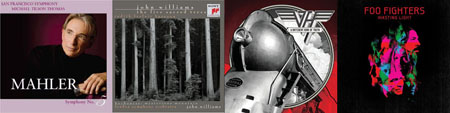
For my music-only listening, I started with a couple of classical standards (to me anyway). The San Francisco Symphony’s Grammy-winning recording of Mahler’s Fifth Symphony on SACD is a benchmark in both performance quality and fidelity. It also has the ability to sound very different depending on the gear reproducing it. Usually I find it laid back with decent detail. Better systems will separate instruments and textures more clearly. The T 187/T 975 combo was one of those. I used the NAD version of Audyssey with its tighter bass and superior midrange definition. I was rewarded with a nice wet sound that portrayed a tremendous sense of space and depth. The hall ambience was extremely inviting and provided a great impression of reality that made the walls of my room melt away. Detail in the softest dynamics was among the best I’ve ever heard and I never had trouble discerning individual instruments no matter what the texture. There was one string passage which flows over a super-quiet tympani roll that sounded particularly tasty. The roll was never buried by the sometimes diffuse sound of what must be a very large violin section. Thanks to Mahler’s brilliant writing and the SFSO’s amazing brass section, fortissimo sections were almost organ-like with a warmth I’ve rarely heard. I also enjoyed the decay of precisely released phrases even as other instruments took over the line.
Judith LeClair’s recording of John Williams’ The Five Sacred Trees is one I consistently go back to as the definition of what a bassoon should sound like. This is a great test of a processor’s ability to separate the soloist from the very large orchestra accompanying her. Needless to say, the T 187 delivered. Again the low-level detail was superb and I could hear things like ringing percussion at the end of movements, very cool! The third movement which features the harp was quite nice. The harp sound seemed to fill the stage and I imagined it to be much larger than it is in reality. Since this is a 2-channel recording, I experimented with the different listening modes. DTS NEO:6 Music was my favorite.
Moving on to a little rock & roll, I dropped in Van Halen’s new album, A Different Kind of Truth. I’ve listened to this CD on many different systems, from iPods to car stereos, and found it generally compressed-sounding with too much emphasis on the bass. The T 187 did a fair job but it still sounds like you’re listening to the band in a small club with crappy acoustics. I toggled through the different listening modes attempting to find a good balance but it was difficult to compare them because they are not volume-matched. EARS, which is NAD’s proprietary surround mode, seemed flat to me and I preferred the Enhanced Stereo mode which volume-matches all the channels. My favorite track on this album is the acoustic blues song Stay Frosty. The guitar and vocals are mixed more forwardly than the other selections and I felt it connected with the listener more intimately.
Turning to a better-quality recording, I cued up the Foo Fighters’ 2011 release of Wasting Light. This album was produced in Dave Groh’s home studio using all analog gear and produced by Butch Vig, who was also at the helm for Nirvana’s Nevermind. This was a much better mix and I thought it sounded fantastic on the NAD combo. Some of the songs have as many as nine layered guitar parts and I had no trouble hearing every one of them. This recording also benefitted from the Enhanced Stereo treatment.
Conclusions about the NAD T 187 Surround Processor & T 975 7-channel Power Amplifier
I really enjoyed my time with the NAD T 187/T 975 combo. I’ve never needed most of the features offered in today’s receivers and processors so I appreciated NAD’s simple and efficient approach to sound reproduction. For music, these separates are among the best. Whether in surround mode or two-channel, the rich dynamics and wonderful separation of instruments was my favorite thing to listen to. The choice of different Audyssey correction curves was extremely cool too. And kudos for one of the best OEM remotes ever!
When audiophiles shop for multi-channel separates, the choices are quite limited compared to the sheer volume of receivers available. And it’s easy to spend ridiculous money to put good surround sound in your home. Thanks to NAD, we now have an affordable alternative that performs on par with the best gear out there. The T 187 and T 975 separates earn my highest recommendation.
Related products
-
Mark Levinson 331 Stereo Power Amplifier
Original price was: R120,000.00.R33,000.00Current price is: R33,000.00. Add to cart -
Ming Da MC 368-B5
Original price was: R64,000.00.R45,000.00Current price is: R45,000.00. Add to cart -
Ming Da MC 368-B90
R36,000.00 Add to cart -
Ming Da MC 845-C12 Single Ended
R59,000.00 Add to cart