Aesthetix Rhea phono preamplifier
Original price was: R148,000.00.R42,000.00Current price is: R42,000.00.
Description
Trickle-down technology is a grand thing. It’s comparatively easy to build an exceptional audio component when there are no constraints on technology, cost, user-friendliness, or lack thereof, but top designers are now packing more and more of the excellence of damn-the-torpedoes components into more affordable and accessible packages. Which brings us to the Aesthetix Rhea, a tubed phono preamplifier of exceptionally distinguished lineage.
The $4000 Rhea is the direct descendant of the formidable Aesthetix Io and Io Signature phono stages, which put the California company smack in the middle of the highest of high-end phono electronics. The Io and Io Signature are huge, costly, imposing pieces, each consisting of two massive plain-Jane boxes filled with tubes (footnote 1).
They also demand some dedication and sacrifice, and not solely from the wallet. An Io takes up a huge amount of real estate, and the sheer number of tubes makes retubing a sobering thought. Aesthetix is purist to the core—even changing an Io’s gain requires undoing a slew of screws and readjusting a set of jumpers inside the case. The tube-regulated power supply is potent enough to drive a 50W power amplifier, and throws off enough heat to bake a pizza.
The Ios accept no compromise and take no prisoners, but oh, they’re worth the sacrifices. I have recently lived with the Io Signature, and it is sonically glorious, possessed of atomic dynamics, staggering resolution, and a sound that entices with both truth and beauty. With the Boulder 2008 and Manley Labs Steelhead, it is one of the three finest phono stages I have ever heard.
Jim White, Aesthetix’s president and designer, realized that the Io preamps, wonderful as they are, are too big, too expensive, and simply too much for many lovers of vinyl who want the special something that only a tubed phono stage brings to the (turn)table. The difficult part of the equation was how to preserve most of the Io in a relatively affordable and accessible package.
So how close does this Boxster S come to its 911 Turbo sibling, anyway?
Under the Hood
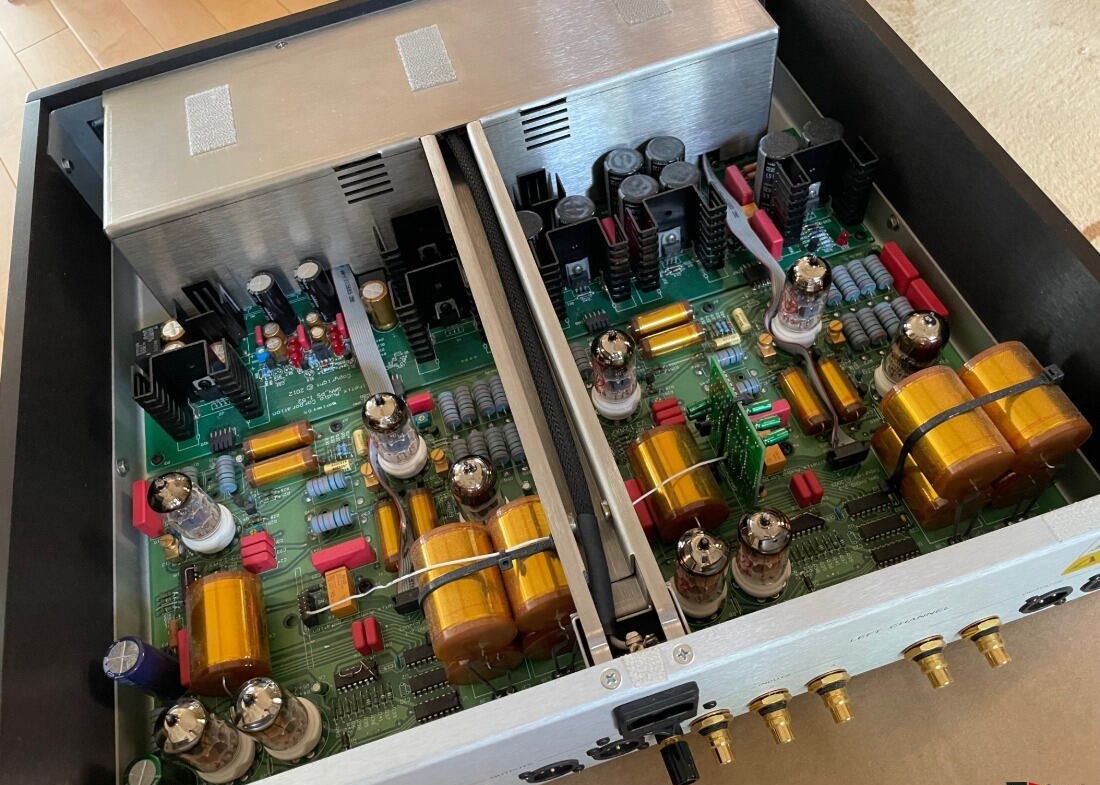
Peeking inside the Rhea couldn’t be easier—its damped top panel is secured with what looks like some sort of industrial-strength Velcro. Everything about the Rhea looks and feels expensive, smooth, and refined; nothing has been left to chance.
Given that Jim White’s résumé includes the stellar Io Signature, it only made sense for him to adapt his well-established basics to the Rhea project. The goal was to “get as close sonically to the Io as possible,” and the Rhea’s circuit, based closely on that of big sis, uses five tubes per channel in a three-stage configuration in a full dual-mono application. (The power supplies and AC cord are shared, but each channel has its own entirely separate circuit board.)
According to the manual, the first stage is “a high-gain, low-noise single-ended amplifier” based on a pair of Sovtek 12AX7LP tubes. This feeds a high-gain differential amplifier, with a single Sovtek 12AX7WB tube balancing and amplifying the signal. Purely passive RIAA equalization is applied at this point, using Roederstein resistors and 1% polypropylene capacitors. Final amplification is courtesy of another Sovtek 12AX7WB operating as a differential amplifier, and the output is then differentially buffered via a Sovtek 6922. The tubes provide all of the gain; there are no solid-state amplifying devices in the signal path.
Power-supply regulation is, sensibly, solid-state, making the Rhea a much more manageable presence in the equipment rack. The power supply itself is highly sophisticated and features two separate low-flux transformers: one for the high-voltage, low-current tube supplies, the second for the low-voltage, high-current heaters. Separate windings and discrete supplies are used for each channel’s heaters, and choke filtering is applied extensively. Nichicon Audio electrolytic filter caps are used, and all bypass filter caps are from Wima.
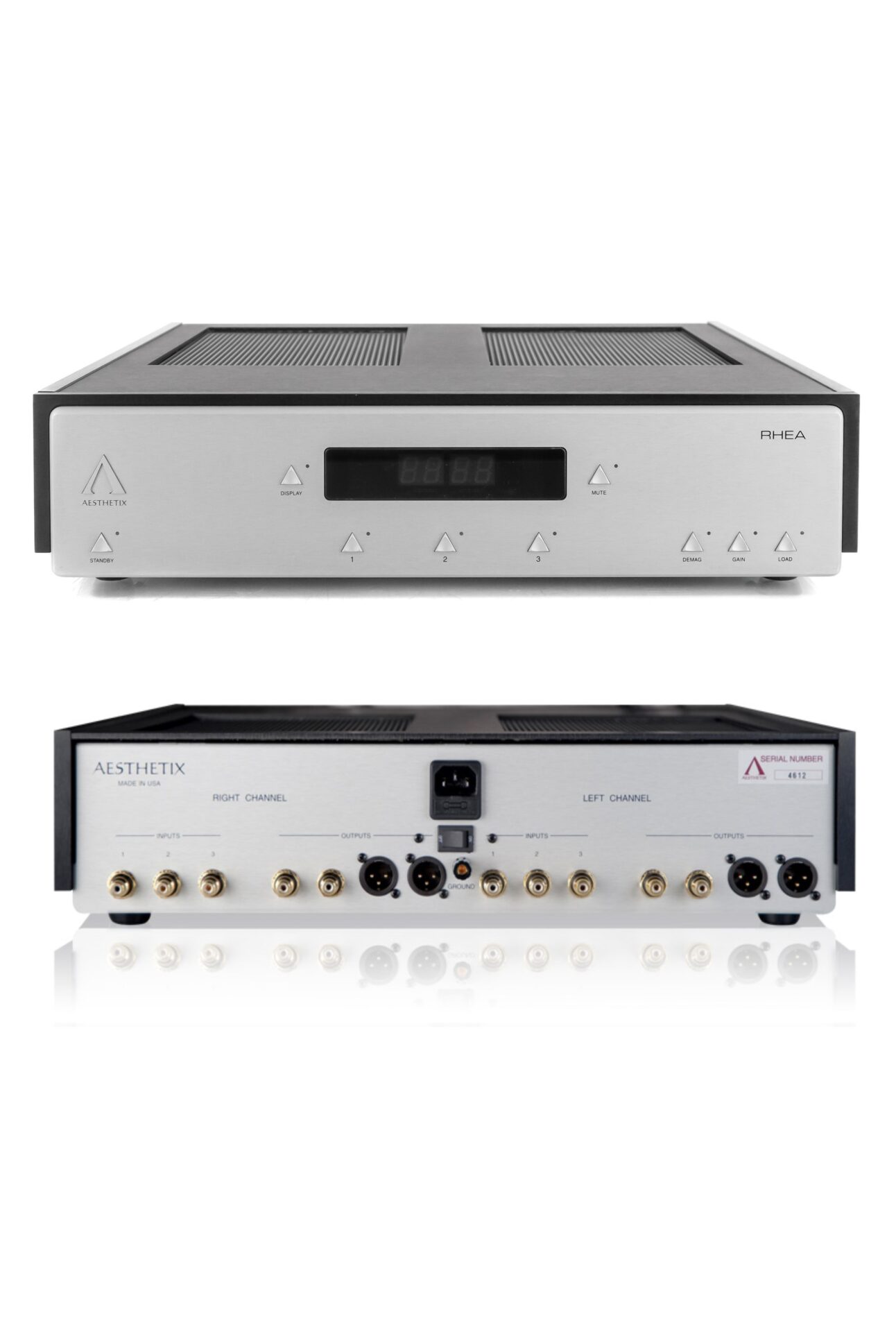
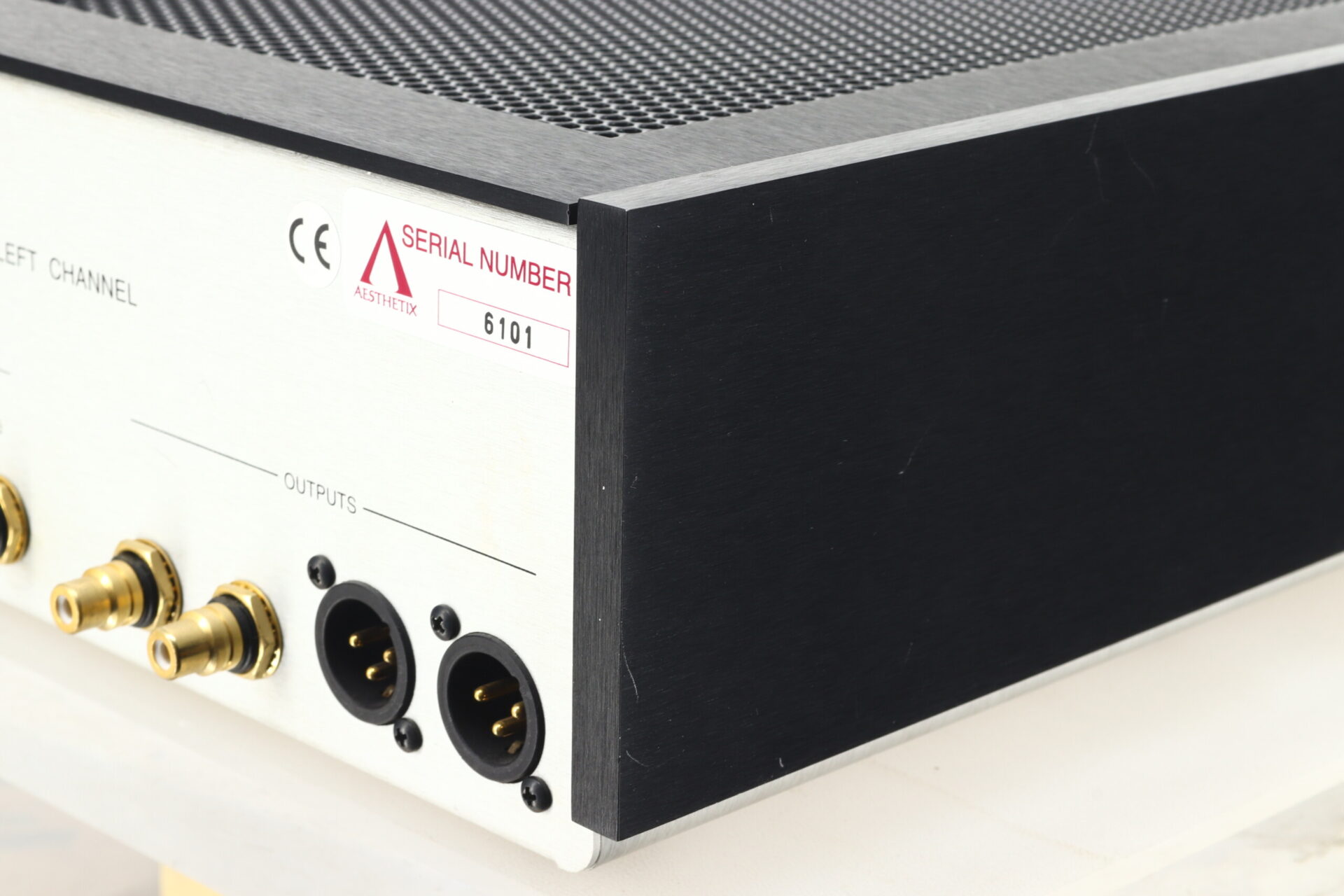
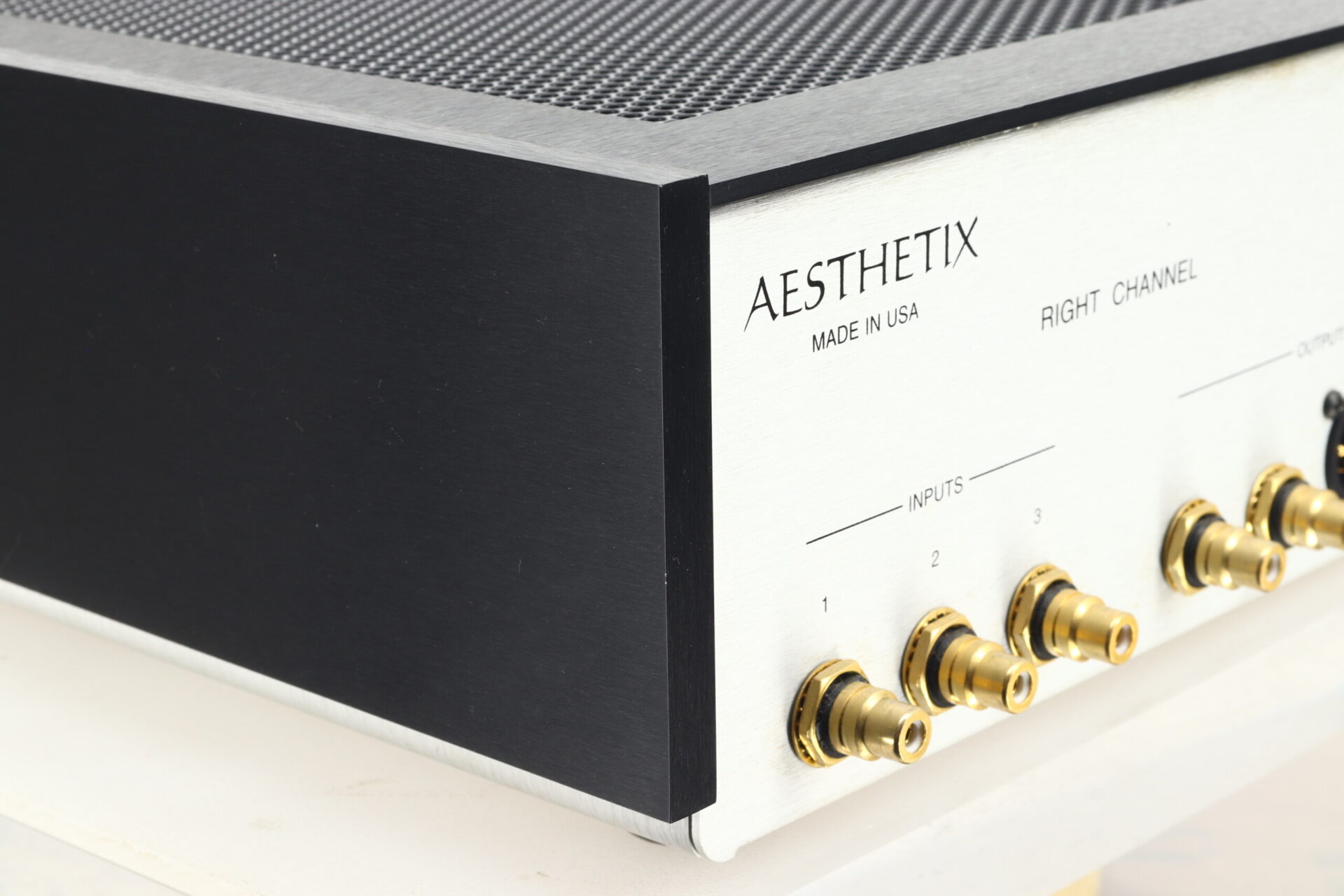
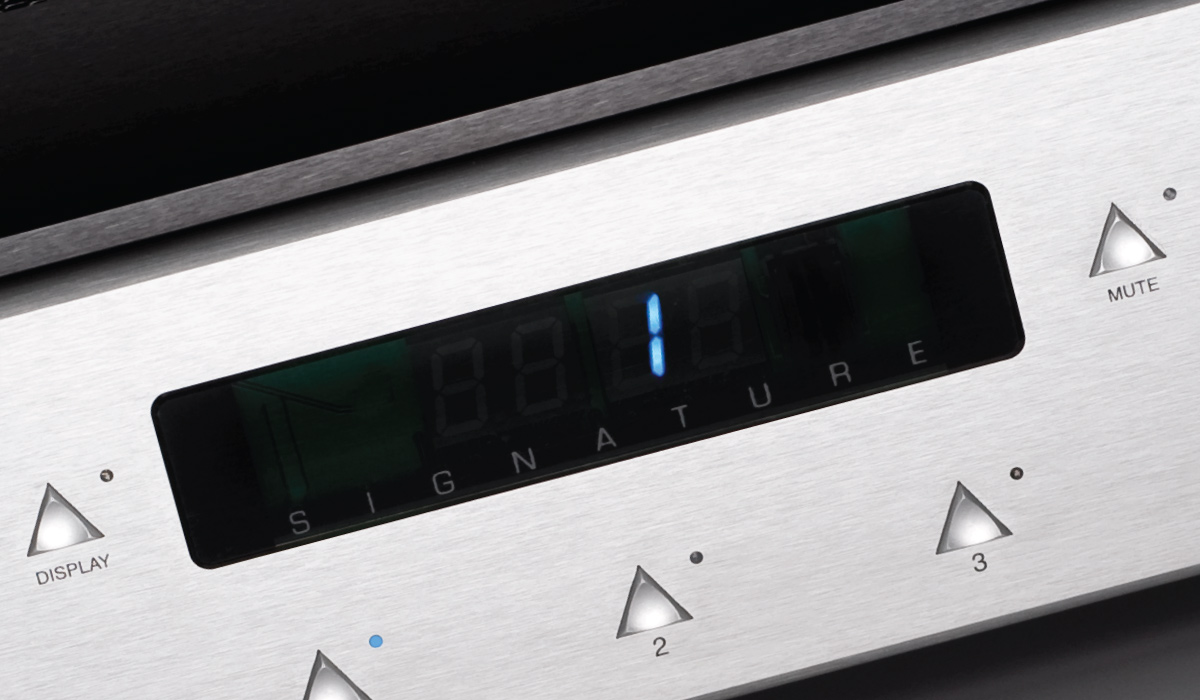
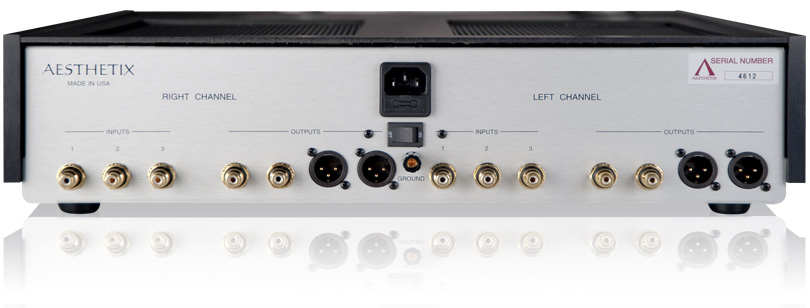
The mains switch lives around back, with a Standby switch on the front panel. In Standby, power is maintained to all of the Rhea’s solid-state components, but only when the Standby switch is triggered does power ramp up, gradually, to the tubes. The Rhea will be especially interesting to those who run multiple turntables, or multiple tonearms simultaneously on one ‘table: the rear panel holds three inputs, selectable from the distinctive little pyramidal switches under the front-panel display. Balanced and RCA output jacks are provided.
A new level of couch-potato ecstasy comes courtesy of the Rhea’s microprocessor control and remote wand: All of the preamplifier’s functions are accessible from the remote. Yes, this means you can change loading and gain on the fly, from the comfort of your chair, while enjoying the beverage of your choice. Not only can you customize the settings without getting up, but the Rhea remembers the individual loading and gain choices for each of the three inputs. Given that you can select seven different levels of gain, from 38dB to 75dB, and nine standard loading settings, there would seem to be few, if any, cartridges that could be accommodated. But should you have one, appropriate resistors, available from Aesthetix, can be custom-installed.
My reference Dynavector XV-1S cartridge was very happy with 56dB of gain and loading of 125 ohms. While there was a bit of tube rush between records through the very-high-gain VTL 7.5 line stage, noise was never audible when music was playing, and there was no more than a normally low amount of tube-related noise through the Balanced Audio Technology VK-51SE or Aesthetix Calypso line stages.
“But microprocessors…?” I hear you thinking. “That means digital noise flying around and contaminating my precious analog signal.” Not here, pal. The Rhea’s processor chip and all clocks are turned off unless commanded to be in action. Press a button and the chip comes to life, performs the desired function, then reverts to sleep mode virtually immediately.
Not that this exhausts the Rhea’s features. Jim White has included a cartridge demagnetizer that can be assigned to any of the inputs and triggered from the remote (footnote 2). The digital control section is thoroughly shielded from the remainder of the innards, and all AC lines run through a shielded back-to-front channel. Sturdy, nonresonant aluminum casing surrounds everything; the entire unit has a pleasing solidity.
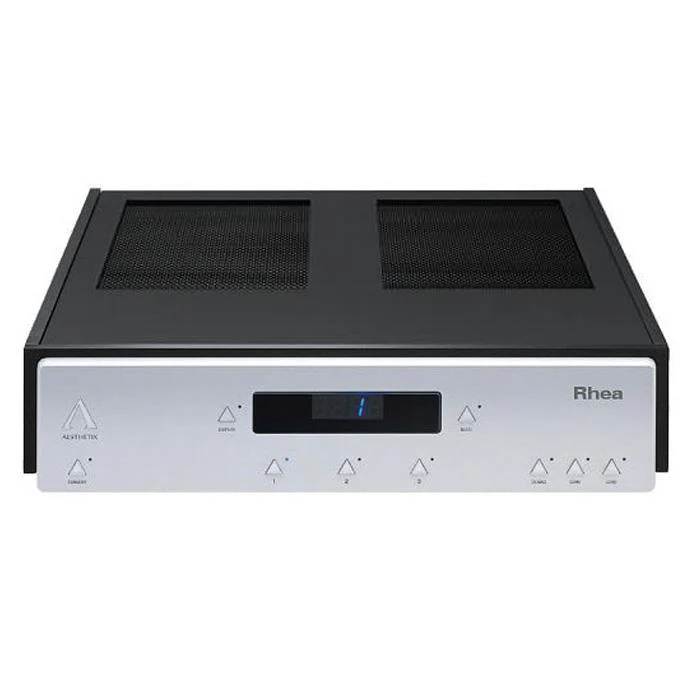
While the looks of the Io are, to put it kindly, utilitarian, the Rhea comes dressed in chic and elegant finery. Its clean, knobless front panel features those snappy little pyramidal switches, which echo the shape of Aesthetix’s “A” logo, and its big, bold readout displays input, gain, and loading information in an appealing sapphire blue. The display can be shut off, but pops on for five seconds when a front-panel switch or remote button is pressed. Should you care to change the gain or the cartridge loading at the preamp, press the appropriate button, then the left or right side of the display, to decrease or increase the setting.
The Rheal Deal?
The single most wonderful thing about a fine tubed phono stage is that delectable, seductive, bloomy midrange, which, even today, seemingly remains the exclusive province of glowing glass. The Rhea welcomed me to Vaughan Williams’ Pastoral Symphony (Boult/New Philharmonia, Angel S-36532) with rich atmospherics and an invitingly fundamental wholeness. Its spatial expansiveness and timbral richness were unmistakably close kin to the Io Signature’s. Much of my favorite English orchestral music depends less on sheer force than on dynamic subtlety and the resolution of finely shaded tonal nuance. The “little” Aesthetix starred with Vaughan Williams, Delius, and, especially, Arthur Butterworth’s A Shropshire Lad (Marriner/ASMF, UK Argo ZRG 680), where it caught—with a particularly light and lovely touch—the quiet but intensely emotional nature of the music and the performance. The Rhea’s performance of the Butterworth was further proof, if any were needed, of the microdynamic magic of fine tubes.
Not that the macrodynamics were anything to sneeze at. John Bonham’s mighty tom-tom blasts on “Custard Pie” and “In My Time of Dying,” from Led Zeppelin’s Physical Graffiti (Swan Song/Classic SS2-200), were thunderous and immediate. On really massive orchestral material, the Io Signature and Manley Steelhead have a slightly superior sense of ease when coping with huge transients, but the Rhea was not in the least embarrassed by the comparison.
The Rhea’s tonal balance wasn’t the slow, lushly romantic sound of old-school tubes. Rather, its presentation was fast, with a wideband, consistently full-bodied harmonic presentation that is the hallmark of today’s best tubes. On Caravan’s “Nine Feet Underground,” from Canterbury Tales (UK Decca DKL R-8-1/2), Richard Sinclair’s Fender Jazz bass guitar had a round, throaty purr and was excellently articulated. David Sinclair’s Hammond organ had that slightly growly, primal quality that Hammonds are supposed to have—an almost touchable, corporeal sound with a little bit of grit coming from the Leslie speakers.
The Aesthetix beautifully captured Richard Sinclair’s melancholy, quintessentially English voice, particularly on the lovely “Disassociation.” Likewise with “Wicked Game,” from Chris Isaak’s Heart Shaped World (Reprise 25837-1), which was wickedly delicious through the Rhea. Isaak’s neo-Elvis vocals and the reverb-drenched guitars were dreamy and lavish—a sonic silk sheet if ever one there was.
Imaging was exactly what you’d expect from a topnotch tube preamplifier: expansive, solid, and precise, without that unnatural “pinpoint” placement that is more hi-fi than it is musical. There was perhaps a bit more image-to-image bleed-through than with the Io Signature or the Steelhead, but, again, the Rhea did not suffer overmuch from the comparison. Brass instruments had precisely the right combination of focused projection, together with an ambient “glow” that is the cornerstone of rightness. Freddie Hubbard’s trumpet on Oliver Nelson’s ever-gorgeous “Stolen Moments,” from The Blues and the Abstract Truth (Impulse! IMP-154, reissue), was decisively centered in a corona of charged air, and the sense of cohesion between the musicians was truly fine stuff.
The Rhea’s bass performance was firmly cohesive by any standard. The spatial and tonal bloom of tubes was neatly combined with resolute pitch definition. Each bassist’s individual sound and personality were preserved with distinctiveness and particularity, be it Paul Chambers or Jaco Pastorius. Things were just a fraction more loose down low than with the Io Sig or the Steelhead, but there was no shortage of power or pitch certainty.
The Rhea was a shade softer and darker than life in the top half-octave or so of the treble range, perhaps, but there was still more than enough resolution to describe the shape and size of recording venues. Far better to have a smidgen of mellowness here than an overly aggressive and artificially transparent etched sound. This bit of forgivingness did nothing to impair the tonal brilliance of Jascha Heifetz’s violin in Beethoven’s Violin Concerto (Munch/Boston, RCA Living Stereo/Classic LSC-1992). The master’s fiddle was crisply defined, with outstanding delineation of bowing and a scintillating clarity during the cadenza, and no blurring or obscuring of his dazzling technique.
Soundstaging was invariably very good, with an estimable sense of depth, width, and height. On the Beethoven concerto, the spacious acoustic of Boston’s Symphony Hall filled the back of my room, though the Manley Steelhead and the Io Signature illuminate the rearmost corners of the stage a pinch more evenly and completely. With rock and pop LPs, the material, not the Rhea, set the size of the stage—as it should—and small-group jazz LPs had a pleasing sense of immediacy and involvement, that gratifying sense of eavesdropping on a performance rather than listening to a recording.
“Musical flow” is a quality that is drawing increasing attention in the hi-fi press. To my mind, “flow” requires three primary things: first, well-controlled bass that is capable of going down deep without losing definition, in order to firmly establish the music’s rhythmic pulse; second, a continuousness and general neutrality of timbre throughout the audible range, so as to maximize the individual character of each instrument and voice; and, third, a high degree of spatial resolution.
“Animal Waves,” from Can’s Saw Delight (UK Virgin V 2079), is 15 minutes of scrumptious and intense musical sensuality that demands “flow” to communicate its heady, almost erotic, essence. Pulsing Afro-Caribbean rhythms ground spaced-out washes of keyboards, and electric violin and guitar converse with both the cosmic and the carnal. The earthy throb of bass guitar, drums, and the complex syncopations of Reebop Kwaaku Baah’s percussion was taut and composed, while the swoops and whooshes of Irmin Schmidt’s electronic keyboards waxed and waned like a celestial tide. This was flow with a vengeance.
A Quart in a Pint Pot
Judged by the high standards Jim White set for himself in designing it or considered strictly on its own merits, the Aesthetix Rhea is a runaway success. Nope, it doesn’t have quite the Krakatoan dynamic range of the Io Signature, quite the sheer speed and resolution of the Manley Steelhead, or quite the massive technological overkill of the Boulder 2008—and none of that matters a bit or a smidgen. To get the last little bit of those things, you’ll spend from nearly double to eight times the Rhea’s $4000 cost. The Rhea’s most remarkable accomplishment is to put together an extraordinary combination of sonic performance and useful features at a price that is within reach for many serious vinyl addicts.
The Rhea tells a striking amount of musical and sonic truth and is, in terms of sound alone, intensely lovable. Did I notice the difference when the Steelhead or Io Signature went back in the system? Sure. But the Rhea has enough of all the qualities that make the megabucks competition so special to make it a source of constant musical joy. Not once did I feel that the Rhea shortchanged any LP I heard through it. That, together with the too-cool-for-school remote functions, multiple inputs, built-in cartridge demagnetizer (for those of that persuasion), and first-class presentation, make it worthy of a wildly enthusiastic recommendation. This one, cats and kittens, is killer good.
TAS 196: Aesthetix Rhea Signature Phonostage

It has long been an article of faith among audio “objectivists” that passive components—wire, resistors, capacitors, and inductors—have no effect on the sound of the product in which those components are used. That is, two capacitors of the same value will perform identically in the circuit—so why not use the cheapest version possible? This thinking led to some audio products, including professional gear, that were loaded with cheap carbon resistors, internal “hook-up” wire, and electrolytic coupling capacitors. Anything more was deemed a waste of money.
The high-end takes a different view. The designer of a well-regarded D-A converter told me about how, before going into production with his latest product, out of curiosity he replaced a $1 resistor with a $10 resistor (in the current-to-voltage converter’s feedback loop). The difference in sound was so great that he couldn’t imagine shipping the unit with the $1 resistor. The company absorbed the price difference.
So how much difference do exotic parts make in the sound of an audio product?
The Rhea Signature phonostage from Aesthetix provides a fascinating test bed. The Signature version uses the same circuit as the standard unit, but in the Signature that circuit is implemented with the higher-quality parts found in the $15k Aesthetix Io phonostage, making it possible to evaluate the sonic difference between very good and nearly-cost-no-object passive components. The price difference is substantial; the Rhea is $4000 and the Rhea Signature $7000. Rhea owners can upgrade to the Signature for the $3000 difference.
I know the standard Rhea very well; it’s been my phonostage of choice since I reviewed it in Issue 151 (December, 2005). The new unit looks nearly identical on the front and back—only a subtle “Signature” legend is etched on the display’s glass. But one peek under the hood and you can see that this is a different product. For example, the Rhea uses very high-quality Rel-Caps at many points in the circuit, but the Signature replaces these with huge red polypropylene film-and-foil caps from Dynamicap. In addition to such upgrades in parts quality, the Signature employs noise damping inside the chassis, as well as special vibration-absorbing feet under the transformers, choke, and the first gain stage (a point at which keeping noise low is critical). These feet are made by Harmonic Resolution Systems, the company that makes perhaps the most elaborate, best-engineered, and most beautiful equipment racks in the industry. The Signature’s tubes are selected to a higher standard—only 10% of the tested tubes pass muster. Finally, the Signature employs expensive variable capacitors in the RIAA equalization circuit to enable hand-tuning of the network for perfectly flat frequency response.
I had the Rhea and Rhea Signature side-by-side in my rack, driven by the outstanding Basis 2800 Signature turntable (fully loaded with Calibrator Base, Syncho-Wave power supply, vacuum hold-down, and Micro-Thin belt), Basis Vector 4 tonearm, and either a Dynavector XV-1s or Air Tight PC-1 Supreme cartridge. (Incidentally, the PC-1 Supreme was a complete revelation to me; I’d never heard a phono cartridge that was simultaneously so resolving yet so smooth and relaxed. The classic trade-off in cartridges between detail and musicality was rendered moot by the PC-1 Supreme.)
Being so familiar with the Rhea, it didn’t take long to appreciate the difference in the Signature. The biggest surprise was the bass, which exhibited far greater weight, extension in the lowermost octave, and dynamic impact. This wasn’t a subtle difference, but rather a wholesale transformation of the bottom end. Kick drum had more impact and solidity, and bass guitar was fuller in timbre and more fully fleshed out in body. The difference in the low end was fully equal to that of changing cartridges—or even loudspeakers. It was nearly on the level of moving from a stand-mount loudspeaker to a small floorstanding unit.
It wasn’t just that the Signature had more bass; it also had better bass. Small-scale dynamics, pitch articulation, and richness and density of tone colors were all in a different league. The Signature had a sense of tautness, precision, and detail that made the standard Rhea sound a bit soft, muddled, and smeared by comparison. Just listen to Jaco’s fabulous ensemble playing (and solo) on the Wayne Shorter composition “Port of Entry” from Weather Report’s Night Passage—the Signature revealed a new level of intensity and virtuosity in Jaco’s performance. After switching to the Signature, this live track was electrifying and thrilling in a way I hadn’t experienced before. The Signature resolved the blinding speed, the precise articulation of each note (in both pitch and dynamics), and the sheer musical intensity of the performance. The standard Rhea sounded a bit “watered down” by comparison, with less of the vibrant energy that makes this track special.
Without making a conscious effort, I found myself focusing on and appreciating the rhythmic contribution of bass players. I’ve heard the wonderful Bill Evans album Quintessence countless times, but through the Signature discovered another level of artistry in Ray Brown’s nuanced performance. Through his dynamic inflections, Brown creates his own varying rhythmic flow within the relatively stable time established by drummer Philly Jo Jones. Brown makes intriguing excursions that add a playful bounce to the sparse arrangements, notable on “Sweet Dulcinea.” The Signature’s greatly improved bass gave me a deeper involvement in, and appreciation for, this old favorite.
In the bass octaves audio components often make a trade-off between weight and precision. The leaner-sounding products tend to better reveal detail and dynamics; the warmer-sounding components are often a little smeared and slow. The Signature’s central triumph is its combination of raw bass power and heft coupled with speed, precision, and articulation. It was a combination I found addictive—particularly with the spectacular bass qualities of the Air Tight PC-1 Supreme cartridge.
Another dramatic improvement of the Signature was its cleaner, sweeter, and more refined treble. The top end had much more detail and nuance. For example, the Signature resolved the fine inner detail of cymbals in a way that the standard Rhea couldn’t match. The stick hitting the metal, the fine complex shimmer, and the way the decay of the instrument hung in the air were significantly better resolved by the Signature. Moreover, treble textures were smoother, purer, and less grainy through the Signature. Solo violin, the string sections of chamber ensembles, and massed orchestral strings all sounded more “organic” through the Signature thanks to its greater refinement, resolution, and reduction in grain. Although the standard Rhea is a great phonostage, the Signature makes it sound a bit coarse and grainy.
This combination of greater resolution and a more natural rendering of timbre extended to the midrange, but not to the same degree I heard in the treble. In the mids, instrumental texture was richer, denser in tone color, and more immediate. Despite the greater sense of palpability in the midrange, the overall perspective through the Signature was slightly more distant than through the standard Rhea. The Signature moved the soundstage back just a bit, and better resolved layers of depth. Having said this, however, I thought that the Signature made certain instruments seem to jump out of the soundstage with greater immediacy. Percussion and other instruments with steep transients seemed to suddenly appear right up front in the soundstage—the timbales on the terrific Mobile Fidelity reissue of Santana’s Abraxas, for example. Not only were depth and presence markedly improved, so was the resolution of instrumental decay.
You should know that if you value a dead-silent background, the Rhea and Rhea Signature might not be for you. This phonostage has up to a whopping 75dB of all-tube gain, which makes for some background noise in some systems. Many tubed phonostages employ a low-noise solid-state gain stage at the input (usually an FET) to amplify the cartridge’s output to a level that requires far less gain from the tubes. Others rely on a step-up transformer for the same reason. The Rhea is pure tube from input to output, with all the advantages and drawbacks of that topology. In addition, the noise level is highly dependent on tube quality.
Conclusion
I was really quite shocked by how much better the Rhea Signature sounded than the standard Rhea. In fact, I had planned on many long sessions of going back and forth between the two products to discern and describe the differences, but quickly realized that was unnecessary. Moreover, I enjoyed music so much through the Signature that it was hard to go back to the standard Rhea.
As great a phonostage as the Rhea is, the Signature version is on another level of performance. Yes, it’s nearly twice the price ($4000 vs. $7000), but the Signature is that much better. If you already own the Rhea, upgrading to the Signature will give you a new perspective on your record collection and favorite music. It did for me.
__________
Inside the Rhea
The standard and Signature versions of the Rhea share the same features and circuit topology. Both are slightly simplified versions of Aesthetix’s acclaimed Io phonostage. The unit features unbalanced inputs, with balanced inputs available for a small additional charge. The gain is adjustable in eight steps, with up to 75dB of gain at the maximum setting. Nine different cartridge loadings are provided. The gain and loading can be set independently for each channel. The way in which you adjust the gain and loading is very cool: Press the “Gain” button, for example, and the amount of gain in dB appears on the front-panel display. Simply push the right side of the display to increase the gain, or the left side to decrease it. The arrangement is the same for changing cartridge loading. In addition, you can adjust gain and loading from your listening seat via the supplied remote control.
The circuit is based on five tubes per channel, with two 12AX7LP tubes at the input operated in single-ended mode followed by a single 12AX7WB that functions as a phase splitter to create a balanced signal. The output of the 12AX7WB is filtered by a passive RIAA network, and then amplified by another 12AX7WB. The output buffer is a 6DJ8. Unique to the Signature version are variable capacitors in the passive RIAA network that allow each unit to be hand-calibrated for flat RIAA response. The variable gain and loading are realized with two separate switched-resistor networks.
The power supply is huge, and features all-discrete regulation (except for the supplies of the control and display circuits). The power transformers are mounted on an isolated substrate and encased in shielding.
The metalwork, industrial design, interior layout, and build-quality are exemplary. Moreover, the feature set—three inputs, adjustable gain and loading via remote control, built-in cartridge demagnetizer, balanced outputs—makes the Rhea compatible with a wide range of systems. RH
Related products
-
Plinius SA-103 (Silver) & Kaitaki (Black) Combo
Original price was: R275,000.00.R145,000.00Current price is: R145,000.00. Add to cart -
Roma 79DC Tube Phono Stage MM-MC
Original price was: R28,000.00.R20,000.00Current price is: R20,000.00. Add to cart -
Valve Audio BlackWidow Preamplifier (Current NEW Model)
Original price was: R89,000.00.R56,000.00Current price is: R56,000.00. Add to cart -
MingDa MC 2A3 Preamplifier
Original price was: R118,000.00.R59,000.00Current price is: R59,000.00. Add to cart