

McIntosh MC275 – Stereo Power Amplifier
Original price was: R150,000.00.R48,000.00Current price is: R48,000.00.
ELECTRONIC SPECIFICATIONS
-
- Power Output per Channel
- 75W @ 4, 8 or 16 Ohms
- 150W @ 4, 8 or 16 Ohms MONO Operation
-
- Number of Channels
- 2 or Mono
-
- Total Harmonic Distortion
- 0.5% maximum harmonic distortion at any power level from 250 milliwatts to rated power, 20Hz to 20,000Hz
(≤ 0.25% harmonic distortion at 1kHz)
-
- S/N below rated output
- 105dB
-
- Dynamic Headroom
- 1.2dB
-
- Damping Factor
- >22
-
- Rated Power Band
- 20Hz to 20kHz
-
- Frequency Response
- +0, -0.5dB from 20Hz to 20,000Hz
+0, -3.0dB from 10Hz to 100,000Hz
Description







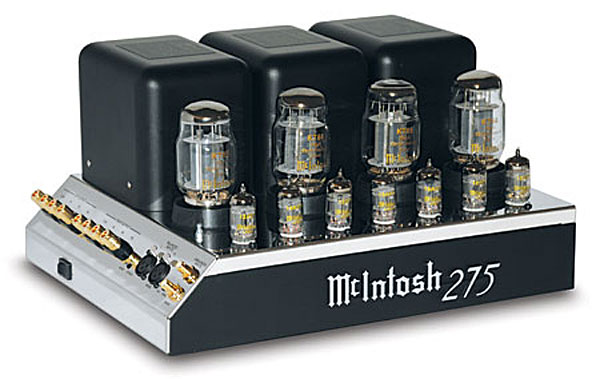
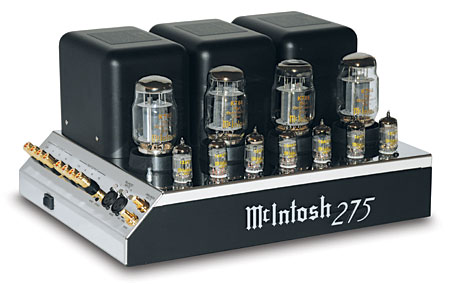
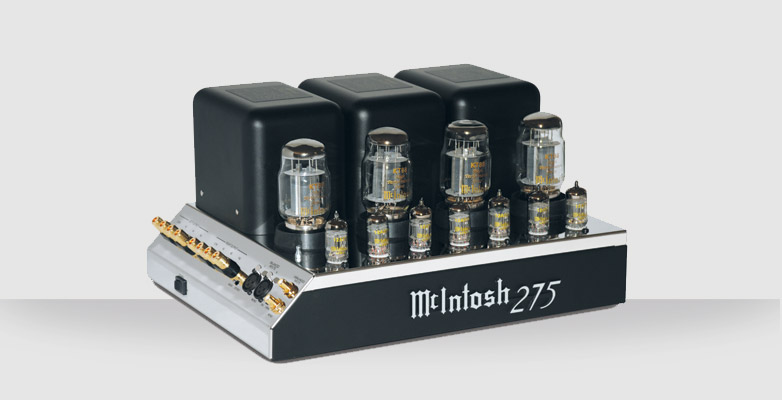
The present version of the MC275 is its fifth incarnation, though it looks strikingly (and, for retro-cool’s sake, deliberately) similar. Looks, of course, can be deceiving or revealing; in this case, they’re a bit of both.
Description and Design
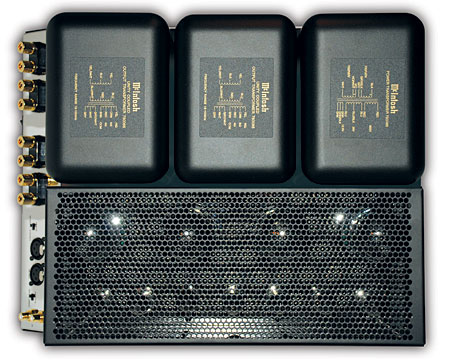
Like the MC275 of yore, the current model is rated at 75Wpc (though McIntosh Labs’ tech man, Chuck Hinton, says it can actually pump out 90Wpc), and it weighs the same 67 lbs. Much of that heft comes from the two output transformers, which are, with the exception of one quality, identical to the original’s, even to the point of being wound on the same equipment at McIntosh’s production facility in Binghamton, New York. The wire in the old transformers was made of lacquered copper, which tended to harden and become brittle. The new wiring is still copper, but it’s insulated with a far more durable synthetic material.
The MC275’s transformers utilize the same “unity-coupled circuit” that McIntosh invented in 1947. The two primary strands—one connected through the power supply to the plate and cathode of one of the output tubes, the other connected in the same manner to the other tube—are tightly wound together, turn for turn, for complete magnetic coupling. This creates almost instantaneous local feedback, which is said to reduce distortion. In the original and all subsequent versions of the MC275, including this one, a third winding is connected to the plates of the cathode follower driver; this was said to extend the ultra-low distortion over a much greater bandwidth, especially into the high frequencies.
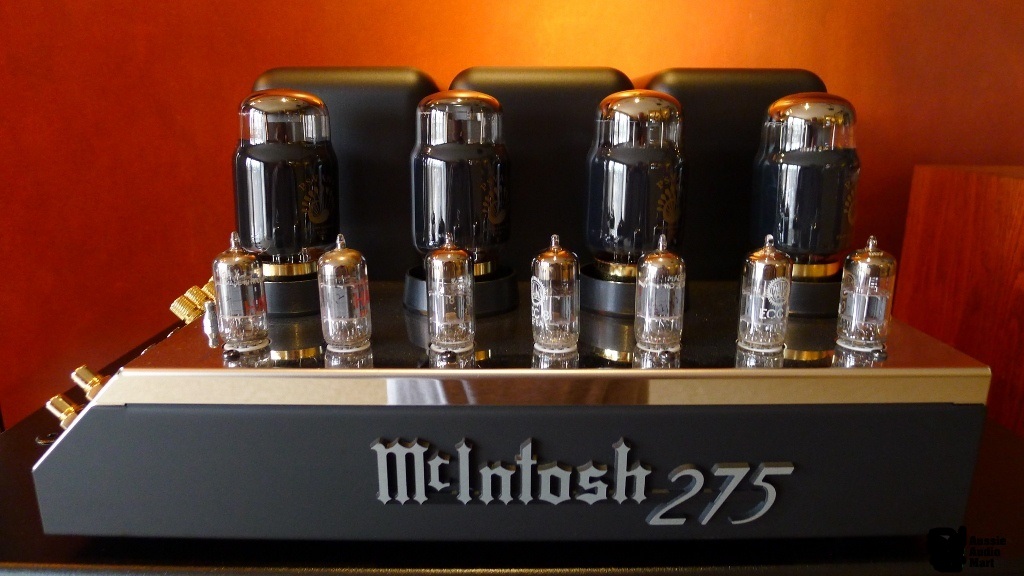
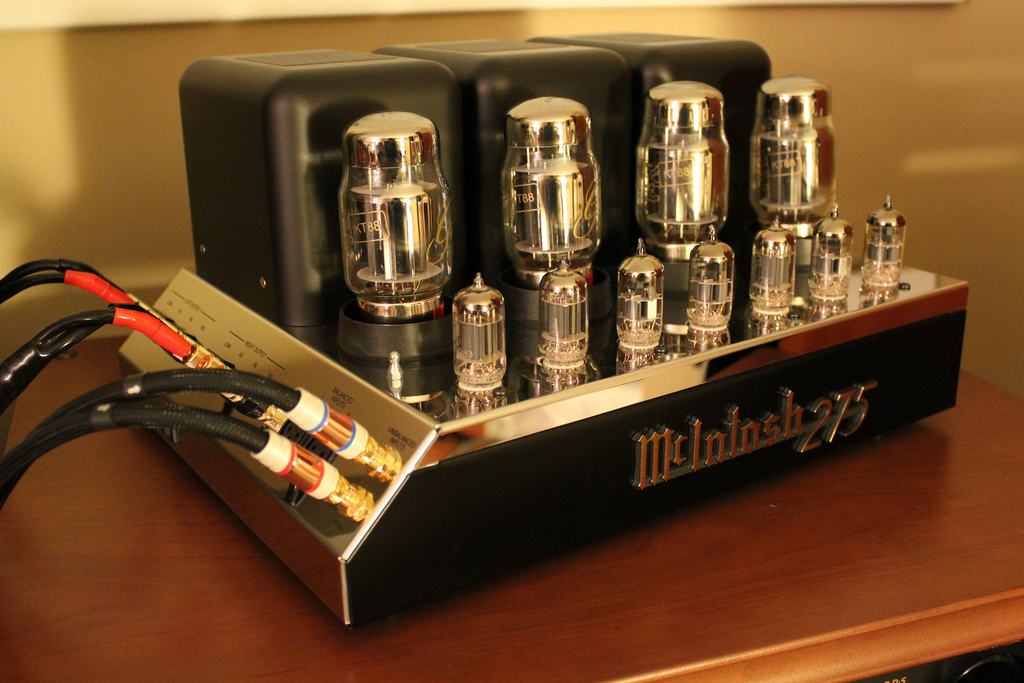
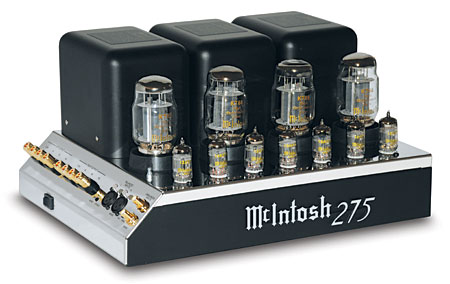
Also like the original, the new MC275 uses four KT88 power-output tubes, three 12AX7A input and phase-inverter tubes, and four 12AT7 voltage-amplifier and driver tubes.
All else, though, is different from the original, to varying degrees. The chassis, once chrome-plated steel bent to shape (and thus prone to cracks and rust), is now highly polished stainless steel. The tube cage, formerly of fine mesh with solid ends, now has larger perforations and slotted ends, to allow more even ventilation. (When listening, I removed the cage, in part because I liked watching the tubes glow, and in part because, in my experience, cages of this sort usually vibrate. First, however, I received assurances from McIntosh that the cage was entirely for safety purposes, and that removing it wouldn’t harm the sound.) The plating on the tube pins, once nickel, is now gold, and the ceramic output-tube sockets have heat chimneys that let cool air flow more freely from under the chassis, thus prolonging the life of the tubes—a McIntosh innovation that began with the MC275’s fourth incarnation.
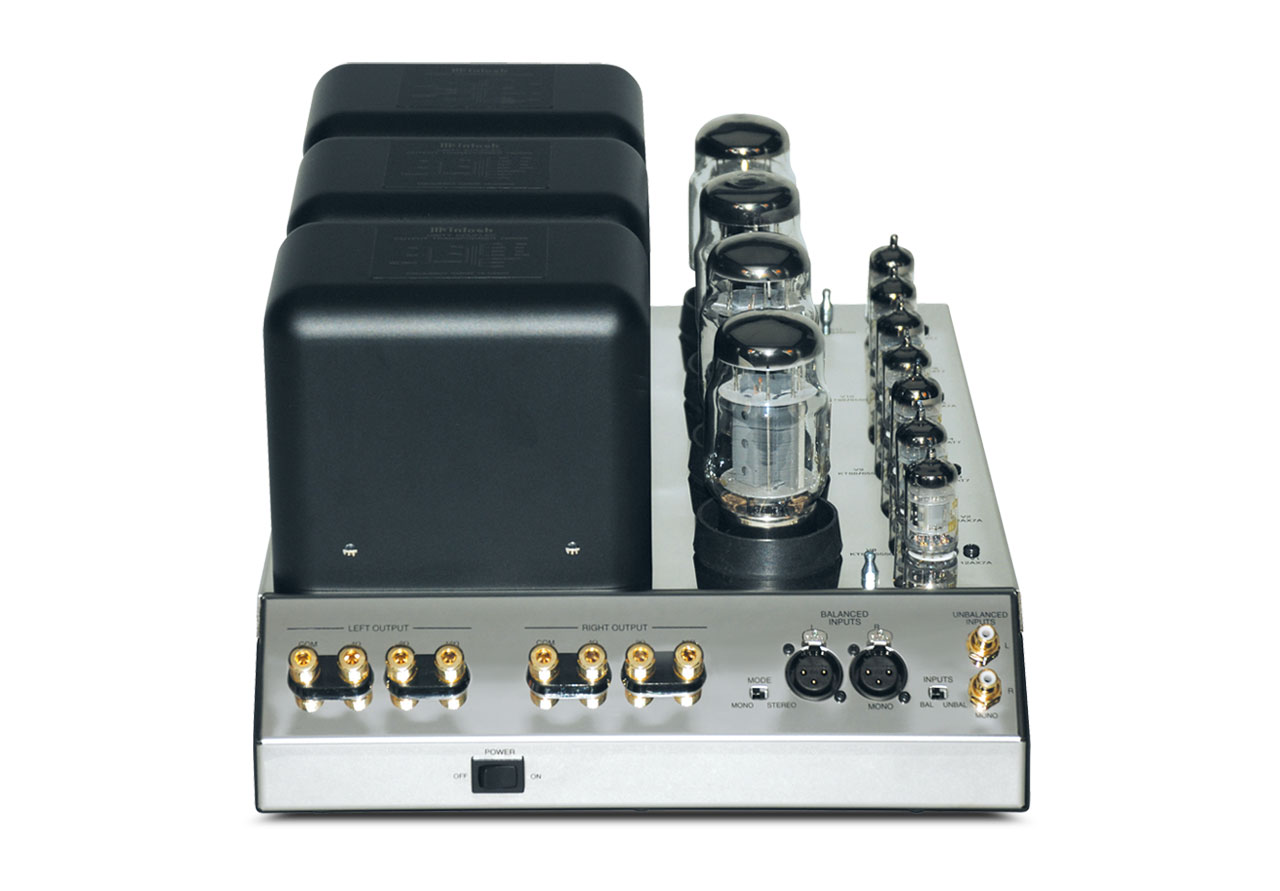
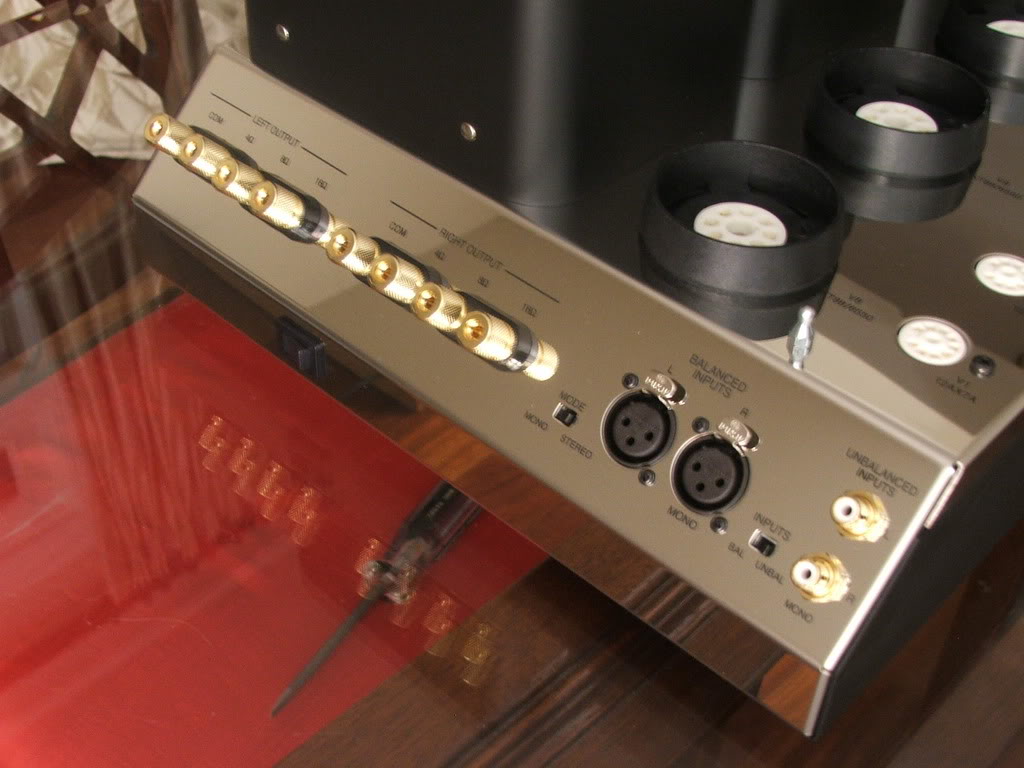
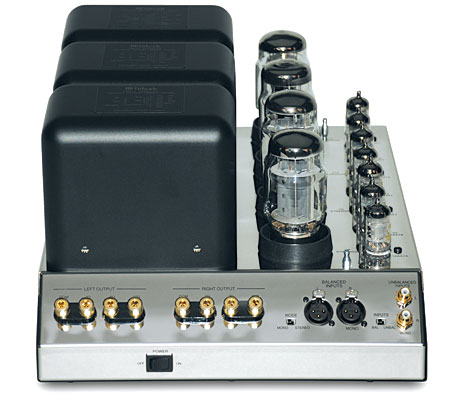
The new model also uses 1% precision resistors and polypropylene capacitors, for lower noise; the specified signal/noise ratio is 100dB, or 10dB higher than the original’s. Balanced inputs have been added; a rear-panel switch lets you choose that option, and if you do, the first 12AX7 tube is bypassed for a more direct connection, though this results in lower gain. The original MC275 had several circuit boards, with all component parts wired point to point. The new version has just one military-grade board, on which the components and tube sockets are directly mounted. Hinton maintains that this results in less induced noise and crosstalk. A rear-panel switch allows the amp to be converted into a monoblock, with the two channels driven in parallel to cope more efficiently with low-impedance speakers.
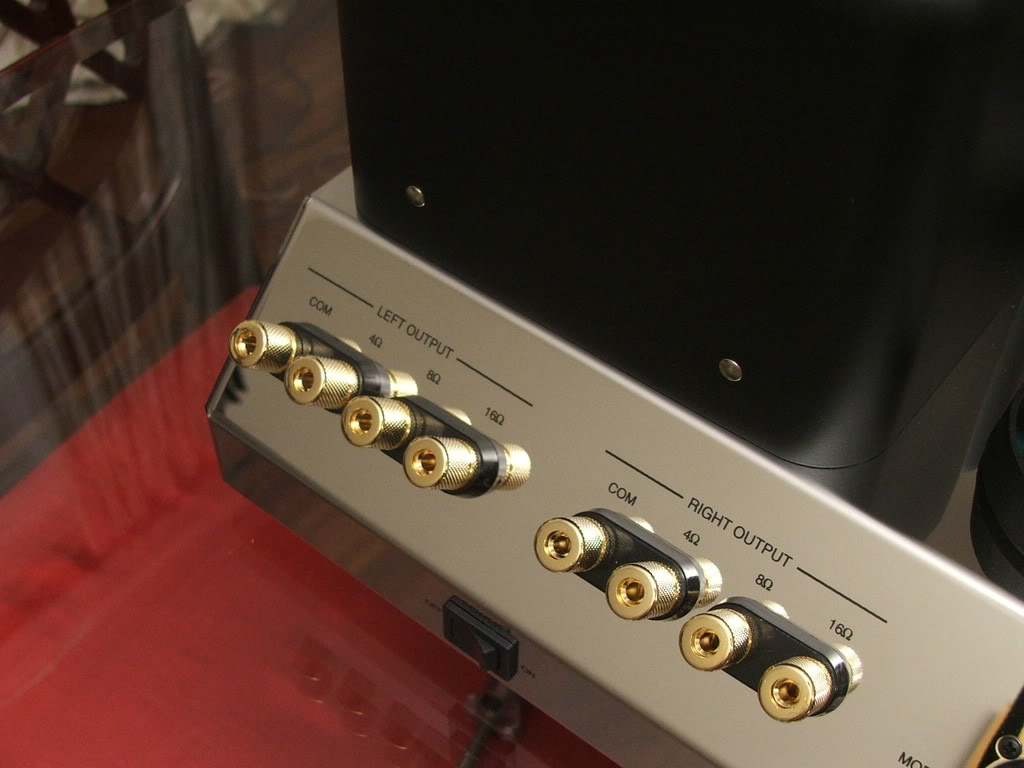
Finally, the new model has a detachable power cord and an On/Off switch (though, as it’s placed under the terminal panel, it’s a bit awkward to get at). More welcome still, the old-fashioned terminal strips for speaker cables have been replaced by gold-plated, five-way binding posts. This is the only significant change since the version that Sam Tellig reviewed—very positively—in the July 2004 Stereophile.
This tube power amplifier has all the features to meet the needs of today’s music enthusiast, while preserving the qualities that have made the MC275 the most revered McIntosh tube amplifier.
This sixth generation MC275 has many subtle enhancements from the previous release that greatly improve performance. Combined with the widest bandwidth McIntosh output transformer design, the MC275 features tauter bass control and thermally quiet circuit design. The result is pure music.
Setup
I did all my listening through Revel’s Ultima Studio2 speakers. The digital source was a Krell Evolution 505 SACD/CD player; for analog, I used VPI’s Classic turntable and JMW Memorial tonearm, a Lyra Delos moving-coil cartridge, and a battery-powered Nagra BPS phono preamp. For a line stage, I used the preamp section of the Krell FBI, a fully balanced integrated amp. (The FBI is essentially Krell’s FPB-300cx power amp and KCT preamp on a single chassis, internally connected by Krell’s proprietary CAST circuitry.)
For a brief time, however, I disconnected the Krell and substituted the McIntosh C2300 tube preamp ($6000), also on loan from McIntosh. I did this for two reasons: first, to hear what the MC275 would sound like in an all-tube system, and especially when joined to a product made by the same company (Hinton told me that the two models are often sold together); and second, to use the MC275’s balanced inputs. (The Krell FBI has just one pair of preamp-output jacks, and they’re single-ended.)
Finally, I mainly used the MC275’s 4-ohm taps, although, for comparison, I listened for a while with speaker cables hooked up to the 8-ohm taps (more on this below). Cables throughout were by Nirvana, except for Nordost CAST interconnects between the Krell SACD player and FBI. When I switched to the McIntosh C2300 preamp, I connected it to the Krell Evolution 505 with a pair of balanced Nirvanas.
Sound
So, did the McIntosh MC275 sound like a burnished antique, or like a 21st-century high-end audio component? I went into my listening expecting the former. Nothing wrong with that, I said to myself, working up an appetite for the sonic equivalent of a sweet crepe suzette or a creamy devil’s-food cake. Imagine my surprise when I was presented with a five-course meal boasting the tastes and textures of all the major food groups.
Listening to Chasin’ the Gypsy, saxophonist James Carter’s tribute to Django Reinhardt (CD, Atlantic ATL 83304-2), I could hear all the attacks and rhythms of the bells, snappers, cymbal swishes, and guitar strums, as well as the difference between the guitar with steel strings and the one with strings of nylon. In the riveting live performance of Mahler’s Symphony 9 by Michael Tilson Thomas and the San Francisco Symphony (SACD/CD, SFS 821936-0007-2), the horns were brassy, and the violins’ bowing exuded the texture of resin. In Miles Davis’ take on “My Funny Valentine,” from Cookin’ (SACD and 45rpm LP, Prestige/Analogue Productions CAPJ 7094 SA and 7094), the trumpet’s bell was golden, the mouthpiece full of air. With Count Basie’s 88 Basie Street (XRCD, JVC JVCXR-0021-2), I could clearly hear the blooming overtones sent up by Basie’s one-note piano jabs; the sense of ambience in the recording hall was palpable.
Playing a vinyl reissue of Eric Dolphy’s masterpiece, Out to Lunch (45rpm LP, Blue Note/Music Matters Jazz MMBST 81463), I could clearly hear—I could practically feel—the keypads of Dolphy’s bass clarinet, and Tony Williams’ work on snare and cymbals, with sticks or brushes, came through in all its dynamic detail. The very high frequencies on Dave Douglas’s Charms of the Night Sky (CD, Winter & Winter 910 015-2) were a bit veiled, but I could still distinguish between Douglas’s trumpet and Mark Feldman’s violin when they played simultaneously—a testament to the MC275’s ability to reproduce a coherent structure between tones and overtones. And when Lorraine Hunt Lieberson sang “Ich habe genug,” from her Bach Cantatas album with Craig Smith and the Emmanuel Music Orchestra (CD, Nonesuch 79692-2), her voice soared so gorgeously, swelling in volume and bursting with pathos while remaining meltingly warm. The MC275 could rock, too. At the start of Radiohead’s In Rainbows (CD, TBR 88088-21622-2), those crunches crunched crisply and loudly, Johnny Greenwood’s guitar strums were tight and liquid, each piece of Phil Selway’s drum kit was distinct, and Thom Yorke’s voice beamed through the mix.
After spending the last several years with solid-state amps, I’d forgotten about the spacious soundstage a good tube amp can toss up. The MC275’s soundstage wasn’t anything special from left to right—though don’t get me wrong, it was fine—but it was stunning from front to back. Those horns in Mahler’s Ninth were way back there. And in all dimensions, the silences between the instruments, as well as between the notes each instrument plays, were spookily silent—as if I could still see the players, or the space they occupied, even when they weren’t making any sounds.
Here, though, I should stress that some of the amp’s shortcomings in the deepest bass octave may have stemmed, in part, from my system. The Revel Ultima Studio2 is nominally a 6 ohm speaker, which raised the same question it would with any tube amp: Should I hook up the Studio2s to the amp’s 4- or 8-ohm taps? I opted initially for 4 ohms because John Atkinson’s measurements of these speakers, accompanying Kal Rubinson’s review of them in the March 2008 Stereophile, noted an impedance dip in the midrange. Because the MC275, like most tube amps, was likely to perform at its best in the midrange, I figured I should aim for the closest impedance match in that region. And, as I’ve noted, the MC275’s midrange, along with much else, sounded wonderful. When I switched to the 8-ohm taps, the soundstage wasn’t quite so deep, violins and voices weren’t quite so warm, orchestras weren’t quite so dynamically coherent—but the bass was a bit tighter. All the bass problems mentioned in the paragraph above were still there, but not so prominently; things were a bit tighter, a bit woodier, a bit pluckier, a bit oomphier.
I hooked the Revels back up to the 4-ohm taps and left them there for most of my listening, but your preferences may dictate a different choice. More to the point, if your speakers are rated at 4 or 8 ohms—not just nominally, but consistently across the audioband—you may be able to enjoy the best of what the MC275 has to offer in the highs, mids, and lows, all at once.
But even then, I think, the MC275’s performance would fall short of the best. I didn’t fully appreciate this until I switched back to the Krell FBI integrated—that is, until I removed the McIntosh from the system and resumed using the Krell in its full operating mode, as both preamp and power amp. Suddenly, I heard not only tighter and deeper bass, but also more extended highs, more musical detail, more subtle gradations in dynamics—more of a sense that people were playing the instruments and singing. On John Scofield’s Quiet (CD, Verve 314 533185-2), his fingerwork on acoustic guitar was more intricate, practically visible. On the Maria Schneider Jazz Orchestra’s Sky Blue (CD, ArtistShare AS0065), I could better hear the bloom of overtones and the texture of each instrument: the breath of the flute, the brass of a horn, the hammers on the piano.
Two things are worth noting about this comparison. First, the MC275 costs $4500, while the Krell FPB-300cx (the circuitry of which is incorporated into the power-amp section of the FBI integrated amp) retailed at $8500 when it came out a few years ago. It’s not surprising, then, that the Krell might have a few things the McIntosh doesn’t. Second, even so, I had to A/B the units to hear the Krell’s advantages directly. The differences, for the most part, were not enormous, and a few were quite subtle; the McIntosh fared a bit better in terms of soundstage depth and intertransient silence.
Finally, just to make sure that the MC275’s shortfalls weren’t the result of some sort of mismatch with the Krell, I plugged the MC275 back into my system, this time connecting it to McIntosh’s C2300 tube preamp. I didn’t listen long enough to formulate a review, or even a very deep sense, of the C2300. Suffice it to say here that what I heard didn’t alter my assessment of the MC275’s strengths and weaknesses. With the C2300 driving the MC275, the sound was a bit too plummy—a bit too close, for my taste, to the “old tube sound” that the MC275-Krell combo transcended.
Conclusion
Carefully set up and matched with other components, the McIntosh MC275 is a very good, very well-balanced amp that goes higher, lower, louder, and softer, with more texture and detail, than you might expect from a “modified classic”—or, for that matter, from any tube amp costing less than $5000. It certainly did more of all that than I was expecting. By any standard, it made listening to all kinds of music a pleasure. I could happily live with it.
Conclusion
Carefully set up and matched with other components, the McIntosh MC275 is a very good, very well-balanced amp that goes higher, lower, louder, and softer, with more texture and detail, than you might expect from a “modified classic”—or, for that matter, from any tube amp costing less than $5000. It certainly did more of all that than I was expecting. By any standard, it made listening to all kinds of music a pleasure. I could happily live with it.
STRENGTH:SOUND,quality, and yes Price…it is quite reasonable
WEAKNESS:are you kidding ?? ok maybe a little hard to handle, but how many times are you going to move it…this one is a keeper!!
What can you say that hasn’t been said…simply a great amp, very musical…which means it makes you want to listen to music…a tube amp with OOOMPH !! most hi end ss amps sound overly bright after listening to this except mac ss amps…I have 252 and have heard the 501s in my home…all share that great Mac character…open lush and musical…this one is a bargain…even the folks at Mac say that….this is the Dino Ferrari of amps…not the fastest not the top of the line etc…but o so sweet…well done MAC !!
Related products
-
Perreaux 350 Stereo Amplifier – NEW
R164,000.00 Add to cart -
Audio Research DSi200
Original price was: R95,000.00.R34,000.00Current price is: R34,000.00. Add to cart -
Audio Research Reference 210 Monoblocks
Original price was: R380,000.00.R108,000.00Current price is: R108,000.00. Add to cart -
Synthesis Metropolis NYC200i Integrated Amplifier (Black)
Original price was: R478,000.00.R138,000.00Current price is: R138,000.00. Add to cart