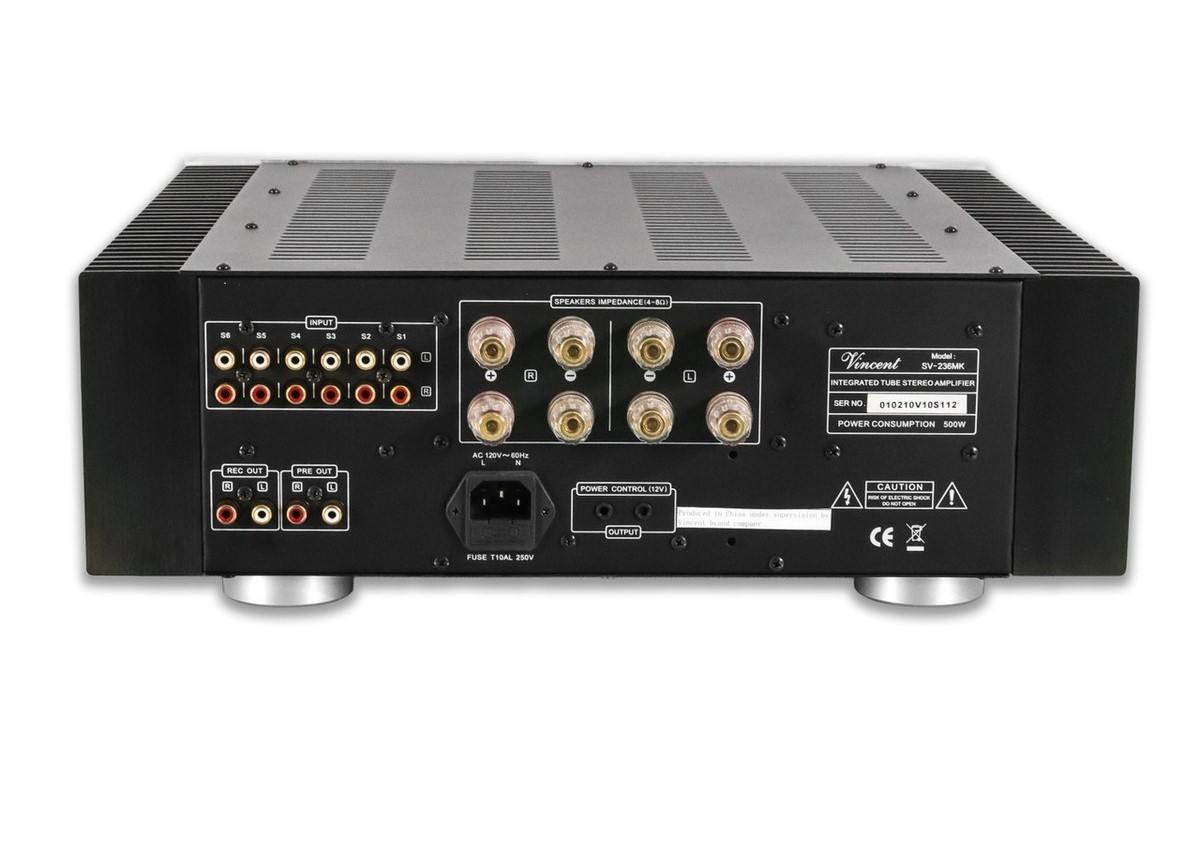
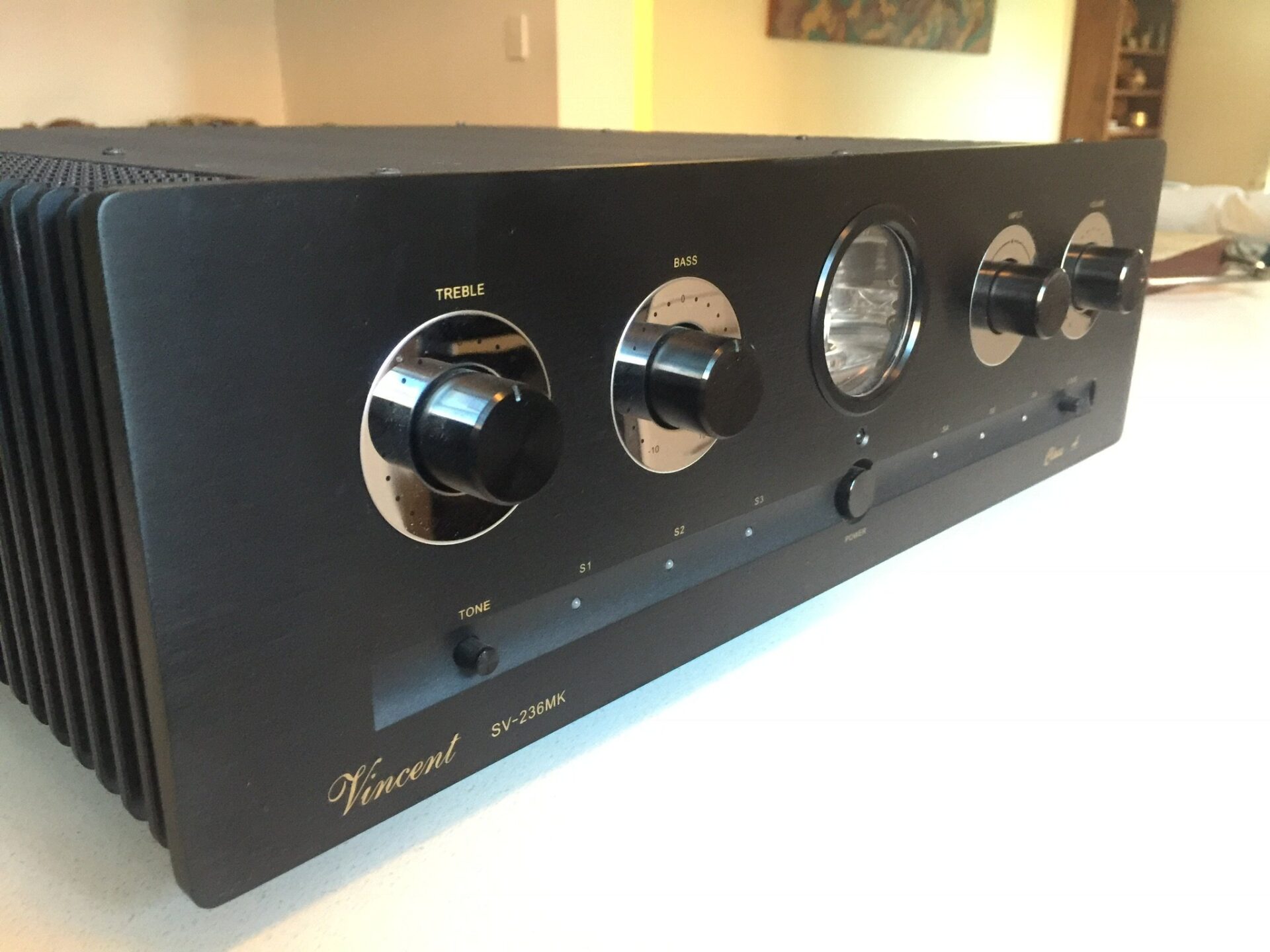
Vincent TubeLine SV-236MK integrated amplifier.
Original price was: R90,000.00.R36,000.00Current price is: R36,000.00.
Description
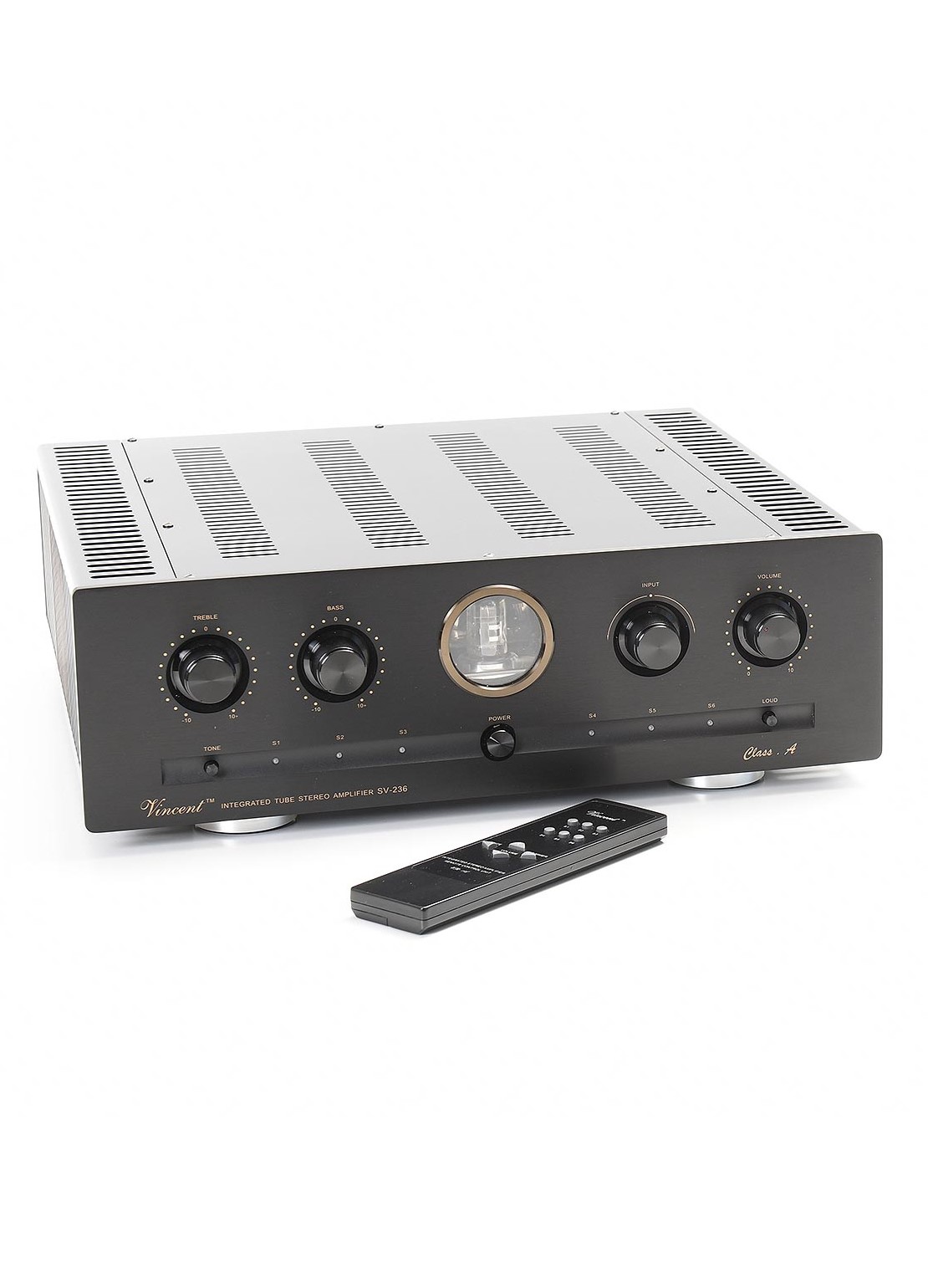
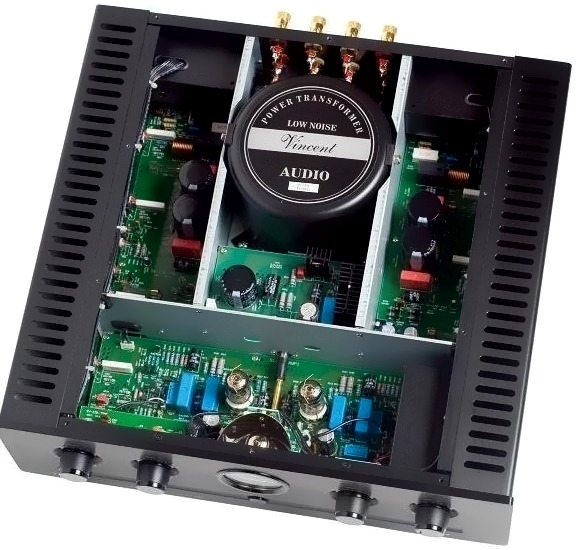
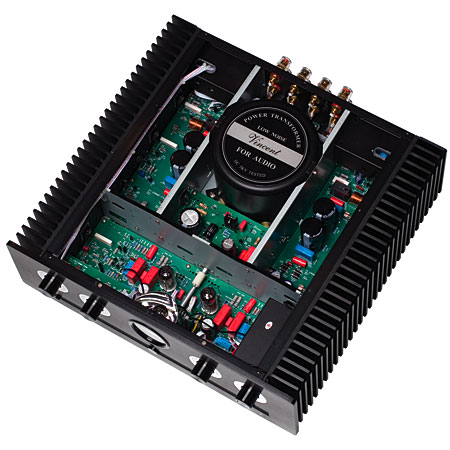
Have the person you’re arguing with inspect the fit’n’finish of this handsome, 45-lb powerhouse, and finger the rugged heatsinks flanking its chassis. Encourage that audiophile to pop the heavy top plate and examine the superior build quality and parts (including WIMA caps), the elegant layout, the dual sets of hunky speaker terminals, the massive toroidal power transformer—not to mention the discrete output devices, and the front-end’s three 12AX7 tubes, ripe for rolling.
When your friend is finished looking, and you’ve told him or her that the SV-236MK is rated to output 150Wpc into 8 ohms (with the first 10Wpc in class-A), or 250Wpc into 4 ohms—and even before you sit down to listen to it—ask your friend to guess its price. $3000? $4000? $5000?
Who’d guess that the SV-236MK’s list price is $1995? Not me, that’s for sure—and I’ve been around this stuff a long time.
Too Grand for Two Grand
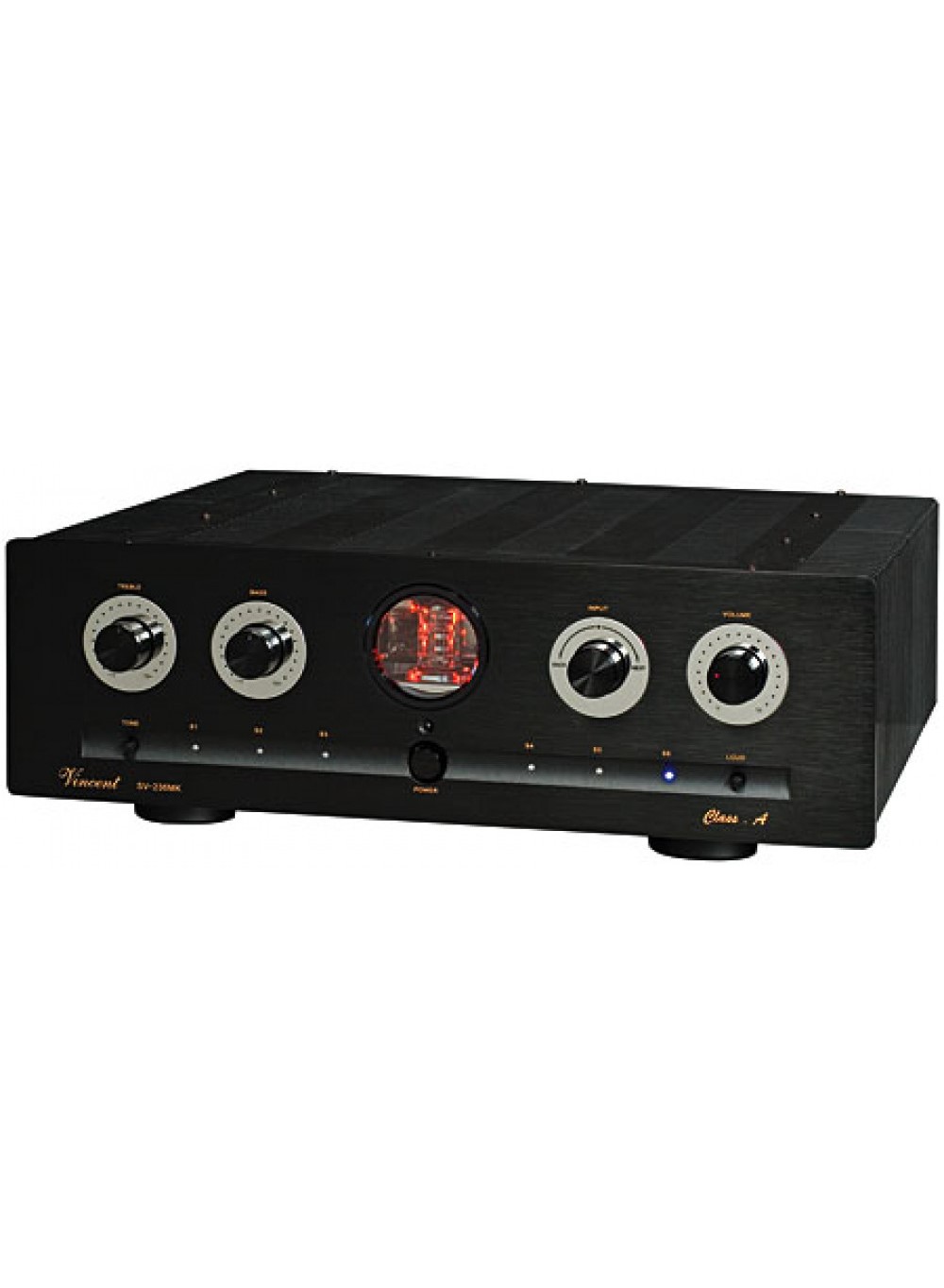
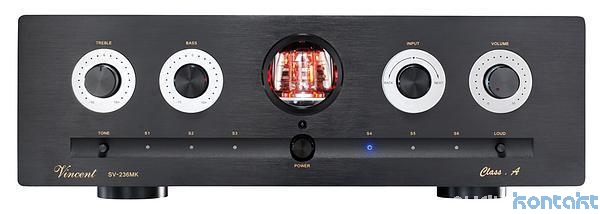
In addition to plenty of claimed power, your $1995 gets you a smoothly machined metal remote control for volume, mute, selecting from among six line inputs, and a dimmer for the “show” tube, which is prominently framed by a circular glass window at the center of the thick front panel, and backed by a mirror. Obviously, it’s not the tube’s filaments that dim when you push the dimmer button. Instead, a series of filament-tinted LEDs mounted to the window’s sides reflect off the tube to do the trick.
And note the tone controls: Treble and Bass, defeatable by a Tone button. In addition to the Volume and input controls, there’s even a Loudness button, which adjusts the amplifier’s response at low volumes to compensate for the nominal changes in human hearing sensitivity. It’s like the 1960s, with a price to match (in ’60s dollars, $2000 is about $395). On the rear panel are Tape Out and Preamp Out jacks.
After removing the RCA jacks’ translucent covers—a nice touch omitted even from more expensive gear—you plug in your sources, connect your speaker cables to the WBT-like five-way binding posts (maybe they’re real WBTs—Vincent is a German firm, after all), push the Power button at the center of the front panel, and—unless you’ve been tipped off in advance by reading this review—you’re in for a big surprise.
Smooth, vibrant sound
It might seem unfair to audition a $1995 integrated amplifier using a $65,000 pair of loudspeakers, but the Wilson Audio Specialties MAXX 3s were the speakers hooked up to my reference system at the time, so that’s what I used. Vincent’s American importer, WS Distributing, said the TubeLine SV-236MK had “no problem” driving the MAXX 2s, and the MAXX 3s are easier to drive. After spending a few weeks listening to the Vincent easily driving the new Wilsons, I had no doubt it would do just as well with the MAXX 2s.
What do you hear when you switch to a $2000 integrated from an amp-preamp combo capable of outputting four times the power and costing more than twenty times more? At first, I heard only my bank account draining. When I fired it up, the SV-236MK was that good.
It sounded even more together about an hour later. Then, the SV-236MK produced a sonic picture that never disappointed, or needed excuses based on its price. Its overall sound was full-bodied, self-assured, seemingly complete. There were no glaring weaknesses, such as softness or rhythmic confusion on bottom. In fact, the Vincent’s ability to firmly grip and hold the MAXX 3s’ woofer bins came as a pleasant surprise. Low-frequency extension was seemingly complete, and the rhythmic presentation was nimble and taut. At no time did I get the feeling that the SV-236MK’s three tubes were excessively or unevenly warming or softening the signal before passing it off to the amp’s solid-state output stage. In fact, the Vincent’s overall sound was on the lean, fast side, with a slight emphasis of transient information at the expense of the harmonic and textural envelope.
However, the SV-236MK’s presentation was more fully fleshed out than that of the Chord SPM 650 power amp I reviewed in March, and which costs more than three times as much. The Chord’s cleaner, faster, more grain-free transients give it an overall purity and transparency the SV-236MK couldn’t provide, but the Vincent compensated with richer instrumental and orchestral colors.
Rather than listen to familiar LPs and CDs on my reference system and then insert the Vincent, I thought it might be more revealing to listen to new and totally unfamiliar recordings. Neil Young’s Massey Hall 1971 (two LPs, Reprise/Classic 43328-1) was released just as I was setting up the SV-236MK, so I immediately played it. The album opens with hall sound, then applause as the conquering hero returns to his native Canada. Young begins with a stripped-down rendition of his moody Buffalo Springfield tune “On the Way Home.” It’s just Neil and his acoustic guitar in a spare, wistful, less chipper, far more vital version of the familiar, overproduced opening track of the Springfield’s Last Time Around, sung on that album by Richie Furay.
Apparent almost immediately were a spare quality to Young’s voice, and a very fast hall reverberation that appeared whenever he lingered between phrases. Not a great deal of depth developed behind his voice, nor was his guitar notably supple and pure, but the transients were fast and, as Young worked his axe, his large-scale dynamic gestures were explosive. Clearly, the intent of the SV-236MK’s designer was not to produce a phonily soft, “rich” sound.
Shimmer in the topmost frequencies was in relatively short supply, as were senses of touch and texture that might have provided realistic “stiction.” However, it was impossible to know which was responsible for this: Massey Hall 1971, the SV-236MK’s reproduction of it, or both. In live recording, leakage from the stage monitors and/or the hall’s sound-reinforcement system can often add layers of electronic grit that can limit the resolution of microdynamics—those low-level fluctuations in dynamics that create a sense of realism and intimacy. Regardless of these picayune problems and what caused them, Massey Hall 1971 on vinyl is an exceptional aural document that had me transfixed for all four sides. The distance between what I heard at home with the lights out and actually being there, sitting close to the stage, couldn’t have been all that great. The 6′-tall Wilson MAXX 3s, which go down to 20Hz, can produce the illusion of an enormous space, and the Vincent SV-236MK didn’t get in their way.
I then played another new arrival: the Jung Trio’s recording of Dvorák’s Piano Trio in F Minor, Op.65 (two 45rpm LPs, Groove Note GRV 10430-1), recorded live in concert to two-track analog tape at 30ips and mastered by Bernie Grundman. It was an ear-opener: the violin, cello, and piano were reproduced with an appropriately rich darkness, three-dimensionality, transparency, and verisimilitude that had me thinking, Can it possibly sound any better?
Yes it can!
After a few weeks of listening to both new and familiar LPs, CDs, and SACDs through the Vincent SV-236MK and nothing but the Vincent SV-236MK, I reached a few conclusions:
First, the taper on the Vincent’s volume control was too severe at the low end. Nudge it up just a bit from zero output and it was loud. Move it only slightly up from that point and it was too loud. That’s a minor quibble, really, but it might be an annoyance with ultra-sensitive speakers.
Second was the Loudness button. Appropriately, it affects the sound only at low volume levels. Inappropriately, it boosts the treble and the bass. Although the Fletcher-Munson curve suggests that it is primarily low-frequency sensitivity that suffers at low volumes, many audio designers of the 1960s and ’70s gilded the lily by boosting the highs as well—as has the Vincent’s designer. Again, a minor issue, given that most high-performance audio gear doesn’t include a Loudness control of any kind, let alone defeatable tone controls.
Beyond those two picked nits, the Vincent TubeLine SV-236MK performed flawlessly and was a pleasure to use. It was subjectively quiet (though its specified signal/noise ratio of 80dB is hardly the state of the art). It felt like a piece of high-end audio gear, it performed like one, and I sat down each day to listen to it with the same eager anticipation I have when playing recordings through my reference system. That should tell you plenty.
Still, could my recordings and my system sound any better? Switching to the darTZeel NHB-18NS preamplifier and Musical Fidelity kW monoblocks immediately demonstrated, not surprisingly, that it could—and should, given the disparities in price and technological sophistication. Even with my reference amps cold, the sound was notably more transparent, as if a thin scrim between me and the performers had been removed. The background silence became notably “blacker.” The bottom end became even more muscular, extended, and well textured, and an added sense of serenity (for want of a better word) overtook the sound.
A fine grain in the SV-236MK’s sound—which, through this comparison, I could now “hear” for the first time, if only in retrospect—disappeared. Images became more highly resolved and three-dimensional as transient purity increased. A sensational depth developed that was also not missed when not there—though it was welcomed when it was! But the biggest difference I immediately noted was in dynamics. The more powerful Musical Fidelity kWs could produce enormous dynamic swings with large-scale orchestral music that the Vincent could only suggest, but even more significant, the kWs also provided those small dynamic gestures, the tones that let me “see” and feel more deeply into the music, with a suppleness that the Vincent couldn’t.
But consider the difference in price: the Vincent’s $1995 vs the darTZeel/Musical Fidelity combination’s $54,000. And consider that, in the absence of this admittedly unfair comparison, the Vincent SV-236MK driving the $65,000 Wilson MAXX 3 speakers didn’t need to make any excuses for its performance. No doubt the SV-236MK will sound nothing less than superb driving real-world speakers at real-world prices, and can be relied on to continue to do so as your speakers increase in cost and, hopefully, performance.
Conclusions
If you need proof that the law of diminishing returns applies with particularly severity to high-performance audio, put the Vincent TubeLine SV-236MK up against any integrated amp, or combo of pre- and power amp, at any price. (I preferred the Vincent’s sound to that of the Chord SPM 650 power amp, which I recently reviewed and which costs more than three times as much without a preamp.) Of course, there will be differences, and depending on your degrees of listening acuity and experience and the quality of the other gear in your system, you’ll say “What differences?” or “Yes, but who cares?” or “It’s worth spending all that money to get those differences.” If you’re a true audio snob, you might even say, “Get that coarse-sounding piece of budget crap out of my system!”
But, more likely than not, you’ll agree that the SV-236MK brings real high-performance sound to the real-world audio enthusiast at a real-world price. $1995 is not an insignificant amount of money in this economy, but it’s a manageable sum that can be paid off over time, and an expense that any music lover should be willing to take on to gain a lifetime of listening pleasure.
No doubt the Vincent TubeLine SV-236MK is not the only component costing $2000 that’s capable of producing such a high level of performance, but it’s certainly one that’s ridiculously easy to recommend. It’s the kind of component that gives me—and should give you—hope for the future of this great hobby.
Related products
-
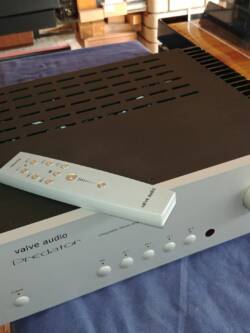
Valve Audio Predator Integrated Amplifier
Original price was: R78,000.00.R42,000.00Current price is: R42,000.00. Add to cart -
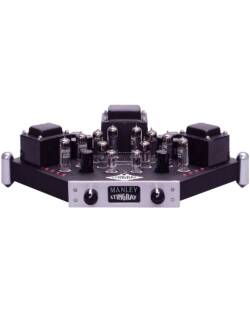
Manley StingRay Integrated Amplifier
Original price was: R109,000.00.R44,000.00Current price is: R44,000.00. Add to cart -
Ming Da MC 368-BSE
R39,000.00 Add to cart -
Ming Da MC 368-B5
Original price was: R64,000.00.R45,000.00Current price is: R45,000.00. Add to cart