Mark Levinson № 32 Reference Preamplifier
REFERENCE PREAMPLIFIER · DUAL CHASSIS · MARK LEVINSON · REVIEW

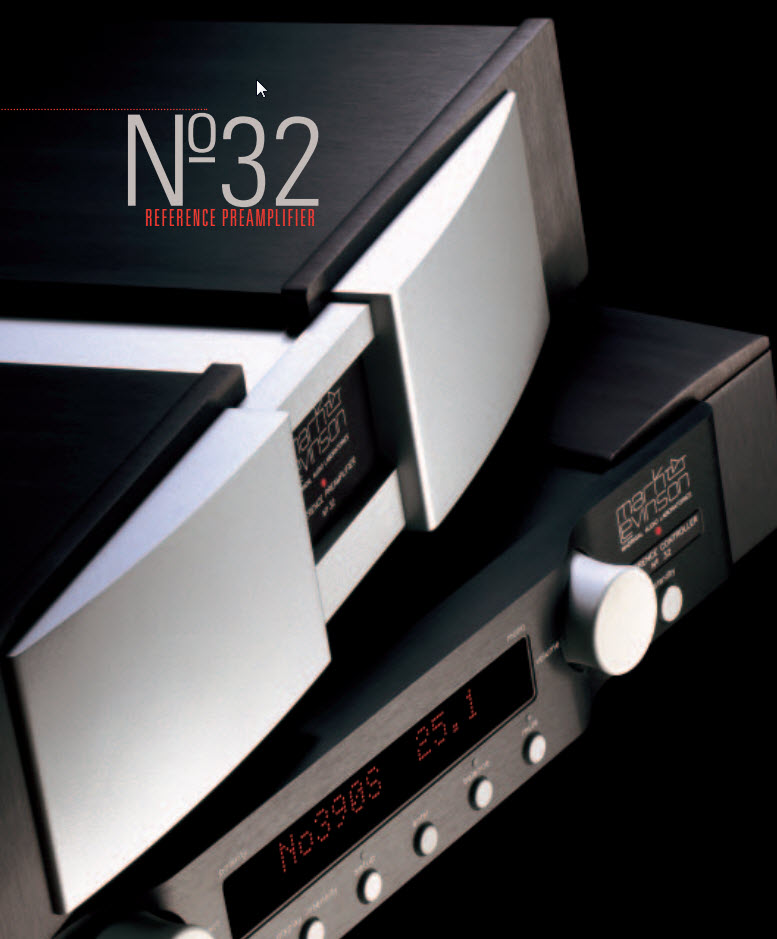

The № 32 Preamplifier is a revolutionary Mark Levinson component — the first preamplifier ever to earn the Reference designation. It is a dual-chassis design: everything that generates noise lives in one box (the Reference Controller), while all audio-preamplifier circuitry lives in another (the Reference Preamplifier). The audio circuits are exposed only to quiet, regulated DC power and the audio signal itself.
Power Supply Architecture
Two master power supplies occupy the center of the Reference Controller — one dedicated to control and communications, one for the audio circuits. The AC mains is pre-filtered and the two supplies are mutually isolated. Custom-designed transformers with multiple secondary windings substantially improve isolation between circuit blocks.
The № 32 employs AC power regeneration: the DC supply feeding the voltage gain stages is derived from an AC source generated within the preamplifier itself via a 400Hz internal oscillator. This is expensive engineering — and highly effective.
Noise Isolation
Microprocessors are inherently noisy. In the № 32, they are not only physically separated into the controller chassis but further housed within their own shielded enclosure. The result is an audio signal path that never encounters digital noise. Each channel is sealed into its own environment by a solid aluminium divider wall cast as part of the chassis — stereo separation equivalent to two separate mono preamplifiers.
Materials and Construction
The № 32 is the first Mark Levinson product to use Arlon 25N circuit boards — a material with superb dielectric properties for handling complex audio signals. The chassis is a custom aluminium casting, machined and finished with a conductive Irridite clear chromate coating. The Reference Preamplifier chassis has no buttons or knobs — control is entirely through the Reference Controller’s front panel or remote. Each source can be named in the display, with full control of all functions including mono/stereo selection and polarity.