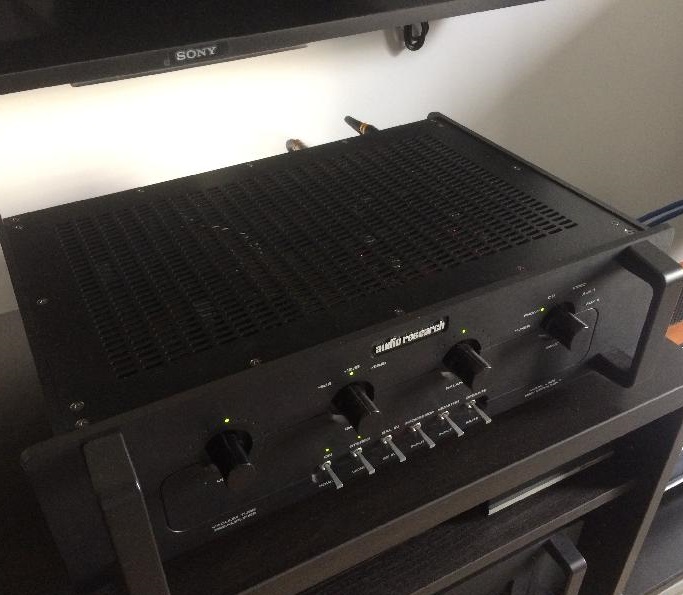
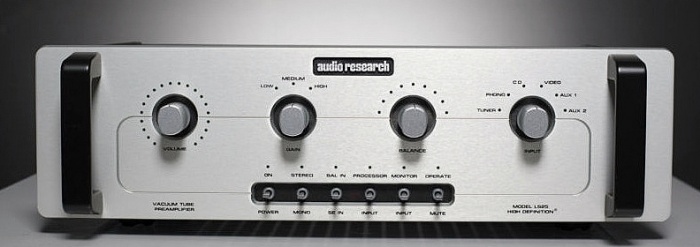
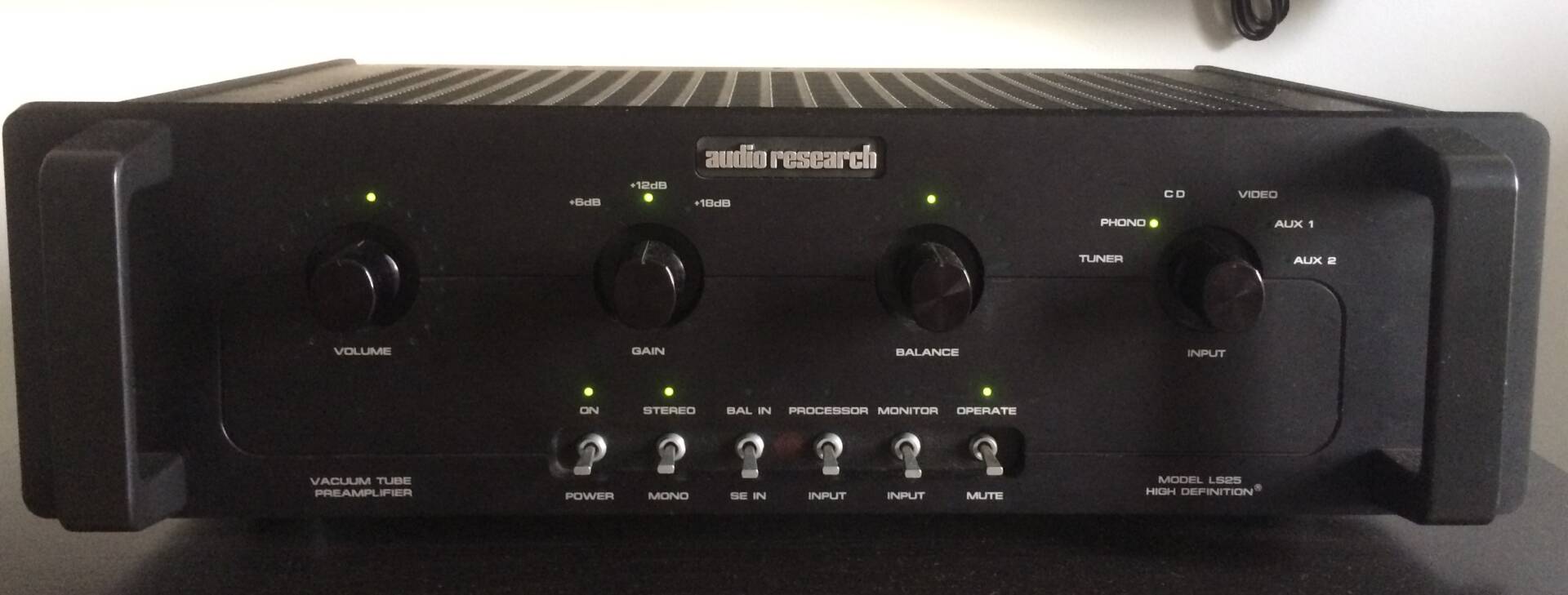
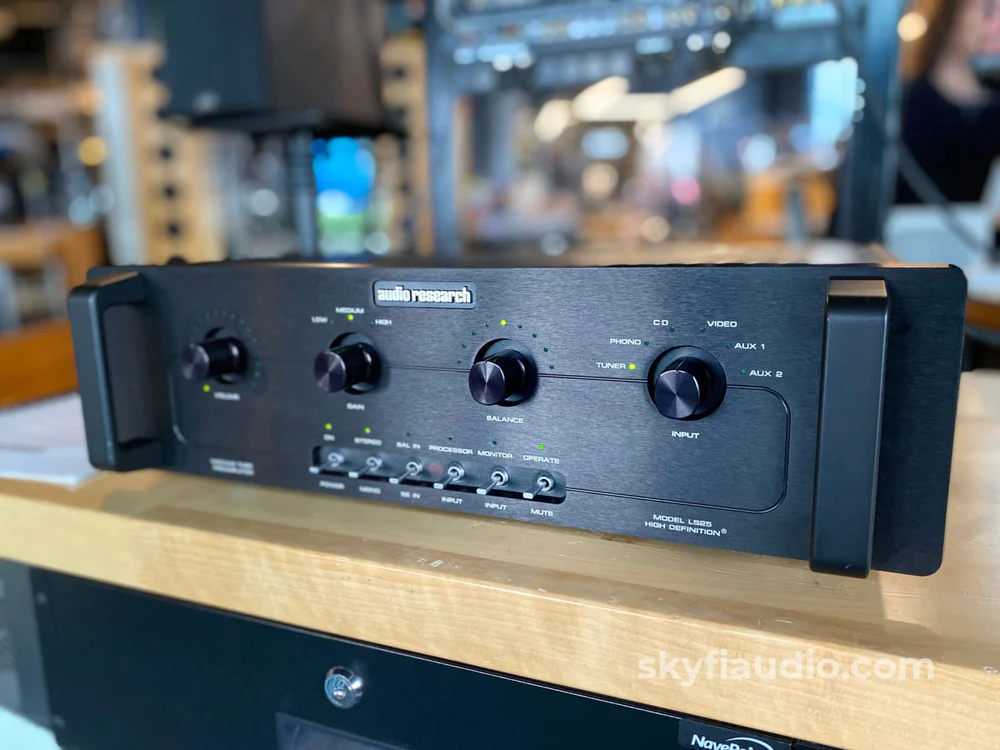
Audio Research LS25 Preamp
Original price was: R96,000.00.R28,000.00Current price is: R28,000.00.
SPECIFICATIONS:
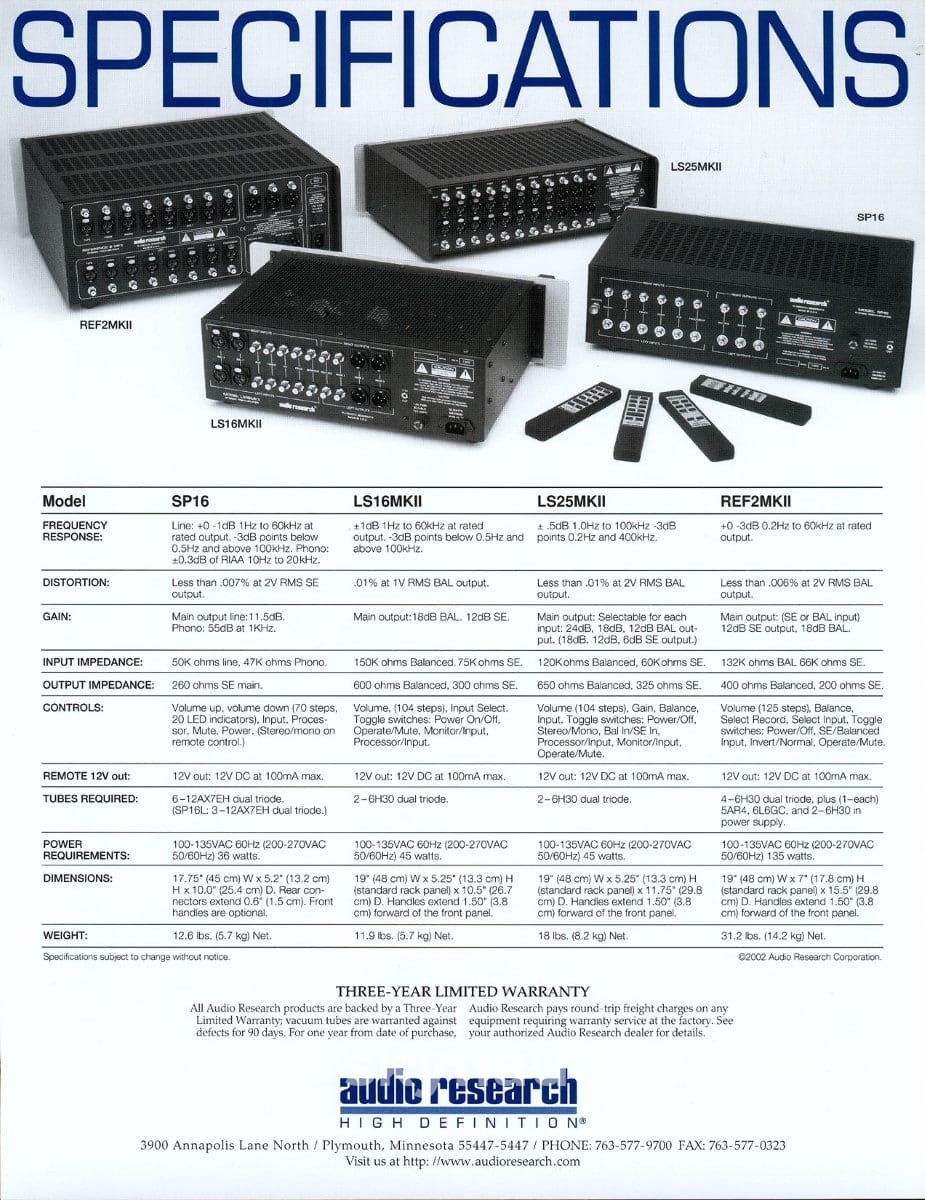
FREQUENCY RESPONSE
±.5dB, 1.0Hz to 100kHz -3dB points below 0.2Hz and 400kHz.
DISTORTION (THD)
Less than .01% at 2V RMS output.
NOISE & HUM
14µV RMS residual IHF weighted balanced noise output with gain control at minimum (103dB below 2V RMS output).
GAIN
Main Output: Selectable for each input: 18db, 12dB, 6dB Balanced output. (12dB, 6dB, 0dB SE output). Record output: 0dB.
INPUT IMPEDANCE
120K ohms Balanced, 60K ohms SE.
OUTPUT IMPEDANCE
650 ohms Balanced, 325 ohms SE Main (2), 20K ohms minimum load and 2000pF maximum capacitance.
MAXIMUM INPUTS
28V maximum, BAL, 14V maximum SE (6dB gain).
RATED OUTPUTS
2V RMS 1Hz to 100kHz into 200K ohm balanced load (maximum balanced output capability is 40V RMS at less than 0.5% THD at 1kHz).
POWER SUPPLIES
Electronically-regulated low and high voltage supplies. Automatic 40 sec. warm-up/brown-out mute. Line regulation better than .01%.
TUBE COMPLEMENT
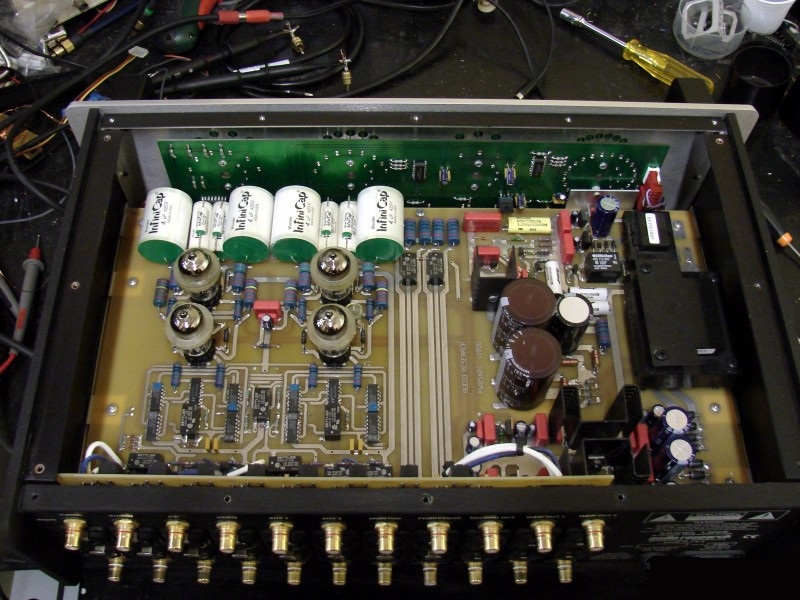
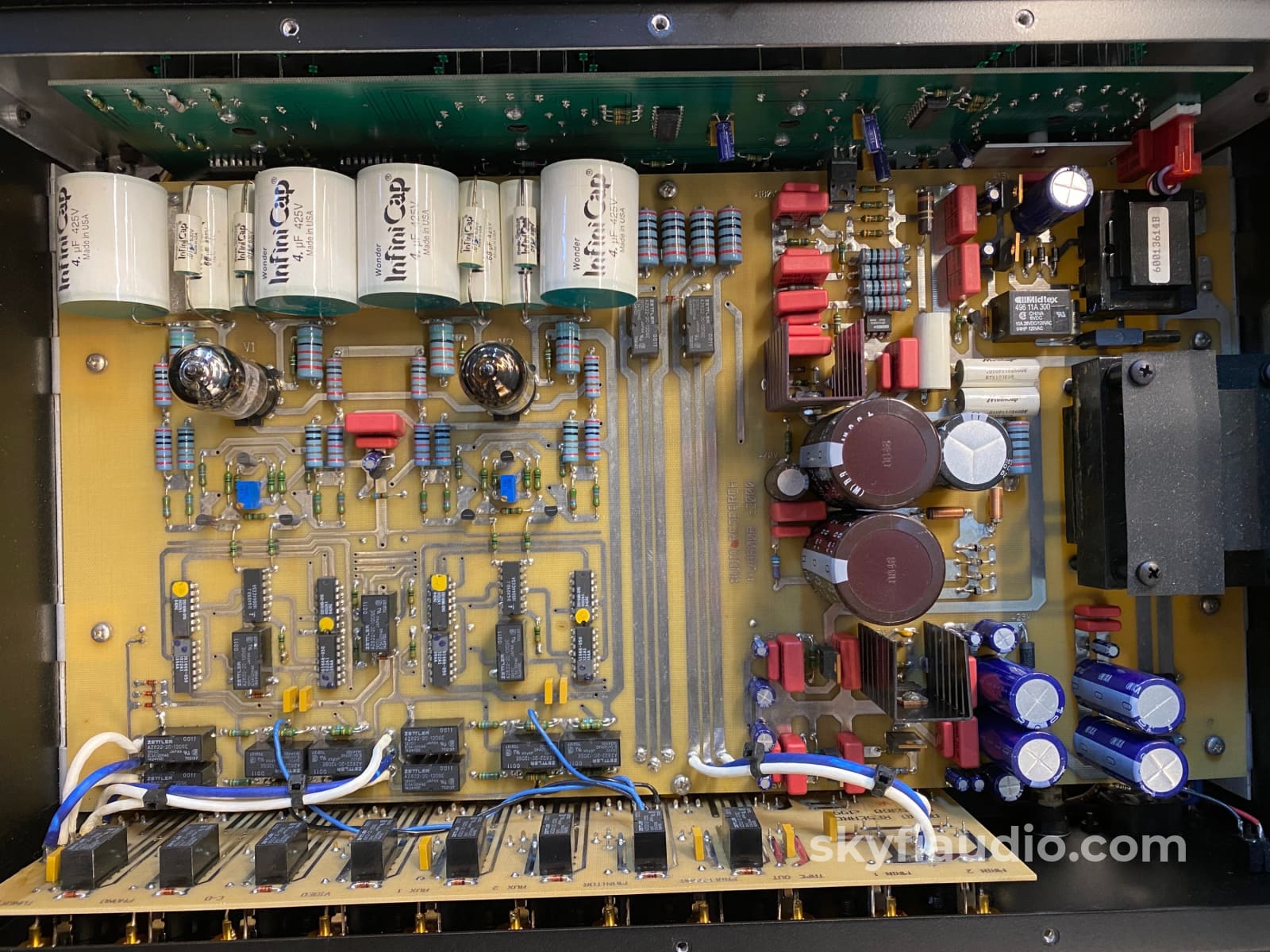
LS25 MKII: 2 x 6H30
POWER REQUIREMENTS
100-135VAC 60Hz (200-270VAC 50/60Hz) 45 watts maximum
OTHER
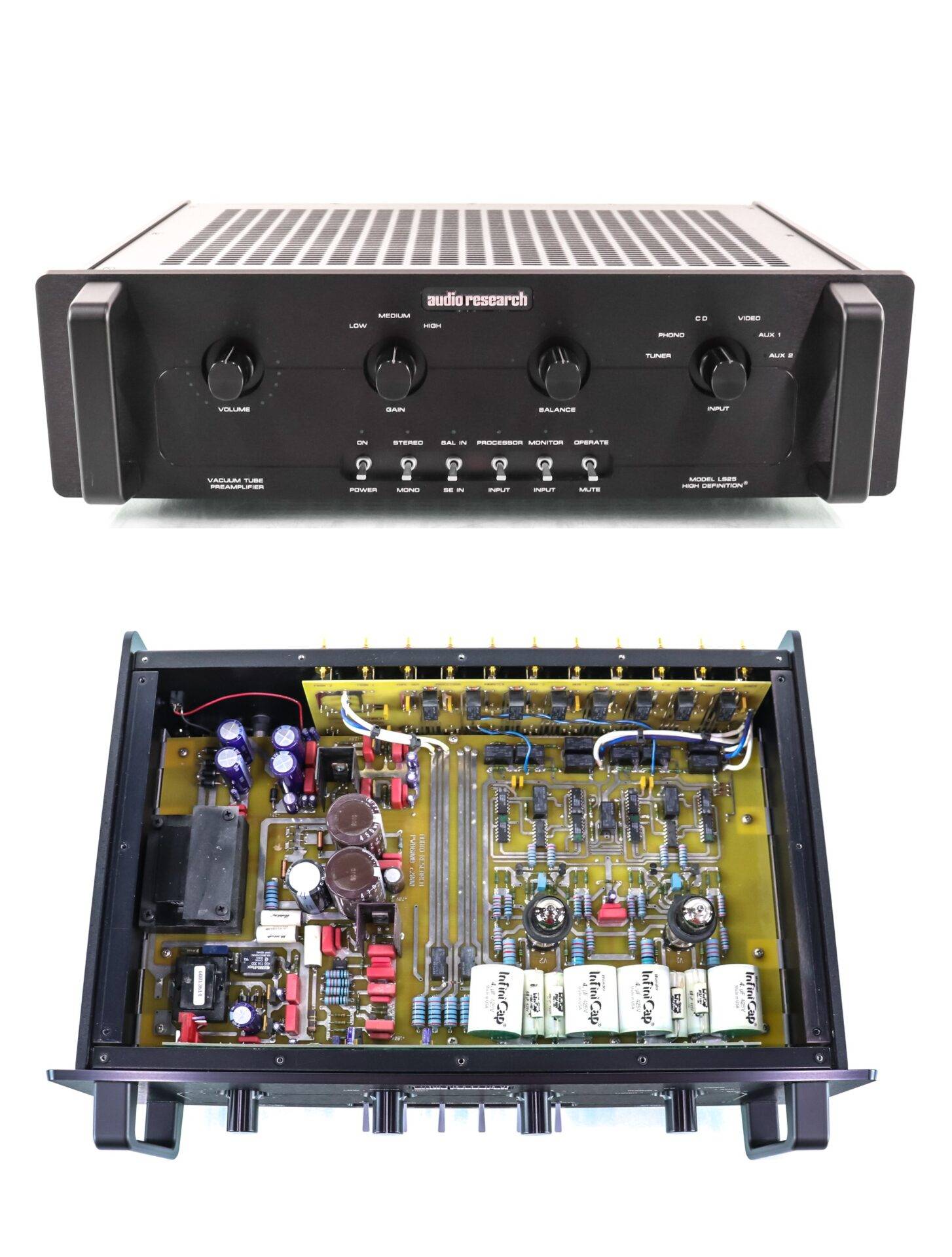
• Vacuum tube audio circuit, solid-state power supply.
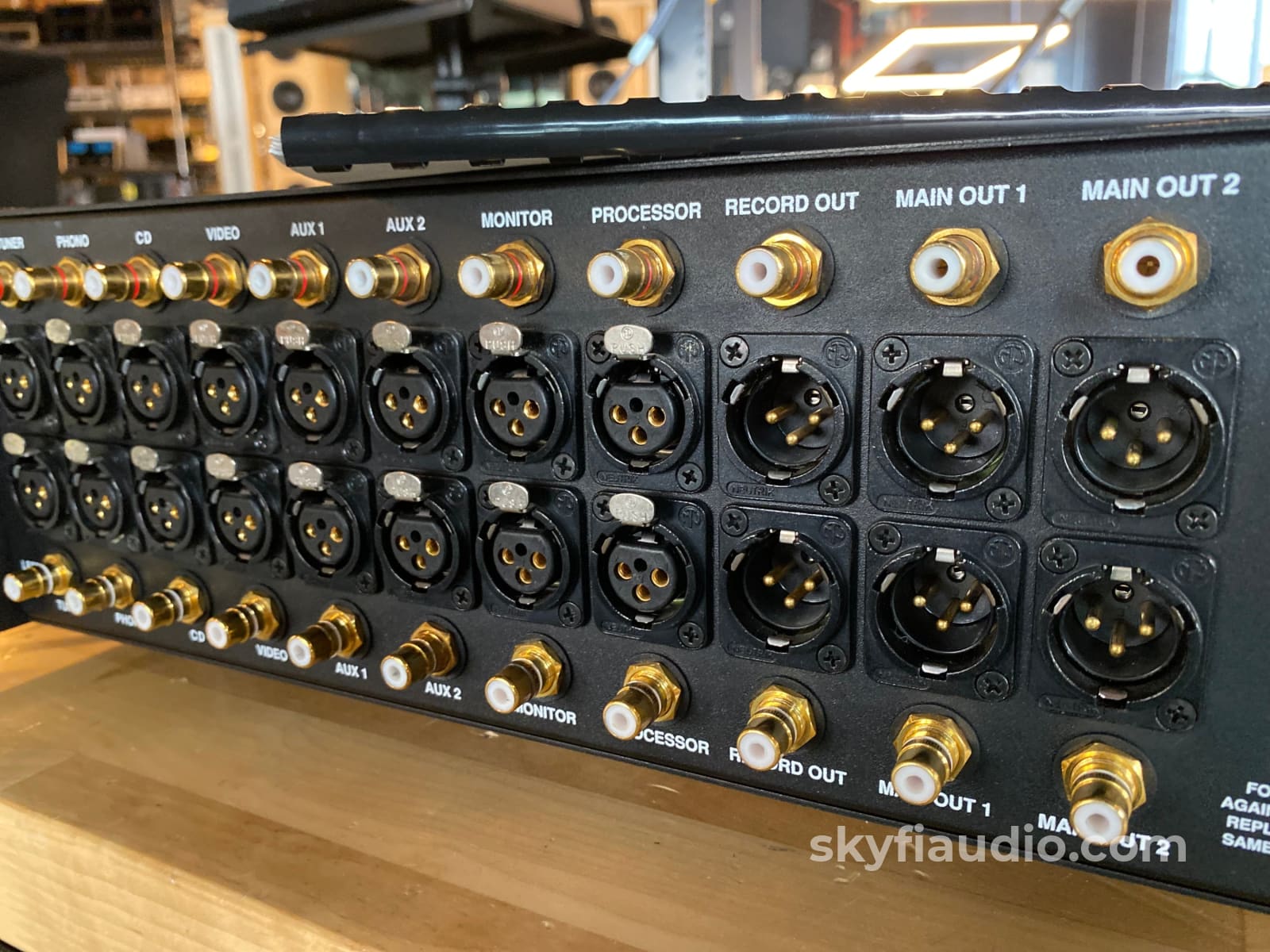
• Inputs (8): Tuner, Phono, CD, Video, Aux 1, Aux 2, Monitor, Processor (XLR and RCA connectors).
• Outputs (3: 2 Main, 1 Record (XLR and RCA connectors).
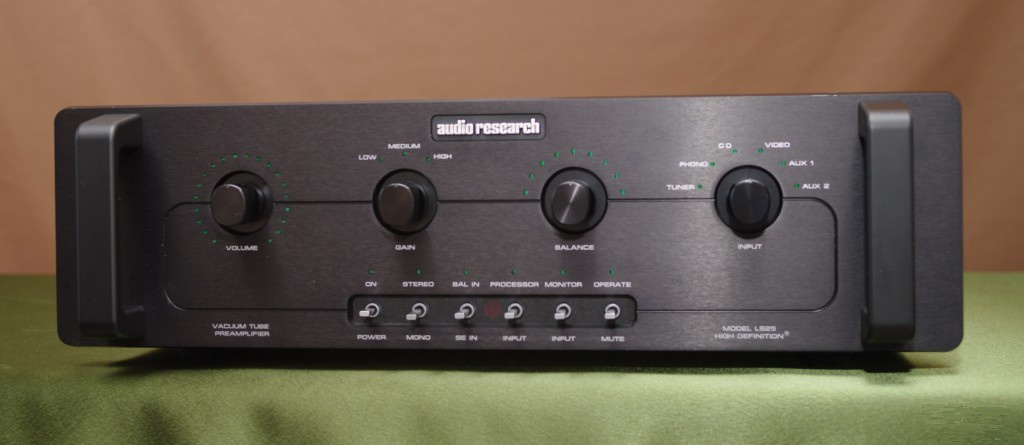
• Controls: Volume (104 steps), Gain, Balance, Input.
• Toggle switches: Power On/Off, Stereo/Mono, Bal In/SE In, Processor/Input, Monitor/Input, Mute/Operate.
DIMENSIONS
19″ (48 cm) W x 5 ¼” (13.4 cm) H (standard rack panel) x 11 ¾” (29.8 cm) D Handles extend 1½” (3.8 cm) forward of front panel.
WEIGHT
18 lbs. (8.2 kg) Net
28 lbs. (12.7 kg) Shipping.
Audio Research LS25 MKII Tube Preamplifier – Owner’s Manual
Description
Audio Research LS25 Preamp Reviewed
Down-scaling – as opposed to dumbing down – has a patchy record in the annals of luxury goods. The VW/Porsche 914 didn’t satisfy 911 wannabees, few would-be Leica M-Series owners cherished the economical CL and you’d have to hypnotise an Italian before he’d accept a Tudor wristwatch as a Rolex.
Read more Audio Research Tube Preamp Reviews from HomeTheaterReview.com
In hi-fi, though, such problems rarely materialise, because hi-fi companies have never shied away from using the same styling and the same series model numbering or nomenclature from least to most. Hence, no Linn dealer will lose sales of the separates just because the company issued the Classik, and a Krell KAV300i integrated amplifier can be demonstrated in the same room as the pukka FPB separates. But what do we make of Audio Research ‘popularising’ the Reference 1?
Over two years ago, the circa £9000 Reference 1 became, for my money, the pre-amp by which all others should be judged. Aside from the whinging of the handful of morons who couldn’t understand that the controls weren’t rotary devices per se, and that they worked in twist-twist fashion, I know of no criticisms worth dignifying…and any criticisms I heard levelled at the Ref 1 invariably came from manufacturers of solid-state rivals. Alas, the price alone ensured that this pre-amplifier would remain the sort of device only accessed by the very well-heeled, and the rest of us could only drool in envy.
While I would hesitate to call the near-halving of the price a ‘bargain’, I must regard the scaled-down, £4999 LS25 something of a gift for those of us who crave but cannot afford Ref 1. In one fell swoop, the LS25 doubles our chances of acquiring the ARC flagship. Why? Because I’m damned if I can decipher a sacrifice.
Referring back to the review of the Ref 1, you’ll recall that it is a no-compromise line-level-only preamplifier with microprocessor control of volume, source selection and balance, all of this taking place outside of the signal path. The microprocessor also provides memory so the source selector remembers whether you’re using balanced or single-ended inputs, necessary because its eight inputs carried duplicated RCAs and XLRs, to be used in either/or fashion.
It was the Reference 1 which introduced the spring-loaded, self-centring intermittent controls like those on the Copland CD player and the Acurus ACT1 processor/pre-amp. They were notable for their tiny operational arcs which you followed left or right to raise or lower the volume, alter the balance or select sources. Holding them scrolled through the entire arc, indicated by green LEDs. Then again, the Ref 1 came with remote control, which provided every single function bar the choice between balanced and unbalanced input selection.
Across the front, the Ref 1 carried gain, balance, record out and source selector rotaries, while the trademark channel below contained press-press toggles with the same feel as the knobs. They self-centred, so you pushed them up or down to choose on/off, balanced or single-ended input, normal or inverted polarity and mute/operate, with more green LEDs telling you what was chosen.
Across the back were the phono and XLR inputs; in addition to those eight sets were three pairs of outputs, one for record and two for main, also in XLR and phono form. Lastly, there were easily accessible fuses, and a captive mains leads.
As if to remind you why you paid the price of a VW Polo for a pre-amp, the Ref 1 weighed 30lb, featured a 3/8in thick aluminium front panel and employed eight Sovtek 6922 dual triodes. Tube regulation was solid-state for maximum silence, via a combination of MOSFETs and JFETs. Part of the weight was due to the inclusion of three separate toroidal power supplies, one each for DC regulation, high voltages and the digital section. Discrete components were used throughout.
21 LEDs surrounded the volume control, with steps in-between providing in excess of 156 gradations at 0.3dB per step. Switch-on was accompanied by a 45 second delay, to ensure that no nasties reached one’s speakers. Specs were impressive, too: frequency response is +/-0.5dB from 1Hz to 200kHz, with -3dB points at 0.3Hz and better than 400kHz, distortion less than 0.01 percent at 2V RMS output. Gain was 12.3dB balanced, 6.3dB unbalanced, tape output is 0dB, and the input impedances 220k ohm balanced and 110k ohms unbalanced.
Now, here’s what differs – or, rather, what you sacrifice for a four grand savings.
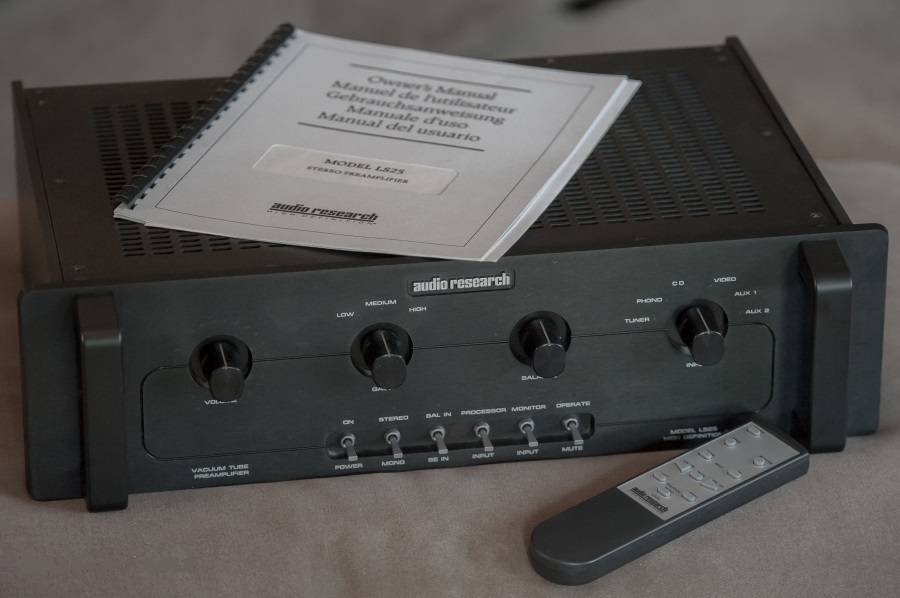
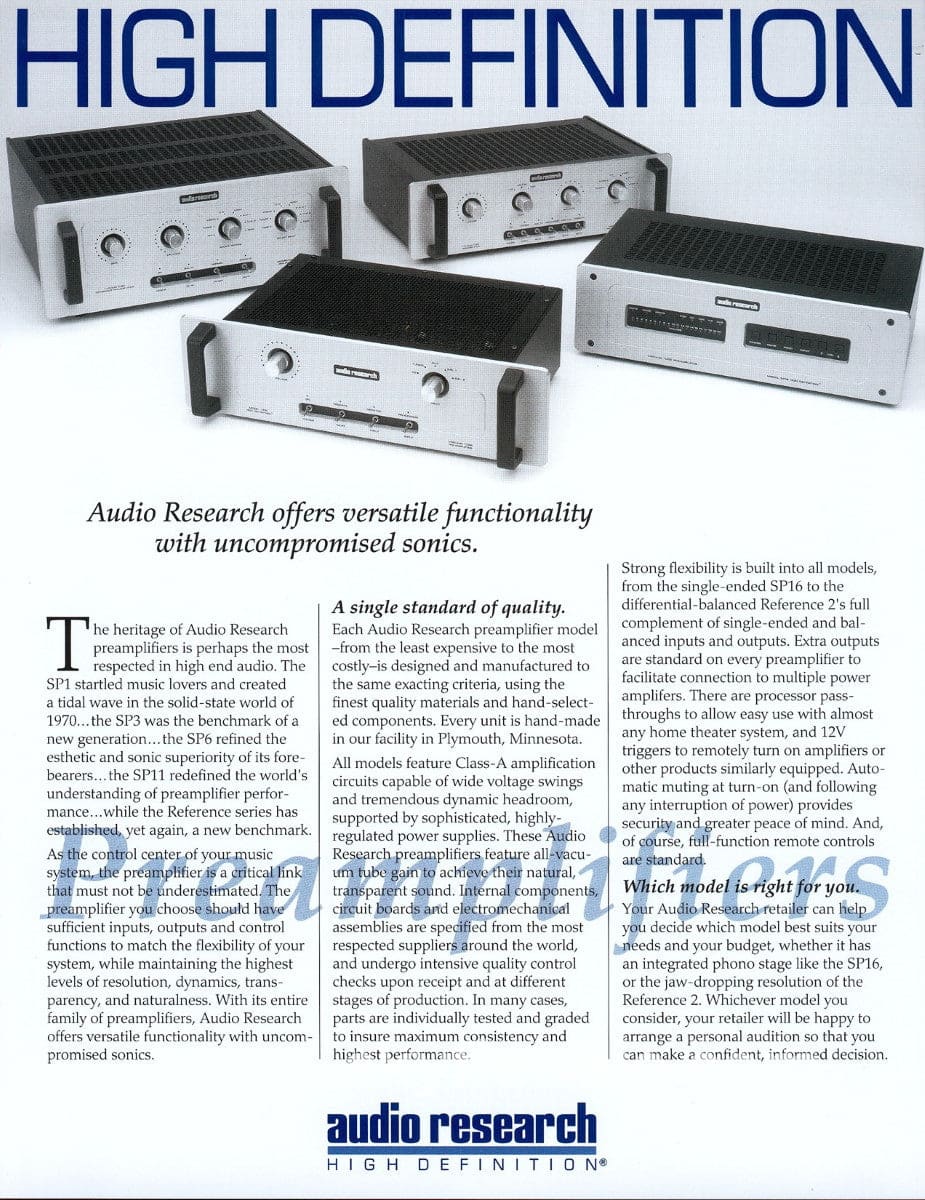
Described by ARC as ‘a slightly smaller REF 1′ because it enjoys similar chassis construction, it also features electronically-controlled rotary controls for user-selectable overall gain setting (6, 12, or 18 dB), volume, balance and input selection, two-way toggle switches for power on/off, stereo/mono, balanced or single-ended operation, true A-V pass-through processor loop, tape monitor and mute. Seven inputs (including tape monitor) and two sets of main outputs are fitted, with on-board memory storing all settings along with previously selected gain levels. There’s a remote control, four (rather than eight) 6922 twin triodes supplying the gain, the tubes are mechanically damped by the new proprietary clear polymer rings, the massive power supplies are fully regulated and InfiniCap coupling caps are fitted at the output.
By my reckoning, we’ve lost half the tubes and weight is down by 12lb, but the LS25 actually on the Ref 1’s flexibility by letting you choose your own AC cable through an IEC input. Specs? Compare these with the above: frequency response is +/-0.5dB from 1Hz to 100kHz, with -3dB points below 0.2Hz and better than 400kHz, distortion less than 0.01 percent at 2V RMS output. Gain is selectable, tape output is 0dB, and the input impedances 120k ohm balanced and 60k ohms unbalanced. Other differences include a lowering of the volume controls steps to 104 and the front panel layout differs slightly according to the functional changes. But from two metres away, it looks like a Ref 1, it acts like a Ref 1 and it feels like a Ref 1. Feeling a bit Clintonian, I stopped at taste and smell.
I’ve now heard the LS25 in something like 15 combinations – balanced and single-ended, driving tubes and trannies and with a variety of sources. And while the teensiest part of me reckons that the Ref 1 has the edge for overall dynamic capability and sheer presence, the LS25 does not go the way of the pretenders listed in the opening paragraph. Quite clearly, the LS25 is a pre-amp for which no apologies need ever be made. And, if ARC and its agents can get their shit together, it could – along with that budget beauty, the LS8, and the current run of VT power amps – herald a new era, returning ARC to tube amp supremacy. It’s as if the time is right for an anti-SET backlash.
Auditioned mainly with source components including the hot-rodded Marantz CD94, Theta’s DaViD DVD transport and the Theta Chroma DAC, the LS25 was used to drive amps including the Talks, Sutherland’s 2000s and a couple of GRAAFs into Aliante’s new Pininfarina speaker, Quad ESL63s and New Audio Frontiers’ Reference One S. Cables included the new Kimbers, ART speaker cable, Steve Rochlin’s digital wire and Musical Fidelity.
Maybe I haven’t yet reached the final stage: even a month of constant use seemed not to put an end to the LS25 run-in period. Either that, or my hearing improved. Whatever the cause, the LS25’s sound just seemed to get better and better on a daily basis. Then again, it could be my memory playing tricks…
By the last few days before deadline, I’d grown to cherish certain qualities which I thought I’d never hear in a pre-amp of lesser stature than the Ref 1. Using lots of recordings of Capitol-era-Sinatra calibre (Dino, Nat, Julie et al), as well as all of the audiophile CDs I’d reviewed this month, I was able to detect – in addition to the trademark ARC sound – a number of refinements which could make this the pre-amp to seduce solid-staters away from their trannies…if the Ref 1 hadn’t already. The main gains which place this pre-amp so high on my wants list are its resolution of the finest details, its Vistavision soundstage and – above all – treble so sweet that you’ll suspect high calorific content.
Let’s backtrack a mo’, before you accuse me of using synecdoche where it’s inappropriate. Leaving aside that space considerations do not allow us to cover the hundreds of aspects of sound which we ought to address, there’s consolation to be found in the school of thought which argues that ‘you can’t have one without the other’. Ergo, if imaging is spot-on, then so must be tonal accuracy. If the bass is convincing, then so should be the midband. But we know it ain’t so, and it’s possible to have an amp with amazing bass and dire treble, or great stage width and little depth. So we choose our preferences, the areas where we can put up with some anomalies and others where we can’t abide a single digression. For me, it’s gotta be lifelike vocals, non-oppressive bass and non-aggravating treble, with everything else almost secondary in its ability to charm or repel.
Read more Audio Research Tube Preamp Reviews from HomeTheaterReview.com
With the LS25, I was struck first by the way it conveyed all of the textures in male voices, at the same time imparting the crystal clarity of a counterpoint in the form of a female vocalist. Assorted duets (think: Ella and Stachmo) conduct this test with unerring focus, far easier than moving from a Willy De Ville to an Emmylou Harris recording, for example, both of which are likely to have completely different sonic traits imparted at the recording stage.
Not only did the LS25 juggle successfully the juxtaposed textures, it maintained the spaces, the positioning and the air around the performers. Every little vocal tic came through clearly, with sibilance sounding lifelike rather than reptilian. And when it came to conveying sheer majesty, the power scale available from the LS25 made Ryko’s soundtrack of seem positively, uh, devout.
What this unit gives up to the Ref 1 is impossible for me to quantify, for at no time did I suffer the sort of pangs of deprivation which accompany the reviewing of a lesser item. It was not like following a Krell KAV300i with a NAD 3020 descendant, or listening to some undistinguished Britbox after a bout with the SLAMMs. Rather, the LS25 is to the Ref 1 what Sevruga is to Beluga: both so damned good that you couldn’t care less about forming a pecking order.
Related products
-
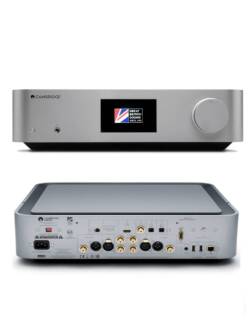
Cambridde Edge NQ DAC/Streamer/Preamplifier
Original price was: R129,000.00.R68,000.00Current price is: R68,000.00. Add to cart -
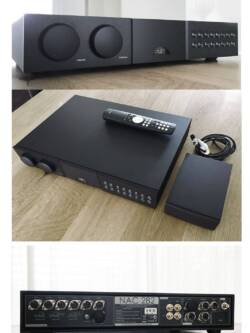
Naim NAC 282 preamplifier + NAPSC Power Supply
Original price was: R174,000.00.R84,000.00Current price is: R84,000.00. Add to cart -
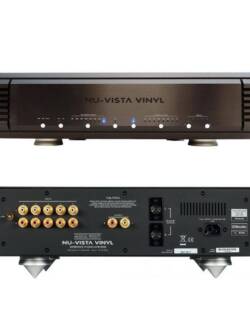
Musical Fidelity Nu-Vista VINYL Phono Stage (WOW!!)
Original price was: R112,000.00.R44,000.00Current price is: R44,000.00. Add to cart -
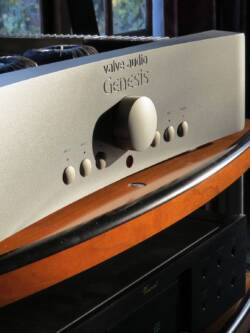
Valve Audio Genesis Preamplifier (NEW Model)
Original price was: R120,000.00.R59,000.00Current price is: R59,000.00. Add to cart