These trends have passed long beyond the cult stage. While tube amplifiers still cannot provide the high damping factors or woofer control that is possible With transistor amplifiers, no one still claims that they soften highs or somehow romanticize recorded sound (footnote 1). There is a consensus among high-end magazines that the best tube units are exceptional in the areas of transient and harmonic detail, high frequency information, and imaging and soundstage data. Further, there is a similar consensus that the days when tube units provided superb midrange at the expense of the frequency extremes are long gone.
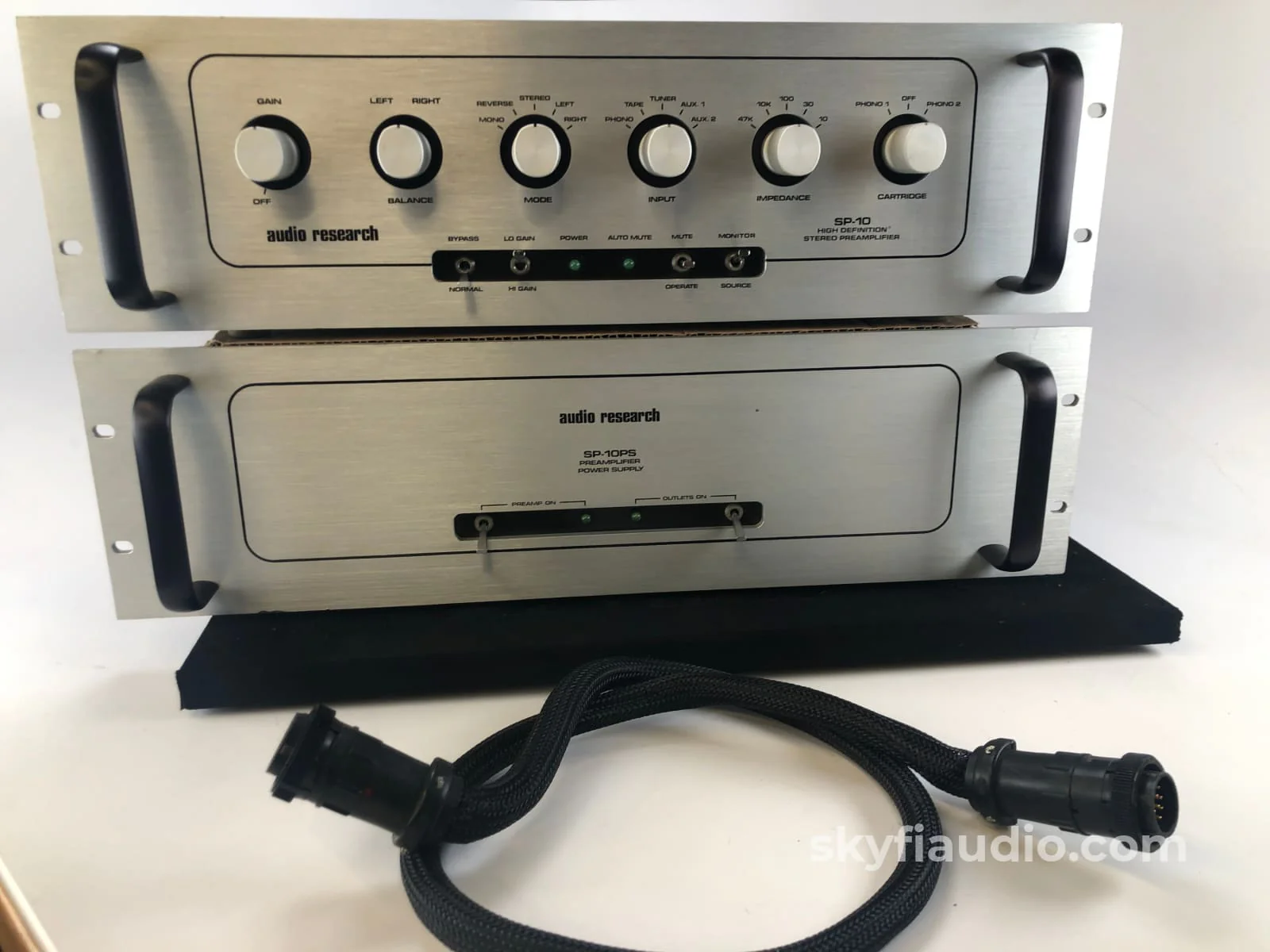
This brings me to the units under review: the Conrad-Johnson H-la head amp and Premier Three preamp combination and the Audio Research SP-10 preamp and D-160B amplifier.
Regardless of “who’s on first,” these two components make a fascinating contrast; they also provide an insight into each manufacturer’s design philosophy. Unlike many tube units, they can be used With most moving-coil cartridges (more on this in a moment), and the preamps have sufficient output to drive most amplifiers.
It is tempting to focus on short-term differences, and to ignore the fact that you’re looking for equipment that gets the best out of a broad collection of records, tapes, CDs, and FM broadcasts, and on which you can listen for hours without reminders that your equipment is introducing unpleasant or constantly detectable colorations. By comparison, transistor equipment always has a distinctly less musical sonic fingerprint than does tubed equipment—either in the form of dryness or harshness in the upper octaves or a distinct loss of detail.
The C-J and ARC sets of equipment also offer amazing realism in the midrange. This is a function of coherence and the ability to reproduce an amazing amount of detail without hardening or softening, the ability to reproduce extremely detailed low-level harmonics, and the ability to provide wide dynamic range without effort—neither appearing to slow the music nor accelerating too far.
This superior coherence shows up clearly on those piano and violin records with both mechanical and musical detail: where the music is complex and covers the entire midrange; where scores are rustled, bowing sounds are clearly heard, the players move slightly, or there are extraneous sounds in the hall. To the extent that illusions are ever real, both the Conrad-Johnson and Audio Research systems seduce you into suspended belief: you listen as if it were live.
Tube units are famous for their imaging and depth, and for providing precise natural placement of the musician or singer. Again both these sets of equipment outperform the best transistors I’ve heard. Centerfill is excellent and the soundstage extends to the right and left of the speakers when the music permits it. Depth is natural. Imaging height is determined by the speakers and not by the electronics. Hall effects are clearer and less exaggerated. Transistor equipment can on occasion do a few of these things better, but never so many in combination.
Although neither the C-] nor the ARC equipment veil or roll off the highs, many audiophiles would enjoy simply to hear the upper octaves without the fatigue or irritation that comes from prolonged listening to their transistor equipment. The key subjective impact of the best tube units is that the highs will reveal any problems in the miking, but will sound natural with decent miking and on those records and tapes that actually do sound natural.
Sonics
Now for the comparison. I tested both a new SP-10 and one borrowed from a local audiophile, Steve Summerall, who had retubed it to his taste. The C-J HV-1A and Premier Three preamp had just been retubed, and I tested two variants of the head amp.
I tested both the Conrad-Johnson and Audio Research combinations using top quality turntables like the Goldmund and SOTA-Sumiko arm combination, top-quality cartridges, and speakers like the modified Quad ESL-63, Thiel CS3, Spica, and Fuselier 3.3s. I have used them with compact discs and a wide range of FM tuners. I have mixed and matched cables, including the Straightwire, Petersen, Discrete Technology, Audiosource, and Monster Cable Interlink Reference.
The SP-l0 or Premier-Three-plus-HV-1a (which are remarkably close in price) have just enough gain so that you can use any moving-coil cartridge with a minimum of 2mV output. “Just enough,” however, means detectable hiss and noise. I have recorded such noise and superimposed it on the sound of much quieter transistor units (this is a rough-cut approach since it is impossible to do this without adding some colorations to the sound), and it is clear that it matters. Ironically, one has an expanded impression of depth or air; the unpleasant aspects are a tendency to mask the softest musical detail and harmonics, while adding a dry coloration in the spectrum where the noise is dominant. Worse, the imaging tends to alter. There is a feeling of expanded soundstage size and detail, but it is not natural and, although it is initially impressive, it eventually has the same irritating effect as exaggerated highs.
Both preamps are nicely styled and have good basic features. The Audio Research SP-10, however, wins hands-down on ergonomics. You have switchable gain, a choice between two turntable inputs or Mute at the phono stage, and switchable cartridge loading. For most high-end audiophiles these are useful controls. The Conrad-Johnson combination has a slight advantage because its balance control is infinitely variable while the Audio Research control is stepped-and yes, dammit, there are times when the ARC’s balance switch won’t “lock in” at just the right place.
Both units are big and involve two rack-mountable boxes. The SP-10 has a separate preamp and power supply; the Conrad-Johnson a separate preamp and head amp. The ARC equipment is a muted silver grey with knobs that match the panel, and the C-J equipment is in burnished gold with gold knobs.
Both combinations seem to balance out in terms of the sonic impact of switches and wires. The SP-10 normally needs to be operated in the bypass mode to do its best, and even William Z. Johnson would probably admit that the variable loading and dual phono input switches impose a slight sonic degradation. I would also strongly advise getting the optional long umbilical cord between the SP-10 power supply and the SP-10 preamp, and using side-by-side rather than over-under placement to minimize hum. You also need to pay exceptional attention to grounding; for some reason the SP-10 is very sensitive to improper grounding, interconnect termination, and AC line-plug orientation.
I should also note that the SP-10 is sensitive to shock. The SP-10 is particularly sensitive in that its input tube—the 6DJ8—can become microphonic in use, or in transit. If you have noise problems, if there is more tube noise in one channel than the other, or if the highs sound slightly disembodied from the midrange on the SP-10, the chances are that changing a 6DJ8 will quickly cure the problem.
Both preamps have the precise “feel” of expensive equipment, and both provide excellent sound. They do, however, sound different in several important ways. The Audio Research SP-10 has the flat, extended upper octaves of the very best transistor equipment, plus all the virtues of tubes; no transistor lover will feel slighted to own the SP-10. Its variable loading also allows a quick approximate calibration of the best loading for a given cartridge.
The end result is that the SP-10 almost seduces you into listening to upper midrange detail while loading a cartridge for the most precise imaging. Since the SP-10 is amazingly silent in its switching functions (even in Phono and with high gain), you may well start playing with the loading just to match an individual record. The outstanding merit of the SP-10 is in its top four octaves. You will hear more detail in a musically natural form in these octaves with the SP-10 than from any other preamp I’ve heard.
The Conrad-Johnson head amp and Premier Three, in contrast, do best in the three octaves above the bottom octave. They are strongest in the areas where tubes traditionally are strongest. You can, for example, hear the bowing sound on a violin more clearly than on an SP-10. Soundstage noises were clearer, because most occur in the frequency band where the C-J does best, and the C-J combination has superior imaging in terms of stability and centerfill.
The units differ in depth presentation. The ARC provides more upper-octave depth information. The C-J provides more bass and lower-midrange depth information. This slightly favors the C-J for orchestral music, because more hall depth-information seems to be present in the frequencies the C-J favors.
Let me hazard another description of the two units. The SP-10 is ideal in reproducing closely miked chamber music, female voice, natural jazz, and other music where you might choose to sit within 30 feet of the performers. The C-J combination is ideal for reproducing the larger orchestra or musical combination, and opera. Both reproduce all music very well, but the two units tend to place you in different parts of the concert hall. The SP-10 brings you close to the music. The C-J is twentieth row center.
Another way of putting it is that the ARC preamp is “fast” and the C-J is “sweet.” A pejorative way of saying the same thing is that the ARC is “hard” and the C-J is “rolled-off.” So much for semantics; the point is that they are audibly different, and you should pay close attention to their characteristics in making your choice.
I will ignore the issue of which is best; this is a matter of taste, and a choice you can make for yourself. They are as different in sound as fine wines from the same district. You may find that the C-J combination performs slightly better with cartridges that have extremely fast highs with a slight rise, while the SP-10 benefits from a cartridge that has flat frequency response.
Although both units performed without fault during my listening, they require care and sense. Shock and rough handling are no-nos. Mixing tubes to try to improve on the designer is a recipe for trouble both sonically and in terms of reliability. Cautious cleaning of the tube prongs with Tweek, according to the instructions that come with Tweek, can be recommended. Regular retubing at the manufacturer’s recommended intervals is an unfortunate and expensive necessity.

The End Result
Both the Conrad-Johnson and Audio Research combinations provide a consistently more accurate reproduction of music, voice, and speech than any transistor unit I have heard in my own home. This accuracy shows up in several key areas, and is evident with a very wide range of source material and over a long period of time.
Both the Audio Research and Conrad-Johnson electronics are what the High End is all about. They are part of that elite group of equipment which leads the way towards filling the awkward gap between live performances and reproduced sound, and which allows you to explore nearly 100 years of recorded sound to its best potential. They, like virtually all high-end equipment, are luxuries and not cost-effective investments. While some of the best things in life may be free, none of them are cost-effective.—Anthony H. Cordesman
Anthony H. Cordesman followed-up his SP-10 review in December 1984 (Vol.7 No.7):
Audio Research hasn’t formally changed the model designation on one of high-end audio’s greatest status symbols, nor have they raised the price. They have “only” improved the phono section of each channel, improving that already-superb preamp so much that I felt justified in adding my own “II” to the model number. And you can convert your existing SP-10 for a quite reasonable $100–$150.
Now, let me whet your appetite: the improved phono stage of the SP-10 is superb. I won’t go quite as far as William Z. Johnson—who called it “an order of magnitude” improvement. Live music is only 0.9387 orders of magnitude better than today’s better preamps, and preamps don’t really get 10 times better in a single step. The improved SP-10 is, however, 0.1936 orders of magnitude (nearly twice) as good in imaging and depth information, and has much better center fill, more transparency, slightly lower noise, and an improvement in coherence and apparent timbre. That ain’t bad, considering we started out with one of the best preamps around!
In fact, you can lose yourself very quickly in the soundfield from this new version of the SP-10. The image “floats,” with the instruments solidly placed in space. The sound is not etched. There are no surprising transients. Instruments don’t suddenly have a new maker, nor do they change in character. In a darkened room, where the sight of your speakers and furniture do not remind you of the truly artificial nature of your listening environment, the SP-10 allows the best records and cartridges to make you forget where you really are.
Don’t misunderstand me. I am not hyping the improvement in sound just to notify you that the SP-10 is the world’s best preamp of the month. The competition remains strong: Krell and Klyne, just to mention the ~two new preamps beginning with the letter “K,” have exciting new designs on the way. Buying for fashion or status is a sucker’s bet at any time, and this is particularly true in a field that changes as rapidly as high end audio.
What I find special about the improved SP-10 is the prospect of being able to count on enjoying years of superbly reproduced music. The SP-10 is neither “dry” nor “romantic” nor “hi-fi,” It succeeds in being both musical and analytical without calling attention to itself in any way. It gives records a coherence and mix of accuracy with natural musical warmth that I have never heard before in a tube preamp. It does not just do some things well, or what “tubes” do well, it does virtually everything well. It certainly provides all the sweetness of tubes, and only the most vestigial sacrifices in top- and bottom-octave performance.
I had been coming to feel that the electronic part of a phono system had been pushed reasonably close to the ultimate attainable. The new SP-10 is proof that it hadn’t. I’ve run through well over 100 records with it so far, and it has always done two things: let me hear new detail, and let me hear new information thatis musically natural.
I should warn you, however, that this is only true when the input material itself is musical. The improved SP-10 serves as a new demonstration of the problems in Compact Disc players. I agree that the new CD players and the best CDs are getting better, and I now prefer them to cassettes and virtually all pre-recorded open reel tapes. They cannot, however, compete with a top-rank record playing system through the new phono stage on the SP-10. If you do a head-on comparison of the same performance on most phonos and CDs, you’ll find the phono system will image better, be cleaner and more transparent in the highs, the depth will be much superior, you will get more natural deep bass, and you will hear more of the fine harmonic details or “air” that make music warm and relaxing enough for sustained listening (footnote l).
The improved SP-10 is also a grim reminder of the drawbacks inherent in the use of low-output moving-coil cartridges and step-up devices. The SP-10 now has less noise in its high-gain mode than it did, but it still cannot be used with many low-output moving-coils without incurring tube noise and hum. You can hear these effects much more clearly with the improved SP-10 than the old SP-10, just as you can hear the effect of changes in VTA, cables, and cartridge loading.
You will want at least a moderate-output cartridge, which may require experimentation. The Argent Diamond, for example, works fairly well, but the Dynavector 17DS is marginal, in spite of their identical output specs. Most Koetsus and Kisekis can work reasonably well, but some do not. The van den Hul EMT, the Decca van den Huls, the new Adcoms, the Argents of all breeds, the Goldring van den Hul, the medium- to high-output AudioQuests, and the high-output Alchemists, all have enough output to achieve the best results with the SP-10.
My advice is to only use a cartridge that can provide all the output needed for normal listening with the high gain stage switched on and the volume control set no higher than 12:00. As good as some of the ultra-expensive low- output moving-coils can sound using a transistor preamp, I suspect that you will be unhappy with any cartridge that doesn’t meet the 12:00 test on the SP-10, once you have heard a really good higher-output cartridge through it.
Abuse during shipping can make one or more tubes go slightly noisy or microphonic, and this can lead to differences in sound between channels or a slight loss of the magic coherence that is the key merit of the improved SP-10. I suggest you check carefully for such tubes when you get your unit. Load the phono inputs, turn the volume control to maximum, and listen to the tube noise on each channel. Both should sound the same, with no clicks or rough noise. If you do hear problems, first try Tweak or Cramolin on all the tube pins. Second, gently tap each tube with a pencil eraser and see if any are unusually microphonic. If so, try replacing them. (Remember that the earlier the amplifier stage, the more microphonics you can expect from the tube in it.)
One strong word of caution, however: buy only Sylvania or Philips 6DJ8s if you don’t have a reliable source of tubes, or buy extras from Audio Research. I tried a wide range of GE tubes, and they performed like every other GE consumer product I have tried in recent years, from steam irons on—abominably. Amperex tubes were better, but still sonically colored.
I can offer some alternatives to the SP-10 if you want many of the benefits but can’t afford the SP-10. Much of the merit of its new phono stage seems to lie in the ability to provide more gain and linearity than other preamps, combined with extraordinary transparency. I’ve found you can get some of the same benefits by adding a really good tube pre-preamp to an existing tube preamp.
I’ve been using a tube pre-preamp designed by Murray Zeligman, that can add the gain of the SP-10, and much of its sonic clarity, to a good tube preamp such as the Conrad-Johnson PV-5. The Zeligman pre-preamp is largely hand crafted, requires a 47k-ohm load, and is suited only to the kind of moderate-output moving-coils recommended for the SP-10. It is very good, and can make it easier to live with the sound of that older tube preamp you know and love. Conrad-Johnson also has two new models of nuvister pre-preamps coming, and my tests of a prototype indicate they also can add much of the sound quality of the new SP-10 to an existing preamp, and give you more gain with a better signal-to-noise ratio.
All in all, however, my hat is off to William Z. Johnson for another job superbly done. The aforementioned tubed head amps plus the best old tube preamps can sound very good, but they are no match for the improved SP-10. If you even suspect that you can afford to buy it, you should hear the SP-10 before you make another major investment in audio. There is a lot of tough competition out there, and a lot more coming, but I haven’t heard as revealing or exciting a piece of electronics in a long time.—Anthony H.