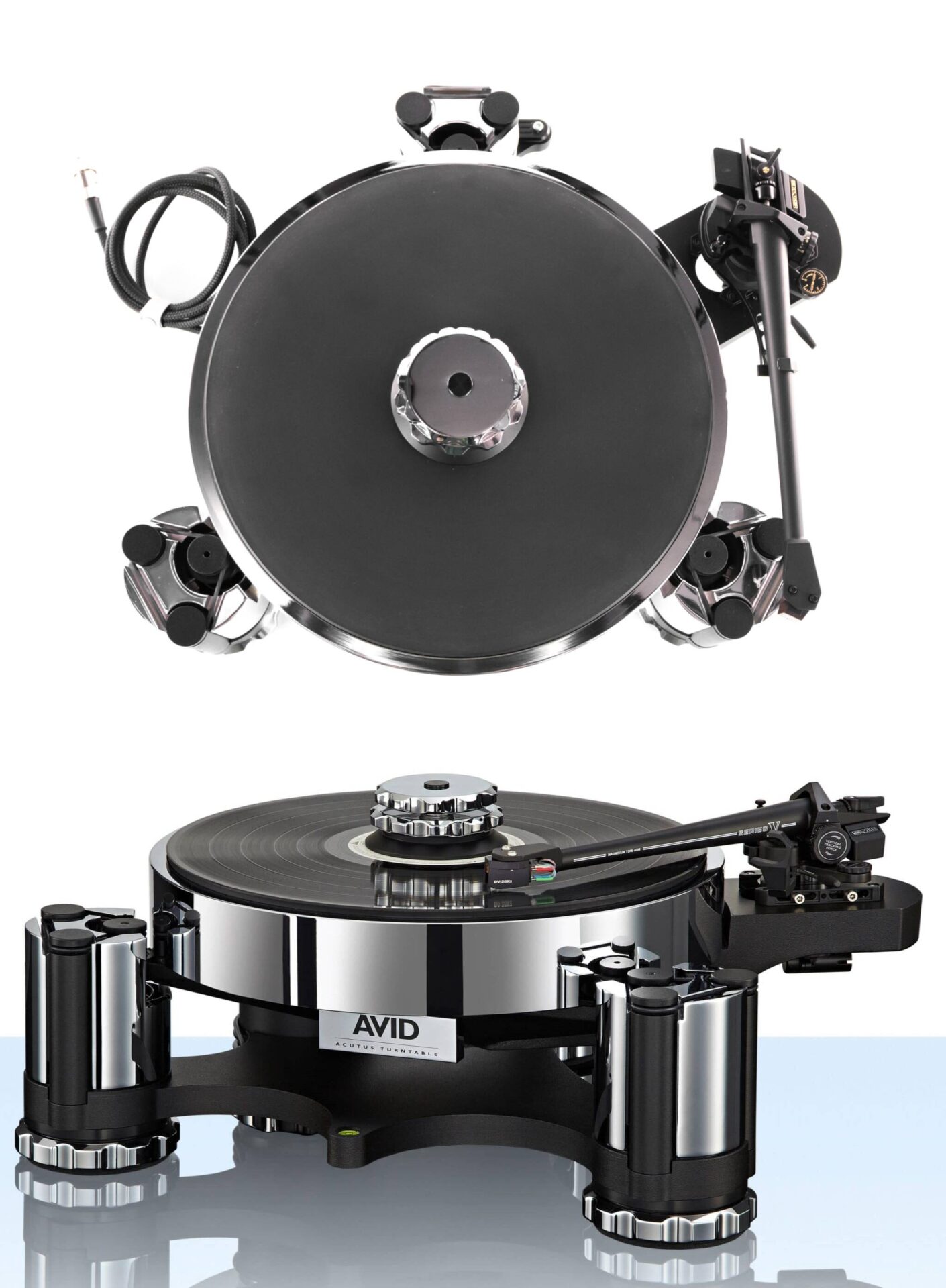
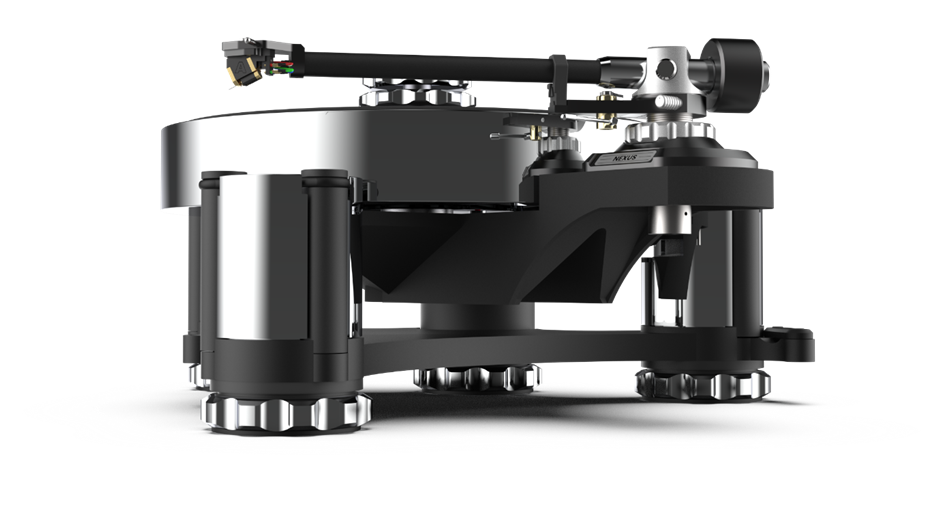
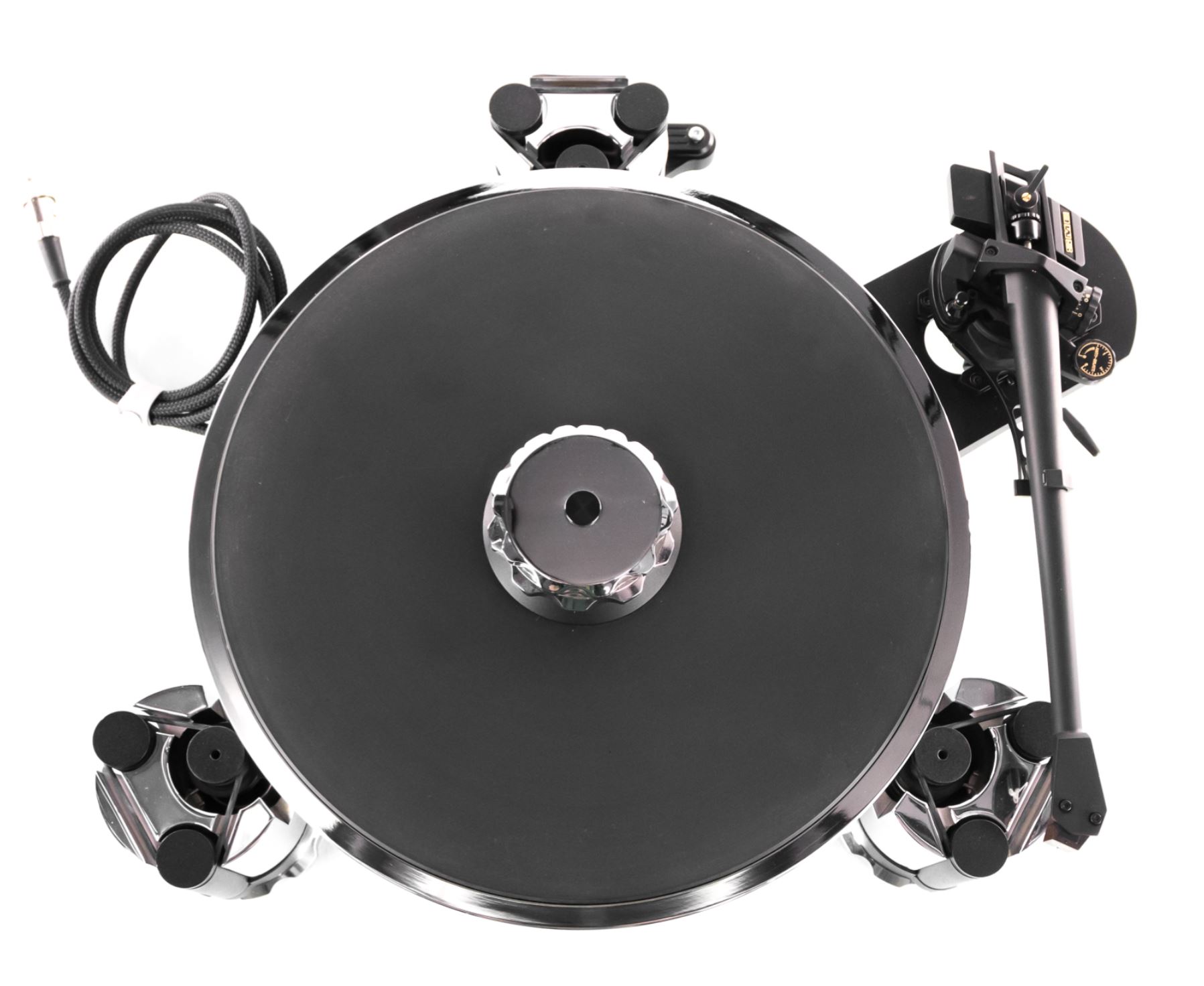
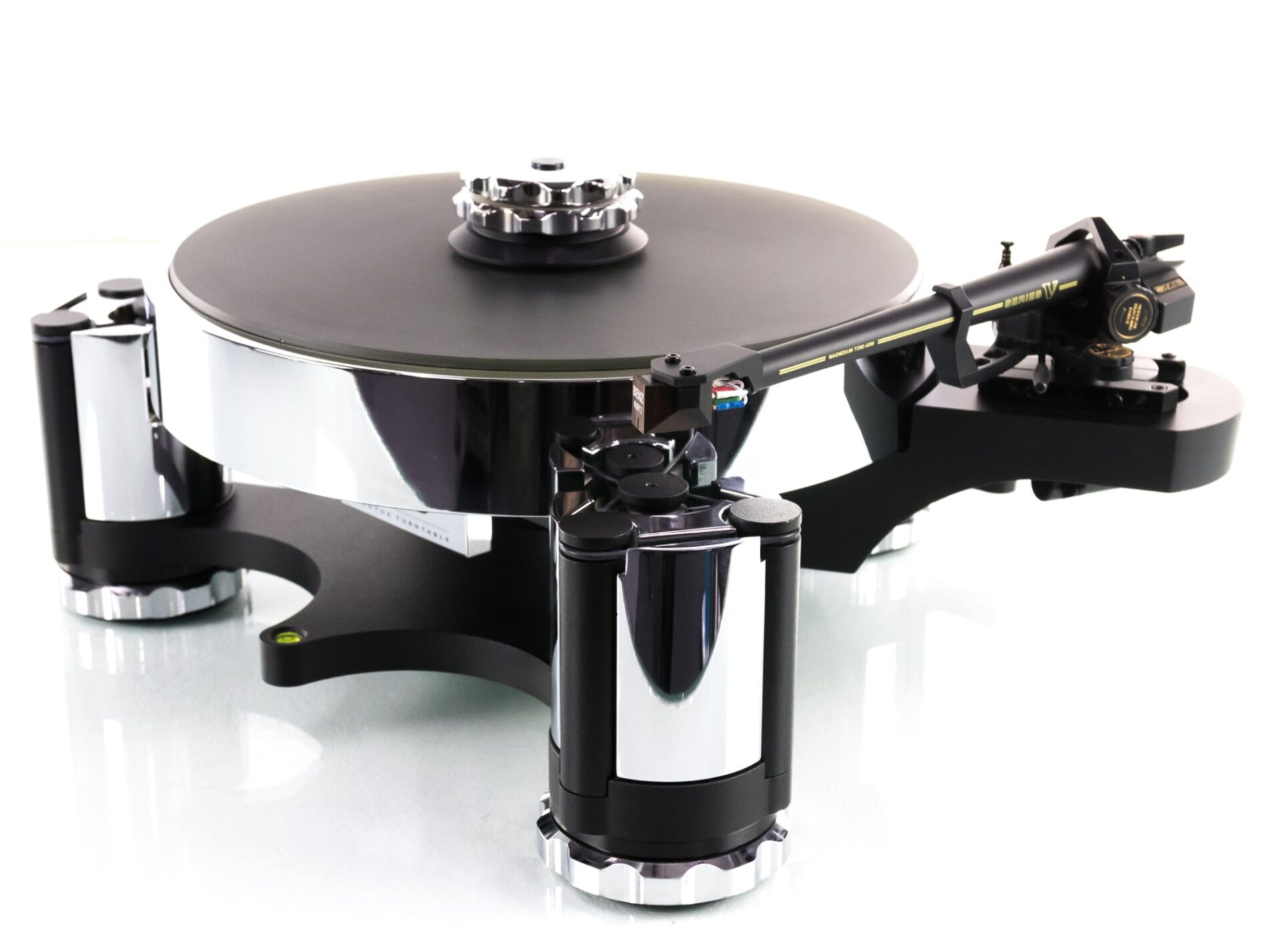
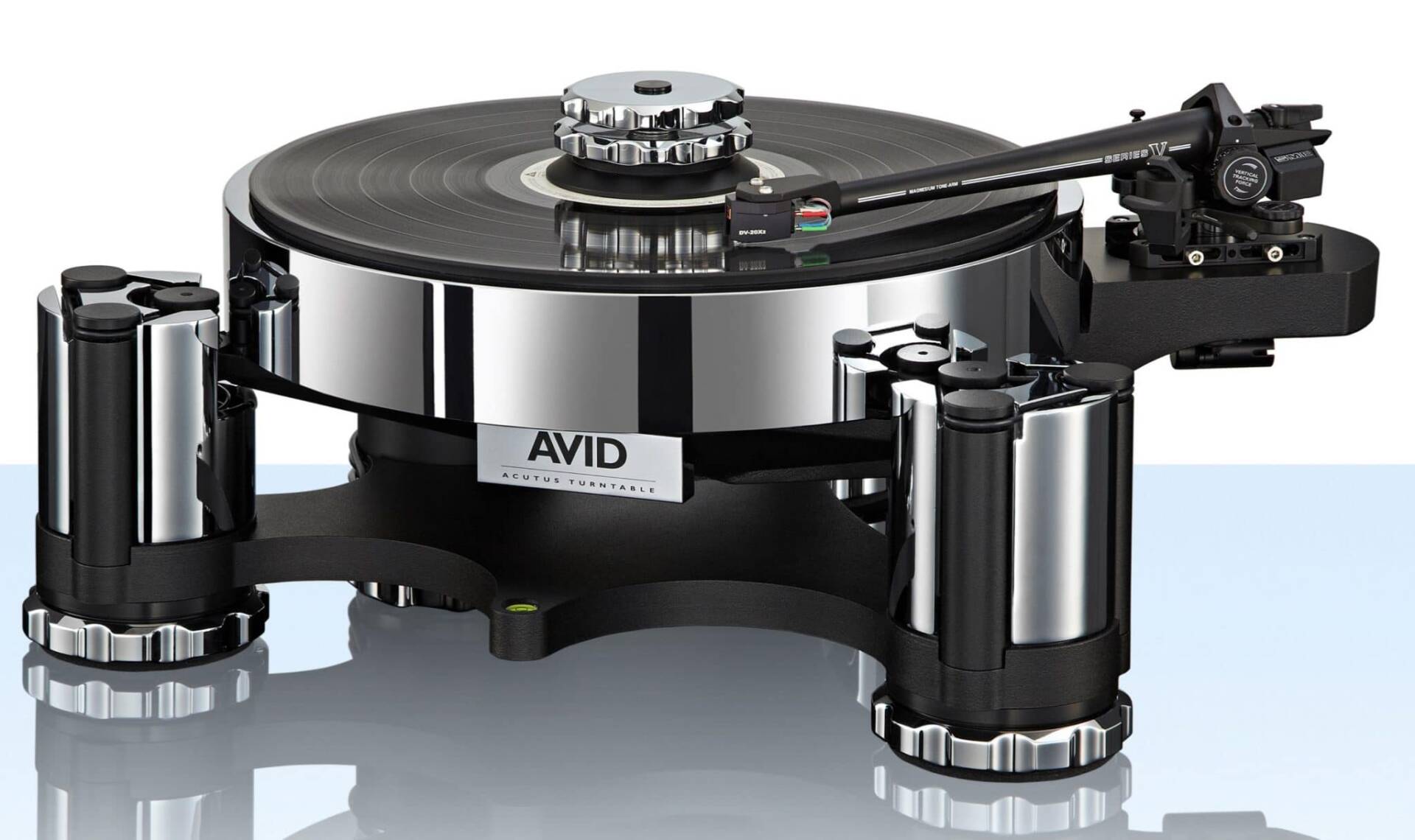
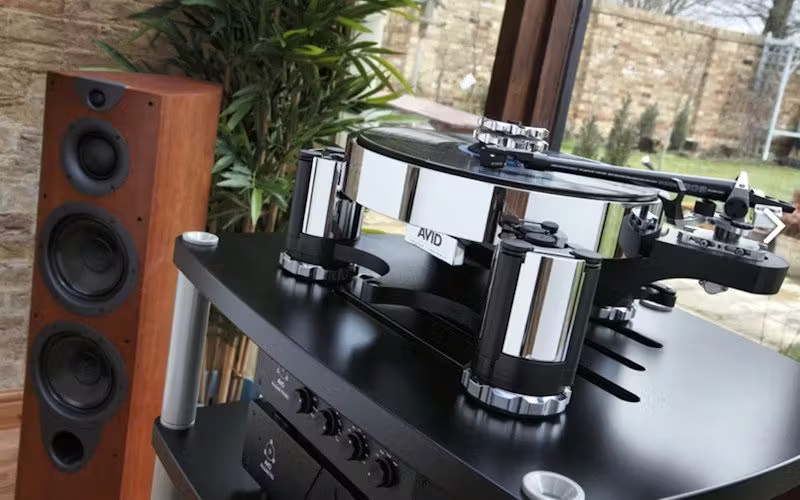
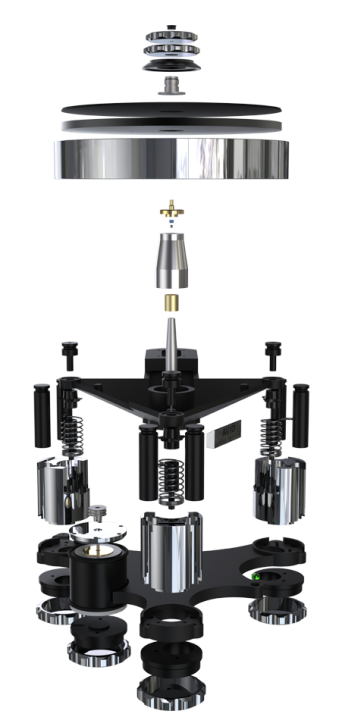
Avid Acutus Reference + SME V + Dynavector XX2 (30000 GBP)
Original price was: R580,000.00.R158,000.00Current price is: R158,000.00.
Specifications
TWIN BELT DRIVE
33.3 & 45.0 RPM (ADJUSTABLE)
ALUMINIUM 10KG
INVERTED STAINLESS STEEL
TUNGSTEN CARBIDE/SAPPHIRE
3 POINT SPRING Vertical 2.5Hz, Lateral 4.5Hz
SME TEMPLATE
YES: SINGLE OR TWIN TONEARMS
HAND BUILT 24V 140mNm AC Synchronous
DSP VARI-SPEED CONTROL UNIT
100-240VAC 50/60Hz 20 Watts Max.
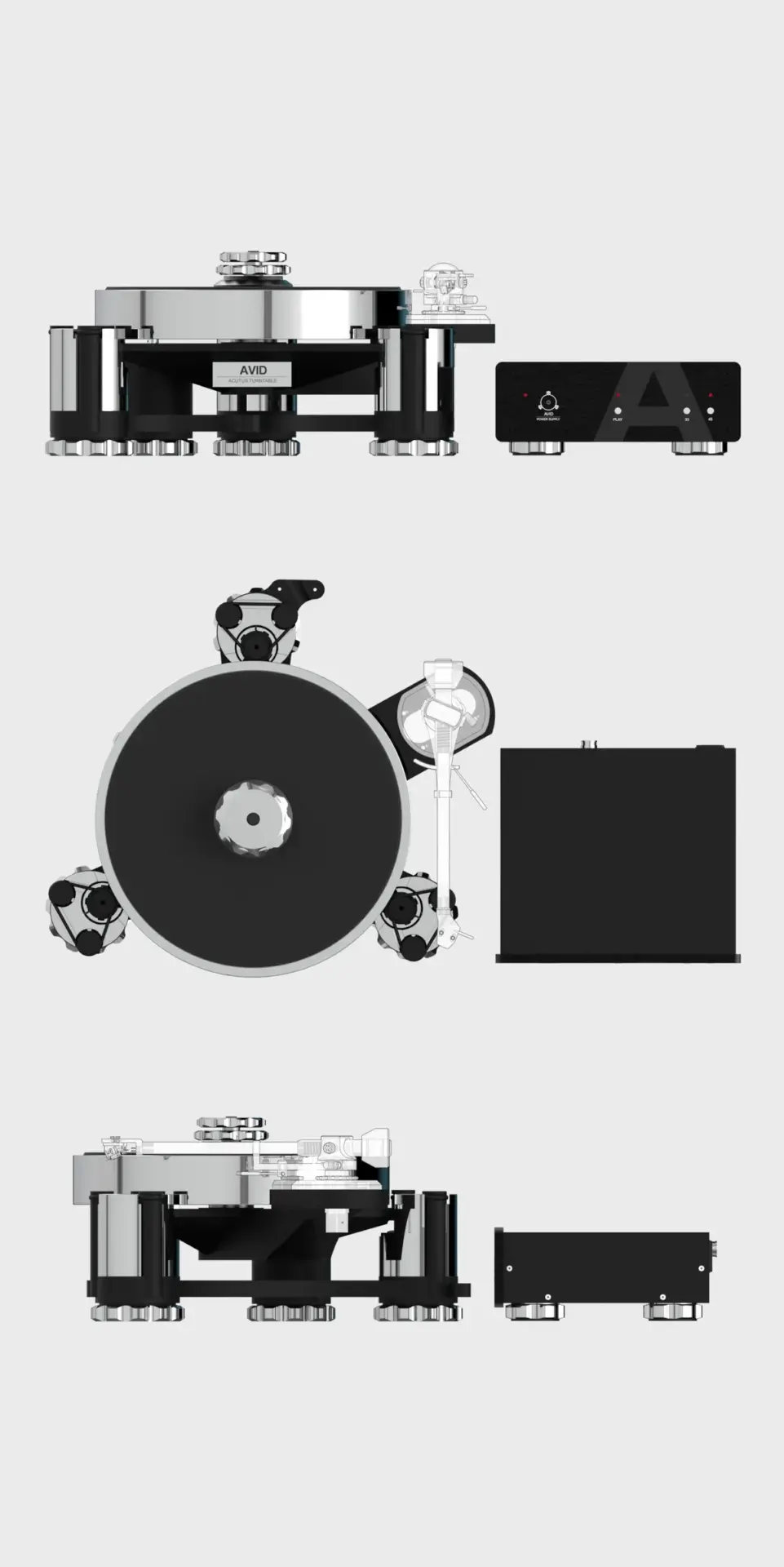
Turntable (overall) 460 x 400 x 210mm (WxDxH)
Turntable (footprint) 410 x 360mm (WxD)
P.S.U. 415 x 350 x 140mm (WxDxH)
19.0Kg (42lb) turntable only
20.1Kg (45lb) psu only
Description
Avid HIFI
£27,500
The ‘table itself lists for $19,995 and the SME V tonearm (which arrived pre-mounted on our review sample) bumps the price up another $5,495. The subchassis on comes pre-drilled for an SME tonearm, but adaptors for Rega, Triplanar, and a few others can be purchased from $100 – $225, depending on the version you require. Current Acutus owners can easily upgrade to the Reference SP—which incorporates AVID’s latest-generation digital-speed control, larger power supply, and two-drive belt system—for $6,400.
NEW Dynavector XX2 – $2995 included
| Review component retail: £12 000 (+ £1490) + £3000 in Poland |
 |
| The Avid Reference turntable is in fact the Acutus model with a different motor, power supply and platter bearing. ‘In fact’ is a bit exaggerated since these elements are all key to realizing the full potential of a given design platform. But in general the design of the model Reference is very close to the basic version, hence my usual description section of the last page repeats some information I already listed in the Acutus review. Turntables from the Avid company look fantastic. Each time I test them, it is not only a feast for the ears but eyes. This time the power supply was a full-sized component to add both physical weight and cosmetic gravitas. |
 |
| I also received Avid boss Conrad Mas’ new Pulsare Phono. He regards it as his crown jewel and proudly first told me about it when we met during the Audio Show 2009. Poland actually became one of the first places where the Acutus Reference was shown with this phono stage. The Pulsare Phono consists of two units – the power supply and the amplification section exactly as my RCM Sensor Prelude IC. I mention this on purpose because I think that it’s time for RCM to move forward in terms of external design and finish. The British devices are gorgeous. That’s how the new Polish reference preamplifier from the Katowice-based company should look if it ever gets made. With the Pulsar we have access to amplification and load settings from the front panel which is key. The Conrad Mas amplifier has a fully balanced architecture so naturally the cartridge signal can be supplied balanced (each cartridge is naturally balanced versus tone arm ground) to the XLR input socket of the phono stage. Alas, we need to use a dedicated cable, the DIN-to-twin-XLR we can order from Avid. At 3.879zl or £790 for one meter, that’s unfortunately extremely expensive and really just a plain van den Hul D-501 Hybrid with Neutrik XLR plugs. |
 |
| Sound: Discs used for testing – Musik wie von einem anderen Stern, Manger Products, MANG-2010, 2 x 180g LP.; Billie Holliday, Songs For Distingue Lovers, Verve/Classic Records, One-sided, 2 x 180g, 45rpm LP; Depeche Mode, Fragile Tension/Hole to Feed, Mute Records, 12BONG42, 2 x 180g, maxi-SP LP.; Frank Sinatra, Sinatra & Strings, Warner Music/Mobile Fidelity, MFSL 1-313, No. 199, 180g LP; Frank Sinatra, Sinatra&Sextet: Live in Paris, Reprise/Mobile Fidelity, MFSL 1-312, No. 238, 2 x 180g LP; John Coltrane, Giant Steps, Atlantic/Rhino, R1 512581, 2 x 45rpm LP; Julie London, Julie is her name. Vol.1, Liberty, LRP 3006, LP; Kraftwerk, Tour The France Soundtracks, EMI Records, 591 708 1, 2 x 180g, LP; Mel Tormé, Mel Tormé Sings Shubert Alley, Verve/Polydor K.K. Japan, KI 8212, LP; Mel Tormé, Mel Tormé at the Red Hill , Atlantic/London Records, HA-K 8021, LP; The Cult, Electric, Beggars Banquet/Sire, W1-25555, LP; The Doors, Limited Edition Vinyl Box, Warner Brothers/Rhino, 7 x 180g LP; Yamamoto, Tsuyoshi Trio, Midnight Sugar, Three Blind Mice/Cisco Music, TBM-23-45, 0080/1000, 45 rpm, 2 x 180g LP. |
 |
| Together with the Air Tight PC-1 Supreme cartridge, the Avid kit in balanced connection always showed the sunny side of the world. If I would like to embed this in some psychological context, I would call this deck a born optimist. There’s nothing in the world which would not be worthwhile, nothing so bad and boring as to not invite a closer look. Anthropomorphization of course is never the best research strategy if we aspire to objectivity. From my experience, such approximations are simply very helpful when we attempt to describe matters which are closely related to emotions. We better understand multidimensional complexity when we compare it to something similar/familiar – and music is obviously emotional. Optimist thus should hit the spot. |
 |
| The British turntable sounds very civilized. I wrote about this already when describing the Acutus but here it was even more pronounced. All events on stage make sense. Everything has a common denominator which holds it all together. If the voice is most important as on Mel Tormé at The Red Hill, then his voice will be showcased as the star. But when it is an interaction of two parallel elements as on Mel Tormé Swings Shubert Alley where the vocalist is accompanied by The Marty Paich Orchestra, then those become clearly—very clearly—two equally important elements. Both are rich in micro events within their boundaries and intriguing. But when playing together, it’s all about their interaction and how they combine. It’s not about analysis of each element separately. |
| Like a source code, this sound has a built-in good attitude towards what the diamond reads from the groove. ‘Good attitude’ is not a precise descriptor but the best I have which describes what I want to convey. Regardless of recording quality or condition of the vinyl, we can be sure that the Avid system will do its best to retrieve the best from the recording. To a certain extent the Pulsare preamplifier is responsible due to its slightly tube timbre but I enjoyed the same general results with my RCM Audio phonostage. This simply is how Conrad Mas has designed his turntables to sound. They don’t confront reality. They befriend it. |
 |
|
This has side effects of course which I will get to. First we must determine what kind of sound we want – what we expect from our system. This validates our choice regardless of what others say about it. Avid is part of a group that’s close to the well-worn track leading up to the peak of absolute real sound but isn’t placed directly on that ascent but moved to the warmer side of it. It is not a warm turntable per se—the Pulsare preamp is warm—nor dark and colored. It’s just that music sounds very manifest and material. It’s not outright forgiving but some. It thus doesn’t matter what kind of music we play. |
 |
| The aforementioned records sounded splendid as did Sinatra in Paris and after that the dance numbers of Depeche Mode’s Hole To Feed/Fragile Tension. The latter confirmed how the Brit can reach very low in the bass but remains colorful and differentiated. Bass becomes the foundation for everything above it also with Jazz. It’s rhythmical and well coordinated with the midrange. The very abyss is not as free from certain mechanical vibration as was the Transrotor Argos and also saw better control with the Black Stork plus Reed Q3 tone arm. |
 |
| There’s no need to cry over spilled milk because we are talking about a very small part of the sound spectrum at the very bottom. It’s simply worth knowing about. It won’t really be noticeable with cartridges beneath the PC-1 Supreme’s stature because those won’t retrieve bass this low. This was nicely confirmed with the Miyajima Lab Waza, which is rather warm on its own to merely suggest the lowest bass. The Bergmann Sindre seemed much lighter and without the same fleshy bass. Its presentation was more precise, resolved and slightly more spacious. Based on my knowledge of the best turntables I heard—the Argos and SME 30—the Avid was closer to them than the Bergmann. |
| As I said, it’s about a slightly warm sound and the Pulsare preamplifier was responsible in a big way. Moving it in directly after the RCM relocated the timbre downward into the lower midrange and warmed and softened the treble. I remember well how the Manley Steelhead v2 tube preamplifier sounded to know that tubes do not necessarily equate to such warmth. |
 |
| My RCM is similar to the Manley. The Pulsare was different. In a blind test, the latter would be pegged as the tube device. One reason could be the contour of the frequency response curve. It’s a departure from neutrality as I define it but one which is part of a greater purpose. This deviation remains within the boundaries of ‘correctness’. It’s not big, thus anyone can decide about accepting or rejecting it with their own judgment and within the orbit of their ancillaries. Regardless of how one decides, it will remain within the rules of good tonal balance, just not necessarily ideally linear. |
 |
| A second reason is harmonic saturation. Voices by Sinatra, Tormé, Morrison from the Doors’ L.A. Woman, Julie London from Julie is Her Name. Vol. 1 all were voluminous and presented slightly closer to the listener – not by much, they were not rushing in front of the speakers but clearly did have more size. There was no talking about small sound or congested elements. This was pleasing but won’t necessarily fit all systems. If your sound is already slightly warm and big, the Pulsare won’t discipline it. |
 |
| However it presents excellent dynamics and shows everything in a very vivid fashion to play on your emotions. Its resolution is not as high as the best I know but I had no real issues especially when I listened to the Avid for some time on its own merit. I have to stress again the excellent user interface. Front panel knobs should become the rule rather than exception for any good phono preamplifier. It’s why I curse my Sensor Prelude IC each time I want to check or improve a setting or change the cartridge altogether. |
| The turntable itself is smooth, saturated and very satisfactory. It has a splendid tonal balance with a slightly stronger bass and softer treble. This is a very good correction and exactly what I chose when I used the Accuphase room correction processor. It seems mandatory to reproduce music in a home environment where the acoustics share nothing with a recording studio. Avid’s voicing does it automatically. I do not think that the difference between the top and bottom is more than 3dB but it can be heard. Similar to the preamplifier, the turntable is very good with dynamics. Perhaps you won’t identify this right off because it differs from most digital players. Yet when appropriate as on the Sinatra disc once the snare drum hits, the listener jumps. Why? |
 |
| Probably this impact exposed part of the treble spectrum of a closely placed microphone. With the Avid, those nuances are clear and unanimous without analysis, brightening or impersonating a digital player. Is this the ideal? No. One reach farther down in the bass to become even more vivid and natural. The midrange could be more resolved and placed on a darker background. But for that you will need to pay more, much more. Personally, this sound would be absolutely sufficient. For now. |
|
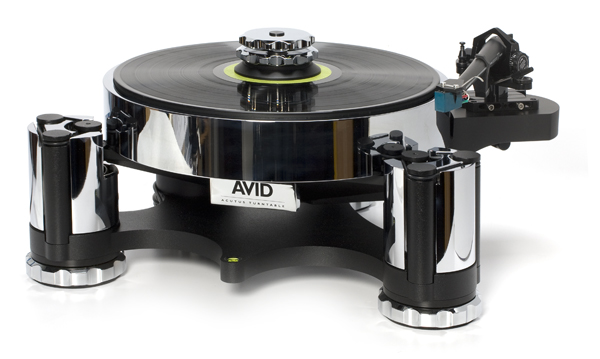
Description: The Acutus Reference is the top model of the four Avid turntables and made in accordance with established company standards employed over years already, i.e. being mass-loaded but with a decoupled sub chassis. SME makes similar turntables yet with Avid, the suspension is very soft. When we apply pressure on the platter, it takes a while until it settles at zero. Because it is part of a dynamic system, it is never still and vibrates delicately at all times. |
||
 |
||
|
||
 |
||
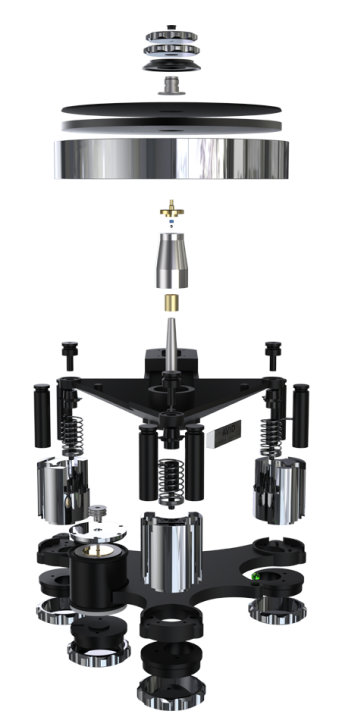
| The stability of the horizontal axis—the typical Achilles heel of such constructions—is maintained by rather large rigid rubber rings mounted to the pillars on one side and the sub chassis on the other. In the Acutus the rings were stretched between two pillar mounting points to decouple effectively in more than one direction. This allowed very low resonance frequencies. This suspension is not as rigid as an SME and motion takes time to settle. | ||
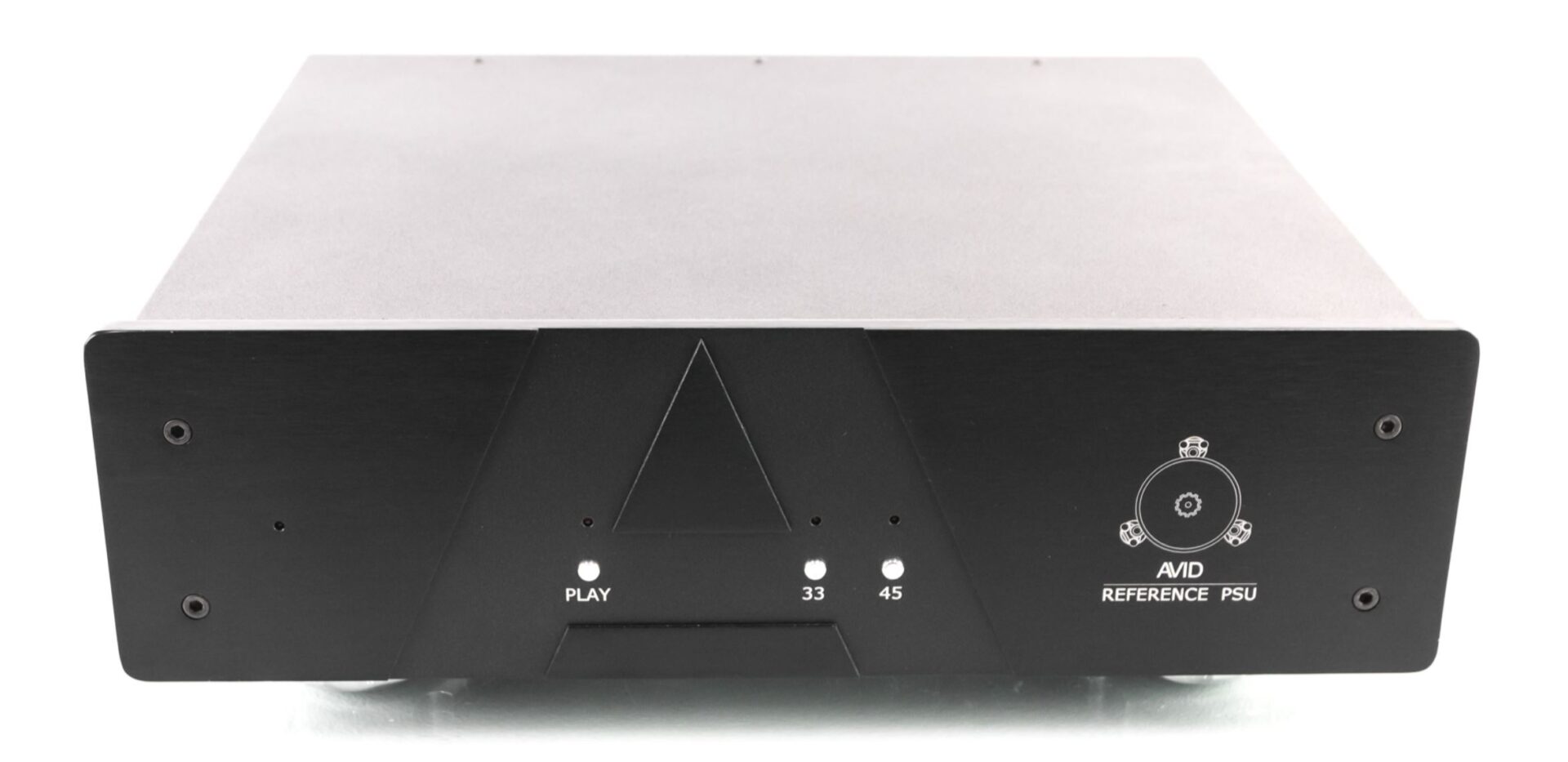
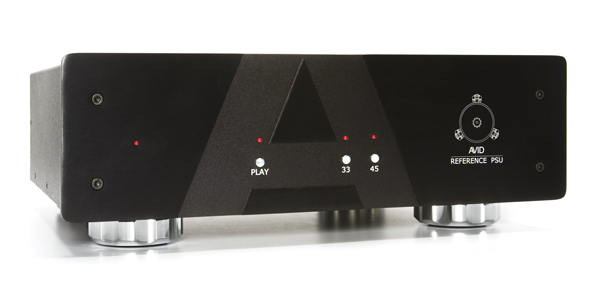
| The heavy motor is mounted to the chassis via rubber string for mechanical coupling with the plinth while also being independent from it. The motor is a synchronous 24V type hand-made by Avid. The Acutus Reference is equipped with a very heavy external power supply in a very attractive chassis where we select the rotational speed (33.3/45RPM). It has a 1kW transformer—instead of 80W—and fully stabilized output voltage with 190.000μF of storage capacity. | ||
 |
||
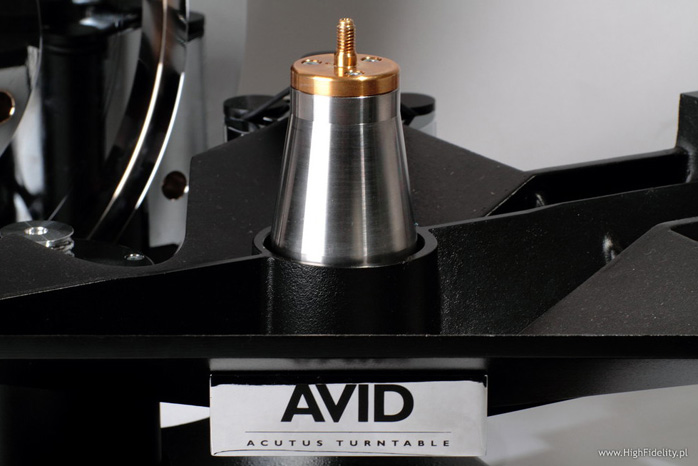
| The company states that the PSU took three years of development and adaptation for the Acutus Reference. It is based on a DSP controller for a quartz-based feedback loop. Torque is transferred directly to the platter with two short round belts. With the single belt of the Acutus, this already wasn’t very handy because the belt was placed not on the outer ring of the platter but a lower part with a lower diameter resembling a sub platter. With two belts which kept falling off, this was very annoying. The platter weighs 10kgs and is placed on a sapphire crown with a tungsten carbide ball bearing. This bearing is placed in a heavy metal cone to which bolts the spindle with a brass coupler. | ||
 |
||
| The platter then gets placed over the cone. The top of the platter is covered with a vibration damping material and the record is clamped with a bolt-on clamp. It is not easy to use and made from two elements, the weight and the screw-on clamp. However the clamp is mandatory as the cone in the middle is higher than the rest of the platter. The records must be clamped. Unfortunately this also eliminates the usage of Feickert tools to calibrate tone arm and cartridge (I have those). We need to use the simple protractors supplied by SME for their tone arms. | ||
 |
||
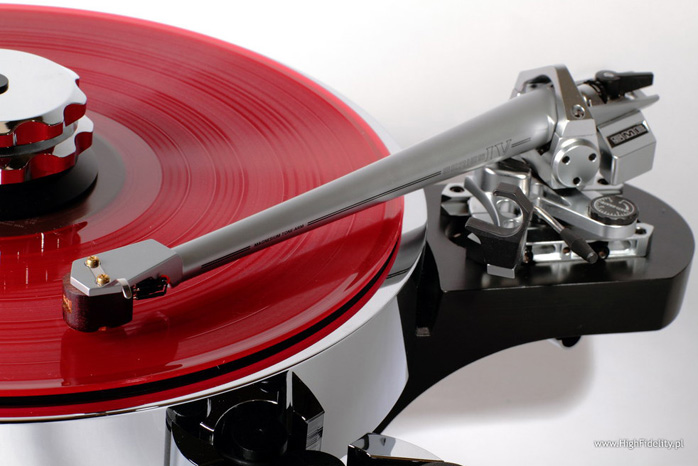
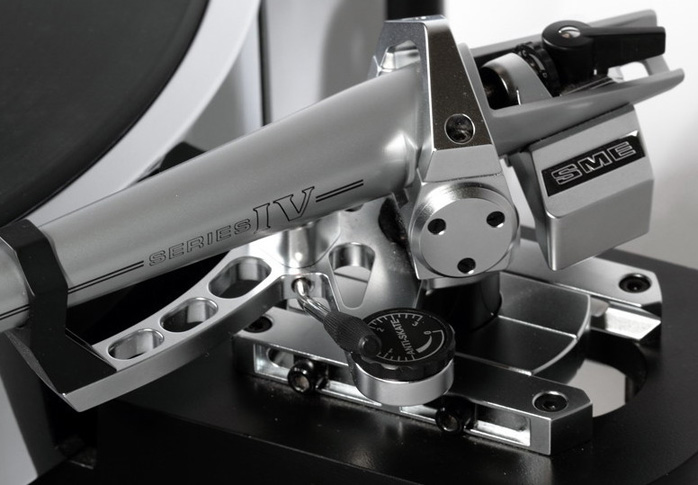
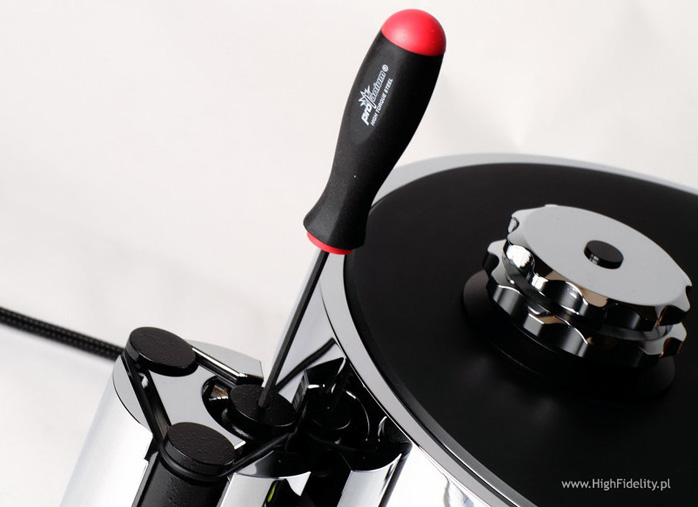
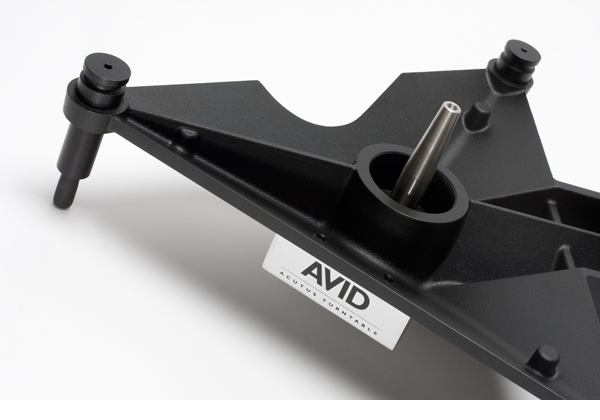
| On the side of the sub chassis there is a protruding arm board prepped for SME arms. For review the turntable was equipped with the fantastic model IV but other boards are available upon request. Leveling the sub chassis is done by adjusting the springs with the long key supplied. The entire deck is beautifully crafted although the chrome-plated elements require frequent cleaning. The turntable is also available with gold-plated elements and one could purchase a fitting gold-black version of the SME V arm. | ||
| Avid’s Pulsare phono preamplifier looks extremely elegant. It is split into two aluminium enclosures of equal size. The fronts use thick brushed aluminum faceplates. The main unit has four knobs with milled edges similar to the turntable and power supply feet. The first knob selects the input – RCA, balanced RCA or XLR. The second selects the gain with four settings – MM, MC (low), MC (mid) and MC (high). The third selects the resistance load – 10-30-100-300-500-1k-5k-10k-47k; and the fourth the capacitance load – 20nF, 10nF, 1.5nF, 500pF, 200pF and 100pF. A red LED indicates power status. | ||
 |
||
| On the back there are RCA and XLR i/o ports, a grounding post and a power socket (DIN type). All sockets are of high quality. Unfortunately I could not open the unit without damaging it to report on the insides. The power supply only has one red LED in the front. The mechanical power switch is placed on the bottom plate close to the fascia. On the back there’s only an IEC power inlet. |

Avid Acutus Reference Turntable

A bit of youthful dabbling with grass aside, I’ve never much been into drugs and have no idea what narcotic withdrawal feels like. But I experienced what I imagine it might be like last year, when for a period of several months I went through what I came to call “analog withdrawal.”
I was scheduled to receive Redpoint’s latest top-of-the-line Model D shortly after the 2006 Consumer Electronics Show, along with Graham’s red-hot, topof- the-line Phantom arm. For a variety of reasons—machining challenges at Redpoint, sky-high demand for the Phantom—that project was delayed five months. Not then knowing when these items would materialize, I was pleased when Music Direct offered me for review a top-of-the-line turntable it imports, the British-made Avid Acutus Reference.
But wouldn’t you know it. No sooner had Music Direct shipped me the Avid, along with an SME V arm and Mobile Fidelity’s new Carbon 3.5 mc cartridge, than Redpoint’s Peter Clark called to say he was ready to visit with the Model D and was also bringing along Graham’s elusive Phantom. Talk about raining and pouring!
Although having two superb playback rigs on hand (along with my reference Tri-Planar VII arm and Transfiguration Temper V and Air Tight PC-1 cartridges) is not exactly what I would call a hardship, dabbling with the minutiae of fine analog adjustments can be just as mind-altering and motor-skill challenging as smoking a bowl of the green stuff. Er, at least as far as I can recall.My review of the Redpoint Model D and Phantom will appear in a special analog feature we’ve slated for Issue 172. Today, it’s all about the Avid.
Though it is now a ten-year-old company, you could say that Avid really began 29 years ago when its founder Conrad Mas began to seriously consider what makes a good—and not so good— turntable. As Mas pithily explained it in a lengthy transcontinental telephone conversation: “When I was 16, a friend of mine proudly showed me a turntable he’d just bought. I thought it was rubbish.” Over the next several years Mas did what comes naturally to any well-adjusted youth—he started buying and tinkering with a variety of turntables. But after about five years of this, Mas decided it was the wrong approach, because it was all in the context of his system, and therefore subject to the variables and imperfections of the other components he was using. “A lot of people don’t know what they’re doing,” he told me, “so they simply follow what others have done, thus repeating the same mistakes. I sold everything, my entire system, and started from scratch.” Getting down to basics, Mas took out a sheet of paper and started thinking about how a turntable should work. In the meantime, he held various day jobs to support himself and his family, including a lucrative gig in the insurance industry.
 As Mas sees it, the challenge of designing a turntable is “like a jigsaw puzzle, each piece must be perfect— and work perfectly together.” The basic Acutus ($13,000), with its regular power supply, was the first Avid product Mas designed, and remains the template for all other models: From the Diva ($2500), to the Volvere ($5000), to the Sequel ($8000), to the Acutus Reference ($19,000), they share the same design philosophy, bearing, and suspension (see avidhifi.co.uk, for detailed descriptions of each design).“You see,” he continued, “most audio companies start with an engineering background. But I started in audio, and the engineering came later.” (Like another English firm, SME, Avid now also does engineering work for other audio firms, as well as the medical field. It exports to 36 countries.)
Mas’ research led him to identify what he sees as two schools of turntable design. One he calls, “The ‘Felt Mat Brigade’— the Linns, Regas, etc., with their muddled bottom end response caused by the whole assembly vibrating during playback.” Akin, says Mas, “to attempting to walk on a narrow carpet while people are pulling at it from either side.” The next is the “‘Plastic Platter Brigade’—Clearaudio, etc., which seems to think that vibrations sink into the platter as if into a black hole, which is absolute rubbish, because at some point the platter becomes like a sponge—it gets saturated, and then reflects resonance back up to stimulate the record, stylus, and arm. Which is why, you’ll notice, acrylic platters keep getting thicker.”
On the subject of resonance, Mas accepts it as a fact of LP playback: “So, the question becomes, how do you get rid of it as quickly as possible—like a drain? It’s like a circle: arm/cartridge/platter/ bearing/subchassis/arm again.” In order to “drain” resonance from his playback system, Mas intentionally allowed for weak areas in the subchassis. The Acutus’ W-shaped subchassis has three folds, which, as with paper, makes it much stronger than a flat sheet. The subchassis’ most rigid point is between the arm mount and the bearing; the single fold at the three suspension points is somewhat less rigid, while the front and motor areas are relatively weak, creating exit points for vibration. The front area and motor points are relatively weak, creating exit points for vibration. And because bearing and arm resonances are quickly absorbed into the subchassis, Mas recommends using arms with rigid bearings on his ’tables. Fans of unipivot arms such as the Phantom should probably look elsewhere.
The Acutus’ single-piece castaluminum subchassis is free of add-on damping materials, because Mas found that they tame high frequencies in a nonlinear fashion. Instead, Mas uses the high granular content of the metal to damp low frequencies, while the finishing paint bonds with the skin of the aluminum, dissipating high-frequency resonance. Mas also recommended that I use no damping fluid in the SME V’s arm trough, because it “kills the highs.” This notion was easy enough to test, because the SME V’s threaded damping paddle can be quickly adjusted in and out of the fluid-filled trough. I tried it both ways, using a record I know well, Nathan Milstein playing the Bach Sonatas and Partitas for solo violin on Deutsche Grammophon. Without damping, Milstein’s Stradivarius seemed much more present and “alive”; his bowing and fingerwork were significantly more precise and dynamically defined. With damping, things were smeared and dull-sounding.
As you have no doubt gathered, Conrad Mas has many strong opinions on turntable design (and, I would venture, pretty much everything else, though I’ve yet to break bread with the man). On the subject of unsuspended turntables, Mas feels that ’tables lacking suspension allow environmental events—footfall, sounds from a speaker, a truck on the street—to be transmitted as smear or some other form of sonic clutter (this is why people use Vibraplanes and the like). Avids are designed to be isolated in their own environments, and are therefore less sensitive to the platforms they are placed on.
I had a chance to test this theory, too, because there is only one surface in my room that can support the Redpoint Model D’s 150 pounds. Naturally, it happened to be the same surface the Avid was set up on when the Redpoint arrived—a hunk of slate that sits atop a Finite Elemente “Spider” rack. With no alternative at hand, I pressed into service a small metal side table that perfectly fit the Acutus’ footprint. I moved and readjusted the ’table, and sure enough, there was no readily discernible difference in the unit’s performance from one platform to the other. This no doubt has something to do with the Acutus’ 2Hz isolation frequency. To drive the point home, Mas has been known to demo the turntable at hi-fi shows while playing it atop a live subwoofer.
Each of the Acutus’ three springs is the same but adjustable so that the frequency of movement is the same independent of load. When everything on the ’table is level—spring adjustments are accessed through holes in the towers—the entire assembly moves up and down in true pistonic fashion. Rubber O-rings fixed to the three towers work as lateral damping, and quickly return the platter to the vertical plane. Avid owners can amaze friends with this analog parlor trick: Begin playing a record, then press your index finger down on the top of the record clamp; as the assembly gently and evenly bounces up and down, the cartridge stays locked in the grooves, playing on without a care.
The stainless-steel inverted-bearing shaft is tipped with a single-point selflubricating tungsten-carbide ball that sits in a sapphire cup. Once the 25-pound, chrome-plated platter is in place, a clamp effectively couples an LP to the bondedpolymer mat, which was designed to decelerate vertical energy, while reflecting horizontal energy back into the LP.
On the subject of motors, Mas firmly believes that a tiny motor with a big platter equals bad sound. “The motor should control the platter, not the other way ’round,” he said. To give this some perspective, Mas told me the Linn LP12 Motor is 12mN.m (millineuton meters), the SME 30 motor is 14mN.m, while the Acutus’ hand built 24V AC synchronous motor is 140mN.m, or 10x more powerful than the norm. The motor is housed in its own pod and nestles just behind the front-left spring tower. A seamless round belt was chosen to avoid cogging effects from the powerful motor as well as for speed accuracy—flat belts can ride up and down, causing speed problems—and affixes to a subplatter that’s machined in the platter’s underbelly.
By the way, the difference between the regular Acutus and the Reference is all about the power supply. The Reference uses a massive split-phase quartz-locked unit that is said to greatly improve performance at the frequency extremes, while lowering noise and increasing dynamic range. This is also where one powers up the unit and selects speed.
When we’d finally exhausted all parameters of the exquisitely made Acutus, Mas finally said, “That’s all well and good, but the bottom line is what happens when you listen to it.”
True enough. And over the five months I’ve lived with the Acutus Reference it has proved to be one of the most pleasurableto- operate and finest-sounding turntables I’ve ever encountered. Its character is notably invisible. What it seems to do is allow whatever phono cartridge you mount on it to speak its voice. (I’ll explore this further in the next issue, when I review the Mobile Fidelity Carbon 3.5 supplied for this review, as well as Air Tight’s astonishing PC-1.) Naturally, this level of transparency applies to LPs as well, and do keep in mind that although I listened to two different cartridges on the Avid, the only arm I auditioned was the excellent SME V, whose own character leans just a tad to the dark side of the spectrum. Hearing Johnny Cash sing “First Time Ever I Saw Your Face,” from American IV: When the Man Comes Around [American/Lost Highway], revealed a few more things about the Avid. For one, groove noise on this turntable is extremely low, particularly when paired with the Air Tight PC-1, which in my experience is simply unequaled in this area. Next was the Acutus Reference’s way of digging down to reveal production details. Producer Rick Rubin deliberately swathed Cash’s voice in a gigantic halo of reverb, and over the Avid it came across as never before—as if an electronic nimbus were surrounding his head, which seemed to hover like that of the Wizard of Oz, several feet behind, just above, and smack in between my Kharma Mini Exquisite speakers. Most importantly, though, the Avid delivers the emotional goods—Cash’s raw, broken voice, drenched in a church-like reverb, the dirge-like insistence of two strummed acoustic guitars, and the swell of the funeral parlor organ burrowed into your soul like grief itself.
Lowering the stylus into the 45rpm pressing of Monk’s Brilliant Corners [Analogue Productions/Riverside], the slightly hesitant opening theme of “Ba-lue Bolivar Ba-lues-are” gives way to a series of solos by each band member. As each player improvises the theme, the Avid brought forth a powerful sense of their instruments’ presence and musical force. From the reedy swoop of Ernie Henry’s alto sax, to Monk’s at first plinkity-plonk then fluid piano playing, from Sonny Rollins’ tenor run that pokes around a bit before launching into brilliant improv, to Oscar Pettiford’s bass solo, which seems not just grounded to the floor but rooted to the very earth, to Max Roach’s drums—delivered with a transient snap and dynamic force we hope for but so rarely get from our systems.
Finally, Hans Werner Henze’s 1973 composition Tristan [Deutsche Grammophon] runs from calm passages for solo piano and the breath of a few woodwinds, to nearchaotic stretches for full-throttle orchestra that include the clamor of high-pitched percussion and woodwinds, strings that are bowed and plucked as well as tapped and scraped with bows, and all manner of violent-sounding taped sounds, with quotes from Wagner’s opera and the Brahm’s First thrown in for good measure. The Acutus Reference & Co. tracked these unusually challenging grooves as if they were lullabies. It also displayed a special ability to pull the minutest details of technique and timbre from the grooves, to never lose a single thread of this highly complex music, to display a dazzlingly beautiful array of tone colors, to carve out a most impressive soundstage of tremendous depth, width, and height, to project dynamics with a convincingly lifelike range of no apparent limits, and to recreate a piano’s sound with exceptional presence, lengthy decay, and bold lower-octave chords with a persuasive sense of weight and power behind them.
AVID Acutus Reference SP Turntable
Unless you earn $2 million an episode, a la Charlie Sheen, $25k is a lot of change to spend on a turntable and tonearm, especially when adding a worthy cartridge and phonostage could easily double the sum. Taking economics into consideration, TONE receives plenty of email from readers with turntables in this range or considering a similar level of purchase. We get substantially fewer communiqués from listeners contemplating a six-figure turntable—now, that’s crazy talk.
To be certain, audiophiles opting to make purchases in these price ranges are well-heeled, yet most seem to be longtime analog lovers that are seeking out that “destination table.” They’ve owned a number of turntables and amassed a fairly substantial vinyl collection. Typically, $25k doesn’t constitute an entry-level price point for many vinyl aficionados; something is often sold or traded (maybe a jet ski or motorcycle) for the down payment, so the sting isn’t quite as severe.
While it’s easy to get carried away with any number of six-figure turntables, $25-$30k represents the sweet spot, and right where the AVID Acutus Reference SP lies. The ‘table itself lists for $19,995 and the SME V tonearm (which arrived pre-mounted on our review sample) bumps the price up another $5,495. The subchassis on comes pre-drilled for an SME tonearm, but adaptors for Rega, Triplanar, and a few others can be purchased from $100 – $225, depending on the version you require. Current Acutus owners can easily upgrade to the Reference SP—which incorporates AVID’s latest-generation digital-speed control, larger power supply, and two-drive belt system—for $6,400.
Save for a sold-out 10th Anniversary Model ($40,000) limited to just ten units, the Ref SP stands for all practical purposes as AVID’s top-of-the-line turntable. In case you’re wondering, AVID stands for “A very interesting design.” And since the Acutus served as AVID’s original turntable design, the SP Reference takes advantage of everything the manufacturer has learned during the past decade. AVID designer and director Conrad Mas explains that, a few years ago, he wanted to take the company and his products to an even higher level. “Rather than say that’s my product, take it or leave it, we listened very carefully to what our customers had to say and, bit by bit, addressed any issues they didn’t feel were best-in-class. We’ve taken this approach all the way to the packaging, with excellent results.”
 Everything is Jelly
While the Ref SP is AVID’s premier turntable, the entire line benefits from Mas’ design philosophies. He feels that it is essential for a turntable to get rid of the vibrational energy in the environment as well as that in the vinyl record itself. As he likes to say, “Everything is jelly at a certain frequency; you just can’t see it. The goal is to move the all of the vibration away from the cartridge.”
The subchassis is cast from a variable density, highly granular aluminum, which damps the mid and low frequencies most effectively while even the coating on the subchassis is specifically designed to reduce the skin tension of the aluminum casting, effectively dissipating the HF resonance. Rather than cast from a solid shape the area between the bearing and the tonearm mount looks as if it is folded, giving the shape more rigidity than a solid piece, yet having lighter weight. Mas comments, “This is the most important part of the subchassis, where rigidity is most critical.” The platter takes the same approach. Mas adds: “The chrome plating on the SP Ref isn’t for the bling factor, it’s functional. It does an excellent job at killing HF resonance. We’ve tried a number of different coatings, but when we did the measurements, nothing worked as well as the chrome plating. When we listened to the different finish options, the chrome sounded best by far.” Interestingly, Mas feels that the recent trend of 180- and 200-gram LPs is counterproductive. “What we want to do is evacuate the vibration of the record as far away from the stylus as fast as possible. A 200-gram platter stores more energy that the stylus will read and adds a veil to the sound.”
Most turntables concentrate the majority of the mass in the chassis/subchassis assembly. AVID takes a different approach with its units by making the platter the most massive component. Since there’s no heavy subchassis deflecting the bearing during vibration, bearing noise is kept to a minimum. This is the main reason that the Reference SP has such a low noise floor. In addition, a polymer disc is bonded to the 10kg aluminum platter has a specially designed polymer mat bonded to it which reflects vibration created by the stylus during playback, this being channeled through the bearing that the record is mechanically grounded to.
This differs from plastic platters that store vibration or felt mats that allow the records to vibrate causing mistracking. Mas feels that a suspended ‘table represents the optimum in vinyl playback design because the springs can be tuned to a specific frequency, again effectively isolating the important stylus from outside vibration. In the vertical axis, AVID’s suspension is tuned to 2.5Hz, a factor of two lower than the average cartridge/arm compliance frequency. By comparison, a seismograph, tuned to measure the vibration of the Earth, is at .5Hz.
The Opposite Approach
The main advantage of direct-drive turntables relates to the amount of on-hand torque; by comparison, to minimize the motor’s control on the platter, belt-drive ‘tables rely on wimpy motors coupled to a tiny belt. Flying in the face of convention, AVID utilizes a powerful motor to drive the platter, thus offering more control. Belt-drive owners also likely notice the fairly pokey start-up. Not so the Ref SP. It starts quickly, just like a direct-drive broadcast table!
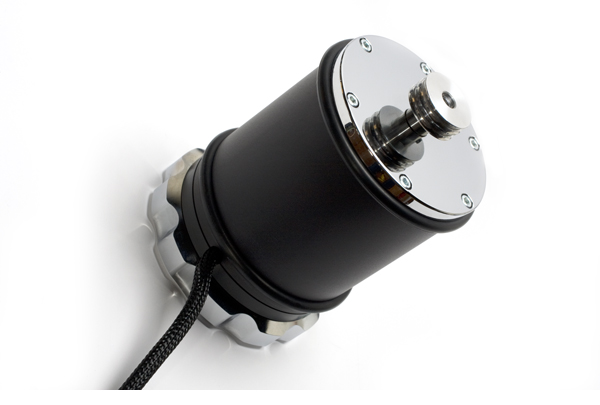 AVID hand-builds the motors in its factory, where they are then hand-tuned to the individual power supply that will be shipped along with the turntable. In the case of the Ref SP, the power supply alone weighs 42 pounds (19kg.) and features a 1KV power transformer. As I unpacked the box, I honestly thought the company made a mistake and shipped me one of its new power amplifiers instead. Tradition aside, the approach works flawlessly. A cursory check of the speed with the Acoustic Sounds test record and digital multimeter revealed perfect accuracy: 1000Hz on the nose.
Setup
The Ref SP requires some assembly, but thanks to the concise manual, you should be up and running within about 30 minutes, even when working at a leisurely pace. As much as you will want to spin records as quickly as possible, a more metered set-up pace will give you an even greater appreciation for the care that went into the component parts.
Once the bearing ball is inserted and the main bearing gently slid into place, you can mount the 35-pound platter on the subchassis, making mounting and aligning your cartridge a much easier task than doing so with the whole ‘table assembled—a nice touch. This streamlines the set-up process, because you aren’t fighting the turntable suspension when trying to set VTA and such. It allows closer access to the area where the stylus meets the alignment gauge and, again, a higher degree of accuracy. AVID supplies an alignment protractor to help with the overhang alignment. Mas mentions that this step is “absolutely critical.” Which is exactly why the company spent the time and trouble to create its own alignment jig for the SME tonearms. (AVID also produces these for Rega and Linn arms as well as a universal version.)
The last bit of setup involves fine-tuning the suspension and placing the chassis onto a level surface. Once the subchassis is leveled with the supplied tool, the suspension is perfectly tuned to the proper frequency. The final act involves fitting the three O-rings to the suspension towers and attaching the two drive belts, the only tough part of the entire process. First, pause in order to focus your concentration. Fortunately, my chi was in perfect order. I slipped the belts on just right on my first attempt. An $80 syringe of silicone damping fluid that usually comes with the SME V is one lone thing missing from the Ref SP box. It’s not advised. The subchassis’ unique design moves the vibration straight away from the base of the tonearm mount, effectively into the subchassis.
 External damping is usually required when using a cartridge with too much compliance in an arm with too much mass, but the AVID’s low suspension frequency and clamping system eliminates the need for its use. “That’s why the SME arms get a bad reputation for wooly bass. Reflected vibration boosts bass and colors the midrange. It’s not the arm at all. And the non-linear damping in the vibration path, making up for the compliance mismatch, kills the high frequencies. Not so with our table.”
Having spent quite a bit of time with SME tables and tonearms in particular (I own four of them, from the vintage 3009 up to the V), I can assuredly state that the Ref SP is a completely different animal. If you didn’t think an SME arm could sound light and lively, guess again. Though I’ve always found SME arms slightly heavy-sounding,
their consistency and ease of setup has always made them a favorite. But with AVID’s ‘tables, there is no sonic compromise. Mas is definitely on to something.
Listening and Comparisons
While it is always difficult to actually describe the sound of any component without putting it into context, the Ref SP reminds me of a combination of my two favorite turntables: the Rega P9 and the SME 30. If you can imagine a ‘table with the weight of an SME 30 that also has the pace, timing, and speed of the P9, that’s the closest anyone can get to telling you exactly what the SP Ref sounds like.
Almost immediately, the Ref SP became the go-to mechanism in my stable of reference turntables. After a few days of comparisons, it was obvious that I could not live without it. It also meant that a couple of other turntables had to go. Its performance with grade A+ pressings was nothing short of amazing. But even with average pressings, like Emerson, Lake and Palmer’s Trilogy—a record I’ve heard hundreds of times since the 70s—revealed new tidbits. Listening to “Abaddon’s Bolero” revealed another layer of very quiet synthesizer playing at the beginning of the track. And as Greg Lake’s bass line entered, there was more texture—and the bass actually had a firm placement in the left channel. Playing the same track with the same tonearm and cartridge combination on my Oracle Delphi V spread the bass out almost evenly between the channels, with a significant loss of pace.
Staying in the classic rock vein and moving to the Classic Records pressing of Alan Parson’s I Robot also yielded a completely new experience. The background chanting in the title track possessed a chilling realism I’d never heard before, as it simply rose up and crept in and out of the forefront. Experiencing acoustic material proved equally great. Listening to Analogue Productions’ recently remastered Bill Evans The Riverside Recordings box set approximated sonic nirvana. “Polka Dots and Moonbeams,” from Moonbeams, starts gently. The ultra-low noise floor of the Ref SP brought the music up out of what seemed like nowhere; the tonality of the piano epitomized perfection. At the beginning of Rachmaninoff’s Piano Concerto No.1 in F sharp minor, Op. 1, the horns jumped right out of the soundstage in a way that they never have done in my system. Thanks to the additional dynamic range, the overall presentation felt louder since quiet passages were now significantly quieter.
Having performed a number of listening experiments with many turntable/cartridge combinations, I’ve arrived at the firm conclusion that a top-notch turntable with a modest cartridge will deliver more sound than a big-bucks cartridge on an inexpensive turntable. Even when using the Ref SP with the inexpensive Denon DL103R, I was consistently impressed at how much further I could hear into the cartridge’s capabilities. Hence, a device I considered somewhat lackluster in budget turntables turned in a stellar performance with the Ref SP. Moreover, all of the $5,000 cartridges I had at my disposal came across as relatively ho-hum (even when aligned to perfection) when mounted to a budget turntable—again confirming Mas’ analysis of how important every aspect of a turntable design is to playback. The Ref SP does a better job of extracting the music out of vinyl grooves than anything I’ve encountered—a job that is deceptively simple yet incredibly tough.
When listening to familiar records with the same cartridge (in this case, a Lyra Skala) mounted to both the Ref SP and my current reference, the Spiral Groove SG-2, the Ref SP’s additional dynamic punch became instantly apparent on heavy rock music, large-scale symphonic music, and everything in between. The ‘table’s ability to unravel the intricacies of complex recordings is simply phenomenal. What’s more, the rock-solid pitch stability and ultra-low noise floor offer up more than pinpoint imaging, painting tonal images in true three-dimensional space. Who needs multichannel when two-channel is rendered so clearly?
The Rabbit is in Hand
I’ve been chasing the analog rabbit for more than 30 years. I’d come awfully close to catching it in the past, but with the AVID, I finally got the rabbit by the ears. The Acutus Reference SP combines bespoke build quality, ease of setup, and stellar performance in a gorgeous package. What else could you possibly want?
Yes, this is the point in the review where the reviewer often says that they would “buy this ‘table if they could afford it and will really miss it when they send it back.” Not here baby. I love this ‘table; it offers by far the most enjoyable analog experience that I’ve ever had. Not only did I purchase the SP Ref, I bought two AVID tables, having also upgraded my Volvere to a Volvere SP.
The Acutus Reference SP is indeed A Very Interesting Design.
Related products
-
dCS Paganini – Complete set – Silver with Crystal Cable
Original price was: R1,450,000.00.R210,000.00Current price is: R210,000.00. Add to cart -
Cambridde Edge NQ DAC/Streamer/Preamplifier
Original price was: R129,000.00.R68,000.00Current price is: R68,000.00. Add to cart -
Audio Research CDT1 Transport (Silver)
Original price was: R55,000.00.R16,500.00Current price is: R16,500.00. Add to cart -
Marantz Reference NA-11S1 Network Audio Player/DAC
Original price was: R65,000.00.R17,500.00Current price is: R17,500.00. Add to cart