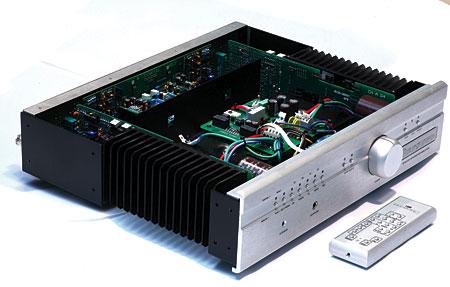
Over the years, I have used and enjoyed in my audio system large, single-purpose components. Each of these chassis has had but one role: preamplifier, amplifier, digital-to-audio converter (DAC), etc. I guess I’ve been just a little suspicious of products with multiple functions crammed into a single small chassis; I’ve figured that the designer may have cut a corner that could affect the sound.Which brings me to the topic of this review, the Bryston B100-DA SST, which is three separate components in one slim chassis: a DAC, a preamplifier, and a 100Wpc power amplifier. (An MM phono module is also available.) Has serving all of these different functions compromised its sound?
There was another reason I was curious about the B100-DA SST. Its optional DAC made it very easy to use with a new type of audio component: the networked music player. Such devices—Slim Devices’ Squeezebox and Roku’s Soundbridge 1000, for examples—can stream digital music from the excellent Internet radio stations praised by Sam Tellig and Wes Phillips, or to a centralized digital music library, as extolled by John Atkinson. The B100-DA SST also avoids the need to use the often mediocre DACs found in some network players, and eliminates from the analog signal path the extra jacks, plugs, and connectors required when using an external DAC.

Internal components
The power-amplifier section of the B100-DA SST ($4395 as reviewed; I didn’t specify the phono option) is based on the 2B-SST, Bryston’s 100W basic two-channel power amp. It offers dual-mono architecture with two 250VA toroidal transformers; a third, smaller toroidal helps power the B100-DA’s digital module. The amp contains over a dozen regulated or stabilized voltage supplies.
Removing the B100-DA’s top panel revealed excellent build quality: minimal point-to-point wiring, high-quality resistors and capacitors, and thick, double-sided, glass-epoxy printed-circuit boards with clear markings. The B100-DA’s analog preamplifier uses multiple-pole relays to switch sources, and an integrated resistance network is used to control the unit’s volume. All analog signal circuits are fully discrete and Bryston uses 0.1% metal-film resistors, polystyrene capacitors, and selects and matches transistors by hand to keep noise and distortion to absolute minimums.
The B100-DA’s DAC is described in an article written by one of the company’s customers, Jeff Switzer, that appeared in Vol.8 No.3 of the company’s online newsletter . A digital signal input through the S/PDIF jacks on the B100-DA’s rear panel is fed via impedance-matching transformers to a Cirrus Logic C58420 digital interface chip. This reduces jitter and upsamples the data from 16-bit/44.1kHz to 24/96. As Switzer states, “the upsampling process doesn’t add any new data to that which came off the CD but it puts the data in a form which can better be used by the DAC.” Another advantage is that a “new clock signal is applied which causes a significant reduction in jitter.”
The D/A conversion is handled by a Crystal CS43122 chip. A digital low-pass filter is applied to the signal before its conversion to analog, and an analog filter afterward. The DAC’s performance is tightly regulated by a separate filtered analog power supply with carefully routed grounds. The same circuitry can be found in Bryston’s SP 2, the five-channel preamplifier and digital processor reviewed by Kalman Rubinson in his “Music in the Round” column in September 2006 (Vol.29 No.9). The only difference is that the B100-DA’s DAC reclocks and resamples the digital input.
The B100-DA is built to last. Each unit must survive a 100-hour factory burn-in in which a squarewave input signal drives the amplifier into a load capacitor at slightly under clipping for one hour, followed by one hour off, and so on. This load is designed to draw the amplifier’s maximum current delivery on the squarewave’s rising leg. Unlike a resistive load, which dissipates all the energy as heat, the capacitor feeds back the entire signal into the amplifier, which puts maximal stress on the output stages. This heats the amplifier, cools it, and heats it again. This expansion and contraction exposes any loose connections or devices subject to early failure. After burn-in, each B100-DA is bench-tested, and those results are shipped with the unit.
Such overengineering, extensive burn-in, and building to the stringent, constant-use demands of professionals allow Bryston to offer its unique warranty program: Bryston will pay parts and labor costs, plus shipping one way, for the first 20 years of ownership (except for the digital circuits, which are warranted for five years, parts and labor).
Rear-panel connections, front-panel controls
At each end of the B100-DA’s rear panel are pairs of speaker terminals. Between them are 10 unbalanced analog RCA input jacks per channel, configured in two rows of five each for each side. There is also rear-panel access to the drive circuits for outboard infrared LEDs, and a bidirectional RS-232 data connector for downloading from Bryston’s website. Below this is a 12V remote trigger output, and next to it an IEC 320 AC power inlet. A single Connected/Separate switch next to each channel’s input bank lets the user internally connect or disconnect the preamp to/from the power-amp section.
Digital streaming music up to 24/96 can be fed to the B100-DA’s S/PDIF coaxial inputs or TosLink optical inputs, which are found near the center of the rear panel. The innermost bottom RCA jacks are designated D1 (S/PDIF coax 2 among the left-channel sockets) and D2 (S/PDIF coax 2 among the right). In the middle of the rear panel are two TosLink optical input jacks, designated D3 and D4.
On the B100-DA’s front panel one finds, on the left, a row of seven pushbuttons, above each an LED. These 7 buttons are labeled along the bottom, from left to right: Aux 2, Aux 1/Phono, CD, Tuner, TV, Video, Rec. Pressing the leftmost pushbutton, Aux 2, activates the B100-DA/s internal DAC, causing its LED to turn green. When the LEDs of D1 (S/PDIF 1 source), D2 (S/PDIF source), D3 (TosLink 1 source), or D4 (TosLink 2 also glow green, this indicates that a PCM digital bitstream is present. If no bitstream is available, or if the bitstream is incorrect (ie, not PCM), the LED will turn red. Pushing Aux 2 again toggles its light off and puts the B100-DA in analog mode. This means that only one source LED of the remaining six input-selector buttons will be illuminated, indicating the exact analog source. The large, anodized, motorized master volume knob can be operated via the remote control in both analog and digital modes. Also on the front panel are the headphone jack, IR sensor, and pushbuttons for Balance, Mute, Clip, and Power.
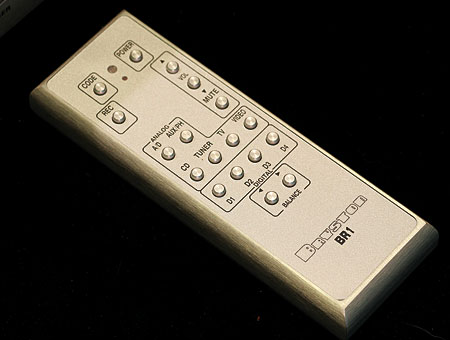
Bryston offers the B100-DA’s remote control as a $400 option. Although I grumbled at the thought of having to pay for a remote, I changed my tune when I held this full-function example in my hand: it’s very well made, its brushed aluminum is highly attractive, and it controls everything: selection of any source, volume up/down, mute, balance, power off/on, and discrete code entry. Its backlighting is even triggered by a motion detector—it lights up as soon as you pick it up. This is the most attractive and cleverly designed remote control I’ve seen for a high-end audio product. If you buy a B100-DA, definitely get the remote as well.
Music Serving
As I said, I chose to review the DAC-equipped B100 so I could use it with my network music player. I use a Slim Devices Squeezebox network player ($299) placed atop my Krell KRC-28 CD player, connected via a WiFi link to the D-Link DW 624 router sitting in the kitchen, about 20′ away. The music is stored on a IBM X-30 laptop, which sits one floor below in my office, which is also connected wirelessly to my WiFi network. (I use a DWL G800 AP D-Link signal booster.) I connected the Squeezebox’s S/PDIF output to the B100-DA’s D1 S/PDIF input, using a 1.5m length of Wireworld Starlight digital coaxial cable.
I then installed the Slimserver software on my laptop and used Windows Media Player v.10 to rip tracks from my favorite music CDs as Windows Media Audio (WMA) Lossless files— ie, the best sound quality, which requires 206–411MB of hard-drive space per CD. The Slimserver software (v.6.5.0, downloaded from Slim Devices’ website) allowed me to gather these lossless music files into a playlist I titled “Stereophile Music CD Test Program.” For the listening tests, I also downloaded Beethoven’s Symphony 9, with Wyn Morris conducting the London Symphony, from the iTunes website (footnote 1).
Returning upstairs, I remotely browsed my laptop’s music folders via the Squeezebox until I found the My Music directory and the “Stereophile Music CD Test Program” playlist. During my audition of the B100-DA, I selected various tracks from this playlist from my listening-room chair, using the Squeezebox’s handheld remote. I also used the free subscription to Pandora.com supplied with the Squeezebox to set up my own Internet radio station to play Keith Jarrett recordings over my system.
Setup
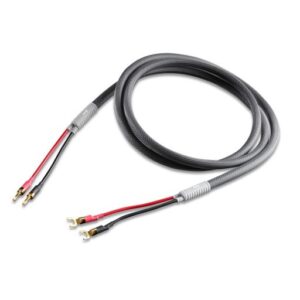
The B100-DA SST’s chassis is slim, and smaller than that of the Bryston 4B-SST power amplifier, with which I compared it. My components are mounted on a long sidewall, the amplifiers situated out in the room behind my Quad ESL-989 electrostatic loudspeakers. I had to think about just where I would place the B100-DA: with the source equipment on the shelves, or with the amplifiers? The former required very long runs of speaker cable from the sidewall shelves to the speakers, the latter long runs of interconnect from the SACD player, CD player, and tuner—or a Manley Skipjack source switcher. I decided to put the B100-DA and Squeezebox on my equipment shelf and run long speaker cables to the Quads.
Despite the B100-DA’s relatively small chassis, its speaker terminals are still large enough to make speaker-cable connections tight and fast. As on other Bryston products, the B100-DA’s hollow posts can directly accept single banana plugs, even though they’re also placed the requisite 19–25mm apart to meet EU regulations. The posts are also shrouded in plastic to keep fingers from directly contacting the metal. Slots in the shrouds accommodate spade lugs up to 5/16″ thick.
Listening
After burning in the B100-DA SST by having it drive my Quad ESL-989s, I began feeding its DAC digital signals from my Krell KRC-28 CD player and the Slim Devices Squeezebox, which let me compare CD and wireless sources. Listening to “Too Rich for My Blood,” from Patricia Barber’s Café Blue (CD, Premonition/Blue Note 5 21810 2), I could detect no difference between the digital outputs of the Krell playing the CD and the Squeezebox playing the losslessly compressed file of the same track through the B100-DA’s internal DAC—but both digital sources were decidedly better than the SB’s internal DAC feeding an analog signal to the B100-DA. For the bulk of my listening, I listened only to streaming digital files fed to the B100-DA.
Through its own internal DAC, the B100-DA’s bass response reminded me strongly of the Bryston 3B-ST‘s. I enjoyed the solidity of the sustained pedal chords from the Lay Family Concert Organ in John Rutter’s “The Lord Is My Light and My Salvation” (CD, Reference RR-57CD), and the staccato plucked bass and deep synthesizer in “Something’s Wrong,” from Randy Edelman’s score for the film My Cousin Vinny (CD, Varèse Sarabande VSD-5364). The synthesizer notes in Terry Dorsey’s “Ascent,” from Time Warp (CD, Telarc CD-80106), were well defined and went deep, and I could easily discern pitch changes in low-frequency synthesizer notes on “Behind the Veil,” from Jeff Beck’s Beck’s Guitar Shop (CD, Epic EK 44313).
Besides reproducing deep bass, the B100-DA could create a sense of depth and space that seemed an accurate facsimile/re-creation of the recording venue. This was evident when I listened to Jean Guillou’s transcription for pipe organ of Mussorgsky’s Pictures at an Exhibition (Dorian DOR-90117)—in Gnomus, the organ was reproduced with the airiness I associate with a cathedral. The B100-DA could also create more intimate ambiences, such as the one heard surrounding Glen Moore’s plucked string bass in “The Silence of a Candle,” from Oregon’s Beyond Words (CD, Chesky JD130).
Playing the digital stream, the B100-DA’s highly satisfying performance captured the different timpani pitches in Stravinsky’s The Rite of Spring, as performed by Eiji Oue conducting the Minnesota Orchestra (CD, Reference RR-70CD, tracks 21–24). The B100-DA tracked the pitch and dynamic contrasts heard on this excellent recording, coaxing surprisingly deep bass from the Quads. The Bryston’s midrange reproduction was most impressive—the brassiness of trumpets, for example, was raw and involving without being annoying.
The B100-DA revealed the richness of Patricia Monheit’s dark voice in her rendition of the 1941 torch song “Besame Mucho,” from The Frank and Joe Show’s 331/3 (Hyena SD 9320). This track was just as enthralling for its “seductive timbral voluptuousness,” as John Marks described it in “The Fifth Element” in the April 2006 issue. The B100-DA also conveyed the beguiling sadness and sweetness of Richard and Linda Thompson harmonizing on “Dimming of the Day,” from the soundtrack of Divine Secrets of the Ya-Ya Sisterhood (CD, DMZ/Columbia CK 86534). Paul Simon’s voice remained clear and warm at high volumes as he sang “Trailways Bus,” from Songs from The Capeman (CD, Warner Bros. 46814-2).
The B100-DA’s highs were clean, open, effortless, grain-free, and extended. Paul Simon’s vocal sibilants at the beginning of “Trailways Bus” didn’t hiss, but were natural, not irritating. Billy Drummond’s brushed ride cymbal in “The Mooche,” from the Jerome Harris Quintet’s Rendezvous (CD, Stereophile STPH013-2), had the characteristic buzz and shimmer of wire brushes, not the static-like hiss heard from lesser amplifiers.
The B100-DA’s imaging was delightful. Patricia Barber’s voice was holographic and riveting on “Too Rich for my Blood,” the instruments behind her clearly separated and occupying their own spaces. In Ariel Ramirez’s Misa Criolla (CD, Philips 420 955-2), tenor José Carreras was centered, surrounded by huge amounts of space that helped conjure up an empty, desolate ambience of solitude and desolation. Live recordings also benefited, as revealed by the intimacy and relaxed atmosphere of the Green Mill nightclub, where Patricia Barber recorded Companion (CD, Premonition/Blue Note 5 22963 2). The width of the Bryston’s soundstaging was also impressive, as I heard when I played the instrumental finish of Richard Thompson’s “Why Must I Plead,” from Rumor and Sigh (CD, Capitol CDP 7 95713 2). The B100-DA was able to move the guitar’s image well beyond the outer edge of my right-channel Quad ESL-989.
The dynamic range was very good to excellent. In “The Hand-Off,” from James Horner’s soundtrack score for Sneakers (CD, Columbia CK 53146), the piano scales exploded out of dead-black silence. And while not as dynamic-sounding as the Revel Salon speakers, my Quads when driven by the B100-DA captured the explosive rim shots, tom-tom beats, kick-drum notes, and audience callouts during the drum solo in “The Maker,” from Emmylou Harris’ Spyboy (CD, Eminent EM-25001-2).
Conclusions
I’m excited about Bryston’s B100-DA SST integrated amplifier. Not only is it a rugged and reliable amplifier with a 20-year warranty, it’s small, compact, and with the DAC option, it will integrate well with an audio system based on a centralized, wirelessly delivered music library. Whether playing music from a hard drive, or downloaded, or streamed from such services as Pandora.com or Rhapsody.com, the owner of a B100-DA will be able to tap an excellent sonic source.
Sonically, the B100-DA has much of the 4B-SST’s character, with its bass definition and speed, openness of high frequencies, and soundstage width, lacking only the 4B-SST’s deep-bass punch and greater macrodynamics.While it’s easier to warm up to an amplifier with a seductively captivating midrange, such as the much more expensive VTL S-400 ($20,000/pair), the B100-DA is much more neutral and can also throw one of the deepest, broadest soundstages of any amplifier I’ve heard.
And for streaming digital sources, I’ll take the B100-DA’s tonal neutrality, conveniences, small size, easy installation, built-in DAC, and backlit remote. Combine all of those features with the B100-DA’s bass definition, wide soundstaging, and open highs, and I can hear the music’s subtlest details through my Quad ESL-989s. Like Bryston’s own 14B-SST and 4B-SST, their little B100-DA SST integrated amplifier connects me to what I truly love in my music collection, and proves that multiple audio functions can work well in a small package.
Bryston B100 SST Integrated Amplifier
by Philip Beaudette
|
|
Review Summary
| Sound |
“The B100 SST gives the sense of hearing everything on a CD…. The background was dead silent as the noise floor dropped to a level of inaudibility.” “Bass reproduction was absolutely sublime.… The B100 SST has changed my perception of what good bass should (and can) be.” |
|
| Features |
Integrated amp “rated at 100Wpc into 8 ohms and 180Wpc into 4 ohms. As is Bryston’s way, this is a conservative rating. The company goes to great lengths to ensure that all of its products exceed their quoted specifications.” “Bryston is a firm proponent of using fully discrete circuitry rather than integrated circuits…. Hence, the B100 SST’s circuitry is fully discrete.” |
|
| Use |
“The appearance and feel of this integrated amplifier make it obvious that it’s built to last as long as its 20-year warranty would suggest.” “It’s difficult to attach a single adjective to the sonic character of this integrated, but the one that best describes it is ‘neutral.’ The B100 SST is a chameleon. It takes on the character of whatever disc is in the CD tray and has very little sound of its own.” |
|
| Value |
“Although the NAD C372 does many things very well and performs to a very high standard at its price, the Bryston B100 SST improves on all of these and performs to a very high standard, period.” |
|
|
|
In previously published reviews, I’ve mentioned that I developed an interest in high-end audio while in college. As such, there were (and still are) limitations regarding the components I could afford. It’s difficult to aspire to audio’s state of the art when there’s tuition that needs to be paid. But I’m hardly alone in this regard. I suspect most audiophiles are in the same position. All of us are looking for the most cost-effective means of acquiring the sound we want, but we also have bills to pay. This presents a challenge that requires knowledge of the market, but doing such research is a part of what makes this hobby so much fun.
I didn’t know what to expect when I got the opportunity to review an integrated amplifier from the Canadian manufacturer Bryston. I was familiar with the company, but as a graduate student on a limited budget, Bryston products were beyond my means. Prior to reviewing the $2995 USD B100 SST, I wondered how much better an integrated amplifier could be than my reference. The answer came as a surprise, and it has forever changed my perception of what is possible with musical reproduction.
Built first to last
Bryston Limited is the oldest independent audio manufacturer in Canada. Formed over 40 years ago, Bryston has earned great respect and numerous accolades in Canada and around the world. If you want to read more about Bryston’s history as well as their manufacturing and design philosophies, have a look at the Bryston Factory Tour article posted in our Features section.
While I won’t rehash what appears in that article, I will state that Bryston gear is nearly bulletproof. The appearance and feel of this integrated amplifier make it obvious that it’s built to last as long as its 20-year warranty would suggest. Its simple appearance and beautiful silver faceplate instill a sense of pride in owning something that is clearly the product of exceptional craftsmanship.
The B100 SST measures 19″W x 4 1/2″H x 10 1/2″D and weighs 19 pounds. To give the integrated a slimmer profile there is also the option of a 17″ faceplate rather than the 19″ one supplied with the review piece. You can also choose to outfit the B100 SST with a black faceplate rather than the silver. I preferred how the silver faceplate matched the brushed aluminum baffle of the PSB Platinum M2s I used for this review.
Bryston’s B100 SST is rated at 100Wpc into 8 ohms and 180Wpc into 4 ohms. As is Bryston’s way, this is a conservative rating. The company goes to great lengths to ensure that all of its products exceed their quoted specifications. Each channel has its own toroidal transformer. This prevents any chance of signal crosstalk between the channels.
Bryston is a firm proponent of using fully discrete circuitry rather than integrated circuits. In Bryston’s view, ICs are inherently prone to phase problems and non-linearities that are avoided when discrete signal pathways are used. Hence, the B100 SST’s circuitry is fully discrete. Even the optional onboard DAC benefits from its own power supply and is directly connected to a pair of proprietary Class A Discrete Operational Amplifiers rather than the IC chips one typically finds in other products. According to Bryston, this improves resolution and dynamic headroom.
Aside from a solid feel and ample power reserves, flexibility is another of the B100 SST’s strengths. There are four sets of line-level RCA stereo inputs, one set of RCA stereo outputs, and one stereo tape loop. There is also the option of adding an onboard digital-to-analog converter to which four stereo devices may be connected. This has two optical and two coaxial inputs. The review piece was supplied with the onboard DAC, a $1000 option (see sidebar). Furthermore, you can also order an internal moving-magnet phono stage ($400).
Altogether, the B100 SST is a highly versatile one-box solution for those wanting to play back their entire music collections regardless of the medium on which it has been stored, but who do not want to be bothered with buying separate components to handle all of the necessary functions. However, even if you want to experiment with a different amplifier or preamplifier, this is possible because the B100 SST boasts pre-out/main-in jacks.
A full-function remote control adds $400 to the B100 SST’s price. I was fortunate to have one of these sent along with the review sample, and I was shocked when I held it for the first time. The remote is hewn from a solid piece of aluminum and weighs about one pound. Furthermore, it can be programmed to be backlit under poor lighting conditions. Because the backlight only comes on in the dark, battery power is saved when there is sufficient light. This may seem a small detail, but things such as this really set the Bryston B100 SST apart from its competitors. I do much of my listening with the lights turned out, so I found the backlight really helpful. All other remotes I have touched since using the Bryston seem shoddy by comparison.
Reference sound?
I won’t waste any time getting to the point: I loved my time with the B100 SST, and I’ve never listened to an integrated amplifier that I enjoyed more. Many listening sessions lasted well into the night — hours that I would normally reserve for things like sleep, which I don’t skimp on without good reason.
| Listening to the B100 SST’s optional DACBryston uses a multi-bit delta sigma chip for the B100 SST’s DAC. It both upsamples and oversamples. Data from the CD are upsampled to 96kHz and then oversampled eight times prior to reaching a digital interpolation filter to create a more analog-like waveform. The effect of the DAC is remarkable, especially because a single button on the remote control can easily switch between the Bryston’s onboard DAC and the analog output of the CD player. This made quick comparisons very easy — I never had to leave the listening chair.
When the onboard DAC was used rather than the CD player’s DAC, it was as though a barrier had been taken down between the speakers and me. The CD player made music sound veiled in comparison to the Bryston DAC, the latter giving a greater sense of space and three-dimensionality to the music. The overall effect was a vastly improved sense of presence, a greater “live” feel to the proceedings. It was as though the CD player confined music to a bubble around the speakers, and the DAC removed that bubble and allowed sound to more easily fill the room. High frequencies were even more extended, and the soundstage had a better sense of width, height and depth. Much like the B100 SST itself, the DAC has the effect of lowering the noise floor and offers a clearer view into the music.
At $1000, the B100 SST’s onboard DAC is not inexpensive. However, unless you already own an exceptional CD player, you should at least consider this option because it takes an already excellent product and makes it even better. Listening to the onboard DAC made me feel that I was missing something with my own CD player.
…Philip Beaudette
philipb@soundstage.com |
|
|
The B100 SST gives the sense of hearing everything on a CD. “Beauty Queen” from Tori Amos’s Boys for Pele [eastwest CD 82862] starts with a few sparse notes played on a Bösendorfer piano and is soon accompanied by Tori’s voice at a level just above a whisper. The closely miked vocals give the song an eerie intimacy that puts Amos directly in the room with the listener. “Beauty Queen” has always sounded very good, even on equipment of lesser quality than the B100 SST. Through the Bryston integrated, though, the song was reborn, and in some ways it was like hearing it for the first time. The background was dead silent as the noise floor dropped to a level of inaudibility. The sound of the hammers striking the strings and the decay of the notes were reproduced with such clarity that the piano took on a presence in my listening room I had not experienced previously.
It’s difficult to attach a single adjective to the sonic character of this integrated, but the one that best describes it is “neutral.” The B100 SST is a chameleon. It takes on the character of whatever disc is in the CD tray and has very little sound of its own. If you value warmth or lushness in your music, look elsewhere. You won’t find it here. As the second song, “Horses,” began, a smile spread across my face as Tori started to plumb the depths of the Bösendorfer. The sound was forceful, powerful, but so easy to discern. Mid and deep bass notes were so well separated that they weren’t obscuring one another. There was no overhang or bloat. It occurred to me that the B100 SST would be a perfect tool for revisiting my CD collection because it offered such an unrestricted view into each recording.
Hence, I would also describe the B100 SST as “extraordinarily transparent.” Listening with it makes it very easy to hear what the recording engineer was trying to achieve. The soundstage is well laid out, and positions of instruments and voices are readily discernible. This was also something that became apparent with Boys for Pele. Channel separation was superb, and images took their precise place in distinct positions on the stage in front of me. There was no blurring of sound between the speakers, and everything was communicated as a musical whole. Not only did this have the effect of producing a great sense of realism in my listening room, I also found myself forgetting that I was listening to a stereo system and focusing more on the music itself — always a good sign.
Because of its neutrality and transparency, I suspect that some listeners may consider the B100 SST’s sound “bright.” This was not my experience. In fact, I often found myself turning the volume up beyond where I normally listen. Distortion is often what causes music to sound bright, and although I know there was distortion present, it was obviously much lower than I was used to hearing. High frequencies never sounded piercing, only very extended. This was best demonstrated on Miles Davis’s classic Kind of Blue [Columbia/Legacy CK 64935]. I’ve heard this album countless times, but with the B100 SST the experience was different. On some systems, John Coltrane’s saxophone can turn harsh in the upper registers, so much so that the volume needs to be turned down. Not with the Bryston B100 SST. Coltrane’s saxophone was very extended but never edgy. A friend of mine who loves jazz and knows Kind of Blue inside and out commented that this was the first time he had ever heard the horns reproduced without becoming harsh. This was quite a compliment coming from someone who is so familiar with the album.
Bass reproduction was absolutely sublime. Everyone has heard boomy bass at some time or other, and oftentimes people confuse this with good bass. Typically what people are actually hearing are loose low frequencies that are muddled and overlapping, without much definition or character. The B100 SST has changed my perception of what good bass should (and can) be. To test this, I played Underworld’s Dubnobasswithmyheadman [Junior Boys Own JBO1001992] using the PSB M2s, but also the PSB 4T floorstanding speakers. The Image 4Ts employ a pair of 5 1/4″ woofers in conjunction with a larger cabinet, so they can go deeper than the M2s. With the B100 SST powering the 4Ts, the song “Mmm Skyscraper I Love You” sounded as it hadn’t before on these speakers. The beat of the drums had plenty of weight, but their “thump” was so tight and quick that the 4Ts sounded more agile. I’ve been listening to the 4Ts for four years, but they have never sounded so good as when they were connected to the Bryston B100 SST. You might be surprised what your speakers are capable of when connected to an integrated amplifier of this quality.
Comparison
Although it does not fall into the same price range as the B100 SST, I am very familiar with the sound of NAD’s C372 ($899), making it the most suitable integrated amplifier for comparison. Although the C372 is an excellent option for someone looking to spend under $1000 on an integrated amplifier, the additional investment necessary to purchase the Bryston brings with it a number of significant improvements. Just by looking at each unit, the first difference you will notice is in build quality. Both are solid pieces of equipment, but the case work, faceplate and remote of the B100 SST all feel sturdier than the NAD’s. This isn’t a surprise. One should expect better craftsmanship as the price increases. However, when you consider that the Bryston also carries a 20-year warranty, it is obvious that your extra money is being spent on what the company intends to be a long-term investment.
| Associated EquipmentLoudspeakers – PSB M2 and Image 4T.
Integrated amplifier – NAD C372.
CD player – NAD C542.
Interconnects – AudioQuest Copperhead.
Speaker cables – AudioQuest Type 4.
Digital cable – Esoteric Audio. |
|
|
Build quality aside, there are many sonic differences. The B100 SST has a lower noise floor, so it has a more detailed, better-resolved character. The exceptional transparency of the B100 SST offers a clearer window into the performance. In terms of bass, the C372 offers plenty of powerful, well-controlled low frequencies, but the B100 SST does the same while adding improved definition and clarity. At the other end of the spectrum, treble sounds more extended and cleaner with the B100 SST.
If you like to listen at high volumes, you will be able to do so much more easily with the Bryston integrated. Its clarity makes it easy to listen to for hours without fatigue. The C372 is also very good in this regard and can play plenty loud, but demanding musical passages can make it sound a bit aggressive and bright at very high volumes. With the Bryston, I usually found myself turning the volume up, while with the NAD I reached a maximum loudness threshold much sooner.
Despite the discrepancy in their prices, both integrated amplifiers offer a great amount of functional flexibility. While the C372 does not have the option of an onboard phono stage, NAD builds a separate unit you can, of course, use with it. What you can’t buy for the C372 is an onboard DAC.
Bottom line: Although the NAD C372 does many things very well and performs to a very high standard at its price, the Bryston B100 SST improves on all of these and performs to a very high standard, period.
Conclusion
I’ve spent the entire review lavishing praise on this integrated amplifier from Bryston and you might wonder whether I think it has any shortcomings. I haven’t found any, and believe me I’ve tried! I am certain there are other companies that produce integrated amplifiers of similar or greater sonic abilities, and I’m equally sure that I would also find them highly enjoyable. However, to my ears here and now, the B100 SST is easily the best integrated amp I’ve heard, and it has raised my system to a much higher level than I have previously known. I spent countless hours going through my CD collection just to experience my music with it. At the end of a busy day, the B100 SST gave me something to look forward to, even with music I knew well. I can’t give any higher praise than that.