

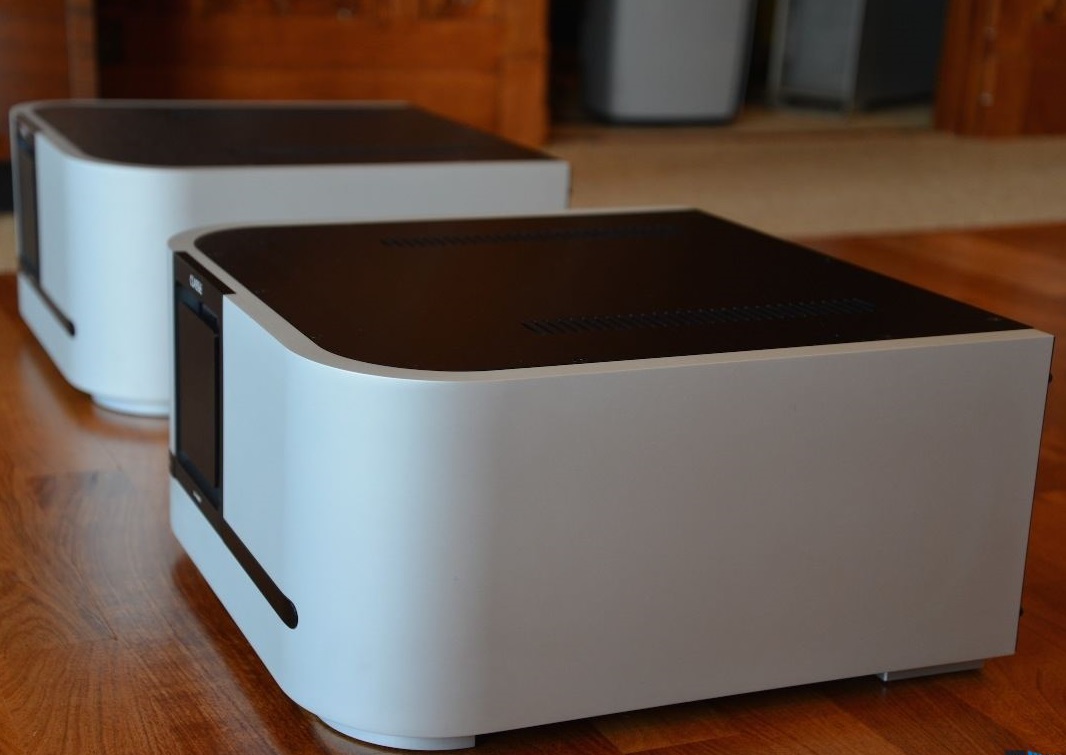
Our newest Delta series amplifiers embody all that Classé represents: innovation, technological achievement,consummate craftsmanship, and iconic design. But they are not just the latest in the distinguished line of Classé
amplifiers to be launched since 1980. They are new, revolutionary and unique.
CA-M600 600W monaural amplifier
DELTA SERIES
Performance first
The original Delta series amplifiers won more than critical acclaim. Elite audio professionals use them to master music and movies that the whole world has enjoyed. Our newest amplifiers are even better.
Objectively, pure technical measurements prove they deliver our highest performance ever. Subjectively, they simply blow audiences away.
The Classé design team has created the ultimate environment to amplify an audio signal. The entire amplification process occurs on a single board, creating the most direct and transparent signal path conceivable. Our uniquely
miniaturized driver stage is virtually noise free, so every nuance of the original signal reaches the output stage. Here, vast quantities of clean power are controlled with absolute precision. Suddenly, the world’s finest speakers sound even better.

Performance fast
There is a relationship between temperature and performance but it is widely misunderstood. Audiophiles say that optimal performance is obtained when an amplifier is “warmed up,” but what does this actually mean?
When is it warm enough and when is it too warm? The exposed heatsink fins found on conventional amplifiers are passive. They can’t help circuits reach their ideal temperature or keep them there throughout a listening session. They run at a temperature wholly defined by their environment and how loud they are playing.
This can be far from ideal. Heat management in Classé’s new Delta series amplifiers is provided by the ICTunnel™ (pronounced Icy Tunnel), a sensor- and microprocessor-controlled technology inspired by the heatsinks found in high-power laser and medical equipment. Mounted inside the unit, the ICTunnel™ actively regulates the amplifier temperature to ensure both optimum performance and reliability. From room temperature, the amplifiers warm up fast. They reach their ideal temperature in less than fifteen minutes and remain there regardless of how hard they are driven. No conventional heatsink can do this.
In a Class by itself Ground-breaking performance, prodigious power, sophisticated control and rock-steady reliability—Classé’s new Delta series is a giant leap in amplifier design. Thanks to exclusive ICTunnel™ and audio technologies, only Classé amplifiers can consistently deliver top performance and reliability in every installation.

Sound Quality
I used first the CT-M600s, then the CA-M600s, for a total of nine months. In that time I used the amplifiers with a wide variety of loudspeakers, from the current-hungry Focal Maestro Utopia IIIs (reviewed in July 2010), the miniature and exquisite Harbeth P3ESRs (reviewed in August 2010), to the supersensitive, horn-loaded Acapella High Violoncello IIs (reviewed in September 2010) and the weird and wonderful Gradient Helsinki 1.5 dipoles (reviewed in November 2010). Following the return of the Gradients, I returned to the Harbeths to review some digital source components. In all that time, I never felt I had a handle on the sound of the Classé amplifiers.
And as I prepare to send this review off for copyediting, I still don’t. In either of its guises, the ‘M600 is the consummate chameleon.
Yes, I could draw comparisons with other high-performance amplifiers. The Parasound Halo JC 1 monoblock, for example, sounded more intense in the treble. But that doesn’t mean the Classé sounded dull. Far from it. Yes, it had a firmer grip on the Focal’s big woofers than did the Simaudio Moon Evolution W-7, but that doesn’t mean it sounded lean. Far from it. Yes, I enthused about the transparency of the NAD M2 Direct Digital amplifier (reviewed in March 2010) fed straight digital data via S/PDIF. But that doesn’t mean the ‘M600s didn’t sound transparent. Far from it. Yes, one reason I had bought the No.33Hes was the enormous soundstage they threw, but that doesn’t mean the Classés’ soundstage was any less expansive than my memory of the Levinsons’. Far from it.
Whatever speakers I used with the Classé monoblocks, each pair of speakers sounded more like themselves than they did with other good amplifiers. Whatever recordings I played through the ‘M600s sounded more like themselves. With both speakers and recordings, it was if the colors in the sonic picture were more intensely saturated. The amplifiers’ deathly quiet level of background noise allowed them to step out of the way of musical details that I have rarely experienced from electronics. Their enormous dynamic range allowed musical climaxes to be reproduced in full measure, even with modest speakers that you’d think would be overtaxed.
As I finish writing this review, the CA-M600s are driving the Harbeth P3ESRs. The front-end is the dCS Debussy processor taking USB data from my Mac mini running PureMusic with AudioQuest’s new Coffee cable. There’s no preamp in the system. I’m using the Debussy’s own volume control, with balanced AudioQuest Wild cables feeding the amplifiers and AudioQuest Wild speaker cables hooking up the Harbeths. Paul Simon is singing “Hearts and Bones,” ripped in Apple Lossless from Negotiations & Love Songs (CD, Warner Bros. 25789-2). It is hard to believe the hi-fi experience can get any better than this. I know that’s not the way the world is, baby, but at this moment, it is all I need.
Conclusion
There seems to be a feeling in some quarters of audiophilia that to get state-of-the-art amplifier sound and performance, you need to pay many tens of thousands of dollars for a product made in tiny numbers from an equally tiny company. By contrast, the Classé CT-M600 and CA-M600 come from a mainstream manufacturer, though they are still expensive amplifiers. But they are nowhere near as expensive as the artisanal models, and they are the best-sounding amplifiers I have auditioned in my system. It is going to be difficult to let them go. Maybe I won’t.