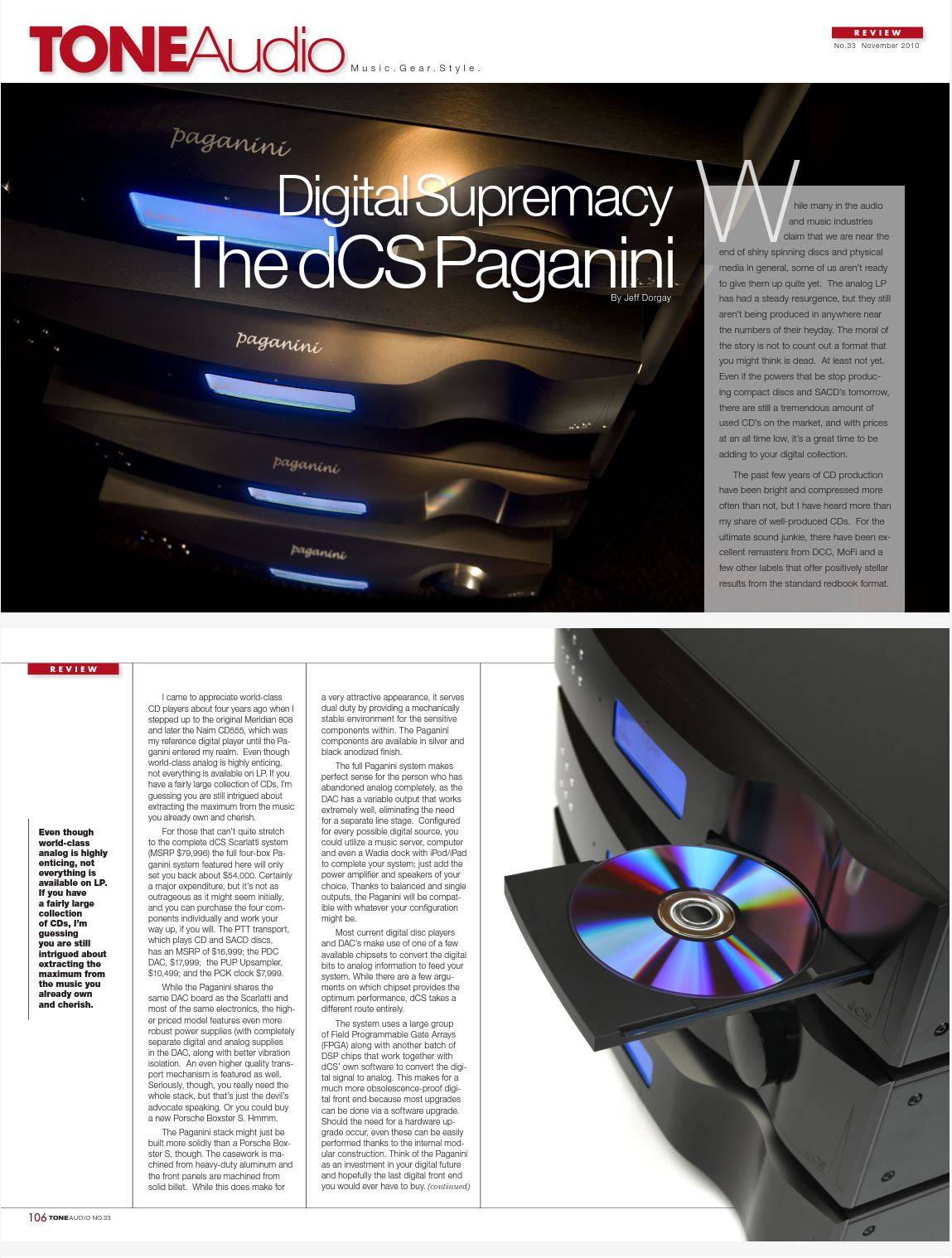
dCS Paganini Reviews
Includes Crystal Digital cables worth R80000!!
The Computer Audiophile
By The Computer Audiophile
Intro
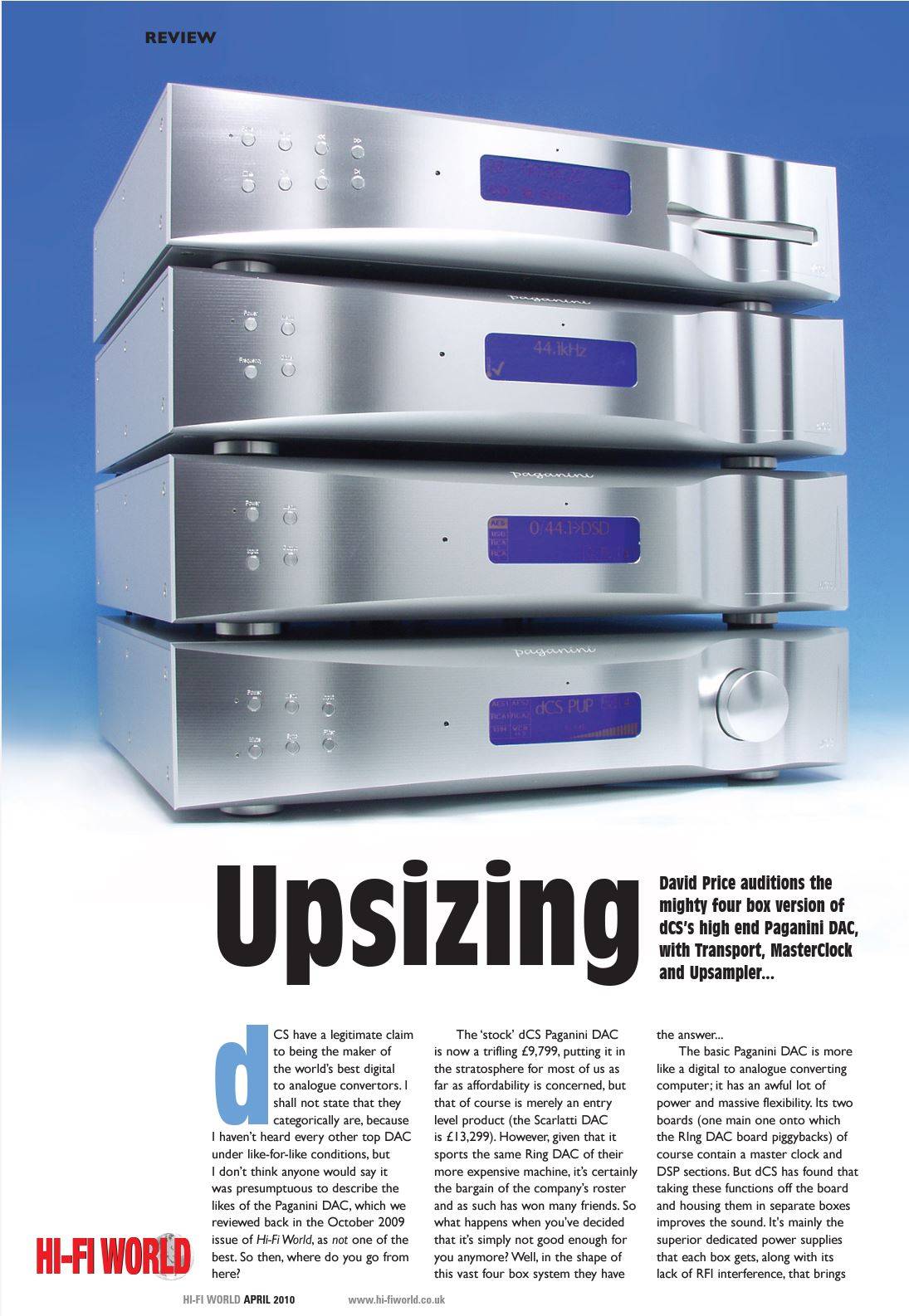
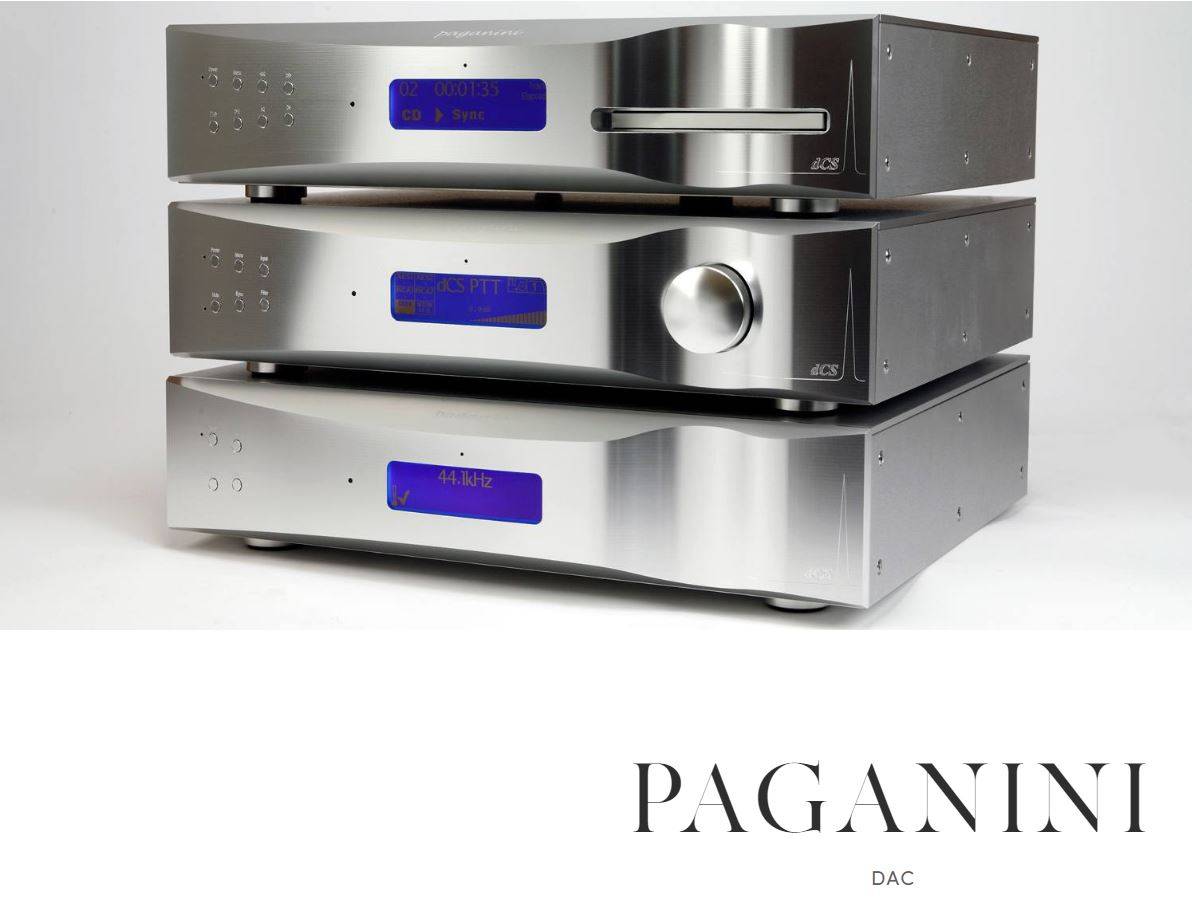
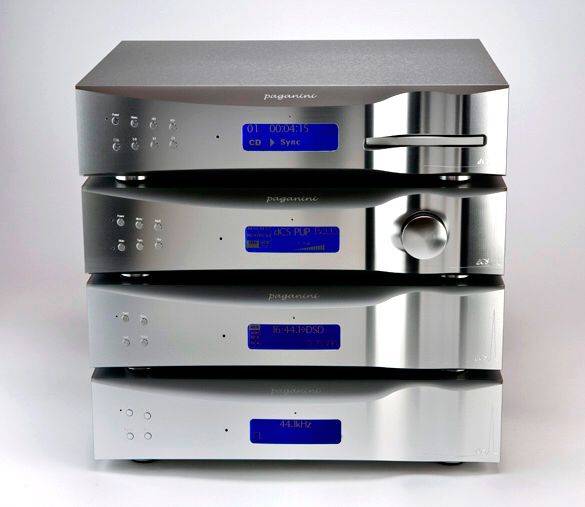
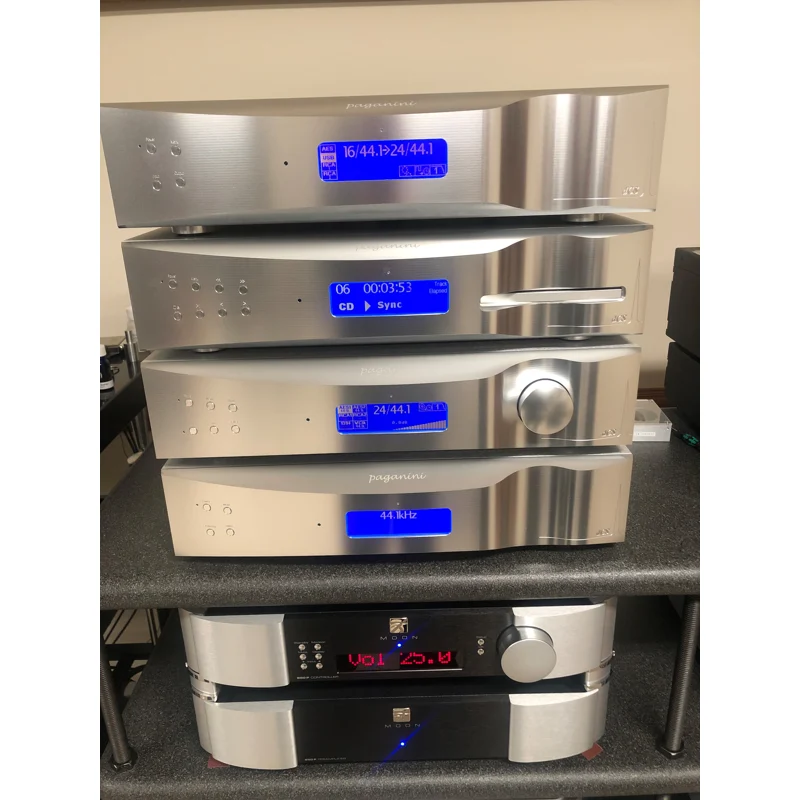
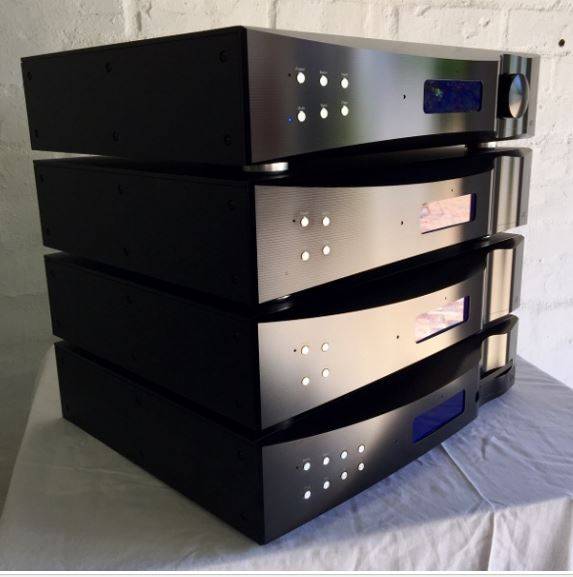
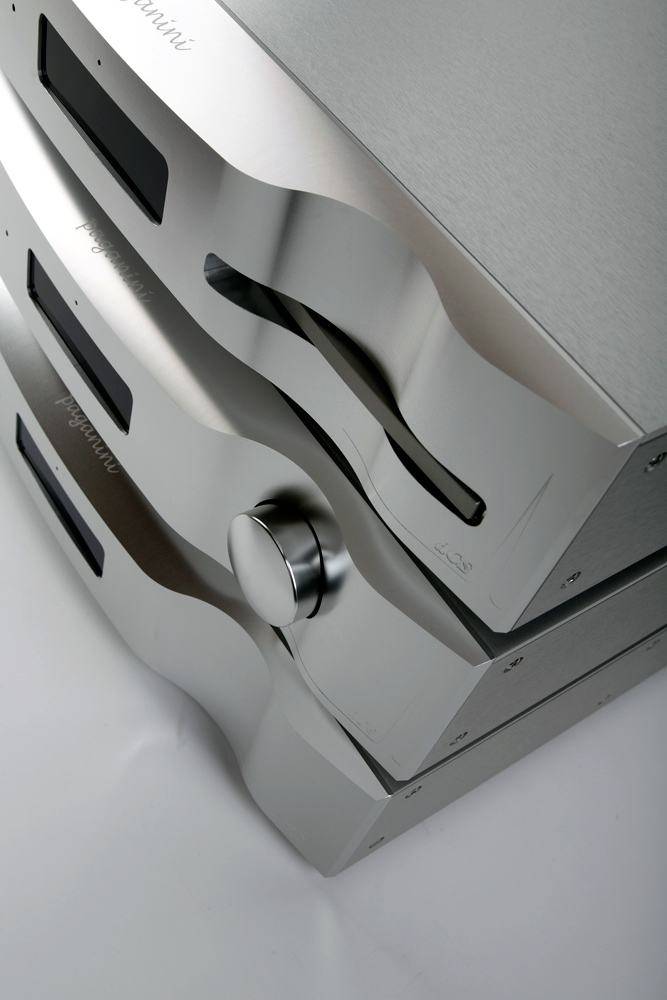
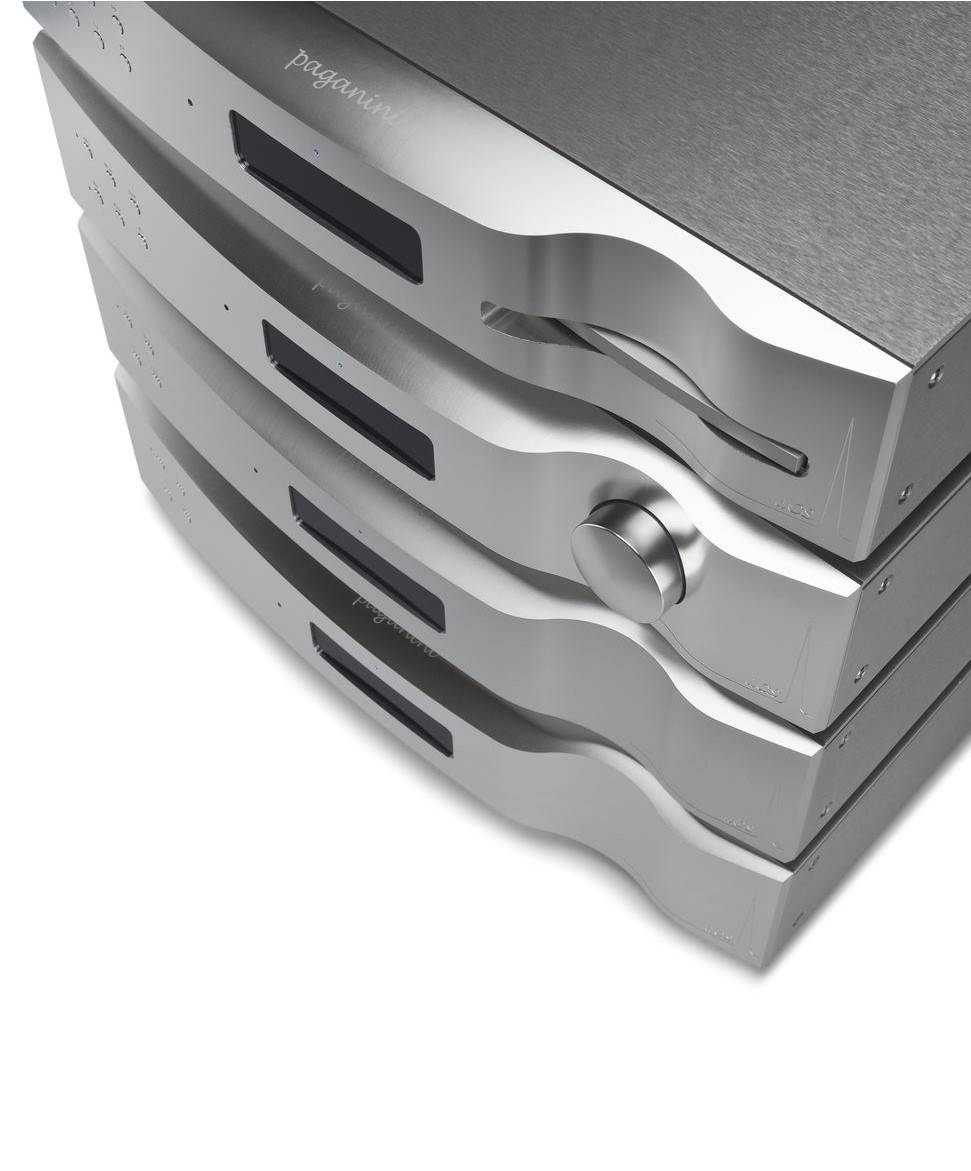
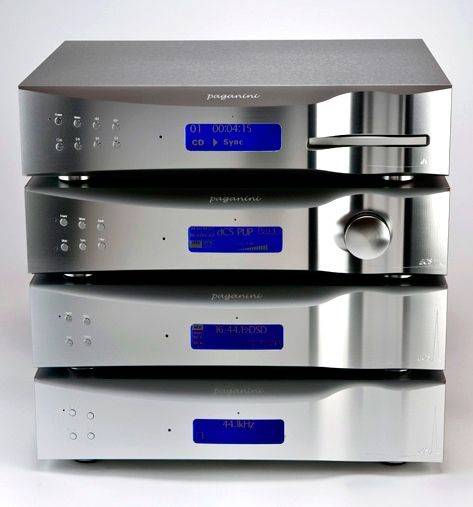
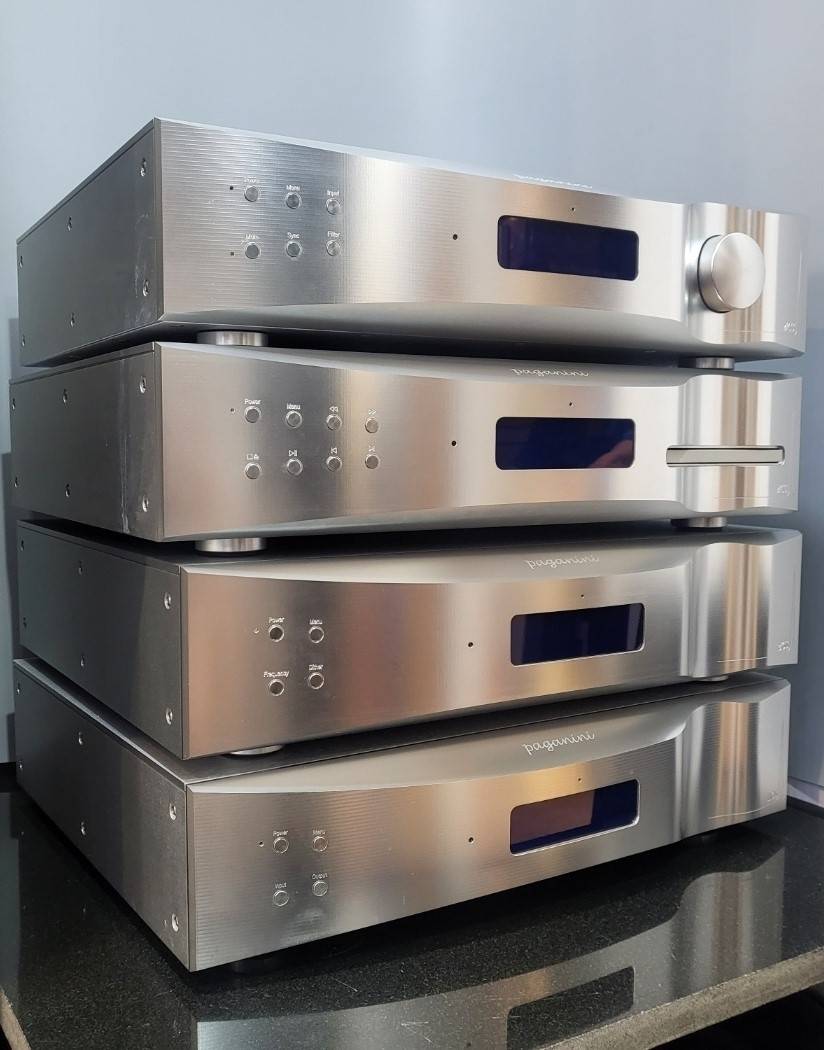
Most CA readers know I sold my last CD Player years ago and never looked back. While working with dCS and its U.S. distributor we toyed with the idea of throwing a transport into this mix of components, but decided against that as it’s really not my cup of tea. It would have been nice to play some SACDs, but in my book physical media is to be ripped and stored incase of an emergency. We settled on a review of the Paganini DAC, Paganini Upsampler, and Puccini U-Clock. This combination offers so many input, output, and clocking options I highly recommend working with a local dCS dealer until one has an understanding of everything these components can accomplish. Luckily David Steven Jr. and Andy McHarg from dCS headquarters in the United Kingdom, and John Quick the U.S. distributor where an easy phone call away during this review period. I liken this dCS stack to a high performance Formula 1 race car. An F1 car is capable of incredible performance but a pit crew is needed to get the car to the starting line. Fortunately the dCS stack does not need intermittent pit stops. Most users will set it and forget it.
The Three Amigos
Paganini DAC
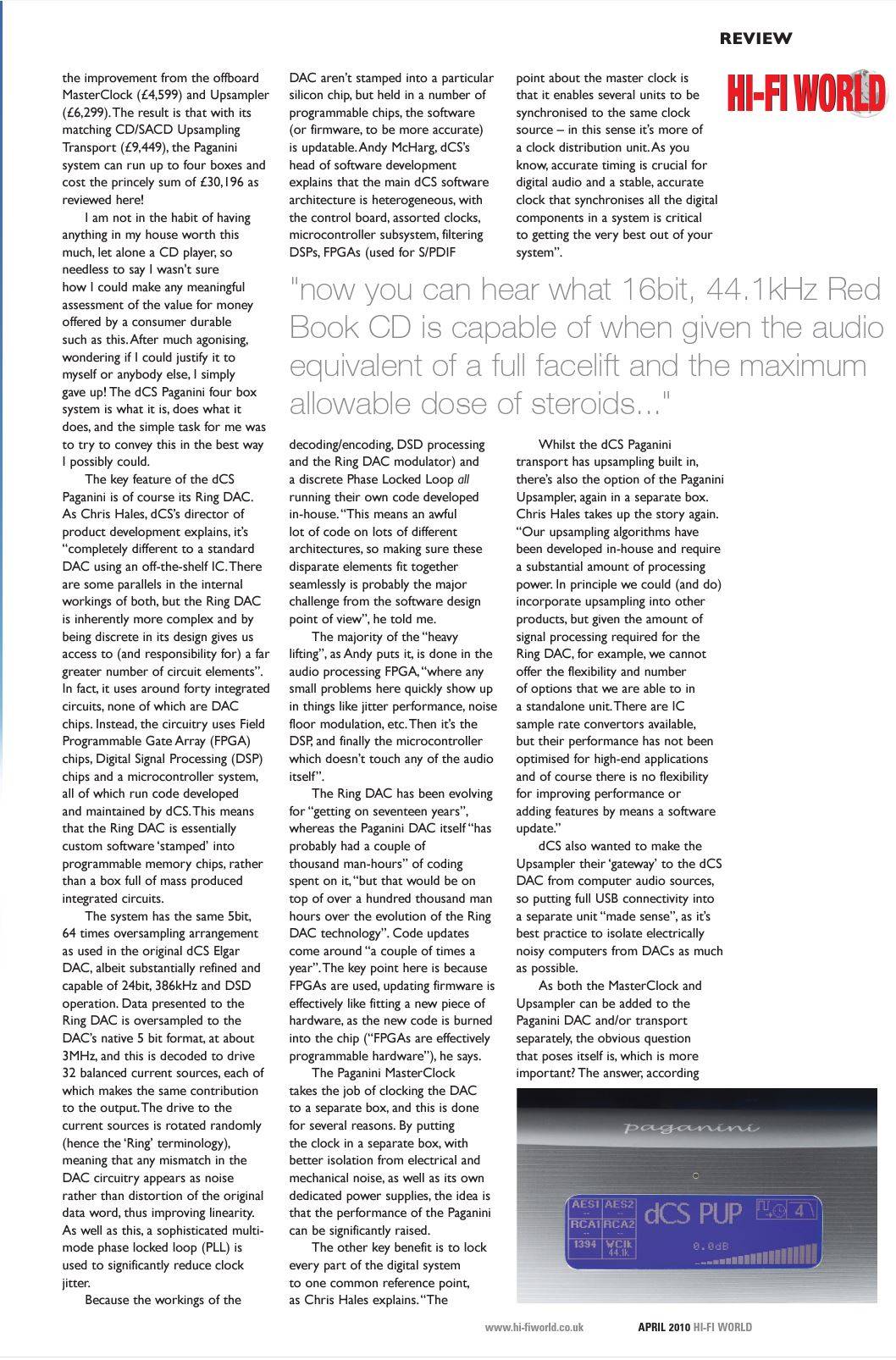
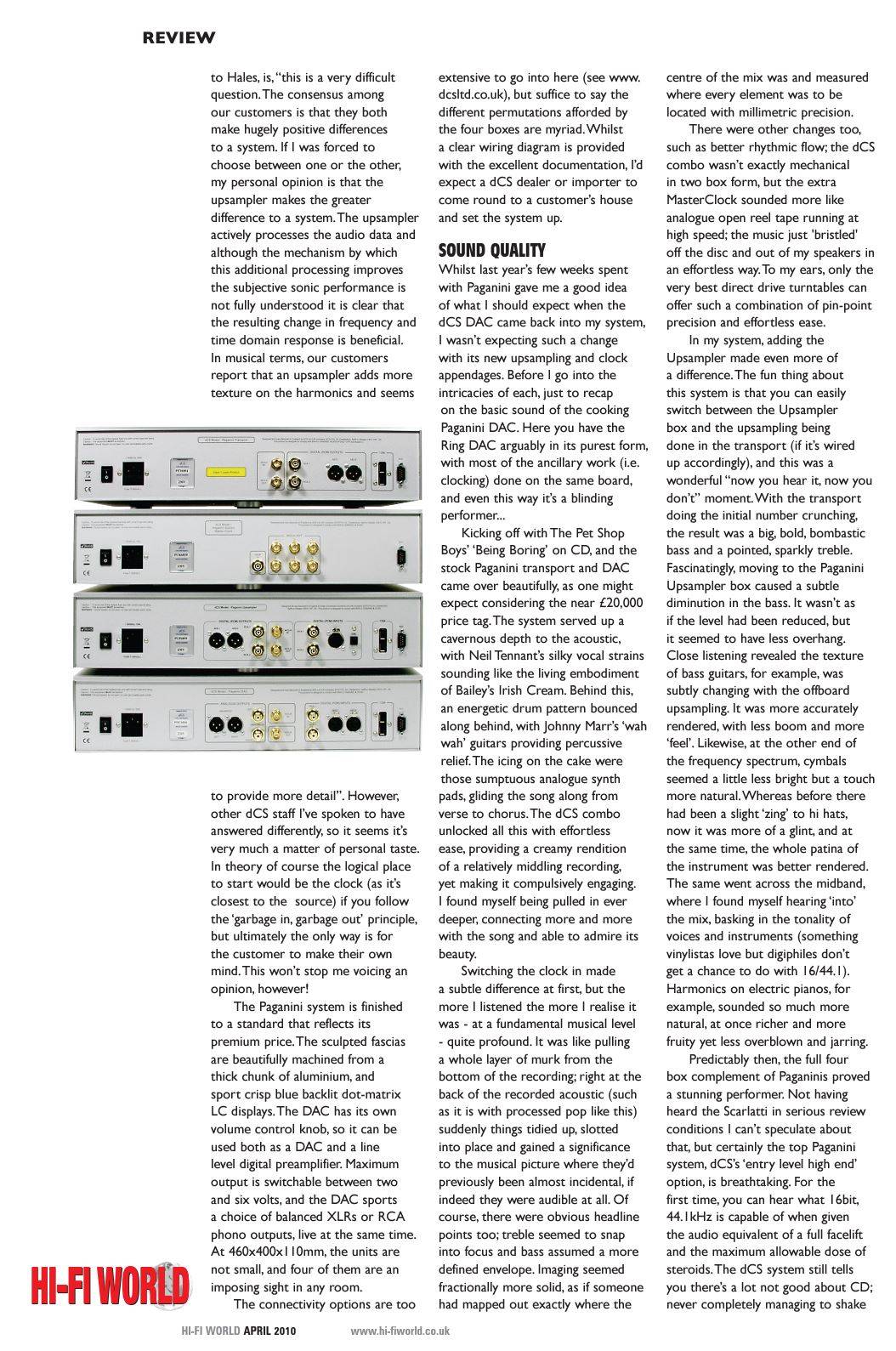
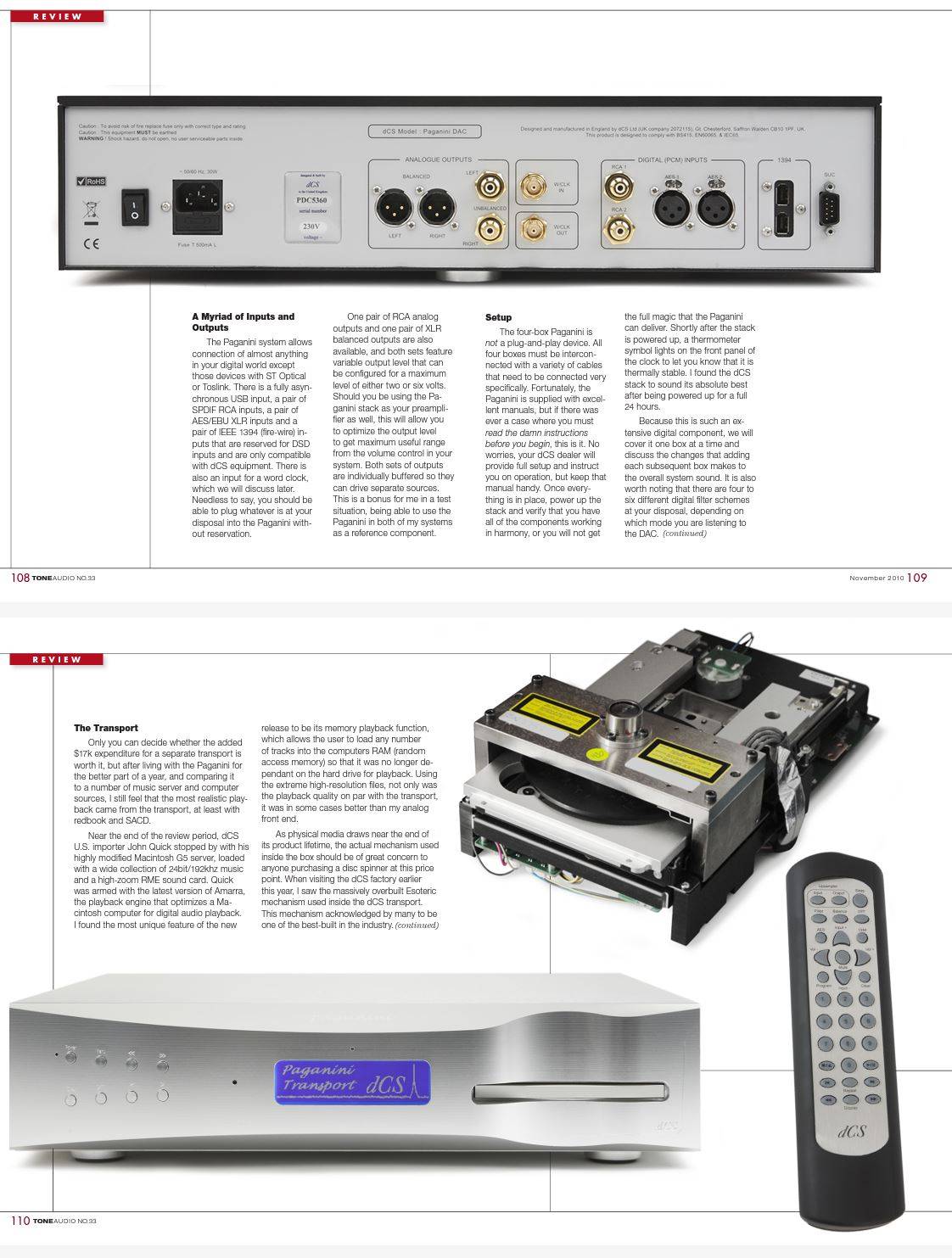
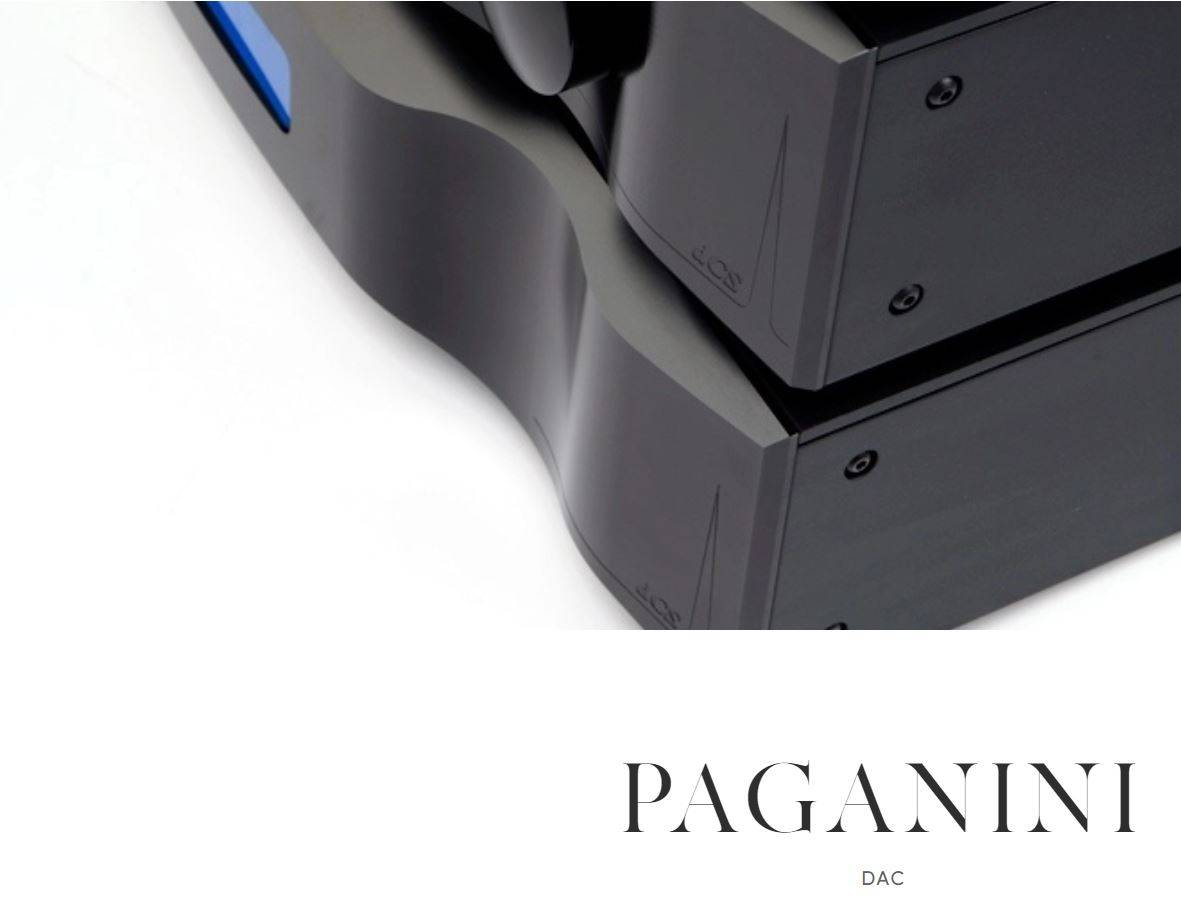
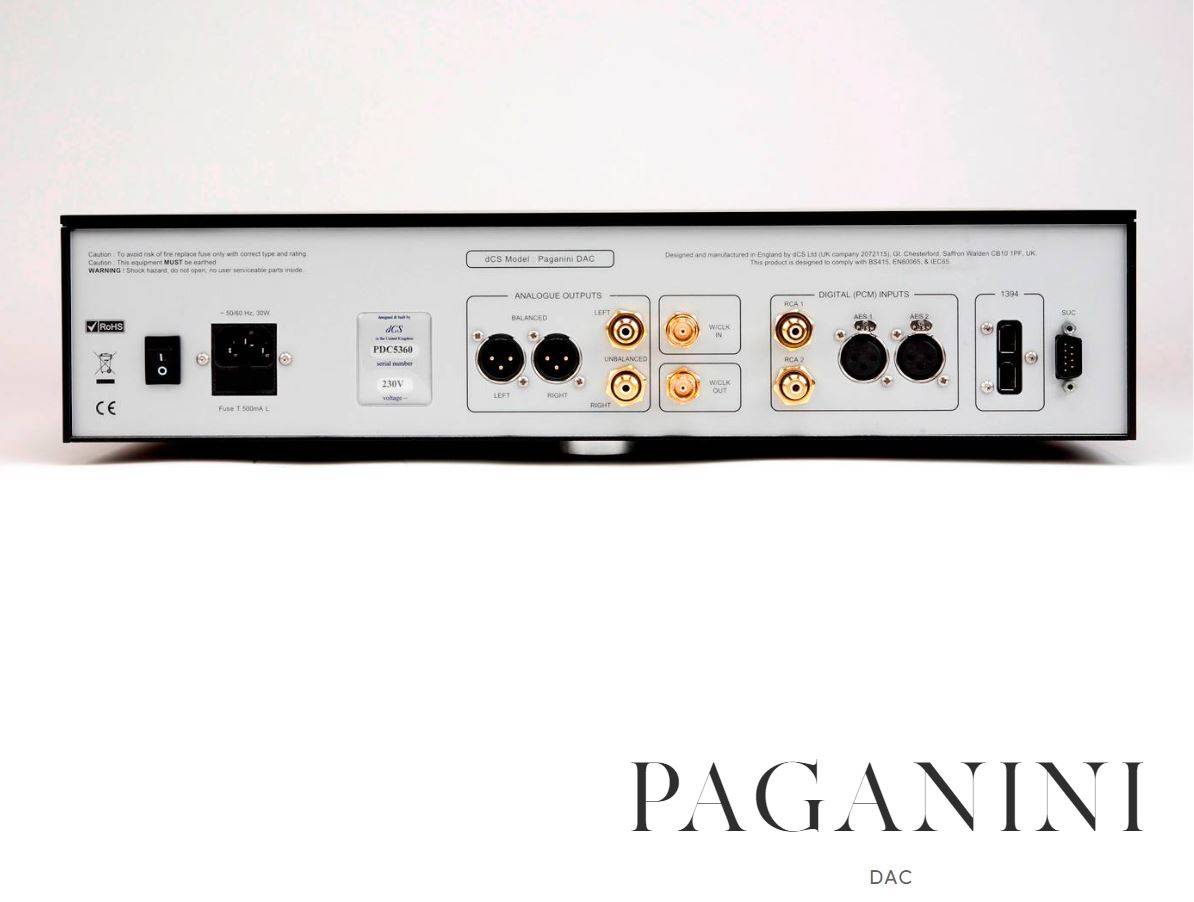
 The dCS Paganini DAC is unique among its competitors in the industry. According to dCS, “Our products use both discrete and software configurable approach to digital signal processing. While most audiophile DACs are based on standard DAC chips from one of approximately six manufacturers, our patented dCS Ring DAC circuit uses around 40 chips, none of which are DAC chips. Our digital processing circuitry is based around Field Programmable Gate Array (FPGA) chips, Digital Signal Processing (DSP) chips and a microcontroller system, all of which runs code developed and maintained by dCS. Our PCM interface and Phase Locked Loop (PLL) circuitry are essentially discrete. This means our hardware is completely controlled and reconfigurable by software.” In addition to the dCS Rind DAC there are a few R2R Ladder DACs available today but most DACs are the Delta-Sigma type. Manufacturers often use ?? (Delta-Sigma) DACs because they are very linear and inexpensive. Attaining the highest levels of quality in digital to analog conversion is not easy. Few manufacturers have the ability to develop something as high performance and complex as the dCS Ring DAC. The Paganini DAC has four digital inputs that accept a range of sample rates. Two AES/EBU inputs accept from 32 to 192 kHz. Note that dual wire AES is required for sample rates of 176.4 and 192 kHz. Readers with a Lynx AES16 card need to connect outputs one and two from the card to the corresponding Paganini AES inputs and enable dual wire in the Lynx Mixer software for these higher sample rates. Currently the Lynx / dCS combination does not support external clocking at sample rates of 176.4 and 192 kHz. I’ve been told Lynx may offer an easy solution to this incompatibility via software or firmware upgrade at some point it the future. The reason for the incompatibility is that dCS components send what is called a base-rate clock signal of 44.1 or 48k to external devices. The Lynx internal digital I/O audio cards do not currently have the capability to multiply that base rate by 4x to achieve higher sampling rates. My understanding is that external lynx devices such as the Aurora line do support multiplying a base-rate word clock and would work perfect with the dCS components. The Paganini has two coaxial S/PDIF inputs that accept from 32 to 96 kHz digital audio. An IEEE 1394 (FireWire) interface is used only for an encrypted DSD signal. Users will not be able to connect a computer to this port via FireWire cable to play music. Analog outputs are single-ended RCA and electronically balanced XLR connections. The analog output stage is discrete Class A. The output levels can be adjusted from 2v rms to 6v rms via the Paganini’s menu system. During this review I used the Paganini DAC set at 6v rms output directly into to my McIntosh MC275 tube amplifier driving a pair of Verity Fidelio loudspeakers. 2v rms just was not enough “juice” for my liking because I did not use any preamplifier during the review. The Paganini DAC’s digital volume control is implemented extremely well and, to my ears, has no sonic degradation. As I eluded to previously the Paganini DAC also has word clock in and out allowing it to be a slave or master clock.
Paganini Upsampler
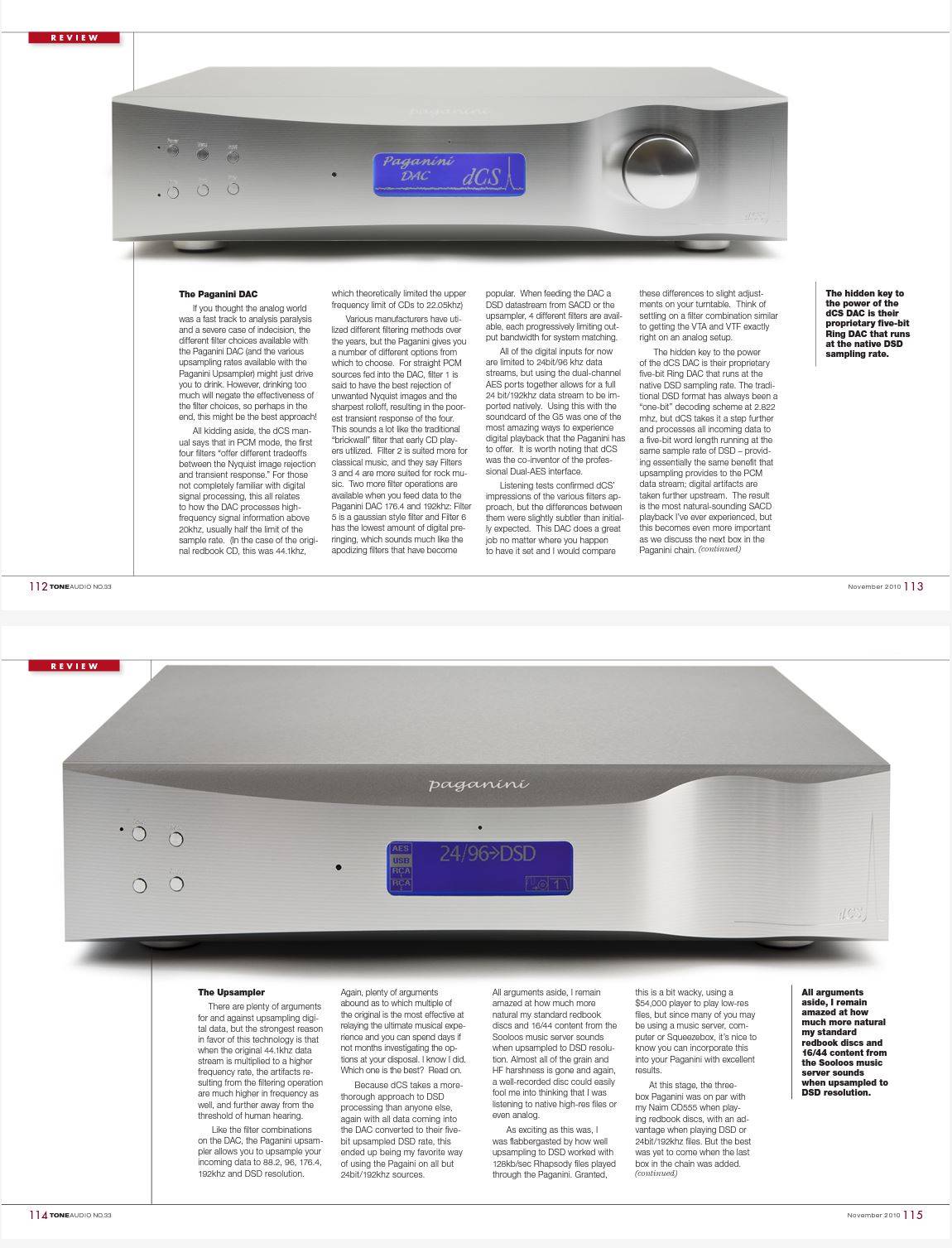
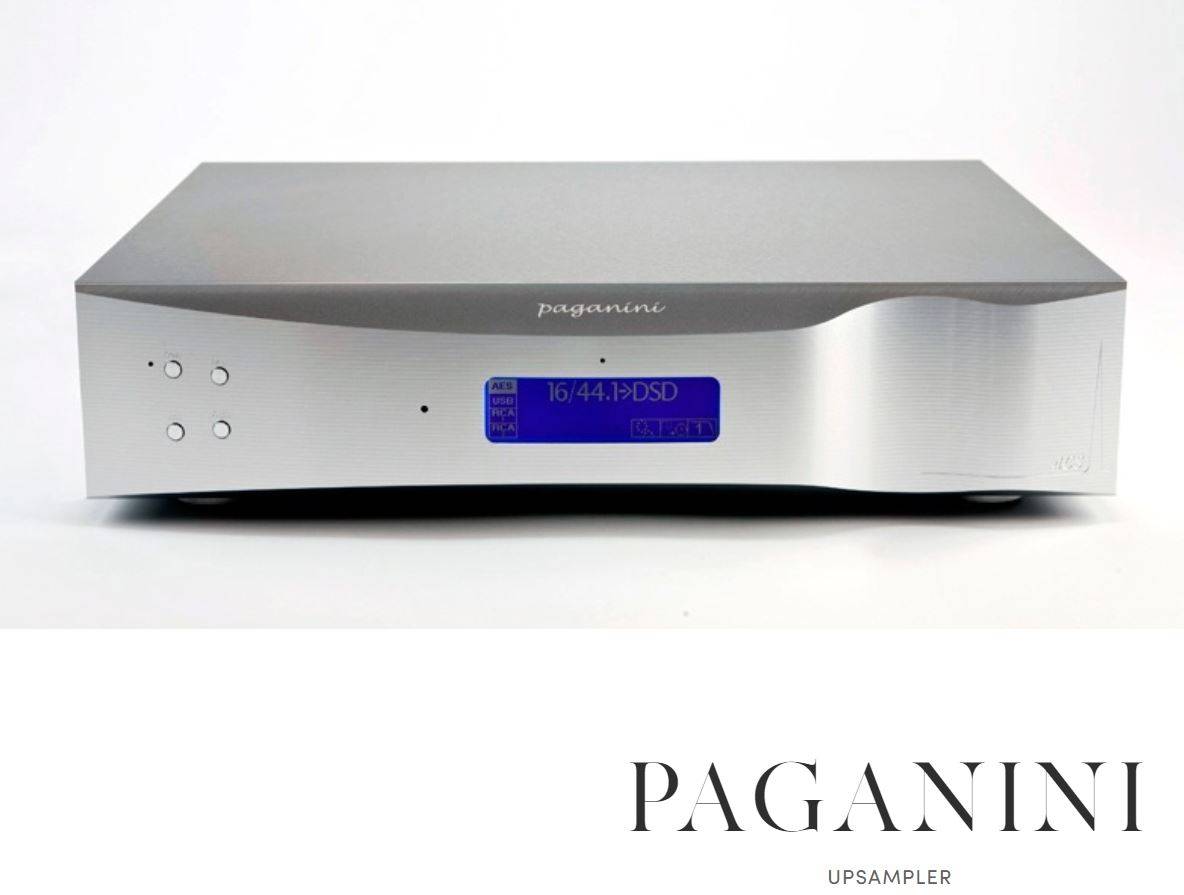
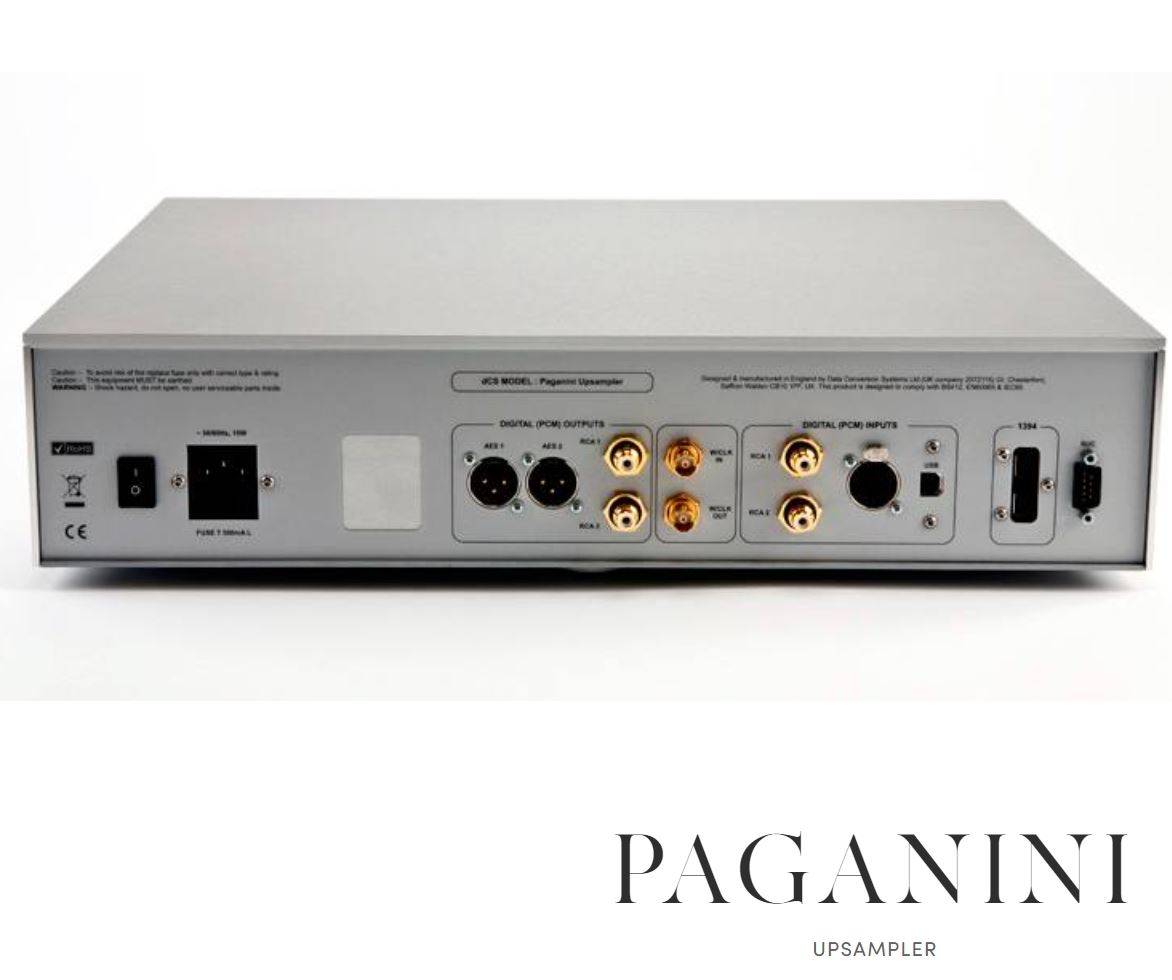
 The Paganini Upsampler is really a digital to digital converter that accepts sample rates from 32 to 96 kHz. The device can output this digital signal at an equivalent or higher sample rate than the incoming data. A standard 16/44.1 audio signal can be output to the Paganini DAC at 16/44.1, 24/88.2, 24/176.4, or DSD. 24/96 material from sites like HDtracks and Blue Coast Records can be output at 24/96, 24/192, or DSD. This Upsampler has three types of digital inputs and three types of digital outputs. The outputs are standard coaxial S/PDIF, AES/EBU single and dual wire, and IEEE 1394. Dual wire is required to output a digital signal at 24/176.4 and 24/192 kHz. The digital inputs are two coaxial S/PDIF RCA connections, one single wire AES/EBU XLR connection, and one asynchronous USB connection. Yes, this is the highly desirable asynchronous USB technology like Wavelength and Ayre use. Note this is not to be confused with asynchronous sample rate conversion. ASRC is completely different and does not play any part in the dCS USB implementation or in the Paganini Upsampler. dCS is not licensing anything from anyone for its USB interface. Its asynchronous implementation was created completely in-house by its highly skilled team of engineers. Using the Paganini asynchronous USB input will be a popular option for those who want to set it and forget it. Using a Mac Mini or MacBook with Amarra outputting via USB to the Upsampler allows one to play anything up to 24/96 and take advantage of the upsampling settings of their choice. Upsamplers have a fair share of skeptics and “purists” who don’t believe in the technology. During the review period I used every possible configuration with the Paganini Upsampler. I will share my preferred Upsampler settings a bit later in this review.
Puccini U-Clock
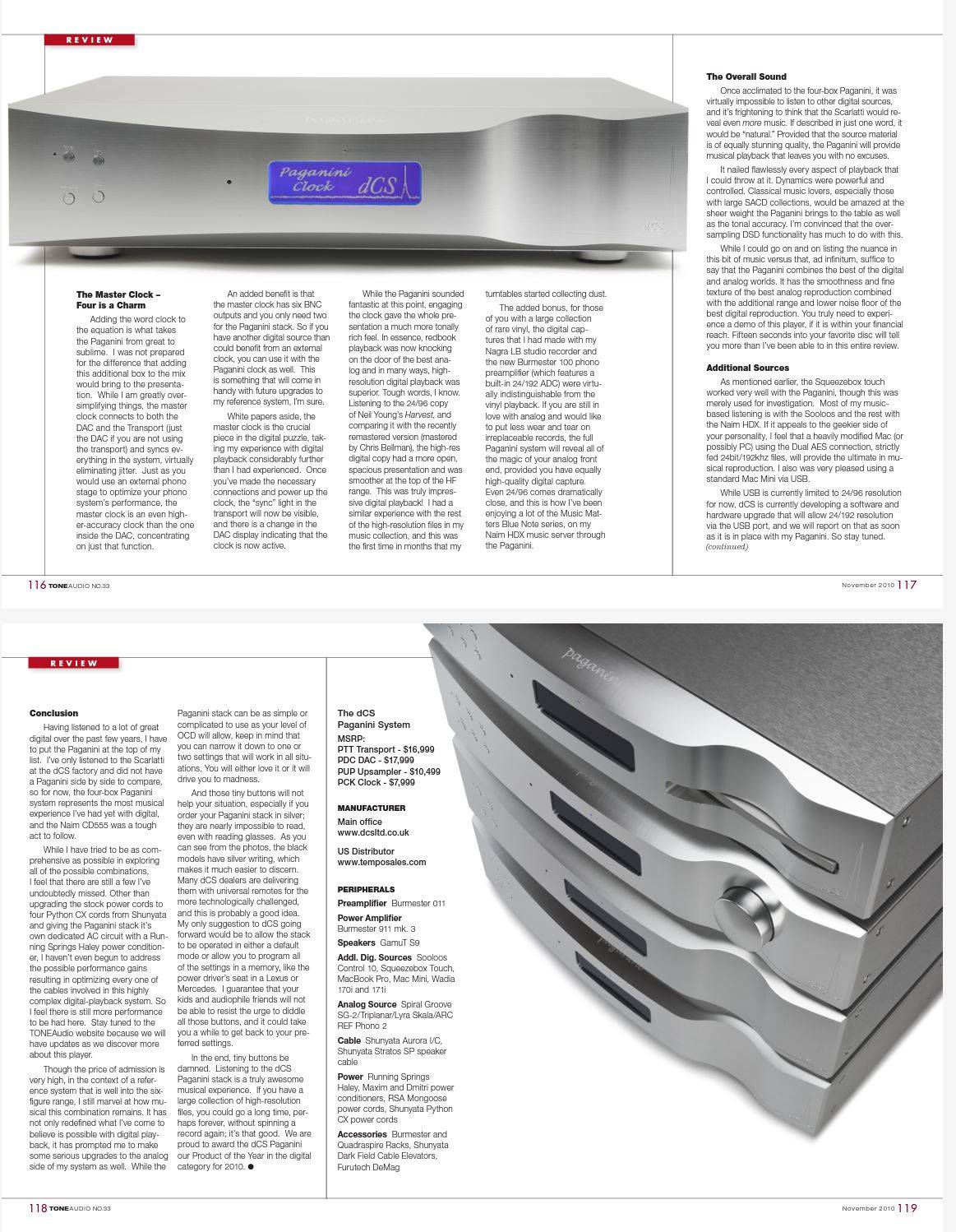
 The Puccini U-Clock is perhaps my favorite component in the dCS line. This “favored component status” stems from my experience using external word clocks and realizing the benefits such clocking can have in a high performance audio system. Plus the Puccini U-Clock contains an asynchronous USB to coaxial S/PDIF converter. Again, the same highly sought asynchronous USB implementation that’s contained in the Paganini Upsampler using the TAS1020B chip. The U-Clock’s USB board layout was designed with an eye on the future. When the inevitable higher sampling rates are available via USB the U-Clock’s USB board is designed to be swapped out by a local dealer saving the expense of over seas shipping back to dCS in the UK. dCS had no comment on the availability of a 24/192 USB interface for its components. As its name suggests the U-Clock is an external master clock for any component that accepts an industry standard word clock signal via 75 ohm BNC connection. The Puccini U-Clock has four word clock outputs. During the review period I clocked everything with the U-Clock when possible. When using a Lynx AES16 card connected to the Paganini Upsampler I used the U-Clock to send word clock signals to the Lynx, the DAC, and the Upsampler. Thus all components had the same clock source. According to the dCS product manuals the best sound quality comes from a configuration where the U-Clock is the single clock source for the complete digital front end. After weeks of listening to many different clocking schemes I agree with dCS. In its system sending word clock from the U-Clock to all components pushes performance to another level. There are other schools of thought when it comes to external clocking. One common clock scheme is using the clock source that is as close to the DAC chip as possible. This would mean sending clock from the DAC to the front end components. On other systems that may work best, but with the dCS stack in my listening room the best performance came when word clock was sourced from the Puccini U-Clock.
Music Servers
Music servers used during this review include the following.
-
- Mac Pro, OS X Snow Leopard, Dual 2.8 GHz Intel Xeon Quad core CPUs, 10GB RAM, 64GB SSD, iTunes & Amarra, Lynx AES16e digital I/O
- Mac Pro, Windows 7 Ultimate 64-bit, Dual 2.8 GHz Intel Xeon Quad core CPUs, 10GB RAM, 64GB SSD, MediaMonkey, Lynx AES16e digital I/O
- Mac G5, OS X Tiger, Dual 2.0 GHz PowerPC CPUs, 3GB RAM, 64GB SSD, iTunes & Amarra, Lynx AES16 digital I/O
- Custom Linux server – Details withheld at this time.
- Thecus N5200B Pro NAS
- MacBook Air Remote Control
High Performance
 This dCS stack unequivocally gave me the best sound I’ve ever heard in my listening room. Period. It produced the most refined and natural sound I’ve heard in recent memory. This natural sound was most apparent with acoustic music. I’ve been on a Jack Johnson kick for a while. I listened to his albums a few times each through the dCS components and through other components I currently have available here. No other components gave me goose bumps like the dCS stack. I certainly was not in the studio for a Jack Johnson recording and do not know what his guitar is “supposed” to sound like, but the sound in my room had to be pretty close. The resonance of his guitar was so real the musical illusion was incredible. As I stated earlier, I used the Paganini Upsampler in every conceivable configuration and with many different types of music. After tens of hours comparing all the Upsampling options I wound up preferring no Upsampling at all. Oddly enough this doesn’t mean I prefer no Upsampler at all. Over the last few days I discovered that I like the sound of the Upsampler via USB better than the U-Clock via USB. I was very surprised that I heard any difference whatsoever. I sent an email to dCS detailing the configuration and my preference for the Upsampler USB input. I received a response from Andy McHarg, one of the brilliant digital engineers at dCS, stating, “…the two *should* sound identical with the same settings…” It’s entirely possible my preference for the Upsampler’s USB input over the U-Clock’s USB input could be based on psychoacoustics. Right now I don’t think that’s the case. When I switched USB inputs I was not looking to compare the sound quality rather I was going to test a different clocking configuration. The sonic difference was immediately noticeable to me. I had been using the Upsampler’s USB input exclusively for a couple weeks so I was intimately familiar with the sound. It was like placing a new component into one’s system after years of listening to one set of components. Differences are easily noticed. A possible explanation for this sonic difference could involve cabling. Using the U-Clock’s USB input I used a WireWorld USB cable and a Kimber Select coaxial S/PDIF digital cable for the output to the DAC. Using the Upsampler’s USB input is used the same WireWorld USB cable, but I used a pair of Tera Labs AES/EBU digital cable from the Upsampler to the DAC. I don’t want to make a mound out of a mole hill. This USB sonic difference was such a tiny part of the whole review period and overall experience I really could have written it in a side-note. Anyway, my preference for no upsampling was readily apparent after an evening listening to Frank Sinatra’s Only The Lonely (Mobile Fidelity UDCD 792). The last track on the album, One For My Baby (And One More For The Road) sounded vastly different when I passed the 16/44.1 signal straight through the Upsampler at 16/44.1 versus when I upsampled from 16/44.1 to DSD. This difference in sonics was expected, but the outcome was unexpected. Without upsampling Sinatra’s voice had wonderful reverb and space surrounding it. When I upsampled to DSD I lost the reverb trail. His voice sounded a bit tighter, but thinner and less full. The following day I talked to the US Distributor about what I heard. He relayed his honest opinion to me that detailed vastly different results. He’d heard increased reverb with the Upsampler and much better sound on a wide array of audio systems. Granted this was with different albums and much different audio equipment, but it’s another data point for CA readers to consider. Back to overall performance. I punched up one of my favorite, Grammy nominated, Classical albums more than a few times throughout this review period. The Minnesota Orchestra’s Bolero! Orchestral Fireworks (Reference Recordings RR-92 HDCD). I’m no classical aficionado but I was immediately sucked into the concert hall with the awesome power of the transients on this album. I’ve never heard this album sound better anywhere. The highest highs and the lowest lows were reproduced faithfully and the critical midrange was the most realistic I’ve heard to date. I can’t complete this review without mentioning Shelby Lynne’s album Just A Little Lovin’. This album was recorded by world-class engineer Al Schmitt on a two inch Studer tape machine. Like the previous albums mentioned above, I’ve never heard this recording sound so real. I must have played it over and over about twenty times this month alone. Through the dCS stack Shelby’s voice didn’t emanate from the speakers. It was right between the speakers, not to far back or forward. Her voice just hung there transparently in space. On the title track the sparse cymbals were so realistic it was hard to believe a 16/44.1 recording could sound so good. The decay of the cymbals from the left speaker to the right was dead-on. There are many more superlatives to describe what this album sounded like thought the dCS stack but I’m sure CA readers get the point without dragging this one out any further.
Comparing the dCS stack to other components is a bit difficult because it includes an external clock, DAC, and Upsampler. Nonetheless I did swap the Paganini DAC with a few DACs I had on hand. Most of the comparisons weren’t very useful as the cost of the sales tax for the dCS stack is more than the total price of some of these DACs. The comparison I was most interested in was the dCS Paganini DAC and the Alpha DAC. The Alpha DAC is still my reference DAC because it’s relatively inexpensive and I own an Alpha. In my listening room the dCS Paganini was sonically superior and would be my DAC of choice could I afford the purchase price. Compared to the Paganini the Alpha sounded a bit forward, a tad less natural and a tad less coherent. Don’t get me wrong, the Alpha is still one of the best DACs on the market and has received many accolades to that affect. It’s just not quite up to the level of the dCS Paganini DAC.
Conclusion
The dCS Paganini DAC, Upsampler, and Puccini U-Clock is the best digital front end I’ve ever heard in my listening room. Since the dCS components are boxed up Jack Johnson, Shelby Lynne, and the Minnesota Orchestra have left the building. The dCS stack not only made the Computer Audiophile Suggested Hardware List, these components are exactly why the CASH List was created. Well done