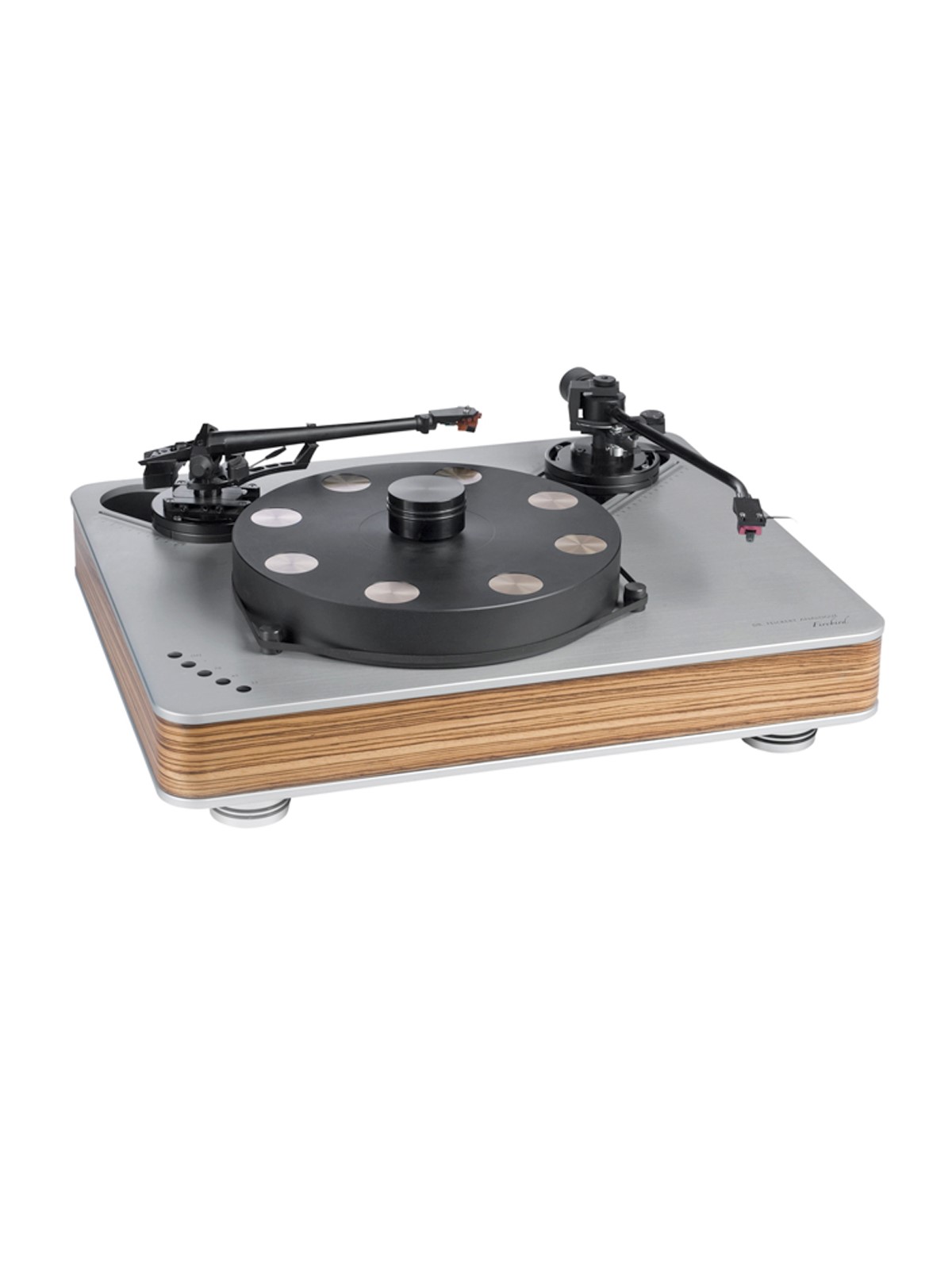
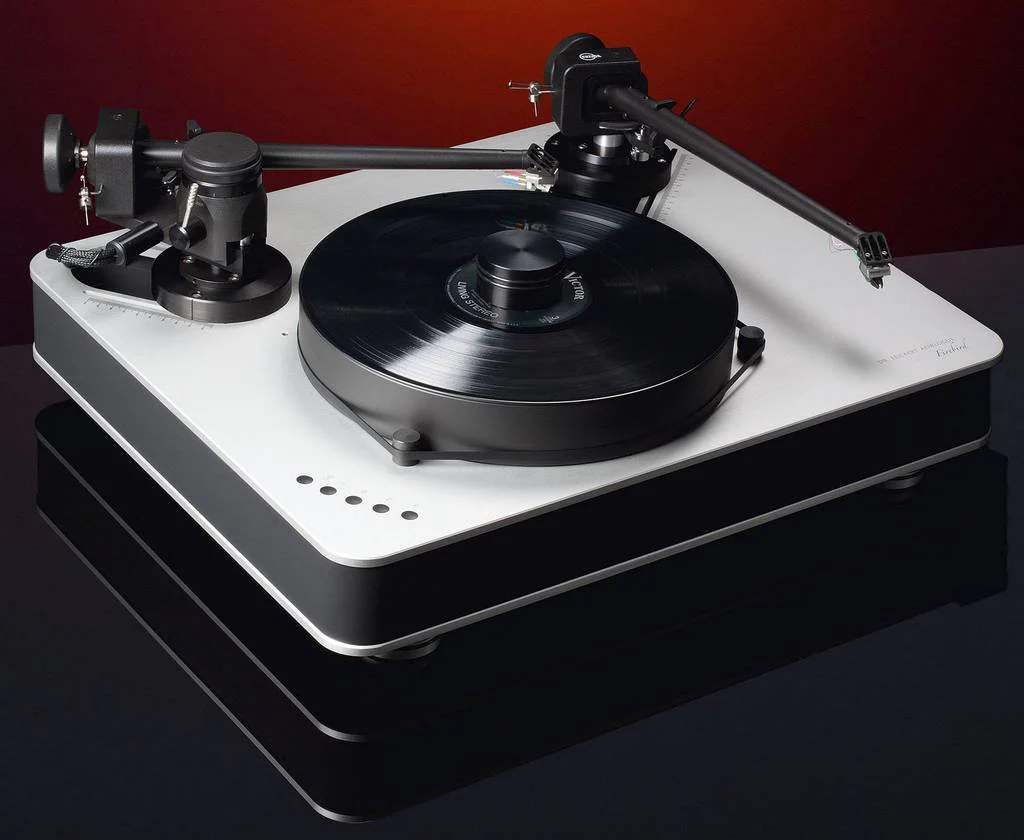
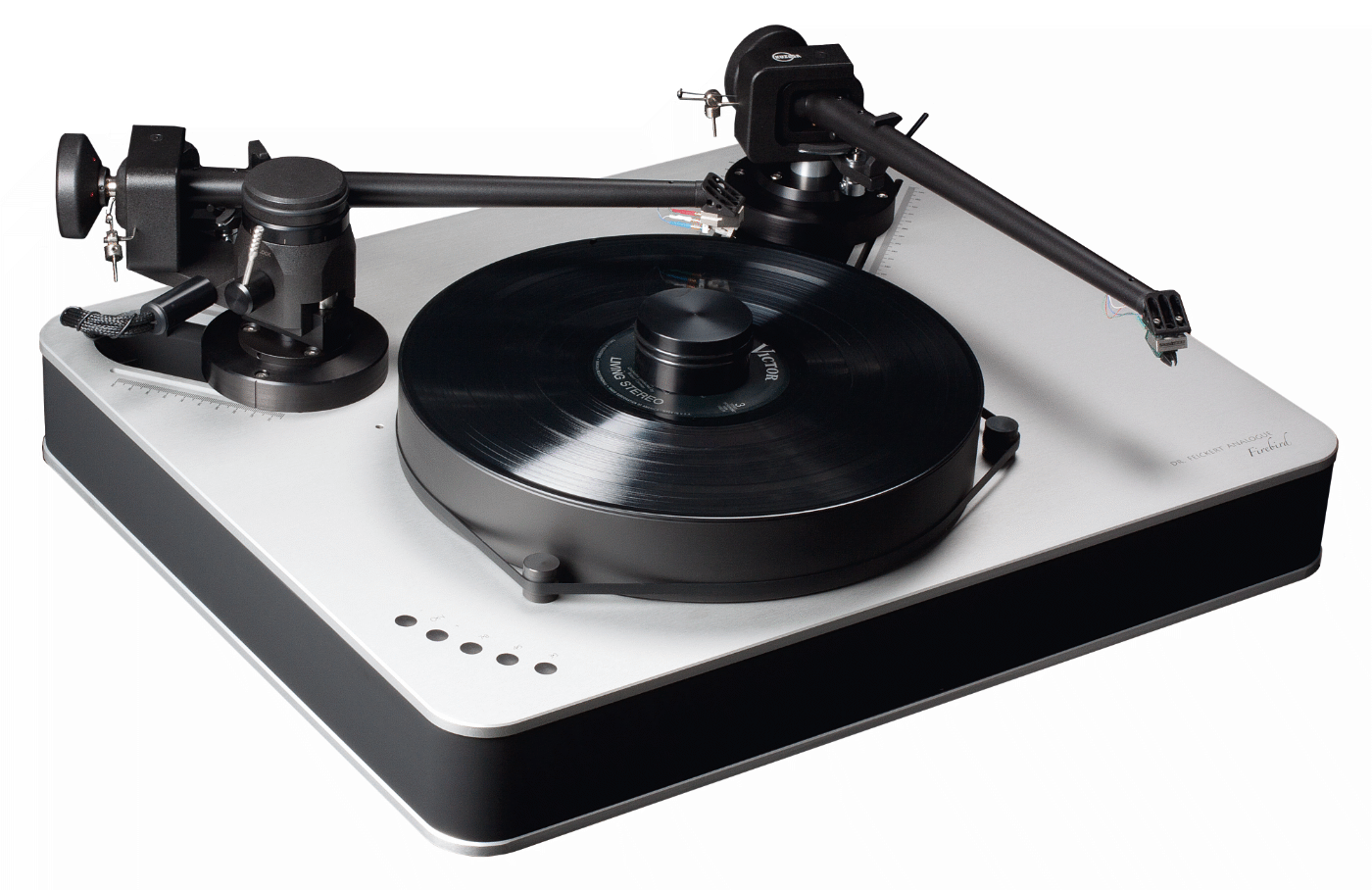
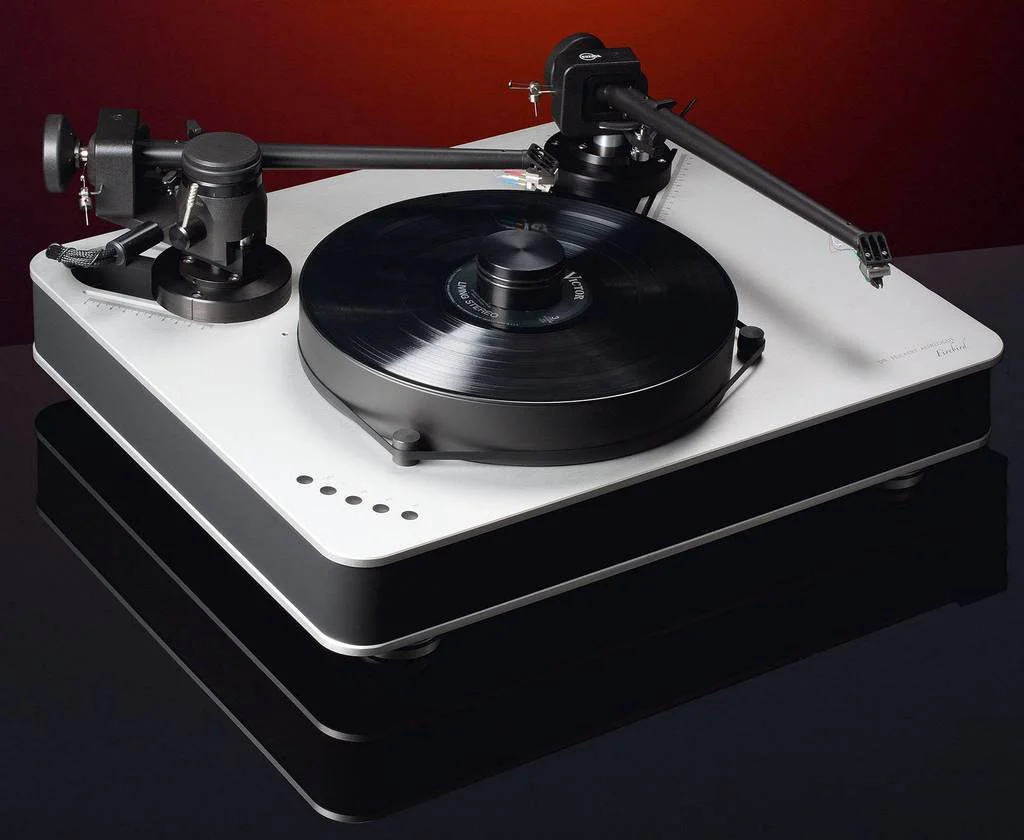
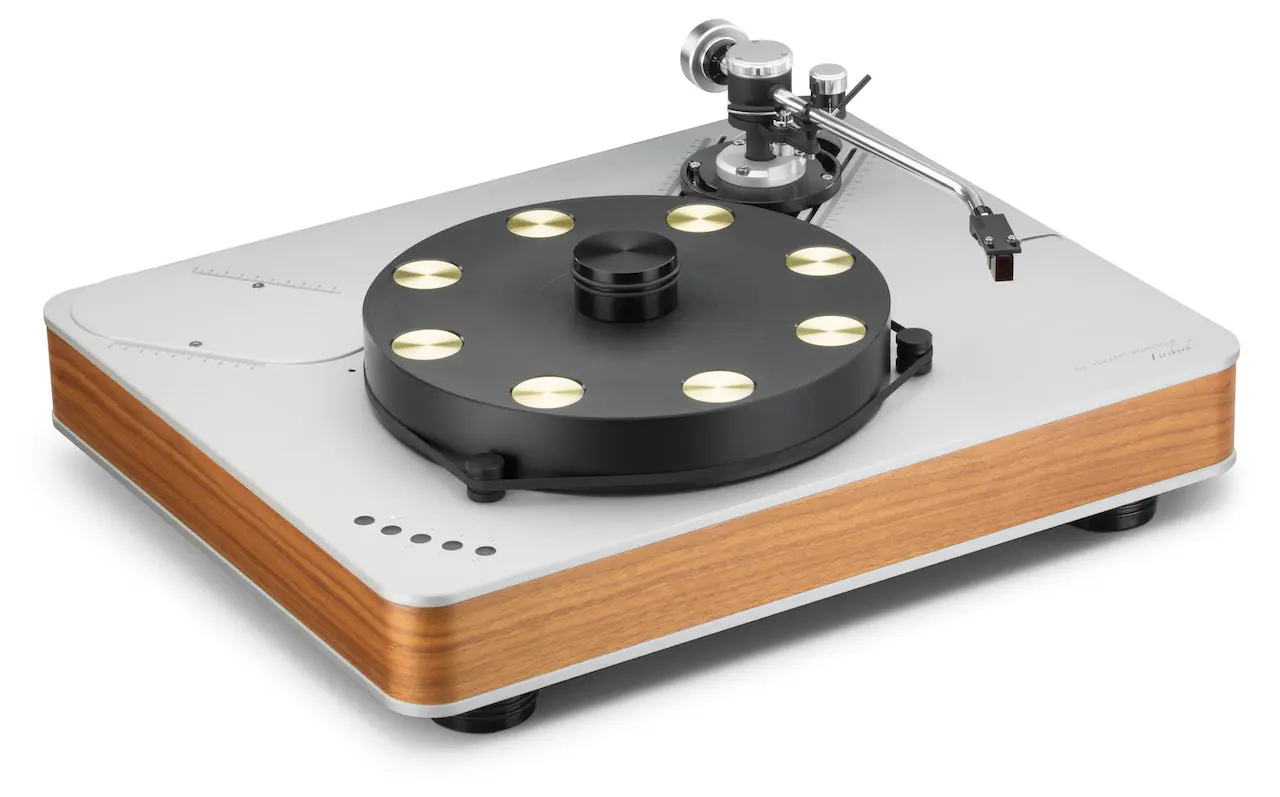
Doctor Feickert Analog Firebird TT (Black/Silver), SME 312S 12″ Tonearm
Original price was: R320,000.00.R105,000.00Current price is: R105,000.00.
What a beautiful beast, and the ARM, New over R120 000 alone!
Descriptiom: .Belt-drive turntable with three motors, POM platter, and the capability to accept two 12″ tonearms.
Dimensions: 22″ wide by 6.25″ high by 18.25″ deep. Weight: 68.5 lbs.
Price: $12,500.
SME312
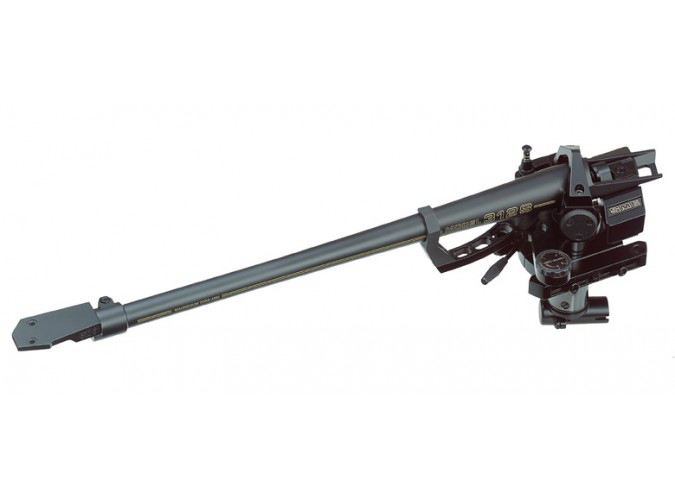
DIMENSIONS
A – Distance from pivot to stylus 308.80mm
B – Distance from pivot to turntable centre 295.60mm
C – Cartridge fixing centres 12.70mm
D – Offset Angle 17.28º
E – Linear Offset 91.54mm
F – Overhang 12.60mm
G – Height above mounting surface max. 87.90mmmin. 56.40mm
H – Height of record surface above mounting surface max. 55.90mm min. `24.40mm
J – Depth below mounting surface 56.75mm
K – Radial clearance for balance weight 73.00mm
SPECIFICATIONS
Cartridge balance range 7.0-19.0g
+ One accessory weight – up to 24.5g
+ Two accessory weight – up to 30.0g
Maximum tracking error 0.009°/mm
Null points:Inner 63.62mm Outer 119.46mm
Internal wiring: Ultra-flexible Silver litz
Audio lead: Length 1.2m
Weight net: 820.0g
Description
Dr. Feickert Analogue Firebird Turntable | REVIEW
September 18, 2019
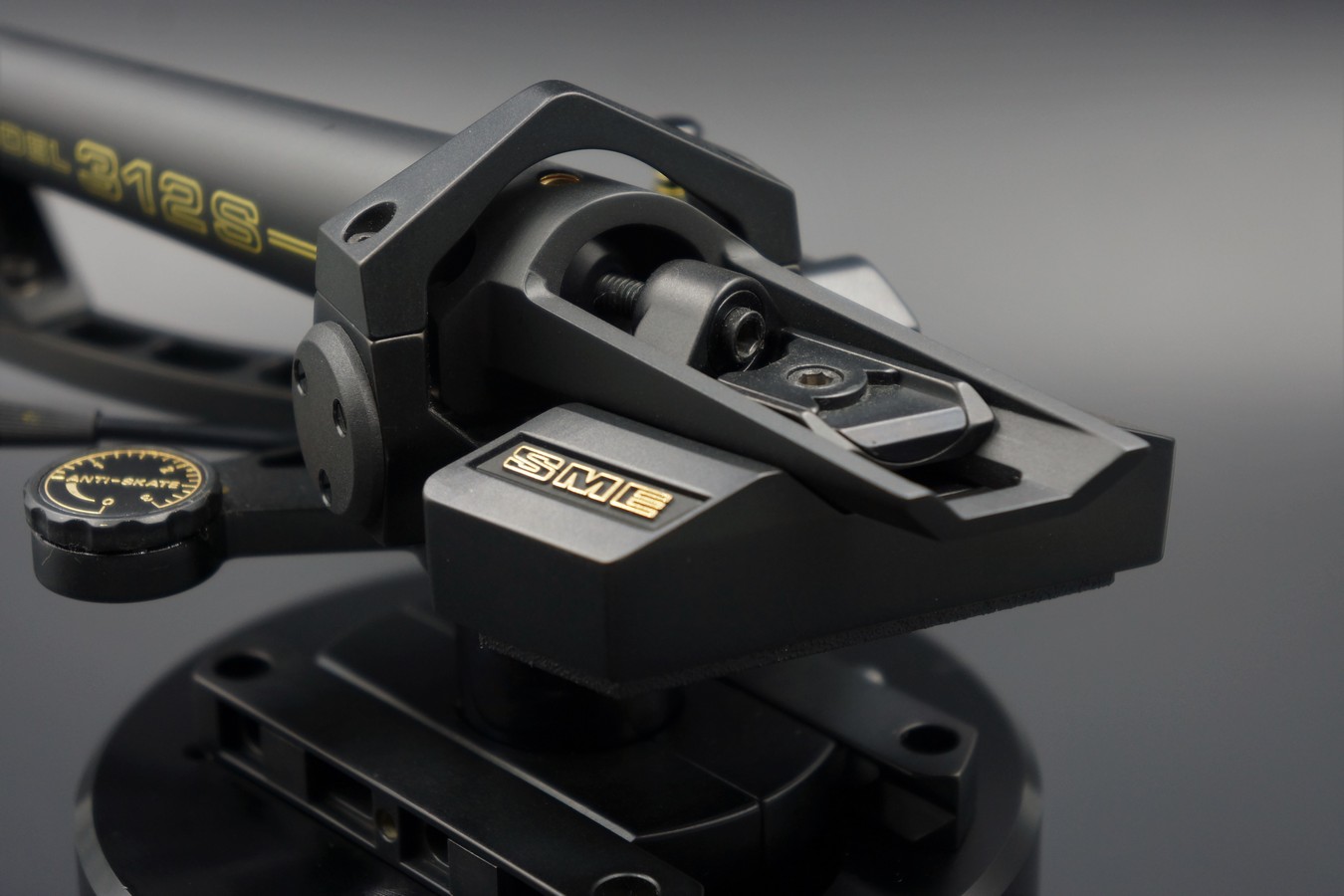

The Dr. Feickert Analogue Firebird turntable signifies a lot of firsts in my vinyl-loving life. It’s the first turntable I’ve used that accommodates two tonearms, and lo and behold I’ve got two tonearm and cartridge combos mounted on it right now. It’s the first turntable I’ve used that has more than one motor to spin the platter. (It has three, in fact.)
Finally, it might be the heaviest turntable I’ve ever reviewed. I’ve had seat time with many, many high-mass turntable designs but I’ve never set one up in my home, all by myself. It was a humbling moment when it took every bit of my strength to lift the Firebird’s plinth out of the box and place it on my equipment rack. “It’s time to hit the gym,” I told myself as my almost 57-year-old arms quietly muttered, under their breath, “You couldn’t have asked to review a Rega? No, you had to grab this beast.”
If I sound like I’m focusing too much on the weight of the Firebird and not the actual performance, there’s a reason. Most of the turntables I’ve owned over the years were not heavy—I’m not sure if I can think of one that weighed more than thirty pounds or so. Low-mass turntables are often characterized by a fast, energetic sound, while some of the heavyweights are often criticized for being a little too dead, a little too lifeless, with all the important life-giving resonances squashed into oblivion.
As I’ve found out a number of times in the last couple of years, however, that’s not true at all.

It Ain’t Heavy, It’s My Turntable
I don’t know why I haven’t spent more time with high-mass turntables until now. Perhaps it was the price—evenly distributed mass and the machining of exceptional heavy materials can cost a lot of money. (The Firebird starts at $12,995.) Maybe it’s the same reason why I’m a fan of 2-way monitors—I like moving stuff around without needing a two-hour break afterward. But there is one reason why I’ve always wanted a high-mass turntable in my system. It’s the sound.
High-mass turntables, in my opinion, have a very distinct sound that can probably be attributed directly to that mass. For instance, I always find that high-mass analog rigs always have remarkably stable and solid imaging, so much so that the music seems to breathe on its own, separated completely from the machinery producing the sound. Everything is RIGHT THERE. You can reach out and touch it.
Secondly, high-mass turntables are superb at taming unwanted vibrations and resonances. I’m always mentioning the importance of lowering the noise floors to allow more music to reach the listener. It’s one of the two things a turntable must do—isolate the stylus tip acoustically from the motor and spin the record at a precise speed. I’ve had plenty of experience with turntables with active suspensions, and I’ve placed my analog rigs on any number of isolation platforms over the years. This high-mass thing seems to produce the most reliable results—for me, anyway.
The Dr. Feickert Analogue Firebird turntable weighs 69 pounds complete. I thought it was more like 200 pounds, but that’s just pride messin’ with my brain. Nevertheless, the Firebird possessed many of those attributes I affix to high-mass designs—stable images, an enormous soundstage and a low noise floor. But there’s more to this turntable than meets the eye.

King of the Mountain
The Firebird currently sits at the top of Dr. Feickert Analogue turntable line. That’s funny, because I had my heart set on reviewing the model at the other end of the line, the affordable and compact and gorgeous new Volare. I saw this in the Tenacious Sound room at the Capital Audiofest last year and thought, “Wow, this is definitely in my wheelhouse.” My plan was to review the Volare, and if I loved it the folks at MoFi Distribution and Dr. Feickert Analogue might just allow me to work my way up the line. No, I’m starting at the top, and I’m glad I did—life with the Firebird has altered some concepts I have always had about turntable design that I will apply in the future.
For example, I always assumed that big, expensive turntables were usually difficult to set up correctly—especially since every adjustment tends to critically alter the sound. You need to get everything just right, and with a heavy machine that might require industrial-sized drums of elbow grease. In addition, I’ve owned a couple of expensive turntables in the past, and they’re usually not what you’d call plug-and-play. Once or twice I opened the box, and if it wasn’t for the platter I would have had no idea I was looking at a turntable.
The Firebird, however, is exceptionally easy to set up. This is, after all, the same company that designed the awesome Feickert alignment protractor, which is a wonderfully elegant tool to have when you’re into vinyl. For the most part you pick up the turntable—as I said, the hardest part—place it on the shelf and do all the things you normally would such as level it and oil the bearing and set the platter (which is heavy on its own) and install the belt.
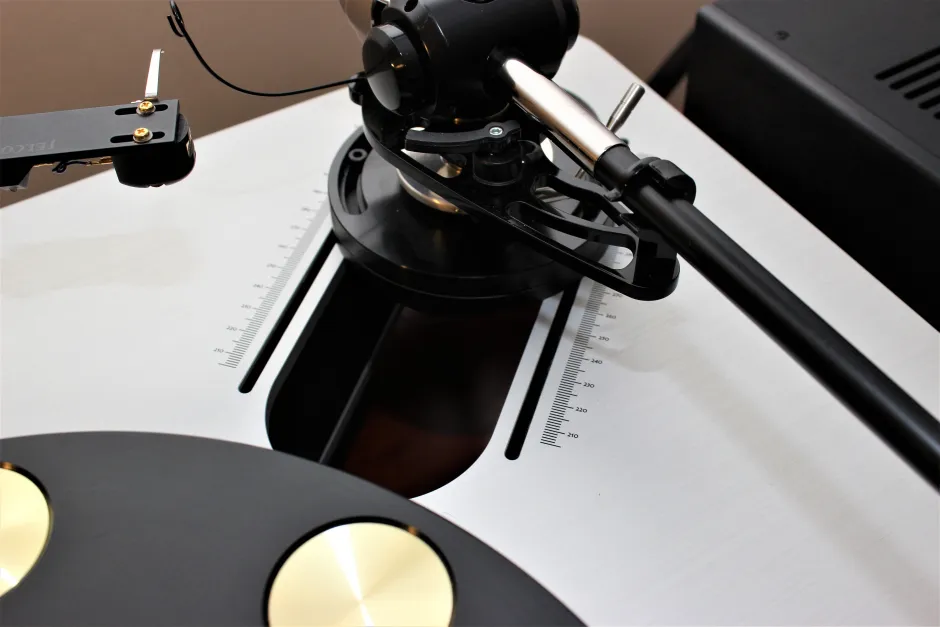
The hard part is mounting the arms and cartridges, but the armboards and trough-like holes on the Firebird are designed so that just about any arm length will work. The calibrated scale not only aids with placement of the arm, but you can also write down the number if you have more than two arms. I was lucky—both arms and cartridges and arms were already mounted for me, so I just had to double-check everything after transporting the Firebird to my house. (As it turned out, I did have to move the arms around just a tad.)

Arms and Cartridges
As I just mentioned, the Firebird was given to me with some serious hardware already installed—a 12” Jelco 850 arm with a Miyajima Madake cartridge on the back, and a 12” Origin Live Illustrious arm with a Koetsu Rosewood Signature Platinum on the side. That back position can accommodate an arm that’s between 9” and 12”, and the side arm can handle an arm that’s between 9” and 14”. (I didn’t have a 14” arm available, nor have I ever, so I’ll take Dr. Feickert’s word for it.) I did about 75% of my listening with the Origin Live/Koetsu combo only because I’ve owned two Koetsus in the past, a Black and a Rosewood, and I really miss that trademark romantic sound.
Upstream, I used a Miyajima ETR-KSW step-up transformer and the PureAudio Vinyl phono preamplifier. Various amps and speakers were used during the review period, mostly the equipment reviewed in the Summer Issue of The Occasional.

Design
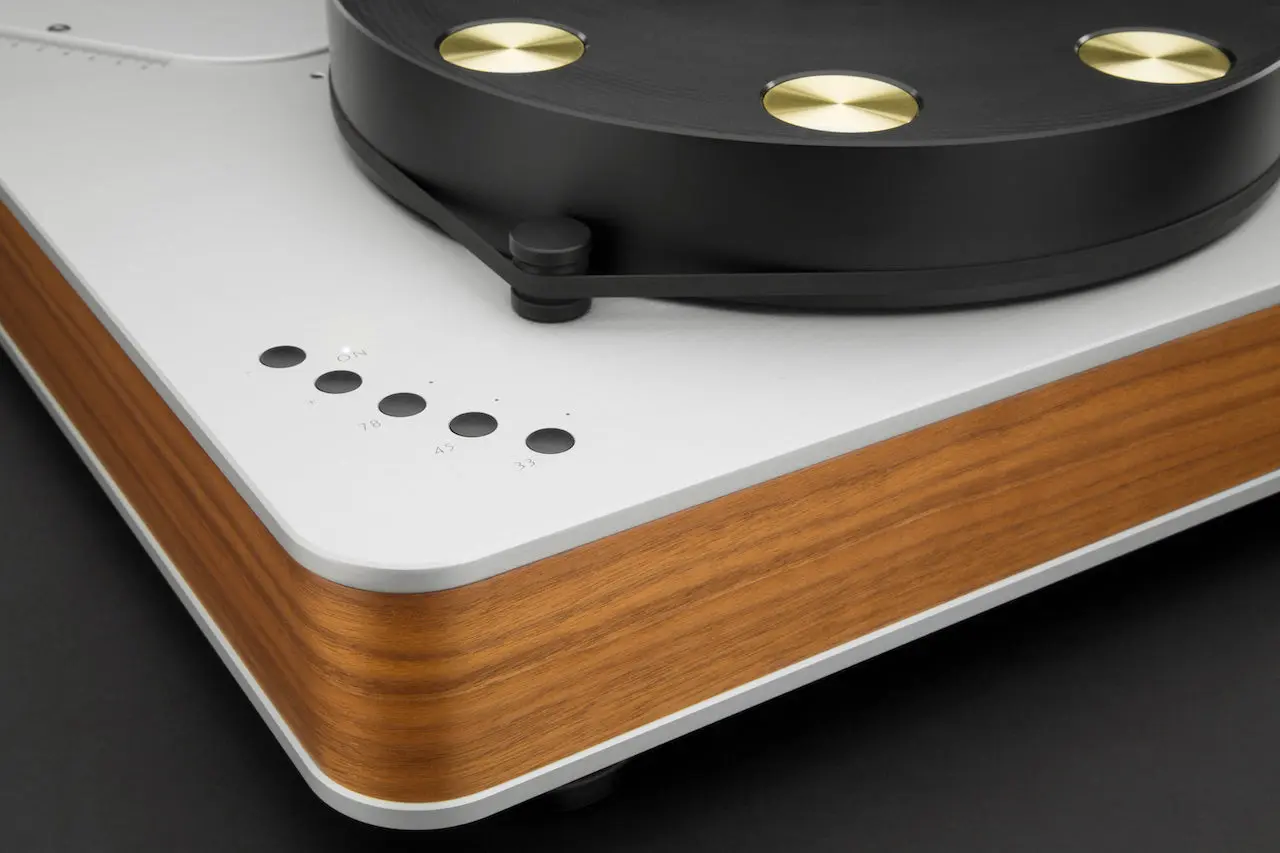
The Dr. Feickert Firebird has a high-mass plinth and three motors, as I’ve repeatedly mentioned. There’s more to it than that, of course. This new design was based on the knowledge gained from designing two smaller turntables in the line, the Woodpecker and the Blackbird, but the actual blueprint had to be completely re-worked to accommodate the three motors. These motors had to be arranged in a precise equilateral triangle to reduce torque. This, in turn, greatly reduces wobble and rumble. Stability is also enhanced through the brass cylinders embedded in the poly-oxy-methylene (POM) platter.
The bearing was also re-designed to reduce friction through materials that are harder and stiffer than before, resulting in a 80% reduction in surface contact. The plinth consists of two aluminum plates that sandwich a core of MDF and was carefully designed to reduce vibrations generated by the three motors.

Sound
This is why I’ve spent so much time talking about high-mass turntable designs in this review—the Firebird, with both arm/cartridge set-ups, imparted a solid feel to the music that was astonishing. This mattered the most when it came to imaging, when each piece of the musical puzzle was so carefully anchored to a specific location that it was eerily clear and tangible. Coupled with an unusually low noise floor, which the entire analog chain undoubtedly created as a whole, there was an extraordinary poise to the music. This provided a stunning contrast to previous perceptions with many of my favorite reference LPs, as if the Firebird was calmly telling me that this was the correct sound, and everything I’ve heard up to this point was wrong.
With my prized Three Blind Mice LP pressings such as the Tsuyoshi Yamamoto Trio’s Misty and Midnight Sugar, the Firebird did a fantastic job of placing the instruments in a space that seems somewhat realistic and logical—lesser analog rigs sometimes create an image that doesn’t quite seem balanced. (The position of each performer during the recording was unorthodox, but it shouldn’t sound nonsensical.)
On the recent LPs I’ve reviewed for French label Newvelle Records, the Firebird made the emotional content clearer by digging deeper into the recording and drawing a detailed image of each performer and the physical interaction with each musical instrument. On Andy Zimmerman’s Half Light, for example, the tenor sax revealed layer after layer of somber reflection, and each note told me more about the composer’s mood and intent. I often found music to be more moving with the Firebird, because I was able to make those emotional connections with less effort.

Conclusion
I had one serious reservation with the Dr. Feickert Analogue Firebird turntable: my time with it was too short. Just as I felt I was getting spoiled by one of the finest analog rigs I’ve ever hosted in my home, I had to pack it up and take it to AXPONA so that Jonathan Derda of MoFi could use it in one of his rooms. I’m not saying I didn’t have enough time to write a proper review. I just wanted to keep playing records on it. I wanted to hear the Dr. Feickert Firebird extract just a little more oomph out of my favorite recordings, to provide a more revealing perspective than I’ve had before.
It’s like tasting something so incredible that you keep telling the chef that you need one more bite to make sure, and you keep on going until it’s all gone. The Dr. Feickert Firebird taught me a lesson: I prefer the sound of a high-mass turntable, despite what my lower back tells me. The focus and the clarity of such a beautiful machine is addictive, and I can’t wait for the next bite.


Dr. Feickert Analogue Firebird turntable


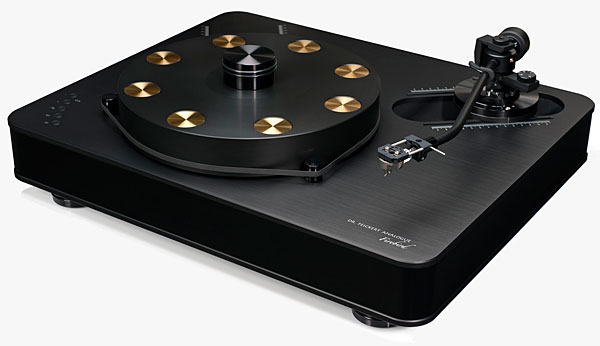
Dr. Feickert Analogue’s top-of-the line turntable, the Firebird ($12,500), is a generously sized record player designed to easily accommodate two 12″ tonearms. Its three brushless, three-phase DC motors, arranged around the platter in an equilateral triangle, are connected to a proprietary controller in a phase-locked loop (PLL); according to the Firebird’s designer, Dr. Christian Feickert, a reference signal from just one of the motors drives all three—thus one motor is the master while the other two are slaves. (Man, today that is politically incorrect, however descriptively accurate.) Feickert says that the key to this drive system is the motor design, which was done in close consultation with its manufacturer, Pabst. The result is a feedback-based system in which the controller produces the very low jitter levels claimed by Feickert.
A complete redesign of the inverted platter bearing used in the Firebird and in Feickert’s two other turntables, the Woodpecker and Blackbird, is claimed to reduce the contact area between spindle and bearing well by 80%, in order to reduce friction and, in turn, rumble, wow, and flutter. (Good thing: The original Blackbird, which I reviewed in my September 2011 column, wasn’t the quietest bird on the block.) Riding on the inverted bearing is a 13.23-lb platter of polyoxymethylene (POM), which is said to have resonance characteristics similar to those of vinyl itself; embedded within that platter, close to its outer edge, are eight solid brass cylinders. Feickert says that his three-motor arrangement, in which the platter is evenly driven by a thick, precision-ground belt made of nitrile butadiene rubber (NBR), results in a more stable bearing and platter by canceling out “virtually all acting forces,” to effectively eliminate bearing and platter wobble.
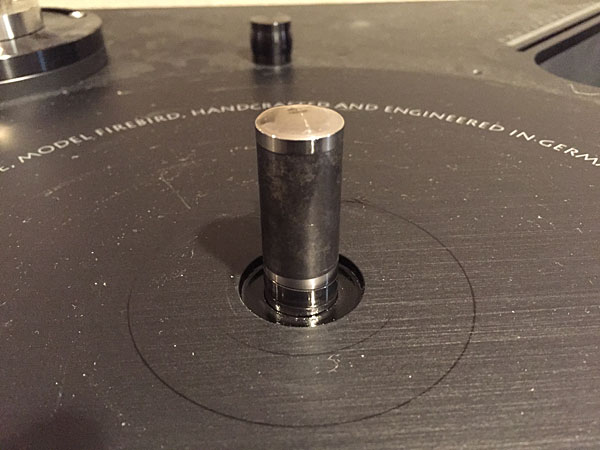
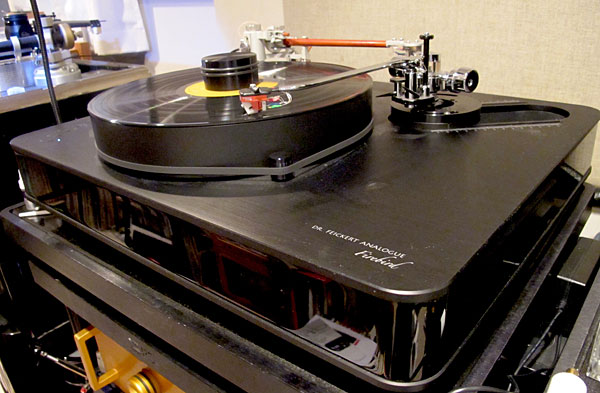
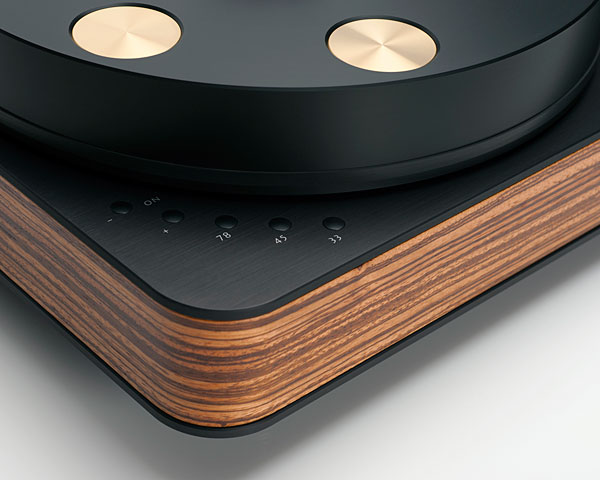
The Firebird weighs 68.5 lbs, and its plinth is large: 22″ wide by 6.25″ high by 18.25″ deep. Its thin upper and lower aluminum-alloy plates sandwich a block of treated MDF, and it sits on (newly designed) adjustable feet. The plinth is available in natural or black-anodized alloy, with side panels of zebrawood or piano-black lacquer.
Feickert’s arm-mounting system makes installing, adjusting, and swapping out tonearms more convenient than on many turntables. In each rear corner of the plinth is a large, oval, diagonally oriented cutout; the one on the right can accommodate arms with effective lengths of from 9″ to 14″, the one on the left arms of 9″ to 12″. Each cutout can be fitted with a circular armboard that bolts to a pair of sliding, captured nuts, one nut on each side of each cutout. A notch in the rim of the armboard aligns with a scale calibrated in millimeters and silkscreened on the plinth, for measuring the distance from the tonearm’s pivot to the center of the platter’s spindle—obviating, in most cases, any need for a pivot-to-spindle protractor. This makes swapping tonearms easy, assuming you’ve already mounted your other arms on Firebird armboards and that their pivots coincide with the centers of those armboards. Otherwise, as with tonearms that have off-center pivots—eg, the Kuzma 4Point, the Tri-Planar, and the Reed 3P—you’ll need to use a protractor capable of measuring pivot-to-spindle distance. Dr. Feickert Analogue, among others, makes such a protractor.
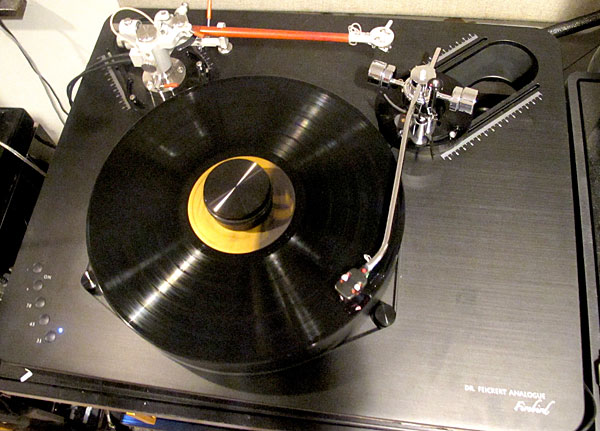
A single armboard is included in the Firebird’s price; to make use of the turntable’s second arm cutout, the user must add to it a Delrin “slider” ($100) and purchase an additional armboard ($125 each). The Firebird’s platter bearing is warranted for five years, everything else for two years.
Relatively Easy Setup
I placed the Firebird’s 68.5-lb plinth atop a Harmonic Resolution Systems isolation base, made sure that both base and plinth were level, then attached to the plinth’s underside the L-shaped mini-plug for the power supply. After applying to the bearing spindle a decent amount of the supplied lubricant, I carefully lowered the platter into place and waited for it to fully seat itself. That wait over, on went the belt. The only sticking point was getting the armboard bolts into those sliding metal nuts. It wasn’t easy, but only those who like to swap arms in and out will have to bother with it.
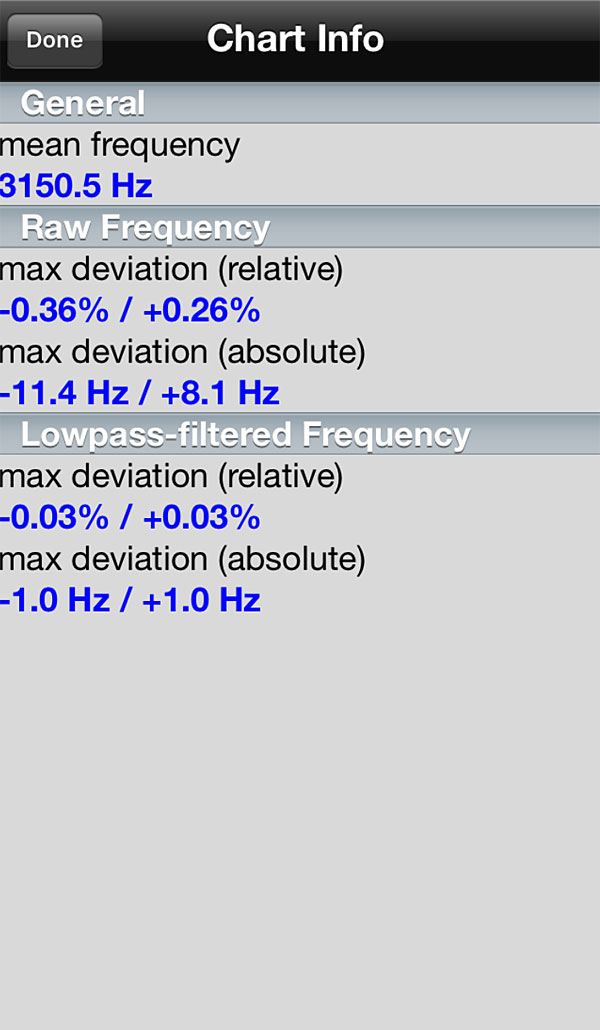
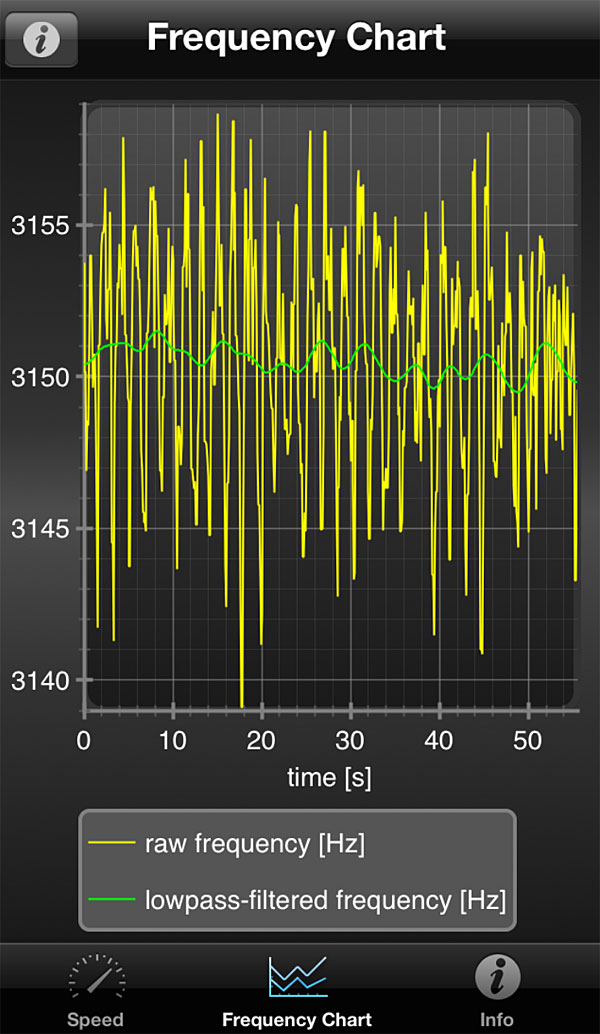
The Firebird can spin at 331/3, 45, and 78rpm; plus and minus buttons permit easy speed adjustment, if needed. The speed controller comes precalibrated, but I nonetheless checked it with Dr. Feickert Analogue’s PlatterSpeed software and 7″ test record. All three speeds were spot on, and remained so throughout my listening. See figs.1 and 2 to check out the measured results at 331/3rpm: They’re very good, and unusually symmetrical (perhaps because of the equilateral three-motor drive system?), though the low-pass-filtered trace (fig.2, wavy green line) seems to indicate the constant correcting action of the controller. Still, the filtered results look good, if not the best I’ve measured.
Despite their popularity in some circles, I’ve never been a big fan of 12″—or longer—tonearms. (What were you thinking?) I’ve long believed that whatever benefits are gained with longer arms’ lower theoretical tracking error and need for less anti-skating force are more than offset by their lower rigidity, their amplification of any errors made in setting overhang or zenith angle, and, especially, problems resulting from the arm’s greater moment of inertia—ie, a tonearm’s ability to handle a record groove under dynamic conditions.This has also been the conclusion of the designers of Continuum Audio Labs’ 9″ Cobra tonearm ($12,000) and, more recently, of Marc Gomez, who designed the Swedish Analog Technologies arm ($29,000). In fact, the SAT arm is actually somewhat shorter than Rega Research’s own tonearm—long a de facto standard—all models of which have an effective length of 239mm (9.321″). Gomez, who has a master’s degree in mechanical engineering and materials sciences, says that whatever tracking-error distortion a shorter arm introduces is more than offset by its greatly superior performance under dynamic conditions. Listening to his SAT arm sufficiently convinced me of that that I plunked down, without regret, five figur
Dr. Feickert Analogue Firebird turntable Page 2
So, when Axxis Audio’s Art Manzano offered a Reed 3P for review, I chose the 9″ version and attempted to mount it in the Firebird’s right-hand corner, with my Kuzma 4Point in the left. But that didn’t work—the Reed’s pivot assembly was where the Kuzma’s long headshell wanted to be.
Nor was it possible to mount and conveniently use the Reed arm on the left with the Mørch DP8 arm (9.25″ effective length) on the right. These shorter arms have a shorter pivot-to-spindle distance, which puts both of them closer to the platter; when correctly set up, these arms, too, interfered with each other.
So I ended up doing much of my listening with just the very familiar Kuzma 4Point mounted on the Firebird’s right armboard. Later, I managed to mount and use the Mørch and Reed arms—but in order to use the Reed on the left mount without it banging into the Mørch, I had to move the Mørch from its rest, then carefully lift the stylus of the cartridge mounted in the Reed over the widely spaced side weights of the Mørch. I was able to use both arms, but not easily.
From all of this, I concluded that while the Firebird is perfectly suited to be used as designed—ie, with one or two 12″ tonearms—before buying you should carefully check for its compatibility with whichever two arms you’re considering or already own, and know that you’ll still be comfortable if your favored arm might have to be mounted on the Firebird’s left armboard.
My experience with the Firebird challenged two long-held opinions: First: The best platter motor is no motor at all. But because a platter must be rotated by something, you have to compromise. But why triple the noise by adding two more motors and their pulleys, knowing that it’s virtually impossible to machine either to sufficiently low tolerance to prevent chatter? Second: The best plinth is no plinth at all. But, again, you need one, so you’d better make it as small as possible, to avoid a large, resonating surface.
The Firebird has made it clear that if enough design attention is paid to the motors, pulley tolerances, mounting arrangement, controller, and interface between motors and platter, the problems of noise and jitter can be, if not completely solved, then reduced to near-irrelevance, leaving intact all of the benefits Dr. Feickert Analogue claims for the design. In fact, when I placed a stethoscope on the Firebird’s plinth close to each of its motors, I heard near silence—and far less noise than I’ve heard from many single-motor designs I’ve ‘scoped. Same with the Firebird’s heavy, well-damped plinth: When I tapped it, I heard near-silence, whether from the stethoscope or my speakers.
In short, if a manufacturer’s aim is to make a turntable with a big plinth and the alleged benefits of three motors, it should be done right. In the Firebird, Christian Feickert has. And if your aim is to own a turntable that can easily and competently handle two 12″ tonearms, the Firebird is well worth considering. But if you’re considering buying or already own a 9″ arm or two, spending $12,500 on a Firebird buys you an awful lot of costly, unnecessary real estate.
Smooth Sound
The Firebird’s sound gave me a sensation of gliding smoothness and a sophistication of leading-edge transients. It avoided rough, hard edges as well as oversmoothed transients, but it definitely leaned toward the latter.
Tonally, the Firebird had a pleasing neutrality, and excelled in the midrange, which was particularly rich and full bodied. High- and low-frequency extension were very good, but in my opinion, well-damped metal platters produce more crystalline, more precisely drawn highs, and a more concentrated and impactful bottom end, with decays that plunge faster into “black.” While POM isn’t exactly acrylic, it’s similar enough to produce acrylic’s pleasingly smooth but somewhat soft overall sound, which is less than dynamically punchy, but which many listeners prefer.
If you mostly listen to small-ensemble classical music or acoustic jazz, the Firebird’s strong suits will carry the day—you’ll have to look hard to find sweeter tone and suppleness in massed strings. But if you’re a rocker or mostly listen to large-scale symphonic works, you’ll find that greater dynamic slam, low-frequency punch, and fireworks-like transients can be had elsewhere for about the same price.
Conclusions
The Firebird’s strong suits were tonal neutrality from top to bottom, and an especially smooth, lush, delicately drawn midrange. Its speeds remained precisely correct during the review period, with fluctuations that were small, consistent, and symmetrical. No wonder it achieved such a pleasing textural smoothness and was so free from etch and grain.
In terms of attack, sustain, and decay, the Firebird’s overall sound indicates careful design that has avoided the sonic thickness and loss of control that, respectively, can be caused by over- or underdamping.
While the Firebird takes Christian Feickert’s design concepts to their extremes of performance and price, I suspect that the sweet spot of performance for price in the Dr. Feickert Analogue turntable line is the redesigned Blackbird—especially if you enjoy its overall sound and plan on sticking with one or even two 9″ tonearms. If you do, paying for the Firebird’s extra real estate won’t make sense.
But if you’re looking for an all-in-one turntable that avoids the hassles of outboard tonearm and motor pods and can accommodate two or more 12″ arms, the Firebird is well worth considering. I greatly enjoyed my months of listening with it.
Related products
-
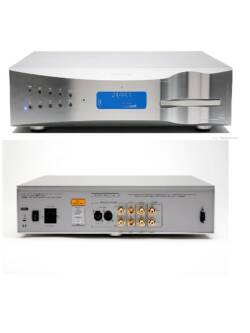
dCS Puccini CD/SACD
Original price was: R295,000.00.R60,000.00Current price is: R60,000.00. Add to cart -
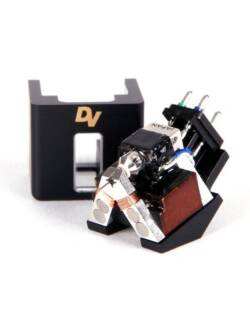
Dynavector XV1-t MC Phono Cartridge (NEW!!)
Original price was: R224,000.00.R108,000.00Current price is: R108,000.00. Add to cart -
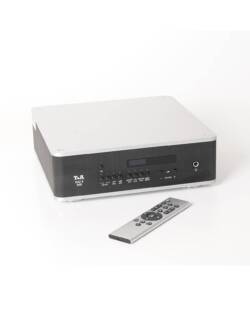
T+A Elektroakustik DAC 8 DSD D/A processor
Original price was: R120,000.00.R68,000.00Current price is: R68,000.00. Add to cart -

Yamaha CD-S3000 CD/SACD (Silver)
Original price was: R124,000.00.R22,000.00Current price is: R22,000.00. Add to cart