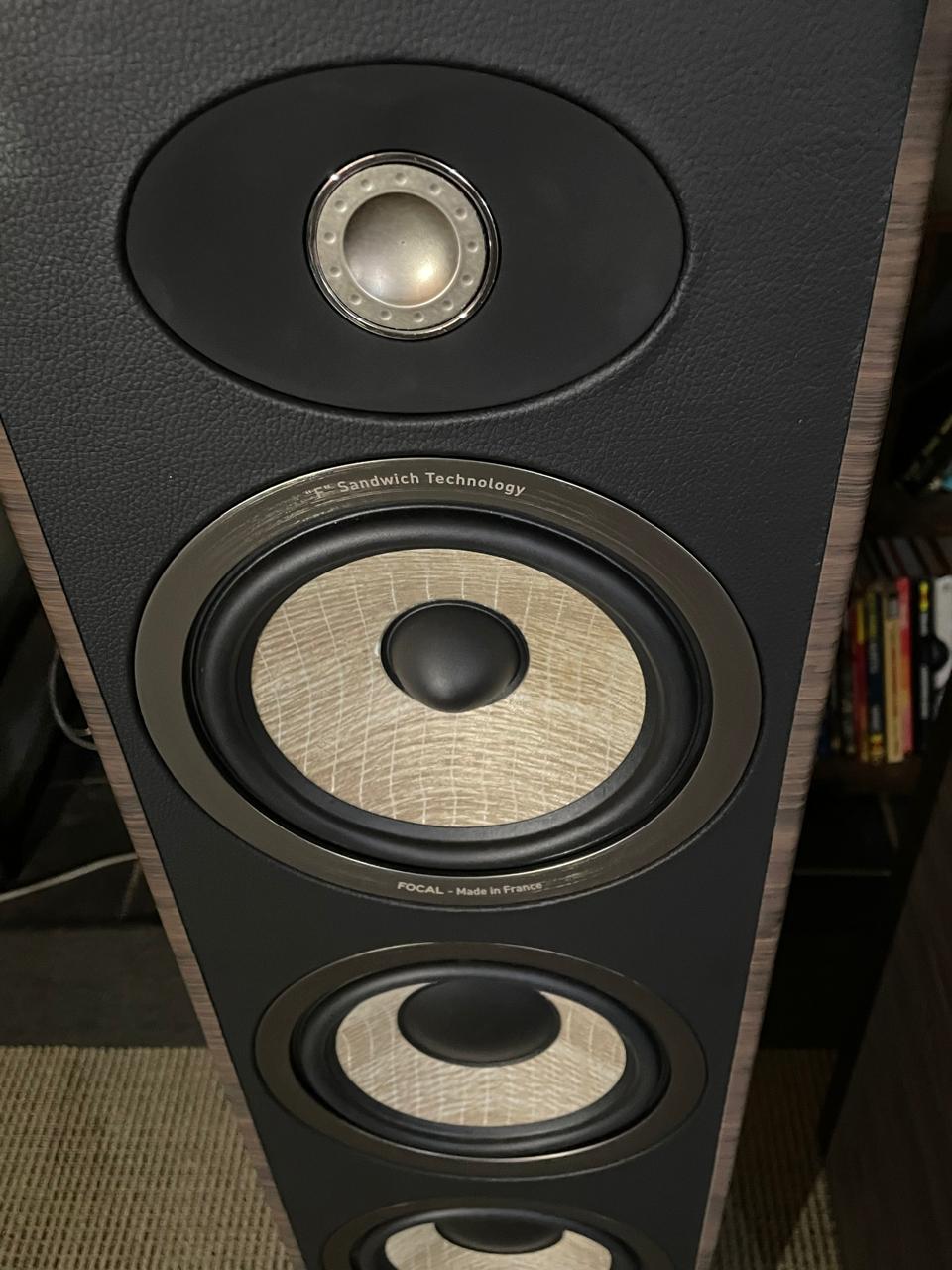
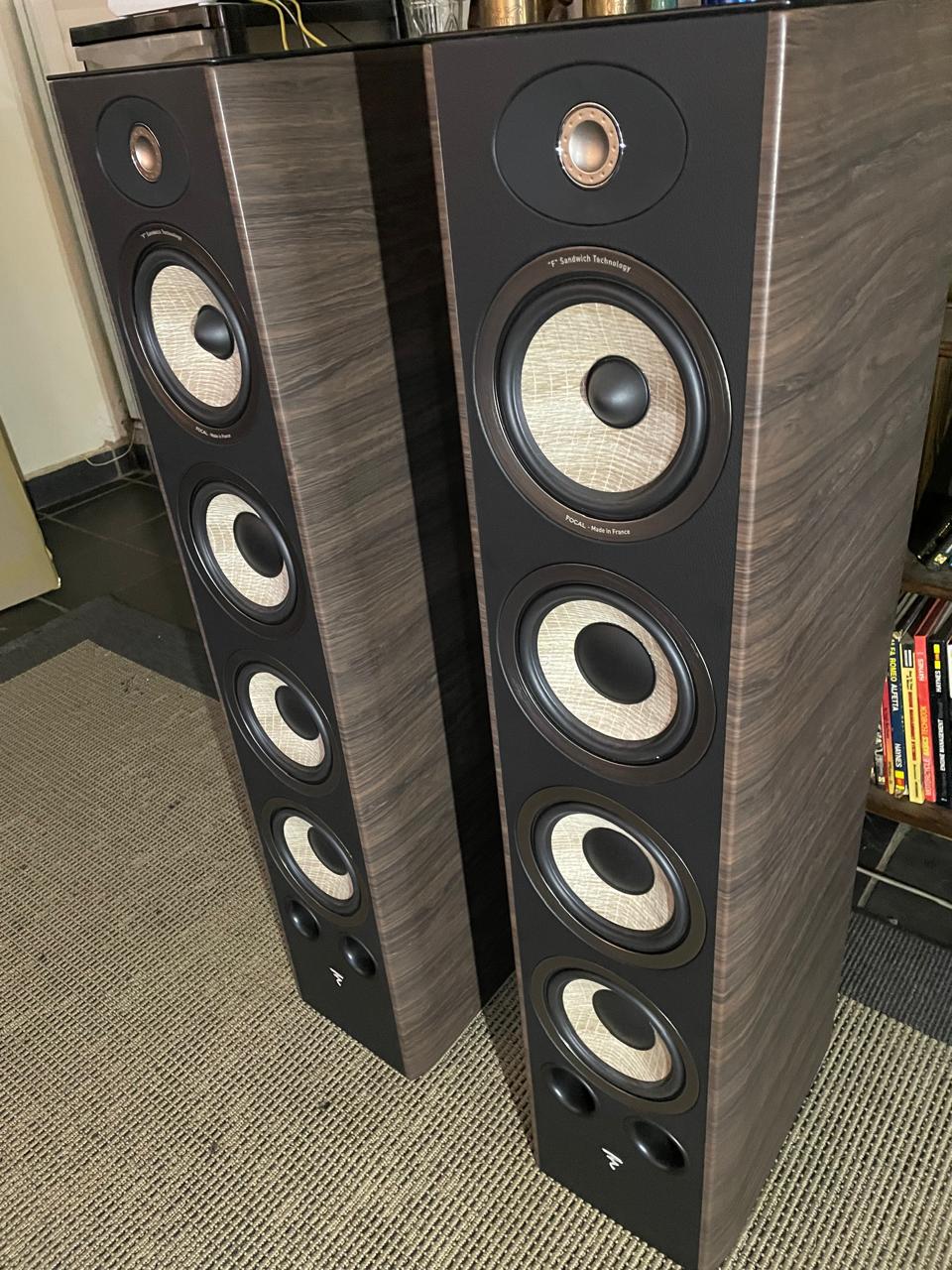
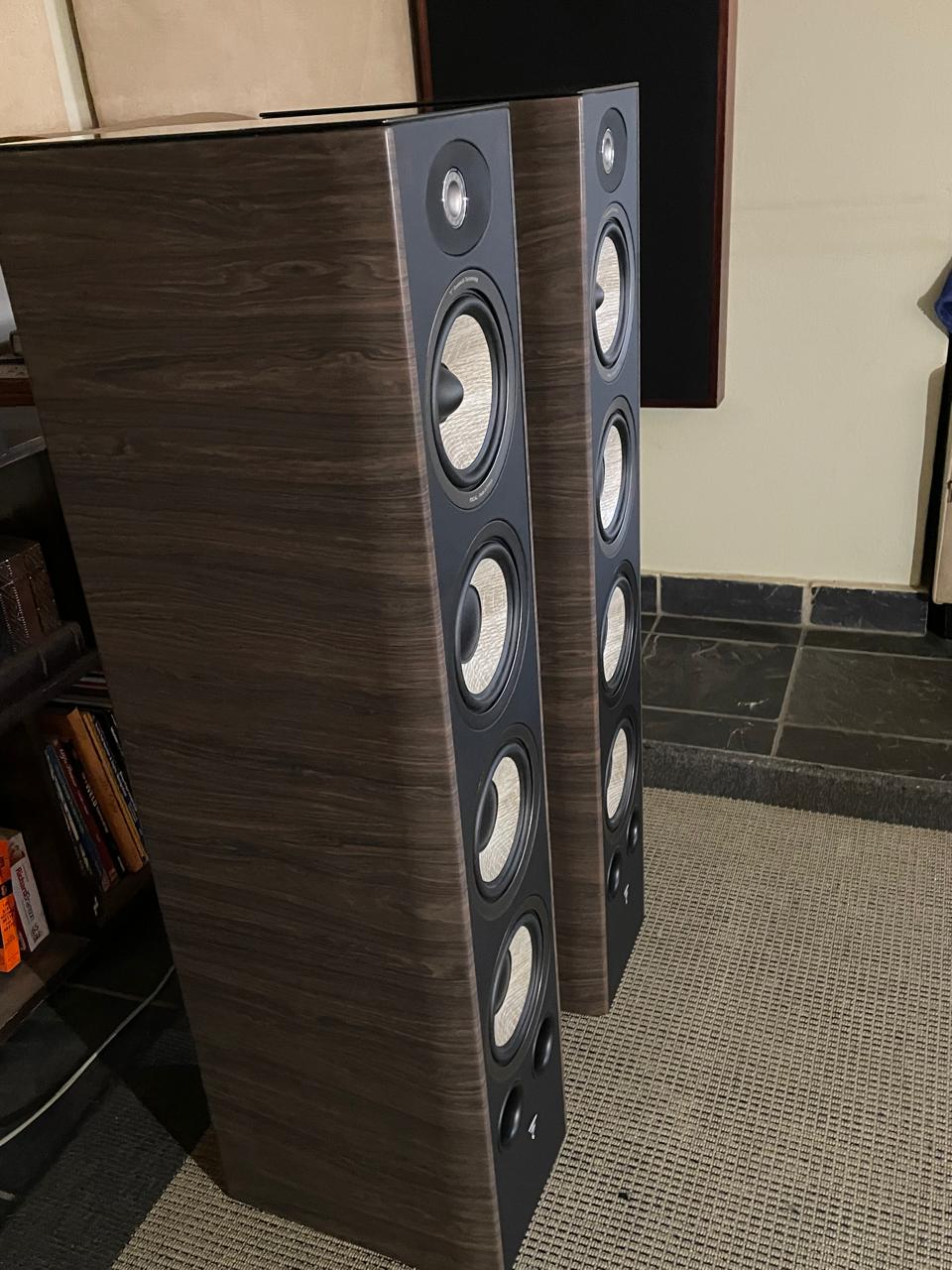
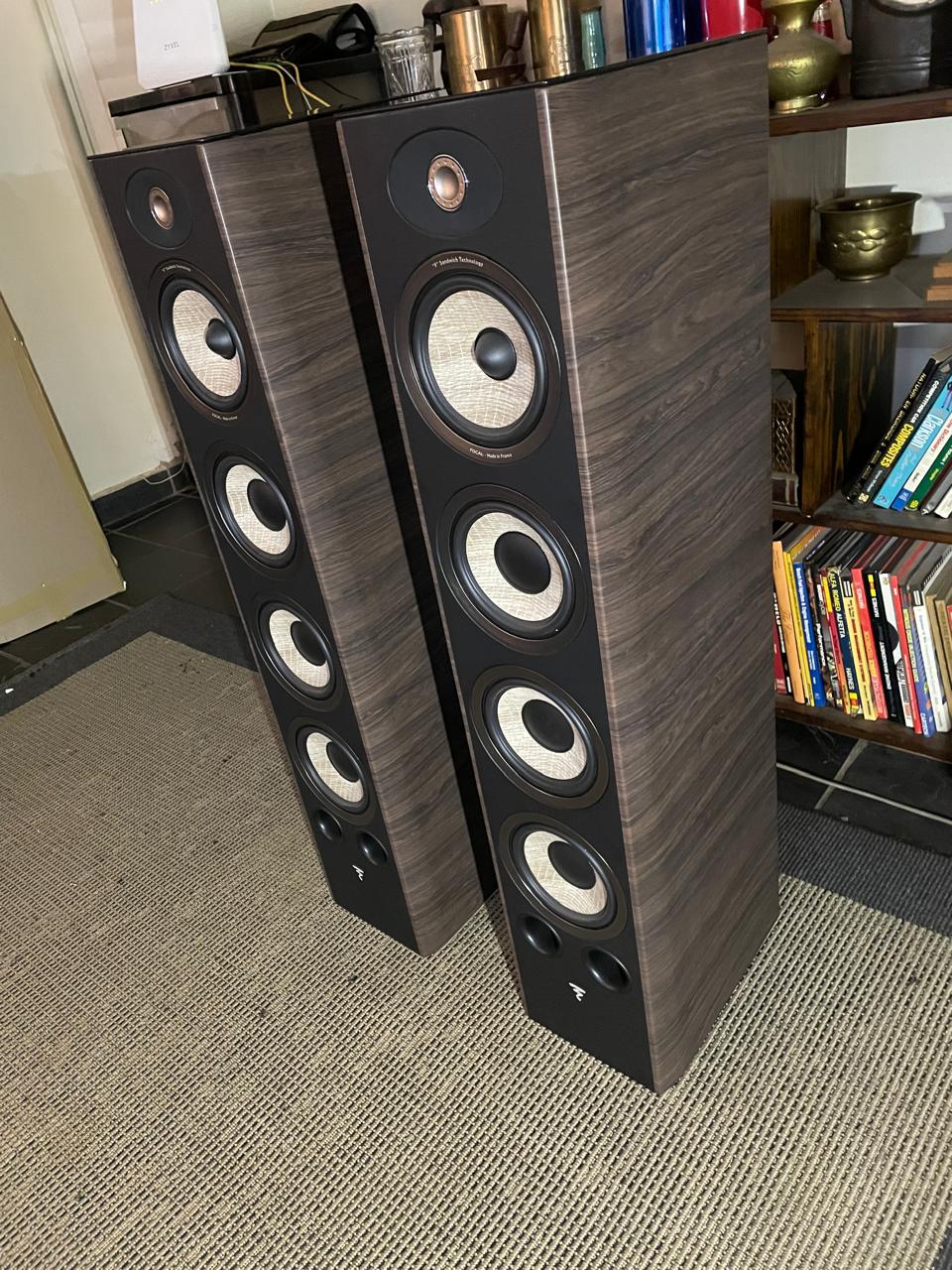
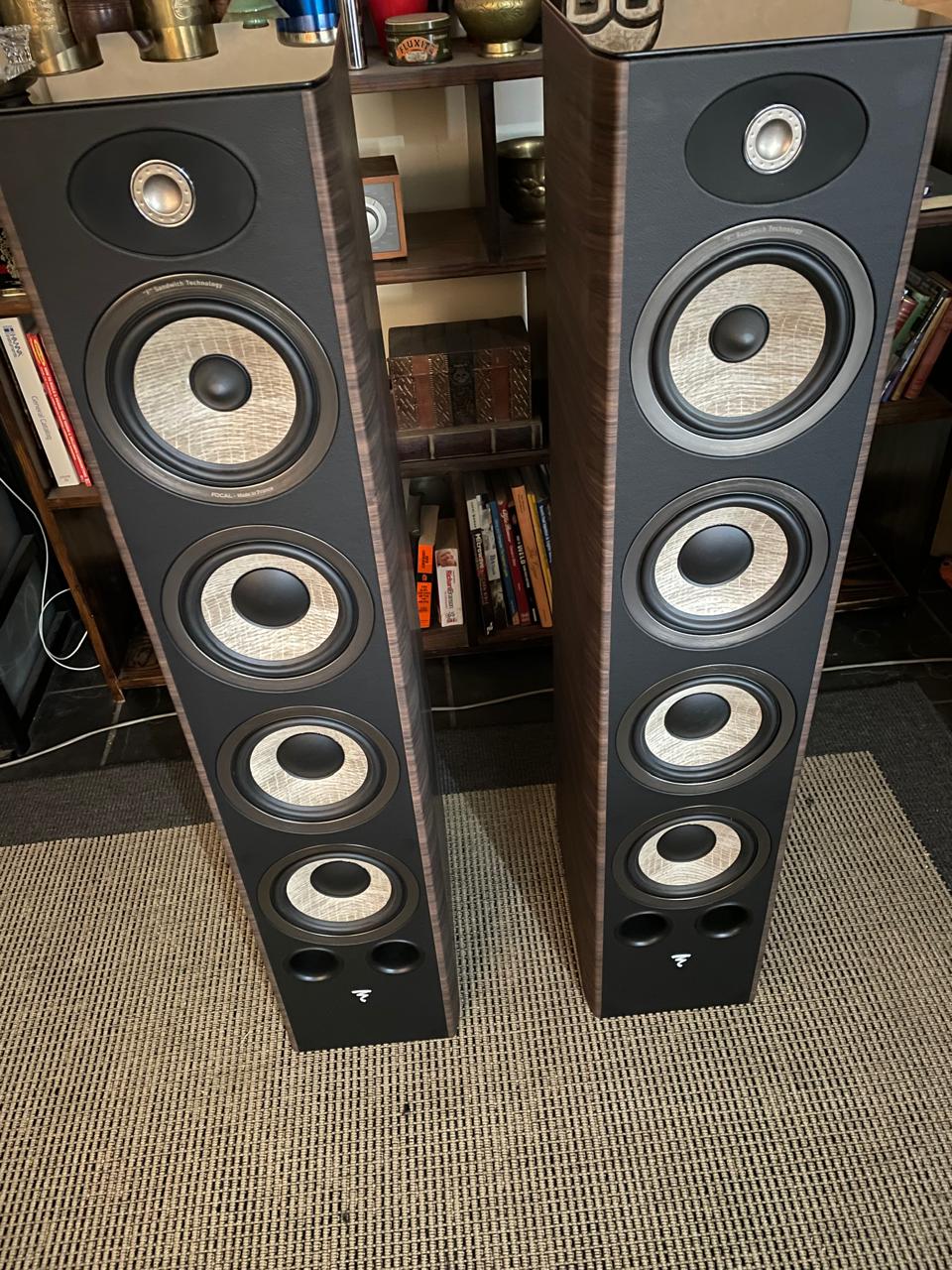
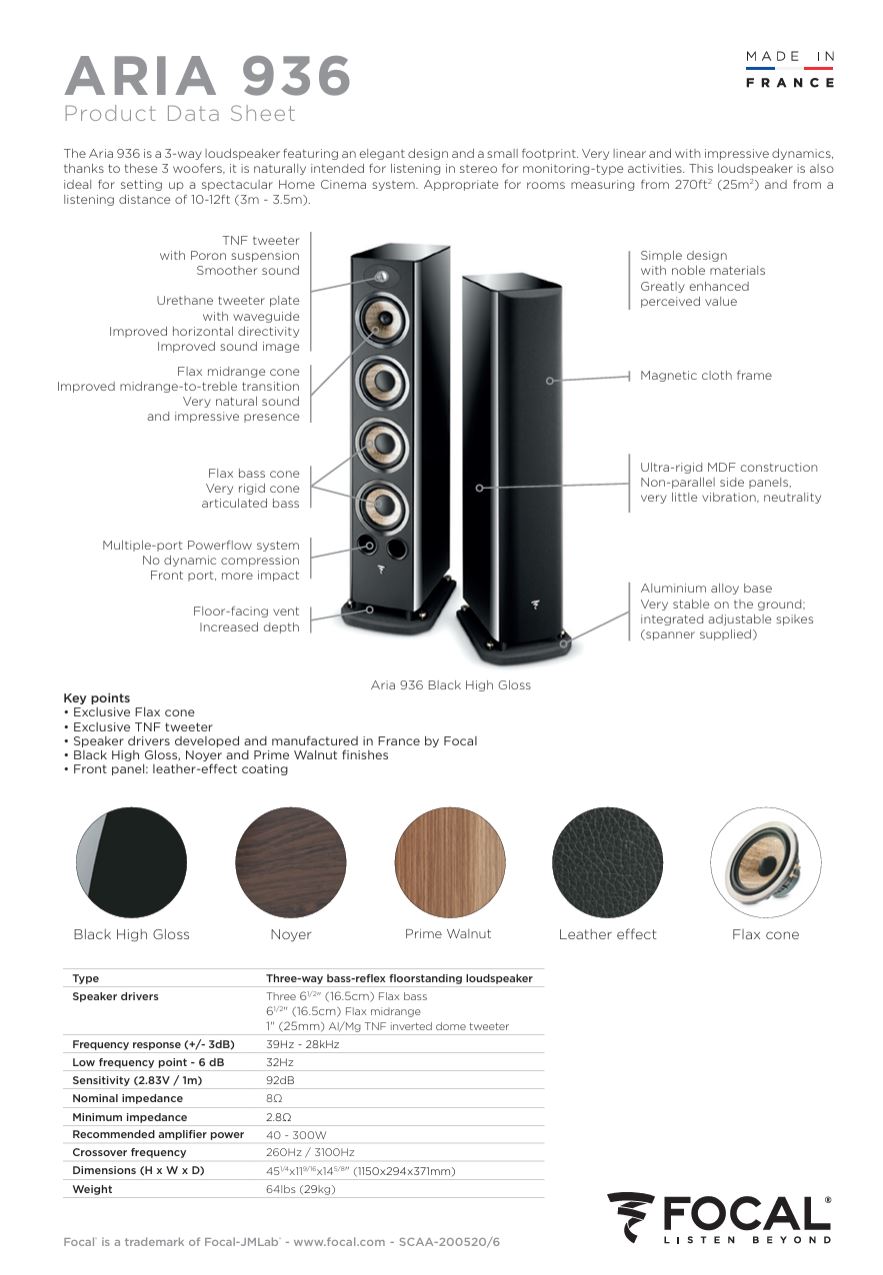
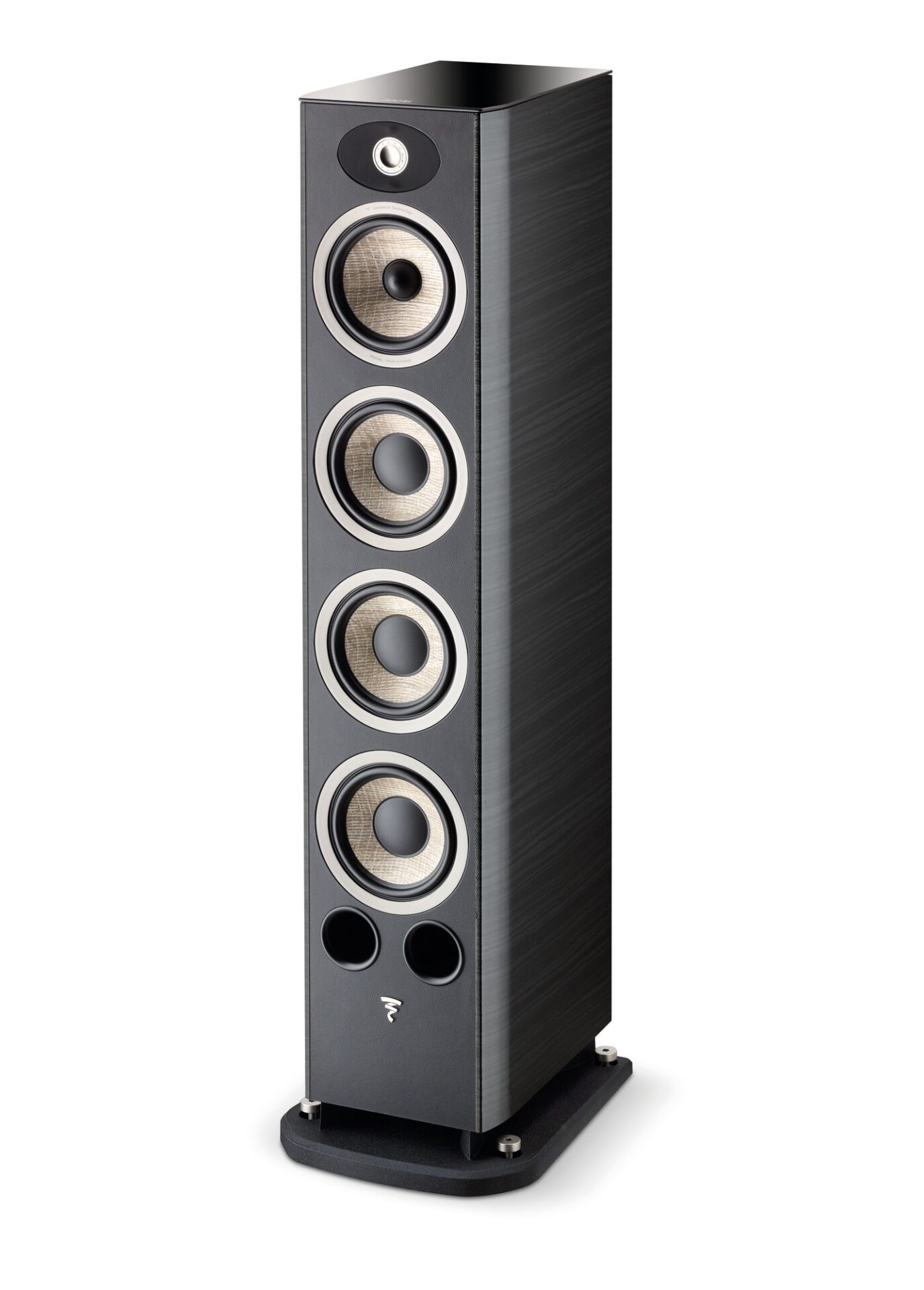
Focal Aria 936 speakers
Original price was: R160,000.00.R58,000.00Current price is: R58,000.00.
Description
Founded in 1979 by Jacques Mahul, Focal—formerly known as JMlab and as Focal-JMlab—is one of audio’s success stories. Beginning with a single speaker model produced in a small workshop in Saint Etienne, France, the company is still headquartered there, but has expanded to employ over 250 workers, making products exported to over 160 countries. All Focal products are engineered in France; only a few lower-priced multimedia models and headphones are assembled in the Far East.
Focal makes products in six categories: 1) high-fidelity speakers, 2) home cinema, 3) multimedia and wireless, 4) headphones, 5) monitoring and pro studio, and 6) custom and public address. Of course, our interest here is in No.1. The 2014 Stereophile Buyer’s Guide lists 21 Focal speakers, with prices ranging from $549 to $190,000/pair. The Aria 936 is too new to be listed in the Guide, but its price of $3999/pair puts it at just about the median.
Although Focal makes some very expensive speakers, one of their priorities has been to incorporate the technology developed for their top models into more modestly priced products. This was true for the Focal Chorus 826W 30th Anniversary Edition loudspeaker (I reviewed it in the November 2010 issue), which used the proprietary W-sandwich–cone midrange and woofer technology found in Focal’s more expensive speakers.
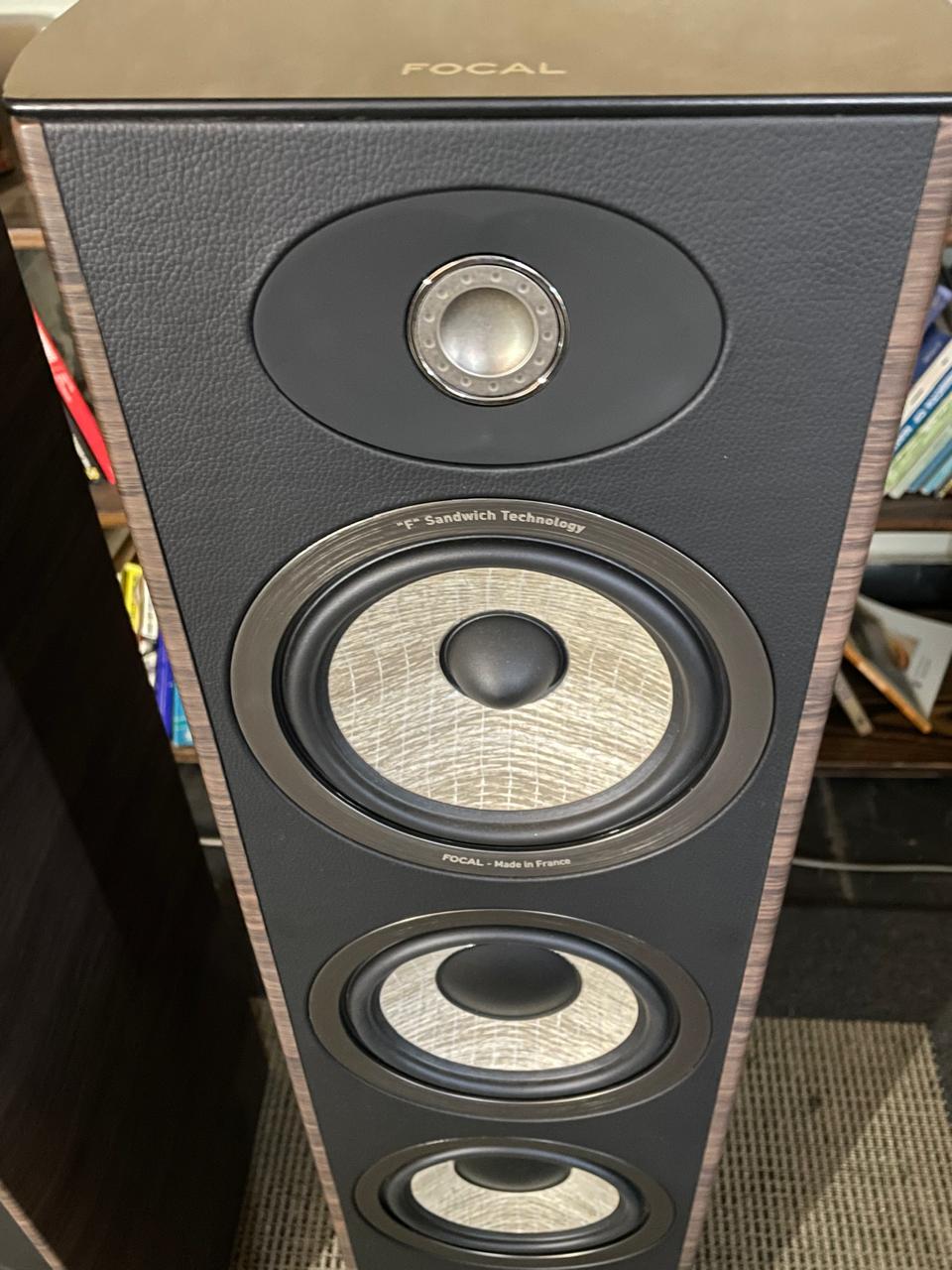
Focal describes the ideal loudspeaker cone as being: 1) light, to allow rapid acceleration; 2) rigid, for pistonlike movement; and 3) well damped, for low coloration. In their view, these often conflicting goals are best met by a “sandwich” construction of different materials. Their W sandwich takes this approach, but its production is labor-intensive and thus costly. In a search for a less expensive alternative, Focal developed a new composite material in which flax fibers of various densities form the core of the cone, in a sandwich construction with fiberglass. Unlike for the W cone, manufacturing of Focal’s F cone can be automated—and France is apparently the largest European producer of flax. (If, like me, you’re a bit uncertain about what flax is, linen is made from flax fibers.)
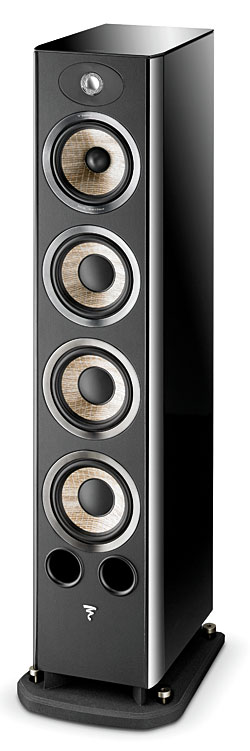 Having developed this new way of making midrange and woofer cones, Focal turned their attention to tweeters, and came up with an inverted dome made of an alloy of aluminum and magnesium. It’s similar in these respects to the tweeter used in the Chorus 826W, but in the Aria 936 the suspension between the dome and the bracket is made of Poron, a “memory foam” of microcellular urethane. This suspension method has been shown by Focal to reduce distortion by a factor of three in the critical range of 2–3kHz. A polyurethane plate with waveguide is said to improve the new tweeter’s horizontal dispersion.
Which Aria?
Focal’s Aria 900 line of speakers comprises five models. I’d heard—and been quite impressed by—the Aria 926 at the last Toronto Audio Video Entertainment Show. My only reservation was that, while the 926 generally sounded very good at TAVES, one of the demo recordings was Copland’s Fanfare for the Common Man, and I found that the bass lacked some weight. At 45″ H by 11.5″ W by 14.5″ D, the Aria 936 is as wide and deep as the 926, but it’s 5″ taller, to accommodate a third woofer. The 936’s claimed low-frequency extension is 32Hz vs the 926’s 37Hz (both –6dB), and that could make a difference with bass-heavy material. I requested a pair of Aria 936s.
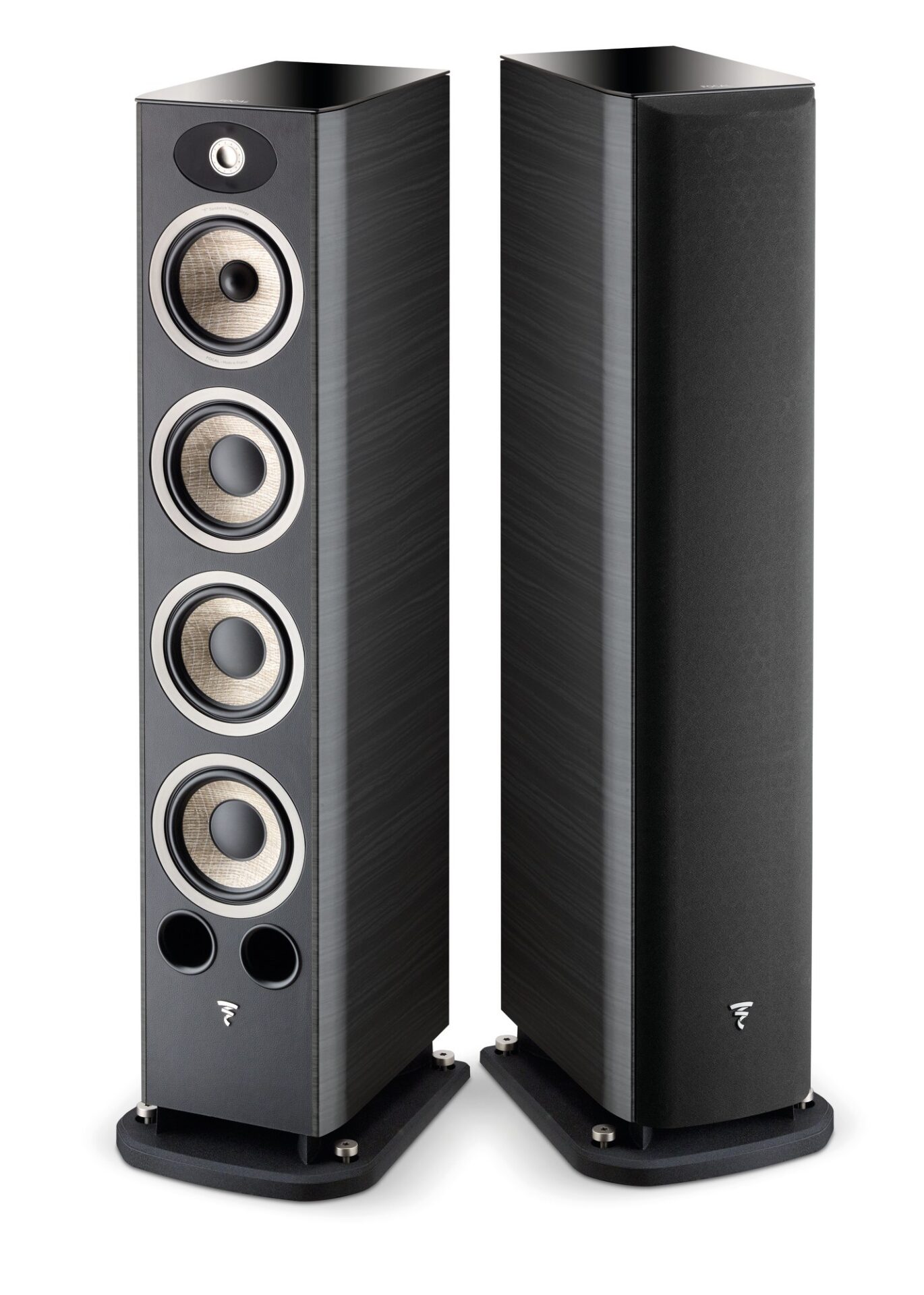
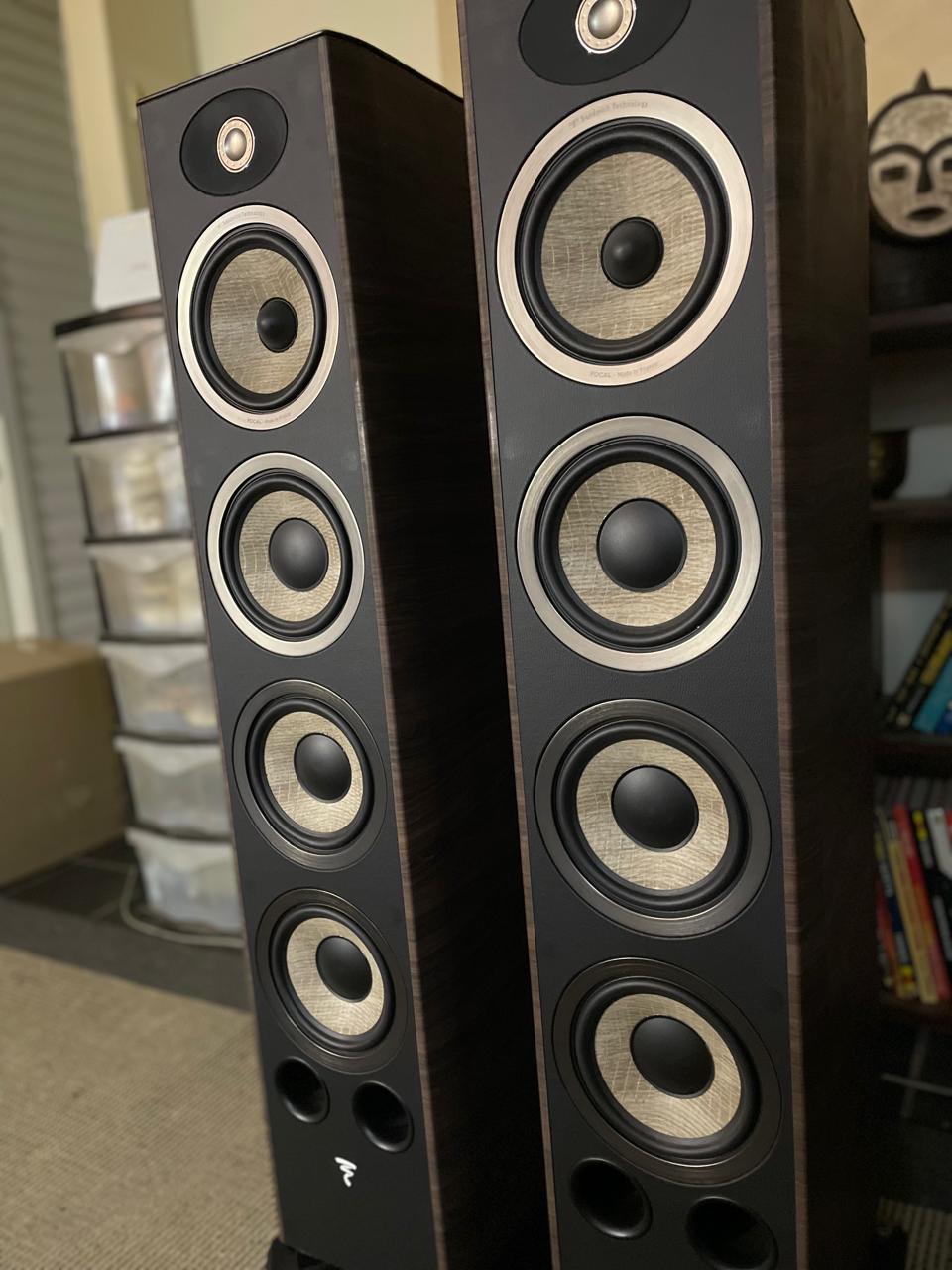
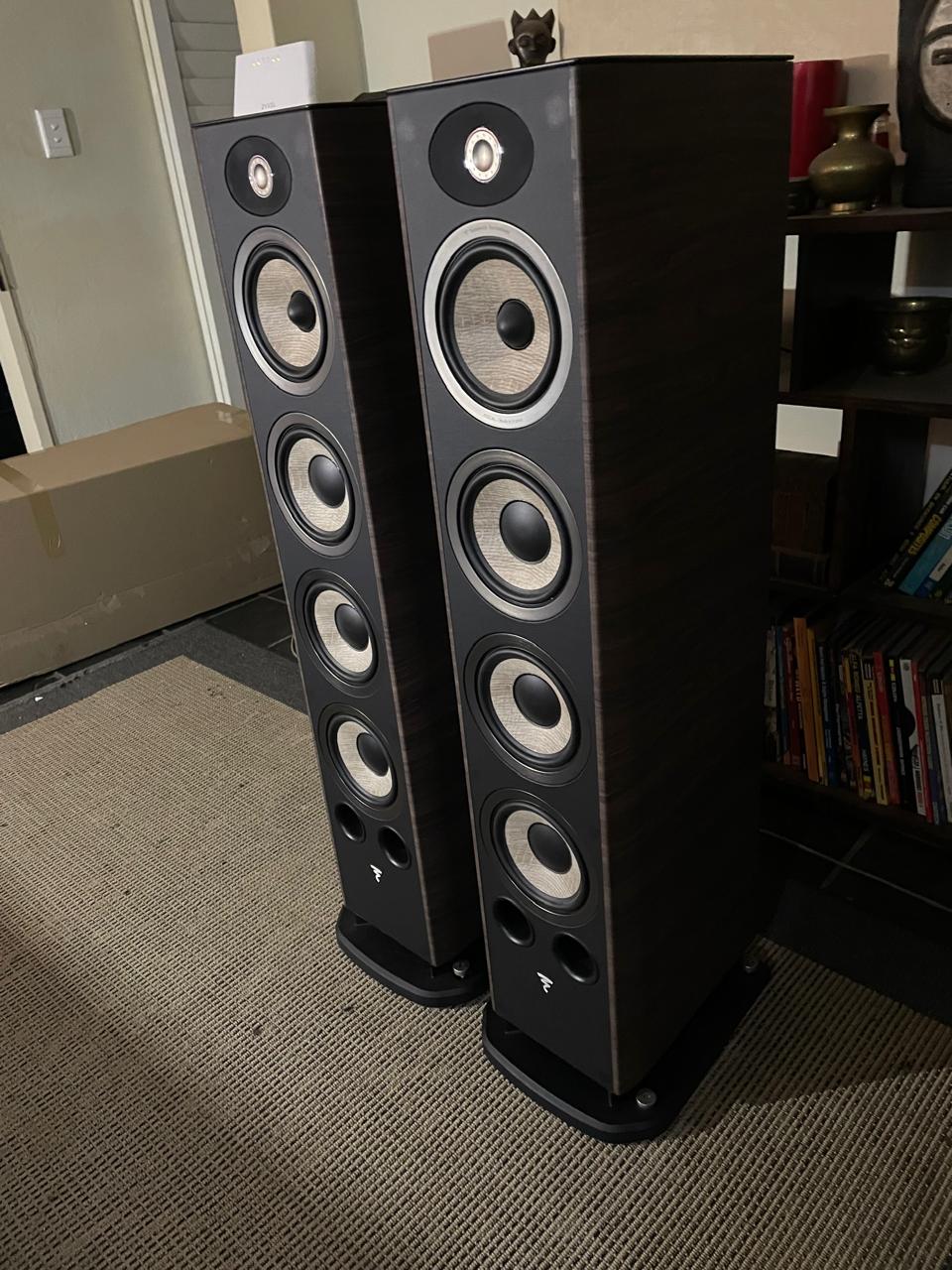
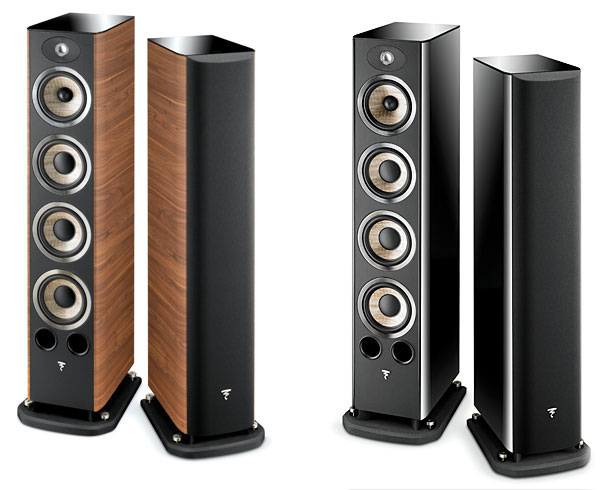
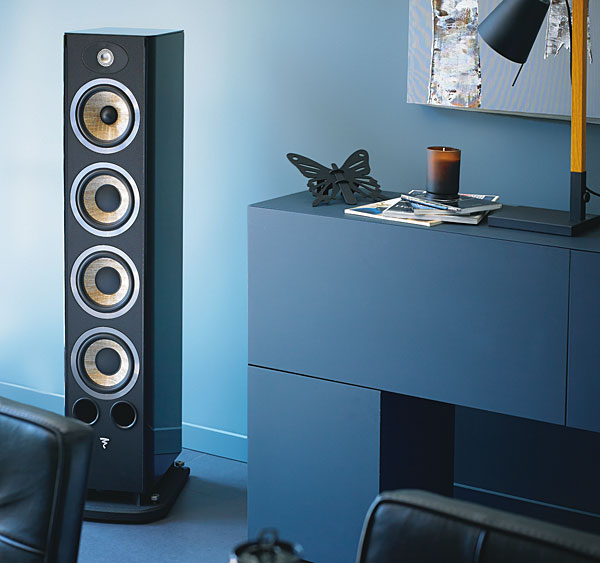
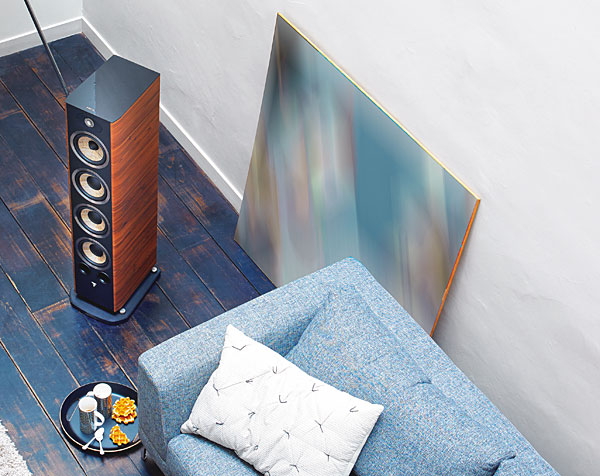
The Chorus 826W was a nice-looking speaker, but the Aria 936 has a more elegant appearance. The finish is impeccable: Black High Gloss on the sides and top, with leather front, rear, and bottom. (It’s also available in Walnut.) There are two ports on the front panel, “for more impact,” and a downfiring port in the base, “for increased depth.”
Setup
Because the Aria 936 has roughly the same footprint as the Chorus 826W, which I’d reviewed, I thought positioning the Arias would not be a problem—and it wasn’t. With the help of Audio Plus rep Ian McArthur, who delivered them, I placed the speakers in more or less the usual positions, along the long side of my listening room, and played with their distances from the walls, the listening seat, and each other, until we felt that the soundstage and bass character and extension were about right. The Aria 936 comes with a plinth that conveniently allows you to withdraw and extend the built-in spikes, first by hand, then using the included plastic wrench. This worked very well—I wish other speaker manufacturers had a similar arrangement.
The Chorus 826W has a removable grille that covers the bass and midrange drivers but not the tweeter, which has its own, apparently fixed grille. Fairly late in my auditioning of the Chorus 826W I discovered that the tweeter grille could be removed with the tip of a ballpoint pen or a paper clip. I did, and was rewarded with greater treble clarity and improved specificity of imaging.
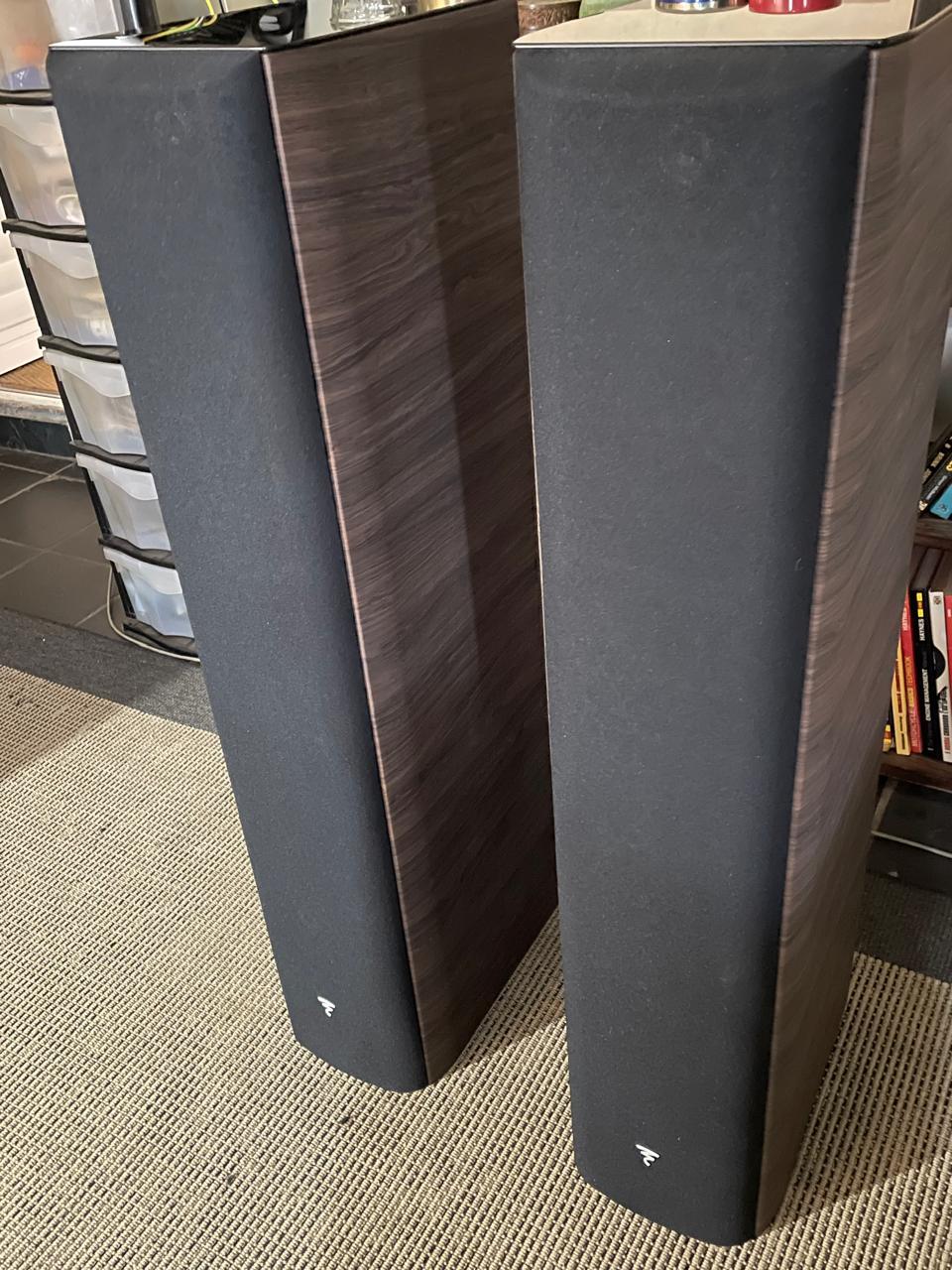
For the Aria 936, Focal has changed the grille arrangement—perhaps because of customer complaints. A single grille covers all five drivers, and it’s attached magnetically. What hasn’t changed is the fact that the speaker sounds better with the grille removed, which is I how I listened to it (and is what Audio Plus recommends).
Ian McArthur told me that, as far as he knew, the review samples had come straight off the assembly line, with no break-in. But they sounded good out of the box, with only minor improvements after more extensive playing. Focal speakers that use a beryllium tweeter have a reputation for needing a longer-than-usual break-in period if they’re not to sound too bright, but that wasn’t the case with the Aria 936’s aluminum-magnesium tweeter.
When selecting electronics to use with speakers, I often find myself in a quandary. Should I use equipment at a price level that represents a typical or likely pairing, or should I use higher-end equipment that lets the speakers really show what they can do? At various audio shows, Focal’s Aria models have been successfully demonstrated with Devialet D-Premier DAC-integrated amplifiers, which are also made in France and distributed by Audio Plus. I was sure that Audio Plus would have loaned me a Devialet for this review, but that would have introduced a second unknown factor into the equation: Before being able to assess the sound of the Aria 936, I would first have to compare the Devialet with other equipment that I was already familiar with, so that I could get a handle on the Devialet’s contribution to the sound (see sidebar, “Confounding, Cables, and Room Acoustics”). That would turn the process into, in effect, a second review—something I wasn’t prepared to do.
So I went with the familiar: my own Convergent Audio Technology SL1 Renaissance preamp ($7995), McIntosh MC275LE power amp ($5500), and loan samples of PrimaLuna’s ProLogue Premium integrated (at $2299, a real-world option) and Simaudio’s Moon Evolution 740P preamp ($9000) and 860A power amp ($14,000). The Simaudios, being new models, weren’t entirely known quantities, but I was familiar with their respective predecessors, the Moon Evolution P-7 and W-7. At one point I’d had both sets on hand for comparison, and knew that this pre/power combo was representative of today’s top solid-state electronics, the 740P/860A having even greater finesse than the P-7/W-7. My comments on the sound of the Aria 936 represent a kind of “averaging” of the sound with the various amplifiers, with differences as noted.
Sound
Smooth. Very smooth. Not smooth in the sense of glossing over or subduing the sharp transients that characterize the sounds of certain instruments, but just not exaggerating or sharpening them. This was my initial impression of the Aria 936, and it persisted throughout extended listening.
One of my favorite tests of transient response is track 3 of the Chesky Records Jazz Sampler & Audiophile Test Compact Disc, Vol.1 (JD37): Brazilian singer Ana Caram’s “Viola Fora de Moda.” It’s not the sort of music I normally listen to—and in terms of absolute fidelity, this 25-year-old recording it may not measure up to the resolution of the latest 24-bit/96kHz sources—but I’m very familiar with it, and it features lots of percussion instruments that challenge the ability of speakers (and other audio components) to reproduce their sounds. Through the Aria 936, the bells, cymbal, etc., rang out freely, with delicacy and without any harshness—much like the real thing. The sound of the cymbal at 0:54 was particularly telling in its clarity, with a crisp onset and a gradual decay. And while the Aria 936 couldn’t match the startling dynamics of the horn-hybrid Avantgarde Uno Nano, it came surprisingly close.
In tonal balance, speakers have come a long way from the days when you had to choose between East Coast (mellow, muted highs) and West Coast (bright, punchy, forward) sounds. As a group, the speakers I’ve reviewed lately—Monitor Audio Platinum 200, MartinLogan Montis, Wharfedale Jade 7, Focal Chorus 826W, GoldenEar Triton Two, PSB Imagine T2 Tower—offer tonal balances in the “neutral” category, and the differences among them fall into a fairly narrow range. The Aria 936 definitely joins them in this category. In olden days (when, as Cole Porter fans will recall, a glimpse of stocking was looked on as something shocking), one was likely to adjust an amplifier’s bass and treble controls to compensate for a speaker’s departure from tonal neutrality. Tone controls have pretty well disappeared from high-performance audio gear, but if we had them, with the Aria 936 I would be inclined to leave the dials in the Flat (or bypass) position. Bass, midrange, and treble were all present in a well-balanced way, with no part of the audioband jumping out at me or sounding too muted.
One thing the Aria 936 was not was “bright.” I mention this specifically because, in my occasional browsing of Internet audio forums, I’ve encountered the statement that “Focal speakers tend to be bright.” Based on my experience with the Aria 936, and with the earlier Chorus 826W, I must disagree. Extended highs, transparent to the tonal characteristics of the recording and of the associated equipment—yes. But from what I’ve been able to determine, the Aria 936 did not add significant brightness of its own. I can certainly imagine that with a cheap-and-not-so-cheerful amplifier, and a particularly “digital”-sounding source, the resulting sound could be brighter than ideal. I preferred to set my Ayre Acoustics CX-7eMP CD player to its Listen rather than its Measure filter—but then, that was my preference with other speakers as well. And while there were differences in the sound depending on whether the electronics were the solid-state Simaudio Moon pair or the tubed CAT and McIntosh, in neither case could the sound be described as too bright—or too soft, for that matter. Vocal sibilants are, for me, the most telling indicators of exaggerated treble—a “spitty” character that I find very annoying. However, the treble of the Aria 936 was clean and extended but not overly bright, with no emphasis added to sibilants—a tribute to the design of Focal’s new tweeter.
I noted earlier that one of my reasons for choosing the Aria 936 over the smaller Aria 926 was that the 936 has an additional woofer and a claimed bass extension to 32Hz, or 5Hz lower than the 926. I was concerned that the bass might be too much for my room, but that wasn’t a problem. (The pair of ASC Bass Traps in the front corners probably helped in this respect.) The bass sounded extended—not quite as low or as room-filling as the GoldenEar Triton Twos, but at least comparable to the PSB Imagine T2s. The Aria 936 went low enough to pass my usual low-frequency test—the 32Hz synthesizer note at the beginning of “Temple Caves,” from Mickey Hart’s Planet Drum (CD, Rykodisc RCD 10206)—with maybe a bit more assurance than the PSBs. Double basses, bowed or plucked, were firm, not weak or exaggerated, and no obvious unevenness manifested throughout the instrument’s range.
Colorations—a speaker drawing attention to the fact that the sounds heard are not being made by musicians playing instruments in the room but are emanating from a box and result from vibrations produced by transducers—are endemic to loudspeakers, and controlling them represents perhaps the greatest challenge in speaker design. The Aria 936 did exceptionally well in this department, mixing very little “speaker sound” in with the music. For the most part, I found it easy to pretend that the sounds in my room were of real voices and real instruments, and not of electromechanical contrivances mounted in wooden boxes. The use of flax in the sandwich construction of the midrange and bass drivers, and judicious internal bracing of the cabinet, must have played major roles in allowing the Aria 936 to be so free of any characteristic “speaker sound.”
The soundstage presented by the pair of Aria 936s and the precision of the images within that soundstage were first-rate. Depending, of course, on the source material, the soundstage was deep as well as wide, and had good specificity of images within the soundstage. Listening to the series of “Depth of Image: Acoustic Clicker” tracks on the Chesky Jazz Sampler & Audiophile Test CD, Vol.2 (JD68), I could hear all of the increases in depth up to 70′, just one step short of the maximum 80′.
Most of my listening to the Aria 936 was with the CAT SL1 Renaissance and McIntosh MC275LE. This was a very good combination: there were no obvious “tube” colorations, but a very liquid, “musical” sound. I also listened quite a bit through the Simaudio Moon Evolution 740P preamp and 860A power amp. Although my preference remains with the tubed combo, I had no difficulty getting accustomed to the sound of the solid-state Simaudio gear, and came to appreciate their highly detailed but still nonclinical sound, and their ability to drive the Arias to a higher level than the tubed gear without strain.
Of course, the CAT/McIntosh and, especially, the Simaudio preamp/amp combos, while not crazy-priced, are still on the expensive side, costing more than most potential buyers of the Aria 936 are likely to spend. Do you have to spend big bucks to get the Aria 936 to sound good? I would say the answer is “No.” My go-to product for a moderately priced integrated amplifier is the PrimaLuna ProLogue Premium ($2299). It worked well with the Aria 936, its 35Wpc not a real limitation at the levels I normally use, and while it had just a bit more tube character and a bit less ultimate transparency than the CAT/McIntosh duo, the Focal/PrimaLuna pairing is one I could live with quite comfortably. I’m not experienced with solid-state integrated amps at about the $2000 price point, but a perusal of the most recent edition of Stereophile‘s “Recommended Components” and talking to a good dealer should help to identify some likely contenders.
Conclusions
“A big, spacious sound, tonally neutral, with impressive dynamics, and powerful bass for the size of the speaker.” That was my capsule description of the sound of Focal’s Chorus 826W 30th Anniversary, and it also describes the Aria 936, which is all of those things—and more. As befits its somewhat larger size and additional woofer, the Aria 936 reaches further down into the bass, without the bass sounding boomy or bloated. No longer having samples of the Chorus 826W on hand for comparison, and thus having to rely on my memory and listening notes, I may be on thin ice here, but I’m comfortable saying that the sound of the Aria 936 is more detailed and more transparent, and its highs are particularly clear and extended without sounding in any way forward or clinical. Soundstages are bigger, and aural images within those soundstages are more precisely defined.
The word voice has long been associated with the reproduction of music, going back to His Master’s Voice, Electro-Voice, and Altec’s Voice of the Theater. It is thus most appropriate that Focal has named their newest line of speakers Aria, a term that refers to vocal music. With the right source and suitable partnering electronics, the Aria 936 sings with a beautiful voice.
- Details
- Written by Doug Schneider
- Category: Full-Length Equipment Reviews
- Created: 01 May 2021
Note: measurements taken in the anechoic chamber at Canada’s National Research Council can be found through this link.
After evaluating KEF’s diminutive LS50 Meta stand-mounted loudspeaker ($1499.99/pair, all prices USD), I wasn’t keen to raise my hand to review Focal’s far bigger and heavier Aria K2 936 floorstander ($5990). I knew they’d be a pain to schlep up to my third-floor listening room. I guess the little KEFs had made me a bit soft.
But at heart I’m an explorer of new gear, and my reluctance didn’t last long. I wanted to hear and see what this new, limited, K2 edition of the Aria 936 was about. Although Focal has been in business since 1979, in the last five or so years, beginning with the Sopra No2 floorstander ($18,990/pair), which I reviewed in October 2015, the French company has come up with one great-sounding speaker after another. Might the Aria K2 936 be their next ball smacked out of the park?

Description
The Aria K2 936 is “a revamped and unique” version of the Aria 936 ($5390/pair), Focal says, and the only Aria model to be released in a special limited edition. However, the K2 isn’t all that great a departure from the original Aria 936.
Like every Focal speaker I’ve reviewed, both versions are made in France. They share the same weight and dimensions: 64 pounds, and 42.75″H x 9″W x 13″D, or 45.25″H x 11.56″W x 14.63″D with bottom plinth (included) attached. Both cabinets are made of MDF, with nonparallel sidewalls that taper slightly inward toward the rear panel, which is just 8.25″W.
Most of the two models’ internal parts and external features are also the same: A 1ʺ inverted dome tweeter with a diaphragm of aluminum and magnesium is set into and surrounded by an oval piece of urethane that acts as a shallow waveguide, mostly to assist with horizontal dispersion. Near the bottom of the front baffle are two round ports, and on the cabinet’s underside is a third, larger port. That bottom port is what necessitates the all-metal plinth: It must be in place, to give this tall speaker a surer footing, and because the gap it opens between its top and the speaker’s underside allows air and soundwaves to exit the bottom port and radiate into the room in all directions, to fill out the low end.

On both models, four spiked feet of metal thread through the plinth to bite the floor, to give the speaker an even firmer stance than would the plinth alone. The height of each foot can be adjusted by hand or with the supplied wrench. (Plastic endcaps for these spikes are provided for those with hard but easily damaged floors.) Both versions of the Aria 936 have a magnetically attached grille for the front baffle (I left these off for all of my listening), a single pair of binding posts on the rear panel, faux leather on the front and rear baffles, and, covering the top panel, a 1/8″-thick glass plate that adds an attractive if purely decorative touch.
Other than the $600 price gap, the key differences between the two models have to do with the finishes of the sidewalls, and the cones of the 6.5″ midrange driver and the three 6.5″ woofers. The Aria 936’s sidewalls are available in Black High Gloss paint and Prime Walnut. The Aria K2 936 is available only in gunmetal Ash Grey, a painted finish Focal uses in their top line of speakers, the Utopia models. Although the most popular speaker finishes, at least in North America, are black paint and wood veneers, I liked the look of the K2’s Ash Grey.
The standard Aria 936’s light-brown midrange and woofer cones are made from Focal’s proprietary Flax composite, used throughout the Aria line except in the K2. The Aria K2 936’s cones are the bright yellow of Focal’s K2 material, which comprises a sandwich of aramid fiber and fiberglass. K2 was also used in Focal’s Spectral 40th loudspeaker ($9990/pair, discontinued), reviewed by Diego Estan in September 2019.

The two Aria 936es’ midrange and woofer cones may differ, but the crossover frequencies are identical: 260Hz from woofers to midrange, 3.1kHz from midrange to tweeter. Also unchanged are these specifications for both models: a frequency response of 38Hz-28kHz, ±3dB; -6dB at 32Hz; a sensitivity of 92dB/2.83V/m; and impedances of 8 ohms nominal, 2.8 ohms minimum. Only in the recommended amplification is there a slight difference: 50-300W for the Aria K2 936, up from 40-300W for the Aria 936.
Setup
My system for reviewing the Aria K2 936es was simple, starting with Purifi Audio’s Eigentakt power amplifier, which I began writing about in June 2020 and is specified to deliver 200Wpc into 8 ohms or 400Wpc into 4 ohms. The speaker cables are the ones Purifi makes and supplies with the Eigentakt: Cordial CLS 425 bulk wire terminated with banana plugs at the speaker end, Neutrik SpeakOns at the amp end. An Anthem STR preamplifier-DAC drove the Purifi via Crystal Cable Standard Diamond balanced (XLR) interconnects. All electronics were plugged into one of two Shunyata Venom HC power distributors. I used my computer’s stock power cord, and Shunyata Venom HC cords for the preamp and amp.
The sole source of music was my Asus Zenbook UX303U laptop running Windows 10, Roon, Qobuz, and Tidal, connected to the Anthem with an AmazonBasics USB link. I listened to files of varying resolutions, all stored on an attached solid-state drive.
My reference listening room is big—about 36′L x 16-18′W. I use only half of this space as a listening room, which leaves a big open area behind me. Having so much room proved vital in getting the Focals to sound their best.

The first thing I noticed about the sound of the Aria K2 936es, as set up in the usual places I put all speakers I review, was that they were far more sensitive than the KEF LS50 Metas, by about 8dB. I knew this because for the KEFs, I typically set the Anthem’s volume control to around -35dB for a “normal” listening level. For the Focals, the volume hovered around -43dB. I kept the French floorstanders at about -60dB for background listening, whereas I’d set the KEFs to around -50dB for such listening. As I write this, we haven’t yet measured the Aria K2 936 in the anechoic chamber at Canada’s National Research Council (NRC), but I wouldn’t be surprised if its sensitivity at least comes close to its specified 92dB/2.83V/m. (We measured 83.2dB for the KEF LS50 Meta.)
I also noticed that, sitting in my usual listening chair, my ears weren’t far enough above the floor to put them on the Focals’ tweeter axes, as that chair does with most speakers I review; instead, my ears were on the level of the center of each Aria’s midrange cone: 38″ above the floor. The center of the tweeter is about 43″ high—quite a bit higher than the 36-39ʺ of the tweeters of most speakers. This helps explain why Focal recommends a listening distance of 10-12′ for both versions of the Aria 936—that puts the listener in the farfield rather than the nearfield, and gives the outputs of all five drivers of this fairly tall floorstander a better chance to cohere into a unified wavefront at the listener’s ears. So I moved the Aria K2 936es 7″ farther from my chair than I usually place speakers in my room, which put my ears 10′ from each front baffle. But I didn’t change the speakers’ distance from each other: with 10° of toe-in, the centers of their tweeters were 8′ apart.
Finally, the Aria K2 936es were properly set up. I got down to some serious listening.
Sound
When I played the 2012 remastering of Blue Rodeo’s 1989 album, Diamond Mine (16-bit/44.1kHz WAV, Atlantic), the K2 936es did a fine job of reproducing its wide, deep soundstages. In the title track, especially, lead singer Greg Keelor’s voice was positioned with reasonable solidity at the center, as it should be, and the abundant ambience around it at the beginning of the track spread way out to the sides and behind Keelor, letting me know that this was recorded in a very large space. (According to Nicholas Jennings, in an article in the April 17, 1989, issue of MacLean’s, Diamond Mine was recorded “initially in a gutted Toronto movie theatre and completed in a New Orleans apartment-studio.”) With this and other Diamond Mine tracks, the speakers also did a good job of “disappearing”—they and their positions in the room seemed to have little to do with the sound of the music I was hearing and that they were certainly reproducing. They weren’t quite as spectacular at this as the KEF LS50 Metas, which are world-beaters in that department, but they were about as good as I’ve heard from any other big floorstander at anywhere near the price.
Yet various tracks on Diamond Mine—the title track, “Now and Forever,” “God and Country”—also revealed that the Aria K2 936es’ tweeters, even above the level of my ears when seated, could sound a bit bright, if never quite too bright. However, on a scale of 1 to 5, in which 1 is too dull, 5 is too bright, and 3 is just right, the Aria K2 936es earned a 4. The KEF LS50 Metas and my reference Revel Ultima2 Salon2 floorstanders ($21,998/pair) get a solid 3 in my room. Obvious conclusion: The Focal is tipped up in the treble. But for Diamond Mine, that level of treble was still enjoyable.

The Aria K2s’ hint of brightness wasn’t a problem with Bruce Cockburn’s wonderful, all-instrumental album Crowing Ignites (16/44.1 FLAC, True North), which has a more robust sound than Diamond Mine. The speaker’s prominent treble was still audible, but it added a lively character to Cockburn’s guitar that never teetered toward too bright.
The Cockburn album also revealed how well the outputs of all five drivers blended—I heard no hint of where the midrange cone handed off to the tweeter or woofers—and how detailed and nimble these speakers could sound. From the spare opening track, “Bardo Rush,” to the more complex mix of the album’s closer, “Bells of Gethsemane”—replete with bells, cymbals, and other percussion, all played by Cockburn—the Aria K2 936es’ lightning-quick delivery was like that of electrostatic speakers: always startlingly clean, from low volume levels to high. In fact, it was this sense of “speed,” combined with outstanding clarity at all volume levels, that endeared these speakers to me, and had me listening to this album a dozen times in two days.
To further test the Aria K2 936es’ performance at high volumes, I played “You Shook Me All Night Long,” from AC/DC’s Hells Bells (16/44.1 WAV, Atlantic), with the Anthem STR’s volume control open to -30dB. That would be reasonably loud with most speakers, but with the Focals it was really loud. The sound at that level was also exceedingly clean, leaving me with no doubt that the Focals could deliver high volumes with an effortlessness that small speakers such as the KEF LS50 Metas can’t compete with. These pretty big speakers could deliver very big sound. However, when I concentrated on Phil Rudd’s powerful drumming, to hear if it was as tight as I know it is, and how low in the bass the Focals could go, I concluded that while the Aria K2 936es could match my reference Revel Ultima2 Salon2s in bass tightness and control, they couldn’t go quite as low.

To further evaluate the Focals’ bass extension, I played the Cowboy Junkies’ The Trinity Session (16/44.1 WAV, RCA), which has strong bass output down to 20Hz. I had only to play the first few seconds of “Sweet Jane” to know that the Aria K2 936es were generating strong bass in the 30-40Hz decade, but not much below that—the room-pressuring whomp my Revels deliver when reproducing the entire bottom octave (20-40Hz) of the audioband just wasn’t there. But to be fair: While the Aria K2 936 is a big speaker, it’s not nearly as big as the Salon2, which at 53.3″H stands almost a foot higher, and costs more than three times as much.
Since its release in August 2019, I’ve played Lana Del Rey’s Norman Fucking Rockwell! (16/44.1 FLAC, Polydor) so often that I now know all its lyrics by heart. “Mariners Apartment Complex” told me pretty much the whole story of the Aria K2 936’s midrange: superclean, ultrasmooth, and amply detailed. There was still a bit of the HF emphasis I’d noted with Diamond Mine and Crowing Ignites, most evident in Del Rey’s voice and the acoustic guitar, but it wasn’t off-putting. It wasn’t the most detailed reproduction of her voice on this album that I’ve heard—that prize goes to Vivid Audio’s Giya G2 Series 2, which costs $50,000/pair. Getting almost but not quite there is more than forgivable in a speaker costing just $5990/pair. The Aria K2 936 presents its buyer with a more-than-reasonable facsimile of the best sound available.
But the title track of NFR! told me how important the right listening distance is with these speakers. When the Focals first arrived, I played this track before moving them back that last 7″. Del Rey’s voice was superclean, but with a touch of lower-midrange emphasis I hadn’t heard from other speakers I’d recently had in. I pushed the speakers back 7″, listened again, and most of that emphasis vanished. When you listen, don’t sit too close to the Aria K2 936es.

In “Love Song,” Del Rey’s close-miked voice has been recorded with a wonderful smoothness, accompanied by a gentle but impactful piano; and the electronic processing of her voice works to great effect. The voice and piano sounded rich and smooth throughout, without sounding too rich or too smooth, and the detail in the vocal effects, which I focus on intently when critically evaluating a speaker, were again very easy to hear. Beginning at 2:06, as Del Rey sings “Grab my waist, don’t waste any part,” heavy reverb is added to the last two words. Ten seconds later, reverb is added to the final word of the question “Is it safe, is it safe to just be who we are?” This reverb extends to the sides and the rear of the soundstage, punctuating these words by starkly contrasting with the sound of her voice as she sings the other words in these phrases. The Aria K2 936es displayed such details in bold relief.
Conclusion
I’m glad I’ve reviewed Focal’s Aria K2 936. This fairly large speaker was easy to drive to high volume levels, and could deliver a big, bold, effortless sound without ever sounding strained. Its bass didn’t reach down to 20Hz, but even bigger speakers at or near this price typically can’t do that—it’s why you pay big bucks for, say, my Revel Ultima2 Salon2s. And though the Aria K2 936’s treble was a bit tipped up, I never found this annoying; instead, my guess is that Focal, long known for their lively-sounding tweeters, has designed that characteristic into the Aria K2 936.

But the Aria K2 936es shone in their ability to project that big, effortless sound with the agility of a pair of electrostatic speakers, in combination with the kind of detail, particularly through the midband, that audiophiles expect from much smaller speakers. That’s why, the longer I listened, the more I thought of the Aria K2 936 as a largeish floorstander with the soul of a minimonitor. But unlike minimonitors, which, to deliver the kind of sound just described, usually work best in small spaces, the Arias needed a pretty big room in which the listener could sit at least 10′ away from them. If you have that kind of space, you can count the Aria K2 936 as among Focal’s string of winning designs.
Related products
-
ProAc Response D48R Floorstanding Loudspeakers – Walnut
Original price was: R230,000.00.R93,000.00Current price is: R93,000.00. Add to cart -
Audio Physic Caldera MK III
Original price was: R330,000.00.R79,000.00Current price is: R79,000.00. Add to cart -
Naim Allae Floorstanding Speakers
Original price was: R68,000.00.R24,000.00Current price is: R24,000.00. Add to cart -
Focal Sopra 2 Speakers (Another Pair Sourced)
Original price was: R410,000.00.R220,000.00Current price is: R220,000.00. Add to cart