IsoTek Sigmas Power Conditioner
Original price was: R65,000.00.R24,000.00Current price is: R24,000.00.
Product Introduction
Sigmas has been developed using the award winning technologies from the GII Mini Sub/Vision and the Titan to create a unique high quality full system power conditioning solution. It has been designed to offer the very best performance possible in a single box ‘plug-n-play’ power conditioner. What’s more Sigmas can be used for a complete audio or home theatre system. The performance one can expect from Sigmas is unrivalled at its price point party due to the fact that it harnesses IsoTek’s unique multi award winning ‘Direct Coupled Design’ a critical element in the design of Titan as well as combining this with component from component isolation, key features in GII Mini Sub/Vision and the proprietary ‘Adaptive Gating’ auto sensing features of Nova. Sigmas gives an insight into what can be expected from IsoTek’s truly cutting edge high-end solutions. Within the IsoTek product range the Sigmas sits between the GII Mini Sub/Vision and the high-end Nova & Titan combination.
Features
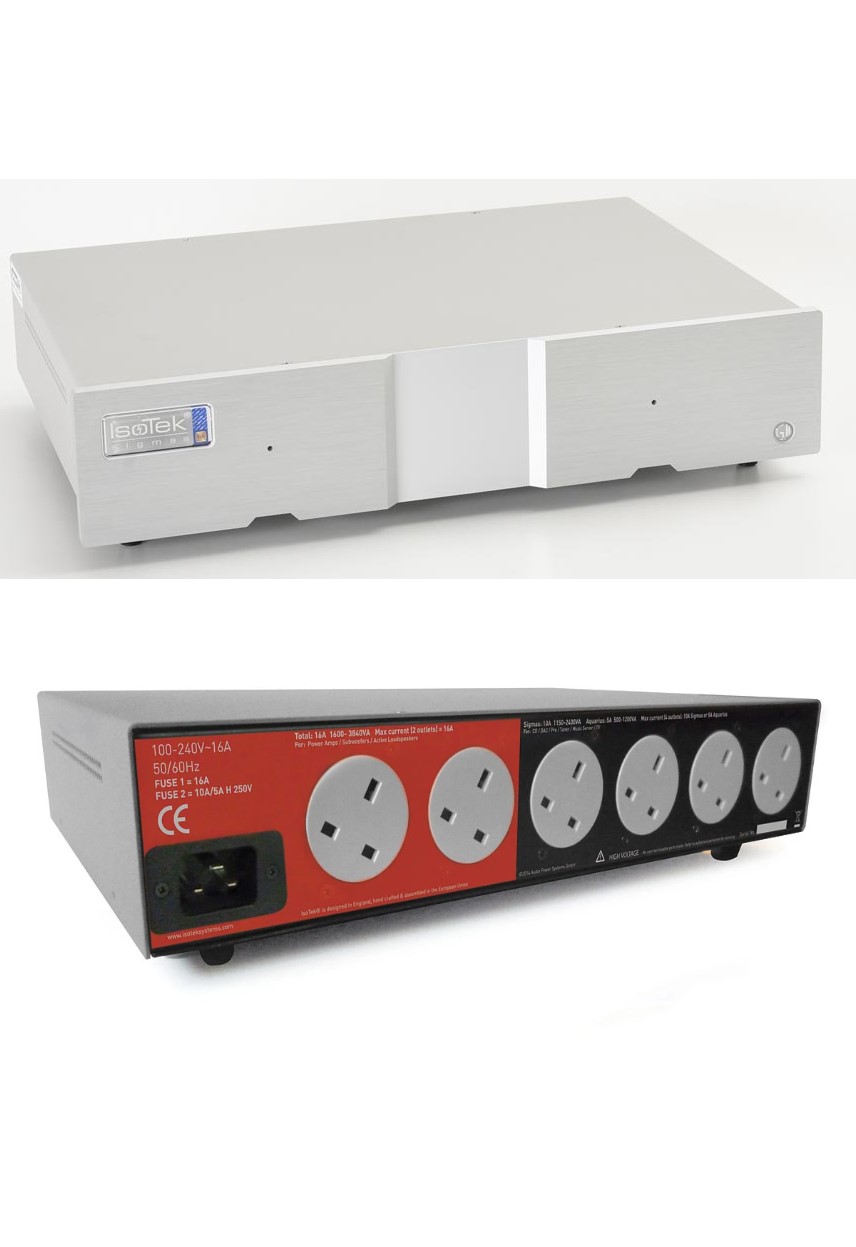
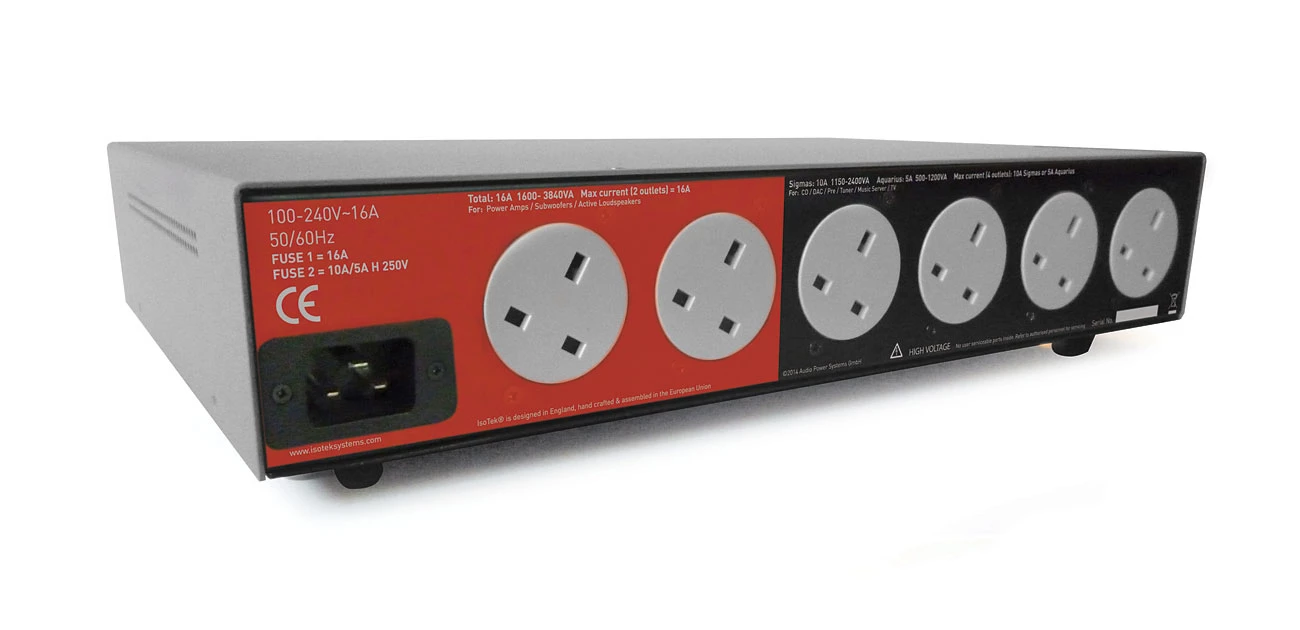
At the rear of the unit you will note six high quality outlets, these are individually filtered to stop components ‘talking’ to each other or corrupting the clean supply provided by the unit. This is achieved by a series of high quality filters on each of the outputs and a sophisticated ‘adaptive gating’ system which auto senses the requirement of filtering products connected to the medium current outlets need.
Outputs 1 & 2 (high current) feature the ‘direct coupled design’ concepts first introduced to the field of power conditioning with the Titan. This allows for almost unlimited transient ability, essential for higher power rated products, such as power amplifiers, integrated amplifiers, some ‘tube’ pre-amplifiers, projectors and plasma screens, etc. the remaining four being suitable for all other equipment.
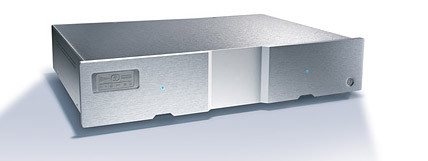
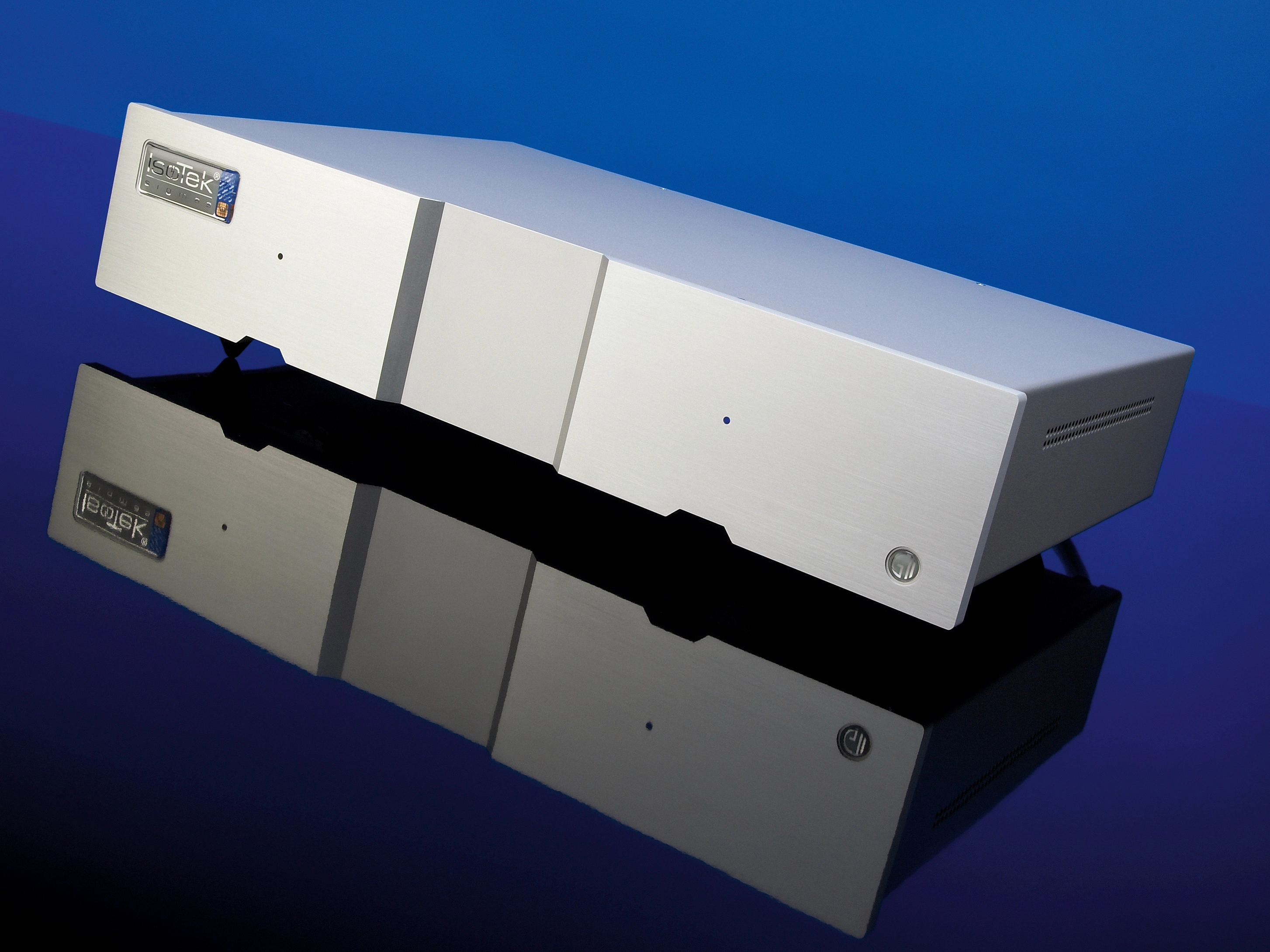
The underside of Sigmas features two Thermo-magnetic fuses, these can be easily accessed from the front panel using the to sculpted cut outs (just below the LEDs) as position indicators. The Sigmas adopts the British electric ‘integrity of fusing’ system. Therefore the (right) 16amp Thermo-magnetic fuse switch must be engaged first, followed by the (left) 6amp. These are located, and can be accessed from the front panel or underside of the unit and eliminate any need to enter the product. IsoTek further enhances the ‘integrity of fusing’ by the use of specialised VDR over voltage protection devices. These are specially selected to offer over voltage safety whilst not effecting audio quality.
All components used within Sigmas are of the highest grade or designed by IsoTek and manufactured to MOD / Aerospace specification and tolerance. All components are under stressed, which gives greater longevity. These high quality parts are then hand soldered (in England) onto the PCB with silver solder. The unit is also fully star earthed.
Placement
Ideally the unit should be placed upon its own dedicated shelf of an audio grade equipment rack. If this is not possible the unit may be placed on top of or under other pieces of equipment to a maximum weight limit of 20 kg. If you have to locate the unit on the floor or in any other location please refer to the safety section of this manual.
Equipment coupling
Once the Sigmas is placed connect the unit to a mains wall socket, with the high quality power cable provided. The unit should then be turned on in the following order. With Sigmas facing you turn on the right thermo-magnetic fuse (located under the chassis), this illuminates the right LED. Then turn on the left thermo-magnetic fuse, again the left LED will turn on. The unit now has full power.
Turn off all equipment you wish to have a clean mains supply, unplug the cables relating to these from the wall socket or redundant distribution block you may have been using and plug these into the rear sockets of the Sigmas. Outputs 1 & 2 (marked as high current) have been given a higher power rating and should be used for high current devices, for example power amplifiers, integrated amplifiers, projectors and plasma screens, etc. The remaining four are suitable for all other equipment.
We strongly rec ommend that the apparatus must be connected to an earthed mains socket outlet.
System integration
Sigmas can be integrated into a complete audio or audio visual system. For two channel applications use the medium current outlets for electronics placed before the power amp in the audio chain. Power amps or active speakers or subwoofers should use the high current outlets. For audio visual applications the same principles apply, however we advise you check the power requirements of projectors, if this exceeds 400W it would be advisable to connect this to one of the high output sockets. We strongly rec ommend that a good quality mains cable is used and this cable is consistent throughout your system. Look for a cable with good conductors, for example oxygen free copper. This cable should also have a high degree of shielding from RFI. All IsoTek cables feature these characteristics.
Características:
- Latest generation design featuring ‘Polaris-X’ technology.
- 2 high current outlets with an optimised ‘Direct Coupled Design’ circuit, similar to the multi award winning Titan.
- Component from component isolation, each outlet individually filtered.
- Auto sensing outputs to optimise filter requirements of connected components.
- Theromo Magnetic fusing for ultimage overvoltage saftey.
- Dedicated earth post.
- Includes high quality power cord.
Description
Lights On
As we all know, high-end audio has a number of enemy combatants that can adversely affect the quality of the musical source and compromise our aural experience. Invisible anomalies like RFI, EMI, vibrations, standing waves and electrical contaminants that plague AC power lines. But fortunately for audiophiles who are trying to get the most out of their systems, there are a number of products that resolve to clean up the sound without altering the integrity of the original signal. Products that elevate, isolate, absorb, and stabilize; with some registering marginal to very good results, with others showing no promise at all. That’s not to say that some of the after market products that exhibit negligible findings do not work, it just suggests that the designers of the original components accounted for those unwanted aberrations and the ‘tweaks’ might work better within other hi-fi systems. Yet during my 20 year tenure centered on high-end audio I can not think of the last time that I was so enamored and transfixed by a high end accessory, specifically an AC line conditioner. Previous devices that I have auditioned have rendered cumulative results that have been a combination of favorable and not so favorable findings, until now. The products I found so exceptional are AC line conditioners from IsoTek Systems.
Iso-Tech
IsoTek Systems is the brainchild of Peter Dolding and Keith Martin. The company was established in 2001 with the sole purpose of providing clean power for audio and video equipment. The folks at IsoTek feel passionately about producing state-of-the-art products that can be experienced by a majority of individuals. They work very hard developing unique ideas and do a lot of mathematical analysis that is backed up by extensive listening tests, and finally field testing. Once they’re happy with the end results, they calculate the cost to manufacture each item and try to price their products so that they can reach an audience that is as wide as possible.
All of IsoTek’s products are designed and manufactured in England with proprietary technology that is a departure from the traditional way of purifying the line with one or more massive isolation transformers and instead uses smaller individual transformers and a unique set of filters connected directly to each individual outlet. The cornerstone of IsoTek’s product range is that each outlet is isolated from every other outlet using their proprietary Polaris-X technology. In many of their products, the use of independent filters connected to each outlet further helps to reduce cross contamination.
The company’s first products used conventional theories about AC line filtration and required a little bit of manual involvement on the part of the customer. Although a huge success, IsoTek’s engineers didn’t stop there and improved on their previous accomplishments and used that knowledge as the foundation for their next line of products commonly referred to as Generation Two or Gen Two (GII for short). The top of line GII Titan ($3,550.00), a product designed specifically for power amplification, and the GII Nova ($3,750.00), a product that is intended to be used only with source components are fantastic. The GII Sigmas ($2,150.00), is a hybrid, single box solution incorporating features from both the generation II Titan and Nova and I was told that is why the name is plural instead of singular. Even though the GII Sigmas is a scaled down version it is a wonderful unit, a fantastic value for the money and is also the subject of this review.
Clean Power
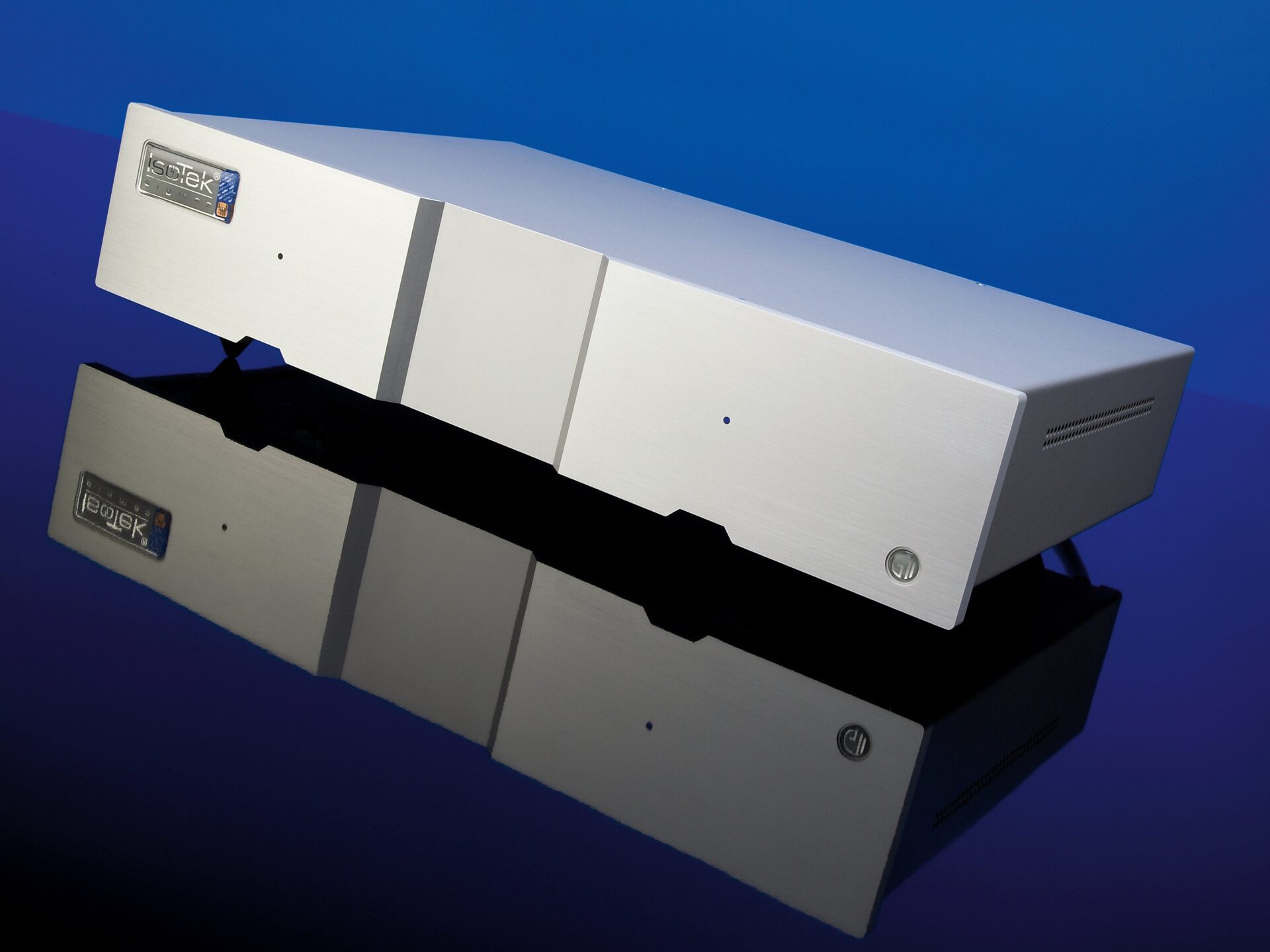
The GII Sigmas is an attractive, simple to use, plug and play, six outlet line conditioner that is 17.5 inches wide, 3.5 inches high, and a little longer than 12 inches deep. It is handsomely constructed with the outlets on the back of the chassis so that you can also place it on the same equipment rack as the rest of your components. There is a standard 20amp IEC female connector that is used to connect the GII Sigmas to the AC mains in place of the high grade Neutrik PowerCon connector that is used on the GII Titan and GII Nova. Since I loaned out my 20 amp power cords I used the supplied IsoTek Optimum power cord which is also excellent, I might add. The unit sans heavy transformers still weighs a hefty 21 pounds and comes in a choice of colors, silver or black.
There are no meters, buttons or switches to push, just a set of thermo magnetic circuit breakers underneath the chassis that turns the unit on. Two blue LED’s on the front panel above the circuit breakers illuminate when the switch has been moved into the ‘on’ position. Most manufacturers will use a resistor to step down the voltage for this power indicator LED, some will add a diode to stop it from flickering, and the really fastidious may even add a soothing capacitor. LED’s will generate noise, however small. In the Sigmas there are seven components connected to the LED that act as a mini filter. The engineers are so serious about preventing noise from tainting the mains that they have even gone so far as to design a filter for the LED connected to the circuit breaker! Wow!
The breakers on the right hand side of the front panel facing the user must be engaged first. This is the high current side derived directly from the GII Titan using IsoTek’s unique technology called ‘Direct Coupled Design’. Direct Coupled Design uses a number of sophisticated filters, including a shunt, delta, and series filter to clean up the line and if you are interested in a detailed and more technical description I suggest that you take a look at the company’s website.
There are two high current outlets in case you have monoblocks, want to bi-amp or have a tube preamp that draws a lot of juice. Each one is rated at 16 amps and can deliver 1760VA continuously at 110 volts and 3840VA at 240 volts. However, according to IsoTek, “it is possible to pull up to 16,000 watt transients through the design, enough for most amplifiers”.
The medium current side has four sockets rated at 6 amps and delivers 660VA continuously at 110 volts and 1440VA at 240 volts and features the ‘Adaptive Gating’ technology from the GII Nova. This is a filter that has auto-sensing which adapts to the requirements of the load over a 5-10 minute period. With all these amps and volts and watts and filters, I was curious to see what the inside looked like on an actual unit because I only have a photo that shows how it looks with the cover removed. But I was unable to sneak a peek inside because I needed a special tool to unlock the security screw. So I had no choice but to plug it up and get started.
Tek Filtered
The unit that I had in for review had not been broken in and it sounded that way. When at all possible I prefer to evaluate a brand new unit because that way I can relate to what the customer might encounter from start to finish. However I do understand that manufactures cannot always send out a fresh unit and I’ll take my Blessings as they come.
Initially, the GII Sigmas sounded lean and slightly congested; but that was expected. After the second day things slowly began to change and the high frequencies improved considerably and the images started to focus within the soundstage. However, the low end was nothing to write home about and I started to think that this might be another line conditioner that robbed the music of body in the lower registers and I would have an unsatisfactory listening experience.
But after just three days of listening (I used the IsoTek Systems Enhancement CD to speed up the break-in process), the low end not only returned, but erupted with demonstrative proportions! There was tremendous force and throughput of bass information that led me to believe that my woofers circumference had increased greatly from its two 6 1/2 inch drivers to a new set of eight inch dynamos. The modified Acoustic Zen Adagio EXtreme loudspeaker recreates the low end with a taut grip and will reportedly go as low as 25Hz. But two 6 1/2 inch woofers can only move so much air. Yet with the GII Sigmas mains filter cleaning up the line, the amount of low end output increased exponentially and it seemed to come a little closer to the prodigious bass production of my Von Schweikert VR-4 JR’s. These loudspeakers have significantly larger drivers with each one of these loudspeakers using two seven inch bass woofers, and one seven inch midbass driver.
On previous occasions I’ve used power conditioners that have softened up the bass lines, constricted the dynamic flow and reduced the low-end weight and authority. But the GII Sigmas had an enigmatic effect on the performance and significantly improved bass definition and thrust, and provided more heft, a signature quality that allowed me to get closer to the emotional impact of real music, something that I didn’t expect.
What I did expect was for the midrange and the high frequencies to demonstrate outstanding improvement and I was correct in my preconceived notions. Yet once again I was surprised by the sheer volume of change. Anytime the noise floor is lowered via reduced distortion I expect an increase in detail, clarity and transparency. But there was new life and vigor to the presentation. Treble information escalated to new heights without adding any excessive noise. It was clean, precise and overly gratifying to the ear. There was a renewed sense of resolution along with greater transient speed. Small details were unearthed and subtle nuances uncovered. There was a noticeable enhancement up top with crash and splash cymbals sounding so sweet and abundant that I realized that another potential distraction that would prevent the presentation from sounding as real as possible was eliminated.
Midrange frequencies also received a cleansing so to speak. An ever so slight, loosely knit, silk scarf that seemed to be delicately placed over voices as well as instruments was lifted. There was a quieter background not entirely black but dark enough to let subtle cues float freely and uninhibited. Voices, whether male or female, sounded superb without any kind of manipulation. With the GII Sigmas ridding the line of electrical parasites it was like I switched from pentode to triode mode. I experienced a sweet, palpable three dimensional holographic sound that had an undeniable and unmistakably mesmerizing effect on the music.
 Extremely satisfied to this point I decided to pull out a disc that I use to gauge a systems capability to recreate high frequency information. The name of the selection isWe Three by Roy Haynes with Phineas Newborn and Paul Chambers on Prestige/New Jazz Records [OJCCD-196-2-NU-8210]. This is a 1958 recording with Haynes on drums, Newborn on piano and Chambers on bass and if the playback system is not up to the task the top end performance can become shrill and over exaggerated. The first cut, ‘Reflection’ is my ultimate test for clarity and it was immediately obvious that clean power had played a major contribution in the positive outcome that I experienced listening to this song. Roy Haynes vibrant play on drums was free of any strain or unpleasantness. His ride on the high hat had more snap and pop and there was fuller sounds emanating from a quieter background.
 The next disc that I selected is one of my favorite live recordings because not only do I get a chance to hear the recorded version but I also get a chance to hear the real ‘McCoy’ when I get an opportunity to attend church, which is quite often. The name of the recording isShekinah Glory Ministry – Jesus[KING3003A2]. This is a two CD set live recording that has a number of inspirational songs both fast and slow. Again there was an overall improvement in the quality of the music and the soundstage benefited as well. There was better separation between musicians and singers. Micro details intensified, and the flow from soft to loud was executed with tremendous precision. On track number six, ‘Stomp’ there is a powerful war chorus against the wiles of the devil and the intensity level increased substantially to the point that I thought that the amplifiers that I was using had suddenly doubled in current and headroom.
It was a snap to follow individual lines and the volume level of minute details increased as expected but what was once minor background sounds could now be realized much easier and it helped to contribute to the pace and the momentum of the music. So what were once obscure and inconsequential details now became an integral part of the performance. I was also impressed with the GII Sigmas ability to construct a wall of silence in between passages. The GII Sigmas did a fabulous job of conveying a sense of peace and tranquility and also created a beautiful ambient atmosphere for praise and worship during the playback of ballads.
A Clean Finish
The IsoTek Systems GII Sigmas has a marvelous effect on recorded music and is a spectacular piece of equipment. It improves the performance throughout the entire frequency range without upsetting the tonal balance or affecting the tempo. I was amazed at how low-end information was so profound, the midrange is rich with harmonic melodies and I could better define and discern high frequency information. The GII Sigmas is innocuous, which it should be, and lets the original signal pass through unadulterated and allows the upstream components to portray the music with a natural and compelling presentation that sounds ever so life like especially if the source material is a recording of a live event.
It is a product that doesn’t compromise at any level and should add a positive and beneficial improvement to systems of modest expense and also dramatically enhance systems that are substantial in price. The proprietors of IsoTek have been informed on numerous occasions that they could charge a bit more for the GII Sigmas based upon its performance, fortunately for us, they declined.
With the Generation II Sigmas removing a lot of the pollution and unwanted noise from the main AC line I feel I have successfully waged a battle against one of the unsightly evils of high end audio that I mentioned at the start of this review and I strongly recommend that you give it an audition.

______________________
Manufacturer:
IsoTek Systems
IsoTek Systems
Unit 16 Plantagenet House
Kingsclere Park
Kingsclere
Hants
RG20 4SW
Tel: 44 (0) 1635291600
Website: www.IsoTeksystems.com
Price: $2,150.00 USD
IsoTek, a company based in Hampshire, England, near Winchester Cathedral, has been in business for over a decade. It has tried to live up to its Gothic neighbor’s imposing reputation by producing what the British like to call “serious kit,” principally by focusing on the foundation of any system—the quality of the power entering your home. As anyone worth his or her audiophile salt knows, there are oodles of companies seeking to purvey products that will allegedly boost the performance of your stereo by conditioning, regenerating, or some other “-ing” the electricity powering it. Some are flapdoodle. Others aren’t.
IsoTek belongs to the latter camp. After Kevin Wolff of VANA Ltd. visited me to pick up the Vienna Acoustics loudspeakers I reviewed for TAS, he also dropped off a box containing an IsoTek EVO3 Sigmas power conditioner. Having used many such devices in the past—ranging from PS Audio to Equitech, not to mention dozens of different power cords—it wasn’t a hard sell to get me to listen to one more. I wasn’t skeptical so much as agnostic, particularly since I’ve gone to some lengths to arrange for the optimal grounding of my stereo.
But once inserted, the IsoTek quickly captured my attention. I had been using a Jadis JA88S MkII integrated amplifier—a wonderful beast, supple and powerful—but there was one nagging issue: It was picking up some hum, and from where I knew not. So I plugged the little French sucker into the IsoTek and was pleasantly surprised to discover that the IsoTek had banished any noise. The tweeters on my Wilson XLFs were silent. The hum, in other words, had gone to whatever netherworld hum occupies.
Score one for the IsoTek. More was to come. I was pleased to note that the overall sound had improved as well. The Jadis sounded more mellifluous and refined. By a wide margin? No. But there were audible improvements across the board. The coveted audio bennies, in other words, were there.
Start with a selection that has been in, as they say, heavy rotation in my system, the Freiburg Baroque Orchestra’s new recording on a Harmonia Mundi of Haydn’s cello concertos. On this CD, Jean-Guihen Queyras’ cello sounded rounder and fuller than I’d remembered it sounding previously. It was also darker, but not in a bad way. This was not a case (as I’ve heard numerous times before) of a power conditioner offering one thing but taking another away. Transients weren’t blunted; rather, they sounded even more precise. The spatial separation between the various instruments also went up another notch.
Similarly, small but significant nuances emerged on Leonard Cohen’s new album Popular Problems. The backing chorus sounded a tad smoother; Cohen’s voice, gruffer. What’s more, the bass line evinced greater solidity, making it easier to distinguish the various musical lines, from the nether regions to the treble. All in all, a very nice perk.
One other effect the Sigmas had (that excellent new equipment often does) was to prompt me to start searching for different recordings to try and see what I’d been missing. This doesn’t amount just to mere detail, but also to the timbres of various instruments. I’m a sucker for hearing a trombone, for example, with its robust blat and punch reproduced as accurately as possible. On the beautifully recorded CD Count Basie Remembered, the IsoTek not only helped better convey the toe-tapping propulsive character of the cut “Broadway,” but also allowed me to visualize trombonist Dan Barrett sliding his way through a number of intervals during his solo. By lowering the noise floor—something of a Holy Grail for any audio system—the IsoTek allowed guitar and bass to come through with a truly byssine sheen.
Then there was the almighty Arturo Sandoval’s album Trumpet Evolution. This is one of those great curiosities, a tribute CD on which Sandoval, with uncanny accuracy, plays in the style of everyone ranging from King Oliver to Louis Armstrong, from Timofei Dokshizer to Maurice André. Each one is every-so-slightly distorted but the overall verisimilitude is so prodigious that it’s a treat to play. Once again the more stygian black spaces that the IsoTek produced allowed the distinctiveness of Sandoval’s trumpet playing to resound with even greater fidelity than I had hitherto experienced.
How does the IsoTek accomplish this feat? Normally a review lists the important technical aspects towards the top, but in this case I had such a good time with the IsoTek that I wanted to cut straight to the chase.
Without belaboring the point, the unit appears to be of sterling quality. It features six outlets with two dedicated for high-power equipment, such as amplifiers or subwoofers, that are said to deliver up to 3680 watts of continuous power. Each outlet is scrupulously divorced from the other so that there is no possibility of cross-contamination. Indeed, IsoTek says it eliminates both common mode and differential mode noise, a claim I am inclined to support after hearing its effect on the Jadis. The IsoTek also has a front panel that, with the push of a couple different buttons, allows you to see the voltage or total harmonic distortion coming from your wall outlet in what amounts to real time. Finally, IsoTek touts Kirchhoff’s law of equal paths of resistance, which the company says means that its products have fully symmetrical signal paths.
This is by no means the most elaborate mains conditioner (to use the British term) that IsoTek constructs. It sells a variety of even more sophisticated units, not to mention power cords and audiophile-grade connectors. Judging by the performance of the Sigmas, IsoTek is producing state-of-the-art power devices. If you’re looking for a conditioner to tackle the vexing issue of electricity quality and to improve the sound of your stereo, then I can emphatically recommend the IsoTek EVO3 Sigmas.
IsoTek Sigmas review
IsoTek’s new middleweight mains filtration box
Related products
-
Nakamichi 1000ZXL Cassette deck (Extremely rare)
Original price was: R280,000.00.R110,000.00Current price is: R110,000.00. Add to cart -
Naim HICAP DR Power Supply
Original price was: R52,000.00.R22,000.00Current price is: R22,000.00. Add to cart