
071 334 4413 | info@audioexchange.co.za
Sale!

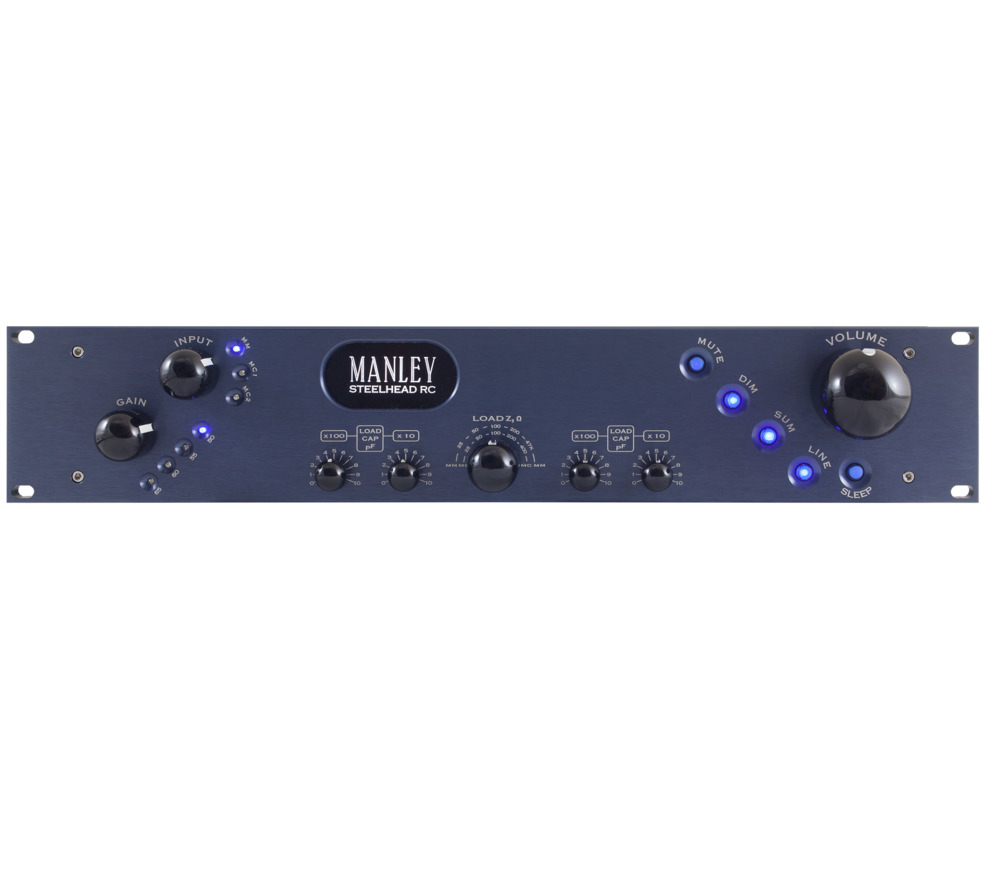
Then you play some music, twiddle the transformer’s impedance knob, and what do you find? Unlike with resistive loading, the lower you set the Manley’s impedance, the louder and more energetic the sound. That’s because—at least with the Helikon SL, which has a relatively low source impedance—you maximize power transfer the lower you set the autoformer’s input impedance.

But be sure to try even the lowest-output MC cartridge into the MM section, as I did. With the 220µV Helikon SL, there was more than enough gain and pitch-black backgrounds. This resulted in even greater purity and delicacy, which is why Manley provides variable loading for the MM input, which normally would be fixed at 47k ohms. If your MC cartridge’s manufacturer suggests running it at 47k and you’re using MM mode, you can easily warm up bright recordings somewhat by experimenting with loading. In theory, if the cartridge is underdamped, it will “ring” when fed a squarewave, with visible overshoot. If it’s overdamped, it will react too slowly and the wave’s corners will be rounded off.

In practice, and for a variety of reasons, it’s not that simple. In MC mode, you can achieve similar results by moving away from the setting that provides the best impedance match. In the end, especially with a phono preamp that permits such convenient on-the-fly adjustments, listening is the best way to fine-tune resistive loading or match impedances.

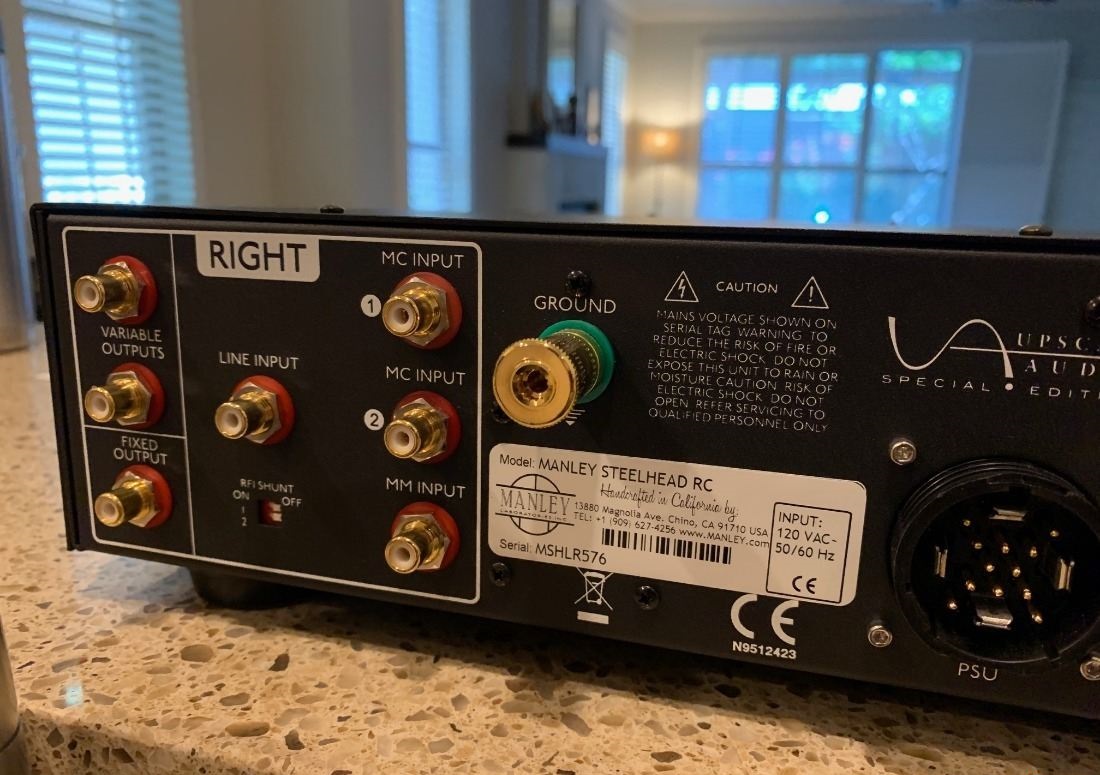
So I played and equalized away, finding the setup that sounded best to me. No matter what I did, the Steelhead never sounded lush, romantic, or warm—unless the recording did. I played a German pressing of Stevie Wonder’s “You Are the Sunshine of My Life” four times, running the Helikon SL into the MM and MC inputs using the variable output, and then again into both inputs but through the fixed output into the Hovland HP-100. Each rendition sounded different. In the end, I preferred the MM input with the Steelhead driving the Hovland, even though the direct connection sounded “faster” and more pure.

Finally, I played the Wonder track through the Hovland’s built-in phono section. Though the Hovland is very, very good, it couldn’t compete with the Steelhead, especially in bass dynamics, transient speed, and overall clarity. But on “You Are the Sunshine of My Life,” the Hovland’s slightly warmer, slower, softer presentation was the more pleasing!

But with the best recordings—the ones I use as references—and driving the power amp directly, the Steelhead had unsurpassed resolution of ultra-low-level detail, sometimes dug out surprising new musical information from very familiar recordings, and gave the finest macrodynamic bass performance I’ve heard from vinyl, with high-frequency transients that were crisp yet delicate—as you might hear them live.

Overall, the Steelhead delivered the best vinyl playback I’ve heard from my system. It combined speed, frequency extension, resolution, harmonic structure, focus, air, stage depth, image specificity, and, most important, overall musical coherence in a way that made the music seem to fly from the speakers unrestrained by mechanical or electrical bounds.

Will the Steelhead be perfect for everyone? Nothing is, and I’d bet some listeners will find it lacking in midrange bloom and overall plushness. A solid-state system might require a pure-vacuum-tube phono section, such as Audio Research’s Reference, to balance out the Steelhead’s honest high-frequency extension and blazing speed. And, of course, bad recordings—of which there are more than we like to acknowledge—have no place to hide when confronted with so ruthlessly revealing a phono section. Then again, I’ve got a set of lush-sounding Amperex Bugle Boy ECC88s that might take this assault on the state of the analog art to exalted levels.

Unfortunately, the Steelhead was designed as a price-no-object component. When the financial dust had settled, Eveanna Manley found that admission was a steep $7300. But remember: If you’re a turntable-only audiophile, you don’t need another preamplifier, and you can use the fixed outputs as a “Record Out.” Multi-sourcers will have to do what I did during the review period: I have two sets of interconnects running to the amplifier, one from the Steelhead, the other from the preamp. Will this become my permanent setup? I’m considering it.

SPECIFICATIONS

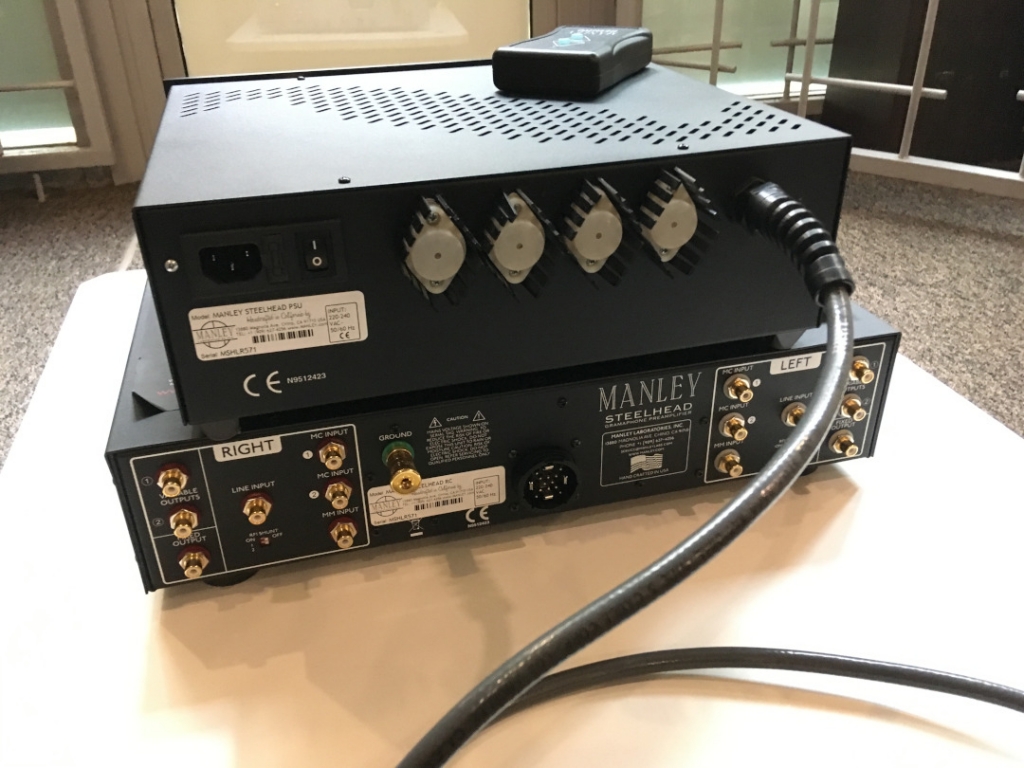
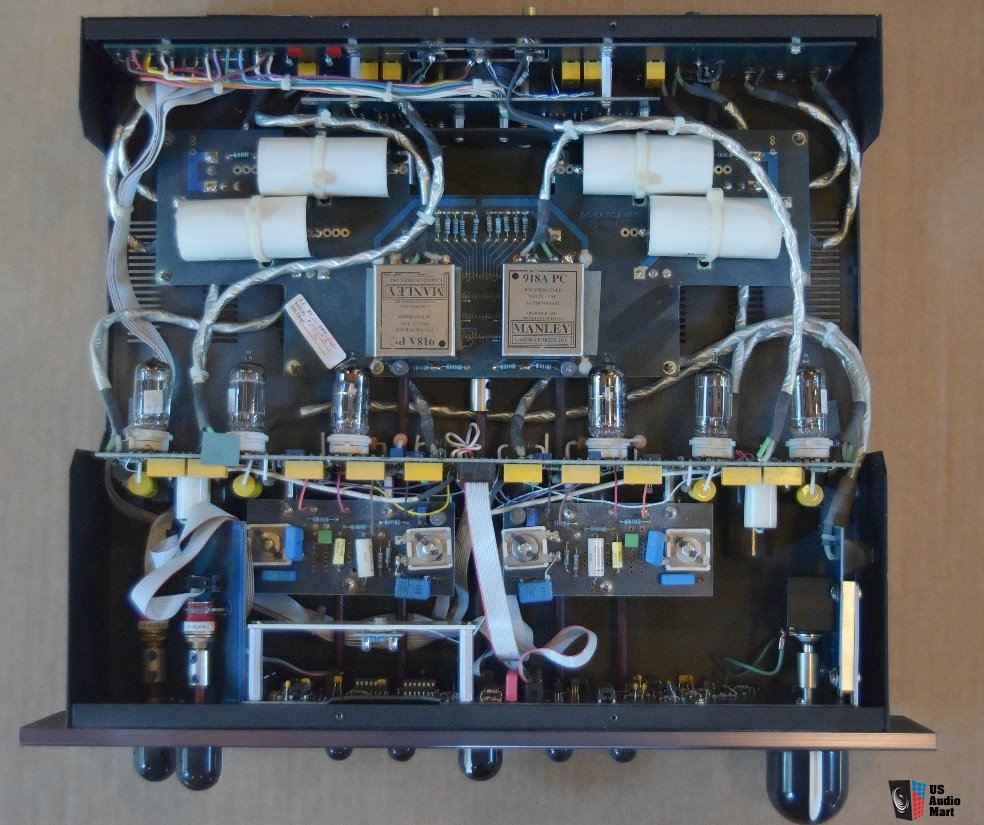
  • Vacuum tube complement: 6922 SOVTEK Russian x 2 (gain) plus JAN NOS GE 7044 or 5687 x 4 (output buffers)

  • Fuse type and ratings @ 117 VAC operation: 1.5 Amp 3AG slow-blow mains fuse 0.5 Amp 3AG slow-blow logic fuse

  • Fuse type and ratings @ 230 VAC operation: 0.75 Amp 3AG slow-blow mains fuse 0.25 Amp 3AG slow-blow logic fuse

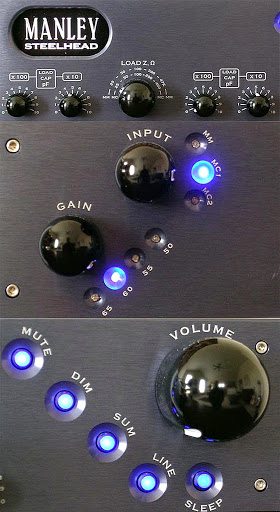
  • Moving Magnet input impedance: 5-step user adjustable via fixed low-noise resistors. 25, 50, 100, 200 and 47000 Ohms.

  • Moving Coil input impedance: 5-step user adjustable via multi-tap autoformer: 25, 50, 100, 200 and 400 Ohms.

  • Input Termination Capacitance: Front Panel Selectable in 10 picofarad steps from 10 to 1100 pF (1.1nF) Residual input capacitance less than 40 pF.

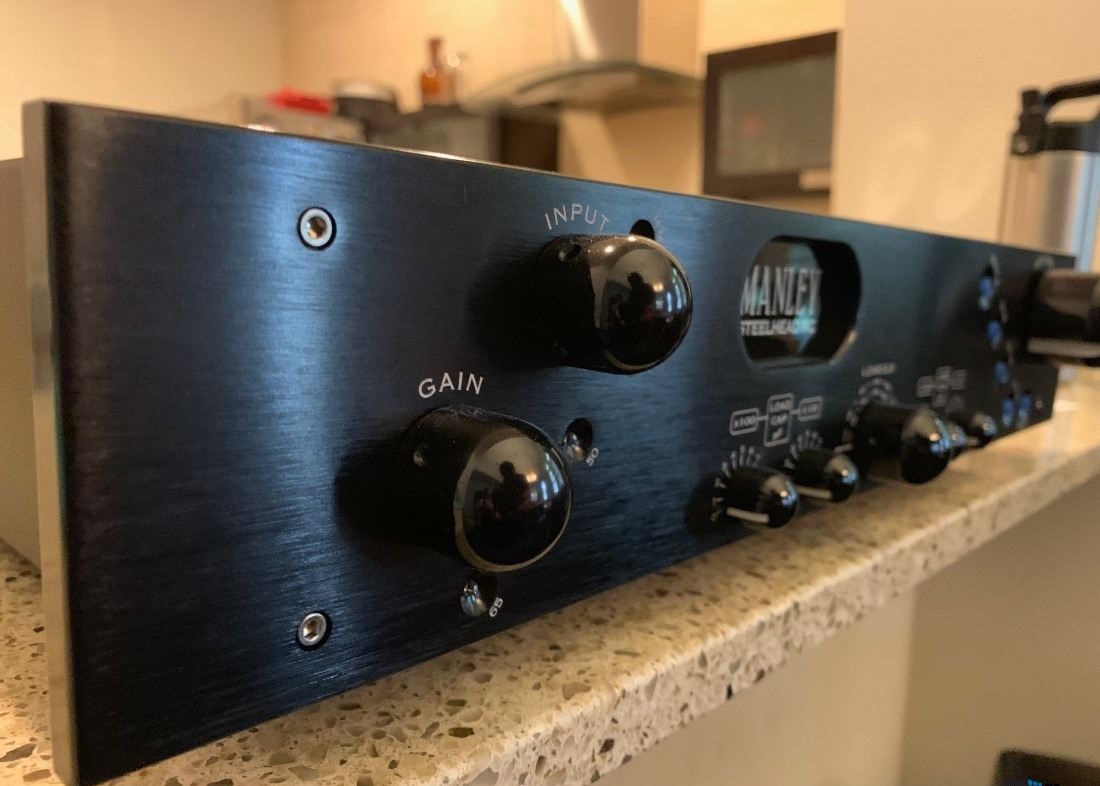
  • Gain: 4-step user adjustable, 50, 55, 60 and 65 dB active gain at 1 kHz referred to the FIXED output jack into a 10 kOhm load. Additional gain available via the MC input’s step-up autoformer. See Owner’s Manual for discussion.

  • Deviation from RIAA curve: Less than +0.5 / -0.3 dB from 20 Hz to 20 kHz at any gain setting. Typically less than ±1 dB from 10 Hz to 100 kHz

  • Inter-channel differential phase: Less than 4 degrees from 20 Hz to 20 kHz at any gain setting. Typically less than 2 degrees.

  • Inter-channel differential gain: Less than ±0.5 dB from 20 Hz to 20 kHz at any gain setting.

  • Dynamic Range: 101 dB @ 1 kHz, 1% THD measured with 200 Ohm source, 47 kOhm input, @ 55dB Gain 97 dB @ 1 kHz, 0.1% THD

  • THD: 0.0042% at 1V output @1kHz

  • Maximum LINE input level: +30.6dBu @ 1KHz for an output of +29.3dBu @ 0.07% THD 26.5Vrms @ 1KHz for an output of 22.8Vrms @ 0.07% THD

  • Maximum Output: +27dBm @ 1KHz with 3% THD into 100 kOhm load

  • FIXed Output impedance: 150 Ohms. Minimum suggested load greater than 1500 Ohms.

  • VARIable Output impedance: 75 Ohms. Minimum suggested load greater than 600 Ohms.

MM Noise (S+N+D) / (N+D)
200 Ohm source, 47 kOhm input,
A-weighted Referred to 2.54 mV, rms @ 1 kHz

Gain Setting 50dB = Fixed Output 86dB = Variable Output 108dB, 99dB, 86dB (9:00, 12:00, VC FULL)
Gain Setting 55dB = Fixed Output 84dB = Variable Output 108dB, 99dB, 85dB (9:00, 12:00, VC FULL)
Gain Setting 60dB = Fixed Output 80dB = Variable Output 108dB, 94dB, 80dB (9:00, 12:00, VC FULL)
Gain Setting 65dB = Fixed Output 75dB = Variable Output 108dB, 89dB, 75dB (9:00, 12:00, VC FULL)

MC Noise (S+N+D) / (N+D)
100 Ohm source, 100 Ohm input,
A-weighted Referred to 0.5 mV, rms @ 1 kHz and rated Input Z

Gain Setting 50dB = Fixed Output 84dB = Variable Output 108dB, 98dB, 85dB (9:00, 12:00, VC FULL)
Gain Setting 55dB = Fixed Output 80dB = Variable Output 108dB, 95dB, 81dB (9:00, 12:00, VC FULL)
Gain Setting 60dB = Fixed Output 75dB = Variable Output 108dB, 90dB, 76dB (9:00, 12:00, VC FULL)
Gain Setting 65dB = Fixed Output 70dB = Variable Output 108dB, 85dB, 71dB (9:00, 12:00, VC FULL)
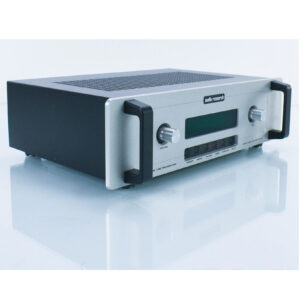
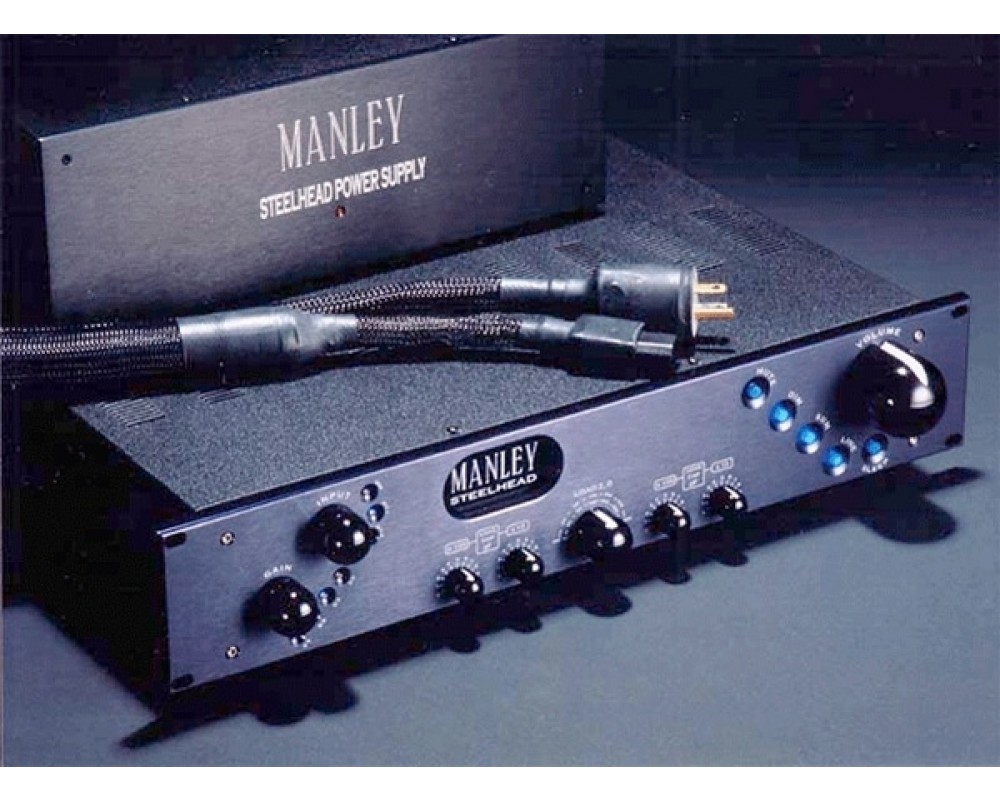
Manley Steelhead

Original price was: R120,000.00.Current price is: R49,000.00.

Join Our Newsletter

Manley Steelhead

Original price was: R120,000.00.Current price is: R49,000.00.