Mark Levinson No.326S Preamplifier and No.432 Power Amplifier
Today’s Mark Levinson brand of electronics traces it lineage back to 1972 when Mark Levinson (the man) founded Mark Levinson Audio Systems (MLAS). The company’s first product, the JC-1 preamp (named after its designer, the great John Curl), jump-started the entire American high-end renaissance in the early-to-mid 1970s. Along with Audio Research and Magnepan, MLAS paved the way for the creativity and innovation in high-performance audio design that continues more than thirty years later.
Unlike those two other pioneers of the American high end, which to this day are owned and operated by their respective founders, the Mark Levinson brand has been produced under a succession of corporate umbrellas. Founder Mark Levinson left the company in the early 1980s to start Cello. Madrigal Audio Laboratories, the parent company that owned the brand for much of its existence (1984 to 1995), sold part of the company to the giant Harman International in 1993. (By chance, I was at the factory on a tour the day the announcement was made to the employees.) The link between Madrigal and Harman was no accident; Madrigal CEO Sandy Berlin had been Sidney Harman’s right-hand man during the decades that Harman became a behemoth by buying smaller audio companies. Madrigal continued to operate independently until 1995 when Harman bought the remaining interest in the company. The Mark Levinson brand is now part of the Harman Specialty Group, which comprises Mark Levinson, Lexicon, and Revel.
Perhaps the biggest shakeup in the company’s history occurred in October, 2003, when Harman closed Madrigal’s venerable Middletown, Connecticut, factory and moved all production to the Lexicon factory in Massachusetts. This move took dealers and customers by surprise, and resulted in a complete cessation of production for several months. Some products were out of production for more than a year as the new factory ramped up. By mid-2005, however, the company was back in full swing.
The question on everyone’s mind was whether the Mark Levinson products made in the new factory were true to the original intent of its founders, as well as to the engineers and product-development managers who made the brand iconic during the 1980s and 1990s.
Which brings us to the subject of this review, the Mark Levinson No.326S preamplifier and No.432 power amplifier. My aim is to not only evaluate these products in and of themselves, but to discover whether the traditional Mark Levinson design and build-quality, meticulous attention to every detail (down to the shipping boxes), and distinctive sonic signature are embodied in the new products. Has this venerable marque become merely a boutique brand under Harman? Or does Harman’s financial stability provide a platform for a new era in creativity and innovation that is true to the brand’s great legacy?
This project is of particular interest to me; I lived with and reviewed a number of Mark Levinson products starting in the late 1980s and became quite familiar with their designs and sonic signature, as well as with the company ethos. Madrigal Audio Laboratories was second to none in explaining to the press the intricacies of its products, the meticulousness with which it built its components, and the passion that drove new development.
The $10,000 No.326S is a single-chassis preamp based on the highly acclaimed No.32 Reference preamplifier, a $15,950 two-box unit introduced in 1999. The No.32 was, astonishingly, the first preamplifier to which the then-27-year-old company applied the designation “Reference.” Unlike other audio companies that use the term for marketing purposes, Mark Levinson reserved that special word for products that embodied the company’s best possible effort. Levinson Reference gear served as an internal benchmark for what could be done in a product category, and as an ideal to which to aspire in subsequent, less-costly designs. Levinson had introduced Reference power amplifiers, digital processors, and transports, but never a preamplifier until the No.32.
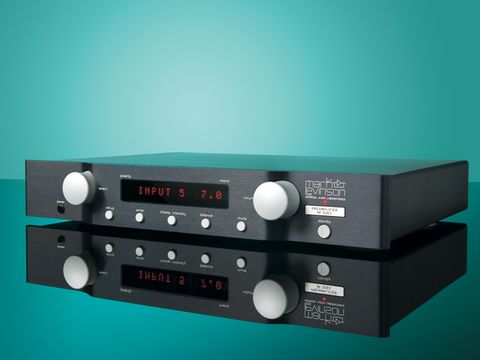
The No.326S’s chassis is smaller than that of most components, but the styling cues (curved front panel, matte aluminum buttons, red LED display) are unmistakably Mark Levinson. Interesting features include the ability to customize the unit by naming each input, deactivating unused inputs, adjusting the gain-offset of each input, and assigning the record-out jacks to an input. A unity-gain bypass mode (called “SSP” for surround-sound processor) allows the No.326S to be used with a home-theater controller. The controller’s left and right outputs feed one of the 326S’s line inputs. With the 326S in SSP mode, it’s as though the preamp isn’t in the signal path. This connection method, which I use in my system, allows you to have a two-channel signal path completely separate and uncorrupted by a surround-sound system. In a nice touch, switching inputs or absolute polarity causes the volume to quickly ramp down before switching, and then ramp up to the previous level, preventing pops or other noises from reaching your loudspeakers. Optional phono boards ($1400) convert the No.326S from a linestage to a full-function preamplifier.
The 326S’s fundamental design is dual-mono, with the left and right audio channels physically separated in the chassis and powered from completely separate supplies. Only the AC power cord is shared between channels. The internal topology is fully balanced, which requires that an unbalanced input signal be converted to balanced by a phase splitter at the input. A differential amplifier at the output converts balanced signals back to unbalanced. This topology adds additional circuitry to the signal path for unbalanced signals. The upside is that balanced signals remain balanced from input to output. Note that a truly balanced preamplifier, such as the No.326S, employs four signal paths (+/– left, +/– right) and four volume-control elements rather than two.
The No.326S’s volume control is a work of art. Identical in design and execution to that developed for the No.32 Reference, it is a stepped attenuator using a discrete-resistor array. The front-panel volume knob’s motion is converted into digital data which then engages the resistor network to achieve the desired attenuation. Volume can be adjusted in 1dB increments up to 23dB, and 0.1dB increments above 23dB. Levinson introduced the switched-resistor volume control in the No.38 preamplifier, but that unit employed an MDAC (multiplying digital-to-analog-converter), an IC that provided digital control over analog signals. The No.326S’s volume control is significantly more sophisticated, employing discrete resistors rather than resistive elements in an IC. Advantages of a switched-resistor network over a traditional volume control are that the audio signal is never subjected to the wiper and resistive element in a potentiometer, and that high precision can be achieved between the left and right channel gain. Even more important in a fully balanced preamplifier, perfect gain matching is possible between the + and – phases of the balanced signal. From a user’s point of view, the switched-resistor network and front-panel volume display allow precise level setting and matching—a feature of even more utility to a reviewer.
The No.326S’s circuit boards are made from Arlon, a material developed for circuit boards used in microwave and radar applications. It reportedly has ideal properties for audio, including low dielectric loss and exceptionally low conduction between traces. Because Arlon is extremely expensive it is reserved for Mark Levinson’s more costly products.
The remote control is a beautifully made oval with nice button layout and enough functions to be useful without becoming cluttered. The owner’s manual is also superb. The parts and build-quality are all comparable to the standards set previously by Mark Levinson products. I have, however, two very small nits to pick. The first is that the No.326S’s front-panel power button is a different size, color, and material than all the other front-panel buttons. Given that the No.326S is meant to be left in standby mode, the power button could have been mounted on the rear panel. The second is that the remote control’s battery-access panel sticks out slightly, disrupting the remote’s continuous curve on the back. These are admittedly minor issues, but the company is famous for being maniacal about such details.
Looking next at the No.432, the power amplifier continues a trend started about ten years ago by Madrigal to make Mark Levinson amplifiers more installation-friendly. Among these measures are internal heat sinks, rack-mounting capability, and the ability to integrate the amplifier into a system with control and communication ports.
The No.432 shares the circuit topology of the company’s flagship No.33H monoblocks. The unit features a massive power supply with separate toroidal transformers for each channel. Indeed, the No.432 is rated at 400Wpc into 8 ohms, and can double that figure into 4 ohms. Any amplifier that doubles its output power as the load impedance is halved must have a massive power supply, a robust output stage, and serious heatsinks. High-level signals are routed through the amplifier on large buss bars rather than via wiring. The DC-servo’d input and driver stages are fully balanced. As with the No.326S, the power amplifier employs Arlon circuit boards.
I started the evaluations by inserting the No.432 power amplifier into my reference system and immediately recognized the familiar Mark Levinson presentation. That sound is characterized by an extremely sophisticated, cool, and polite rendering that doesn’t try to impress by hi-fi fireworks. Instead, the No.432 presented a finely woven fabric of musical subtleties that invited me into the music. Although laid-back, the No.432 had tremendous resolving power, but in a much more subtle way than that of most power amplifiers. The sound had an easy-going and relaxed quality that fostered an immediate involvement in the performance. To draw an analogy with pianists, the No.432 was like Bill Evans; no flash, but a wealth of subtlety and expression if you take the time to listen.
The No.432 presented a wonderful impression of space, depth, and dimensionality. This was one of the amplifier’s defining—and best—qualities. The overall perspective was characteristically Mark Levinson—that is, with a feeling of sitting a little farther back in the hall. The soundstage was beautifully rendered, with a tremendous sense of size, air, and bloom. The soundstage had the unusual (unusual in an audio component, not in live music) attribute of a billowy quality at the edges that made the space more like the presentation of live music and less like an audio system’s reproduction of a soundstage. It was as though the soundstage didn’t abruptly end, but extended well beyond the boundaries of my listening room. The No.432 managed to sound simultaneously diffuse and focused, with an overall sense of spaciousness, precisely defined images, and layers of depth between instruments. It was a combination I found extremely engaging.
Although it was polite, subtle, and sophisticated in the midrange and treble, those qualities didn’t prevent the No.432 from delivering a rock-solid, tight, and extremely dynamic bottom end. This amplifier can rock when asked. Roscoe Beck’s outstanding bass work on Robben Ford and the Blue Line’s Handful of Blues had terrific punch and drive, laying the foundation for Ford’s searing guitar work. Timpani whacks had the appropriate measures of depth, suddenness of attack, and freedom from strain. With 800Wpc on tap into 4 ohms, the No.432 isn’t likely to run out of power even when driving the most difficult load. I never heard a softening of the bass, a reduction in bottom-end dynamics, or a congealing of the soundstage—all characteristics of an amplifier nearing its power limitations—during the auditioning. The No.432 is fully competitive with the best amplifiers Mark Levinson has produced, but offers a greater value, in my view. At $8000 for 400Wpc, the No.432 is about half the price of the company’s comparable efforts of ten or more years ago, and perhaps a touch better sounding. If you don’t need this much power, consider the otherwise-identical 200Wpc (400Wpc into 4 ohms) No.431 at $7000.
If the No.432 held few sonic surprises, the No.326S preamplifier rendered me slack-jawed. Inserting it into the reference system, now with the No.432 installed, completely upended my preconceptions. Yes, the No.326S had some identifiable Levinson characteristics, but was in a completely different league compared with the company’s previous efforts in preamplifier design. Specifically, the No.326S had much less of a “house sound” and vastly greater transparency and truth to the source than any other Mark Levinson preamp I’ve heard. In my review of the Mark Levinson No.38 preamp (Stereophile, August, 1994), for example, I wrote that the unit didn’t quite resolve the last measure of detail, and that its soundstage was somewhat constricted. The No.38 had a veiled and distant character that never really let me connect with the music. Not so the No.326S. This new preamp is absolutely world class in terms of transparency, soundstaging, bass extension, dynamics, and most dramatically, dimensionality.
Inserting the No.326S into my system (combined with the No.432 power amplifier) produced the most convincing and engaging sense of dimensionality I’ve heard from my system. Dimensionality is difficult to describe; it is a multifaceted aspect of reproduced music that encompasses soundstaging, tone color, image focus, bloom, and the ability of a component to resolve space between instrumental images. Dimensionality is that quality of an audio system that provides the impression of an instrument’s size, shape, texture, and precise position in the soundstage. Lots of hi-fi components throw images between the loudspeakers, but very few project a convincing illusion of the instrument’s body hanging in three-dimensional space before you. Dimensionality is also related to a component’s ability to differentiate tone colors, allowing the listener to pick out a single instrument from within a dense orchestration. This particular quality was apparent on the JVC XRCD resissue of Holst’s The Planets during the loud and brash multiple brass lines on “Mars.” I heard no smearing, no congestion, and no congealing of instrumental textures, just a sound very much closer to what one hears in the concert hall. (I had the benefit of hearing The Planets performed recently.) Interestingly, counterpoint was well served by the No.326S’s dimensionality, particularly its ability to keep left- and right-hand piano lines distinct. Listen to the Bach Passacaglia and Fugue as transcribed for piano and performed by Junichi Steven Sato [Sato Music Editions] on a fabulous new recording. The No.326S simply made the counterpoint more interesting and engaging.
Dimensionality is of course dependent on cues encoded in the signal, but is actually created by the brain. The signals driving the left and right loudspeakers are two-dimensional in nature—merely voltages that vary over time. These signals are converted to two patterns of compression and rarefaction in the air. From this pair of two-dimensional signals, the brain creates the illusion of objects (musical instruments) existing in space before us. How miniscule the difference in signals must be between a preamp that delivers dimensionality and one that doesn’t—but how important to the musical experience. Dimensionality gives music a natural sense of vividness and life without resorting to hi-fi trickery. Some components attempt to make up for lack of dimensionality by sounding forward, forced, and aggressive. This sonic vividness quickly becomes fatiguing, but natural dimensionality has the opposite effect, drawing the listener into the presentation in a completely relaxed way that encourages long listening sessions.
The No.326S had a remarkable transparency, not just sonically (lack of veiling), but to the musical expression. For example, when I listened to guitarist John McLaughlin’s Que Alegria [Verve] from start to finish, the wide spectrum of expression on this album seemed to be heightened. The pensive, almost meditative tracks such as “Reincarnation” seemed even more introspective, and the exuberant “1 Nite Stand” conveyed a stronger feeling of this amazing trio locking into a groove and having a blast. I had this impression every time I listened to the system with the No.326S and No.432—of the system conveying the musical values on the recording. Bass extension, definition, and dynamics were another of the No.326S’s great strengths. Whether it was an orchestra’s double- bass section or an electric bass and kick drum working together, the bottom end had a solidity and power that anchored the music.
The No.326S had a very clean, precise sound, presenting the music against an utterly silent and velvet-black backdrop. Musical dynamics seemed to emerge suddenly from this inky blackness, with deep silences between notes. There was a distinctive lack of haze, both in the background and overlaying musical textures. This quality, combined with the dimensionality described earlier, fostered a deep feeling of engagement and involvement with the music.
CONCLUSION
The Mark Levinson No.432 power amplifier is a worthy successor to the company’s previous efforts in power-amplifier design. It combines brute-force output power with remarkable delicacy and resolution, and embodies the company’s aesthetic of subtlety in presentation. If you know and like the classic Mark Levinson sound, the No.432 won’t disappoint.
The No.326S preamp is a huge step forward for Mark Levinson preamplifiers in resolution, transparency, and dimensionality. With less of an identifiable sonic signature, the No.326S is truer to the source, musically and sonically, than any previous ML preamp. There’s much to like about the No.326S, including its jet-black background, unconstricted dynamic expression, bottom-end punch and extension, and clean, grain-free rendering of timbres. It’s also beautifully built and a joy to use. But what really makes the No.326S special is its remarkable dimensionality. This preamp goes beyond conventional soundstaging to throw a convincing illusion of threedimensional instruments in a three-dimensional space.
Based on my experience with the No.326S and No.432, the Mark Levinson brand under Harman International not only upholds the sterling tradition it spent 35 years developing, it has, in my view, actually expanded the reputation of one of the great marques of high-end audio.
At present, the No.326S is the only pre-amplifier in the Mark Levinson range, which seems a little incongruous in the context of its power amps which top out at £40K (for a pair of No.53 monoblocks), a matching reference preamp is on the way to plug that gap, but this compact beast is probably up to the job.
It has been painstakingly designed to keep all forms of noise away from the power supply and hence the audio signal itself.
This is achieved with shielding in the form of steel boxes encasing both signal processing circuitry and the power supply itself. It is dual-mono right back to the mains transformer – there are two of these, but not for each channel – one is for the control circuitry.
Internally it’s separated into three sections: power supply, signal processing and control circuitry. Incoming AC is heavily filtered using noise suppression and isolation techniques of the variety usually found in external power filters, all of which is designed to keep the signal as clean as possible.
The PCB itself is made of Nelco, which replaces Arlon in the previous incarnation and is said to have even better dielectric (insulating) properties. In practical terms, it’s an extremely flexible workhorse, with seven inputs in both balanced and single-ended varieties and for each of these you can set the gain and dial-in a name of your choice, so long as it doesn’t exceed seven characters.
What’s more, doing so is remarkably intuitive and we managed it without a manual (all too often extra facilities means extra complication, but with the dot-matrix display this preamp is as easy to use as it is to enjoy, well almost).
Another very nice touch is the way that the volume is faded down and then up when changing inputs, which gives you a few microseconds to switch back if the next source is too loud. Of course, if you’ve set input gain properly this shouldn’t happen too often, but there are always rogue recordings with silly levels.
Volume is indicated in tenths of a decibel (above 23dB, 1dB increments below that) which seems a little bit on the fine side – it makes changing level with the remote a bit slow – but these steps come into their own at the top and bottom of the range where small increments are more useful.
If you want to reduce volume quickly the mute button is the best bet, especially as you can dial in just how much attenuation you want.
There are two volume attenuators inside the box, one for each channel, continuing the dual-mono theme. Useful features include a mono setting for older recordings – the Beatles mono box set sounds significantly better than its stereo counterpart for instance – and polarity or phase inversion, both available on the remote handset.
Extra miles
The supplied remote is a comfy lump with a rubber pad on the underside so that it doesn’t slip off the sofa, plus it has a reassuringly heavy build that exudes nearly as much quality as the unit itself.
But not quite, there is something about the quality of metalwork, fit and finish of Mark Levinson products that puts them at the top of the tree. Maybe it’s because they were among the first to go the extra mile in this department, but whatever it is, it’s certainly reassuring when you are being asked to shell out the readies.
Everything from the matte-finished buttons and knobs to the anodised metalwork of the chassis exudes quality and durability. The RCA phono sockets are made to M-L’s design and are a shade smaller than usual, which is very nice when you have extremely tight-fitting plugs to deal with, as is often the case with high-end cables.
In terms of value, the No.326S looks pretty strong, it’s very expensive granted, but it is built with utmost attention to detail by a company with a track record for making some of the best amplifiers in the business. Bowers & Wilkins does all its listening and tuning using a pair of Mark Levinson No.33 monoblocks and has been doing so for years.
Wonder drug
Our first impression with this preamp was not necessarily positive, because it seems to remove all the edges from the sound, smoothing things out and giving the impression of reduced detail.
Advertisement
But it’s not very long before it becomes apparent, that what has been removed is hash in the high frequencies, essentially noise that most amplifiers add to the signal in such a subtle way that it seems like part of the music, but once it’s taken away the amount of musical and spatial detail that comes through is nothing short of astonishing.
It’s not just audiophilia either, by which we mean it’s more than sound effects like sparkly highs or bone-crunching lows against an ‘inky black’ background. It’s more of the notes, more of the acoustic, more of the production and more of the music.
It’s surprising that any one component can do all this, let alone the one that changes the volume, yet this is clearly a very difficult thing to do really well otherwise the No.326S wouldn’t stand out so dramatically.
Led Zeppelin III is one of our favourite albums, it captures the band as it reached its creative peak and is remarkably well recorded to boot. The preamp delivered Bonzo’s chugging beats and Percy’s voice at its finest, while focussing on the remarkably inventive compositions of Page and Jones.
All the microdynamics are there to be enjoyed alongside the compressed vocals that seem so small compared to the band. This was a revelatory experience and one that continued with every familiar album. It literally makes you cast your troubles aside and live for the music, which can’t be bad at any price.
Sonic gold
What also makes this component worth its weight in sonic gold is the incredible three dimensionality it can produce, its uncannily clean sound which allows you to play at silly levels without discomfort and a world-beating sense of timing.
Bass lines are reproduced with a coherence and precision that is all too rare and this foundation means that rhythm and melody are delivered in a totally coherent, fluid fashion. This and the ability to show you the fine details of the recording in the context of a gripping overall presentation makes the No. 326S an addictive bit of kit.
Okay, so the price is high, but the rewards are truly the stuff of a music lover’s dream.
We also like the feel of the front panel controls: the input selector has a lovely, positive action while the volume control just glides as it turns.
Mark Levinson’s statement preamps are usually two box designs that keep the signal and power supply circuits physically separated to minimise any interference.
Here it’s all in one case, but the engineers have worked hard to minimise any sonic degradation by covering the entire power supply section in a steel case to shield the audio circuitry from any unwanted electrical effects.
Remove this shield and you’ll find a sophisticated power supply arrangement. There are two mains transformers – one for the signal path and the other for the control circuits – in a bid to avoid any sonic degradation caused by interference.
he mains is heavily filtered too, and any noise suppressed with the view to providing the audio circuits with the purest power feed possible.
The preamp’s internal electrical layout is dual-mono, where the left and right channel circuits are as symmetrical as possible to optimise stereo imaging.
Take a look at the rear panel and you’ll see this internal layout echoed in the way the left and right connections are positioned on opposite sides.
Connectivity is good with no less than seven line-level inputs in a mix of single-ended and balanced XLRs. If you have a record player there’s also the option of a built-in MM/MC phono module for an extra £1375.
The 326S can be configured easily, with input names customisable and everything else adjustable, from display brightness and gain for each source.
Performance
This is a pairing that sounds promising, even straight from cold. Given a few days of running the sound gains in transparency and refinement, while continuing to deliver plenty in the way of scale and authority.
While the duo is undeniably talented, we initially wondered whether its presentation is just a little too subtle for its own good. There’s never any shortage of volume or power – how could there be with such a muscular power amplifier? – but questions remained over what we saw as a shortfall of punch and attack.
Over time these doubts fade, as we realise this impression is a result of the 326S/532H combo’s class-leading refinement and composure. There just aren’t any hard or bright edges in the sound so there’s never any artificially emphasised excitement.
Play a challenging piece of music such as Hans Zimmer’s The Battle(from Gladiator OST) and this pairing takes it all in its stride. We’re greeted by a full dose of fire and fury; crescendos crash with impressive force while there’s plenty of drive to the rhythmic elements of the track.
This music is enthralling and quite fearsome when replayed at the huge volume levels this amplifier is capable. There is a massive sense of scale here and class-leading authority to the rich and insightful low-end.
While enjoying the thrills on offer, we also become aware of just how composed the presentation is. Even with the music at its most challenging, this ML pairing sounds totally unflustered, almost like it barely has to try to produce all that fury.
There’s no undue hardness in presentation during dynamic peaks, and no softening of extremes either. The pairing’s sonic stability is breathtaking, with subtle instrumental strands remaining easy to follow no matter how demanding the music gets.
The stereo imaging is impressive too, with a presentation that is wide, deep and very well layered. Instruments are locked in position, refusing to budge even when a crescendo hits.
It would be a real surprise if qualities such as resolution and transparency weren’t straight out of the top drawer, and they are. While this amplifier is happy for you to concentrate on the big picture, it’s equally content if what you crave is analysis.
Low-level details are all there just waiting to be heard. You can hear the subtle clues that define the recording acoustic when listening to Beethoven’s haunting Moonlight Sonataor revel in the lovely electronic texture of the bassline in SBTRKT’s Wildfire. The midrange is surprisingly fluid in the way it communicates nuances, and there’s an appealingly natural way with which this amplifier renders vocal-based music.
Rhythmically, this pairing does a good job, communicating the changing pace and momentum of the track. The delivery is agile for one so powerful, and it traces the leading and trailing edges of notes nicely.
Tonally we don’t think these Levinsons are strictly neutral. They sound just a little rounded at the top end and a touch rich through the midrange for that. But, these characteristics are mild and give this combination a more forgiving outlook as far as handling aggressive recordings are concerned.
Verdict
The 326S/532H combination is certainly revealing enough to show-off any shortcomings in the production (or partnering equipment for that matter) but they never overemphasise things, and that’s good if your collection is based around music you like (as ours is) rather than audiophile recordings.
It’s a massively capable pairing that delivers a refined, controlled yet hugely entertaining sound. Add terrific build and the lure of the legendary Mark Levinson brand name, and it’s easy to be tempted.
We certainly are.
General Specifications
Description: Unless otherwise specified, these specifications indicate nominal values measured over a 20Hz to 20kHz bandwidth through balanced (XLR) connections.
Frequency Response: 10 to 40kHz, ±0.2 dB
Input Impedance: 100kΩ
Height: 2.92” (74.04mm)
Width: 17.75” (450.85mm)
Depth: 13.58” (344.91mm)
Weight: 30lb (14kg)
Communication and Control: 2 8-pin RJ-45 connectors for Link communication; 1 6-pin modular RJ-11 connector for RS-232 communication; 1 3.5mm mini-jack for trigger output; 1 3.5mm mini-jack for ir input
Analog Audio Outputs: 1 balanced (male XLR) stereo main output; 1 single-ended (Mark Levinson-RCA) stereo main output; 2 single-ended (Mark Levinson-RCA) stereo record outputs
Total Harmonic Distortion (THD): 0.001%
Crosstalk: -94dBV, 20Hz to 20KHz input terminated
Gain: 0, 6, 12, or 18dB line-level stage
Output Impedance: < 50kΩ
Power Requirements: 100, 120, 220, or 230V AC power at 50 or 60Hz (preset)
Audio Specifications
Description
Unless otherwise specified, these specifications indicate nominal values measured over a 20Hz to 20kHz bandwidth through balanced (XLR) connections.
Frequency Response
10 to 40kHz, ±0.2 dB
Input Impedance
100kΩ
Height
2.92” (74.04mm)
Width
17.75” (450.85mm)
Depth
13.58” (344.91mm)
Weight
30lb (14kg)
Communication and Control
2 8-pin RJ-45 connectors for Link communication; 1 6-pin modular RJ-11 connector for RS-232 communication; 1 3.5mm mini-jack for trigger output; 1 3.5mm mini-jack for ir input



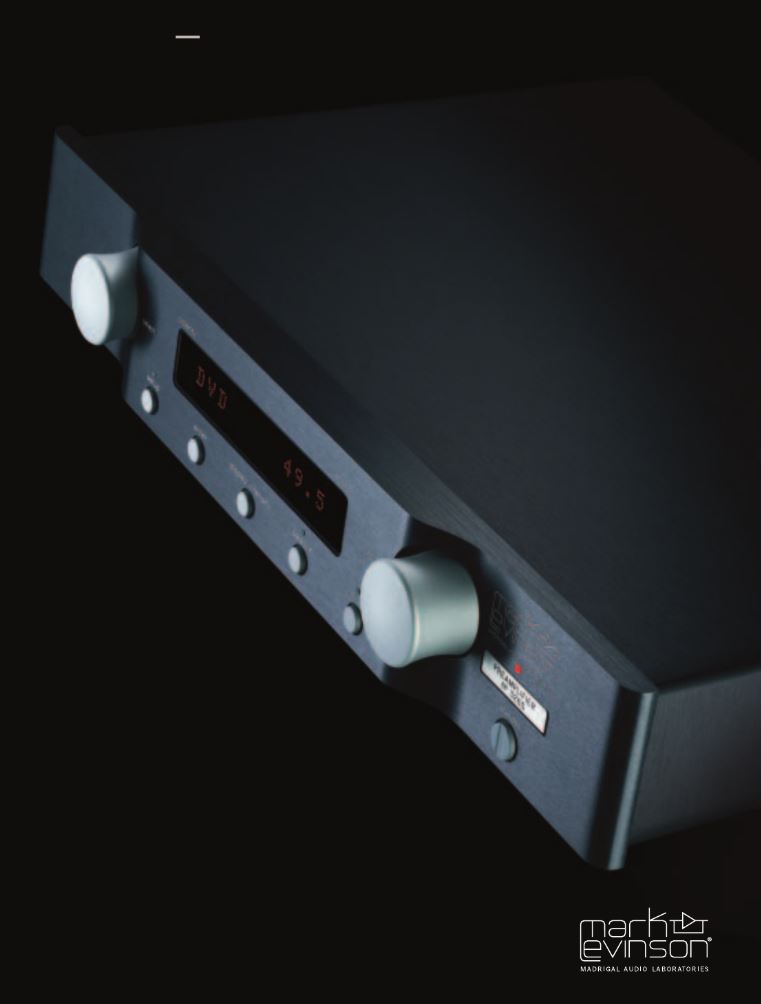


 The No.326S’s chassis is smaller than that of most components, but the styling cues (curved front panel, matte aluminum buttons, red LED display) are unmistakably Mark Levinson. Interesting features include the ability to customize the unit by naming each input, deactivating unused inputs, adjusting the gain-offset of each input, and assigning the record-out jacks to an input. A unity-gain bypass mode (called “SSP” for surround-sound processor) allows the No.326S to be used with a home-theater controller. The controller’s left and right outputs feed one of the 326S’s line inputs. With the 326S in SSP mode, it’s as though the preamp isn’t in the signal path. This connection method, which I use in my system, allows you to have a two-channel signal path completely separate and uncorrupted by a surround-sound system. In a nice touch, switching inputs or absolute polarity causes the volume to quickly ramp down before switching, and then ramp up to the previous level, preventing pops or other noises from reaching your loudspeakers. Optional phono boards ($1400) convert the No.326S from a linestage to a full-function preamplifier.