Here is a review of its SMALLER brother, well ok half size one…
Although Mark Levinson Audio Systems components continue to be produced, the company’s headquarters moved in late 2003 from the Madrigal plant in Middletown, Connecticut, to Harman Specialty’s facility in Bedford, Massachusetts. There ML shares manufacturing and sales space with Harman’s other high-end lines, Revel and Lexicon.
The ML line of high-end solid-state power amplifiers changed even before the company was reorganized. Beginning with the 400W No.436 monoblock (reviewed in the August 2003 Stereophile, Vol.26 No.8), ML amps morphed into low, flat, rack-mountable chassis with internal heatsinks—a marked change from the tall, massive, curved, silver-and-black art deco exteriors of the No.300 line, with its prominent external heatsinks. The No.436 monoblock is near the top of the Levinson line by virtue of price ($12,600/pair) and power (400W), but I wanted to hear one of their less expensive dual-mono designs. I’d previously reviewed ML’s lowest-powered solid-state stereo amplifiers, including the No.27 (Vol.13 Nos.6 & 7), No.27.5 (Vol.16 No.7), No.331 (Vol.19 No.1), and No.334 (Vol.22 No.9). The No.334, which served as one of my reference amplifiers for five years, has now been replaced in the ML line by the No.431. I wondered if the changes in company structure and design philosophy had been accompanied by a sonic transformation.
Slim new design
The two-channel Mark Levinson No.431 is 3.51″ shorter, 1″ deeper, 0.2″ wider, and 7 lbs lighter than the No.334, while rated to deliver almost twice the power into 8 and 4 ohms. In fact, one can stack two No.431s in the space required for one No.334. ML also supplies an optional rack-mount kit for the No.431 that provides conduits for dressing interconnect and speaker cables.
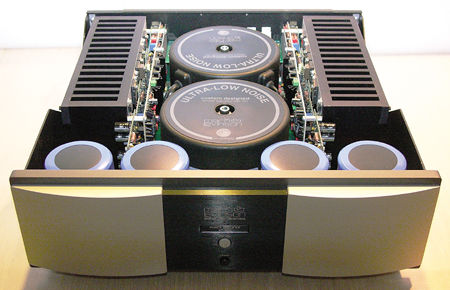
The No.431 requires neither the No.334’s prominent external heatsinks nor the No.436’s cooling fans. Why? First, the No.431’s output stage is biased at half the level of the No.334’s, so it runs much cooler. Second, the No.431 is not rated for loads below 4 ohms or for bridged operation. The No.431’s internal crosscut heatsinks are mounted in two tunnels that run along both sides of the chassis, the circuit boards between them. The heatsinks are visible through two 2 7/8″ by 10″ rectangular openings in the amplifier’s top panel. Nearby, two rows of perforated holes in the amplifier’s top panel provide extra ventilation. At the No.431’s lower operating temperatures, the differences in heat inside the chassis produce enough of a convection, or chimney, effect to pull air through the chassis and cool the amplifier without the need for fans. Air flows through the tunnels while remaining isolated from the circuits, to keep dust from being drawn into the amplifier’s center.
Inputs, outputs, controls
The No.431 is controlled by three different switches: the Power and Standby buttons on the front panel, and the Power Save switch on the rear panel. The latter selects among the No.431’s four operating modes—Off, On, Sleep, and Standby.
Standby mode can be selected by first setting the Power Save switch to Off, then pushing and releasing the front-panel Power button. This connects power to the main power supply and voltage gain stages, to allow them to run at their normal operating temperatures, but doesn’t turn on the output stages. Pressing and releasing Standby turns the amplifier on fully.
The Sleep mode is activated by setting the rear-panel Power Save switch to On, then pushing and releasing the Power button. AC is then connected to a small power supply, communication circuits, and control circuits, but the No.431 consumes less than 15W of power while Sleeping. This mode also allows the amplifier to respond to the DC trigger control via a rear-panel, 1/8″ mini-jack labeled Trigger In, something that will be favored in an extensive home theater system, where a central control unit can toggle all the amplifiers between Sleep and On. The front-panel Standby button also can toggle the amplifier fully on if pressed and released, or toggle between Standby and Sleep if pressed and held down.
The No.431’s rear panel handles all signal and communication functions. It has custom speaker binding posts, two three-pin balanced XLR input connectors, two RCA single-ended input connectors, and an IEC AC receptacle for the detachable power cord. For balanced operation, one must remove tiny U-shaped shorting pins that connect pin 1 (signal, ground) to pin 3 (signal, inverting) of the XLR connectors. The shorting pins reduce noise pickup during single-ended operation, but are small and difficult to find if dropped on the carpet.
The rear panel also has control ports. Three RJ-11 jacks sit in a row at the center of the rear panel. One, labeled Control, functions as an RS-232 port to allow the amplifier’s software-controlled operating system to be updated. It can also be connected to a master control system such as an AMX or Crestron. The other two RJ-11 jacks are marked with the Link logo and labeled Link Input and Link Control. These can be connected to compatible Mark Levinson preamplifiers to share linked controls. For example, switching a linked preamplifier to Standby mode switches all linked power amps to Standby as well. If a linked amplifier experiences a fault condition, it will report the fault to the preamplifier, which will display the power amp’s model number and fault code. Finally, there is a 3.5mm mini-jack that can be connected to an outboard infrared receiver so that the No.431 can be controlled remotely.
Internal circuitry
The No.431 has been refined compared with earlier ML designs by minimizing the amount of wiring in the power supply and by reducing circuit complexity. This makes service in the field easier, increases the amplifier’s electrical stability, and lowers the amount of local feedback needed for low-distortion operation. The No.431’s voltage-stage printed-circuit boards (PCBs) are made of Arlon 25N composite, as in ML’s No.32 Reference preamplifier. Arlon 25N has a lower, more stable dielectric constant than conventional PCB material, resulting in better electrical isolation of the circuit stages for better sound.
The No.431’s dual-mono design means that the amp has a separate power supply for each channel. Each power supply includes a low-noise, 660VA toroidal transformer and two triple-bypassed, low-equivalent-series-resistance 24,000µF, electrolytic capacitors. Heavy bus bars of oxygen-free copper and high-frequency power-supply bypass components are used to lower the No.431’s power-supply impedance. The amplifier can draw 15 amperes at 120V from the mains when driving a 4 ohm load to its full power rating of 400Wpc.
A turn-on circuit prevents sudden thumps and damage to components from the inrush of current as the power supply’s large filter capacitors charge, and extensive protection prevents internal or external component failure. The latter includes servos to block DC at the output, and a circuit that shuts down the amplifier if the temperature of its heatsinks or power-transformer cores exceeds 85ºC or if a sustained current draw exceeds 15 amperes. The voltage-gain stages are fully balanced, using independently regulated supplies, while each output stage uses five pairs of matched, complementary TO-3P bipolar output power transistors. These are clamped to the heatsinks with an aluminum bar. Soft-clip circuits prevent the output devices from saturating, so that the high-energy, high-frequency artifacts generated by hard-clipped output transistors don’t damage the loudspeakers.
The No.431 enjoys the same fit’n’finish, tank-like internal construction, and superior component quality found in the Mark Levinson’s reference monoblock amplifier, the No.33H. The No.431 comes with a five-year, nontransferable warranty, but it’s built to last several lifetimes.
Setup
My lightly damped listening room is a rectangular space 26′ long by 13′ wide by 12′ high. Behind my listening chair, the other end of the room opens onto a 25′ by 15′ kitchen through an 8′ by 4′ doorway. I set the No.431 between the speakers, which were 5′ from the front wall and 3′ from each sidewall.
I attached the spade lugs of my Pure Silver Cable speaker cables to the No.431’s speaker binding posts, which are widely spaced to meet European CE regulations, and tightened the connections between speaker cable and amplifier using the large, curved, plastic wing nuts attached to the amplifier’s speaker terminals. I plugged into the wall the amplifier’s detachable power cord, pushed and released the Power button, then pressed and released the front-panel Standby button. Although the No.431 went into Standby mode, it then refused to turn on. After multiple attempts, I did what every red-blooded American does when faced with a technologically challenging device: I carefully but forcefully punched the top plate. Voil! I pushed the Standby button and the No.431 powered up. I e-mailed Andrew Clark of Mark Levinson, who rushed a second No.431 to my listening room. The new sample turned on immediately, and has continued to work without a hitch.
Sound
Driving my Quad ESL-989 loudspeakers, the No.431 sounded smooth and delicate, with open, extended highs. Just like the No.334, it had midbass punch and the ability to throw a wide, deep soundstage. It exerted tighter control over the Quads’ bass response than had the No.334, but sounded more analytic driving my Revel Ultima Salons, with less bass extension. In contrast, the No.334 sounded fuller and warmer through the Revels, darker through the Quads.
Driving the Revel Ultima Salons, the No.431 proved fully capable of reproducing full-volume percussion without compression. During the opening of “Tito,” from Arturo Sandoval’s Hothouse (CD, N2K 10023), Tito Puente’s timbales were reproduced with tremendous speed and definition, so that I could easily make out the tonalities of the separate drums in his kit when he struck two different drum heads simultaneously. Through the Salons, the No.431 matched the Bryston 14B-SST in playing this demanding drum solo without compression or distortion.
But even with the exemplary headroom the No.431 gave the Salons, the Quad ESL-989s proved a better match overall. When I hooked up the electrostatic screens and started playing music, it was amazing how the soundstage widened, the highs became more extended, and bass became fuller, deeper, and better defined. Whether it was Tom Fowler’s subtle but firm electric bass backing B.B. King and Ray Charles’ duet on “Sinner’s Prayer,” from Genius Loves Company (CD, Hear Music/Concord CCD-2248-2), or Michael Annope’s tight, driving plucked bass and Ruben Alvarez’s bongos, which open “Use Me,” from Patricia Barber’s Companion (SACD/CD, Premonition/Blue Note/Mobile Fidelity 5 22963 2), each bass note’s pitch was better defined than ever before. I was easily able to distinguish the bass-drum and timpani overtones when I listened to tracks 21–24 of Eiji Oue and the Minnesota Orchestra’s performance of Stravinsky’s The Rite of Spring (CD, Reference RR-70CD).
The Quads’ distinct tone and pitch enabled me to hear deep-bass notes without adding a subwoofer, including: the distant drum pulses that provide the dynamic backdrop of “Silk Road,” from I Ching’s Of the Marsh and Moon (CD, Chesky WO144); the deep pedal notes in Jean Guillou’s transcription for pipe organ of Mussorgsky’s Pictures at an Exhibition (CD, Dorian DOR-90117); the taut, well-damped, stepped bass notes that open Oregon’s “The Silence of a Candle,” from Beyond Words (CD, Chesky JD130); and the step-like progression of sustained organ-pedal chords that provide the underpinning of John Rutter’s grand chorus “The Lord is My Light and My Salvation,” from his Requiem (CD, Reference RR-57CD).
Similarly, organ-pedal notes rose distinctly above the bowed double basses in Uranus, the Magician, from Walter Susskind and the St. Louis Symphony’s remastered recording of Holst’s The Planets (SACD/CD, Mobile Fidelity USACD 4055). I was entranced by the ghostly soprano set against rumbling subterranean synthesizer chords in “The Hit,” from the Patriot Games soundtrack (CD, RCA 66051-2). However, with their limited low bass, the Quad ESL-989s could only suggest the subterranean vibrations depicting the entrance of the ghosts in the Casper soundtrack (CD, MCA-11240).
The No.431’s midrange reproduced the brilliant palettes of orchestral tonal colors heard in Susskind’s Planets—in Mars, the Bringer of War, and the full, rich timbre of massed strings in Jupiter, the Bringer of Jollity—and brilliantly depicted the timbre of the bassoon in Herbert Owen Reed’s La Fiesta Mexicana, from Howard Dunn and the Dallas Wind Symphony’s Fiesta! (Reference RR-38CD).
Driving the Quads, the No.431 projected a huge, wide soundstage and pinpoint, three-dimensional imaging, as well as an intimacy during the call and response of tenor and chorus in “Mary had a Baby,” from Cantus’ Comfort and Joy: Volume One (CD, Cantus CTS-1204). During “Silent Night” from the same recording, I was able to make out the central singer, standing in his own space, as the chorus sang ascending and descending scales behind him. Mary Gauthier’s voice, too, stood alone on “A Long Way to Fall,” from her Filth and Fire (CD, Signature Sounds 1273), her central sonic image standing three-dimensionally between the Quads.
The amplifier and speakers allowed me to track the variations in Ray Charles’ voice across the 12 duets of his Genius Loves Company. He harmonizes and blends so effectively with Norah Jones on “Here I Go Again” that the pitch of her voice drops into his range. He sounds hip and sophisticated singing “You Don’t Know Me” with Diana Krall, then steps up the drive and pace in “Sinner’s Prayer,” with B.B. King. In contrast, the ambience generated by the Turtle Creek Men’s Chorus’ spacious-sounding and detailed voices on “Lord, Make me an Instrument of Thy Peace,” from John Rutter’s Requiem, helped delineate the recording venue. Similarly, the No.431 conveyed the ambience and soundstage width of the soft backstage female chorus that ends Neptune, the Mystic, from The Planets.
And the highs? The No.431 and Quad ESL-989s had an extended, translucent, sweet treble that just didn’t stop. This combo brought out the transparency and speed of Etta Baker’s guitar playing on “Railroad Bill,” from Etta Baker with Taj Mahal (CD, Music Maker/Cello CD50), and conveyed the glistening transparency of the bells and xylophone in Mercury, the Winged Messenger, from The Planets. I was transfixed by the glowing timbre of the reverberating chimes that open Reed’s La Fiesta Mexicana, and swept away by the blend of the Spyboy Band’s voices in “Calling My Children Home,” from Emmylou Harris’ Spyboy (CD, Eminent 25001 2), Harris’ ethereal soprano floating above, translucent and serene.
Conclusions
Mark Levinson Audio Systems may have moved its production facilities but it continues to build fine amplifiers, even after having shrunk those amps to fit into home-theater equipment racks. Compared with its predecessor, this newest and smallest Mark Levinson amplifier has gained smoothness, has an increased ability to transmit musical information, and continues to generate some of the best soundstage imaging I’ve heard. Sure, there was a slight reduction in bass solidity and punch when the slim No.431 was compared with the massive No.334 through the Revel Ultima Salons, but there were also improvements in midrange detail and treble extension through the Quads. Mark Levinson amplifiers, once proudly massive chassis fierce with rows of sharp heatsinks, are now configured for sonic excellence while being slim enough to fit into two-channel and home-theater systems alike.
Mark Levinson No.326S Preamplifier and No.432 Power Amplifier
Today’s Mark Levinson brand of electronics traces it lineage back to 1972 when Mark Levinson (the man) founded Mark Levinson Audio Systems (MLAS). The company’s first product, the JC-1 preamp (named after its designer, the great John Curl), jump-started the entire American high-end renaissance in the early-to-mid 1970s. Along with Audio Research and Magnepan, MLAS paved the way for the creativity and innovation in high-performance audio design that continues more than thirty years later.
Unlike those two other pioneers of the American high end, which to this day are owned and operated by their respective founders, the Mark Levinson brand has been produced under a succession of corporate umbrellas. Founder Mark Levinson left the company in the early 1980s to start Cello. Madrigal Audio Laboratories, the parent company that owned the brand for much of its existence (1984 to 1995), sold part of the company to the giant Harman International in 1993. (By chance, I was at the factory on a tour the day the announcement was made to the employees.) The link between Madrigal and Harman was no accident; Madrigal CEO Sandy Berlin had been Sidney Harman’s right-hand man during the decades that Harman became a behemoth by buying smaller audio companies. Madrigal continued to operate independently until 1995 when Harman bought the remaining interest in the company. The Mark Levinson brand is now part of the Harman Specialty Group, which comprises Mark Levinson, Lexicon, and Revel.
Perhaps the biggest shakeup in the company’s history occurred in October, 2003, when Harman closed Madrigal’s venerable Middletown, Connecticut, factory and moved all production to the Lexicon factory in Massachusetts. This move took dealers and customers by surprise, and resulted in a complete cessation of production for several months. Some products were out of production for more than a year as the new factory ramped up. By mid-2005, however, the company was back in full swing.
The question on everyone’s mind was whether the Mark Levinson products made in the new factory were true to the original intent of its founders, as well as to the engineers and product-development managers who made the brand iconic during the 1980s and 1990s.
Which brings us to the subject of this review, the Mark Levinson No.326S preamplifier and No.432 power amplifier. My aim is to not only evaluate these products in and of themselves, but to discover whether the traditional Mark Levinson design and build-quality, meticulous attention to every detail (down to the shipping boxes), and distinctive sonic signature are embodied in the new products. Has this venerable marque become merely a boutique brand under Harman? Or does Harman’s financial stability provide a platform for a new era in creativity and innovation that is true to the brand’s great legacy?
This project is of particular interest to me; I lived with and reviewed a number of Mark Levinson products starting in the late 1980s and became quite familiar with their designs and sonic signature, as well as with the company ethos. Madrigal Audio Laboratories was second to none in explaining to the press the intricacies of its products, the meticulousness with which it built its components, and the passion that drove new development.
The $10,000 No.326S is a single-chassis preamp based on the highly acclaimed No.32 Reference preamplifier, a $15,950 two-box unit introduced in 1999. The No.32 was, astonishingly, the first preamplifier to which the then-27-year-old company applied the designation “Reference.” Unlike other audio companies that use the term for marketing purposes, Mark Levinson reserved that special word for products that embodied the company’s best possible effort. Levinson Reference gear served as an internal benchmark for what could be done in a product category, and as an ideal to which to aspire in subsequent, less-costly designs. Levinson had introduced Reference power amplifiers, digital processors, and transports, but never a preamplifier until the No.32.
The No.326S’s chassis is smaller than that of most components, but the styling cues (curved front panel, matte aluminum buttons, red LED display) are unmistakably Mark Levinson. Interesting features include the ability to customize the unit by naming each input, deactivating unused inputs, adjusting the gain-offset of each input, and assigning the record-out jacks to an input. A unity-gain bypass mode (called “SSP” for surround-sound processor) allows the No.326S to be used with a home-theater controller. The controller’s left and right outputs feed one of the 326S’s line inputs. With the 326S in SSP mode, it’s as though the preamp isn’t in the signal path. This connection method, which I use in my system, allows you to have a two-channel signal path completely separate and uncorrupted by a surround-sound system. In a nice touch, switching inputs or absolute polarity causes the volume to quickly ramp down before switching, and then ramp up to the previous level, preventing pops or other noises from reaching your loudspeakers. Optional phono boards ($1400) convert the No.326S from a linestage to a full-function preamplifier.
The 326S’s fundamental design is dual-mono, with the left and right audio channels physically separated in the chassis and powered from completely separate supplies. Only the AC power cord is shared between channels. The internal topology is fully balanced, which requires that an unbalanced input signal be converted to balanced by a phase splitter at the input. A differential amplifier at the output converts balanced signals back to unbalanced. This topology adds additional circuitry to the signal path for unbalanced signals. The upside is that balanced signals remain balanced from input to output. Note that a truly balanced preamplifier, such as the No.326S, employs four signal paths (+/– left, +/– right) and four volume-control elements rather than two.
The No.326S’s volume control is a work of art. Identical in design and execution to that developed for the No.32 Reference, it is a stepped attenuator using a discrete-resistor array. The front-panel volume knob’s motion is converted into digital data which then engages the resistor network to achieve the desired attenuation. Volume can be adjusted in 1dB increments up to 23dB, and 0.1dB increments above 23dB. Levinson introduced the switched-resistor volume control in the No.38 preamplifier, but that unit employed an MDAC (multiplying digital-to-analog-converter), an IC that provided digital control over analog signals. The No.326S’s volume control is significantly more sophisticated, employing discrete resistors rather than resistive elements in an IC. Advantages of a switched-resistor network over a traditional volume control are that the audio signal is never subjected to the wiper and resistive element in a potentiometer, and that high precision can be achieved between the left and right channel gain. Even more important in a fully balanced preamplifier, perfect gain matching is possible between the + and – phases of the balanced signal. From a user’s point of view, the switched-resistor network and front-panel volume display allow precise level setting and matching—a feature of even more utility to a reviewer.
The No.326S’s circuit boards are made from Arlon, a material developed for circuit boards used in microwave and radar applications. It reportedly has ideal properties for audio, including low dielectric loss and exceptionally low conduction between traces. Because Arlon is extremely expensive it is reserved for Mark Levinson’s more costly products.
The remote control is a beautifully made oval with nice button layout and enough functions to be useful without becoming cluttered. The owner’s manual is also superb. The parts and build-quality are all comparable to the standards set previously by Mark Levinson products. I have, however, two very small nits to pick. The first is that the No.326S’s front-panel power button is a different size, color, and material than all the other front-panel buttons. Given that the No.326S is meant to be left in standby mode, the power button could have been mounted on the rear panel. The second is that the remote control’s battery-access panel sticks out slightly, disrupting the remote’s continuous curve on the back. These are admittedly minor issues, but the company is famous for being maniacal about such details.
Looking next at the No.432, the power amplifier continues a trend started about ten years ago by Madrigal to make Mark Levinson amplifiers more installation-friendly. Among these measures are internal heat sinks, rack-mounting capability, and the ability to integrate the amplifier into a system with control and communication ports.
The No.432 shares the circuit topology of the company’s flagship No.33H monoblocks. The unit features a massive power supply with separate toroidal transformers for each channel. Indeed, the No.432 is rated at 400Wpc into 8 ohms, and can double that figure into 4 ohms. Any amplifier that doubles its output power as the load impedance is halved must have a massive power supply, a robust output stage, and serious heatsinks. High-level signals are routed through the amplifier on large buss bars rather than via wiring. The DC-servo’d input and driver stages are fully balanced. As with the No.326S, the power amplifier employs Arlon circuit boards.
I started the evaluations by inserting the No.432 power amplifier into my reference system and immediately recognized the familiar Mark Levinson presentation. That sound is characterized by an extremely sophisticated, cool, and polite rendering that doesn’t try to impress by hi-fi fireworks. Instead, the No.432 presented a finely woven fabric of musical subtleties that invited me into the music. Although laid-back, the No.432 had tremendous resolving power, but in a much more subtle way than that of most power amplifiers. The sound had an easy-going and relaxed quality that fostered an immediate involvement in the performance. To draw an analogy with pianists, the No.432 was like Bill Evans; no flash, but a wealth of subtlety and expression if you take the time to listen.
The No.432 presented a wonderful impression of space, depth, and dimensionality. This was one of the amplifier’s defining—and best—qualities. The overall perspective was characteristically Mark Levinson—that is, with a feeling of sitting a little farther back in the hall. The soundstage was beautifully rendered, with a tremendous sense of size, air, and bloom. The soundstage had the unusual (unusual in an audio component, not in live music) attribute of a billowy quality at the edges that made the space more like the presentation of live music and less like an audio system’s reproduction of a soundstage. It was as though the soundstage didn’t abruptly end, but extended well beyond the boundaries of my listening room. The No.432 managed to sound simultaneously diffuse and focused, with an overall sense of spaciousness, precisely defined images, and layers of depth between instruments. It was a combination I found extremely engaging.
Although it was polite, subtle, and sophisticated in the midrange and treble, those qualities didn’t prevent the No.432 from delivering a rock-solid, tight, and extremely dynamic bottom end. This amplifier can rock when asked. Roscoe Beck’s outstanding bass work on Robben Ford and the Blue Line’s Handful of Blues had terrific punch and drive, laying the foundation for Ford’s searing guitar work. Timpani whacks had the appropriate measures of depth, suddenness of attack, and freedom from strain. With 800Wpc on tap into 4 ohms, the No.432 isn’t likely to run out of power even when driving the most difficult load. I never heard a softening of the bass, a reduction in bottom-end dynamics, or a congealing of the soundstage—all characteristics of an amplifier nearing its power limitations—during the auditioning. The No.432 is fully competitive with the best amplifiers Mark Levinson has produced, but offers a greater value, in my view. At $8000 for 400Wpc, the No.432 is about half the price of the company’s comparable efforts of ten or more years ago, and perhaps a touch better sounding. If you don’t need this much power, consider the otherwise-identical 200Wpc (400Wpc into 4 ohms) No.431 at $7000.
If the No.432 held few sonic surprises, the No.326S preamplifier rendered me slack-jawed. Inserting it into the reference system, now with the No.432 installed, completely upended my preconceptions. Yes, the No.326S had some identifiable Levinson characteristics, but was in a completely different league compared with the company’s previous efforts in preamplifier design. Specifically, the No.326S had much less of a “house sound” and vastly greater transparency and truth to the source than any other Mark Levinson preamp I’ve heard. In my review of the Mark Levinson No.38 preamp (Stereophile, August, 1994), for example, I wrote that the unit didn’t quite resolve the last measure of detail, and that its soundstage was somewhat constricted. The No.38 had a veiled and distant character that never really let me connect with the music. Not so the No.326S. This new preamp is absolutely world class in terms of transparency, soundstaging, bass extension, dynamics, and most dramatically, dimensionality.
Inserting the No.326S into my system (combined with the No.432 power amplifier) produced the most convincing and engaging sense of dimensionality I’ve heard from my system. Dimensionality is difficult to describe; it is a multifaceted aspect of reproduced music that encompasses soundstaging, tone color, image focus, bloom, and the ability of a component to resolve space between instrumental images. Dimensionality is that quality of an audio system that provides the impression of an instrument’s size, shape, texture, and precise position in the soundstage. Lots of hi-fi components throw images between the loudspeakers, but very few project a convincing illusion of the instrument’s body hanging in three-dimensional space before you. Dimensionality is also related to a component’s ability to differentiate tone colors, allowing the listener to pick out a single instrument from within a dense orchestration. This particular quality was apparent on the JVC XRCD resissue of Holst’s The Planets during the loud and brash multiple brass lines on “Mars.” I heard no smearing, no congestion, and no congealing of instrumental textures, just a sound very much closer to what one hears in the concert hall. (I had the benefit of hearing The Planets performed recently.) Interestingly, counterpoint was well served by the No.326S’s dimensionality, particularly its ability to keep left- and right-hand piano lines distinct. Listen to the Bach Passacaglia and Fugue as transcribed for piano and performed by Junichi Steven Sato [Sato Music Editions] on a fabulous new recording. The No.326S simply made the counterpoint more interesting and engaging.
Dimensionality is of course dependent on cues encoded in the signal, but is actually created by the brain. The signals driving the left and right loudspeakers are two-dimensional in nature—merely voltages that vary over time. These signals are converted to two patterns of compression and rarefaction in the air. From this pair of two-dimensional signals, the brain creates the illusion of objects (musical instruments) existing in space before us. How miniscule the difference in signals must be between a preamp that delivers dimensionality and one that doesn’t—but how important to the musical experience. Dimensionality gives music a natural sense of vividness and life without resorting to hi-fi trickery. Some components attempt to make up for lack of dimensionality by sounding forward, forced, and aggressive. This sonic vividness quickly becomes fatiguing, but natural dimensionality has the opposite effect, drawing the listener into the presentation in a completely relaxed way that encourages long listening sessions.
The No.326S had a remarkable transparency, not just sonically (lack of veiling), but to the musical expression. For example, when I listened to guitarist John McLaughlin’s Que Alegria [Verve] from start to finish, the wide spectrum of expression on this album seemed to be heightened. The pensive, almost meditative tracks such as “Reincarnation” seemed even more introspective, and the exuberant “1 Nite Stand” conveyed a stronger feeling of this amazing trio locking into a groove and having a blast. I had this impression every time I listened to the system with the No.326S and No.432—of the system conveying the musical values on the recording. Bass extension, definition, and dynamics were another of the No.326S’s great strengths. Whether it was an orchestra’s double- bass section or an electric bass and kick drum working together, the bottom end had a solidity and power that anchored the music.
The No.326S had a very clean, precise sound, presenting the music against an utterly silent and velvet-black backdrop. Musical dynamics seemed to emerge suddenly from this inky blackness, with deep silences between notes. There was a distinctive lack of haze, both in the background and overlaying musical textures. This quality, combined with the dimensionality described earlier, fostered a deep feeling of engagement and involvement with the music.
CONCLUSION
The Mark Levinson No.432 power amplifier is a worthy successor to the company’s previous efforts in power-amplifier design. It combines brute-force output power with remarkable delicacy and resolution, and embodies the company’s aesthetic of subtlety in presentation. If you know and like the classic Mark Levinson sound, the No.432 won’t disappoint.
The No.326S preamp is a huge step forward for Mark Levinson preamplifiers in resolution, transparency, and dimensionality. With less of an identifiable sonic signature, the No.326S is truer to the source, musically and sonically, than any previous ML preamp. There’s much to like about the No.326S, including its jet-black background, unconstricted dynamic expression, bottom-end punch and extension, and clean, grain-free rendering of timbres. It’s also beautifully built and a joy to use. But what really makes the No.326S special is its remarkable dimensionality. This preamp goes beyond conventional soundstaging to throw a convincing illusion of threedimensional instruments in a three-dimensional space.
Based on my experience with the No.326S and No.432, the Mark Levinson brand under Harman International not only upholds the sterling tradition it spent 35 years developing, it has, in my view, actually expanded the reputation of one of the great marques of high-end audio.
Nº432 & Nº431Dual-Mono Power Amplifiers
Rated power output: Nº432
400W/ch rms power @ 8Ω
800W/ch rms power @ 4Ω
all above power ratings from 20Hz–20kHz at <0.5% THD
(assuming that the AC mains can deliver adequate current, without its own voltage sagging)
Frequency response: within 0.3dB from 20Hz to 20kHz
Signal-to-noise ratio: better than –65dB (ref. 2.83V)
Voltage gain: 26.8dB
Input impedance: 100kΩ (balanced)
50kΩ (unbalanced)
Input sensitivity 2.83V output: 130 mV
Full output: 2.58V for Nº432, 1.82V for Nº431
Power consumption: Nº432 650W in on, 130 watts in standby, 10W in sleep
Nº431 375W in on, 100 watts in standby, 10W in sleep
Mains voltage: Determined by the needs of the country for which the unit was manufactured;
cannot be reset by dealer or user
Connector complement: (4) custom binding posts
(2) 3-pin XLR balanced input connectors
(2) RCA input connectors
(2) 1/8” mini-jacks for remote turn-on
(1) RS-232 port on RJ-11
(2) Mark Levinson communications ports on RJ-11, RJ-45
(1) IEC-standard AC receptacle
Output impedance: less than 0.02Ω from 20-20,000 Hz
Damping Factor: greater than 400, 20-20,000 Hz @ 8Ω
Overall dimensions: Nº432
width: 17.75" (45.1cm)
height: 7.65" (19.4cm)
depth 19.83" (50.4cm)
Nº431
width: 17.75" (45.1cm)
height: 5.91" (15cm)
depth 19.83" (50.4cm)
Shipping weight: Nº432 125lb (57kg)
Net weight: Nº432 115lb (52kg)
Mark Levinson 432 Stereo Power Amplifier (350W)
R162,000.00Original price was: R162,000.00.R62,000.00Current price is: R62,000.00.




 The No.326S’s chassis is smaller than that of most components, but the styling cues (curved front panel, matte aluminum buttons, red LED display) are unmistakably Mark Levinson. Interesting features include the ability to customize the unit by naming each input, deactivating unused inputs, adjusting the gain-offset of each input, and assigning the record-out jacks to an input. A unity-gain bypass mode (called “SSP” for surround-sound processor) allows the No.326S to be used with a home-theater controller. The controller’s left and right outputs feed one of the 326S’s line inputs. With the 326S in SSP mode, it’s as though the preamp isn’t in the signal path. This connection method, which I use in my system, allows you to have a two-channel signal path completely separate and uncorrupted by a surround-sound system. In a nice touch, switching inputs or absolute polarity causes the volume to quickly ramp down before switching, and then ramp up to the previous level, preventing pops or other noises from reaching your loudspeakers. Optional phono boards ($1400) convert the No.326S from a linestage to a full-function preamplifier.