McIntosh MC501 Monoblock Amplifier Review
It’s true—you never forget your first love. And no, I’m not talking about little Jackie Lynn Neeck in my second-grade class when I was seven years old. I still remember her, almost as vividly as I remember my first encounter with a fantastic stereo system, and therein hangs a tale.
When I was in my early teens, I studied classical and theater organ for several years. My teacher, Elaine, and her husband were, to put it mildly, fanatical about their hobbies. They spent four months slowly moving a moth-eaten, mouse-infested, and utterly non-functional 1925 Wurlitzer pipe organ into their basement from its original residence in an Iowa theater. Whatever happened to that Wurlitzer, I do not know; what captivated me lived upstairs: a three-manual Rodgers Trio theater organ and the most incredible stereo system I’d ever seen. The highlight of my week was to go over and play that beautiful Rodgers for an hour—at least until the day Elaine introduced me to some new music by playing it on that complicated, fascinating-looking, but as yet unheard system. On that day, my interest in audio was awakened and a lifelong obsession was born. It’s fair to say that without having heard that system, I would not be writing these words in 2004.
Elaine and Gary’s stereo system was a thing of wonder and awe, and every piece of electronics in it was from McIntosh: a glitzy tubed tuner-preamplifier and two 50W tube monoblocks, all driving a pair of Altec-Lansing Voice of the Theater speakers—the ones with the fancy woodwork, not the black, theater-ready boxes (footnote 1). Hearing Virgil Fox played over that system was like hearing the voice of God. It was then that the light was turned on. I had never in my life thought that the sound of music could come that vividly into a home, and even my skeptical parents were impressed enough to eventually let me pick out my first stereo system and buy it for me (footnote 2).
For years, until I encountered the High End in the mid-1980s, McIntosh remained my Holy Grail—the Best of the Best, the Brand to Aspire To. After all, it was Mac gear that had anchored the best system I’d ever heard, so it must be the best. Even the notoriously picky Grateful Dead used nothing but McIntosh amps in their most ambitious PA systems. Who could argue with those credentials?
As I immersed myself in the High End, first as a hobbyist and eventually as a reviewer, I learned that “real” High-Enders considered McIntosh to be passé and something of a carriage-trade brand—still well made, supremely reliable, and cool-looking in their retro way, but nowhere near the state of the art in terms of modern, high-performance sound. Bankers and doctors bought McIntosh, not “serious” audiophiles. So ran the conventional wisdom.
A voice from my past
Beginning in the mid-1990s, something began percolating in Binghamton, New York (footnote 3). It began slowly, when McIntosh reissued the classic tube C22 preamp and MC275 power amplifier. The runaway success of those Sidney Corderman-designed pieces seemed to light a fire under the McIntosh design staff. While expanding into a remarkably comprehensive range of components for home theater and whole-house systems, two-channel audio of the highest quality—both tube and solid-state—once again became a top priority for the venerable company. The MC501 ($4100 each) is the latest and most powerful expression of McIntosh’s solid-state thinking.
I rediscovered McIntosh via the unlikely route of home theater. Though I’m not an enthusiast, I appreciate the fun of home theater, and over a number of years, the most consistently enjoyable home theater setups I experienced were in McIntosh’s rooms at various Consumer Electronics Shows. Unlike most manufacturers, Mac always made a point of first demonstrating that their HT systems were excellent music systems, before moving on to the plane crashes and dinosaurs. At last year’s Home Entertainment Show in San Francisco, McIntosh had a great-sounding two-channel room which I visited repeatedly, as if to convince myself that a Mac system could sound that good. The megapowered MC501 monoblocks caught my ear, and Mac’s Sally Goff was perfectly happy to send me a pair, along with the new C200 two-chassis control center (which I will review in the October issue). So, would my first audio love still curl my toes some 30 years later? I couldn’t wait to find out.
Reacquainting ourselves
The design of the McIntosh MC501 is straightforward and extremely burly. Not only is the amp capable of delivering 500W into any load between 8 and 2 ohms, it’s also rated to deliver more than 100 amperes of output current. It seems exceedingly unlikely that there is a speaker that the MC501 could not drive.
McIntosh’s overarching paradigm is maximum linearity and minimal distortion. To this end, the linearity of each gain stage is maximized before the application of negative feedback, and all transistors are selected, according to McIntosh, to have “nearly constant current gain over the entire current range they must cover.” The output transistors “have matched uniform current gain, high current bandwidth product and large active region safe operating area.” According to the manual, “an automatic tracking bias system completely eliminates any trace of crossover distortion,” and “precision metal-film resistors and low-dielectric absorption film capacitors are used in all critical circuit locations.”
The ‘501’s circuitry is described as Double-Balanced Push-Pull. Each half of the amplifier is fully balanced from input to output. I’ve never seen each phase of a signal rendered in balanced configuration before, but there you go. The four output signals of the two balanced circuits are all reunited at the Autoformer coupling transformer.
The most unusual feature of McIntosh solid-state amps is, of course, that Autoformer. The basis of the patented Autoformer concept is that transistors, like tubes, perform best into an optimum load. According to Mac, “this optimum load may vary considerably from what a loudspeaker requires…a power amplifier connected to a load that is lower than optimum causes more output current to flow, which results in extra heat being generated in the power output stage.” The Autoformer, by creating an optimal match between speaker and output stage, allows the amp to work within its comfort range virtually all of the time. No performance sacrifices are necessary, says McIntosh, as the Autoformer’s frequency response “exceeds that of the output circuit itself, and extends well beyond the audible range.”
McIntosh’s Power Guard circuit, a waveform comparator, monitors input and output waveforms. When the amp is overdriven, the Power Guard notices any difference in the two waveforms that exceeds 0.3% harmonic distortion, and engages a dynamic attenuator at the amp’s input to reduce the signal just enough to prevent any further distortion reaching the amp. This is not limited to the amp’s rated output power; the manual states that the McIntosh MC501 will actually produce distortion-free output well above its rated power (footnote 4).
Unwrapping and getting comfortable
McIntosh’s packaging is the best I’ve seen for electronics short of the custom-made Anvil-style cases provided by Halcro and Lamm’s massive wooden crates. Each MC501 is bolted to a wooden plinth and a thick foam pad, then surrounded by foam packing within multiple heavy cardboard boxes. Even UPS might not be able to bang up one of these amps. The instruction manual is exemplary—it’s easy to understand, and even includes welcome instructions on how to re-pack the brutes. Brutes they are: each MC501 weighs a truss-busting 105.5 lbs in its box and a barely more manageable 92 lbs out of it.
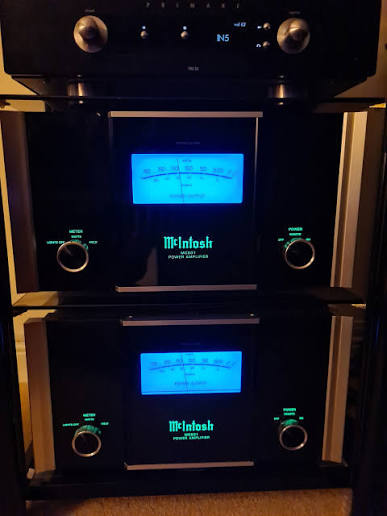
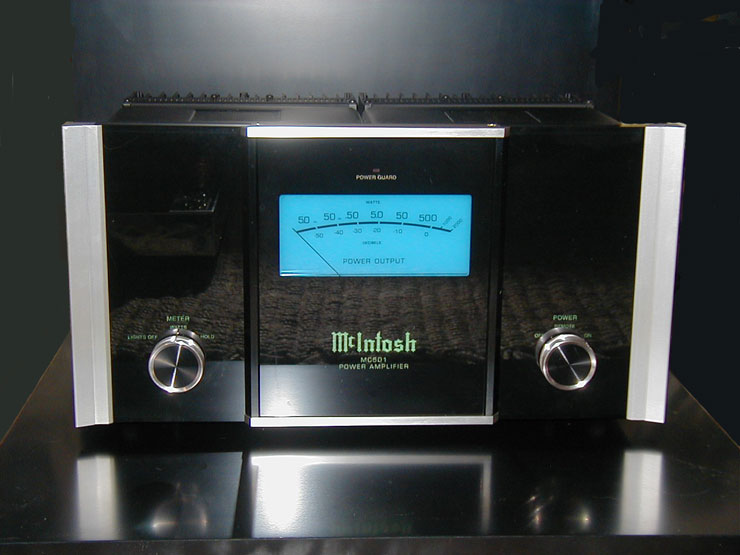
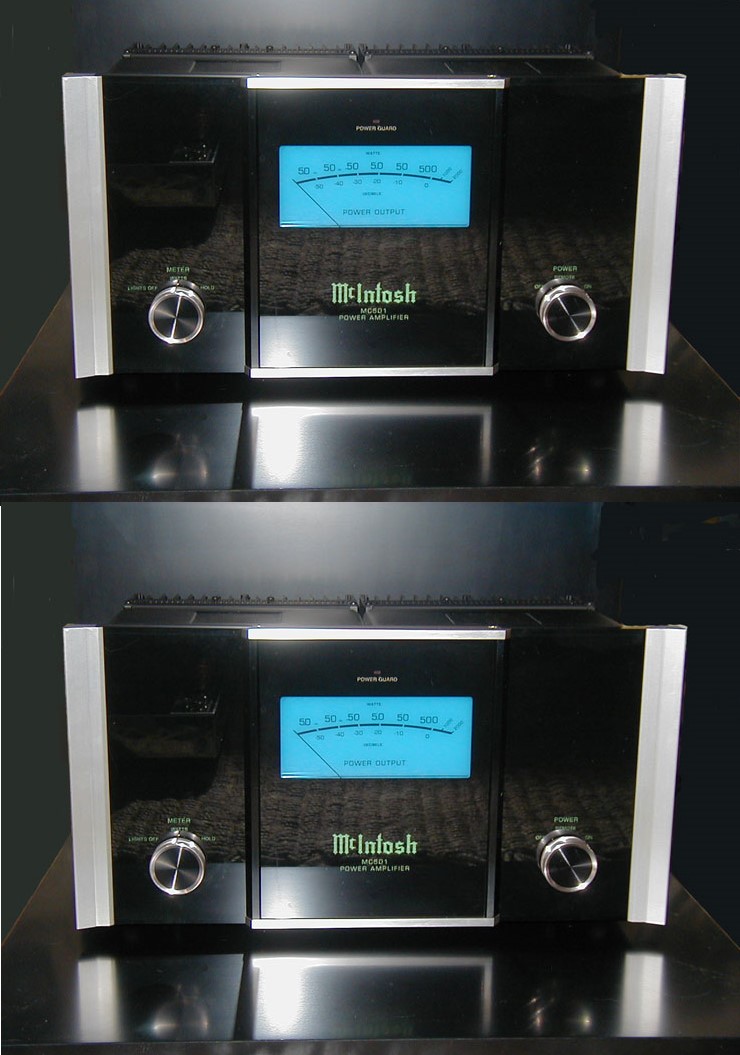
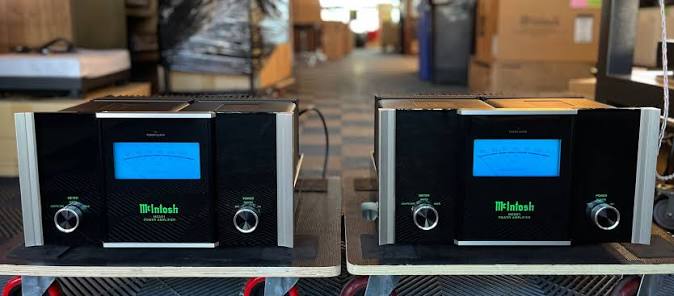
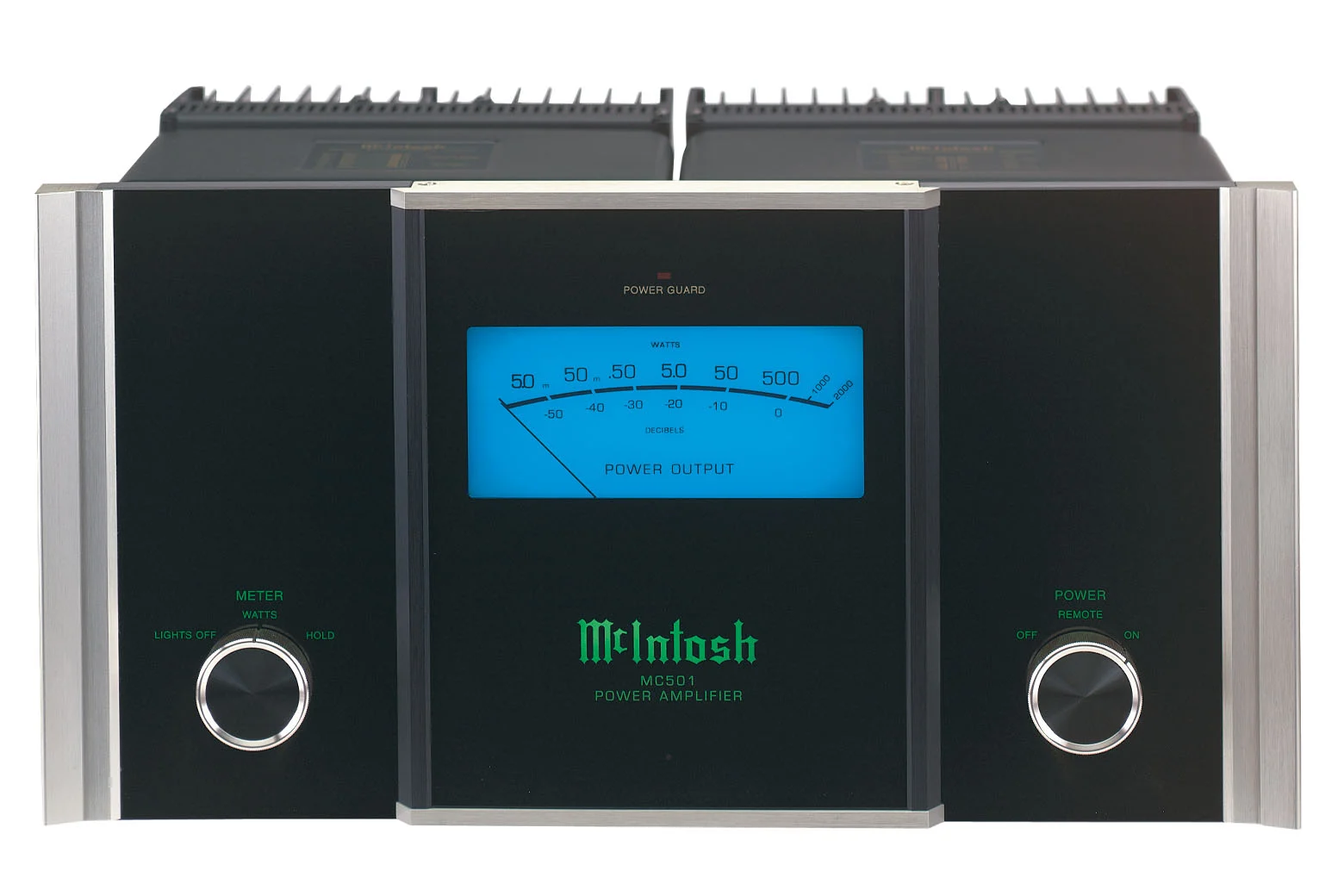
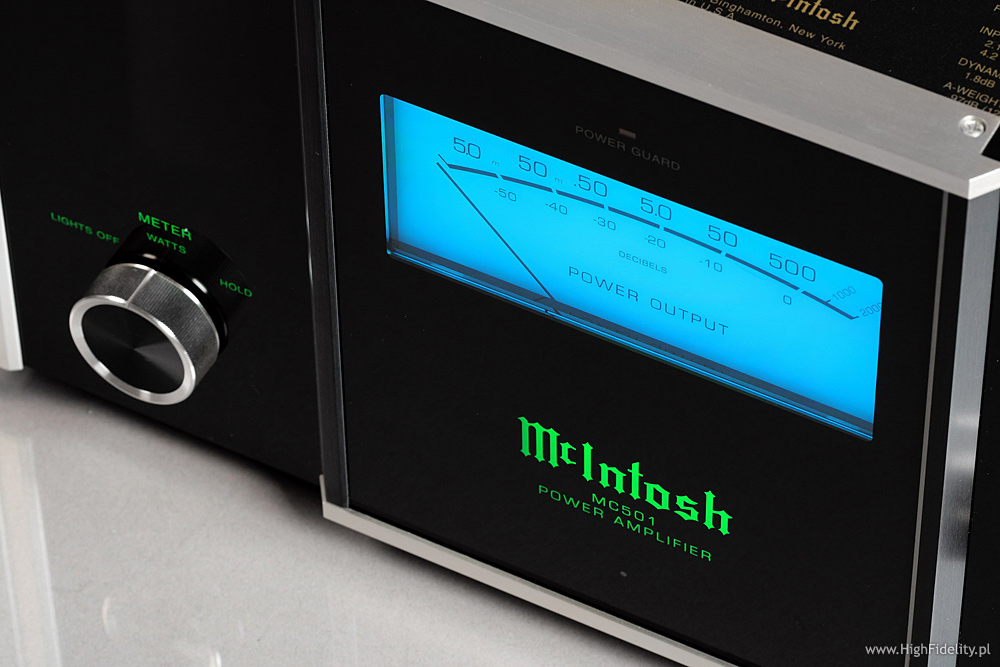
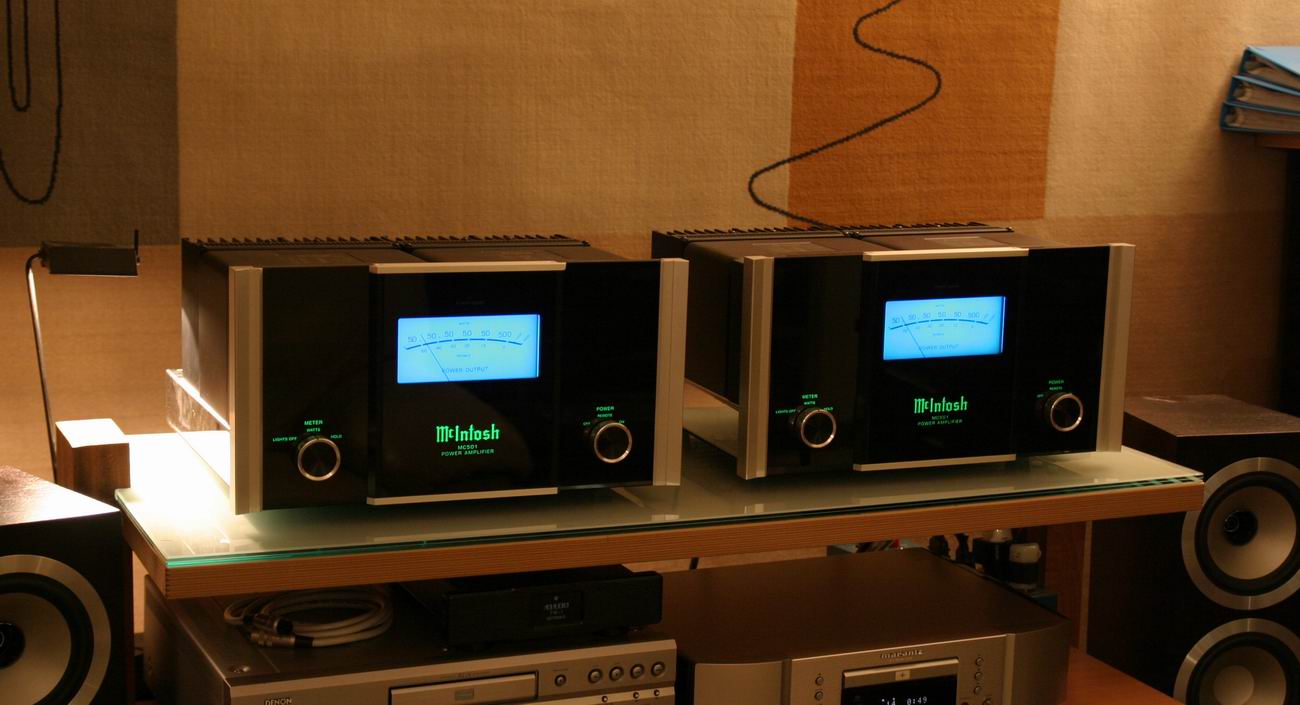
Styling is a smoothly modern update that remains true to Mac tradition: these amps look like something Bryan Ferry might own. A sleek front panel of black glass carries that gorgeous, remarkably informative power meter and two switches, one for On/Off/Remote turn-on, and one that turns off the meter’s lights and selects its function—peak hold or real-time readout of watts. The switch legends and traditional McIntosh logo glow an almost tropical green, while the meter is illuminated in soft blue. Very sexy.
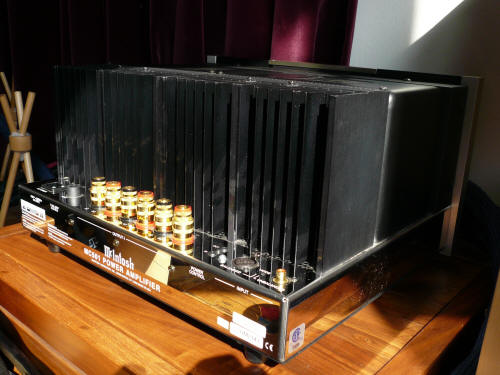
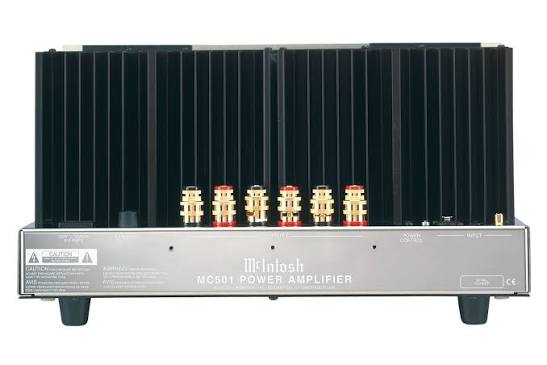
Around back are some large heatsinks and, at the top rearmost edge of the chassis, an AC power input, fuse, excellent-quality XLR (pin 2 hot) and RCA jacks, a selector to switch between inputs, and sockets for remote turn-on connections. The package is completed with three massive sets of WBT binding posts (they look identical to those used on the Nova Utopia speakers) for the Autoformer’s 8, 4, and 2 ohm outputs.
The ‘501s were settled atop the usual Grand Prix Audio Monaco amplifier stands, and I used Siltech SPX-30 Classic power cables for the first part of auditioning. Some interesting things happened when Shunyata’s Hydra 2 power conditioners arrived, with a matching set of Anaconda and Anaconda Vx power cables to run from wall to Hydra 2 to Mac (see Sidebar, “Shunyata Research Power Products”). Siltech SQ-110 Classic and Acoustic Zen Silver Reference interconnects saw principal duty, with Nordost Valhalla and Siltech LS-188 Classic speaker cables. During my time with them, the MC501s showed all the diva temperament and high-maintenance character of a pair of manhole covers—exactly what you’d expect from a Mac.
Much to my surprise, the ‘McIntosh MC501 required surprisingly little break-in time, their performance changing barely at all within the first 100 hours or so. The only detectable changes of significance were that the overall dynamic response became a little more open across the spectrum, and the whole presentation sounded a bit more relaxed. This was a wonderful change from the usual lengthy break-in procedure required with a big solid-state amplifier.
A couple of other seldom-acknowledged facts: I gather that McIntosh products hold their value better than any others in the business. That the company has been around for 55 years is hugely reassuring, and their matchless reputation for reliability and standing behind their products has been earned over time for good reason.
Rekindling the flame
Right from the get-go, the McIntosh MC501 sshowed their basic character. From first listen, they exhibited sound that was totally relaxed yet completely controlled. They could easily manage mighty peaks with no apparent effort, and had superb bass control. The Nova Utopias demand an iron fist in a velvet glove for best sound below 60Hz, and the Macs handled those large ported woofers with ease.
The ‘501s’ bass was something different from the norm of powerful solid-state amps. As John Atkinson observed on hearing the Macs in my system, they define the leading edge of bass transients in an especially lifelike way: to the ear, the transients of bass instruments are seemingly slower but no less precise than those of upper-midrange and treble instruments. The Macs perfectly captured this quality.
An industry friend burned me a copy of a demo disc he uses at shows, and one of the most impressive tracks on it is Eleanor McAvoy’s “I’ve Got You to See Me Through,” from her Yola CD (Market Square 113). Apart from being one of the finest grownup love songs I’ve heard in ages, it’s exquisitely recorded, and the five-string bass guitar was fabulously convincing. Through the Macs, the bass rolled into the room—it didn’t jump or snap into the space as if it were gated. Bass guitar should sound exactly so when played with the fingers rather than a pick. On the McAvoy track, it bloomed beautifully and was sensationally convincing, not to mention deep—the low C set loose objects abuzz in my room.
Listening to Steve Swallow’s beautiful playing on the title track of Carla Bley’s Nite-glo (LP, WATT 16) was very illuminating. Swallow plays with a heavily worn brass pick, and the minute scrape of the pick against the bass’s strings was still there, though less highlighted and more of a piece with each note than with most other amps, particularly solid-state ones. The tautly drawn, relentlessly pulsing synth bass on Majestic 12’s remix of Kelis’ “Milkshake,” from Ultra.Trance:3 (CD, Ultra UL1180-2), was waaay too cool on the Macs—one of the few things I’ve ever heard that actually made me want to get up and do the goofy-white-guy funky chicken.
The stygian depths of Sugar’s “Let’s Feel the Music,” from Shine (Korean CD, Starworld/BMG PD-6621), and the stomping, bugged-out “Dream” from their new Double Rainbow (Japanese CD, Toys Factory TFCC-81650, footnote 5), were nothing less than definitive. Whatever I asked the Macs to do in the bottom two octaves, they did. There was no drama unless the music demanded it, no “Hey, listen to what I can do” exaggeration, and no wussing out. There was only what I would describe in a person as complete and unqualified professional excellence.
The MC501’s midrange was far more like that of the best tube amps than that of any but the very finest solid-state amplifiers. Its greatest virtues were perfect echoes of those provided by fire bottles. Voices, especially women’s voices, were fabulously snared. On The Cropredy Box (UK CD, Castle Music CMETD815), the live document of Fairport Convention’s 30th-anniversary concert at their annual festival, Vikki Clayton’s unnerving channeling of the late Sandy Denny on “Come All Ye,” “Reynardine,” and “Matty Groves” was an “I’m there with a pint in each hand” experience. Clayton’s vocal resemblance to Denny was at times so complete that it was as though Sandy were still with us. The Macs served up Fairport in the finest fashion, with richness, soul, and everything but the smell of Cropredy.
Justine Suissa’s opulently sexy vocal on Armin van Buuren’s “Burned With Desire,” from 76 (CD, Ultra L 1168-2), and the deliciously soulful and luscious voices of Sia Furler and Sophie Barker on “Destiny,” from Zero 7’s Simple Things (CD, Quango/Palm QMG 5007-2), melted me into a small puddle in my listening chair. Posh, plush, lush, and generous are the words that best describe the MC501’s midrange.
The Mac’s ace in the hole was that this intoxicating loveliness was not bought at the price of diminished dynamic nuance or retrieval of detail. Strings were as persuasively wonderful as voices. Sir Granville Bantock’s Celtic Symphony, performed by Vernon Handley and the Royal Philharmonic (CD, Hyperion CDA664501), is a silken glory; the Mac was more than up to the task. On the other side of the orchestral spectrum, Ravel’s Rapsodie Espagnole (LP, Vox Box QSVBX 5133), performed by Stanislaw Skrowaczewski and the Minnesota Orchestra, had the crisply defined sound and deftly located images that are typical of Minneapolis’ Orchestra Hall. The venue’s defining characteristic is clarity, not a round glow, and the MC501s came through with flying colors without shorting my hometown hall’s ability to blend sounds into an atmospheric whole.
The Mac did something very few solid-state amps can do—it breathed, with sometimes long and languorous pauses. The ‘501 caught attacks and decays with the tempered variety of intensities that one seldom hears from audio components, however expensive or exotic, but that’s heard every day from real instruments and voices.
The Mac’s treble performance was something of an enigma. It never seemed to have the purely unfettered extension of such amps as the Halcro dm58 or Edge NL-12, but when I attempted to identify what it was lacking I always came up empty. When I looked for maximal spatial resolution on recordings such as the Ravel and Bantock, it was there. There may not have been the precise description of every mouse hole in the wainscoting that the Halcro dm58s so effortlessly summon, but neither was anything meaningful missing. Ride cymbals had a feathery and polished sound of brass—no dullness, no harshness or white-noisey nasties—the MC501 was true and right. So did the fault lay within the Mac or within my conditioned audiophile responses? The longer I listened, the more I came to believe it was the latter. I heard never so much as a hint of glare, grain, or glassiness unless it had been engineered into the recording.
The Macs’ soundstaging was comparable to the very finest—[cough] Halcro—that I have heard. There was sometimes a smidgen less depth, but width was superlative, and so was the Macs’ sense of place. Say what you will about modern studio recordings—sensitive and intelligent musicians and engineers do some mind-bending things with electronic virtual space. Ron van den Beuken’s “Clokx” (a dramatic and mesmerizing remix of the piano intro to Coldplay’s “Clocks”) and “Timeless” (both from Ultra.Trance:3) threw colossal and wholly plausible soundstages into my room. Depth was abyssal, and breadth was Cinerama spectacular.
Images were placed in space with an authority and solidity so great that there was no electronic artifice to notice. Things were just there, without exaggeration or underplaying. The Macs’ dynamic performance was exemplary. They never seemed to work hard at all, even on material designed to break an amplifier’s will—such as the Poem of Chinese Drums, from the third Burmester demo CD. Low-level dynamics were as refined and delicately nuanced as ever I have heard, and on all types of music.
What made me think about the MC501s so hard my head hurt was their ultimate ability to resolve the smallest details that I’ve heard from the likes of the Halcro dm58 ($27,990/pair) and Lamm ML1.1 ($22,690/pair). It was not the case that the Macs were unable to resolve subtle and revealing detail. They did so without breaking a sweat. The question was one of degree, not of kind. I always seemed caught by the feeling that the Halcros and Lamms resolved a worthwhile bit more than the Macs managed, but at the same time, the ‘501s seemed to be lacking nothing that made music so meaningful.
It’s possible that the slight difference in resolution between the Macs and the Halcros and Lamms is due to the Macs’ use of negative feedback. Contrariwise, the negatives normally associated with the extensive use of negative feedback—an obvious darkness on top and lack of treble dynamics—didn’t exist when I listened to the MC501s. Perhaps the enormous collective experience of the McIntosh design team has given the company an institutional memory of how to resolve these seemingly eternal contradictions.
The best reflection on the overall character and presentation of the MC501s is that I constantly found myself listening to whole CDs and LPs, not just isolated cuts. The Macs were so uniform and consistent from top to bottom, and so continuously good, that they politely escorted hi-fi concerns out of the listening room and invited back in the love of music for its own sake—but with no loss of what are considered to be the “audio” virtues.
Where shall we honeymoon?
Listening to and living with the McIntosh MC501s was rather like going to a high school reunion and hitting the trifecta. Not only was the beautiful girl I had the terrible crush on way back when more beautiful than ever, she was successful, available, and asked me out to dinner. So sue me, I fell in love all over again—the big Macs were an unstinting delight to live with with all types of music. As noted, they may not deliver the last, infinitely minute degrees of resolution and palpability that the more-expensive Halcro and Lamm amps manage to find, but they deliver more than enough to make the experience of music deeply rewarding to the inner man, not just the cerebral audiophile. They brought musical joy by the truckload. I’ve never had a harder time taking off my music lover’s hat and putting on my reviewer’s mortarboard (dunce cap?) than when listening to the Macs.
I have never experienced as much pure musical pleasure as I did when the MC501s were teamed with the VTL TL-7.5 Reference line stage and the Focal-JMlab Nova Utopia Be speakers. I have heard marginally—I stress marginally—better in absolute sonic terms, but if it were my own money being spent at retail, the big Macs would be my no-brainer choice as my amplifier to own for the long run. At their price of $8200/pair, they’re untouchable, and only a few amps at any price offer such a rewarding combination of power, reputation, build quality, and overall sonic acumen. Like the Legacy Audio Focus 20/20 loudspeaker I reviewed in January 2004, the McIntosh MC501 offers a singular combination of value and performance.
Thomas Wolfe was wrong. You can indeed go home again, at least when the amps at home are from McIntosh.