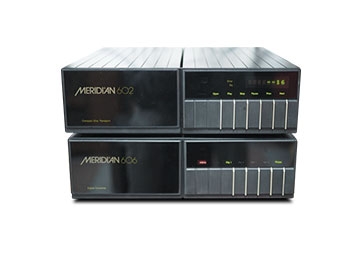
Meridian 606 Digital to Analogue Converter is a high-end outboard DAC from the early 1990s (circa 1990–92), part of Meridian’s prestigious 600-series lineup. It was typically paired with the matching 602 CD transport to form one of the era’s more sophisticated two-box CD players. Original UK price was around £1,221–£1,350.
It represented Meridian’s (Boothroyd Stuart) embrace of Philips’ then-new Bitstream (PDM / pulse-density modulation) technology, specifically the advanced DAC7 system. This was a deliberate move away from traditional multi-bit ladder DACs toward 1-bit conversion, which promised better low-level linearity.
Design and Features
The 606 uses a distinctive dual-chassis construction: two independently screened enclosures that separate the digital data-acquisition/input stage from the digital processing, DAC, and analogue output sections. This physical isolation was intended to minimise interference and improve noise performance. The overall appearance is elegant and understated in typical Meridian black styling of the period (approx. 440 mm wide × 88 mm high × 332 mm deep).
Key features include:
- Four digital inputs: two coaxial (RCA) and two optical (Toslink), selected via front-panel switches.
- Analogue outputs: unbalanced RCA.
- Philips Bitstream DAC7 (PDM) conversion, operated differentially.
- Advanced input-stage design using the Philips SAA7274 ADIC with three discrete crystal oscillators (one for each common sample rate: 32, 44.1 and 48 kHz) for low-jitter data recovery.
- Meridian’s proprietary jitter-reduction techniques.
- Fixed analogue output level (no digital volume control).
The dual-box approach and careful power-supply isolation reflected Meridian’s engineering philosophy of the time—clean digital handling combined with refined analogue stages.
Sound Quality
Contemporary reviews (notably Paul Miller in Hi-Fi World, January 1992) described the 606 (especially with the 602 transport) as having a distinctive, refined character. Initial impressions were often of a laid-back, smooth, almost “prostrate” presentation that lacked immediate excitement or drive. Treble was sweet and fluid rather than extended or assertive, and the overall balance tended toward gentleness.
However, longer listening revealed strengths that grew on reviewers. The sound was described as easy-going, natural, and free of grain, hardness, or digital edge. Dynamics and scale could surprise once the listener settled in—the combination was capable of delivering contrasting dynamics and a sense of authority without aggression. Compared with more forceful DAC7 implementations (such as Deltec’s PDM2), the Meridian was gentler and more insistent rather than bold or solid.
Later user impressions vary. Some find it smooth, warm, and refined but ultimately lacking in vitality, colour, and soundstage width compared with modern or even contemporary multi-bit alternatives. Others appreciate its non-fatiguing, fluid presentation, particularly in systems that already lean bright or analytical.
In short: the 606 prioritises smoothness, refinement, and long-term listenability over slam, ultimate resolution, or excitement. It is the antithesis of “hi-fi spectacular” digital sound.
Strengths
- Very refined, grain-free, and non-fatiguing presentation.
- Elegant dual-chassis construction and thoughtful engineering (low-jitter input stage, isolation).
- Smooth, fluid treble and natural overall balance.
- Strong partner for the Meridian 602 transport.
- Distinctive Meridian house sound of the early Bitstream era.
Limitations
- Laid-back character can sound dull, lacking in drive, rhythmic energy, or colour for some listeners.
- Soundstage often described as relatively narrow or lacking substance.
- Fixed output level requires a preamplifier (no digital volume).
- Limited connectivity by modern standards (no USB, balanced outputs, or high-resolution support beyond 48 kHz).
- As with many early Bitstream designs, it can be outperformed by well-executed multi-bit converters of the same period (or later designs) in resolution, dynamics, and involvement.
Verdict
The Meridian 606 is a classic example of early-1990s high-end Bitstream digital design from one of the most thoughtful British manufacturers of the era. It delivers a refined, smooth, and non-aggressive sound that prioritises ease and naturalness over excitement or ultimate detail retrieval. Paired with the 602 transport it formed a sophisticated, elegant system that many listeners grew to appreciate deeply.
Today it is a collector’s or period-correct piece rather than a competitive modern DAC. If you value Meridian’s refined house sound of that generation, enjoy Bitstream’s characteristic smoothness, and already have a compatible transport or digital source, a well-maintained 606 can still provide enjoyable, fatigue-free listening. Those seeking greater dynamics, resolution, soundstage, or modern connectivity will find better options elsewhere—often at lower used prices.
Meridian 602 CD Transport is a high-end dedicated Compact Disc transport from Meridian’s 600 series, produced roughly between 1989 and 1993. It was designed as the partner to the 606 DAC (and also worked with Meridian’s digital active loudspeakers such as the D6000). Original US price was around $2,750; UK price was in the region of £1,750.
It ranks among the more refined and carefully engineered CD transports of the early 1990s, reflecting Meridian’s (Boothroyd Stuart) emphasis on low jitter, mechanical isolation, and system integration.
Design and Features
The 602 shares the elegant, compact styling of other Meridian 200/600-series components: a black chassis with a distinctive glass front panel, a single row of gold pushbuttons, and a clear green alphanumeric display. Dimensions are approximately 325 mm wide × 100 mm high × 320 mm deep, with a weight of about 6.4 kg (14 lbs).
Key features include:
- Philips CDM-4 swing-arm laser mechanism (a highly regarded design of the period for its tracking ability and musicality).
- Disc placed directly on the motor spindle (tray-mounted mechanism); careful loading is required to avoid jamming.
- Digital outputs: one coaxial (RCA) and two optical (Toslink).
- Meridian communications ports (DIN and optical) for integration with Meridian digital active speakers and system control.
- Full remote control via the supplied 209 handset (also compatible with other Meridian components of the era).
- Designed to be left powered; a standby mode keeps critical circuitry warm.
- Later updates improved jitter performance with precision oscillators, double reclocking, and a high-tolerance toroidal output transformer intended to preserve waveform integrity over longer cables.
The transport prioritises clean data delivery with low jitter rather than elaborate multi-bit conversion (that role was left to the matching 606 or other external DACs).
Sound Quality
John Atkinson’s Stereophile review (June 1991) was strongly positive. Used primarily into a high-end Stax DAC, the 602 delivered a wide, deep soundstage in which individual instruments retained their tonal character even at high recorded levels—avoiding the high-frequency “mash” or intermodulation congestion common in lesser digital sources.
Bass performance stood out: low-frequency extension and authority were excellent, giving organ recordings (and other bass-heavy material) a convincing sense of weight and power. Detail retrieval was high, the presentation musically satisfying, and free of the treble congestion Atkinson noted in many digital sources of the time. Compared with the Meridian 208 used as a transport, the 602 offered better bass extension and slightly greater palpability of instruments.
Later user impressions are more mixed. Some still praise its refinement, smoothness, and system synergy (especially with Meridian DACs or digital speakers). Others find older examples can sound somewhat rounded, less lively, or less fluid than the best contemporaries (for example certain Marantz or other high-end transports of the era), particularly if the mechanism has aged or drifted out of optimal specification. Error correction was described as excellent in the original review.
Overall character: refined, detailed, and analogue-like in its best moments, with strong bass authority and good spatial presentation when partnered with a capable DAC.
Strengths
- Excellent low-jitter data delivery and strong error correction for its time.
- Wide, deep soundstage and good instrumental separation.
- Notable bass extension and authority.
- Elegant build, refined ergonomics, and seamless integration into Meridian systems.
- High-quality Philips CDM-4 mechanism.
- Class-A recommendation level performance in contemporary reviews when used with good processors.
Limitations
- Price was high relative to complete CD players of the period.
- Loading requires care (disc on spindle with limited clearance).
- No balanced digital output or modern interfaces.
- Performance is highly dependent on the partnering DAC and interconnects.
- Ageing mechanisms can affect long-term reliability and sound; serviceability of the CDM-4 is a practical consideration today.
- Some modern listeners find the presentation less dynamic or colourful than the best later transports.
Verdict
The Meridian 602 is a classic high-end CD transport that exemplified thoughtful British digital engineering of the early 1990s. It prioritised low jitter, clean data recovery, and musical refinement, delivering strong soundstaging, detail, and especially impressive bass performance when properly matched. Paired with the 606 DAC it formed one of Meridian’s flagship two-box systems of the era; it also served effectively as a source for Meridian’s pioneering digital active loudspeakers.
Today it is a period piece best suited to collectors or those building a classic Meridian system. In good condition and with a high-quality DAC it can still provide enjoyable, refined CD playback. Prospective buyers should prioritise units with known service history, as the mechanical and optical condition of the CDM-4 mechanism is critical to performance. For pure modern performance, later transports or high-resolution digital sources generally surpass it, but the 602 remains a well-regarded example of its generation.