Monitor Audio Platinum 200 (Piano Black 2nd Generation)
Original price was: R136,000.00.R44,000.00Current price is: R44,000.00.
Years Active 2007-2016
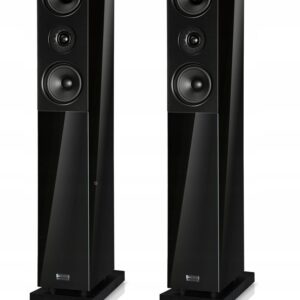
Flagship 3-Way floorstander speaker with twin 2 x 6 1/2” long-throw RDT bass drivers, 4” C-CAM midrange driver and high frequency ribbon transducer. Finished with hand-upholstered leather baffles and luxurious piano gloss.
Frequency Response
35 Hz – 100 KHz
Sensitivity (1W@1M)
90 dB
Nominal Impedance
4 Ohms
Maximum SPL
117.8 dBA
Power Handling (RMS)
250 W
Recommended Amplifier Requirements
100 – 250 W
Bass Alignment
Rear Ported HiVe®II technology
Sealed Mid-range TLE®
Mid / H.F Crossover Frequency
3600 Hz
Bass Low Pass Crossover Frequency
600 Hz
Drive Unit Complement
2 x 61/2 long-throw RDT® bass drivers
1 x 4″ RDT® mid-range driver
1 x C-CAM® high frequency ribbon transducer
External Dimensions (Including Plinth (H x W x D))
998 x 360 x 375 mm
(395/16 x 143/16 x 143/4 inches)
Weight (each)
33Kg (72.7 lbs)
Description

A few years ago, I had a phone call from a marketing organization. I was asked, as a member of the audiophile press, to participate in a survey dealing with the “images” of various brands of loudspeakers.
I declined to participate in the survey—Stereophile editorial policy does not allow writers to act as consultants, and this was tantamount to being a consultant, albeit an unpaid one. However, if one of the brands in the survey had been Monitor Audio, my answers would not have been terribly helpful: I had no very clear “image” of Monitor Audio speakers. British, well-made, uses gold-anodized dome tweeters—that’s about all I could have said about them. I had not listened to Monitor speakers for any length of time. My impressions were vaguely positive, but nothing to make me think that these were speakers I simply must review.
My impression of Monitor Audio speakers changed at the 2007 Montreal Festival Son & Image. At a show at which many excellent speakers were displayed, the demonstration of Monitor’s Platinum PL300s was characterized by sound that I described in my show report as being “arrestingly lifelike.” I made a mental note to myself to consider reviewing these speakers, but, what with this and that, by the time I got around to taking steps to arrange a Monitor Audio review, the year was 2009 and the new speaker in the Platinum line was the PL200. This speaker has much the same technology as the PL300, but in a more compact package and at a lower price ($8000/pair)—a combination that always appeals to me. And a demo of a pair of PL200s at the 2009 Montreal show was most convincing. This time, I made sure that reviewing the PL200 was not a “Think about . . .” but a “Do!”
Description and design
Remember the advertising slogan for Clairol’s Nice ‘n Easy, “The closer he gets, the better you look”? Perhaps a wee sexist in today’s world, but if Monitor Audio were to borrow this slogan, they could well adapt for the advertising of the Platinum PL200. From a distance, it looks much like any other floorstander. But get closer, and you’ll see that the fit and finish are of a quality far higher than the norm. The wood finish (Santos Rosewood on the review samples) is impeccable: smooth, with a gloss that indicates multiple coats of varnish, each coat (of 11, I’m told) polished to perfection. Joins in the veneer are invisible. The front baffle is finished in leather—not just any leather, mind you, but “Strathspey leather,” selected for its acoustical properties as well as for its appearance.
The drivers are on the exotic side: the midrange and bass have metal-covered cones, and the tweeter is a ribbon rather than the ubiquitous dome. The midrange and bass cones are made of a honeycombed Nomex combined with Monitor’s Ceramic-Coated Aluminum Magnesium (C-CAM) alloy, forming a rigid structure with low mass. C-CAM is also used in the construction of the ribbon tweeter, whose frequency response is claimed to extend to 100kHz. Although this is well above what’s normally considered to be the upper limit of human hearing (and the CD format is bandwidth-limited to 22kHz), there is some evidence that, at least with wide-bandwidth sources, ultrasonic response may improve the sense of reality of the reproduction. Even if the audibility or utility of the ultrasonic response is questionable, there is still the argument that a tweeter whose response extends far beyond the range of human hearing may perform better in the audible range. Oh, and in case you were wondering, other than in the finish of their WBT binding posts, the Platinum PL200 contains no platinum.
I couldn’t find much information about the PL200’s crossovers in the product literature or on Monitor Audio’s website, but Dean Hartley, the company’s head designer, told me that the low-pass bass-driver crossover and both the high- and low-pass crossovers on the midrange are 12dB/octave, and that the tweeter is protected by an 18dB/octave crossover. Crossover components include high-spec foil capacitors and air-core inductors; the internal wiring is pure silver.

The fine-furniture finish of the PL200’s cabinet hides a complex, high-tech construction. Multiple layers of bonded MDF form a multicurved shell; steel bolts tie the front and rear panels to a “pinhole” bracing structure. A tool is provided for tightening the bolts, which can loosen during shipping. Under the leather, the front baffle is made of something called Anti Resonant Composite (ARC), “a thermo-set polymer loaded with minerals.” The midrange driver occupies its own sealed, tapered enclosure within the main enclosure. The bass is ported, but, again, the design is unique, and called HiVe II: a straight-rifled aperture that’s claimed to be able to move air in and out more quickly than conventional designs.
The PL200’s integral plinth is also made of ARC, and has feet that are adjustable for leveling. (A spirit level is provided.) The plinth houses two sets of WBT terminals for optional biwiring. I single-wired the Monitors.
Monitor Audio is owned and managed in the UK, but since 2004 its manufacturing facilities have been consolidated in China. (“The best move we ever made,” says Dean Hartley.) According to Hartley, parts for the PL200 are sourced or made with the objective of achieving the highest quality and tolerances. The tweeter itself—the manufacturer of which requires extremely tight tolerances—is made in Malaysia. The final assembly is done in Monitor Audio’s factory in China, with QC supervised and inspected by Monitor Audio’s own staff.
System and setup
In considering reviewing a pair of speakers, I first must make sure that I have an amplifier that can drive them. Though the last speaker I reviewed, the Avantgarde Uno Nano (July 2009), thrives on low-powered tube amplification, a glance at the Platinum PL200’s specifications told me that this speaker would require something else. Monitor Audio recommends an amplifier with a minimum output of 100Wpc. But with a speaker of the PL200’s pedigree, those shouldn’t be just any kind of watts—I’d want to use an amplifier good enough that its sound quality would not compromise the speaker’s performance. Which one?
The solution presented itself when I remembered that Monitor Audio has exhibited very successfully with Simaudio electronics. A loan of the Moon Evolution W-7 amplifier (150Wpc) was arranged, and the folks at Simaudio also suggested that I use the matching Moon Evolution P-7 preamplifier as well—which, in combination with my Ayre CX-7eMP CD player, would result in a fully balanced system. Well, why not? Besides, the P-7 and CX-7eMP are both listed in Class A of Stereophile‘s “Recommended Components,” and the W-7 is a lower-powered version of the Moon W-8, another Class A denizen. In terms of electronics, I was pretty sure I’d be in good shape.
But my reviewing system still had not fully evolved. I looked at the interconnects I had on hand and realized that I lacked the requisite two identical balanced pairs: one pair for CD player to preamp, the other from preamp to power amp. In fact, the interconnects I’d been using were a bit of a hodgepodge, and some of them were no longer made—perhaps it was time to upgrade. But there are lots of interconnects out there, and I had no interest in trying all sorts of models from different manufacturers. The cables I’ve used more than any other are from Nordost: Valhalla speaker cable, still current in their line; and Quattro Fil interconnect, discontinued some time ago. My positive experience with them led me to think that Nordost would be the logical choice. I talked to Nordost’s vice-president of marketing (and sometime audio scribe), Roy Gregory, who offered to loan me some Valhalla interconnects and power cables to supplement the Valhalla speaker cables I already had. Replacing my stock Linn Ittok tonearm cable with Nordost’s Frey (the Valhalla is too stiff for the Linn turntable’s suspension) completed the Nordost cable loom. (See Art Dudley’s discussion of the “loom” concept in “Listening” in the December 2009 issue.)
Over the years, I’ve found that speakers sound best when placed within a fairly circumscribed area, away from the front and sidewalls and along the 16′ length of my 14′ by 16′ by 7.5′ room, forming close to the classic 60° angle,when perceived from the listening position, or even a bit wider. (I like a wide soundstage.) Within that area, moving the speakers by small increments from the front and sidewalls and varying their toe-in allows some tuning of the tonal balance and optimizing the width and depth of the soundstage.
Sheldon Ginn of Kevro International, Monitor’s North American distributor, came by to help me with the setup. He tightened the bolts that keep the enclosure rigid, and adjusted the feet so that the spirit level indicated that both speakers were level. Together, we moved the speakers around a bit until the soundstage came into good focus. I was told that my review samples had had a fair amount of break-in time, but more never hurts—whenever my wife and I were away from home, I programmed Monitor Audio’s break-in CD (supplied with my review samples) for repeat play. Over a period of several weeks, the bass improved and the sound generally seemed to become more relaxed—but since the audio electronics and the cables were new in the system as well, I can’t definitely attribute this change to speaker break-in alone.
As I kept listening to the PL200s after the initial setup, I had the feeling that although their soundstage was fine, the tonal balance was a little bass-shy. I moved the speakers a few inches toward the wall behind them (too close and you exacerbate room modes), which resulted in a better balance of the bass with the rest of the range. The PL200s come with metal grilles that conveniently attach with magnets. I compared their sound with the grilles on and off, and found the focus to be better with the grilles off, so that’s how I listened to them. (This was also Sheldon Ginn’s recommendation.)
Sound
For me, the two most important attributes that define loudspeaker quality are resolution and transparency. By resolution I mean the ability of a speaker to communicate the fine details of the music encoded in the recording, while transparency refers to a speaker’s ability to present a “clear window” on the music, free of distortions and colorations. These characteristics are important for any audio component, but are particularly important—and particularly difficult to achieve—in a mechanical product like a loudspeaker. Some speakers that offer a detailed presentation also have a distinctive sonic personality that keeps reminding you that you’re listening to speakers, not live music. Other speakers are pleasantly “musical,” with little in the way of a distinctive “speaker sound,” but gloss over the music’s finer details: such speakers are high in transparency but low in resolution. It’s hard to get both in the same speaker. My Avantgarde Uno Nanos have very high resolution, but they also have a distinctive sonic personality—the well-known “horn coloration,” which, while lower in the Uno Nano than in other horns, is still audible.

My usual test of resolution is to play highly familiar recordings, listening for any details I had not been aware of before. One disc that I find very useful for this is All Star Percussion Ensemble (CD, Golden Strings GS CD 005), an early digital recording (1982) selected in 1993 by Home Theater magazine’s Thomas J. Norton, then my colleague at Stereophile, as a “Record To Die For.” It’s a sonic spectacular in the best sense: “balance is superb, detailing is precise and at times striking, dynamics wide, and the soundstage is particularly broad and deep,” to quote TJN. I don’t know what equipment Tom used to come up with that assessment, but I’ve listened to this recording many, many times, and through the PL200s I heard details of orchestration that simply had not been apparent before. For example, in the arrangement of Pachelbel’s Canon in D, I noticed for the first time that a percussion instrument enters the fray (at 2:42 into track 3) making “clucking” sounds. Could I have heard it through other speakers if I’d listened more attentively? Perhaps. All I can say is that with the PL200s in this system, the presence of this instrument was very obvious, and an effective part of director Harold Farberman’s arrangement.
The PL200 also sailed through my other tests of resolution, such as revealing the editing glitches in Sylvia McNair’s Sure Thing: The Jerome Kern Songbook (CD, Philips 442 129-2). These details didn’t sound exaggerated, like a digital photo with the sharpening control turned up too high; they were just there.