

Pass Labs XA 30.5 Power Amplifier
Original price was: R180,000.00.R65,000.00Current price is: R65,000.00.
Specifications
Type: Solid-state stereo amplifier
Power Output: 30 wpc into 8 Ohm, 60 wpc into 4 Ohm
Gain: 26 dB (dB)
Sensitivity: 0.77 V
Frequency Response: 1.5 Hz to 100 kHz (-2dB)
Distortion: 0.01% at 3 watts, 0.1% at 30 watts (measured at 1 kHz)
Input Impedance: 30 kOhm balanced, 15 kOhm unbalanced
Damping Factor: 150 for an 8 Ohm nominal load
Maximum Output Current: 23 Ampere
Maximum Output Voltage: 18 Volts
Output Noise: 150 microvolt unweighted 20 Hz – 20 kHz
DC Offset: <50 mV
Slew rate: ±50 V/µs
Dimensions:19 x 7 x 19 (WxHxD in inches)
Weight: 60 lbs.
Price:$5500
Description
Pass Labs XA30.5 power amplifier


Over the course of his 30-plus years in high-end audio, Nelson Pass‘s designs have never been far from the leading edge. In his first Threshold amplifiers he pioneered the use of dynamically adjusting bias and cascode circuitry; then, in the later Stasis models, he switched gears to the simpler approach of pure class-A. All were innovative designs, and among the very best-sounding amps of their time, but were just warmups for what was to come. In 1991, Pass Labs introduced the Aleph 0, a class-A amplifier that was a startling departure from conventional solid-state designs and combined design elements generally thought mutually exclusive: transistors, single-ended operation, and the ability to output 75Wpc into an 8-ohm load. Not surprisingly, the Aleph 0 sounded like nothing else, and became the basis for the widely acclaimed series of Pass Labs amplifiers that evolved over the next decade.
Pass’s designs have varied widely, but all reflect his quest for simplicity. It’s considered a self-reinforcing design philosophy: simple circuits and a minimum number of gain stages result in less distortion being generated, ergo less need for feedback and the additional gain needed to offset it. This approach leads to low-distortion, typically smaller devices that operate under optimal class-A conditions. The challenge has always been to accomplish these goals in an amplifier with enough power and current capacity to drive insensitive audiophile loudspeakers. Dynamically adjusting bias, cascoding, Stasis, Supersymmetry, and the hybrid configuration in Pass’s XA.5 series are different ways to enable the simplest possible gain circuit to do the job.
The X.5 and XA.5 series of amplifiers are the second respective generations of the original X and XA series. The X models, beginning with the X1000 in 1998, were the first implementation of Nelson Pass’s patented Supersymmetric topology (see “Nelson Pass on the Patents of Pass“). The XA series, which debuted four years later, combined Supersymmetry with the single-ended class-A operation of the Aleph series. The XA and XA.5 models run substantially hotter and produce about half the power of their X and X.5 counterparts, which operate in class-A at low levels but switch to class-AB for most of their dynamic range. Though the .5 designs aren’t entirely “new,” they incorporate enough small changes to merit the designation.
The XA30.5
Nelson’s amplifiers, whether they were his earlier designs for Threshold or his later ones for Pass Labs, have always been on my wish list, so I was delighted when the opportunity arose to review one of the latest Pass amps. I was a little surprised, however, at Nelson Pass’s suggestion that I audition the XA30.5. I’d expected a pair of X1000.5 monoblocks perhaps, or maybe XA200.5s, if he thought they’d do the job…but a nominally 30Wpc stereo amp? I double-checked, and yes, he did know what speakers and other amplifiers I was using, and yes, he was aware of the sort of gear I usually reviewed. Despite all that—actually, because of all that—he reiterated his preference that I audition the little guy.
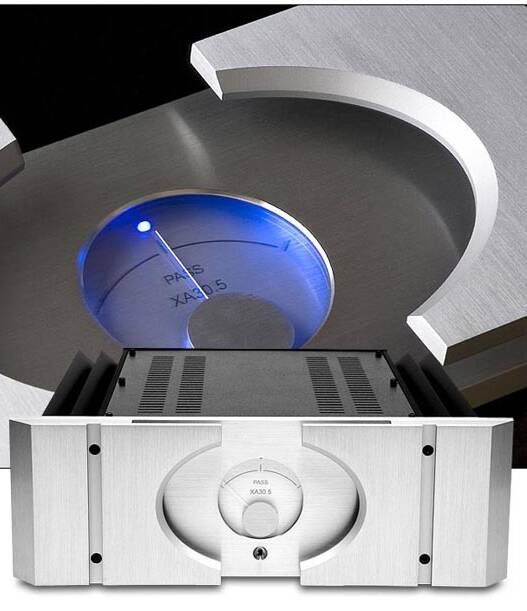
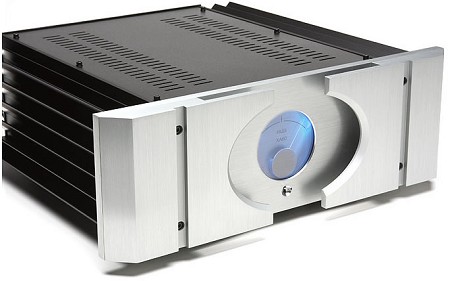
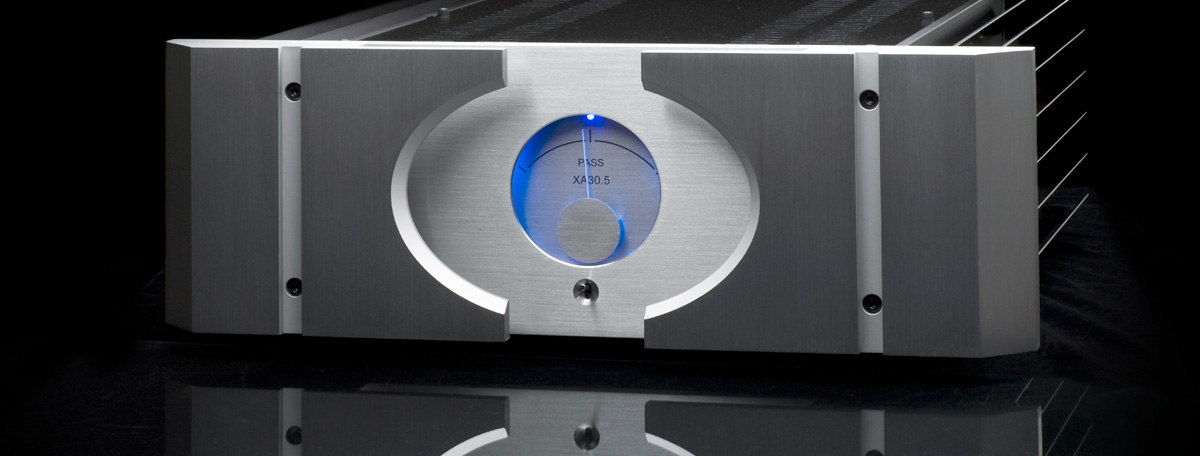
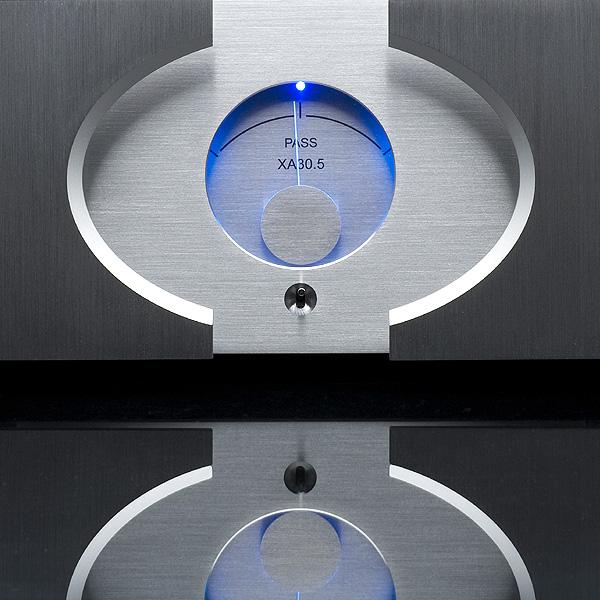
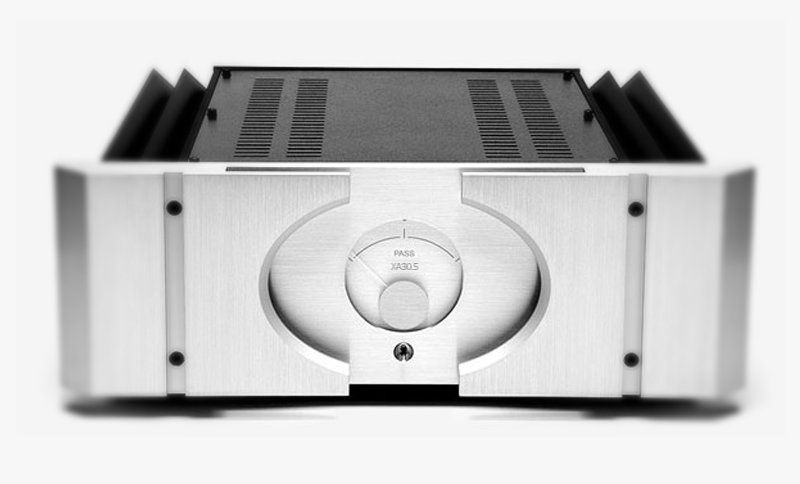
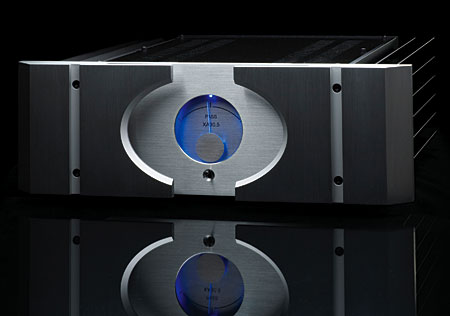
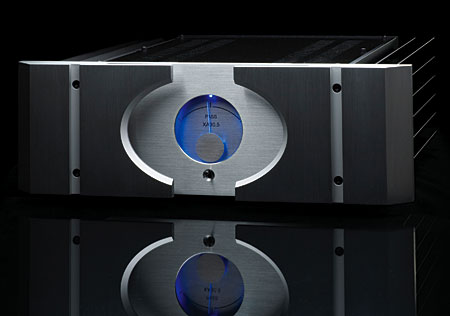
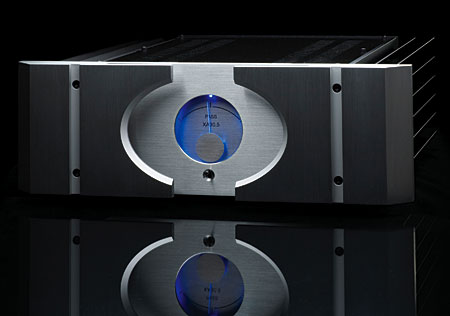
The smallest amplifier in the Pass Labs line, the XA30.5 retails for $5500. It’s hardly a featherweight, though, because producing 30Wpc of pure class-A power requires a lot of hardware. The XA30.5 shares the handsome industrial design Desmond Harrington created for the larger Pass Lab amps: a mix of strong, simple shapes and textures surrounding a glowing blue power meter. The overall impression is one of strength and elegance. Were the XA30.5 a car, it would be something beautiful yet purposeful, like a Ferrari 599GTB—midway between the soft curves of a Jaguar XKR and the angular menace of a Lamborghini Gallardo LP560-4.
The XA30.5’s inner workings are similarly well executed. The boards are nicely laid out and well labeled, the wiring routes simple, the parts all of top quality. The mechanical assembly is similarly well thought out, and the workmanship is excellent throughout. There are relatively few boards, reflecting the simple, symmetric nature of the design. One board just behind the front panel holds the meter and Standby/Operate switch. There are two more boards at the rear of the chassis: The lower one contains the power-supply electronics, the upper one the bias circuitry. The upper board also acts as a mother supporting two daughter boards. Each of these is what Pass calls a Universal Gain Stage (UGS), which consists of a cascoded input and a voltage gain stage. Two more boards run the full length of the chassis, one along each side. These are the output stages, each comprising 10 pairs of power MOSFETs. Because the XA30.5 is a fully balanced design, this translates to five complementary pairs each for the plus and minus legs. The front half of the chassis is filled, nearly top to bottom, with a huge Plitron toroidal transformer that no doubt accounts for most of the amp’s 75 lbs.
This simple, three-stage topology is common throughout the Pass line, the major differences being in the power supplies and biasing. In the XA.5 amps the bias is set quite high, so that the output stage operates in class-A up to the rated output and emulates a single-ended amplifier at low levels. Pass described this to me as “a push-pull output stage in parallel with a constant current source. The n channel, which handles the push, or plus, side of the push-pull, is biased at a higher level than the p, or negative channel. At very low power levels, the p channel doesn’t see the current source and the output is effectively that of the n channel functioning in single-ended mode. At higher levels, both n and p devices contribute to the output as a push-pull pair, operating in class-A mode up to the amp’s rated output and class-AB beyond that point.”
Beauty, brains…how about personality?
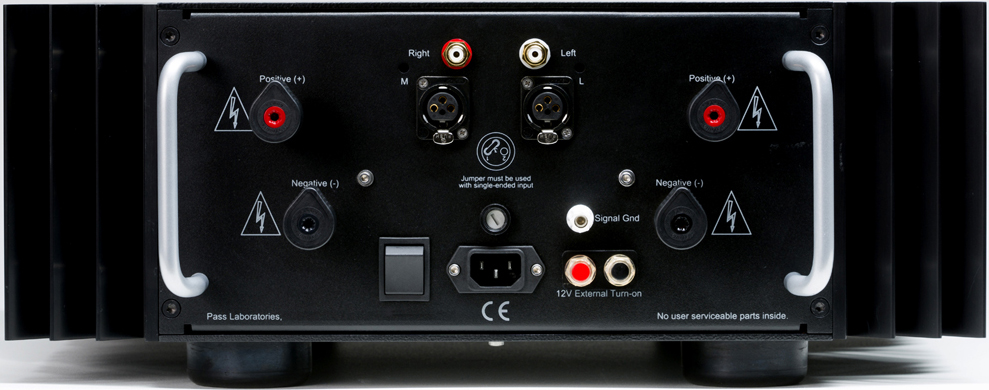
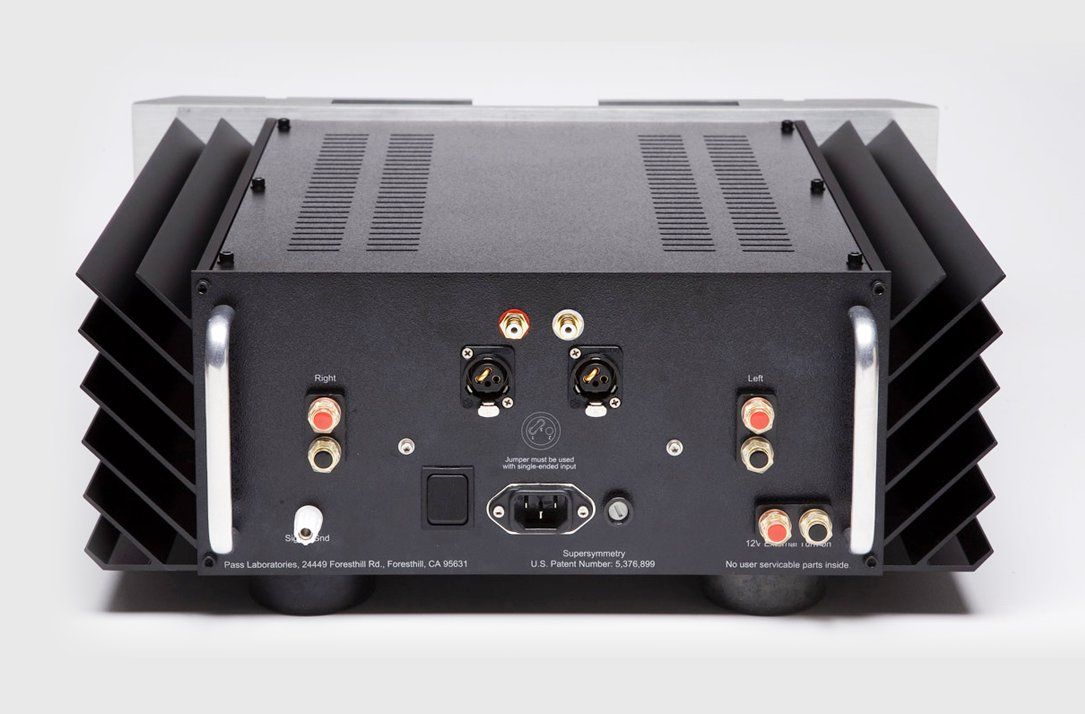
The XA30.5 was very simple to set up and operate. On the rear panel are balanced and unbalanced inputs, a single set of hefty binding posts for speaker cables—the user is warned not to connect either terminal to ground—another set of lugs to bring in a 12V trigger signal if desired, a removable power cord, and an on-off switch. The amp is intended to be left on at all times, and switched between its Standby and Operate modes via a toggle switch just below the meter. I let the XA30.5 burn in for two weeks before doing any listening, then left it on throughout the review period. At least an hour before each listening session, I switched the amp to Operate to let it warm up.
My system was pretty stable during the XA30.5’s tenure here. I used two turntable-tonearm combos: the VPI HR-X, and a Spiral Groove SG-2 with a Triplanar arm, each fitted with either a Grado Statement Reference or Lyra Titan i cartridge. Digital signals were supplied by a Primare CD31 CD player, and the electronics consisted of a Sutherland PhD phono stage feeding either a Sutherland Direct or Placette Active line stage. The Pass drove two sets of speakers, the Sonics by Joachim Gerhard Allegras and my Wilson Audio Sophia 2s. After experimenting a bit, I settled on Nordost Valhalla interconnects and speaker cables as the best match for an XA30.5-powered system. The amp was plugged directly into the wall; everything else was fed juice from the new Audience AdeptResponse T power conditioner via Audience PowerChord e AC cords.
All of the true class-A amplifiers I’ve had in my system have shared a few characteristics that I can now tick off on my fingers: a smooth, distortion-free purity to the sound that is most obvious across a gorgeous midrange; tonal balances that are often a bit dark, due to a softened and truncated high end; bass reproduction that typically lacks a bit of punch and extension; slightly softened dynamics; and soundstages that are deep but recessed, particularly at the center. The mix and extent of these characteristics have varied from amp to amp, but all have always been present to some degree.
The XA30.5 had the lifelike smoothness and purity in spades. It’s easy, on a steady diet of recorded music, to “listen around” too-common distortions. We turn the volume down a bit to tame a bit of harshness in closely miked trumpets or a steeliness in crescendos of massed violins, and learn to accept a forceful but indistinct impact when a bass drum is first struck. The absence of these insidious distortions is one reason that live music is so immediately and obviously different from recordings. But within the first few seconds of listening with the XA30.5 in the system, it was clear that these distortions had been dramatically reduced. There was a natural ease to the sound, and a level of inner detail that hadn’t been distinguishable before.
One evening, Dave Grusin’s album of Glenn Miller classics, In the Digital Mood (CD, GRP Digital Master, GRP-A-1002), provided a few great examples of these differences. Before installing the XA30.5 in my system, the sound of this album had been dynamic, with a bright, sunny feel. The orchestra had sounded tight and well paced, with a foot-tapping kind of drive. Installing the Pass changed this feel to one of effortlessly smooth swing. It was as if the band members had relaxed, lowered their shoulders, and taken a deep breath. The trumpet crescendos in the halting, expanded runs midway through “In the Mood” sounded less forced through the Pass, and a slight glare was now gone, leaving the images of individual instruments more distinct and harmonically more rich. The musicians gained body and depth, and there was a sense of the spaces between them. I could picture the individual musicians and imagine the air moving through each instrument. Whenever I replaced the Pass with a different amplifier, the images flattened and the slight glare returned. Although these differences were subtle, I was surprised at how badly the glare smeared or obscured inner detail during the loudest passages.
The XA30.5 extended this effortless purity and portrayal of inner detail from the midrange out to the frequency extremes. The cymbals on the Grusin disc had a sweet timbre and long, delicate decays. Their crashes seemed a little attenuated, though, so I wondered if the Pass might be softening transients or rolling off the highest frequencies. The drum set on Test CD 2 (Stereophile STPH004-2) is a more natural recording, and showed that the Pass didn’t lack extension. It was just removing a splashy overemphasis from the leading edges of hard transients—such as those cymbal crashes. In fact, the XA30.5 reproduced the initial cymbal stroke well enough that I could easily hear both the initial impact of the drumstick and the bell-like ringing within the transient.
I heard less of this ringing in the cymbals when I switched to other amps, though the differences weren’t huge. With my VTL Ichibans, for example, the cymbals still sounded like cymbals, though with a bit less ring and a bit more dense, metallic hiss. They had a complex timbre and structure, just not as sweet or as focused as they’d been with the Pass, or quite as three-dimensional. Switching from the Pass to other amps also seemed to truncate the cymbals’ decay, preventing me from hearing the last, faintest traces of the shimmer dissolving into the background. Again, however, the differences were subtle.
The Pass did a great job of reproducing harmonic and inner detail on the bottom end as well, although here the XA30.5 did lack a bit of weight and extension in comparison to more powerful amps. Returning to Russ Henry’s drum kit on Test CD 2, the Pass beautifully captured the round, booming nature of the bass drum, but didn’t really convey the sense of a moving pressure wave. In a run down succeedingly larger toms, the Pass gave each drum a distinct location, size, and shape, each described by a clear and unique blend of elastic skin sound and trailing body resonances. The toms had more punch through other amps, and increasingly so as they dropped in pitch, but with neither the precision nor the tonal and textural detail they had through the XA30.5.
The Pass’s effortless, almost lazy feel did lack some of the snap and energy I heard with other amps. Instead of turning the volume down a bit to tame the crescendos, with the Pass I was constantly turning the volume up—partially because there was no glare to tone down, but also in a quest for more impact and drive. Parsing it into audiophile terms, the XA30.5’s macrodynamics—the big swings and huge crescendos—weren’t as large as with my other, far more powerful amps. Where my VTL Ichibans would transition from, say, ppp to ffff, the Pass would go only from ppp to perhaps ff. Don’t get me wrong—the XA30.5 had dynamic range, just not as much as my larger, pricier, class-AB goliaths.
To be fair, I was running the XA30.5 well out of its comfort zone. Nelson Pass explained to me that the front-panel meter, which indicates the amount of current being drawn from the wall, “should sit somewhere in the middle” and “won’t move if you’re running in class-A.” During most of my listening sessions, the meter would bounce between the middle and, say, the three-quarters point of its range. When I was listening to and for large dynamic swings, the meter would frequently be pegged. This didn’t seem to bother Pass when we discussed it, though he did say, “Hmmm…so you’re pulling a lot of juice.” Well, maybe if I’d gotten those XA200.5 monoblocks…
On the other hand, the XA30.5 beautifully rendered the subtle, microdynamic nuances in more intimate material. With the volume set at a level that seemed correct for the material, my megaton class-AB amps would quickly and cleanly step between ppp and pp, but lost focus and detail at the lowest, pppp, levels. They sounded perfectly fine—until I compared them to the Pass. With the XA30.5 again set to a level appropriate for the material, the difference between ppp and pp was, instead of a step, a continuous spectrum of subtly different levels—even the faintest, barely audible sounds were detailed. The unearthly voices of “Yulunga,” from Dead Can Dance’s Into the Labyrinth (CD, 4AD 45384-2), were exactly that through the Pass: voices rather than sounds. There were now different layers of microdynamic nuance within these voices’ tonal components, which gave them a more natural complexity than I was used to hearing from this track. The balance of these layers would shift as the voice changed pitch or level, thus giving it a slightly different character. It’s difficult to describe what the XA30.5 did in audiophile terms, but the way it reproduced these nuances flipped some internal switch of mine: instead of synthesizer, I was now thinking vocal cords.
Pure class-A amplifiers are often thought of as having a slightly dark tonal balance, but that wasn’t the case with the Pass. Though it definitely wasn’t bright, the XA30.5’s tonality sounded pretty neutral to me. Male and female voices sounded correct, as did orchestral instruments from the cello up to the violin and piccolo. One of the most compelling aspects of the Pass’s performance was how well it re-created both voice and instrument in a solo acoustic performance. One of my favorite examples was Townes Van Zandt’s performance of his “Pancho and Lefty,” on Together at the Bluebird Café, a benefit concert album by Van Zandt, Steve Earle, and Guy Clark (CD, American Originals SDPCD161). Not only were the tonal balances of his voice and guitar spot on, I left my listening room absolutely convinced that I would recognize his guitar—that specific instrument—if I heard it somewhere else. Another, similar combination that the Pass handled uncannily well was Diana Krall’s voice and piano on her debut album, Stepping Out (CD, Justin Time 50). Both seemed exactly right, alone and mixed in a common acoustic space, and sounded consistently so across very wide ranges in pitch and level.
One characteristic that I have observed in a lot of class-A amps is a distinctive spatial presentation that can be grossly described as being deeper and wider, slightly more recessed in the center, and filled with smaller-than-normal images. This definitely did not describe the XA30.5’s soundstage—it was both wide and deep, with excellent resolution to the outer edges in both dimensions. If anything, there was an occasional tendency for soloists at center stage to be a bit more forward than with other amps, though in all cases, images were correctly sized.
With simple recordings made in real acoustic spaces, the distances and perspectives all seemed correct. While listening to one of my favorite opera recordings, soprano Mady Mesplé’s performance in Delibes’ Lakmé, with conductor Alain Lombard and the Paris Opéra Comique (LP, Seraphim SIC-6082), I noted how well all the pieces were tied together. I could place myself in the audience, in the hall; the characters were the right size, and moving around on a stage that was consistent with both their size and my vantage point. Even the orchestra pit was sized and placed correctly, without any spotlighting or segregation of soloists. The Pass’s spatial performance was just as impressive with studio tricks. The barking dog at the beginning of “The Ballad of Bill Hubbard,” from Roger Waters’ Amused to Death (CD, Columbia 468761), wasn’t next door, it was in the next county—and the infamous breaking glass in “Private Investigations,” from Dire Straits’ Love Over Gold (CD, Warner Bros. 47772-2), was not just across the street but at the far end of the alley.
Summing up
The Pass Labs XA30.5 is the latest in a long line of brilliant designs from Nelson Pass. Its innovative circuit combines the best attributes of single-ended and push-pull architectures while sidestepping their respective weaknesses. It’s a pure class-A amplifier with the power to drive insensitive loudspeakers while avoiding most of the stereotypical weaknesses associated with class-A operation. The design is a simple, three-stage configuration, but the elements that permit that simplicity to be practically realized are the subjects of multiple patents.
Most of all, the XA30.5 is a superb-sounding amplifier. I absolutely loved listening to music through it, album after album and night after night. It’s simple to operate, nice to look at, and extremely well built. It will almost certainly extend the bulletproof reliability I experienced over the short term to a lifetime of use, and add to the stellar reputation that previous Threshold and Pass Labs components have established. Plus, in today’s high-end audio world, the XA30.5 is a steal. Compared to what else is out there, a price of $5500 is low for an amplifier of this quality. No, I probably wouldn’t buy one, but only because I think that a larger, more expensive Pass Labs model would work better in my system. Absolutely, positively, and enthusiastically recommended!
The XA.5 series of power amplifiers, released in late 2008, represents Pass Labs’ new flagship line of power amplification. The common denominator is pure Class A operation. Significant enhancements are said to have been implemented, including a cascode JFET symmetric front end, single-ended Class A bias at low wattage, improved push-pull bias circuits and output stage topology, more MOSFET output devices, bigger power supplies and better circuit layout. The Super-Symmetry circuit, the star of the X series has been retained, and the cosmetics are similar. I have to admit that the metered fascia of the XA30.5 gives me a reassuring impression of strength and elegance. But it can’t entirely hide a bevy of heat sinks which run toasty warm (around 50 degrees C) as the amp dissipates about 225 watts.
Technical Details
At 30 wpc (into 8 Ohm) the XA30.5 is officially the baby in the XA.5 lineup which culminates with the XA200.5 monoblocks. Yet, it’s my impression that papa Nelson is proudest of the little guy. And I suspect such feelings are based on subjective performance rather than measurements. Since both of us have access to high-efficiency speakers, power is not an issue. As an advocate of the First Watt concept, Nelson probably discovered that the XA30.5 delivers the best sounding first watt in the lineup. The first watt is king. It sets the stage, so who cares about the other zillion watts if they’re no better than the first. The trick here is coaxing the first watt in single-ended mode. The push-pull output stage consists of n-channel MOSFETs (positive going push side) and p-channel MOSFETs (negative going pull side). According to Nelson, the n-channel is biased at a higher level than the p, so that at very low power levels the output is effectively that of the n-channel functioning in single-ended mode. At higher levels, both n and p devices contribute to the output as a push-pull pair. Lower power also means less output devices, a positive in my book. And I imagine that the Super-Symmetry circuit Pass Labs is so proud of is most proficient in eliminating noise products when the number of output devices is minimized.
But this amp is far from being a wimp. It can generate almost 60 watts peak in pure class A and is capable of being driven hard well beyond 100 watts peak as it shifts into Class AB operation. As there are so many loudspeakers on the market with impedance minima around 3 to 4 Ohm, it’s good to know that the XA30.5 doubles its power output into a 4 Ohm load; 60 wpc of pure Class A is substantial. There was a time when 15 wpc was considered ideal for domestic use. Of course, that was before the advent of inefficient bookshelf speakers in the mid 1950s. So exactly what sort of loudspeaker sensitivity would the XA30.5 be comfortable with? For various reasons this review had an unusually long gestation period. The positive aspect of that was the additional time to experiment with a variety of speaker loads.
 The XA30.5 loved my BassZilla Platinum Edition Mk2 DIY speakers. The BassZilla’s in-room sensitivity of about 97 dB makes 30 wpc into 8 Ohm look like a colossal power reserve. It was also evident at the other sensitivity extreme that the Analysis Audio Omega planar/ribbon speaker at a sensitivity of 86dB/W/m is probably already a tad below a reasonable lower threshold. The Omega is known to be a current hog, and while the playback of baroque music did not present any particular problem, there were occasions with more dynamic source material when I wished for more headroom. On the other hand, the Reference 3A Episode, rated at 91dB/W/m, was more than satisfied by the XA30.5 in my medium-sized listening room. My guidance is to stick with a speaker sensitivity of at least 89 dB in order to maintain sufficient headroom.
A couple more details. You’ll note an AC power switch on the back plate and a switch on the front plate that toggles the amp from Standby mode to Operate mode. The intent is to leave the amp powered in Standby mode while not in use. For best sound, it needs to warm up until the heat sink temperatures are hot to the touch and that may take about an hour. It’s surprising how much more sweetly this amp sings when it’s fully cooking at between 50 and 55 degrees C.
Sonic Impressions
Some 1970s designers, most notably Jim Bongiorno, have shunned MOSFETs and stuck with bipolar output devices over the years. Bongiorno’s Dynaco Stereo 400 was quite a beast in its day, and I’ve come to associate its androgenic character with that of muscle amps. It sonics were drenched in testosterone, a bit gruff and grainy, it sounded like it hadn’t shaved in a couple of days. Yet it could kick butt while early MOSFET designs were softer and gentler lacking fire in their belly. It may be strictly a male thing, but BNP (before Nelson Pass) my feeling was that MOSFETs were too wimpy to be taken seriously – too much yin and not enough yang. Thank you Nelson for molding the MOSFET into a Samurai-like weapon with the ability to cut through the old paradigms of solid-state amplification. The XA30.5 offers a precise blend of power and harmonic purity – a balance of male and female attributes that I find most consonant with the needs of the music.
Let me spell it out: this is not the sort of amplifier to impose a particular personality over the soundstage; it maintains a neutral balance. Yet is reveals itself as being in the room Zen-like – by the things it does not do. It does not limit bandwidth, obscure detail, veil the soundstage, or mellow harmonic textures. It’s possible to change the subjective balance by simply limiting an amplifier’s bandwidth. Transformer-coupled single-ended triode amps are very good at that. With a power bandwidth of maybe 20 kHz, harmonic textures turn soft and liquid, and the tonal center of gravity is shifted toward the midrange. Instead, the XA30.5 dazzled with its transient speed – a function of its wide bandwidth and excellent slew rate. A high damping factor was responsible for marvelous bass control. And the soundstage remained transparent and cohesive.
Transparency, the ability to “see” the inner recesses of the soundstage is a very good thing, but just as important and much more difficult to pull off is cohesiveness. Pulling the left, right and center regions of the soundstage into a convincing organic whole is something few amps can do well. The XA30.5 was able to convincingly “connect the dots” thus joining a select company. However, image outlines were not as palpable as with the Audio Space Reference 3.1 (300B) integrated power amplifier which is quite a magical amplifier in its own right. Fully fleshed out image outlines seems to be a tube phenomenon. Tube based power amps are better at this than solid-state designs and the explanation may well lie with inherent differences in distortion spectra. I would be fine accepting tube distortion as the perceptual mechanism for a more spatial delineation of the soundstage. What matters to me the most is reproducing the most convincing illusion of the real thing, and in this case the means justify the end. To paraphrase the late Jason Bloom of Apogee Acoustics fame, I don’t care if the amplifying devices are even made of Swiss cheese!
For me, in addition to tonal weight, major realism triggers are timbre accuracy, textural purity, low distortion and unbridled musical drama. The Pass amp scored high in each of these categories. Distortion products were kept in check even when it was driven hard. There was no grit, grain, or electronic glaze to interfere with the ebb and flow of harmonic textures. Microdynamics together with pitch and rhythmic inflections constitute the music’s emotional foundation. J Gordon Holt’s famous goose bump test was about being startled by nuances, dramatic tension bubbling beneath the surface. It was not about mindless audiophile delights such as being able to reproduce the 1812 Overture’s cannon shots at gut shaking volume levels. With the Pass amp the magic was in the whispers.
Conclusion
I’m basically a tube guy but try to stay amplification agnostic, keeping an open mind about what sounds best in a particular application. The Pass Labs XA30.5 won me over in several system contexts and I plan to continue enjoying it for years to come. It’s one of only a handful of solid-state amps with musical heart and soul. A mandatory audition for anyone shopping around for an amplifier under $10,000.
Related products
-
Audio Research Reference 210 Monoblocks
Original price was: R380,000.00.R108,000.00Current price is: R108,000.00. Add to cart -
Perreaux 750p Mono blocks – NEW
R180,000.00 Add to cart -
Valve Audio Predator Integrated Amplifier
Original price was: R78,000.00.R42,000.00Current price is: R42,000.00. Add to cart -
Cary Audio CAD280SA V12 Power Amplifier
Original price was: R120,000.00.R64,000.00Current price is: R64,000.00. Add to cart