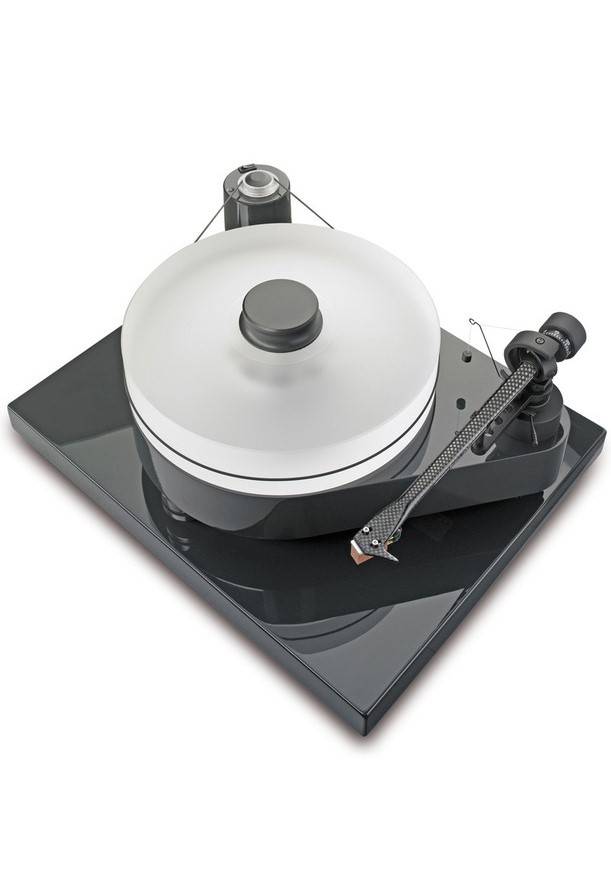
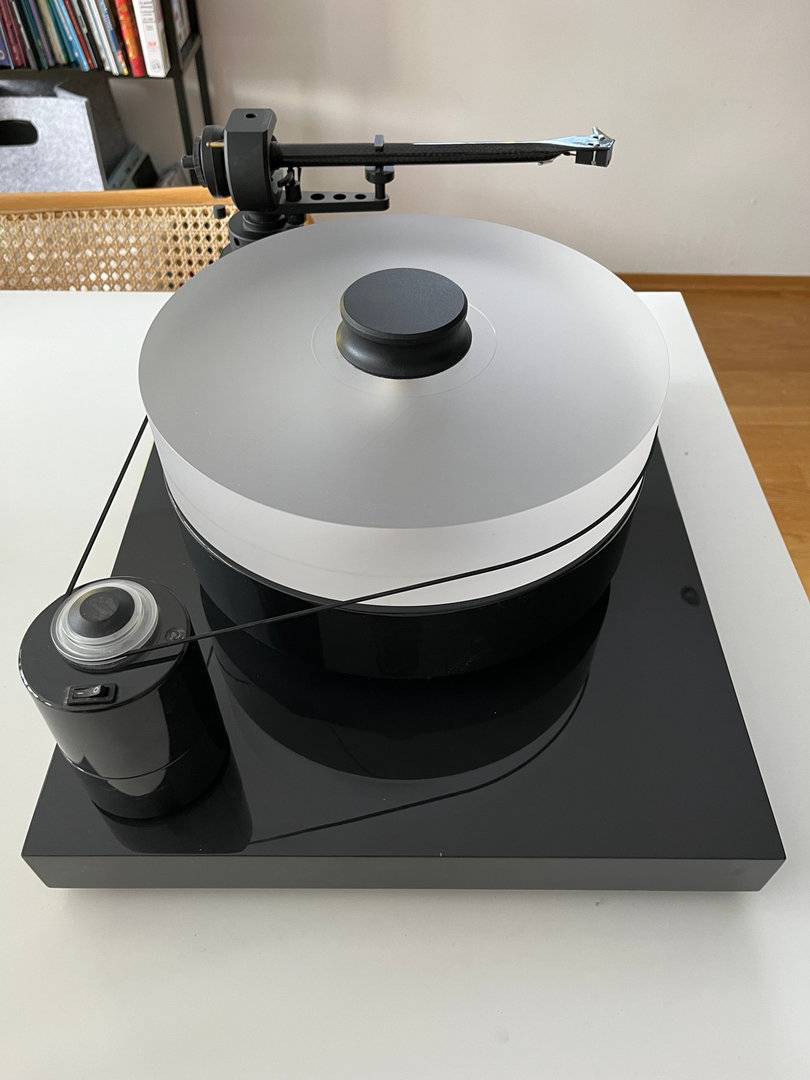
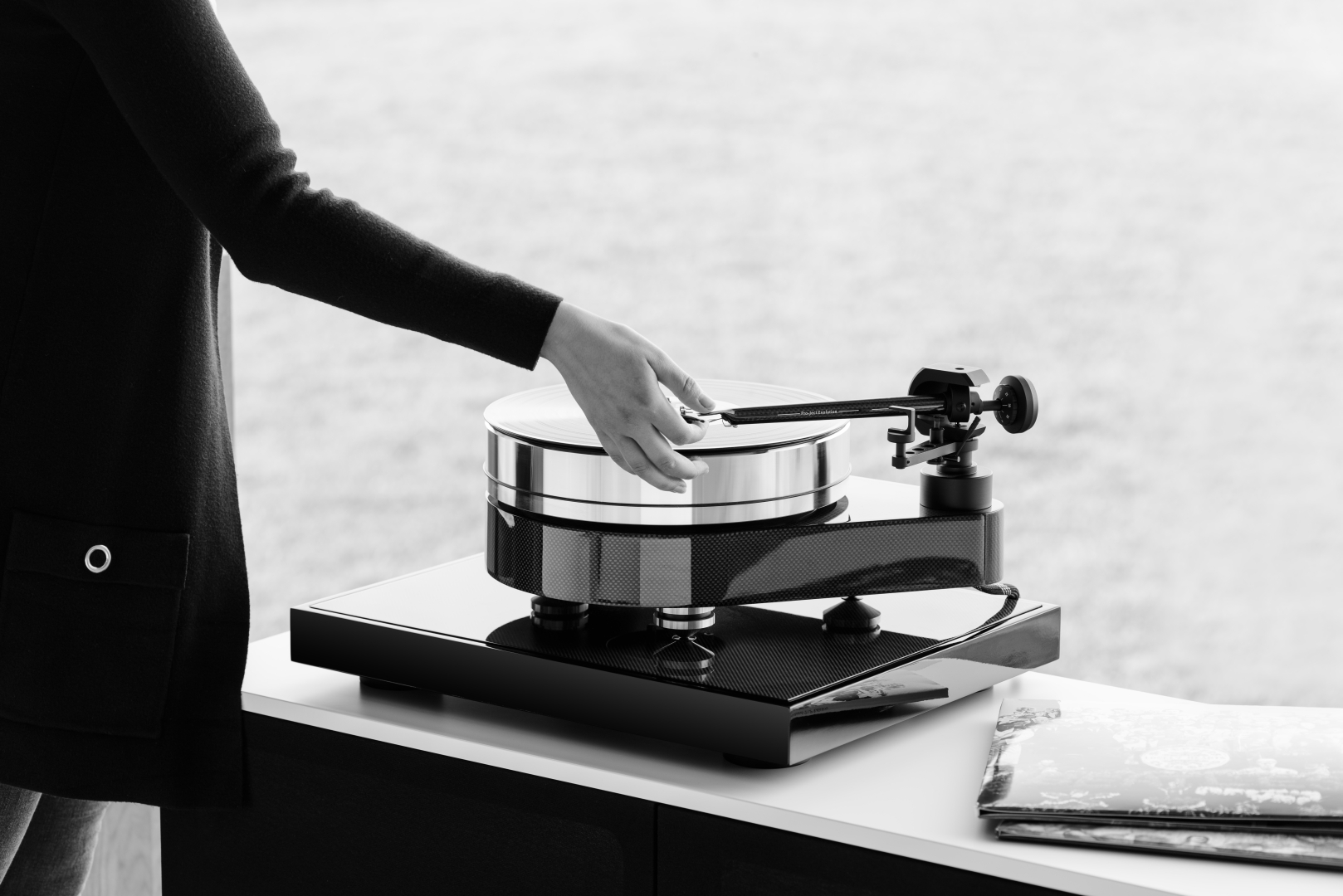



Pro-Ject’s founder Heinz Lichtenegger is no longer satisfied with just cornering the budget market, he’s now set his sites on the turntable high end and his latest weapon, the RPM10.1, is a substantial and shiny beast.
Heinz is a classical music lover and this turntable directly addresses one of the key issues with such music on vinyl: trackability. The RPM10.1 comes with not one, but four alternative counterweights, which are supplied so that the arm/cartridge resonance can be kept totally under control in order that the system can track anything you throw at it.
Pro-Ject has also produced a test disc and by combining the two you can establish which counterweight gives the best tracking and thus the least distortion.
The canon in Tchaikovsky’s 1812 Overture requires the highest stylus acceleration on record at 90μm – a rate with which most moving coils struggle to cope, yet Pro-Ject’s engineers have managed to get an MC to track its test disc at 100μm.

Lichtenegger is quick to point out, though, that there is more to a great turntable and arm combination than theoretical tracking ability. He appreciates that setting up turntables well requires more than a test disc, but is clearly aiming to bring a little bit of science into the process.
The RPM10.1 is a revision of the RPM10, but quite a significant one. There are two key differences: one in the base, or Ground It Deluxe 3 (which is the rectangular slab that supports everything) and the other in the tonearm.
The Ground It incorporates magnetic decoupling through its four adjustable feet and provides a literal physical ground on account of its 13.4 kilogram mass. The 10cc version of the Evolution arm has had a lot of attention applied to controlling resonance and Pro-Ject has used more carbon fibre in a tighter weave than the previous incarnation. It has also incorporated Sorbothane damping in the four counterweights, each of which covers a range of cartridge weights ie: 4-6g, 5-8g etc, but there is some overlap between them.
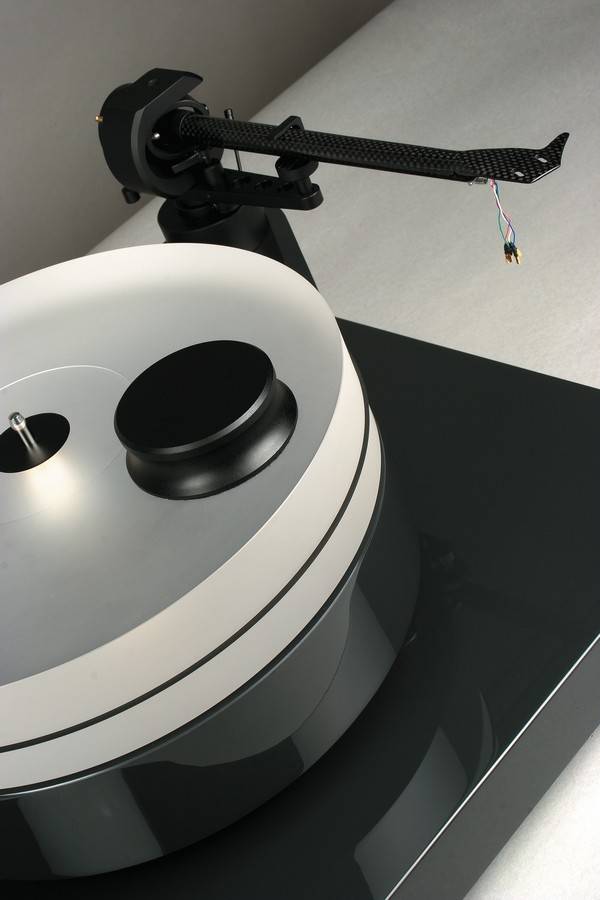
In other respects this 10-inch arm is made of a single piece of carbon fibre with a conical shape, in order to combat standing waves. The bearing is an inverted type that uses ABEC7 ball races in a substantial ring-shaped housing for maximum rigidity.

You can adjust armbase height in order to vary VTA and the armtube can be rotated so that azimuth can be changed. As with most Pro-Ject tonearms, the arm wiring is terminated in a pair of RCA phono sockets, so that alternative cables can be used to connect with the amplifier.
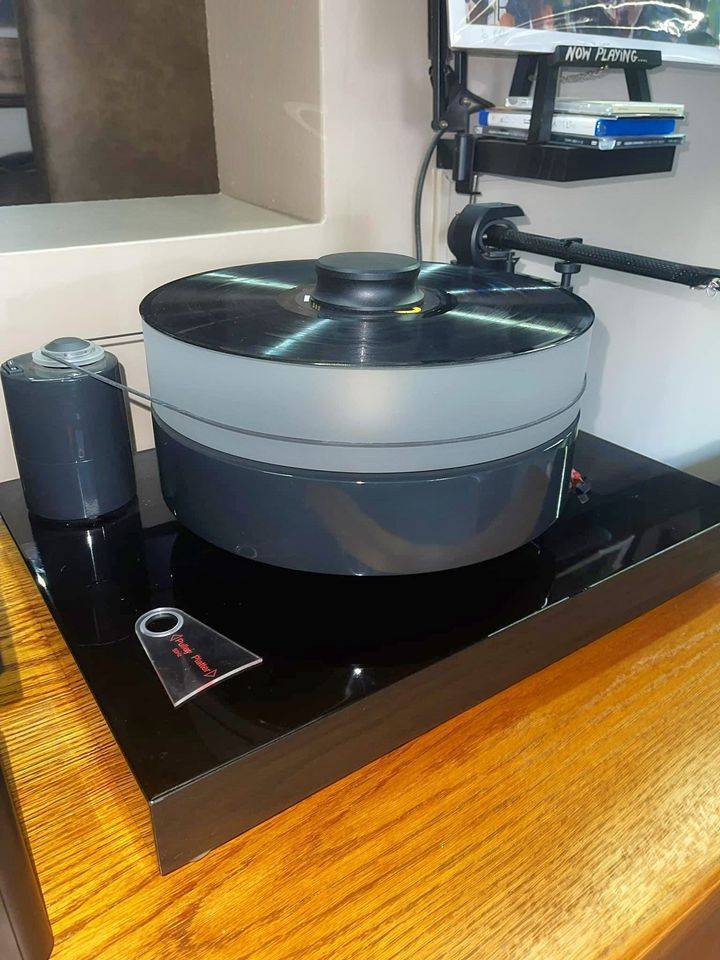
The rest of the RPM10.1 is hardly less substantial than the Ground It, the plinth is made of 63mm-thick MDF, with the same dark-grey gloss finish as the base. It sits on three sorbothane-damped aluminium cones and incorporates the armbase and a magnetically supporting inverted bearing for the platter.
This part is 60mm-thick and made of acrylic, but is described as ‘a sandwich construction’ which seems odd as it’s clearly one-piece, albeit one five-kilo-plus piece that’s topped off by a brass record puck.
The motor is effectively freestanding and sits atop a piece of metal of the same diameter and finish. Pro-Ject supplies a spacer device so that it can be placed the correct distance from the platter and connected by a thin square-section rubber belt.
On/off switching is atop the motor and speed-change a case of switching pulleys.
Every picture…
The pictures do not lie: this is a superbly finished turntable with plenty of attention to detail and the tonearm is particularly inspiring, thanks to the chunky bearing housing, although the thread and weight anti-skate system seems a shade old-school these days.

There’s no doubt that Pro-Ject offers excellent value for money in its turntables and this is just as apparent here, as it is with its budget models. Next to the Well Tempered Simplex, it looks twice the price, but as we know great record players are about more than scale and finish.
Our current favourite in this price range is the Michell Gyro SE, which is equally impressive for the level of sheer engineering it delivers. But high-mass designs are always more expensive than conventional ones.
This price sector is becoming one of the most hotly contested, with a number of established designs being available with and without a tonearm. From the Gyro SE (£1,450) including a TecnoArm to the Townshend Rock 7 sans arm and Well Tempered’s relative newcomer the £1,495 Simplex with its damped golf-ball arm bearing. The latter two have a technological advantage, while the Gyro SE is a well executed suspended design at a great price.
The RPM10.1 on the other hand offers good isolation, thanks to its Ground It base and combines a truly evolved tonearm with a range of counterweights that offer a real advantage in resonance control.
Feel the quality
All that mass in the platter confers a certain stability to the sound of this turntable; we fitted a van den Hul Frog LO moving coil into its carbon-fibre arm and used the supplied interconnects to connect it with a Trichord Dino+ phono stage and got a smile-inducing result.
Tom Waits picked a very fine band for the album Swordfishtrombones and this turntable certainly brings out the quality of the recording, with plenty of acoustic around the percussion and double bass.
The tiny fingerlift is a bit tricky to drop into inner grooves, but the lift/lower device can be used for this purpose, while the arm is notably microphonic when you move and dock it in the clamp. This is not a problem while playing, however, and where resonances are higher, this is not necessarily a bad sign.
There is very little sense of the ‘halo effect’ that can challenge acrylic platters because of the deck’s mass and clamp and while it’s not the most luxurious-sounding turntable around, it’s pretty damn smooth – capable of delivering weighty, tuneful bass which helps to create good image depth. In fact, the bass can be sumptuous when the record delivers the goods.
Rickie Lee Jones’ Flying Cowboys does it with a chewy bass guitar beneath and a crisp high-hat up top, while another track reveals superb string tone above a beautifully timed bottom end. This is a classy turntable no doubt about it.
We investigated the benefits of the Ground It base by using the turntable both with and without a Custom Design stand. It certainly proved its worth by allowing the RPM10.1 to deliver a considerably more open sound that lifts and separates in true ‘cross your heart’ style. The bass gets a lot more room to breathe in and you can hear distinctly more fine detail across the range.
It’s a contender
With its comprehensive approach to cartridge set-up and the efforts put into keeping resonance at bay with the Ground It base, this Pro-Ject is clearly a sophisticated beast. A state of affairs that’s reflected in a resolute and engaging sound.
Whether it would better our recent Blind-listening Group Test winner, the Michell Gyro SE, is hard to tell. It doesn’t have the pace of a Well Tempered or the solidity of the Rock 7, but it does have a certain finesse and calm resolution that is very enticing.
At the top end of Pro-Ject’s increasingly-serious RPM range, this imposing player betters its predecessors by exploiting high-mass design, at not too high a price

Bigger and fatter even than the RPM 9, which it otherwise resembles, the RPM 10.1 Evolution updates on the earlier RPM 10 with a better arm and other refinements. But the choice of materials is as important as the quantities of them. Pro-Ject’s Austrian founder and owner has been experimenting with different materials since the inception of the company 20 years ago. It was in February 1990 that Heinz Lichtenegger first drove over the border to visit the Czech factory which has continued to build turntables for Pro-Ject ever since. The earliest Pro-Ject budget models were based on the factory’s existing designs and parts, including a simple pressed-steel platter.
PLATTERS MATTER
The chassis sits on three adjustable coned feet, resting in special cups set into the face of the Ground It platform, which is made of medite with a ‘granulate’ mineral filling. In its latest version, called Ground It 3 Deluxe, this in turn floats on four
level-adjustable magnetic-repulsion feet. On top of all this you now get Pro-Ject’s priciest 10in arm, the 10cc Evolution, essentially an even more rigid and better-damped version of the 10cc model. In this case, the arm does not come with the usual cable and phono plugs, but is hard-wired to the turntable. The signal wires passing down through the arm pillar are soldered to the backs of the phono socket connectors, which can be seen looking out from a small metal housing below the plinth. Having balanced out the arm and set the loose marker disc to zero, you wind the weight forward further to dial the desired tracking force. I found the calibration accurate but felt the counterweight threading too loose for comfort, a bit too easily disturbed in handling.
TALL TALES
I found that Pro-ject’s record weight does help the solidity and precision of the bass, and makes the whole sound a little tidier. On some recordings you seemed to lose a little air and liveliness but I felt that the slightly looser, splashier weightless sound was less accurate. Serious listening started with the Ortofon Cadenza Blue, running via the excellent Moon LP5.3 phono stage [see HFN April ’10]. Immediately, Action: Oscar Peterson Vol 1 [MPS 68.073] seemed to reveal the key virtues of the turntable. Peterson and the trio kick off ‘At Long Last Love’ with an exuberance that’s audibly busting out all over before settling gracefully into the acoustic of the venue, but even here, where many systems become clangorously bright, the sound was smooth and never raucous. With the wild guitars of Eric Clapton’s ‘Motherless Children’ from 461 Ocean Boulevard [RSO 2479 118], there was even a slight feeling that the guitars weren’t quite wild enough, that the lid was being kept on. Carl Radle’s bass line was clearly portrayed, and yet the rhythm seemed almost sedate, rather than the headlong and exciting rush that it can be. The Pro-ject seemed happy to move on to the next track, ‘Give Me Strength’, where it shone, illuminating Clapton’s guitars and vocal with precision, detail and clarity. There were no complaints about the rhythm on the next album. ‘Sultans Of Swing’ from Dire Straits [Vertigo 9102 021] showed that the Pro-Ject could give both clarity and control, as Knopfler’s lead guitar had real power and magic, while his vocal enjoyed character and depth. At the same time, the tight and mobile rhythm was immediately arresting.
EPIC SOUNDS
A quick burst of Harry James and The King James Version [Sheffield Lab LAB 3] confirmed the Pro-Ject’s solid abilities at the bottom end, and its convincing stereo imagery. For example, the way the piano, though very much in the background, still had its own space and ambience. Brass was punchy yet never too fierce and the saxes sounded positively creamy. From the Ortofon I moved on to the Koetsu Black, perhaps a likely and attractive alternative for a deck in this price range. Predictably, perhaps, the Pro-Ject/Koetsu delivered a much more stirring rendition of ‘Motherless Children’ than the Ortofon’s. The slide guitar was loud and brash, a big, tearing sound, while Clapton’s vocal sounded almost majestic. Yet there was a sense of chasing detail that you couldn’t quite catch. Carl Radle’s bass had nothing like the clarity achieved with the Ortofon, but it drove the track along better. On ‘Sultans Of Swing’ the Koetsu again delivered passion, energy and vibrancy at the cost of subtlety, making this studio recording sound as if it was coming from some draughty, highly-electrified stage. It even seemed, subjectively at least, to up the tempo, with a beat that pushed ahead urgently rather than smoothly rolling on. With the Koetsu on ‘Easy Money’, it seemed the Pro-ject was doing its best to control the cartridge’s big bass sound, but it couldn’t avoid a somewhat overblown and even clumsy effect. This cartridge gave a breathier, more dramatic presentation of Rickie Lee’s vocal, while higher-pitched instruments like the celeste on this track became more prominent and tinkly. Few buyers of a £2000 turntable will stay with moving-magnet cartridges, but I was curious to see how the Pro-Ject would handle one of the best of the breed. With the Roksan Corus Black installed I went back to ‘Easy Money’, finding the bass well-controlled, even if it couldn’t match the firm clarity of the Cadenza Blue or the grunt of the Koetsu Black. Mid and treble were well detailed and nicely balanced, with stable stereo imagery. On ‘Sultans Of Swing’, the Corus Black sounded very good indeed, with fine detail in the percussion and great rhythm. I felt that this was an excellent result for a moving-magnet cartridge. And it surely proved that the Pro-Ject 10.1 Evolution must be doing something right. Probably most things!
VERDICT
Weighty but well-priced, this player vindicates Pro-Ject’s work on plinth materials, but what really makes it work so well is the high-grade 10cc Evolution arm. There is clean, deep bass quality that allows the rhythmic drive of the music to come through, solid but not heavy-footed. Giving an uncoloured and open midrange with fine imaging, this is a well balanced, vice-free package, and very good value.
Sound Quality: 80%
Thanks to good dynamics and timing, not to mention excellent separation of detail – it needs to be auditioned.