RME ADI-2 DAC FS Digital-to-Analog Converter
Original price was: R52,000.00.R28,000.00Current price is: R28,000.00.
RME’s anniversary reference AD/DA converter is:
- A high-end AD/DA converter in professional studio quality
- A double headphone amplifier in true high-end quality
- A USB DAC like no other – the most versatile and capable one
- A high-end AD/DA frontend and headphone amp for iPad / iPhone
- A multi-format converter (AES, SPDIF, ADAT) with monitoring function
- A DSD record and playback solution
- An AD/DA frontend for audio measurement at up to 768 kHz sample rate
Ultra-fidelity PCM/DSD 768 kHz AD/DA Converter
As the most flexible converter available, the ADI-2 Pro offers balanced/unbalanced analog I/Os, double Extreme Power headphone outputs, SteadyClock III, 4-stage hardware input and output level control, DSP-based signal processing, external power supply operation, Class Compliant USB compatibility, sample rates up to 768 kHz as well as DSD record and Direct DSD playback (256 / 11.2 MHz).
Analog or Digital – Options Galore
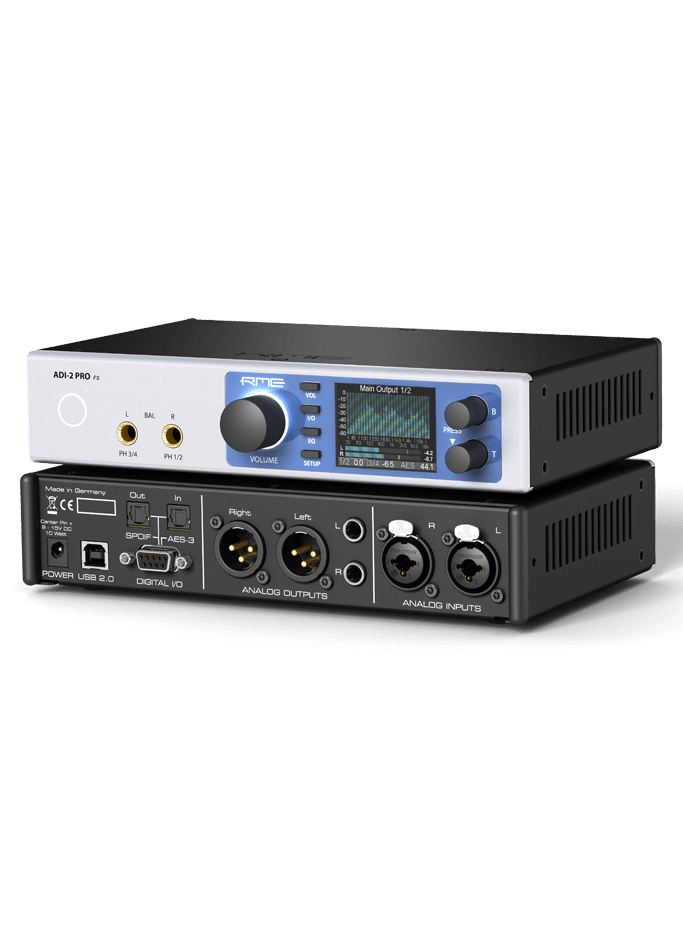
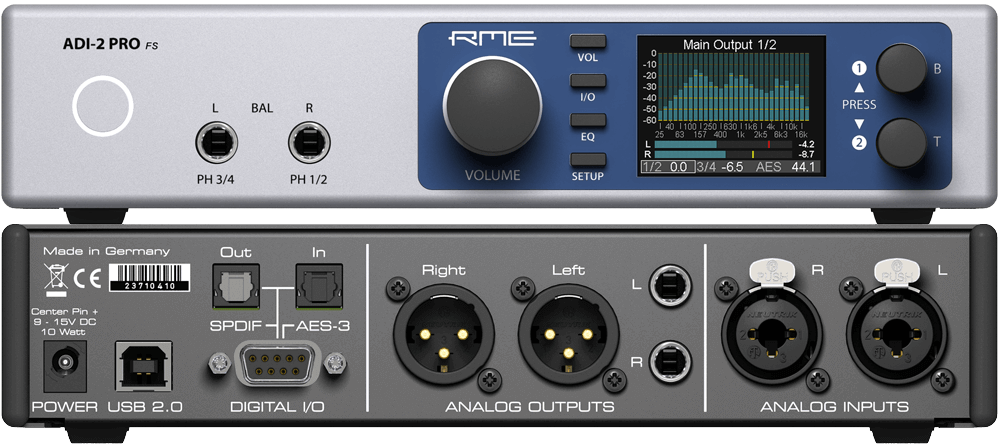
The ADI-2 Pro includes two servo-balanced analog inputs on combo XLR / TRS jacks, two separate balanced and unbalanced outputs on XLR and TS, two stereo Extreme Power headphone outputs on the front, an optical SPDIF I/O that also understands ADAT, and coaxial SPDIF (RCA) and AES I/O (XLR) via an included breakout cable. This universal set of I/O options offers superior quality and flexible connectivity to those who take a no-compromise approach to audio.
The USB 2.0 port is fully Class Compliant (UAC 2) for connection with compatible iOS devices, and is also used for firmware updates. Including an external switched power supply with lockable connector, the ADI-2 Pro can be easily powered from battery, opening up mobile applications as well as galvanically isolated use cases.
As a computer interface the ADI-2 Pro offers a stereo (2 in / 2 out) and a multichannel mode (6 in / 8 out). Compatibility with Mac OS X comes right out of the box. Under Windows the ADI-2 Pro uses RME’s MADIface series driver, for full WDM and ASIO compatibility and highest performance.
Perfect Sound Capture and Reproduction
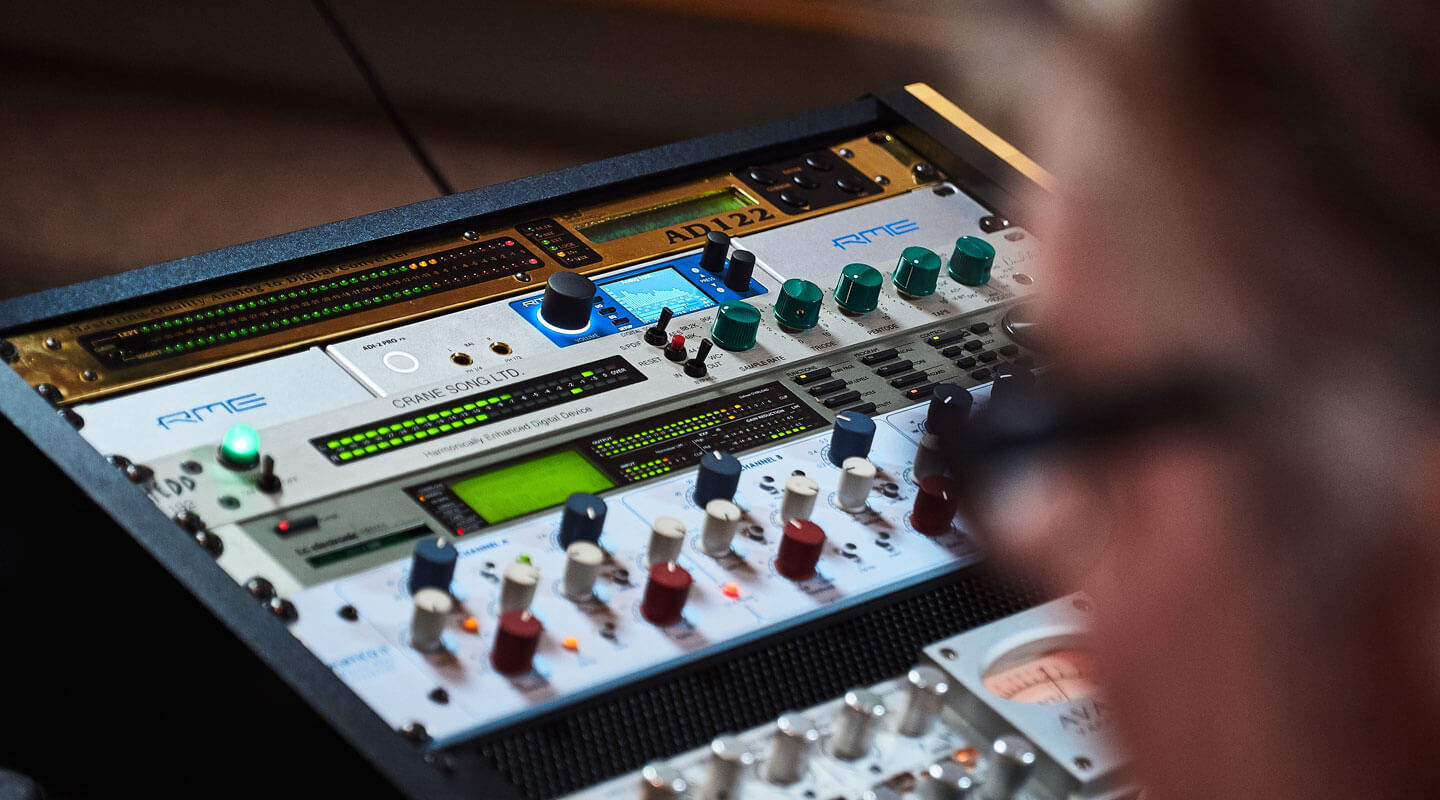
Aiming for the absolute reference sound, any detail in the ADI-2 Pro is special and has its own story. The main PCB is an extraordinary 10 layer design with custom copper thickness, guaranteeing finest undisturbed sound as well as ample but separated power for the phones outputs. Internal power supply stages and precise regulators use a super-low-noise design to not degrade performance through the power rails. Selected SoundPlus operational amplifiers maintain highest SNR, lowest THD and high slew rate under all conditions. The whole analog circuit design is fully symmetrical and balanced throughout – and DC-coupled. The only capacitors in the signal path perform DC protection at the analog input sockets, and have been carefully selected to avoid any sonic impact.
The 4-channel AD-converter, supporting 786 kHz sample rate and DSD recording, is used in a dual mono design, with 3 dB improved signal to noise ratio. Two premium DACs are used for two separate stereo outputs. Internal audio processing like EQs, Crossfeed and spectral analysis, is done by a high performance DSP with 2.17 Giga FLOPS (2882 MIPS), delivering enough computing power to work even at 768 kHz sample rate.
For easy operation a high quality Sample Rate Converter has been added, switchable to the AES or SPDIF input, solving any clocking problem between those. And RME’s latest SteadyClock III technology ensures perfect jitter reduction and stable clocking, no matter if internal or external clocks are used.
High Resolution Display Operation
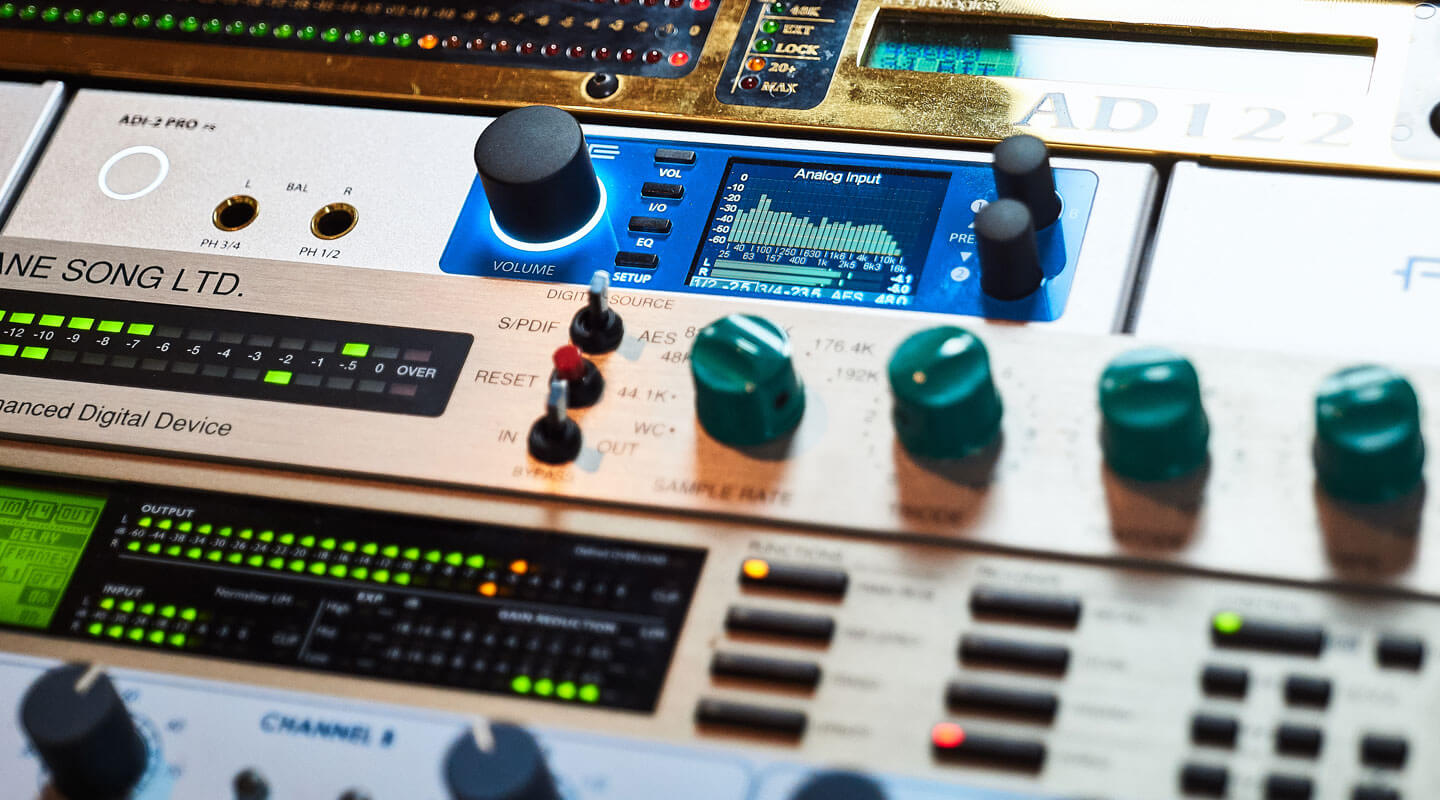
RME have incorporated many unique features, not found on any comparable devices, like 5-band parametric EQs for fully individual phones compensation, adjustable Bass/Treble controls with quick access, a binaural crossfeed function, adjustable loudness filter, selectable AD/DA filters, four discrete I/O reference levels, auto reference level setting, auto balanced phones mode, and many more. The display is not only used to control the unit, but also shows warning and guidance messages.
Professional features such as M/S Processing, stereo width and phase reversal up to full control and storage of all settings are included, as well as RME’s famous Spectral Analyzer, a 30-band biquad filtered analysis tool offering unprecedented musical visualization, perfectly complementing the high-resolution IPS display.
Extreme Power Headphone Outputs
There is no use in boasting about -110 dB THD, when such values are not available in real world operation – for example when a 32 ohm headphone is connected. RME’s engineers therefore designed a new headphone output stage that brings the full performance of the premium DAC to the phone jack – even when using low impedance headphones. The Extreme Power design excels with 0.1 Ohm output impedance, a maximum output level of +22 dBu, and a maximum output power of 1.5 Watts – per channel! The two, fully separated stereo headphone outputs deliver the same 120 dBA SNR performance as the line outputs, for a full hum and noise free listening experience. THD is far below -100 dB (0.001%) even at full power, for the most clear and detailed soundstage possible. The Extreme Power design also incorporates current limiting, power surveillance, overload detection and DC protection. A low power mode and a high power mode are provided, for a perfect match from IEM up to planar.
Having two stereo outputs, balanced headphone operation is possible. As RME’s engineers were not satisfied with the existing techniques they developed a new Advanced Balanced mode for the ADI-2 Pro, that removes most limitations of standard balanced operation, and turns this mode into a a fully new experience. The exclusive Advanced Balanced mode delivers a balanced signal path from the DAC straight to the phone, with 3 dB gain in Signal to Noise Ratio, smoothed out deviations in components, optimized frequency response, super low output impedance (0.2 Ohms), and a maximum output level of +28 (twenty eight) dBu.
The Anniversary Converter
The ADI-2 Pro is RME’s reference AD/DA converter, USB DAC, USB interface and headphone amp. It’s numerous use cases make it an ideal choice in many fields, from the home user appreciating innovative solutions offering highest sound quality, the studio owner asking for reference AD/DA conversion, the Hi-Fi enthusiast demanding a flexible yet high-end headphone amplifier, up to the industry using the portable device as front-end for measurement systems. 20 years of RME – cumulated into a precious unit, that once heard and used one will never give away. Promised.
Femtoseconds for clocking
With the SteadyClock FS, the ADI-2 Pro FS features the latest clock and jitter rejection technology from the recently introduced ADI-2 DAC. Based on a femtosecond clock – a femtosecond is one quadrillionth of a second – SteadyClock FS reduces the intrinsic jitter of the ADI-2 Pro FS to a new all-time low.
Furthermore, the ADI-2 Pro FS also features the AutoDark mode from the ADI-2 DAC. With this, users can deactivate all illuminated elements of the device if necessary – except of the standby button, which in contrast to the ADI-2 DAC, is always illuminated on the ADI-2 Pro FS. In this way, studio users receive permanent feedback about the on/off status of their converter. The lighting is reactivated by pressing any button or turning an encoder.
Bit Test
A bit test is used to check the playback path for unwanted changes in the playback data. Playback software can cut bits, add dither, or change the level – without these changes becoming noticed easily. A poorly programmed driver can manipulate bits, and a playback hardware could be both badly designed and defective (hanging bits, swapped bits). Even such features as proper channel assignment, left/right synchronicity and polarity can be tested by a well-made bit test.
With a bit test, such errors can be detected and – more importantly – excluded.
Specs
ADI-2 Pro FS
Analog Inputs
- XLR
- Input: XLR, servo-balanced Input sensitivity switchable +24 dBu, +19 dBu, +13 dBu, +4 dBu @ 0 dBFS
- Signal to Noise ratio (SNR) @ +13/19/24 dBu: 120.x dB RMS unweighted, 124.x dBA
- Signal to Noise ratio (SNR) @ +4 dBu: 119 dB RMS unweighted, 123 dBA
- Frequency response @ 44.1 kHz, -0.1 dB: 5 Hz – 20.5 kHz
- Frequency response @ 96 kHz, -0.5 dB: 3 Hz – 45.5 kHz
- Frequency response @ 192 kHz, -1 dB: 2 Hz – 92.7 kHz
- Frequency response @ 384 kHz, -1 dB: < 1 Hz – 124 kHz
- Frequency response @ 768 kHz, -3 dB: < 1 Hz – 180 kHz
- THD @ -1 dBFS: -116 dB, 0.00016 %
- THD+N @ -1 dBFS: -112 dB, 0.00025 %
- Channel separation: > 110 dB
TRS
As input XLR, but:
- Input: 6.3 mm TRS jack, servo-balanced, fully compatible to TS and RCA
Analog Outputs
1/2 XLR
- Output level switchable +24 dBu, +19 dBu, +13 dBu, +4 dBu @ 0 dBFS
- Signal to Noise ratio (SNR) @ +13/19/24 dBu: 117 dB RMS unweighted, 120 dBA
- Signal to Noise ratio (SNR) @ +4 dBu: 115 dB RMS unweighted, 118 dBA
- Frequency response @ 44.1 kHz, -0.1 dB: 0 Hz – 20.2 kHz
- Frequency response @ 96 kHz, -0.5 dB: 0 Hz – 44.9 kHz
- Frequency response @ 192 kHz, -1 dB: 0 Hz – 88 kHz
- THD @ -1 dBFS: -112 dB, 0.00025 %
- THD+N @ -1 dBFS: -110 dB, 0.00032 %
- THD @ -3 dBFS: -116 dB, 0.00016 %
- Channel separation: > 110 dB
- Output impedance: 200 Ohm balanced, 100 Ohm unbalanced
1/2 TS (rear)
- As output XLR, but:
- Output: 6.3 mm TS jack, unbalanced
- Maximum output level: +19 dBu
- Signal to Noise ratio (SNR) @ +13/19 dBu: 117 dB RMS unweighted, 120 dBA
- Signal to Noise ratio (SNR) @ +4 dBu: 113 dB RMS unweighted, 117 dBA
- Output impedance: 100 Ohm
Phones 1/2
As Output 1/2 TS, but:
- Output: 6.3 mm TRS jack, unbalanced, stereo
- Output impedance: 0.1 Ohm
- Signal to Noise ratio (SNR) @ +22 dBu: 117 dB RMS unweighted, 120 dBA
- Signal to Noise ratio (SNR) @ +7 dBu: 114 dB RMS unweighted, 118 dBA
- Output level at 0 dBFS, Ref Level +19 dBu, load 100 Ohm or up: +22 dBu (10 V)
- Output level at 0 dBFS, Ref Level +4 dBu, load 8 Ohm or up: +7 dBu (1.73 V)
- THD @ +18 dBu, 32 Ohm load, 1.2 Watt: -110 dB, 0.0003 %
- THD+N @ + 18 dBu, 32 Ohm load: -107 dB, 0.00045 %
- THD @ +14 dBu, 16 Ohm load, 0.94 Watt: -110 dB
Output Phones 3/4
As Output Phones 1/2, but:
- Output levels at 0 dBFS: Hi-Power off +7 dBu, Hi-Power On +22 dBu
Balanced Phones mode
As before, but:
- Output levels at 0 dBFS: Hi-Power off +13 dBu (9.8 V), Hi-Power On +28 dBu (19.5 V)
- Output impedance: 0.2 Ohm
- Signal to Noise ratio (SNR) @ +28 dBu: 120 dB RMS unweighted, 123 dBA
- Signal to Noise ratio (SNR) @ +13 dBu: 118.4 dB RMS unweighted, 122 dBA
- Output level at 0 dBFS, Hi-Power On, load 150 Ohm or up: +28 dBu (19.5 V)
- Output level at 0 dBFS, Hi-Power Off, load 8 Ohm or up: +13 dBu (9.8 V)
- Max power @ 0.001% THD: 2.9 W per channel
Digital Inputs
General
- Lock Range: 28 kHz – 200 kHz
- Jitter suppression: > 50 dB (2.4 kHz)
- AES/EBU
- 1 x XLR, transformer-balanced, galvanically isolated, according to AES3-1992
- SPDIF compatible (IEC 60958)
SPDIF coaxial
- 1 x RCA, transformer-balanced, according to IEC 60958
- AES/EBU compatible (AES3-1992)
SPDIF optical
- 1 x optical, according to IEC 60958
- ADAT compatible
Digital Outputs
AES/EBU
- 1 x XLR, transformer-balanced, galvanically isolated, according to AES3-1992
- Single Wire mode, sample rate 28 kHz up to 200 kHz
SPDIF coaxial
- 1 x RCA, according to IEC 60958
- Single Wire mode, sample rate 28 kHz up to 200 kHz
SPDIF optical
- 1 x optical, according to IEC 60958
- Sample rate 28 kHz up to 200 kHz
Digital
- Clocks: Internal, AES In, SPDIF In, ADAT In
- Jitter suppression of external clocks: > 50 dB (2.4 kHz)
- Supported sample rates for external clocks: 28 kHz up to 200
- Internal Clocks: 44.1 kHz up to 768 kHz
General
- Included power supply: external switching PSU, 100 – 240 V AC, 2 A, 24 Watts
- Standby power consumption: 50 mW
- Idle power consumption: 10 Watts, Max. power consumption: 22 Watts
- Idle current at 12 V: 850 mA (10 Watts)
- Dimensions (WxHxD): 215 x 44 x 130 mm (8.5″ x 1.73″ x 5.1″)
Description
- Note: for the full suite of measurements from the SoundStage! Audio-Electronics Lab, click this link.
 Breaking into the audiophile sphere can be profoundly difficult for a professional audio company. Audio professionals and stereo enthusiasts tend to hold wildly divergent values regarding the gear they use, and at times, they seem to speak different languages altogether. So when a company introduces a product that crosses over from one of these worlds into the other, at best, it may be regarded as being a bit out of touch. At worst, it will garner little more than caustic derision. Hi-fi companies with pro audio roots tend to avoid revealing too much about their history for this reason. Given the circumstances, it’s a bit unusual that German audio company RME isn’t shy about disclosing its professional-grade background. In fact, they seem kind of proud of it.
The ADI-2 DAC FS ($1299, all prices USD) is RME’s first, and as yet only, foray into audiophile-oriented gear. While the product is clearly intended for the high-end audio market, much of its value proposition—and thus its unique charm—is derived from its extensive and unabashedly pro-audio-sourced feature set. Affordable, feature-laden DACs that measure well aren’t hard to come by these days, though the ADI-2 DAC FS manages to push the everyman’s standalone DAC paradigm to the extreme. But as it turns out, pro audio companies may just have more to offer audiophiles than we’ve been giving them credit for.
Technical description
Measuring just 8.5″W × 2.05″H × 5.9″D (not including the feet) and weighing in at 2.2 pounds, the ADI-2 DAC FS is a compact package. But of course, when it comes to DACs, physical size and appearance aren’t necessarily predictors of technical capability. The specs and features list is a long one, so buckle up. The current iteration of the ADI-2 DAC FS is built around the ESS ES9028Q2M chip. Prior to the factory fire that put AKM chip manufacture on hold in October 2020, the device used the AK4493, though RME assures us that the sonic and functionality differences between the AKM- and ESS-based units are nearly imperceptible. Digital inputs are possible via USB and with S/PDIF over TosLink optical and RCA coaxial; AES/EBU is accepted over coaxial with the requisite adapter for the RCA input jack and ADAT format is accepted via TosLink. The USB input is capable of handling PCM data of up to 32 bits at 768kHz and one-bit data up to DSD256, while the other inputs accept PCM data only up to 192kHz.

The “FS” in the model name is derived from one of RME’s pro-audio-based technologies, the SteadyClock FS, which RME claims rejects both the very lowest- and highest-frequency jitter, for an on-the-fly jitter rejection spec of 50dB regardless of the source. “FS” is short for femtoseconds, the accuracy range this low-phase-noise quartz device is said to have. SteadyClock FS, clock synchronization, and DSD interpretation—along with a slew of other features we’ll get to later, like custom filtering and Crossfeed—are all managed by an FPGA.
The analog section is DC-coupled to the RCA and XLR outputs, as well as two individually optimized headphone jacks, which ensures a linear phase response over the entire audioband. This all adds up to some impressive specs: 2.5dB of digital headroom, an unweighted signal-to-noise ratio of 120dB at the highest output level, and THD and noise of 0.00016%, as well as an output impedance of 100 ohms for RCA and double that for XLR. The 6.3mm TRS Extreme Power headphone jack has an output impedance of 0.1 ohm and can output a max of 1.5W to drive the most demanding ’phones, while the mini-TRS in-ear monitor output is designed to maintain a high SNR of 118dB (unweighted) at much lower power levels for high-efficiency IEMs.

The ADI-2 DAC FS sports an array of features that certainly make it versatile enough to quell the needs of most audiophiles, if not those of audio-production pros. A 2.17 gigaFLOPS DSP chip, along with the aforementioned FPGA, equips the ADI-2 DAC FS with controls for bass, treble, variable loudness, volume, left-to-right balance, and a five-band parametric EQ, all of which allow adjustments in 0.5dB increments. Equalization can be applied separately to each channel if necessary, and users can store up to 20 custom EQ presets. The power and flexibility offered by the DSP and FPGA working in concert mean that other unconventional features are also available: a Width control with 200 steps between stereo, mono, and reverse stereo; Crossfeed, which subtly reduces stereo separation to mimic the sound of speakers in a room when you’re listening through headphones; and Mono/Stereo processing.
Of perhaps greater interest to those of us at the home audio end of things is the number of custom digital filters enabled by the ADI-2 DAC FS’s chipset. In recent years, it’s been the rage for high-end DAC manufacturers attempting to set their products apart to use custom digital reconstruction filters (or, in some cases, none at all). These filters are supposed to solve the impulse-response problems incurred by the Red Book standard’s demand for a steep drop-off between 20kHz and 22.05kHz to prevent aliasing in the audioband. The six digital filters available on the ADI-2 DAC FS—Short Delay Sharp, Short Delay Slow, Sharp, Slow, NOS, and Brickwall—allow listeners to select between some of the most common filter designs. Each of these filters addresses the problem in its own way, but in return, each also comes with its own compromises.

The Sharp filter is similar to the filters found in most digital audio devices, having a steep roll-off after 20kHz. The Slow filter offers better impulse response, though it’s down 1.2dB at 15kHz and a full 5dB at 20kHz. The Short Delay versions of each have similar frequency response characteristics and much improved impulse response, though this comes at the expense of phase linearity due to the use of IIR filters instead of the FIR filtering used by the previous two filtering options. The Brickwall filter provides theoretically near-perfect anti-aliasing through the use of an ultra-steep filter whose roll-off begins around 19kHz. NOS mode may be the most interesting of the included filters, or at least it’s the most controversial. It mimics the response of a non-oversampling DAC, stair-step sine-wave reproduction and all. The impulse response is perfect, though due to aliasing, the frequency response and out-of-band noise are severely compromised; the super-slow roll off is already down nearly 1dB at 10kHz and just over 3dB at 20kHz. The preceding figures are all for data sampled at 44.1kHz with wider bandwidth for higher sample rates. There’s a lot of debate surrounding the nature of the ideal digital filter and whether digital filtering really even matters. Regardless of their position on the digital filter debate, anyone with an ADI-2 DAC FS at least has the ability to listen to each of the most commonly implemented filters and decide for themselves.
Setup
Despite the almost-ridiculously long list of built-in functions, I found the ADI-2 DAC FS cooperated surprisingly well with my plug-and-play methodology. To RME’s great credit, the included 70-page user manual is possibly the clearest and most detailed work of audio literature ever to accompany a piece of consumer electronics. But even without consulting the manual, learning to use the ADI-2 DAC FS and integrate it into your system is a process marked more by little idiosyncrasies than any real difficulty. In appearance, it’s not unlike a stereo integrated amp that’s been zapped by a shrink ray, with a centrally located volume knob, four mechanical buttons, a smallish color LCD screen, and two rotary encoder knobs for navigating the various menus. While the number of possible setup permutations seems infinite—you can even choose the color of the built-in spectrum analyzer—getting set up to play music is easy enough.

First I hooked up the included switch-mode power supply, which RME says can be exchanged for any DC supply between 9 and 15V and capable of at least 1A, although there’s supposedly no audible benefit in doing so. The ADI-2 DAC FS has a switching regulator followed by a linear one, a layout RME claims is so effective at rejecting incoming power-supply noise that it renders power-supply upgrades unnecessary. I used only the supplied PSU with the ADI-2 DAC FS, so I can’t comment on the veracity of this claim, but I never once considered that the power supply could be a weak link in my listening tests. It’s also worth bearing in mind that many of the high-quality DC supplies designed for audio use approach or exceed the price of the little RME, so this quickly becomes a moot point.
A similar argument can be made that it doesn’t matter whether the balanced XLR or unbalanced RCA outputs are used. RME says the servo-balanced symmetric output stage achieves the quoted noise and distortion specs internally before the output jacks and would do so even if one side of the balanced signal were grounded. My preamp, which I used during my time with the ADI-2 DAC FS, has only RCA inputs, so I used those. For digital inputs, I connected my LG C1 OLED display via a Monster optical cable to the TosLink input of the ADI-2 DAC FS. A Tributaries 75-ohm digital coax cable was used to hook up the Toshiba SD-9200 DVD player I use as a transport.
Four audible clicks accompanied the RME logo briefly flashing across the screen as the DAC switched on. The first time I used the ADI-2 DAC FS, I found it simple enough to press the “I/O” button to configure the source selection and set the volume level. Messing with the EQ, digital filters, and learning to use the remote would come later.

At first glance, the remote control seems kind of clunky and confusing, but as I began to use the ADI-2 DAC FS, I realized that though it doesn’t look like a more typical TV or stereo remote, it’s actually very logically laid out and utilitarian. It’s not a particularly luxe remote—the thin, lightweight plastic feels well made, but it can’t be used for self-defense like some of the more ostentatious remote controls included with certain hi-fi gear. Perhaps unsurprisingly, the remote control is user-configurable, with four keys that can be remapped for any action or function on the DAC. But because of my system and approach to using the DAC, I mostly used the remote to turn it on and off and to switch between the optical and coaxial inputs. After reveling in all the features included in the ADI-2 DAC FS, I sat down to listen to it. All those doodads and whatsits are meaningless if it sounds like crap, right?
Sound
Distortion is a funny thing. It often signals that we’re listening to something too loud. The audibly intrusive harmonic distortion created by an amplifier when it encounters clipping or a loudspeaker cone when it’s pushed beyond its linear operating region in a way mimics the higher-order overtones that voices and acoustic instruments are capable of when a musician asks too much of them. And the natural compression provided by the structures of our inner ear reacting to a nearby thunderclap or a roaring jet engine is not entirely unlike that of an audio system with the volume knob dimed. The sensation of hearing distortion as it rears its head during a listening session affects not only the perception of grit or grain in the sound, but also our perception of loudness, the acoustic space, and the size and shape of images in the soundstage. If the measurements and marketing literature are to be believed, this DAC’s distortion and noise figures are low enough to be considered below the audible threshold.
Like almost every other DAC on the market, the ADI-2 DAC FS is not a major contributor to the distortion present in a stereo system—not by far. And yet, the absence of even the slightest signal disturbance at the DAC stage is kind of an unusual experience. I’d had the unit in my system for nearly a week when, as a sanity check, I decided to compare the sound output of the ADI-2 to that of the analog outputs on the Toshiba DVD player. Up to this point, I was thinking, “It sounds OK, but there’s a bit of bloat in the bass, and it seems to have a bit of trouble placing things in the soundstage. Maybe this thing isn’t all it’s cracked up to be.” I spun Teenage Symphonies to God, the Mitch Easter-produced sophomore album by Velvet Crush (CD, 550 Music BK 64442). After listening to “#10” played through the ADI-2 DAC FS, I swapped the RCA cables over to the Toshiba and promptly realized I’d been listening to the RME DAC at a much louder level than I normally would have. I cranked up the volume while playing the CD straight from the Toshiba until it matched the level I’d been listening at with the DAC. It was too loud, and obviously so. The ADI-2 DAC FS plays so cleanly that the usual signals that it’s time to turn down the volume were so subdued that I didn’t even realize I wasn’t giving it a fair shake. The bass bloat I heard was most likely due to the bass playing loudly enough to begin overwhelming the room. I lowered the volume on the DAC 4.5dB and tried again. The distortion and noise levels were so low that I had to readjust my expectation of how my stereo was “supposed” to sound. I suppose this is a testament to RME’s design philosophy.

As I lived with the RME during the review, I began to settle in and become more comfortable with it. I dialed in the EQ to shelve off frequencies under 80Hz by 3dB, a setting that’s helpful for bass-heavy recordings and can be turned on or off using the remote. I also set up the remote to change between Sharp, NOS, Slow, and Short Delay Sharp filters on the fly. I tested these settings as I spun the 2016 remaster of XTC’s Skylarking (CD, Ape House APEBD108). This densely recorded album is a stylistic throwback to ’60s psychedelia, but it also clearly took advantage of the superior recording technology available when it was made in 1986. Complex passages rich with electric and acoustic instrumentation proved no problem for the ADI-2 DAC FS. It rendered Andy Partridge’s howling vox with the clarity necessary for it to remain intelligible while Colin Moulding’s bass thumped beneath a soundstage filled with biting guitars and ethereal synthesizers. “That’s Really Super, Supergirl” was a great track for demonstrating the RME’s forte of laying down a set of sonic images completely divorced from the speakers, as the staccato guitar solo floated right in front of the soundstage rife with panning synth effects. Despite each of the digital filters claiming its own characteristic behavior, and thus a unique sonic presentation, the differences between them were very slight, and I think I’d be hard-pressed to tell them apart in a blind test. And yet, I consistently gravitated to the Sharp filter, as it seemed to give the best sense of imaging, punch, and neutrality among them. The NOS filter was the only one that was really audible, as the early high frequency roll-off attenuated the upper octave enough that it sounded ever so slightly quieter than the other options. This was most obvious on tracks like “1000 Umbrellas,” where banks of string instruments play a major role. Whether due to the perfect impulse response or just the upper-frequency aberration, the NOS filter sounded a bit calmer, which may suit some recordings. However, the Sharp filter wound up being my usual choice, especially with rock music like XTC.
Some more contemporary psych rock was up next: I streamed The Weather by Pond (256kbps AAC, Universal Music Australia / Spotify) via the LG C1. The opening track, “30000 Megatons,” has a dynamic range that’s unusual in 21st-century digital recordings. This song gets off to a quiet start and builds dramatically in volume and intensity as it progresses, so I gave the volume knob a good clockwise twist. The ADI-2 DAC FS impressed me with its composure as the blissed-out synthesizers and tight, strobing bass built up and up until the music totally enveloped me, entirely filling my living room with sound. The DAC didn’t falter in either its control of the low frequencies or maintaining clear and distinct separation of sounds across the wide soundstage. As I changed gears musically, the DAC’s bass control and clarity made listening to hip-hop pleasing in a way that isn’t possible with many hi-fi components. The track “Snakes” from alt-rapper Joey Bada$$’s album 1999 (256kbps AAC, Pro Era / Spotify) features lyrics from Joey and T’nah Apex; both male and female vocals had a clean, natural quality, and importantly, they stood out clearly above deep bass and a moody, jazzy backdrop. Where DACs with a different sonic character might lose the all-important human voice amid the heavy beats and rhythms, the ADI-2 DAC FS consistently allowed all of the music to shine through on this album.
Talking up the strengths of the ADI-2 DAC FS will surely flatter both the product and the design ethos from which it sprang—its clarity, neutrality, and ability to immerse listeners in the program material allow it to completely get out of the way of the music. That’s about the highest compliment an audiophile can pay a piece of gear, though it’s not always black-and-white. When I played Come Away with Me by Norah Jones (CD, Blue Note 7243 5 32088 2 0) and Tigerlily by Natalie Merchant (CD, Mobile Fidelity Sound Lab UDCD 771), I wasn’t as impressed—or rather, I wasn’t as impressed as I was hoping to be. Both discs are top-notch audiophile-grade recordings, each with a sense of spaciousness, detail, and realism that most other recordings lack, even when played on the best equipment. With the ADI-2 DAC FS, both came across as a little mechanical or even sterile. The soundstage created by the RME appears to come from around and behind the speakers, but it’s relatively flat compared to that of competing DACs with different design goals, some of which may provide a soundstage that recedes deeper back behind the speakers and with greater dimensionality. The RME’s soundstage almost seems to come from the wall behind it, so while it’s precise and can provide an immersive experience, it’s not the most three-dimensional presentation I’ve heard. This DAC is a precision instrument, one that doesn’t add any sugar or spice to the source material, and both Tigerlily and Come Away with Me were engineered with a similar degree of attention to detail. The depth you hear with these recordings is what’s on the disc, but no more, or maybe even slightly flattened. I was surprised at this shortcoming, but chose to see the silver lining: while I wouldn’t be using my fancy audiophile recordings to show off this DAC, I was instead more drawn to playing the kind of music that I actually enjoy. What’s more, I was discovering new music via streaming on Spotify, and because the ADI-2 DAC FS consistently just got out of the way and performed well with virtually everything, I found I was having involving experiences with the music. My experiences with Pond and Joey Bada$$ sprang from listening to these artists in earnest for the first time; I now consider myself a fan of both. The RME deserves commendation for that.

I tested both headphone outputs as well. Unfortunately, at the time of testing, the only headphones I had available were my Grado SR60e’s and Sennheiser HD 280 Pros. Neither really played to the strengths of either the Extreme Power or IEM output jacks, though I can confirm they worked as intended. The Extreme Power function forced me to turn the volume way down, so I expect that a more difficult load would be no problem for the ADI-2 DAC FS. Likewise, the level on the IEM output was lower, but there was still inaudibly low noise with both pairs of headphones. Playing Reading, Writing, and Arithmetic by the Sundays (CD, DGC 9 24277-2) through the IEM output with my Grados offered sound expectedly similar to what I normally experience through my stereo system—everything was well separated and highly intelligible, with sounds emerging from an inky-black background. I even tried out the Crossfeed feature, and while it didn’t work miracles for me, it did offer an interesting perspective on the sound of headphones that I’d never experienced before.
Comparison
The DAC I had on hand to compare against the ADI-2 DAC FS was the substantially less expensive S.M.S.L D300, which clocks in at $399. It might seem like an inappropriate comparison at first, but it might not be unusual for a budding audio nut to step up from something like the S.M.S.L to the RME. How did the two compare? While the ever-so-slightly warmer S.M.S.L flatters my uber-high-grade recordings a bit more (Jones, Merchant, Dire Straits, et al.), the RME’s wider, more spatial soundstage gives it the edge on virtually all other source material, to say nothing of its features list. The D300 offers high-resolution Bluetooth connectivity that the ADI-2 DAC FS lacks, but this isn’t a feature I ever use. And with six digital filters to the S.M.S.L’s two, plus parametric EQ, dual headphone outputs, and on and on and on, the RME feature set smokes the S.M.S.L There are other DACs in its price range, most of which sound very, very good, but few of them rival the ADI-2’s functionality.
DACs in the same price range as the RME ADI-2 DAC FS include the S.M.S.L VMV D2 ($1699), the Denafrips Ares II ($1149), and the Schiit Gungnir ($1199). These products are fairly disparate in terms of their design objectives, yet a noteworthy common thread is that they all purport to be close to the top-of-the-line offerings. In fact, you might wonder if, as the second-in-line to their respective companies’ flagship models, the VMV D2 and the Gungnir are attempts to hit the knee of the diminishing returns curve. I didn’t have them on hand to compare directly to the ADI-2 DAC FS, but if the RME competes with these other products in real-world performance, then other digital hi-fi manufacturers will face a heady challenge if they want to take on the heavily featured DAC from this German pro audio company.
Conclusion
Instead of giving the RME ADI-2 DAC FS a wholesale thumbs up or thumbs down, I think we should consider the type of user this device is designed for. There’s someone out there for whom this DAC is the endgame. Since the ADI-2 DAC FS is a DAC, DSP unit, preamplifier, and headphone amp all rolled into one package, someone with a desktop setup who uses headphones as well as loudspeakers would be able to eliminate three or four boxes on their desk. This is an obvious target, but users like this occupy a relatively small niche among hi-fi enthusiasts.

Other audio lovers—myself included—are liable to succumb to similar uncharitable rationalizations about its overall suitability: “It has a ton of features I won’t use. The company probably spent all its time and money adding more stuff rather than focusing on the sound quality. It’s not worth considering.” Of course, there are people out there looking for a DAC with a particular sonic characteristic that synergistically complements their system; these audiophiles are hunting for the perfect DAC. I sympathize with their quest for great sound, but in the meantime, I say give the RME a fair shot. I found myself using and enjoying its myriad features on a daily basis, and I’m going to miss it when I send it back. The ADI-2 stays out of the way of the music enough for you to forget it’s there—and that’s a wonderful thing. It also offers enough opportunities to tweak the settings and dial in exactly the sound you want. While it’s not for everyone (and some folks may be put off based on looks alone), the ADI-2 DAC FS is an astoundingly versatile DAC, one that represents a great value in its price class and beyond. And it’s one worthy of consideration by any music lover looking for a high-performing digital solution.
This is a review and detailed measurements of the updated version 2 of the RME ADI-2 FS DAC and headphone amplifier. It was kindly sent to me by the company. The cost us US $1,149.
The ADI-2 looks very nice in black with a bright, super responsive display (doesn’t come out as well in the picture):

I usually only focus on performance of audio products and DACs don’t have much to talk about anyway. Not so with RME products. There are tons and tons of features including two different headphone outputs with automatic detection and settings. There is a built-in parametric EQ which can help you optimize your room or headphones. And on and on.
The display is highly informative which I appreciate. I like to know what my settings are, sample rate, volume, etc. at a glance and they are all here and then some.
Soft white LEDs surround the power button, the main rotary controller and backlight for the switches.
A nice reassuring set of relays click on power on. A compact 12 volt, 2 amp power supply with a clever locking mechanism comes with the unit. As does a remote control (which I did not use).
The back panel is tidy:

Of course the product is made in Germany which makes availability much better for our EU members. Support is superb on our forum and RME’s own and company makes frequent updates to the unit through firmware updates.
Overall, this is a beautiful DAC with extensive feature list.
DAC Audio Measurements
Let’s start with our usual dashboard of 1 kHz tone and measure what comes out of the XLR balanced connectors (used for all the DAC tests):

The distortion level now is state of the art with levels at -130 dB (15 dB better that best case human hearing). Noise level is higher though and dominates, resulting in SINAD of 115 dB. This is 3 dB better than version one of this DAC so definitely improved but not the best we have seen:

Yellow is the version 2 under test, and purple is the older one.
The reason noise level is not as good as seemingly cheaper DACs is because the ADI-2 is a pro product and can produce much higher output level. When we let it loose this way, performance improves yet again:

SINAD reaches a maximum of 117 dB now with nearly 7 volts output. You can use this higher level output with amplifiers like Benchmark, Purifi, hypex ncore, etc. to get the best performance out of them.
We can see that in our dynamic range tests:

IMD test is likewise impacted by the output level although it is excellent both ways:
There is tiniest hint of jitter (hugging our main tone of 12 kHz and a pair at 6.2 and 17.8 kHz) but at -140 dB and lower, are utterly inaudible:
32-tone test resembling “music” shows very low levels of intermodulation distortion:
Linearity is essentially perfect to the maximum level I measure:

There are a set of filters. In the interest of time, I just tested the default:
THD+N versus frequency is low but perhaps not as perfect as it could be:
Headphone Amplifier Measurements
Since there is no analog input, these measurements are the combination of the performance of the DAC plus the headphone amplifier. With stand-alone analog headphone amplifiers, you would lose a few dBs of performance when you pair a DAC with them. Also, the volume control here is digital which means channel matching is excellent unlike analog solutions.
Let’s start with our usual power measurement into 300 ohm:
310 milliwatts of power into 300 ohm is superb as my threshold of excellence is 100 milliwatts. This means you can drive high impedance headphones with ease. Combined DAC+amp in high power clocks at 110 dB SINAD which is just shy of best case theoretical threshold of hearing (again, 115 dB).
If you want lower noise, you can use the IEM output in low power mode (blue):
You have three nice settings for three different scenarios.
Switching to 33 ohm load we get:

We have 1.5 watts of power which should be good for most headphones. I did not bother to test the IEM output as the low power mode (red) already had excellent low noise performance.
I was surprised that with 50 millivolts output, performance was not as good as version 1:

I use different fixtures to wire up to my analyzer so perhaps that is the reason for slight regression. Still, what is there at 89 dB, beats majority of headphone amplifiers out there.
I did not bother to measure the output impedance and trust the RME spec of it being near zero.
Headphone Listening Tests
I started testing with my Sennheiser HD-650. Wow, these sounded super with incredible amount of power available on tap. I had no trouble getting my ear lobes to resonate with bass heavy music!  If I did not fear for quick loss of hearing, I would listen that way for hours.
  Ample power, low noise and distortion meant great dynamic range, detail, lack of noise, etc. Everything reflected the fidelity of the source.
I then switched to my super inefficient and low impedance (25 ohm) Ether CX headphone. Here performance was very good but I could get the amp to distort. Granted, by then it was too loud for me to tolerate but still, I like to see some headroom there. Again, these are super difficult headphones to drive.
Conclusions
The RME ADI-2 FS V2 improves on the first generation design in lowering distortion levels. The slick look and huge feature list is a major add-on which doesn’t exist in DAC-only products. Headphone amplifier is very powerful and is able to drive most headphones with authority and high fidelity. No records have been broken on the performance though.
Overall combination of features and performance pushes me to give the RME ADI-2 FS DAC V2 my strong recommendation. Indeed, I am still listening to it as I type this and will make it my everyday DAC+amp at my workstation.
Related products
-
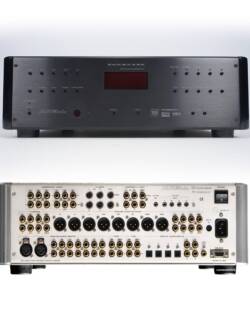
Krell Showcase 7.1 preamp/Processor
Original price was: R150,000.00.R18,000.00Current price is: R18,000.00. Add to cart -
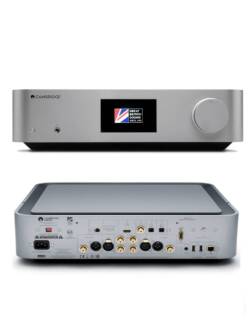
Cambridde Edge NQ DAC/Streamer/Preamplifier
Original price was: R129,000.00.R68,000.00Current price is: R68,000.00. Add to cart -
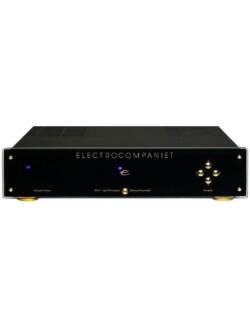
Electrocompaniet EC 4.7 Preamplifier
Original price was: R94,000.00.R28,000.00Current price is: R28,000.00. Add to cart -
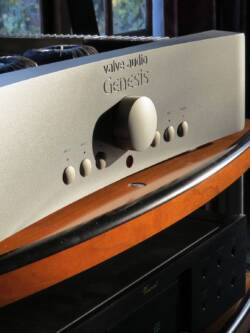
Valve Audio Genesis Preamplifier (NEW Model)
Original price was: R120,000.00.R59,000.00Current price is: R59,000.00. Add to cart