Sale!

In the early 1980s, when CDs began trickling out of the few existing pressing plants, they were such rare and exotic objects that Aaron’s Records, on Melrose Avenue in Los Angeles, kept them secured under lock and key in a tall glass cabinet. A customer forsaking vinyl would enter the store and, with great fanfare, announce the decision by dropping a load of LPs on the front counter with a disgusted thud. Then, in a ceremony resembling a rabbi removing the sacred scrolls of the Torah from the ark, the customer would approach the glass cabinet. An employee would unlock and swing open the doors, and, under that watchful gaze, the customer would choose from among a scattering of titles, carefully avoiding any disc that did not include the Strictly Kosher mark of “DDD.”

Fast-forward 30 years. So far has the pendulum swung the other way that Simaudio has implored me to please not refer to their Moon Evolution 650D as a “CD player.” But in fact, the Moon Evolution 650D is a multi-input digital-to-analog converter that, as an added convenience, happens to include a CD transport, just in case you still play those old-fangled things. Why they didn’t also add eight-track, cassette, and floppy-disk transports, I’m not sure.

A DAC with a Drawer
Two years ago, Simaudio introduced the Moon Evolution 750D CD transport/DAC ($11,999), billed as “the world’s first true 32-bit asynchronous DAC.” The new Moon Evolution 650D ($7999) is physically and functionally identical to the 750D. The differences are inside.

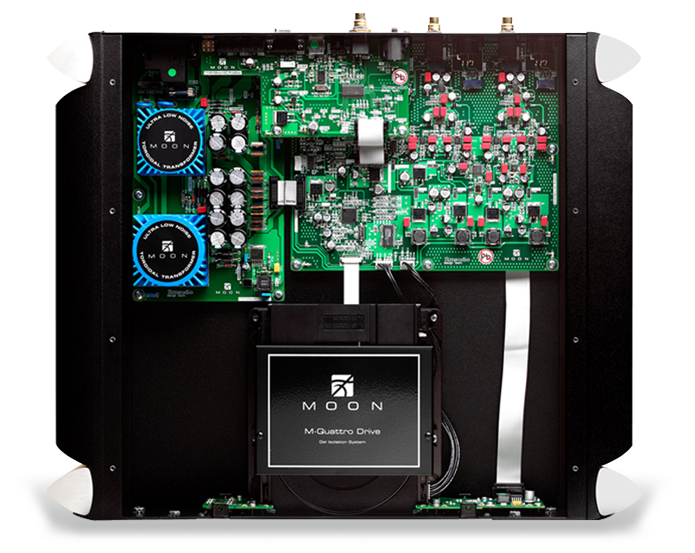
The Simaudio Moon Evolution 650D uses the ESS Technology SABRE32 Ultra DAC/Digital Filter (ES9016), whereas the 750D uses the ES9018 chip. Like the 750D, the 650D features a 32-bit data path, that the initialism-happy Simaudio calls MA-JiC32, as well as eight DACs per channel. The 650D’s fully balanced analog stage is not quite as sophisticated as the 750D’s. For instance, the 650D has 18 stages of independent, inductive, DC power-supply voltage regulation (Simaudio calls this i2DCf) vs the 750D’s 24 stages.

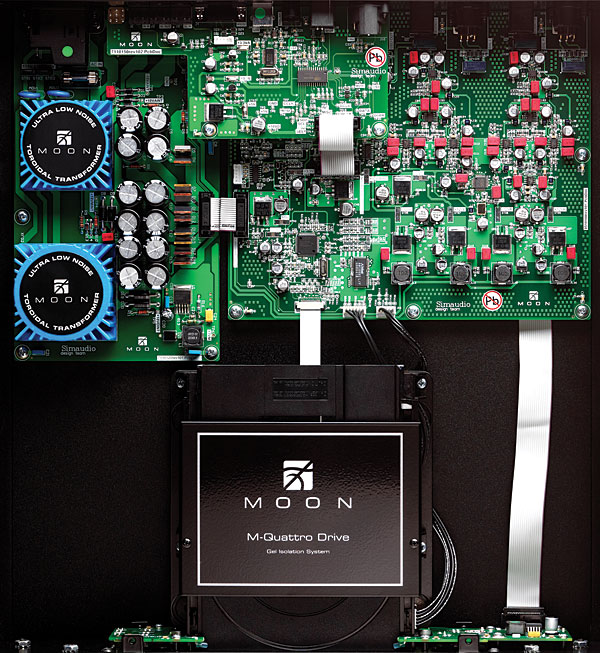
Independent toroidal transformers feed separate digital and analog power supplies. The fully balanced, dual-differential, dual-mono analog output stage features what Sim claims is a “very short,” capacitor-free DC servo circuit, and a proprietary 12dB/octave analog filter. A short signal path and pure copper tracings on a four-layer PCB are said to produce improved signal/noise ratio and a more accurate sound, while the ultrarigid chassis construction minimizes bad vibrations.

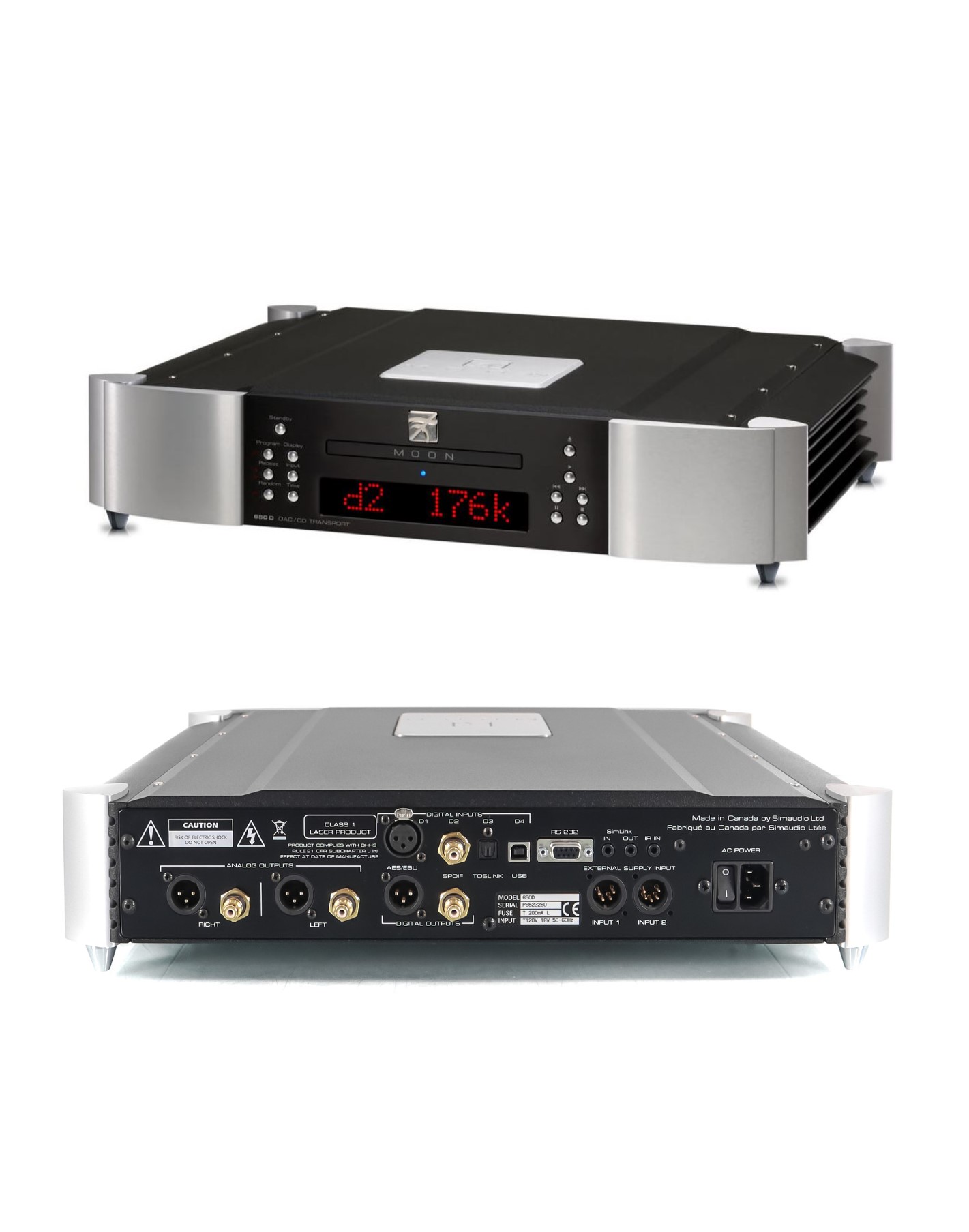
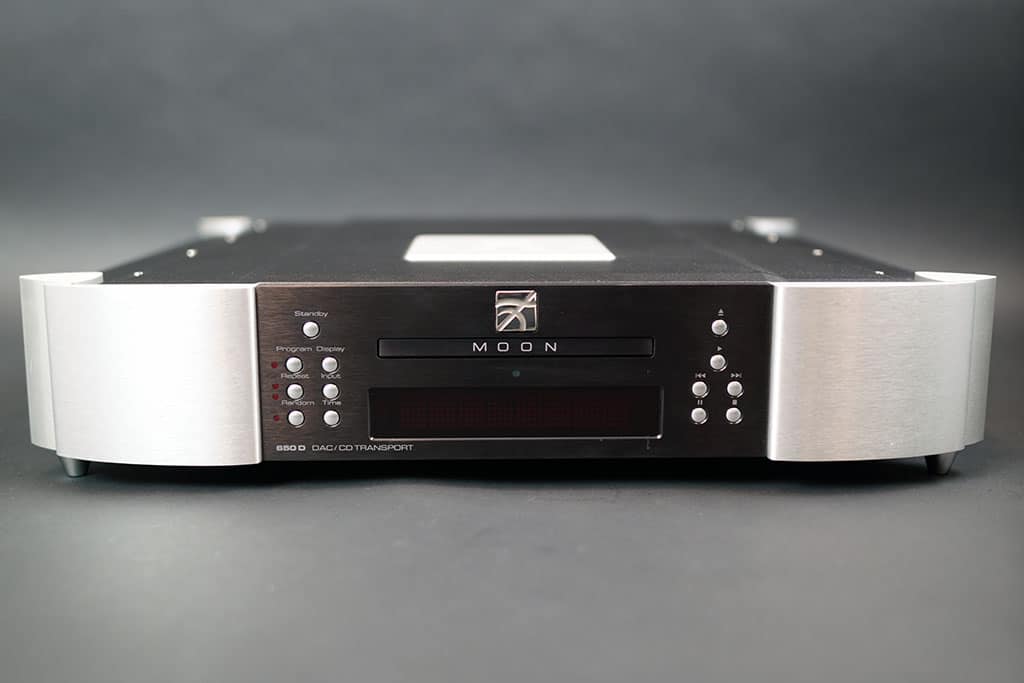
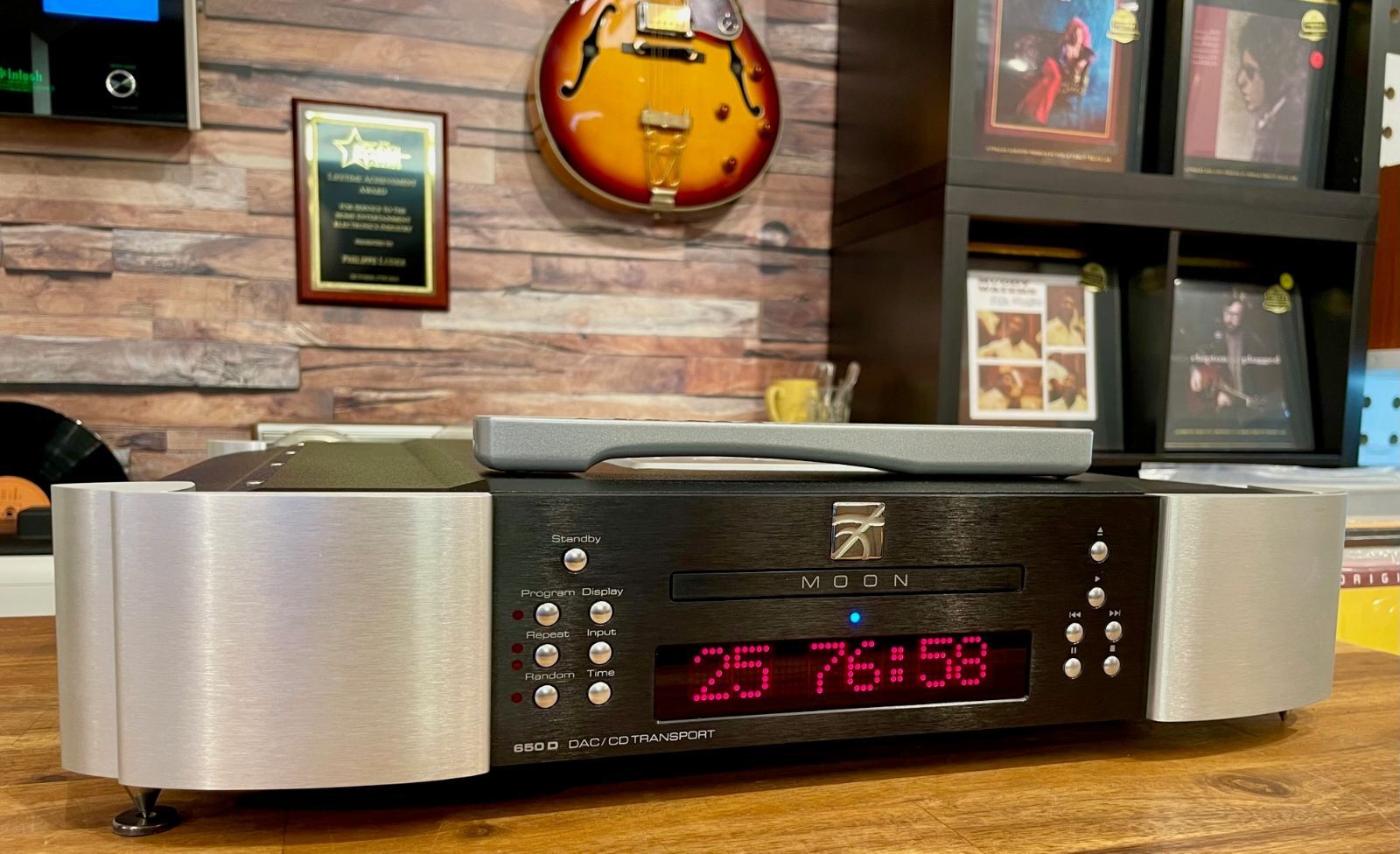
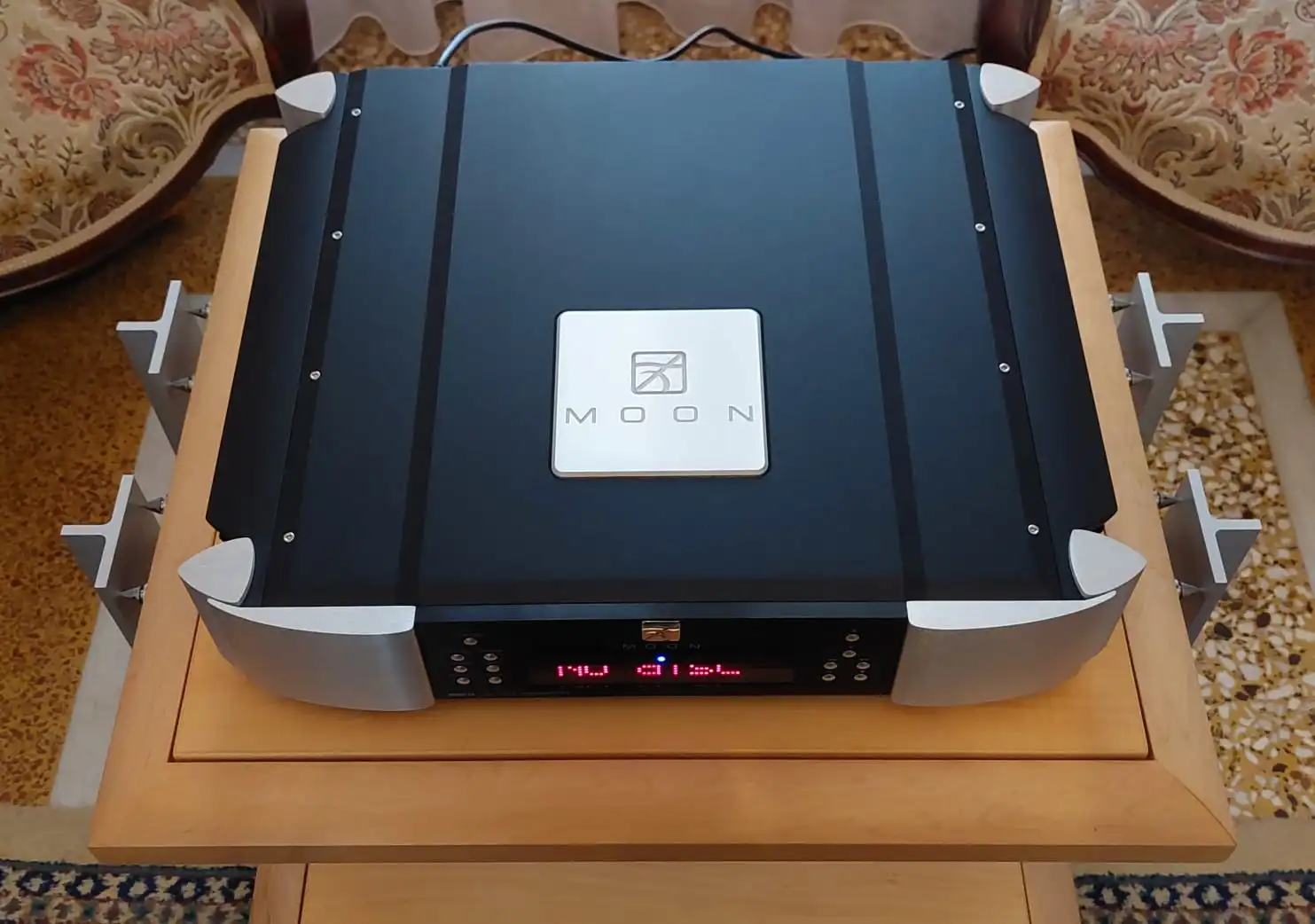
The Simaudio Moon Evolution 650D is physically compact, dense, and shelf-friendly—it’s sufficiently squat to fit on most lower rack shelves. The front panel is illuminated by LEDs in dot-matrix style, with letters and numbers so large you may have to remove your glasses to read them. You can adjust the panel’s brightness or shut it off entirely.

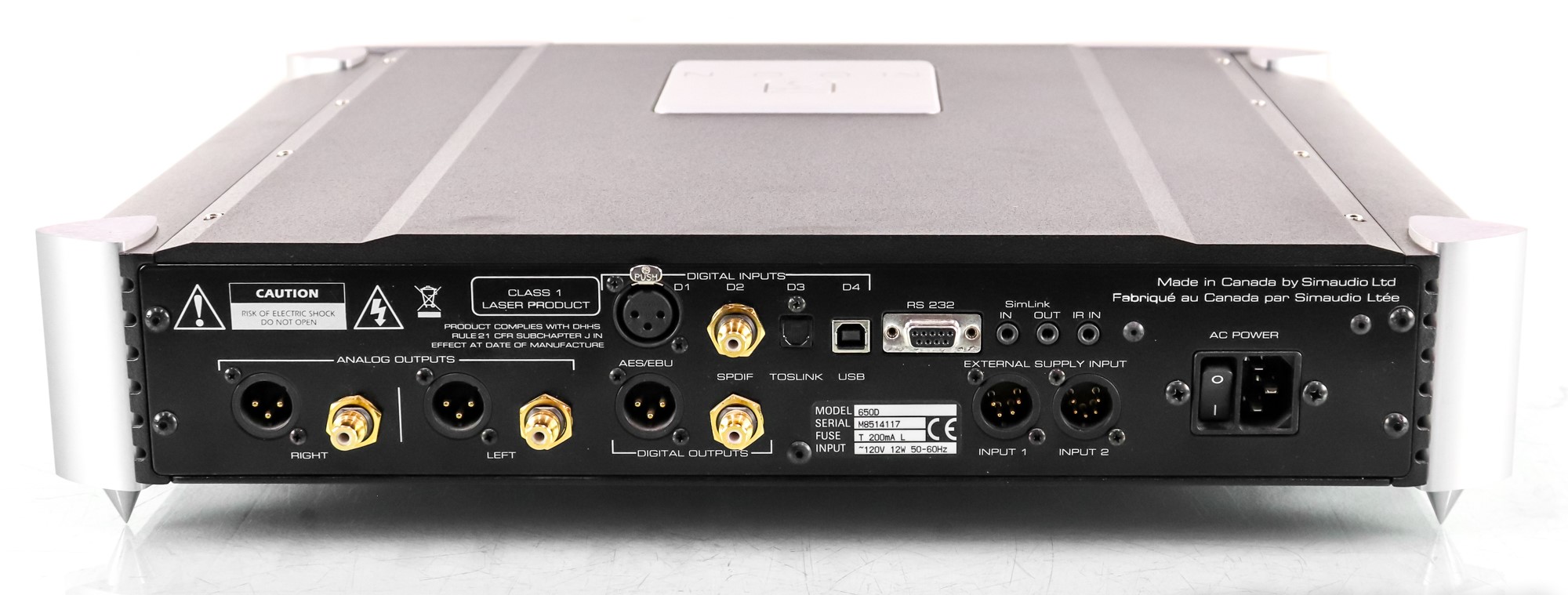
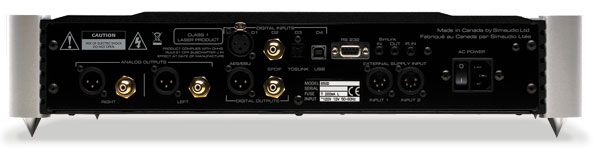
On the rear panel are four digital inputs: AES/EBU, S/PDIF, TosLink, and USB. By the end of the year, an extra-cost (price TBA), in-the-field swapping out of the digital input board will up the USB input’s maximum resolution of 16-bit/48kHz to 24/192, which the other inputs are already capable of decoding.

Oh, and there’s also that CD-drawer, which is part of Simaudio’s proprietary M-Quattro Drive transport, mounted on the gel-based, four-point floating suspension—or, as I like to say, “the transport’s on some rubber.”

Also on the rear panel are S/PDIF and AES/EBU outputs, an RS-232 port for firmware updates and “unsolicited bi-directional control” (sounds like a kinky personals ad), an IR input for external control, and a SimLink port to communicate with and control other Simaudio components. The 650D’s nicely machined remote control can operate those other Sim devices, so some of the buttons are superfluous for a CD play—I mean, a multi-input CD transport–DAC—but from the remote you can toggle through (though not directly select) inputs and control the transport. Not that it’s important, but I found the remote’s shape—it looks like a long tooth—less than appealing.

In short, except for a few chips, the 650D seems identical to the 750D, for much less. A 750D wasn’t provided for a comparison, so it’s difficult to say what another $4000 gets you in terms of audible or measurable performance, or what you might lose (if anything) by opting for the less expensive model. For all I know, the 650D might sound better.

Setup and Listening Strategies
Screw in the Moon Evolution 650D’s spiked feet (provided) and, if you’ve got wooden shelves, set them on the supplied bases (provided), run some interconnects and digital inputs from external sources, and you’re ready to go.

I used the 650D’s S/PDIF input with the Meridian Sooloos music server, the AES/EBU input with the Alesis Masterlink hard-disk recorder, and the TosLink input with my MacBook Pro computer, and ran a set of Stealth Sakra balanced interconnects to the Ypsilon PST-100 Mk.II preamplifier.

Operated via iPhone, the Sooloos made for an incredibly handy tool that I couldn’t have imagined 20 years ago. I could choose from among more than 2300 CDs and higher-resolution files, create instant playlists, and access individual selections, all within seconds. Swap a few cables and I could rehear the same music through the Playback Designs SACD player–DAC, the only DAC reference point I had on hand.

No Expectations Met with Shock and Awe
Rummaging through my Sooloos jukebox produced a playlist that had no rhyme or reason other than that it was music I wanted to hear as I came upon it. It added up to a varied selection that proved extremely useful. The selection ran from the Animals’ “Don’t Bring Me Down,” from the CD layer of ABKCO’s hybrid SACD, to a JVC XRCD of Offenbach’s Gaîté Parisienne, the famous 1954 recording by Arthur Fiedler and the Boston Pops (CD, RCA Living Stereo/JVCXR-0224).

Also on the playlist: Lalo Schifrin’s “Pampas,” from the superb release Antonio Lysy at The Broad: Music from Argentina (CD, Yarlung 27517); “Touch of Grey,” from the Grateful Dead’s In the Dark; “There Goes My Baby,” by The Drifters; “I’ll Get You,” in mono, by the Beatles; “Take the ‘A’ Train,” from the M&K Realtime CD of Bill Berry and His Ellington All-Stars’ For Duke (M&K’s direct-to-disc vinyl kills it); “Let’s Go Away for Awhile,” from Brian Wilson’s Live at the Roxy; the Zombies’ “Time of the Season” (in mono and stereo); André Previn’s jazz recording West Side Story, on Contemporary (tape dropout included); and the high-resolution recording of Malcolm Arnold’s Commonwealth Christmas Overture, from the disc of Arnold conducting the London Philharmonic in his own overtures (HRx, Reference), which can sound like pompous parodies fit for the entrance of a high government official in a Monty Python sketch.

I began with the Dead’s “Touch of Grey,” and it was love at first hearing. At first I just listened without trying to analyze why I was finding the sound so pleasurable (for CD resolution). Then it was time to get to work.

I had zero expectations of the Moon Evolution 650D’s sound. Other than a few modestly priced, reasonably good-sounding phono preamplifiers, I’ve had no Simaudio models in my system. But the 650D’s bottom end foundation was noticeably muscular, deep, articulate, and well balanced. The kick drum was well textured and punchy, while the bass line floated cleanly and separately beneath it, free of bloat and in exceptionally fine focus. Jerry Garcia’s voice hovered between the speakers in an unsmeared, three-dimensional space that made deciphering the words unusually easy. The overall instrumental separation and three-dimensional image solidity and transparency, combined with the bottom-end foundation, produced an exceptional digital reproduction of “Touch of Grey” that was free of glare and harsh overtones, and that didn’t come at the expense of clean, fast transient articulation or a detailed decay structure, both of which helped produce rhythmic certainty and a physically solid, organized sound picture. In other words, this pleasing sound didn’t seem to be caused by a sonic cover-up from diffuse warmth or softness. Rhythmically, the 650D could not be faulted. It rocked!

Next up was the vintage recording of Offenbach’s Gaîté Parisienne. While this is an exceptionally spacious and transparent recording, its mid-1950s origins are obvious in its overly generous midrange and upper midrange, which put the strings, woodwinds, and brass at the beginning in a bit of a confused, bulbous haze. Only after these subside and the ultratransparent snare drum, woodblock, flute, and triangle take over do you begin to hear what all the fuss this recording has generated is about. The 650D’s reproduction of the woodblock and the grainless, pristine clarity of the triangle caught my attention as being unusually clean, finely drawn, and precise—particularly the triangle’s attack, clean sustain, and decay into “black.”

The kick drum and bass line in Brian Wilson’s Live at the Roxy is cavernously deep but can sound bloated. Through the 650D it seemed to be depth-charge deep—unusually so—and rock solid: deeper, more solid, and better focused than I’m accustomed to hearing it.

Working through my mostly 16-bit/44.1kHz playlist, I was struck by the 650D’s consistent overall sound: unusually transparent, delicately drawn, and ethereal, with an almost complete absence of digital glare and hardness. Yet the 650D accomplished this without noticeably softening instrumental attacks or smothering natural transient sharpness. Reverb trails were easy to follow as they naturally faded to black in an analog-like fashion similar to what I remember hearing through dCS’s Debussy USB DAC ($10,999). I wished I’d still had the Debussy on hand for a direct comparison, but no such luck.

The spread between the speakers was pushed back from a line drawn between them, particularly in the center, helping to produce a picture with a slightly flattened U shape, that drew my ears in toward it. The farther I was pulled in, the more separated, articulate information I could pull from it. The Moon 650D’s had a digital sound that drew me in and never pushed me away.

For instance, in the mono mix of the Beatles’ “I’ll Get You,” from the 24-bit remastering of Past Masters issued on USB stick (FLAC files transferred to the Sooloos), each vocal element seemed unusually easy to separate out, as were all of Ringo’s splashy cymbal strokes. There’s an almost froggy lower vocal track by John Lennon that I don’t recall having heard with such ease and clarity.

Likewise, the clarity with which it was possible to hear John’s flubbing of the lyrics in the bridge: he sings “I’m gonna make you mine” as Paul correctly sings “I’m gonna change your mind.” That’s because it seemed so much easier to follow each singer’s part leading up to the faux pas than I remember it having been.

Playback
So much in my system has changed since I last paid attention to such sonic minutiae, including the insertion of the MBL 9011 monoblock amps, the Ypsilon PST-100 Mk.II preamp, and some new cables, that determining what, exactly, were the contributions of the Moon Evolution 650D required swapping it out for something else. So with the Playback Designs MPS-5 SACD/CD player–DAC in place, I listened to “I’ll Get You,” using an SPL meter to match levels.

“I’ll Get You” (1963) is about as primitive a recording as you can imagine, yet from it I was able to corroborate all of the observations I’d been making, and be assured that the source of these observations had been the Moon Evolution 650D, not the other new gear inserted in the system. Through the Playback, Paul’s bass line wasn’t as deep or as texturally well developed, wasn’t as easy to follow, and was somewhat more diffuse and less well focused. Ringo’s cymbals were more prominent because the upper midrange and treble region had been pushed farther forward, producing a glare that I could diminish only by slightly dropping the overall level.
There was less separation of Paul’s and John’s vocal lines, and the froggy quality of John’s voice was somewhat homogenized into a softer mush. Most striking was the loss of clarity when John flubbed his line. Of course, you can hear this through both DACs, particularly when you’re listening for it, but through the Playback, since I was less able to follow each individual vocal line, the mistake was less jarring, the word change just barely jumping out of the jumble.

Running through the full playlist again produced similar, now predictable results that pointed not toward the Playback MPS-5 being anything less than a very good DAC, but that demonstrated that the Moon Evolution 650D was superior to it in many ways, and overall more pleasing and less fatiguing to my ears.

Back to “Touch of Grey.” Compared to the Simaudio’s rendering, the kick drum through the Playback had sharp transient attack but lacked compacted weight and physical focus. The bass’s attack was soft and diffuse, and the line faded then reappeared, jumping forward and back in the mix, depending on the note. Following the bass line was therefore more difficult, which made it less of an anchor for the track.

Garcia’s voice was dimensionally flat and not nearly as well focused, and it appeared within a mass of instruments strung across the stage in a relatively straight line, with less delineation of depth or instrumental separation, compared to the Simaudio. There was more than a touch of gray to the Playback’s harmonic production, in contrast to the Sim’s more vibrant, more colorful sound—but most significant, the 650D’s evenhanded decay characteristics helped produce three-dimensional images and a better-organized picture.

A reissue of the Takayuki Kato Trio’s Guitar Standards (Three Blind Mice/JVC XRCD) was instructional. This superb recording features the guitar center stage, the bass in the right channel, and the drums to the left. Through the 650D, the warmly recorded guitar’s focus was compact, with the plucks of strings well articulated and the guitar’s body contributing a bit of warmth well below the image of the strings. When the guitarist strummed, through the Playback the warm bloom fought the strum and occasionally overwhelmed it. The bloom seemed to remain well controlled and under the plucked strings through the Simaudio, helping to produce a more immediate and consistent guitar image centered between the speakers. Through the Playback, the body warmth blended with the strings to produce a larger, bloomier picture with diminished focus and less physical clarity.

The better the recording, the more pronounced were the differences between the DACs. Through the Moon Evolution 650D, the piano in M&K’s For Duke sounded more woody and three-dimensional, while the trumpet in the right channel was more transparent, physically better organized, and floated farther free of the speaker. And Markus Schwartz & Lakou Brooklyn’s superbly recorded Equinox (24/96 download, Soundkeeper SR1002), and Reference’s 24/176.4 Arnold Overtures, not to mention the superiority of higher-resolution digital sources in general, further amplified the differences between these two very good DACs.

But more interesting was a comparison of the CD layer of the Rolling Stones’ Beggars Banquet through both DACs vs the SACD layer through the Playback (SACD/CD, ABKCO), compared to the 24/176.4 download from HDtracks.com decoded through both DACs. (Got that?) First, the CD layer (transferred to the Sooloos) through the Simaudio surprised me with nice textures that were mostly free of cardboardy overlay. The bongos and bass lines in “Sympathy for the Devil” were tactile, but Mick Jagger’s voice sounded somewhat hard and two-dimensional. Through the Playback, the bass and bongos were less tactile and had a harder edge, while Mick’s voice was more in my face.

The 24/176 download of this album sounded fantastic through the 650D. The stage depth expanded dramatically, the attack structure became far more supple, the sustain lengthened, and the decay seemed to go on forever—like those pesky “artifacts” that make vinyl so pleasurable. I could crank it up and feel only pleasure. Mick’s voice became far more believable and three-dimensional, and when the 16-bit version of the track began, I could sense that the “room sound” was missing.

Through the Playback, the 24/176 file produced bass and bongos that were somewhat drier and less texturally supple. The overall picture was flatter, but it was a big improvement over the CD layer. However, the Playback shone with the SACD. The bass line’s texture was more supple yet better defined, the stage was more three-dimensional, and the bongos had more skin in the game. The SACD sounded better than the 24/176 file through the Playback, but the best sound, in my opinion, was the 24/176 file through the Moon Evolution 650D. Then, the track positively came to life.

The transport operated smoothly, but reporting on the differences between the Sim’s CD transport, AES/EBU, TosLink, and USB inputs would be redundant: All three produced essentially the same sound with 16-bit audio. With the 650D’s USB input limited, for the time being, to 16-bit/48kHz, I’d be happy to write a Follow-Up on the new input board when it’s released, because it should be obvious by now that the Moon Evolution 650D is a great-sounding CD play—I mean, CD transport–DAC—that I’d love to spend more time with.

Conclusions
At $8000, the Simaudio Moon Evolution 650D, made in North America, is not inexpensive. But it’s beautifully built (if not so beautiful to look at), and it performed flawlessly during the review period. Most important, its sound rivaled the best PCM digital I’ve heard in my listening room. I’m sorry I didn’t have the dCS Debussy here for a direct comparison, but I suspect that the 650D is comparable for $3000 less. Still, the price of the input-board upgrade has yet to be announced; if you need a hi-rez USB connection, it will cost somewhat more.

The Moon 650D impressed me with its extremely solid yet supple bass performance. If your speakers go low, you’ll appreciate what it can do. As I write this, I’m listening to the pipe organs on Pipes Rhode Island (CD, Riago CD 101), and this player has bottom-end muscle. But more than that, the 650D is essentially free of glare and grain on top, while exhibiting exceptional transparency and transient clarity. It also managed sweetness and delicacy without sounding soft or mushy. The 650D made CDs and CD-resolution files sound about as good as I’ve heard them sound here, while its decoding of hi-rez files produced exceptional soundstage width and depth combined with analog-like imaging.

I loved Simaudio’s Moon Evolution 650D. Ignore the somewhat less than appealing industrial design and go directly to the sound, and I think you’ll love it as much as I do.


Simaudio Moon Evolution 650D Specifications

The Moon Evolution 650D by Simaudio is a high-end CD transport and 32-bit asynchronous DAC. Originally priced at $8,000, it features a proprietary gel-suspended CD drive, an ESS SABRE32 DAC chip, and versatile digital inputs/outputs (AES/EBU, S/PDIF, TosLink, and USB). [1, 2, 3, 4]
Key Features and Specifications
    • Audio Processing: Utilizes M-AJiC32 (MOON Asynchronous Jitter Control in 32-bit mode) to effectively eliminate digital jitter and ensure bit-perfect playback. [1, 2]
    • Drive Mechanism: Housed on the proprietary M-Quattro 4-point gel-based floating suspension system, which dampens vibrations for better spatial and ambient detail. [1, 2]
    • Power Supply: Employs independent inductive DC filtering (i²DCf) for separate analog and digital power supplies. [1, 2]
    • Inputs & Outputs: Four digital inputs (AES/EBU, S/PDIF, TosLink, USB) and two digital outputs (AES/EBU, S/PDIF), along with balanced (XLR) and single-ended (RCA) analog outputs. [1, 2]
    • Performance: Boasts a 120 dB dynamic range, 0.0001% total harmonic distortion, and an intrinsic jitter rating of less than 1 picosecond. [1, 2]

Performance and Reception
The 650D is widely praised for its bottom-end muscle, exceptional transparency, and lack of digital glare. Users and audiophiles on platforms like Head-Fi often highlight its excellent micro-details and wide soundstage. While Michael Fremer of Stereophile noted minor caveats with 16-bit Redbook CDs compared to analog setups, the general consensus is that it provides a relaxed, fatigue-free, and analog-like listening experience.

Simaudio Moon Evolution 650D CD/DAC player

Original price was: R168,000.00.Current price is: R62,000.00.

Simaudio Moon Evolution 650D CD/DAC player

Original price was: R168,000.00.Current price is: R62,000.00.