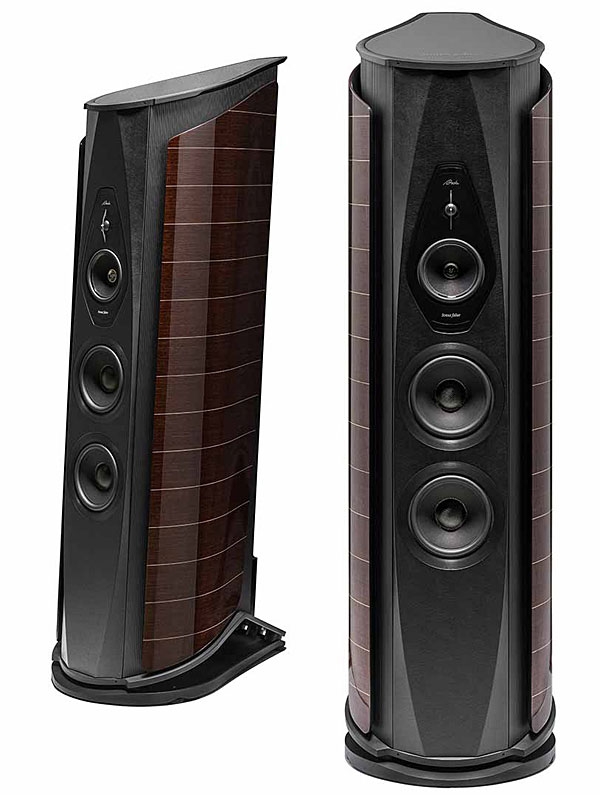
Sonus Faber Aida (The mighty giant!!)
Original price was: R1,980,000.00.R970,000.00Current price is: R970,000.00.
Sidebar 1: Specifications
Description: “Three-and-two-thirds-way” reflex-loaded, floorstanding loudspeaker.
Drive-units:
1.1″ (28mm) damped-apex silk-dome tweeter,
7.1″ (180mm) natural fiber, viscous-damped midrange driver,
two 8.7″ (220mm) sandwich-cone woofers,
12.6″ (320mm) Nano Carbon Fiber/foam core Infra (sub)woofer;
rear-firing Sound Field Shaper comprises 1.1″ (29mm) damped-apex silk-dome tweeter and two 3.15″ (80mm) midrange drivers.
Crossover frequencies: 55, 150, 200, 3000Hz.
Frequency range: 18Hz–35kHz. Sensitivity: 92dB/2.83V/m.
Nominal impedance: 4 ohms.
Recommended amplification: N/A.
Power handling: 100–1000W (without clipping).
Dimensions: 68″ (1725mm) H by 19″ (482mm) W by 30.7″ (780mm) D. Weight: 363.8 lb (165kg).
Finishes: Wenge (wenge veneer, maple inlays), Red (stained walnut veneer, black inlays), both with black leather.
Serial numbers of units reviewed: 014 (both).
Price: $130,000/pair, including dedicated carbon-fiber pedestals.
Out of stock
Description
Sonus Faber Aida loudspeaker


In 1959, in their musical revue At the Drop of a Hat, the British musical-comedy team of Flanders and Swann sang their “Song of Reproduction.” It’s not about sex. The song mocks audiophiles (you thought this was something recent?) for how we spend “all of that money to get the exact effect of an orchestra actually playing in their sitting room.” Before launching into the song, Flanders quips, “Personally, I can’t think of anything I should hate more than having an orchestra playing in my sitting room!”I’m here to tell you that there’s nothing I love more than having the sensation of an orchestra playing in my sitting room—or, more to the point, of being transported to the venue in which the orchestra was recorded.
On the last night of the few months I had Sonus Faber’s recently revised Aida loudspeakers in my own sitting room—my basement listening room—I decided to check out the boxed set of Beethoven symphonies from the Berlin Philharmonic, issued on vinyl (10 LPs, Berliner Philharmonic BPHR160092). Though released in 2017, it had arrived here only recently, and I first wanted to hear Sir Simon Rattle’s interpretation of Symphony 9.
The vinyl releases (and associated high-resolution downloads) were recorded at 24-bit/192kHz with a pair of mid-side (M/S) microphones. As anyone who’s heard the justly famous Satchmo Plays King Oliver (LP, Audio Fidelity AFSD 5930/Analogue Productions AAPJ5930), the M/S technique can produce intensely solid, three-dimensional imaging. The late Louis Armstrong sounds as close to being “alive” between my speakers as a recording can manage. The CD and BD editions of the Beethoven box were made from multi-miked recordings.
At around 2am, as the reverberation of the Ninth’s last notes faded away, I found myself exhausted, overwhelmed, and somewhat disoriented, all in the most pleasurable way, by the most convincing illusion I’ve ever experienced—by a considerable margin—of having been transported from my modestly sized listening room to a concert hall (the Berlin Philharmonie).
I haven’t heard the multi-miked version. I have sets of the Beethoven symphonies by Bernstein, Karajan, Klemperer, Leibowitz, Walter, and Paavo Järvi—all of them sound good, some better than others. This new one from Rattle and Berlin might be the most spatially together and believable of all, and it’s digital. Of course, I think the reason for this is the minimal M/S miking. The digits are just how it’s originally stored, and the software keeps getting better.
Generally speaking, the performances sound very “proper,” well organized, and understatedly British. When I listen to Karajan or even Bernstein, I see dark evergreen forests. Rattle’s Ninth had me seeing English countryside, rolling fields, and meadows. I’m not kidding!
The next day, when Bart LoPiccolo, regional director of sales for Sonus Faber’s parent company, the McIntosh Group, and a coworker came to pack up the Aidas, they first asked to hear them. I obliged with the Ninth’s final movement. I also played for them “Whole Lotta Love,” from Bob Ludwig’s now-famous 1969 cut of Led Zeppelin’s II. Later, when John Atkinson arrived to do some measurements, I played him the Beethoven. Then the Aidas were gone.
Big, Bold, Beautiful Flagship
The revised Aida costs $130,000/pair, and pictures in a magazine or online don’t well communicate its size or dramatic styling. It’s big—5′ 8″ tall by 18.9″ wide by 30.7″ deep—and graceful looking, and in a modest-sized listening room a pair of them seem even larger, almost comically so for the space. I shot a video of their installation here and posted it to YouTube—where you can read the comments of skeptics who can’t imagine that these speakers and my room could possibly work together.
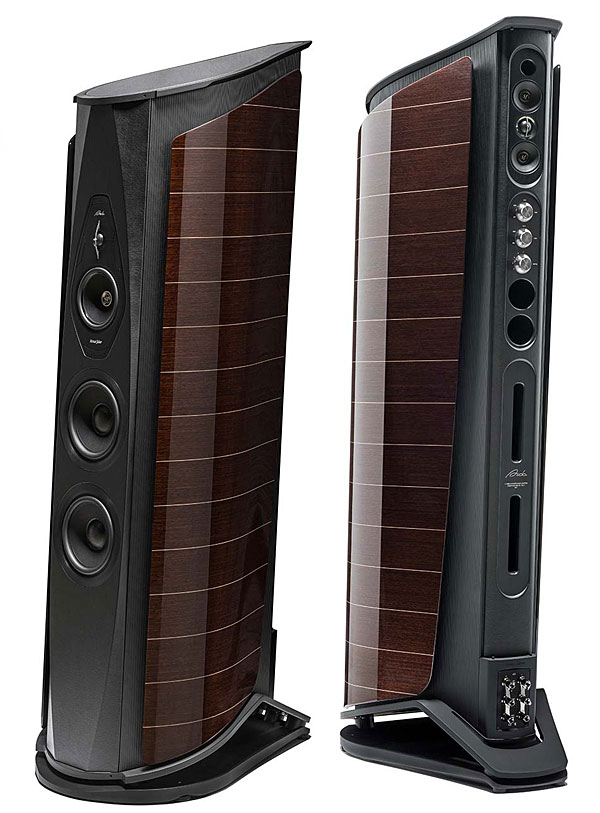
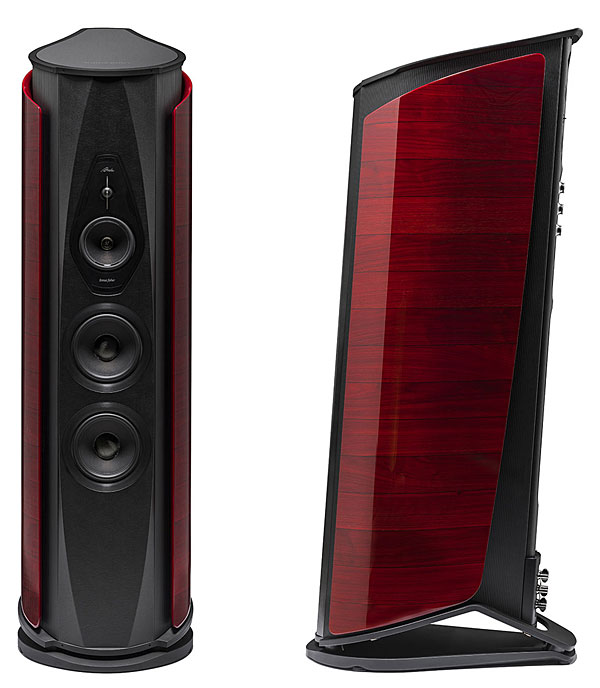
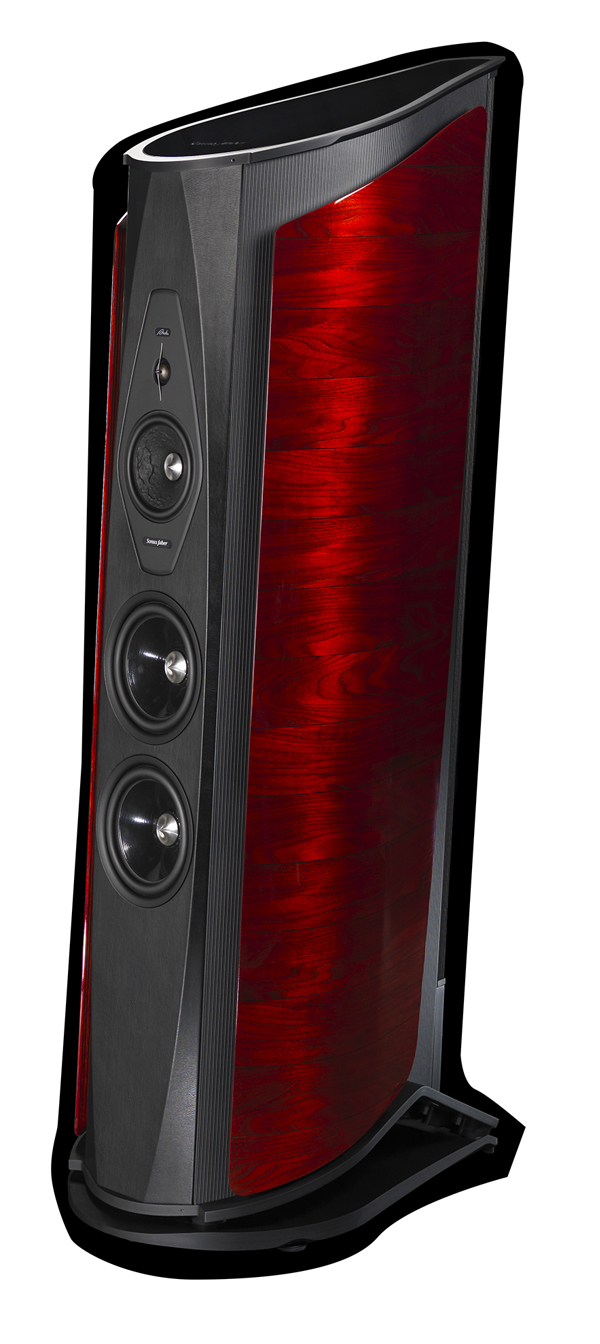
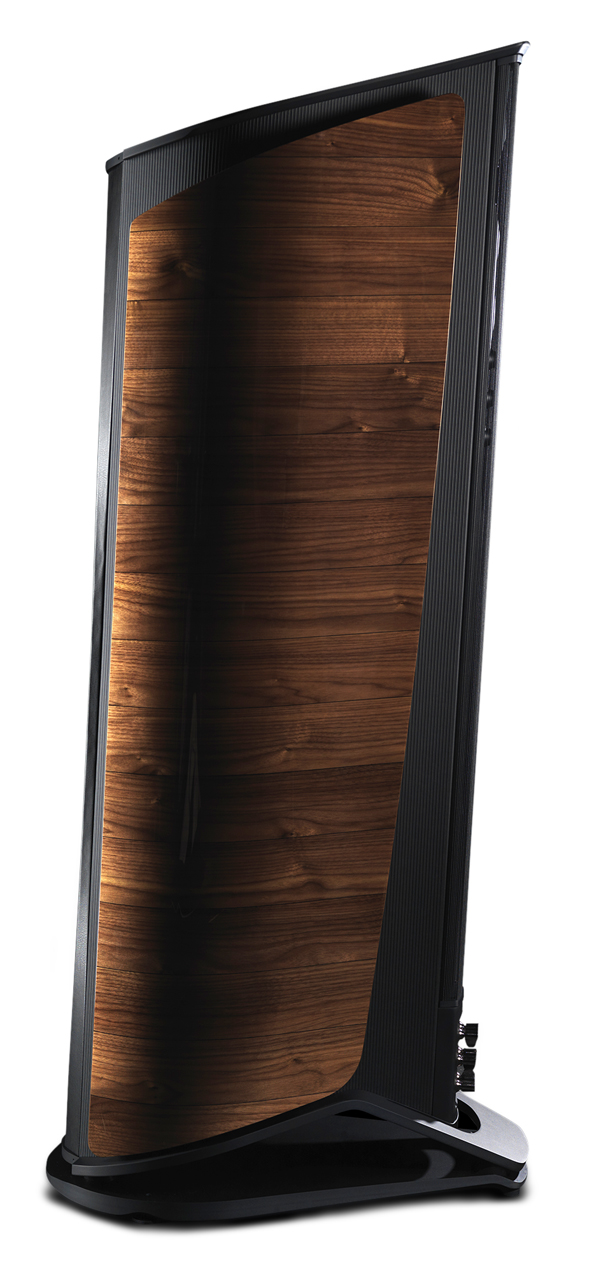
Externally, the 364-lb, “3 and 2/3 way,” multi-driver Aida is indistinguishable from the original, which was launched in 2011. It’s available in Sonus Faber’s new Wenge finish, in addition to the familiar Red. Both feature inlays of maple and glossy, hand-polished surfaces, and Sonus Faber’s snazzy combination of black leather, gleaming metalwork, and their unique, top-to-bottom, stretchy stringy, licorice harp thing.
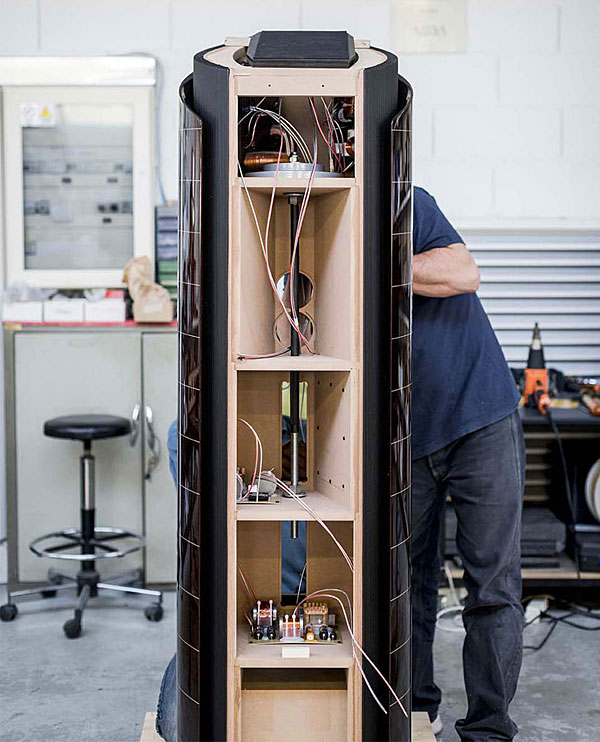
Inside, the Aida is entirely new, including the drivers, which have neodymium magnets and were designed by Sonus Faber, then built to their specifications.
Some speaker makers—eg, Wilson Audio Specialties, YG Acoustics, Magico—seek to heroically eliminate cabinet colorations and resonances altogether. Sonus Faber has long advocated “tuning” their speaker cabinets by combining materials of different resonances. However, it’s not accurate to say that SF views its loudspeakers as “musical instruments,” though of course they’re “tuned.”
A photo on Sonus Faber’s website shows an Aida II under construction. The inner cabinet is a curved structure of leather-clad wood in which at least five chambers are created by cross-braces, a few of them wedge-shaped to direct rear-radiated energy to the Aida’s various ports. To those who use metal and composites to eliminate resonances, the Aida’s innards probably look old-school—but the proof is in the listening and, to a lesser degree, the measuring.
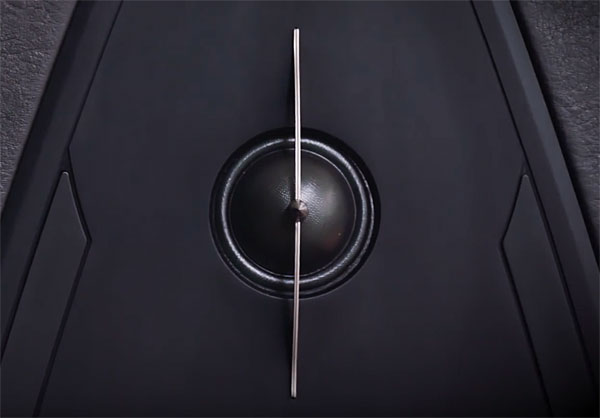
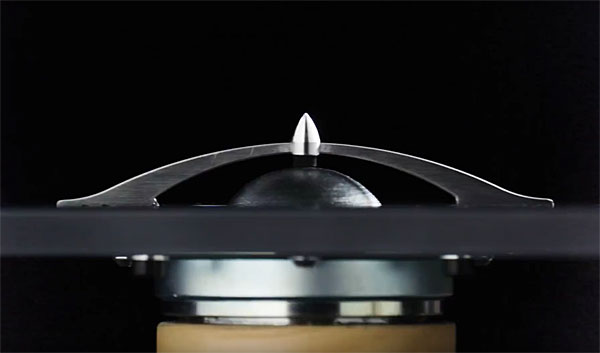
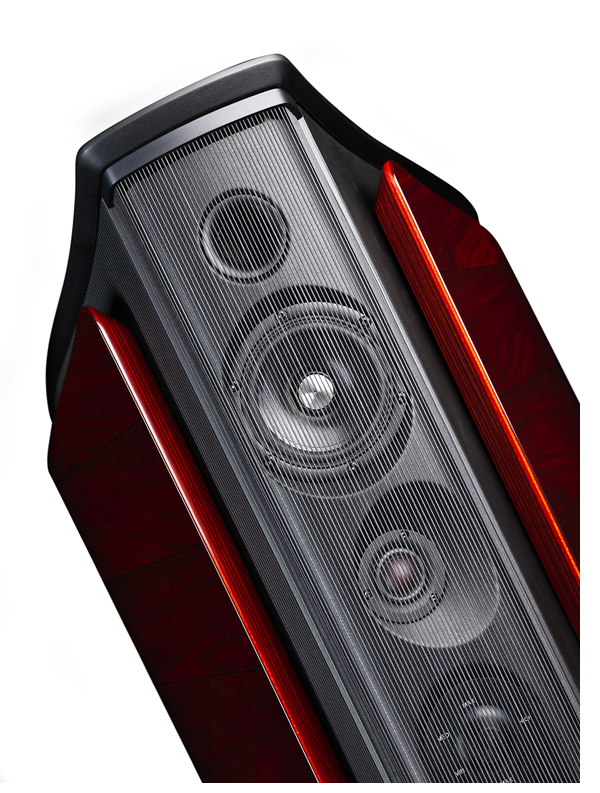
Mounted on the Aida’s gently sloped baffle is the Voice of Sonus Faber: a tweeter-and-midrange module comprising a 1.1″ (28mm) XTR-4 silk-dome Damped Apex Dome (DAD) Arrow-Point tweeter and a 7.1″ (180mm) XTR-04 midrange unit with a cellulose-pulp cone. A vertical bracket holds a small damping pad against the tweeter dome’s apex, to optimize top-octave dispersion. Both drivers are decoupled from the main baffle, the tweeter’s rear wave loading into a natural wood “acoustic labyrinth.”
Below this module are two 8.7″ (220mm) W22XTR-12 woofers with neodymium magnets. Not visible is a downfiring 12.6″ (320mm) SW32XTR-08 long-throw subwoofer featuring a Nano Carbon sandwich cone and a 4″ voice-coil. Also not visible from the front is the Sound Field Shaper, a rear-firing, ported, midrange-tweeter-midrange array, comprising a 1.1″ (29mm) silk-dome XTR2 DAD tweeter and two M8XTR 3.15″ (80mm) midrange units. The Aidas are handed: the axes of the Sound Field Shaper drivers are offset from those of the front-firing drivers, so by swapping the left and right speakers, the user can opt to have the rear-firing arrays angled in toward the center of the stage or out toward the side walls. Sonus Faber suggests angling the Sound Field Shapers in when the Aidas are placed close to sidewalls, and out when the speakers are at least 2m from the sidewalls.
The Aida’s massive cabinet is affixed to an arched pedestal, made of aluminum. This is designed to provide clearance for the output of the downfiring subwoofer, and the zero Vibration Transmission system decouples the cabinet from the floor with springs and elastomers, their compliances carefully calculated based on the speaker’s weight.
Also used here, as in some previous big floorstanders from Sonus Faber, are their Tuned Mass Dampers (TMD)—a series of weights suspended inside the cabinet, and designed to vibrate in antiphase to “erase” cabinet vibrations. SF says that this system helps produce clearer bass and increased “cabinet silence.”
Sonus Faber’s patented Stealth Ultraflex para-aperiodic venting system is claimed to reduce total harmonic distortion (THD) while improving bass extension and eliminating vibrations created by the flow of air through the reflex port. The design is also said to have made possible a smaller enclosure. Also used here is SF’s Anima Legata system, which features a cabinet-stiffening, “vibration collecting metal rod, here running between the speaker’s upper and lower-middle inner chambers.
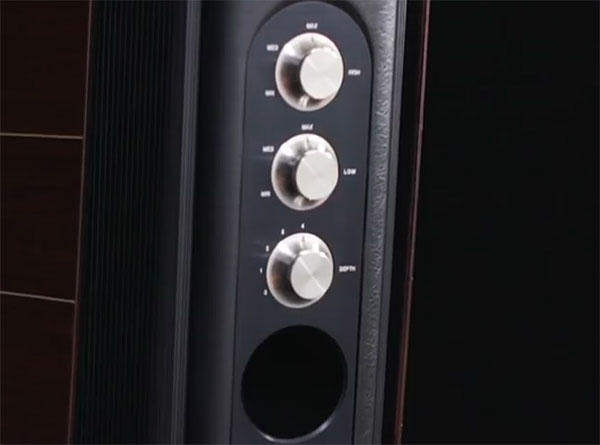
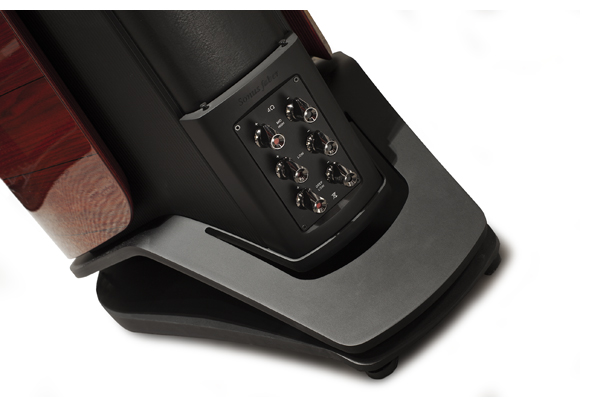
In addition to the Sound Field Shaper MTM array, the Aida II’s rear panel includes three potentiometers for adjusting the output levels of various drivers: High for the front tweeter, Low Damp for the subwoofer, and Depth for the Sound Field Shaper.
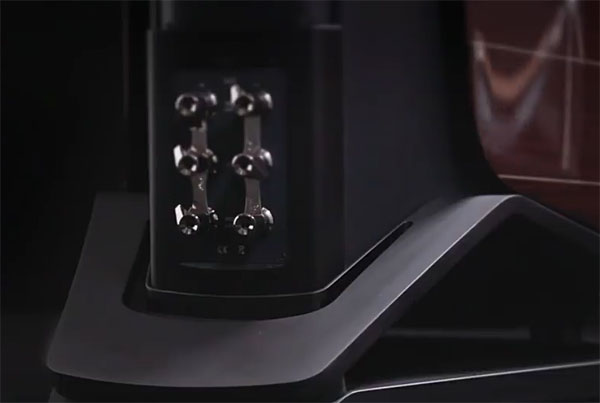
Each Aida II has three pairs of binding posts and is thus tri-ampable, but I used the included jumpers and single pairs of TARA Labs Omega Evolution SP speaker cables.
There’s more to this complex design, and especially to the design and construction of the drivers, but that’s enough for the purposes of this review, other than Sonus Faber’s basic specifications: a frequency range of 18Hz–35kHz, a sensitivity of 92dB/2.83V/m, a nominal impedance of 4 ohms, and crossover frequencies of 55, 150, 200, and 3000Hz.
A Bit of Background
Paolo Tezzon, Sonus Faber’s head of R&D, has been the company’s chief designer since 2006, when founder Franco Serblin left the company (he died in 2013). Tezzon is responsible for the sound, while Livio Cucuzza handles industrial design, at Sonus Faber as well as at Audio Research and sometime McIntosh. Like most gifted speaker designers, Tezzon has created some hits and a few misses.
I’m steeped in Sonus Faber. In 1999 I bought a pair of original, pre-Tezzon Sonus Faber Amati Homage speakers, and since then have reviewed numerous SF models. I’ve visited the factory at least four times. In fact, I turned down an invitation for another visit in preparation for this review. Turning down any trip to Italy is crazy, but I didn’t feel the need to see the factory again (footnote 1).
As Advertised: “Limitless Immersion”
The Wilson Alexxes were rolled out and the Sonus Fabers were wheeled in—the installers positioned the Aidas and adjusted each speaker’s three level knobs. I listened.
Immediately, I noticed that the Alexxes’ intense three-dimensional imaging and image specificity had been replaced by slightly more diffuse, less-well-focused images, mitigated in great part by the immensity of the soundstage in every direction: width, height, and especially depth.
The soundstage was not only huge, it was properly proportioned, in part because the setup guys knew how to correctly adjust the Sound Field Shaper’s Depth control—which obviously affected more than just the depth dimension. And the imaging was better than fine: sufficiently well-focused, and correctly sized for the generous picture. The Aidas worked perfectly well in my relatively modestly sized room.
Once I’d grown accustomed to the Aidas’ spectacular reproduction of space—the first thing that hit me and every visitor—I realized that their overall frequency response must be among the flattest and most full-range of any speaker I’ve reviewed in this room. So much inner detail and delicacy was easily revealed by the Voice of Sonus Faber module, with all its renowned delicacy, warmth, timbral, and textural richness intact, but minus some of the much older speakers’ top-end politeness and overly velvet transients—at least according to some listeners.
The Aida’s reproduction of the upper octaves was ideal: neither bright and tizzy nor recessed and in need of sparkle. That’s why it was possible to switch from Beethoven’s Ninth directly to Bob Ludwig’s noncompressed version of “Whole Lotta Love”—which has among the most spectacular cymbal strokes on a rock record—and not have to make excuses. The cymbal attacks were as clean, precise, metallic, and properly aggressive as any rocker might want, with generous sustain and ideal decay.
If you really want to drop dead with pleasure, as in Records to Die For, listen through the Aidas to Herbert Downes and Jacqueline Du Pré’s Music for Viola and Cello (LP, Parlophone CSD 1499/Electric Recording Company ERC 028), preferably while gazing at a photo of Du Pré. This 1963 recording includes a performance of Vaughan Williams’s Fantasia on “Greensleeves,” with harp accompaniment, that might stop your heart, and a Bach-Gounod “Ave Maria” with deep organ notes that also might do the trick. And if they don’t, maybe the price will—only 300 copies have been pressed, at ú500 each. But an original will cost you considerably more.
Du Pré’s cello sat between the speakers, appropriately warm, sheen-y, and three-dimensional, while the harp, at stage left, had true, precise transient attacks and was not at all soft or over-romantic.
My go-to record for transient clarity and attack precision is John Renbourn’s Sir John Alot of Merrie Englandes Musyk Thyng & ye Grene Knyghte (UK LP, Transatlantic TRA 167). Don’t bother with the US edition on Reprise, which has added reverb that ruins everything. Renbourn’s acoustic guitar is accompanied by Terry Cox’s finger cymbals, African drums and glockenspiel, and Ray Warleigh’s flute, all recorded by John Wood at Sound Techniques. (I tried to get an interview with Wood when the recordings he made with Nick Drake for Island were reissued, but he insisted that he’d have nothing interesting to say. No enticement worked.)
The Aida revealed everything you’d want to hear from this intimately recorded sonic gem: the precise attacks of Renbourn’s guitar, the ringing transparency of the finger-cymbal attacks and sustains, the delicate texture of the drum skin that, to sound correct, must be neither too hard and cardboardy nor too soft and lacking in skin tone.
I can’t imagine that any listener would find the Aida too laid-back or too aggressive, though of course associated equipment always plays a big role in a system’s sound. What I heard was smooth in the best sense of the word, and not at all smoothed over.
No doubt my room’s bass bump at around 50Hz, with a suckout between 60 and 110Hz, will show up in John Atkinson’s measurements, and those who can’t distinguish what they see from what they hear will “see” the bump as “boomy bass”—but what I hear in this room from well-designed speakers is deep, authoritative bass from recordings that contain such information, with no perceivable overhang. Or, as the late Siegfried Linkwitz (of Linkwitz-Riley crossover fame) recently said to me, “You get cues from the eye, but some things that look gross in the frequency response, the ear says, ‘I don’t care’.” The Aida ‘s bottom end was fast, powerful, deep, and unobtrusive—it appeared only when summoned by the recording, and never during the entire listening period did it appear as “bass.” It was always attached to the music, never stuck in the box.
For $130,000/pair you should get full bottom-end response delivered powerfully, without compression or mechanical aftertaste, and with a sensation of ease. The Aida did that. For electric bass, try Jaco Pastorius (LP, Epic EK 33949/ORG 114); for acoustic double bass, Ray Brown’s Soular Energy (two 45rpm, 200gm LPs, Concord Jazz 4468/Analogue Productions AAPJ 268-45).
But the real bass success for this speaker happened at the bottom of the Ninth. (Haw.) Not all that conversant with classical-music terminology, I did an online search to find the best way to describe what I’m talking about. What came up was fart. That’s the word British conductor Roger Norrington (now 84) used to describe a passage near the end of this symphony, just after the choir envisions God: an intervention by two bassoons, contrabassoon, and bass drum, at a new tempo and on the wrong beat of the bar, in the wrong key.
The Aidas’ reproduction of this passage was as vividly believable as it was incredible. What did I just hear? I thought. How can a speaker manage that? The bass drum’s tight definition, extension, and power, plus its positioning in three-dimensional space—the way it just appeared was a sensational experience, the first time and every time I played it—which was often. I played it for the Sonus Faber guys and for John Atkinson, but neither said nor telegraphed anything about what they were about to hear. John’s first comment was about that bass drum and Beethoven’s musical fart, that he had never heard the positioning of the instruments in the surrounding space so clearly resolved.
After the Aidas’ departure, I reinstalled the Wilson Audio Alexxes and played Rattle’s recording of the Ninth. I knew the soundstage wouldn’t be quite as immense—I’d already given that up by swapping in the Alexxes for Wilson’s Alexandria XLFs, which had indeed produced soundscapes of similarly grand size, to get the Alexxes’ better bass and more transparent midrange—but I didn’t expect to be so thoroughly disappointed by the far less visceral attack and loss of definition of the bass drum. It was a serious and surprising letdown—and I love the Alexxes.
Conclusions: All Romance Is Gone
The new Aida is Paolo Tezzon’s most brilliant and meticulously crafted design.
Rightly or wrongly, many audio enthusiasts associate Sonus Faber speakers with a “romantic” sound, and thus feel that they’re better suited to acoustic music, especially classical. That’s probably more true of the company’s stand-mounted than its floorstanding models. But after reviewing the original Amati Homage in June 1999, I bought a pair—and I listen to a lot of rock. I experienced no problems with rock through the Amati Homages.
In that review I described the Amati Homage’s sound as being “more emotionally and physically alive” than I’d been used to hearing, and I was enticed by its ability to express “tiny volume modulations, subtle nuances of amplitude phrasing I had never been aware of.”
In his Measurements section, JA wrote: “While some of the Amati Homage’s measurements are excellent, there is nothing to indicate why Michael Fremer was so enamored of the speaker’s sound. Indeed, some of the measurements, such as of the speaker’s bass performance, raise more questions than they answer.”
I didn’t take that last line seriously until, shortly after buying the Amati Homages, I moved to where I now live. I simply could not get them to work in my new room. I don’t know why, but the bass was weak—as if I’d spent all that money on a small two-way speaker.
Here, in the same room, Sonus Faber’s new Aida produced some of the best low-frequency response I’ve heard—much like that of Marten’s Coltrane III, which made me realize how much better my room’s bass could be than what I’d been getting from the Wilson Alexandria XLF. The Wilson Alexx fixed that. And now the Aida II—which costs 6.5 times the price of the Amati Homage in 1999—fixes it even better.
The rest of what the Aida does—especially its ability to perfectly hang together without ever revealing a sonic seam (an amazing design feat, considering its considerable complexity), and how well it performed with every type of music I played, or against any checklist of sonic parameters you might come up with—produced the kind of sonic thrills and solid, believable musical performance to which $130,000 entitles you. And my experience tells me that you needn’t fear putting a pair of them in a room of relatively modest size.
Paolo Tezzon has produced a masterpiece of a loudspeaker that both honors Sonus Faber’s glorious past and moves it confidently into the future. This lady isn’t fat, but she sure can sing!
Sonus faber Aida Loudspeaker“Aida” is the New Italian Word for Perfection
By Jeff Dorgay
 How many times have you heard a fellow audiophile or music lover say, “For that kind of money, those speakers should wash your car” or, “They should be better than sex”—or something to that effect? A pair of Sonus faber Aida loudspeakers cost $120,000 and are better than sex. Spend a few minutes immersed in a serious listening session, and you won’t care if your luxury car is dirty. Play a few more tunes, and you might not even notice your significant other beckoning you to the bedroom for some intimate time. They are that good. Indeed, the Aida is as close to perfection as I’ve experienced, and I’ve spent a lot of time listening to the world’s finest speakers. These, however, do nothing wrong.
Steve Martin once said, “First, get a million dollars.” Perfection doesn’t come cheap, and that’s the only bad news concerning the Aida. This speaker caters to an exclusive club, yet sales are steady, especially now that the $200,000 “Sonus faber” is no longer on the market. And while these gems flawlessly perform no matter what they’re connected to, the better your source components, the better the end result.
Listening to an old favorite, 10cc’s Bloody Tourists, the heavens align, as they do every time I listen to the Aidas (pronounced Eye –ee-dah). Regardless of the recording material or recording quality, I’m hearing more music than I’ve ever experienced on familiar recordings—and my reference GamuT S9 speakers aren’t exactly slouches. Passages decay more than they did before. There’s an extra guitar overdub here I hadn’t noticed, and an extra layer of vocals. If you audition the Aida, prepare to invest in coffee. You’ll be shutting off the lights at 2 a.m. just because you have to hear just one more record.
These rewarding experiences, my friends, are what the pinnacle of high-end audio is about. Sound so good, so real, you can just reach out and touch it. If you like smooth vocalists like Diana Krall, the Aidas offer you the opportunity to have a sonic lap dance. If you want to rock, and have enough amplifier power, the Aidas put Slash and a wall of Marshall cabinets in your room. And if you like electronica, the Aidas deliver Deadmau5 to your door, mouse mask and all. Acoustic music lovers are in for the biggest treat. The Aidas present a tonal accuracy and contrast that, by far, are the most natural and convincing I’ve ever witnessed.
When covering a Deadmau5 show with Music Editor Bob Gendron last year, he remarked, “Your system can’t do that…” Yet, on a recent visit to the TONE studio, he had recalibrated his perspective. Playing “Raise Your Weapon” from 4×4=12, and twisting the level control on the ARC REF5SE up to 80, a monstrous grin came over his face. Switching the program to the Slayer Vinyl Conflict box set, he admitted, “These speakers play at concert-hall levels with none of the distortion and fatigue you get at a live performance. I’ve never heard a stereo system sound like this.” Another convert.
 Posh Treatment
Every pair of Aidas comes with a visit from Sonus faber to make sure the speakers are optimized for maximum performance. If you live in North America, chances are high that Sumiko’s Bill Peugh will make the journey. Having heard Peugh work his magic at countless dealers and audio shows, it was a pleasure to have him take the time to set up the Aidas here.
For a speaker that weighs 365 pounds each, the Aida is a svelte tango partner. Thanks to the enclosed collapsible trolley, they are easily moved about. And the job can be done with one person, making it easy to place the speakers in a listening room. Another example of how no stone has been left unturned by Sonus faber.
After a brief listen to a single speaker in the room so we could get a handle on bass response, we introduced the second speaker into the system and found the pair beginning to optimize. The Aida uses a rear-firing midrange and tweeter, each having their own controls on the rear panel. The “Sonus faber” introduced this concept, and it’s used to great success here. For now, the Aida is the only other speaker in the Sonus faber range with this function.
Having set up the speakers for the best combination of imaging, frequency smoothness, and bass response, we turned to fine-tuning the rear firing drivers. It’s an illuminating process: The level coming from the drivers isn’t terribly high, yet when adjusted, it causes a profound difference to the overall sound. Setting the level too high destroys the Aidas’ precise imaging performance by way of brightness. Not enough, and the speakers lose some airiness and coherence. Much like fine-tuning VTA, the speakers disappear when a perfect balance is obtained. No small feat for six-foot-tall models.
How quickly the Aidas settle into a groove. We are listening in earnest by the end of the first afternoon. My review models boast very few hours of prior listening time, so they are—for all practical purposes—a fresh pair. Like those on any speaker, the drivers require a certain amount of physical break-in to open up and achieve full body. The Aida is no different, although in retrospect, it merely sounds smaller and less extended after the initial uncrating. Bass is not completely fleshed out, and coherence between drivers is not as good as it is with a couple hundred hours on the clock. By the next day, after 24 hours of continuous play, they begin to relax.
Sumiko’s John Paul Lizars assures me the speakers change character during the break-in period, but it must have happened while I was sleeping. To be clear, I left them playing 24 hours a day during the review period; they had to be back in time for the 2013 Consumer Electronics Show.
As tests evolved, all I noticed was a slight fog, which progressively dissipated. Leaving the Pass XA200.5s Class-A monoblocks powered-up for nearly a month had consequences on my electric bill; I used three times more electricity as the average house in my neighborhood. Yikes. I’ve had a few paranoid delusions of the DEA showing up at my house with a SWAT team wanting to know where I’m growing the marijuana crop, only to give them a tour of my studio. “Sorry officers, no drugs in here, just these big amplifiers.” If I’m not at CES in January, you’ll know why.
I spent the bulk of my listening time utilizing the Pass monoblocks and Octave Jubilee monoblocks, which offer 250 watts per channel of vacuum tube power.
Under Pressure
The Aidas are polite company at low to modest listening levels. But as the volume goes up, they do an even better job at disappearing in the room. Sumiko representatives often discuss the concept of “pressurizing the room,” and I’ve never heard it better illustrated than with these speakers. Interestingly, I found myself (and guests) listening to the Aidas at higher levels than normal. Once the volume hits a certain point, the aforementioned effect becomes hypnotic, drawing you further into the presentation than you might have thought possible.
Fatigue that accompanies twisting the volume control to the upper regions? It’s just not there with the Aidas. Instead, it feels as if you can just keep turning up the volume forever, or at least until your amplifiers run out of power.
Tied to a chair and given truth serum, I’ll confess my love of the sound of a great electrostatic speaker like the Quad 57 or the MartinLogan CLX. Coherency is my hot button. It’s not so much midrange magic, but midrange correctly rendered. With no crossover in the path, the associated distortions, by design, do not exist. And distortions are a big part of what convinces your brain that you’re listening to a stereo system instead of the real thing.
Again, the Aidas do the seemingly impossible, providing a seamless soundstage that never sounds like a woofer, tweeter, and midrange in a cabinet (even though their complement of drivers has crossover points at 55, 180, 250, and 3,000Hz). There’s so much new technology incorporated in this speaker, it would take a whole book to cover depth. And that’s precisely what’s included with the Aida— a 200-page tome, illustrating every facet of the speaker’s philosophy, design, and construction. Not to mention a massive collection of great photos, beautifully printed.
The Aida’s downward-firing 13-inch woofer produces bass with incredible texture and grip. I also suspect it heavily plays into its ease. The bass isn’t as aggressive, gut-punching, or pants-flapping as that of a few favorite audiophile darlings, but it possesses a presence that provides a true musical foundation, as it should. Just like when you listen to a musician playing a stand-up bass in a club.
Vide, the acoustic bass line in Stanley Clarke’s In the Jazz Garden is rich with decay, texture, and pace. Clarke’s instrument does more than maintain a separate space from piano and drums; it projects a three-dimensional effect that bass rarely manages in a recording. When changing the program to Dan Deacon’s America, the growling synth bass line shakes my room. These speakers move serious air when required.
The high-frequency spectrum is equally well represented. Older Sonus faber speakers, while providing highly pleasing sound, are often criticized for a midrange glow that borders on coloration. The Aida retains a high degree of utter tonality and soul, and provides a high degree of resolution and the ability to render musical detail without harshness, distortion, or fatigue. It yields a greater degree of loud-to-soft gradation than anything I’ve heard shy of the world’s finest horn systems.
Moving away from the ring radiator design of the former flagship, the Stradivari, a new, 29mm “arrow point” tweeter gets incorporated in the Aida. The intriguing albeit delicate bar is a very specific wave guide. Nothing in the Aida is without function. Peugh states the soft dome allows for a more natural response as well as more even and natural room dispersion. Experiencing the Aida is remarkably similar no matter where you sit in the listening environment, contributing to the notion of musicians playing in another room when listening from afar.
While the Aidas have a sensitivity spec of 92db with one watt, they give more with tons of clean power on tap. A sampling of lower-powered amplifiers in the 25- to 50-watt-per-channel range proves acceptable. Still, small amplifiers run out of juice when called upon to really rock. And I can’t imagine an Aida owner not wanting to take advantage of as wide a range of music as possible.
 Ooh, the Cabinet
Much of the Aida’s sound can be traced to the cabinet and Sonus faber’s approach. A visual tour de force, these speakers arouse and impress, coated with layer upon layer of hand-applied and hand-polished lacquer. The metal bits receive the same amount of attention to fine detail, right down to the exact formulation of the bath used to apply the anodized coatings. Words and photos do not do justice to these audible works of art. The booklet states the processes used in the speakers’ construction is “like that in an Italian supercar,” and it isn’t kidding.
Many current speaker manufacturers live and die by the sword of completely eliminating any resonance from the enclosure. However, Sonus faber looks at speaker design like an instrument manufacturer would, working with resonances and fine-tuning to achieve a more musical result. If you like the Wilson/Magico/YG Acoustics approach, I doubt you will love the Aida—just as I wouldn’t expect an automobile enthusiast that loves the Aston Martin DBS to be equally excited about the Porsche 911 GT3. High performance, different approach.
As for the emotional connection the Aidas engender? A non-audiophile friend, who is a cabinet maker by trade, was in awe of the enclosures that take nearly three weeks to complete. Before I put Mobile Fidelity’s recent 45RM remaster of The Freewheelin’ Bob Dylan on the turntable, he was explaining “no one listens to vinyl anymore.” Then, when the needle dropped, he teared up. “I used to go to the Village and see Dylan all the time. This puts him right in the room.” We switched back to the same album on CD, even played through the fantastic dCS Paganini, and the magic diminished. How can you ask for a better, more emotionally engaging experience?
 Listen to Get the Rest of the Story
If you were hoping for a treatise on specs, measurements, and speaker configuration, that’s not what matters here. And none of it will matter to you after you’ve spent 60 seconds listening to one of your favorite pieces of music through the Aidas. I can’t think of a more sublime example of high technology serving fine art.
Should a $120k pair of speakers not be on your short list, try and experience the Aida anyway. And have your Sonus faber dealer demonstrate the new $2,498 Venere 2.5 speakers. A staggering amount of technology trickled down to the company’s entry-level speakers, and is only be made possible by an enterprise that has the resources to build an Aida.
Just as Verdi’s Aida took his art to its highest level, Sonus faber’s Aida takes the aesthetic and acoustic art of speaker-building to an equally lofty level. While it can be tough to justify the value with products so expensive, having spent plenty of time with most of the top models in the six-figure bracket and a considerable number of great speakers in the $20k- $50k range, I can say with absolute certainty that Aidas offer sound and build quality commensurate with price. They have provided one of the most enjoyable musical experiences of my career.
Sonus faber Aida
MSRP: $120,000/pair
Related products
-

Rotel 1582 Mk1 Stereo 200W Power amplifier
Original price was: R36,000.00.R14,000.00Current price is: R14,000.00. Add to cart -
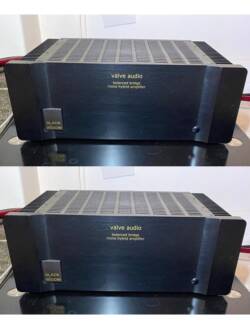
Valve Audio Blackwidow Monoblocks x 2 (BLACK)
Original price was: R140,000.00.R68,000.00Current price is: R68,000.00. Add to cart -
Rotel RB-1582 MK2 Stereo Power Amplifier (2nd)
Original price was: R46,000.00.R19,400.00Current price is: R19,400.00. Add to cart -
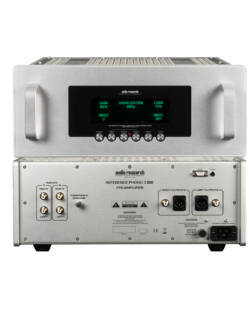
Audio Research REF Phono 3 – Silver
Original price was: R325,000.00.R150,000.00Current price is: R150,000.00. Add to cart