T+A P3000 HV Preamplifier
R365,000.00
If you seek real muscle to drive a high-end stereo system, look no further than this premium T+A combo. Both preamp and dual-mono power amp (2x300W/8ohm) hail from its HV (High Voltage) series, where transistor stages are driven at the high voltages normally associated with valve amps, achieving low distortion regardless of power output. Presenting music with a vice-like grip, this luxury pairing conjures up holographic images and reveals fine details with consummate ease. Want even greater power? Then check out the PS 3000 HV power supply upgrade.
T+A’s ‘no compromise’ HV series components are designed for the luxury audiophile market. In that context, this latest amp combo is sensational value. We’ve said this so often of T+A’s separates there’s a danger of it becoming tedious: if they were made by a boutique audio manufacturer they’d come with price tags two or even three times larger. Little wonder the German company is selling them hand over fist.

Kraft-Werk – Auf der Suche nach dem allerfeinsten Klang scheint es keine Grenzen zu geben.
Herausragend verarbeiteter, technisch kompromissloser Pre-Amp mit zuschaltbarer Raumakustik-Kompensation, der Dank exklusiver Hochvolt-Schaltung das jeweils Beste aus Röhren- und Transistorwelt vereint.
Fazit: Mit der P 3000 HV / A 3000 HV hat sich T+A ein eigenes Denkmal gesetzt. In 30 Jahren wird man sagen: “Das war die ultimative Vor-/Endkombi.”
Klang: Absolute Spitzenklasse
Gesamturteil: überragend
Preis / Leistung: überragend

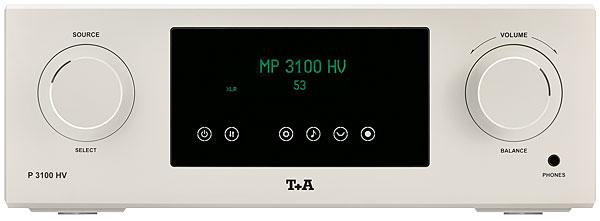
 With some sensible internal revisions, the German company has made its heavyweight preamplifier even more precise and detailed, without sacrificing any of the music’s soulYou can tell a lot about a company from the title it takes for itself – from the name of the founder to classical or musical allusions to the equivalent of go-faster stripes, every brand seems to set out its stall in a somewhat different way. German manufacturer T+A elektroakustik is no exception, except here the name – the initials stand for ‘Theorie und Anwendung’, Theory and Application – is saying ‘we’re no-nonsense, and led by engineering’. Or, as the company puts it in a brief bio, ‘Actually we’re scientists…’.
Part of the T+A thinking, apart from the ‘appliance of science’ thing, is to give its products long lifecycles, and build them in a modular manner, allowing facilities to be added to suit the user’s needs, and that’s the case with the P 3100 HV preamp we have here. It sells for £12,690, and is available in silver or titanium lacquer – or under the HV Individual programme, you can have it in ‘many special paint types, such as car finishing lacquers’.
Pure Pleasures
The P 3100 HV is all-analogue, and a line-only design. It may have separate digital and analogue power supplies, right back to requiring two mains cables, but the ‘digital’ section is purely there for display and control functions, the audio section being entirely analogue. Meanwhile the modular design seen across the company’s range allows the buyer to add a phono section for £1088, in either moving-magnet or moving-coil flavours, while the parametric eq/tone module, designated APM, is included as standard.
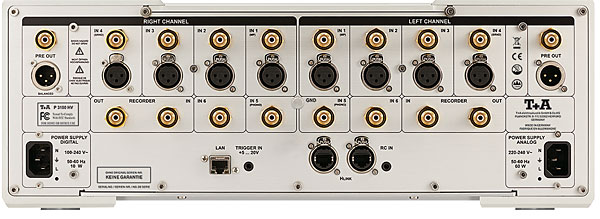
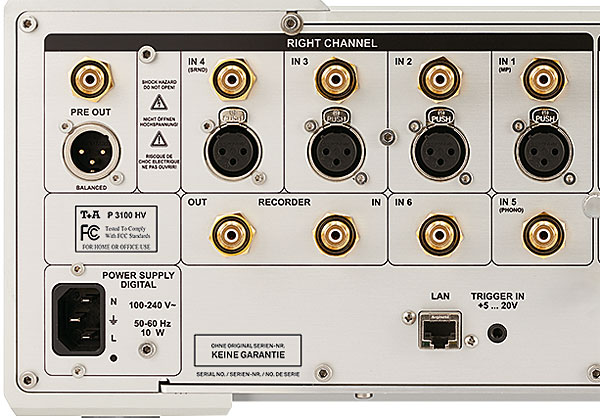
At heart, however, the P 3100 HV is very simple, with seven unbalanced inputs on RCAs, four balanced on XLRs, and preamp outs on both RCAs and XLRs, the layout of the rear panel making clear the dual-mono construction of the unit, which uses identical circuitboards for both channels. In addition there’s a single trigger-in socket for remote switching, an Ethernet port for remote control via the T+A app, and the company’s Hlink remote control bus that enables an entire T+A system to be run from a single remote control.
Furthermore, the Ethernet port connects with the company’s HVEQ software running on a PC, enabling room correction to be carried out. The headphone socket is powered by its own amplifier, and the only other ‘frill’ here is that one of the analogue inputs can be set in ‘bypass’ mode, allowing it to be used with an external surround processor. So this may be purist hi-fi, but there’s no reason why it shouldn’t be easy to use.
So far I could have been describing the P 3000 HV [HFN Sep ’14] this preamp replaces, but while the P 3100 HV looks identical and the ‘High Voltage’ topology is retained, much has changed under the lid.
Class Act
For a start the power supplies have been completely redesigned, using a more powerful, ultra-low-flux density transformer with a greatly reduced electromagnetic field for the analogue stage, designed to diminish current spikes and suppress any residual mains frequency noise. The transformer for the digital control section is also new, more powerful and uses extra electromagnetic shielding, while there’s improved filtering in both power supplies.
The main audio circuitry is also upgraded, using new Mundorf capacitors, precision Vishay resistors and even a completely different base material for the circuitboards, designed for lower dissipation. This isn’t a running tweak, despite outward appearances, but a complete redesign, along with the extensive DC-coupling of the preamp in order to remove as many capacitors from the signal path as possible.
Moreover, the volume control is the same superb relay-based design found in the P 3000 HV, giving the preamp superb channel-matching across its range. Anyone used to preamps in which the sound drifts a bit to left or right at very low levels is going to be delighted, as there’s none of that to be heard here.
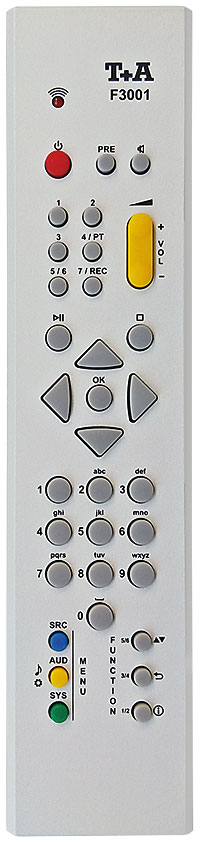
Above all, the P 3100 HV exudes class, and not just because it’s big, solidly built – it weighs as much as some power amps at 28kg – and immaculately finished. The controls have wonderful precision, from that hefty volume control to the reworked front panel touch-buttons, which have been retuned for greater sensitivity, and the whole thing is a delight to use. Even the metal-clad remote control is a cut above the norm.
 Top Brass
In the absence of a matching T+A power amp, the P 3100 HV was used in editor PM‘s listening room with Constellation Inspiration Mono [HFN Oct ’19] and Bricasti M25 power amps [full review next month], driving the Bowers & Wilkins 800 D3 speakers [HFN Oct ’16], and with the usual Melco/dCS Vivaldi One front end [HFN Feb ’18]. It was immediately apparent that this preamp is very much in the T+A tradition of precision and detail, with an entirely open view of the music that grabs and holds the attention. But there’s nothing ‘technical’, mechanical or sterile here. After just a few hours of post-lab test warm-up (and aided by temperatures hitting well into the 30s outside), the P 3100 HV was in fine form from the very first track played.
The swing, resolution and all-out brass power on Count Basie’s classic ‘Corner Pocket’, from Live At The Sands (Before Frank) [MFSL UDSACD 2113] was suitably attention-grabbing, lush and tinglesome. There was no sense of coloration, but purely a big, warm sound of a band of master-musicians in action, captured wonderfully in this 1966 recording. If this was the warm-up session…
Thrilling Stuff
Seduced by that brass sound, it was on to more horns in the form of the Gustavo Dudamel/Simon Bolivar Symphony Orchestra of Venezuela recording of ‘Siegfried’s Rhine Journey’ from the prologue of Götterdämmerung [Wagner; n/a cat no], and a chance to revel in the finest detail in the opening, before unleashing the power with those great brass passages. Thrilling stuff, and really one to have you turning up that beautifully-weighted volume control. Indeed, it’s worth forgoing the remote and using the front-panel control, simply because it feels so good, enhancing the ‘user-experience’ along with the excellent soundstaging and three-dimensional depth.
 That glorious scale of imaging is just as in evidence in the hushed tones and plucked strings of the opening to Vaughan Williams’s Fantasia On A Theme Of Thomas Tallis [LSO/Simovic in DSD64 from LSO Live LSO0792]. The orchestra is laid before the listener, and the lovely romantic sweep of the playing makes the piece simply fly by.
Nor is this ability limited to conveying wonderful orchestral music. With the snarly Texas boogie of ZZ Top’s ‘La Grange’ [Tres Hombres; Warner Bros download, 192kHz/24-bit], the P 3100 HV just takes the music from the source and passes it through to the power amp in a manner that may be precise and focused, but is also a whole load of fun. The ZZ Top track may be dense and gritty but everything going on is easy to hear – and enjoy.
Super Vibrant
By this point I was trying all kinds of tracks, just to hear this super-vibrant presentation in action. The Barenaked Ladies’ live version of ‘Brian Wilson’ [Hits From Yesterday & The Day Before; Rhino/Raisin’/Warner 8122-79757-3] is nothing if not vivid, and I don’t think I’ve ever heard quite as clearly that the audience singalong is word-perfect from the first notes. And neither have I ever experienced this track giving the Aerofoil bass drivers of the 800 D3s such a severe workout, even at ‘sensible’ listening levels!
So confident was I by now of the abilities of the whole system, and the preamp at its heart that it was time to re-visit some old favourites. Dire Straits’ ‘Money For Nothing’ [Brothers In Arms; Vertigo 9871498] had me thinking I’d never noticed how Pink Floyd-esque is the track’s ‘I Want My MTV’ opening, while Knopfler’s signature riff has a truly visceral quality, all strings and guitar body and pick-ups and electronics – you can sense how every note is being created.
Similarly with The Beatles’ ‘While My Guitar Gently Weeps’ [White Album; UMC download, 96kHz/24-bit] where it’s intriguing to hear how much of the old ‘left and right’ production style still remained by 1968, but also how clearly every element of the mix is captured.
This was also apparent with what has become a one-riff cliché, Fleetwood Mac’s ‘The Chain’ [Rumours; Rhino 96kHz/24-bit download]. OK, so I was listening on the weekend of the 70th anniversary Grand Prix, but still the clattery guitars and tight harmonies of the opening sounded enchanting, as did Mick Fleetwood’s pattering then thumping drums under the growl of John McVie’s celebrated bass line.
The same effect was in evidence with The Police’s ‘Spirits In A Material World’ [Every Breath You Take; A&M 069 493 607-2], on which the tight rhythm section Sting and Copeland formed (at least when not fighting) is just as deliciously obvious.
Hi-Fi News Verdict
I had an absolute ball with this preamp, combining as it does a remarkably ‘straight through’ sound with quality throughout, from design to engineering to styling and finish. I might swerve the ‘match my car’ paint options, but otherwise there’s nothing not to like here. It looks – and sounds – a million dollars, and is as much a pleasure to use as it is to listen to and with. Clearly the theory has been well applied here.
T+A P3000/A3000/PS3000HV Pre/Power Amplifier Review
When German audio specialist T+A Elektroakustik introduced its MP3000HV media player and partnering PA3000HV integrated amplifier its design engineers hinted that there were more components to come in its new HV, High Voltage, series. (For more on T+A’s HV design methodology, whereby its components’ various amplifi cation stages are driven at unusually high voltage, readers might refer to our detail appraisal of the PA3000HV.)
THREE NEW COMPONENTS
And now here are three new HV components: a preamplifier, a twochannel power amp, and an additional power supply to ‘beef up’ the power amplifier’s performance [see Lab Report]. Each is housed in an all-aluminium chassis identical in size and appearance to the previous units. And each boasts the same extravagant attention to detail and immaculate fit ‘n’ finish that has made its high-end integrated amp and media player such runaway successes [see boxout].
 |
||
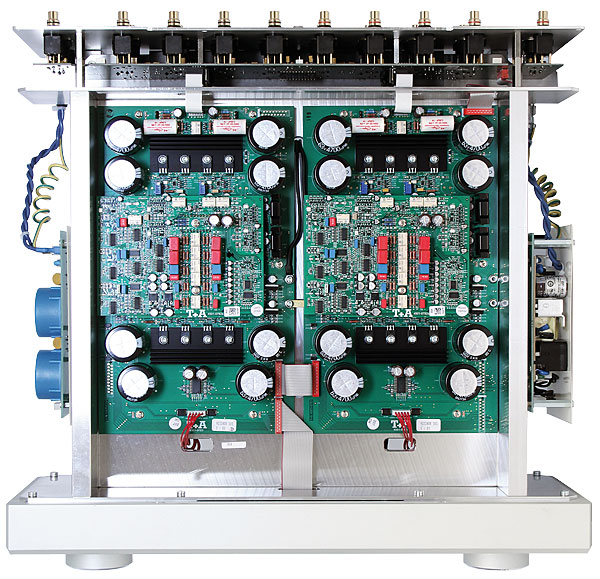
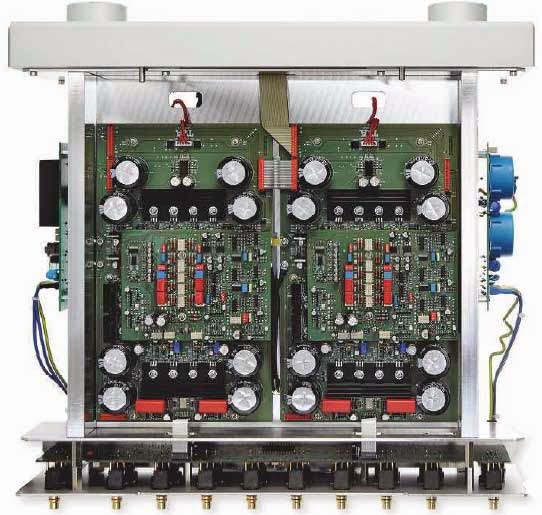
All are ‘double mono’ throughout, the left and right channels both electrically and mechanically separated, with power supply sections, audio circuits and control electronics housed in shielded chambers.
Given a cursory glance, the new P3000HV preamplifier (£9500) might easily be mistaken for the PA3000HV integrated (£9900) with its large VFD dominating the fascia, the display flanked in identical fashion by a rotary source selector and volume control. It’s a tantalising combination of ‘purist’ audio exotica and comprehensive functionality that includes an analogue tone processor module to provide bass/treble adjustment, a user-variable ‘loudness’ control which can be adjusted to suit your loudspeakers’ sensitivity and how far you sit from them, and three narrow-band parametric equalisers (per channel) working in the 20-500Hz range for tuning your speakers’ bass performance to your listening room.
T+A provides a CD of audio signals and a free Windows PC utility on its website (with instruction manual) to aid accurate setup, although keen hands-on hobbyists will need to invest in a calibrated USB microphone. Settings can be entered manually or sent to the preamp via Ethernet from your PC. Or, of course, you can play around to your heart’s content simply setting everything by ear to taste.
Illuminated touch-sensitive controls below the display window allow access to the preamp’s configuration menu; inputs can be named; and the tone, loudness and parametric EQ functions can be individually enabled or bypassed. A headphone amp is built in as well, which similarly can be turned on/off via the front panel. The preamp’s source selector and volume control knobs have needle roller bearings to provide a luxurious operational feel, the electronic volume control employing discrete resistors and goldcontact relays to provide gain adjustment in 1dB increments. All input switching is
carried out by sealed gold-contact relays incorporated within the circuits to keep signal paths as short as possible.
At the rear there are six line inputs, inputs 1-4 being switchable between single-ended (RCA) and balanced (XLR) operation. Furthermore, input 4 can be configured as a pass-through for integrating the preamp with a surround decoder. An optional MM/MC phono stage can be fi tted by dealers, priced £990. And the preamp’s microprocessor and display circuitry, and its critical analogue audio circuits, are driven by completely independent power supplies – all the way to two AC inlet sockets. Oh yes: powering up the preamp requires two mains leads.
 |
| Two huge rotaries flank T+A’s familiar operational display, governing input and volume as well as navigating through the set-up menu. In this picture, T+A’s media player is selected |
A SERIOUS STATEMENT
The partnering A3000HV power amplifier (£11,900) features a larger display window sporting two deliciously retro-looking power meters. Naturally these can be dimmed or turned off if you find them distracting. And you’ll know it’s a ‘serious’ power amp the moment you try to lift it – although its 2x300W/8ohm specified rating (and 38kg weight) is actually identical to that of the integrated PA3000HV. A rear switch converts the power amp to ‘high current mono’ mode.
Voltage and current amplifier sections are on discrete PCBs in separate case sections and galvanically isolated, while the fully symmetrical output stage employs MOSFET drivers and ‘thermal tracking’ bi-polar output transistors with integral temperature monitor diodes. Says T+A: ‘We maintain the power transistors at a constant operating point, regardless of temperature, which allows us to control the circuit’s distortion behaviour regardless of the momentary load.’
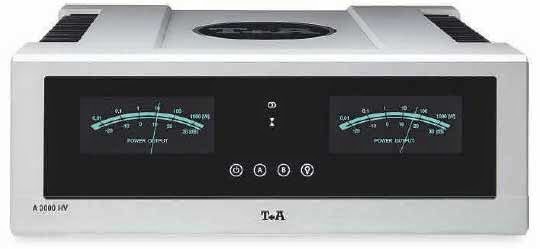 |
| T+A’s classic ‘fishbowl’ meters are bang-on accurate, revealing power output into a 4ohm load, not 8ohm. |
There are two sets of rhodium-plated speaker terminals machined from pure brass which can be turned on/off via the front panel and used for bi-wiring or driving a second pair of speakers.
The A3000HV’s linear power supply features a whopping 1000W transformer and is extremely ‘stiff’, nevertheless to further increase voltage and current stability to the amplifier’s output stages the supplementary PS3000HV power supply unit can be added. Containing a 1200W transformer and a reservoir capacity of 240,000μF, it is hooked up via an umbilical cable terminated at each end with substantial M23 multi-pin connectors. At £7900 the PSU takes the price of the power amp to £19,800 – but it does transform it into something altogether different [see Lab Report]. The supply’s huge VU meters can be switched to indicate operating voltage, current drain, or interference from the mains! Both the power amp and PSU employ IEC C20 inlet sockets rated at 16A, each unit supplied with a mains lead fitted with the requisite C19 female plug rather than a typical C13/C15 ‘kettle plug’.
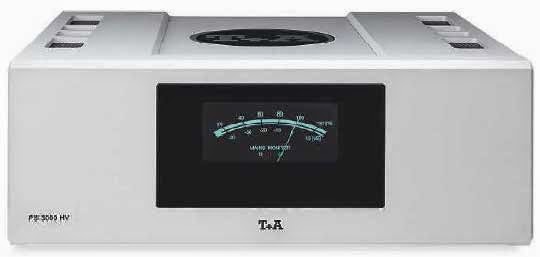 |
| T+A’s ‘supplementary’ PS3000HV PSU replaces the A3000HV’s 1000VA supply with a 1200VA powerplant solely for its bipolar output stage |
All key functions are controlled via the chunky aluminium handset supplied with the preamplifier, and the three-box system becomes ‘unifi ed’ for single button on/off switching once the units are daisy-chained via supplied ‘E-Bus’ CAT5 cables terminated with Neutrik RJ45 plugs.
Partner the amp combo with the MP3000HV media player and you’re bound to prefer controlling your entire system with the company’s FD100 handset supplied with the media player. This is a splendid bi-directional RF handset incorporating a small LCD screen displaying album artwork when streaming music files over a network – it comes with a charging base where it can be parked at night.
LIQUID POWER
I began listening to the P3000/A3000HVs as a two-box pre/power combo (£21,400). As with the PA3000HV integrated tested last year, I was greeted by a subjectively ‘fast’ and vivid sound with tight, punchy and fearfully powerful bass. I’d expected it to be revealing, yet was struck more by its effortless liquidity that resulted in a less ‘stark’ and rather more forgiving nature than I’d witnessed from T+A’s integrated.
I was feeding CD-quality and hi-res audio from my computer into T+A’s £1990 DAC 8 converter [HFN Oct ’12]. When I’d used this identical source into the HV integrated I’d thought the DAC not quite good enough for such a revealing amp, yet with this pre/power combo I harboured no such concerns.
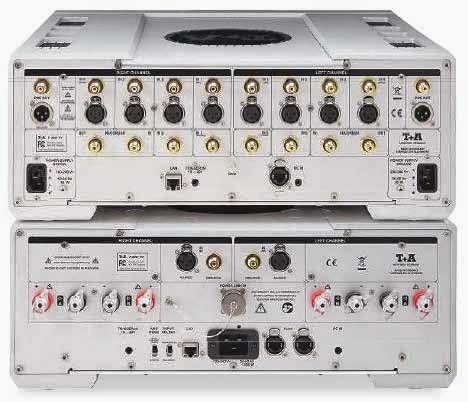 |
| Preamp has six line inputs, four with balanced (XLR) options, a recorder in/out, and balanced and single-ended pre-outs. Power amp has two sets of speaker terminals for bi-wiring or can be switched to ‘high current mono’ mode. |
Returning to Stravinsky’s Rite of Spring with the Cleveland Orchestra under Lorin Maazel [Telarc CD-82001] the three-dimensional picture of a recording venue was palpable, woodwind and strings clearly separated, and the overall tonality frankly ‘beautiful’ – without appearing artifi cially sweetened.
Even with pretty standard quality pop fare such as Daryl Hall and John Oates’ ‘She’s Gone’, from the duo’s Greatest Hits: Rock ‘n’ Soul Part 1 compilation CD [RCA PD84858], the presentation was surprisingly smooth and civilised, with good control of sibilants. Meanwhile clarity was excellent, allowing the singers’ close harmonies to be easily assimilated even as the dynamics of the recordings became ‘crushed’ during the song’s chorus sections.
I soon concluded this pre/power combo is far superior to T+A’s nonetheless fabulous PA3000HV integrated. It delivers detail a-plenty, while appearing relaxed and unforced. Adding the PS3000HV PSU to the A3000HV increases its power output capability by a good few watts while offering a substantial reduction in noise [see Lab Report]. The increased sense of ease and effortlessness it provided to music replay represents a major upgrade in sound quality – transforming a beautiful pre/power amplifier into a world-class combo of which hi-fi dreams are made. It sounded both immediate and exquisitely refi ned, and dynamic contrasts were startlingly lifelike.
I got one heck of a fright from its explosive bass power while swimming in the ambience of the experimentally dissonant ‘New Moon At Deer Wallow’ from Rain Tree Crow [Virgin CDVX 2659]. The pre/power/PSU combo’s seemingly unfettered low frequency power and definition plunges wa-ay down into the infrasonic region with ease, while the timbre and texture of Mick Karn’s bass clarinet was described in all its deliciously chocolatey detail.
Similarly David Paich’s bass synthesizer embellishments on Boz Scaggs’ seductive ‘Thanks To You’ from Dig [Virgin 10635 2 1] were described immaculately by the HV amp combo, adding immense gravitas to the track’s lusciously creamy recording quality.
STRIDENCY IN CHECK
I’ve not witnessed my Townshend Sir Galahad speakers so thoroughly ‘gripped’ and controlled since driven by Mark Levinson No53 monoblocks, or so open and transparent to fi ne details buried in recordings. Moreover, voices and instruments always appeared realistically fl eshed-out thanks to the combo’s richly voiced midrange and natural high frequency reproduction.
With hi-res audiophile recordings I enjoyed holographic musical images, but also revelled in plenty of high-adrenalin hi-fi fireworks even when my system was challenged to reproduce less-than-stellar CDs.
One such was Michael Jackson’s Dangerous [Epic 465802 2]: a cacophonous mess of a recording that sounds harsh, lean and scratchy on any hi-fi system. But T+A’s combo made the best of the rumbustious opening track ‘Jam’ and the only slightly less jarring ‘In The Closet’.
The amplifier’s dynamic prowess delivered the music’s attacking rhythms with aplomb and its uncommon civility made a pretty good stab at keeping stridency in check. As the preamp has tone controls even the most unpalatable of recordings can be tweaked to sweeten them.
As a trio this pre/power/PSU combo is the price of a new car, so I wouldn’t dare call it ‘affordable’. Yet I’m already turning a shade of green, as there will doubtless be audiophiles ordering ‘fivepacks’: mono-ing two of the power amplifiers and adding a power supply to each!
LAB REPORT
The technical prowess of this pre/power is beyond doubt with the P3000HV preamp the more ‘linear’ device offering a maximum +14dB gain (balanced), fabulously low distortion of 0.00007-0.00025% [20Hz-20kHz re. 0dBV – see Graph 2, below], a wide 102dB A-wtd S/N ratio and response flat to –0.45dB/100kHz. T+A’s custom volume control acts in 1dB steps over a 60dB range with ±0.1dB overall accuracy, over an 80dB range with ±0.2dB accuracy and 90dB with just ±0.3dB variance – an incredible result!
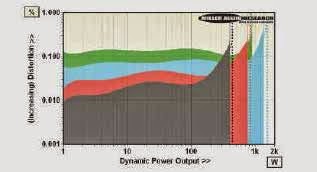 |
| Dynamic power output versus distortion into 8ohm (black trace), 4ohm (red), 2ohm (blue) and 1ohm (green). Dashed traces with PS3000HV PSU. |
The partnering A3000HV amplifier benefi ts substantially from the optional PS3000HV outboard PSU. There’s obviously no change in the overall +26.5dB gain and only a fractional reduction in distortion from 0.01-0.043% to 0.0089-0.039% (1-300W/8ohm at 1kHz) and from 0.013-0.027% to 0.011-0.024% (20Hz-20kHz at 0dBW). The response is fl at from 1Hz-50kHz (–0.5dB), reaching 100kHz at –2.3dB. Noise and power output are another matter, however. Disabling the A3000HV’s main internal PSU reduces residual noise by 6dB and improves the A-wtd S/N ratio from 81.5dB to 88.8dB (re. 0dBW) with the PS3000HV connected. Continuous power output increases from an already substantial 350W/620W to 385W/700W into 8/4ohm while the dynamic output improves from 405W, 760W and 1.37kW into 8, 4 and 2ohm loads to 445W, 845W and 1.59kW [see Graph 1, below]. The output stage is protected above 890W (29.8A) into 1ohm with or without the PS3000HV.
 |
| THD vs. extended frequency; P3000HV (1V out, black trace) vs. A3000HV (10W/8ohm, blue) |
VERDICT
T+A’s ‘no compromise’ HV series components are designed for the luxury audiophile market. In that context, this latest amp combo is sensational value. We’ve said this so often of T+A’s separates there’s a danger of it becoming tedious: if they were made by a boutique audio manufacturer they’d come with price tags two or even three times larger. Little wonder the German company is selling them hand over fist.
SOUND QUALITY: 89%
SPECIFICATIONS
Power output (<1% THD, 8/4ohm) : 350W (385W) / 620W (700W)
Dynamic power (<1% THD, 8/4/2/1ohm) : 445W / 845W / 1.59kW / 890W
Output imp. (20Hz–20kHz, pre/power) : 45ohm / 0.051–0.061ohm
Freq. resp. (20Hz–100kHz, pre/power) : +0.0 to –0.45dB / +0.0 to –2.28dB
Input sensitivity (for 0dBV/0dBW) : 200mV (pre) / 133mV (power)
A-wtd S/N ratio (re. 0dBV/0dBW) : 101.9dB (pre) / 88.8dB (power)
Distortion (20Hz-20kHz, 1V/10W) : 0.00007-0.00025%/0.011-0.024%
Power consump. (pre/idle/rated o/p) : 45W (An)/5W (Dig) / 160W/960W
Dimensions (WHD All units) / Weight : 460x170x460mm / 28, 38, 38kg
Description
Preamplifier stage
Outputs
Mains / Accessories / Dimensions
Input 4 can be configured in surround mode
(surround pass-through)
Related products
-
Ming Da MC 845-C12 Single Ended
R59,000.00 Add to cart -
DEQX A250 (250w x 2) Stereo Amplifier
Original price was: R32,000.00.R15,000.00Current price is: R15,000.00. Add to cart -
Ming Da MC 368-BSE
R39,000.00 Add to cart -
Perreaux 750p Mono blocks – NEW
R180,000.00 Add to cart