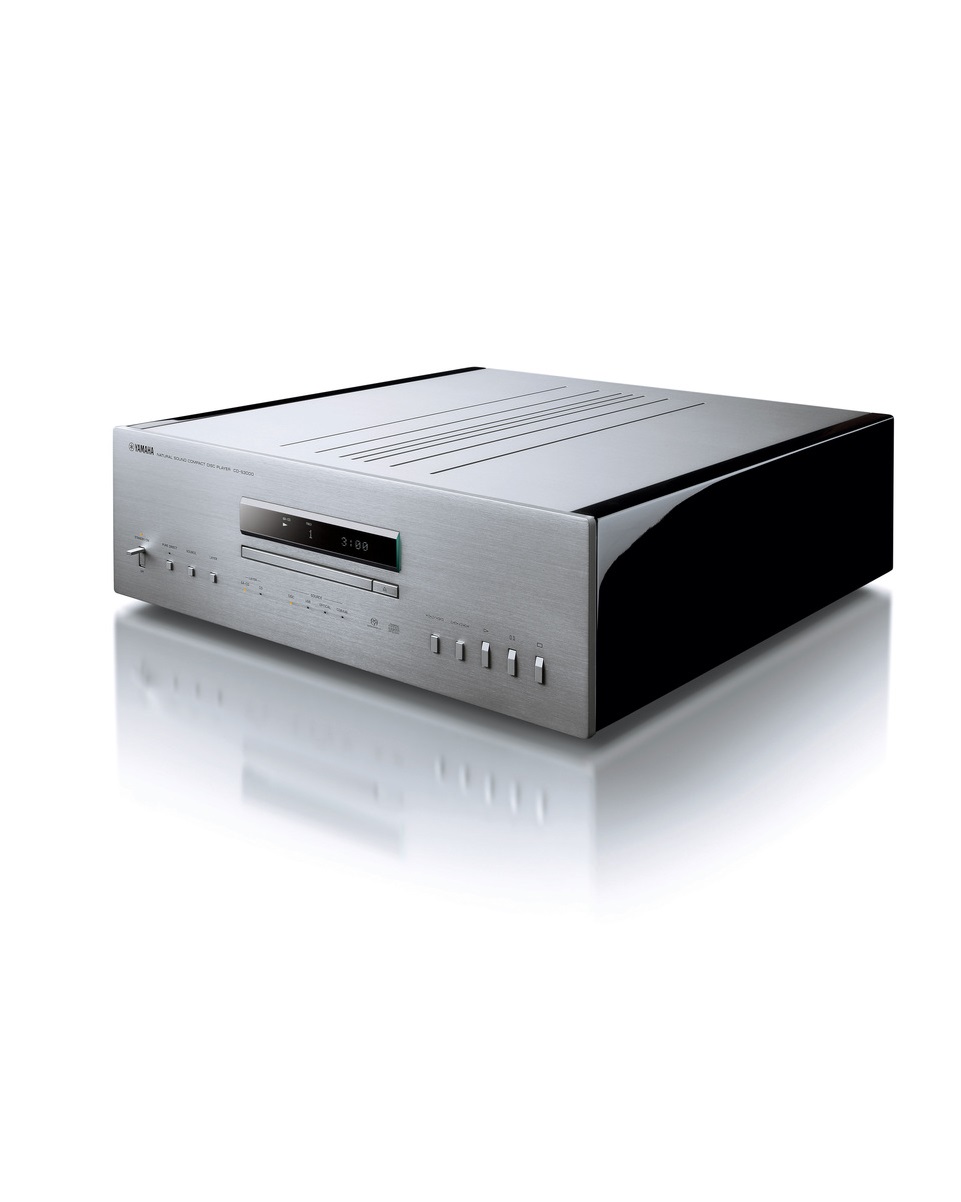
Yamaha CD-S3000 CD/SACD (Silver)
R124,000.00 Original price was: R124,000.00.R22,000.00Current price is: R22,000.00.
| CD-S3000 | ||
|---|---|---|
| CD Player | ||
| Type | Single Disc CD Player | |
| Disc Compatibility | SACD, CD, CD-R/RW (MP3, WMA), USB | |
| Output Level | SACD / CD 2.0 ± 0.3 V (1 kHz, 0 dB) | |
| Signal-to-Noise Ratio | SACD / CD 116 dB | |
| Harmonic Distortion | SACD / CD 0.002% (1 kHz) | |
| Dynamic Range | SACD 110 dB, CD 100 dB | |
| Frequency Response | SACD 2 Hz-50 kHz (-3 dB), CD 2 Hz-20 kHz | |
| Output | Optical and coaxial | |
| Power Consumption | 30 W | |
| Dimensions (W x H x D) | 17-1/8” x 5-5/8” x 17-5/16” | |
| Weight | 42.3 lbs. | |
- Optimised High-precision Rigid CD Mechanism with heavy anchors improves vibration control and achieves precise signal reading
- High rigidity aluminium CD tray
- High rigidity main chassis improves anti-vibration properties and left-right symmetrical construction
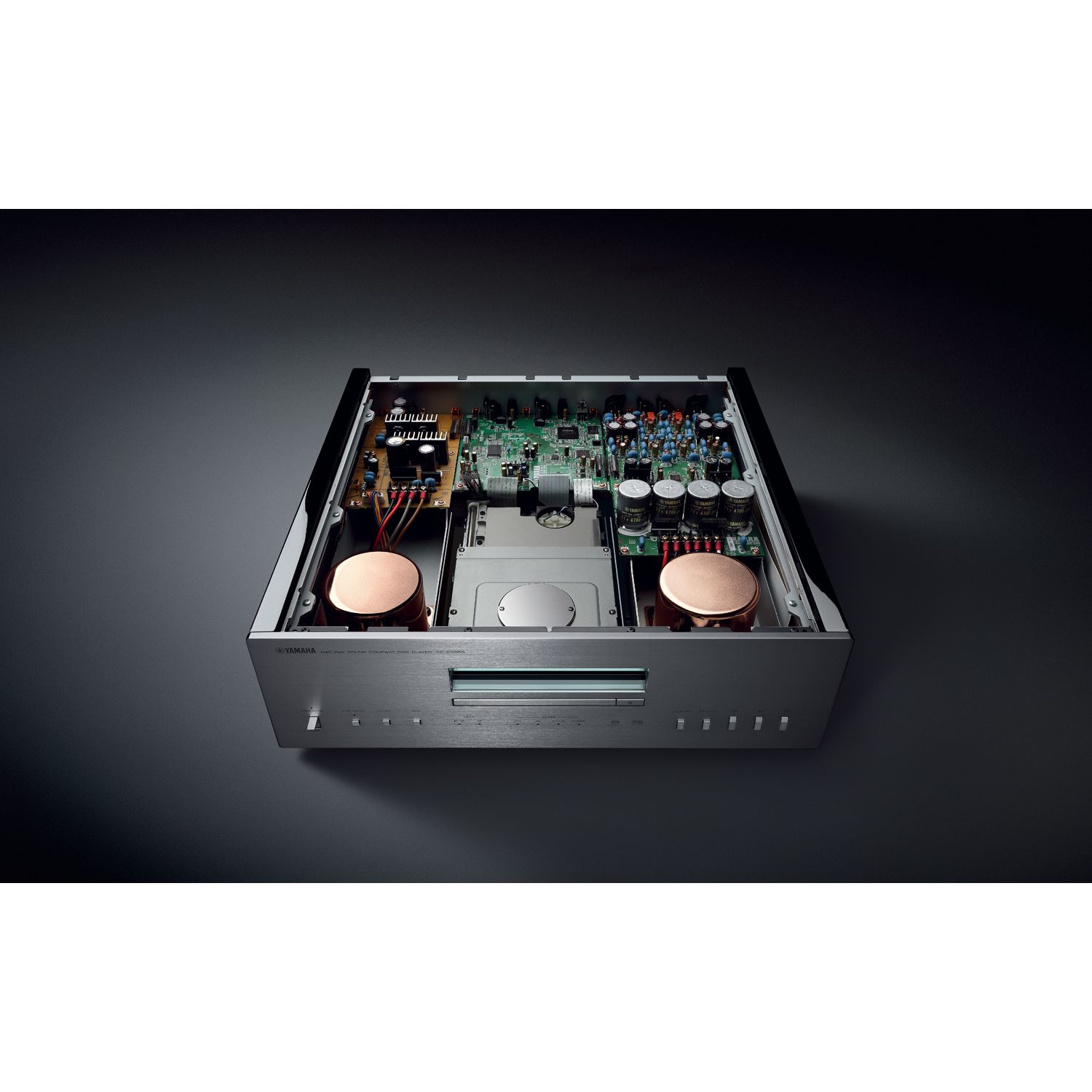
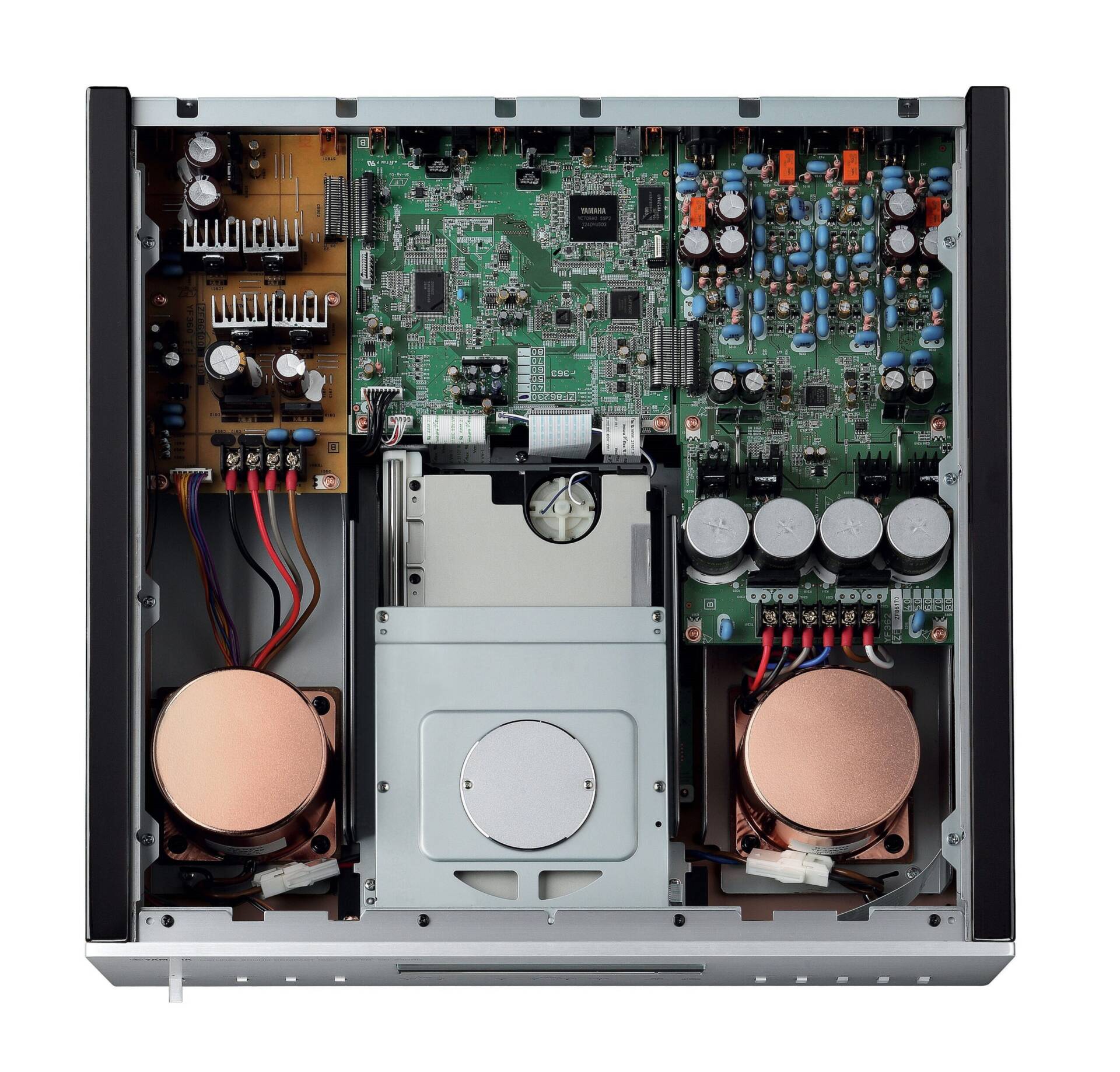
- Independent configuration of digital and analogue circuits
- Digital/analogue boards with integrated power supply circuits
- Single-stage configuration I/V conversion circuit enables direct analogue output
- Exceptionally high performance 32-bit D/A converter
- Built-in USB DAC functions
- ASIO 2.3 Yamaha Steinberg USB Driver
- Pure Direct Mode further enhances the quality of analogue sound
Description
What Hi-Fi? Verdict
A beautifully engineered player – and a refined and insightful performer too
Pros
- + Superb build and finish
- + Well-judged tonality
- + Insightful and well-balanced presentation
- + Digital inputs
- + Nice remote
Why you can trust What Hi-Fi? Our expert team reviews products in dedicated test rooms, to help you make the best choice for your budget. Find out more about how we test.
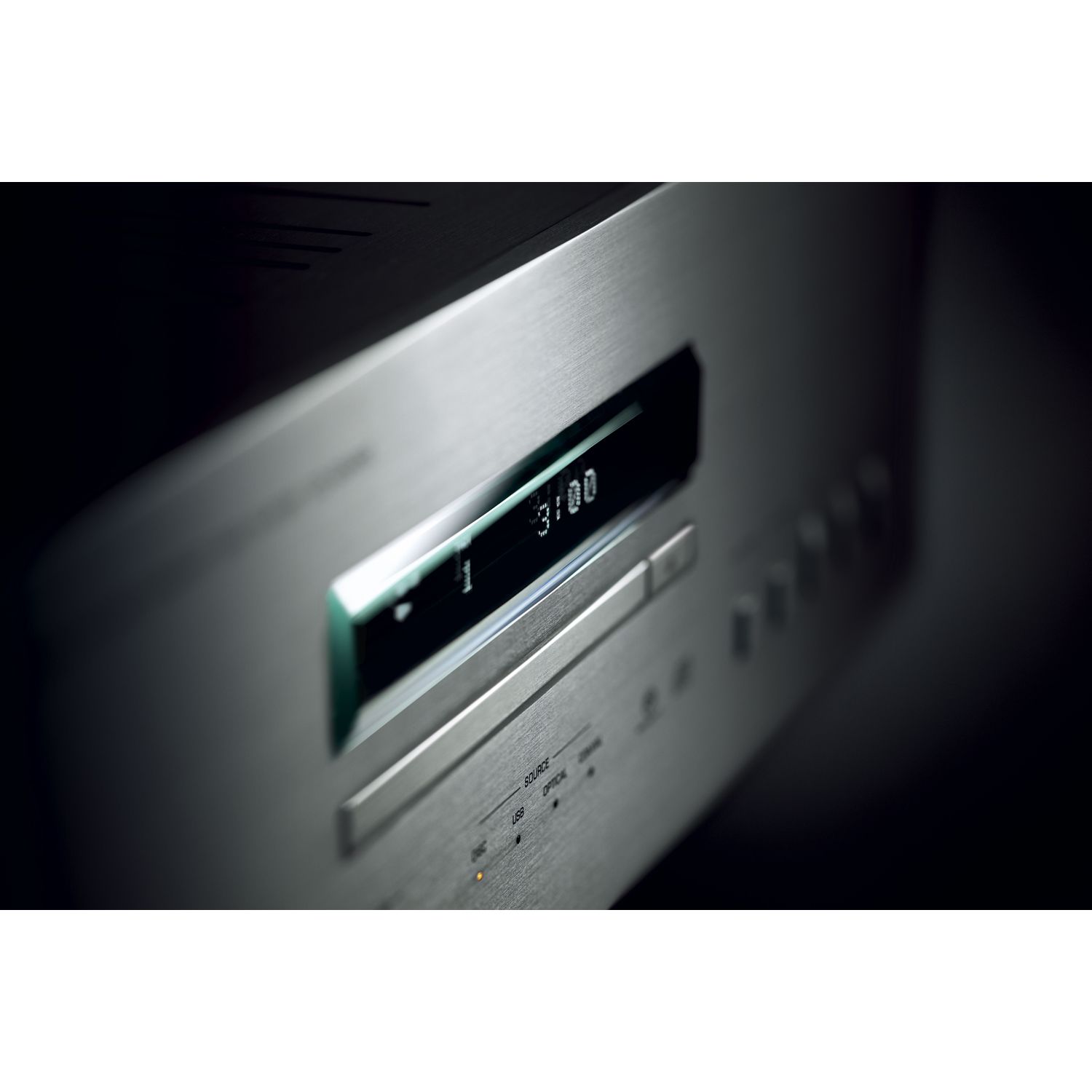
It’s the little things that make a difference. In the case of Yamaha’s CD-S3000, it’s the disc drawer.
Most rivals are happy using off-the-shelf rickety plastic drawers; the aluminium unit on the Yamaha glides out with grace.
Build and design

It wouldn’t count for much if the rest of the transport mechanism weren’t engineered to similar standards, but it is: with everything from the laser to the way the complete transport is mounted inside the casework carefully considered.

Its casework is made up of thick aluminium plates and houses a generous power supply. The supply is configured with separate feeds for the analogue and digital sections of the circuitry, right down to dedicated mains transformers.
This separation minimises any unwanted effects caused by the sections interacting. The result should be greater sonic transparency.
Those two mains transformers are encased in copper housings to reduce any distortion caused by magnetic leakage and keep the amount of vibrations fed into the player’s structure at a minimum.

Everywhere we look there are signs of attention to detail – from the carefully laid-out circuit boards to the neat arrangement for levelling the transport’s position inside the casing.
Yamaha has even engineered the player’s feet so they can be used spiked or unspiked. This thoroughness continues to the casework, where fit and finish are absolutely top class.
Every surface is finished immaculately and all the panels line up just so. The supplied remote control is suitably classy too, being nice to hold and easy to use. It’s becoming increasingly common for CD players to come with digital inputs.
It makes sense: if your player has a high-quality DAC, why not make the most of it by routing other digital sources through the circuitry.
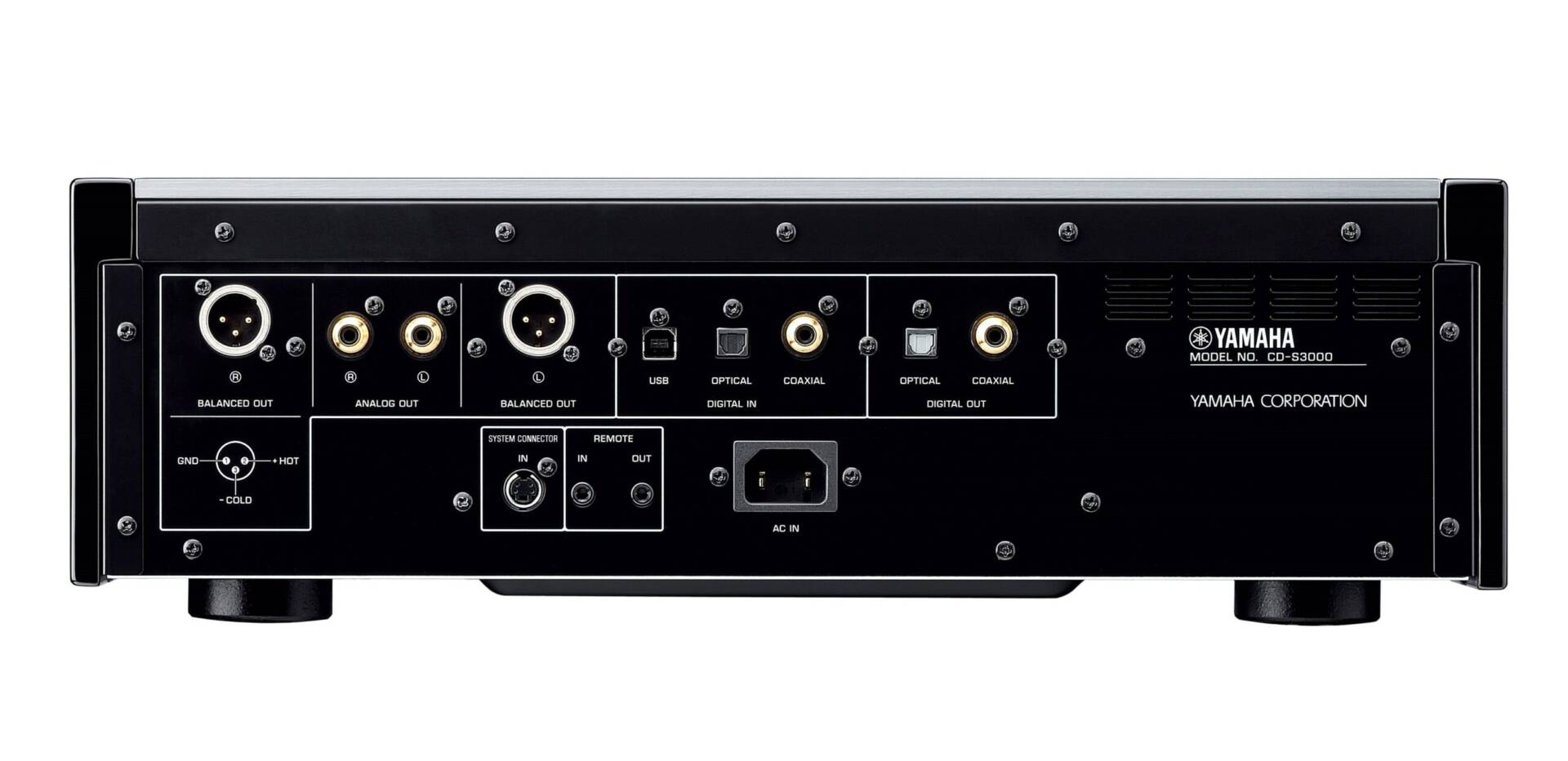
The CD-S3000 comes with the usual trio of USB, optical and coax (all capable of accepting a 24-bit/192kHz music streams, with USB adding DSD capability to that).
Performance

When we start using the CD-S3000 we realise its not a player for the impatient. Responses are a little dim witted, particularly when loading a disc or switching inputs.
Given a few seconds it always does what you want though. We start with CD – an old favourite in the form of Rounds from Four Tet – and this Yamaha does well.
It’s agile, detailed and delivers a decent dose of punch. Like its partnering A-S3000 amplifier, this player sounds really well balanced. There’s a hint of excess warmth, but all it does is to give the player’s sound a likeable solidity.
Rounds is full of complex rhythms, and we’re pleased to report the CD-S3000 does a good job with them.
It doesn’t quite have the hard-charging attitude of a Naim CDX2 or the leading-edge precision of Cyrus’s transport and DAC combination, but it remains composed, precise and delivers enough energy to keep us hooked.

There’s a good degree of insight and an admirable level of composure when the music becomes complicated. We like the Yamaha’s punch too, and its way with dynamic shifts.
There’s enough muscle here to deliver a sizable kick when necessary but plenty of finesse when the music requires. That finesse comes in handy when we listen to Beethoven’s Moonlight Sonata.
This beautiful piece of music requires subtlety, resolution and fluidity to really shine, and the Yamaha obliges, putting in a spellbinding performance that has us gripped from beginning to end.
The good news continues with SACD replay. Eric Bibb’s Good Stuff sounds luscious. The sound is smooth and richly detailed, delivering the heart-felt vocals with passion and forcefulness.
We switch to the digital inputs and are happy with what we find. The on-board DAC reflects the surefooted presentation we hear with disc replay.
Listening to a range of music, from Nirvana’s Nevermind to Elvis, it strikes us that we’ve stopped thinking about the Yamaha and have started focusing on the music alone.
Verdict
This is an understated player that just gets out of the way of the music. While it may not be the last word in any one respect, bar possibly build quality, it has enough talent to let the music shine.
And, when you think about it, that’s what good hi-fi is all about.
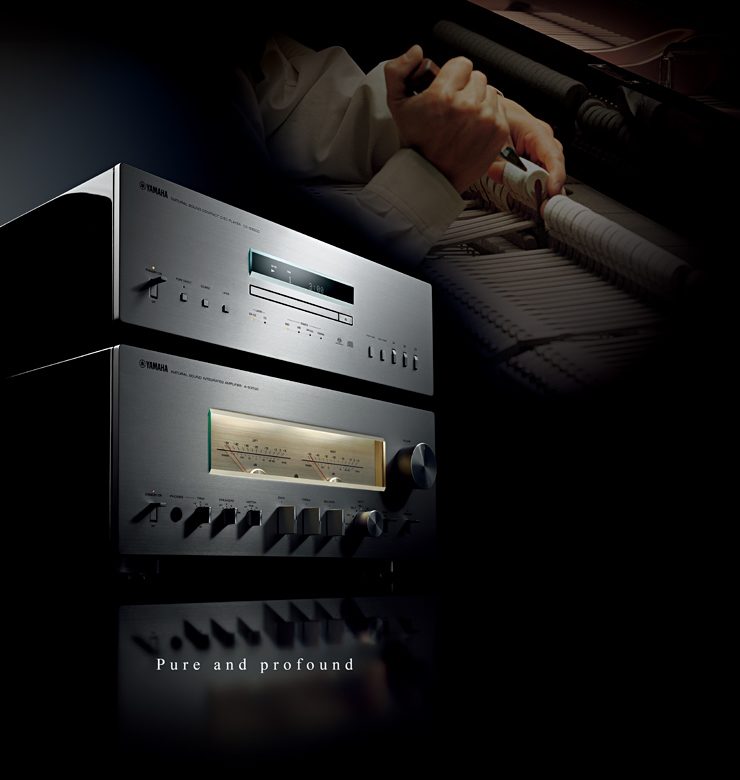
A piano comes into this world through the perfect synergy of advanced technical skill and artistry. Such a piano can create sound that truly reflects the player’s feelings.
The final stage in piano production is called “voicing.” This breathes life into the instrument and truly makes it musical. To accomplish this, highly skilled experts focus their concentration and sensitivity completely on each note and delicately adjust the hardness and resilience of the hammers that strike the strings, establishing the perfect, consistent sound for the entire instrument and determining its tonal personality.
Yamaha brings this exact same approach and process to its audio products. Our experienced technicians perform exhaustive listening tests and strictly consider every single element and component, to draw closer—step by meticulous step—to the ideal sound.
Introducing the S3000 Series, the absolute culmination of hi-fidelity audio. Yamaha knows all about sound and even more about music, and has brought all its rich artistic sensitivity into the creation of this line.
All the energy and finely nuanced technique of the artist, all the power and subtlety of the original music is fully reproduced, with absolutely nothing left out. The result is a remarkably pure sound—powerfully expressive and exquisitely profound.
Beautiful and elegant in appearance, sturdy and reliable in construction, created with the latest, innovative technology and genuine craftsmanship—all nurtured by our long experience in the manufacture of musical instruments.
Yamaha proudly offers this new high-end lineup, delivering supreme quality in every way. This is the manifestation of our passion to give music lovers the ultimate in listening enjoyment—a tradition we’ve been carrying on and advancing for more than 125 years.
The Yamaha CD-S3000 is not simply a disc player, because to survive as a CD/SACD player in 2015, a device also needs to support a range of digital inputs. The Yamaha CD-S3000 comes with coaxial, optical, and USB inputs. Yamaha supports DSD64 and DSD128 file replay, but rolls its own Steinberg ASIO driver for PC and Mac, and its website has a recommended configuration for Foobar replay. Essentially, instead of the more commonplace ‘DoP’ system (where the DSD file is wrapped in a pseudo-PCM outer shell to be read by compatible hardware and software) this sends native DSD files from computer to player. It’s unclear whether DSD sounds better this way or through DoP, or indeed whether there is a difference to be heard at all. Both DSD and PCM files are fed through the player’s ESS9018 32bit 192kHz Sabre DAC. The CD-S3000 has balanced and single-ended outputs.
This system comprises the basic trio of components, the likes of which could have been at the core of an audio system 25 years or more ago, albeit brought up to date. The electronics are both from Yamaha’s current flagship S3000 range, which consists of just two products: the CD-S3000 CD/SACD player, and the matching A-S3000 integrated amplifier. Meanwhile, the loudspeakers are the larger bookshelves from Monitor Audio’s new Gold series, the Gold 100, which replace the popular GX100 models.
Yamaha has not skimped on its flagship pairing at all. These are products built to show what Yamaha is capable of doing when all the stops have been pulled out, and simply from the point of lifting either product out of its packaging, you know you aren’t dealing with some middleweight. Take the CD-S3000 for example: lifting that out of the box, you could mistake it for a power amp, and a substantial power amp at that. It’s comprehensively well built, right down to the disc drawer – no plasticky, wobbly sled, this mech glides out of the front panel, is held in place with a positive, rigid feel, and gently withdraws to play your discs with military-spec confidence. You even have the option of spiked or normal feet.
The Yamaha CD-S3000 is not simply a disc player, because to survive as a CD/SACD player in 2015, a device also needs to support a range of digital inputs. The Yamaha CD-S3000 comes with coaxial, optical, and USB inputs. Yamaha supports DSD64 and DSD128 file replay, but rolls its own Steinberg ASIO driver for PC and Mac, and its website has a recommended configuration for Foobar replay. Essentially, instead of the more commonplace ‘DoP’ system (where the DSD file is wrapped in a pseudo-PCM outer shell to be read by compatible hardware and software) this sends native DSD files from computer to player. It’s unclear whether DSD sounds better this way or through DoP, or indeed whether there is a difference to be heard at all. Both DSD and PCM files are fed through the player’s ESS9018 32bit 192kHz Sabre DAC. The CD-S3000 has balanced and single-ended outputs.
Moving over to the A-S3000 amplifier, it’s obviously reminiscent of those vast Japanese amps and receivers of the 1970s and 1980s, especially with its large VU meters. No fluro displays here, these are proper waggling needles illuminated by bulbs, the way things always used to be in the good ol’ days. It has tone controls, and all the knobs and dials have the kind of solid ‘thunk’ and resistance to your fingers that exudes old-school quality. Yes, these things appear facile and unimportant next to the technical details, but they ultimately inspire confidence in the product, and are not to be sniffed at.
The A-S3000 is a solid 170W design, with the accent on the solid – open it up and you might mistake it for a small Krell design, such is the size of the toroidal, the caps and the heatsinks behind those piano gloss end cheeks. It is massively over-built everywhere, and fantastic for it. It’s a little old-school in its fairly limited options for phono (just MM and MC – at this level, there should be some adjustment of gain and load for MC), but the MC input is well-engineered enough to have a silent background, good gain, and pretty good dynamic range when used with the kind of cartridges that might partner a £4,000 integrated amp.
There is one important consideration here. Both CD and amplifier have the option of being run in either balanced or single-ended modes, with either a pair of XLR cables or a set of RCA wires. While the balanced option seems like a good idea on paper, in most cases you are best avoiding it, because the two devices sound very listless through their XLR inputs and outputs. Single-ended sounds better, a lot better.
Yamaha’s audio equipment took something of a back seat to its audio-video and other products until recently, but with the S3000 models, the company is making a bold “We’re back!” statement. And so is Yamaha’s ‘Natural Sound’ concept, which lives up to the name, but is possibly at odds with the ‘shiny, fast, forward’ sound of a lot of modern electronics. Especially in the CD-S3000, which is an extremely refined and precise player irrespective of disc or data, or even what file type is being used. The A-S3000 amplifier puts more energy into its higher frequency performance than the player (it’s not ‘brighter’ just ‘more energetic’ in the mids and treble). I was always fond of the Natural Sound presentation, although with age I’m beginning to prefer a more forward sound in my own listening. But I think Yamaha’s approach is less overt, more honest, and yes, more natural, than many rivals. OK, more immediate sounding devices will perform better in demonstration, but for long-term listening a more refined sound is preferable.
Monitor Audio has long been one of the most successful loudspeaker brands around, but in recent years the company has taken that success to new levels, and a key part of that unparalleled success is its ever-popular Gold line of loudspeakers. Monitor Audio’s ethos from the outset has been to combine high technology drive units with beautifully finished cabinets and the rear-ported two-way Gold 100 standmount is no exception. This uses the latest iterations of the company’s C-CAM ribbon tweeter (which extends to 60kHz) coupled with the brand’s dimpled Rigid Surface Technology (RST) radiating dish bass driver, which uses a larger motor and longer voice coil than most bass cones, for longer cone excursion with less cone break-up.
This means lower distortion and more bass; this is a 165mm bass unit with the kind of response expected from a 200mm conventional driver, and the Gold 100 realistically reaches down to 42Hz. Also, despite a comparatively (by high-end standards, at least) modest price, the Gold 100 bristle with high quality components, including polyprop caps, air core and laminated steel core inductors. The Gold 100 is designed to be used at least 20cm from a rear wall, (although they can go closer if you insert the rear foam bungs).
My own exposure to Monitor Audio’s designs has been fairly limited until recently, but their directness and vibrant presentation has been a constant for years. There is an easy immediacy and energy to the sound that always strives to make music fun.
Like the Yamaha designs, the Gold 100 is an excellent performer in its own right, and like the Yamaha designs, it’s one of a distinct character. The Gold 100 is supremely detailed, and exceptionally fast sounding, in the manner of Monitor Audio speakers of old, and while it follows in the footsteps of its predecessors, it is moving away from the ‘lean and bright’ sound of the original gold dome designs. The Gold 100 is more ‘cut glass’ than ‘breaking glass’, but that signature high frequency energy is still there. What the Gold 100 does is build substantial and significant soundstage size and depth to that energetic top. It also makes the midrange more open and vibrant. The thing about the Monitor Audio loudspeakers today is they offer a lot of loudspeaker for the money, and while they might not be the last word in stark neutrality or tonal accuracy, they more than make up for in ‘fun factor’.
I enjoy the sound of both the Yamaha duo and the Monitor Audio for very different reasons. One is ‘head’, the other ‘heart’. The Yamaha CD player is a satisfying, civilising force, with excellent soundstaging, extraordinary detail and vocal articulation, and compared to some of the more ‘excitable’ players out there, is more mannered and cerebral. The Yamaha amp is less controlled (especially in the midrange and high frequencies) than the player, but is equally civilising and refined across the board. The Monitor Audio, on the other hand, is more immediately impressive and entertaining. What I’d really like, however, is something that combines the refined elegance of the Yamahas with the fun of the Monitor Audios.
Combining the trio is no guarantee of success, for several reasons. First, this is not ‘three wrongs making a right’: the musical intentions of these products are distinct and correct for their end users. The ‘natural sound’ component of Yamaha’s player and – to a lesser extent, the amplifier – is unforced and excellent, but might be too ‘chilled out’ for those looking for a more immediate presentation. Similarly, the Monitor Audio Gold sound is exciting and excellent, but might be too ‘up front’ for those after a more contemplative listening session. In combination though, there is synergy at play, and the two sonic signatures work in perfect harmony.
More importantly, the big risk in building a system up in this manner is the chance to get it mostly wrong. There was a risk that the characteristics of both would end up with a system that managed to iron out the good in all three devices and just leave a sound that is peaky in places and dull in others. Although there was a very slight emphasis on the upper mid that seemed to come from the amp-speaker meeting point, in fact this system managed to pull together the best in all of them. And the acid test of this is the need for ‘ancillary’ devices – if your system is crying out for equipment supports and cables to ‘fine tune’ an already fine-tuned system, you are lost. Here, the need for such devices was more to bring out what was already good in the overall system sound. There was no need to ‘shoot the moon’ and add cables that cost as much as the system, although the usual suspects (AudioQuest, Nordost) worked well.

Finally, the risk in putting together a system in dynamic balance is you can put it out of kilter with the wrong music. A system that works well should work well with all genres, and by trying to trade what works in one component with what works in another is almost asking for cracks to appear, where whole musical genres can fall through. I needn’t have been concerned, because the system performed extremely well playing Schoenberg’s Verklärte Nacht [von Karajan, Berlin Philharmonic, DG], because the combination of the beauty of the playing and the energy of the climaxes almost matches the system balancing act taking place. The same does not hold for music like ‘Light of Some Kind’, by Ani DiFranco [Not A Pretty Girl, Righteous Babe records], where the angular, percussive acoustic guitar sounds and her DiFranco’s close mic’d, very personal vocals need a system of complete poise and honesty to play properly. Fortunately, the Yamaha and Monitor Audio trio were perfectly poised in partnership. The almost relaxed tempo of the Yamahas counterbalanced the high-energy transient intensity of the Gold 100 extremely well.
This isn’t a perfect pairing. Sometimes the electronics tipped the sound over to easy-listening, and occasionally the upper mids briefly sounded ‘zingy’ and forward, but the key word is ‘balance’: On balance, the system was balanced enough to deal with the tonal balance of the balance of music you will play (unless you used balanced operation!). The parts are good, but the whole here is so much greater.
This system was something of an eye-opener for me. Components that I liked individually but like for entirely different sonic reasons mix together like some kind of audio chemistry lesson and the overall performance is a rare treat. I wasn’t expecting that kind of result, and it’s making me re-think the way we piece together systems on a fundamental level. Harry Potter would be pleased with the magic cast here!
Related products
-
Bryston BDP-1 Music Server
R45,000.00Original price was: R45,000.00.R7,000.00Current price is: R7,000.00. Add to cart -
Theta Miles CD Player
R55,000.00Original price was: R55,000.00.R7,400.00Current price is: R7,400.00. Add to cart -
Naim CDX2 CD Player
R130,000.00Original price was: R130,000.00.R48,000.00Current price is: R48,000.00. Add to cart -
Cambridde Edge NQ DAC/Streamer/Preamplifier
R129,000.00Original price was: R129,000.00.R68,000.00Current price is: R68,000.00. Add to cart