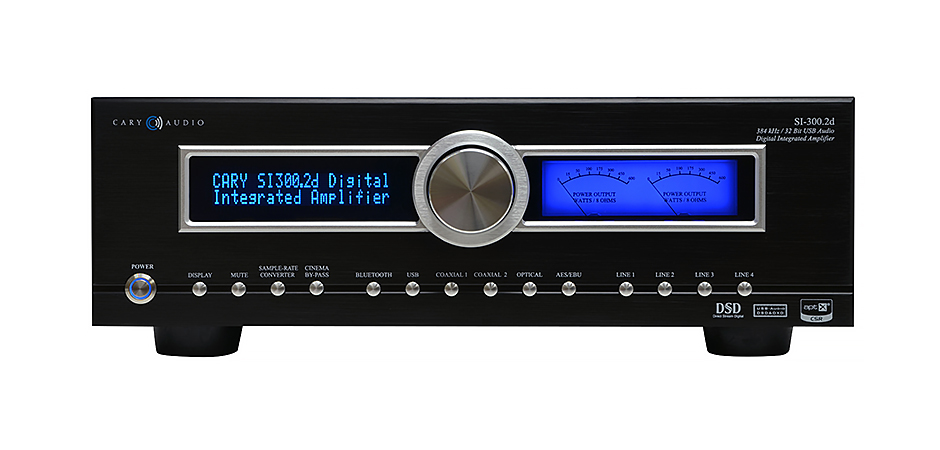
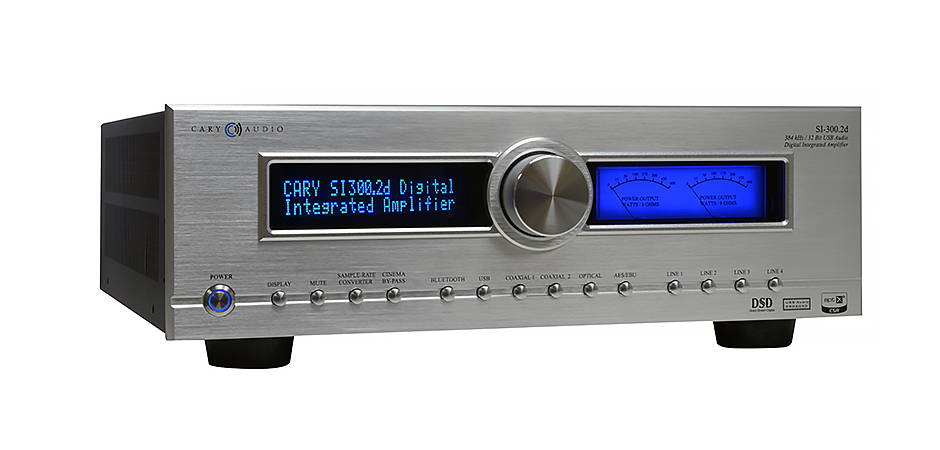
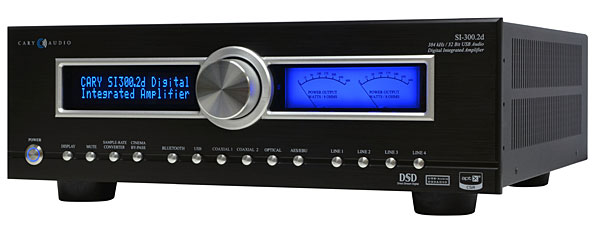
Cary Audio SI-300.2d integrated amplifier (Black)
Original price was: R180,000.00.R75,000.00Current price is: R75,000.00.
The SI-300.2d – a revolutionary integrated amplifier engineered to redefine your listening experience with its sheer power and musical finesse. Boasting an impressive 300 watts per channel of solid-state Class AB amplification, this fully balanced amplifier sets a new standard in audio performance, delivering nuanced richness and remarkable agility reminiscent of tube amplifiers yet capable of driving even the most demanding loudspeakers.
From thunderous bass to crystalline highs, each note is rendered with breathtaking clarity and depth, eliminating the “dryness” often associated with high-powered amplifiers. Equipped with cutting-edge features like a home theater bypass and built-in AKM DACs for USB, coaxial, and Toslink inputs, the SI-300.2d offers unrivaled flexibility for modern enthusiasts, seamlessly integrating into your setup while delivering pure musicality and precision. Experience the epitome of audio excellence with the SI-300.2d – Cary Audio’s ultimate expression of unwavering commitment to perfection.
The following section describes the SI-300.2d basic specifications. The specifications are subject to change without notice or obligation.
| Digital Outputs | Coaxial, Toslink operating at Sample Frequency (Fs) from 44.1 kHz to 192 kHz, 16-bit to 24-bit |
| Digital Input Sample Rates | USB operating at Sample Frequency (Fs) from 44.1 kHz to 384 kHz, 16 bit to 32 bit, DSD 64, DSD 128 and DSD 256 BLUETOOTH operating at Sample Frequency (Fs) 44.1 kHz, 16 bit AES/EBU, Coaxial, Toslink operating at Sample Frequency (Fs) from 44.1 kHz to 192 kHz, 16bit to 24 bit |
| Master Clock Jitter | Below measurable levels |
| Digital Sampling Rates (Fs) | 44.1 kHz to 768 kHz |
| Digital Filter | 8x Oversampling Digital Filter |
| Digital/Analog Converters | 2 channel AK4490EQ |
| BLUETOOTH | CSR Bluetooth v 4.0 with aptX® low latency audio decoder |
| Analog Filter | 3rd Order Bessel |
| Preamplifier Outputs | Single – Ended RCA |
| Analog Input | Single-Ended RCA x 2 Balanced XLR x 2 |
| Analog Input Impedance | 10 kΩ Unbalanced 20 kΩ Balanced |
| Power Amplifier Outputs | 2 x 300W RMS in 8 Ω from 20Hz to 20KHz 2 x 450W RMS in 4 Ω from 20Hz to 20KHz |
| Circuit Type | Solid State, Class A/B |
| Frequency Response | 10Hz – 50KHz +/- 0.1dB (at 10db below rated output power) |
| Distortion (SMPTE-1M) | < 0.5% |
| S/N Ratio | >100dB, “A” Weighted |
| Protections | Full short circuit, thermal, Ultrasonic, RF Signal muting & current limiter |
| Control | Trigger output 12.0 VDC x 1 IR control x 1 |
| Communication | Ethernet RJ45 full remote configuration interface Wi-Fi 802.11 b/g/n |
| Power Input | Configured at factory for either 110-120 or 220-240 VAC, 50-60 Hz |
| Power Consumption | 950 Watts (4 ohm load at full output) |
| Finish | Black powder coated matte chassis with silver or black aluminum faceplate |
| Weight | 52 lbs |
| Dimensions | 6.0″ H x 17.25″ W x 18.0″ D |
Description
Cary Audio SI-300.2d integrated amplifier


My entrée to high-end audio was in the late 1990s, when I bought a used pair of Cary Audio CAD-572SE tubed monoblock amplifiers to add to my Marantz CD player, Audio Note M2 preamplifier, and ProAc Response One SC loudspeakers. This system reproduced recordings with a sound that made me happier than a country boy with a glass of milk and a helping of peach cobbler. (I was reared, as my grandmother would say, though not born, in North Carolina, where Cary is based.)
Though the CAD-572SE’s class-A, single-ended-triode (SET) design produced only 20Wpc into 8 ohms—probably not enough wallop for the 87dB-sensitive ProAc One SCs—I thought the combo sounded terrific. The Carys were lush and a bit woolly, but created a wonderful sense of soundstage bloom, with gorgeous, richly saturated tone. The Carys also kick-started my love affair with the 6SN7 tube, also used in the Audio Note M2 preamplifier; I collected copious quantities of new old stock 6SN7s before sadly selling it all in a bid for fiscal responsibility.
I imagine that this sort of story—the Cary purchase, not the fiscal shenanigans—is familiar to many Stereophile readers. Conrad-Johnson and Audio Research repopularized tube amplification in the US in the 1980s, and Dennis Had‘s Cary Audio brought SET designs to the mainstream in the early ’90s. Such Cary models as the SLP-05 and SLP-90 preamplifiers, CAD-300SEI integrated amplifier, CAD-805 and CAD-211 power amplifiers, and, eventually, lines of CD players, DACs, network players, phono stages, and headphone amps made Cary Audio a company with a seemingly solid legacy.
Billy Wright has been involved with Cary Audio practically since its inception, first as CPA, then as CFO, and, since 2009, as owner. Like Had, Wright is a native of North Carolina, and oversees in Raleigh a team of analog, digital, and software engineers. He helped them bring to market Cary’s first ground-up digital product, the CD-303 CD player, in the late ’90s. Think of Wright as the house co-designer, getting down and dirty with every product carrying the Cary Audio brand.
Welcome to Lifestyle Country
Originally, Cary Audio was all about SET amplification. Today, Cary is as much a lifestyle brand as a high-end audio company, as exemplified by the solid-state SI-300.2d digital integrated amplifier ($5995). Sporting the modest chassis height, brushed-aluminum faceplate, and plethora of tiny buttons of Cary’s newer designs, the SI-300.2d is an extremely versatile, 52-lb beast that brandishes 300Wpc into 8 ohms or 450Wpc into 4 ohms of class-A/B power. Its amplifier section is coupled to a class-A preamplifier gain stage. At the heart of its digital section is the Asahi Kasei (AKM) AK4490EQ DAC chip also used by Astell&Kern, Denon, Marantz, and TEAC.
“We like these DACs because they process signals natively, PCM up to 32-bit/768kHz,” Wright told me. “So 16/44.1 is processed at native 16/44.1 with our proprietary TruBit selectable upsampling technology. The user can choose playback at the file’s native rate or from six additional sample rates, or even convert any PCM signal to DSD64, 128, or 256. Like PCM, DSD signals are handled natively—bitstream—up to DSD256 [on a PC platform]; Mac is relegated to DoP [DSD over PCM] 128 for the time being, due to Mac’s native limitations, not our ability to stream native DSD up to 256.”
DACs incorporated within integrated amplifiers are common nowadays, but I wondered: Why include a DAC chip that’s sure to become obsolete in no time, yet ignore headphone fans and vinyl aficionados? (The SI-300.2d has no headphone jack or phono stage.) Wright responded via e-mail:
“Whether homes, cars, or audio, lifestyle trends reveal that customers are comfortable knowing they no longer need separate items and can confidently combine or get the best of both in one. And DAC technology is actually quite mature. It’s the formats and file rates that change. The SI-300.2d can play native PCM at 32-bit/768kHz and native DSD up to 256 [via USB, not S/PDIF]. An overwhelming majority of the audiophile base is listening to 16/44.1, slowly sneaking up to as high as 24/192 or perhaps 24/358.2, with respect to PCM. If ever these bit depths and sample rates become mainstream, the SI-300.2d still has a lot of headroom to take on 32-bit depths and 768kHz sample rates. . . . [W]ith that said, we will have MQA-certified products in the very near future.”
Part of me is a diehard separates-and-analog fan who views “lifestyle” as more of a marketing niche than a subset of serious audiophilia—but I acknowledge that tomorrow’s audiophile is likely to embrace a set of audio values very different from mine. Of course, what always matters most is not how the music signal travels from point A to B, but the sound of the music flowing through the product to your ears.
Description
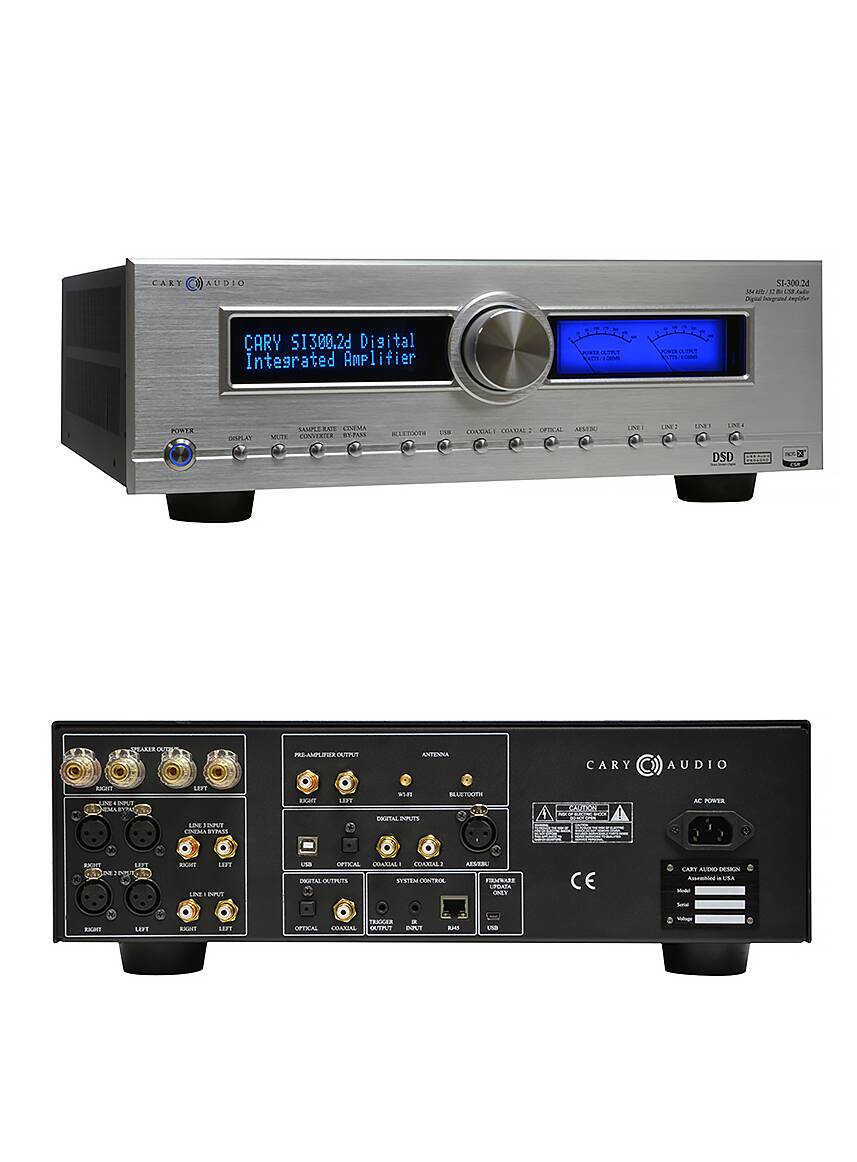
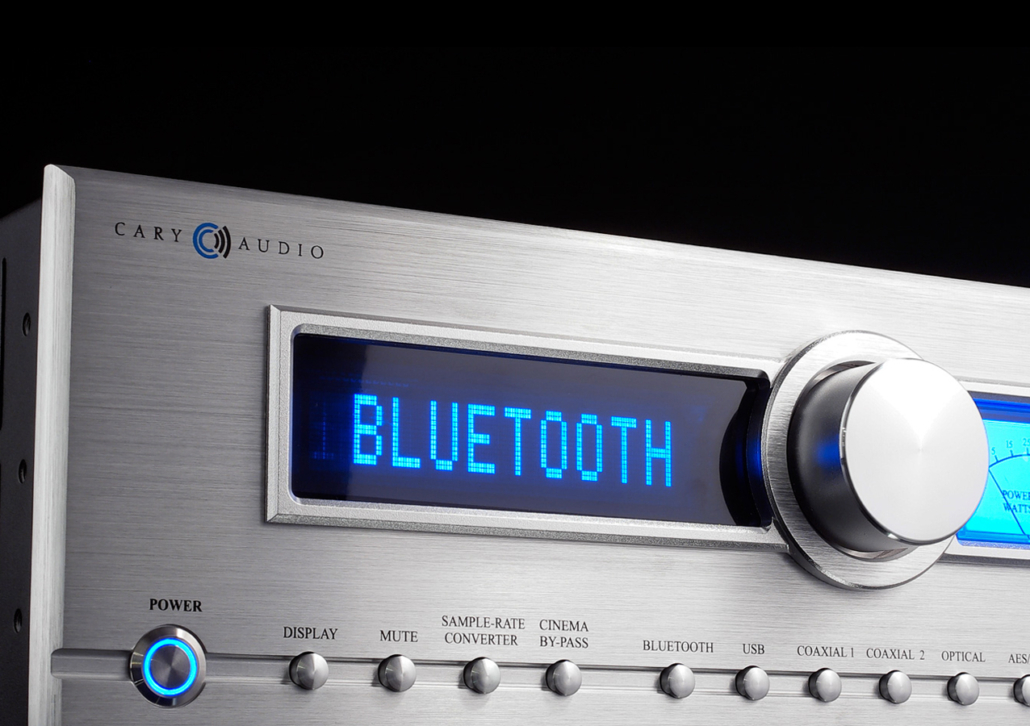
The Bluetooth-capable SI-300.2d is fashionably retro, with a large, 1980s-style volume knob and cool, McIntosh-blue VU meters on its ¼”-thick aluminum faceplate. The preamplifier section is a new design for Cary, the power amplifier is based on a circuit previously used in the company’s CAD-200 stereo power amp, and the SI-300.2d’s digital circuitry is derived from Cary’s DAC-200ts stereo DAC-preamp. Assembled at the Cary factory, the SI-300.2d’s chassis and case are made of steel, the faceplate and volume knob milled from aluminum.
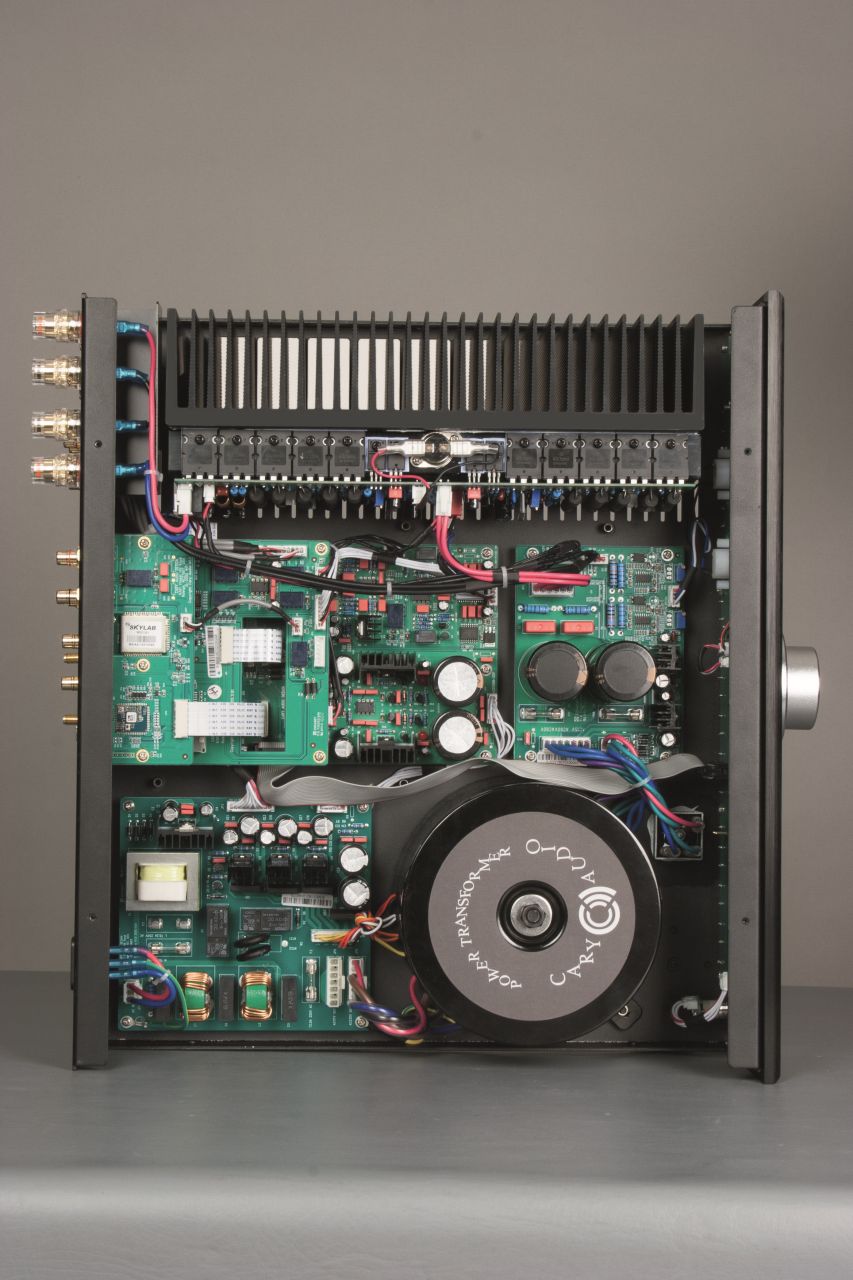
The SI-300.2d’s well-organized interior includes two large heatsinks back to back, one visible through the ventilation grille in the top plate. Inside a shielded can is a 1000VA toroidal power transformer. A series of larger Elna and smaller Matsushita/Panasonic capacitors occupy the six circuit boards.
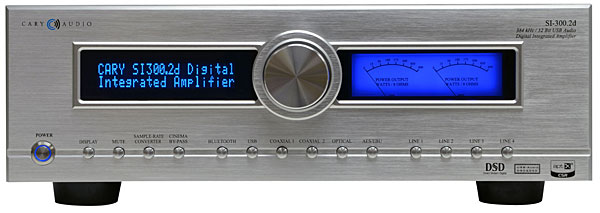
The SI-300.2d’s faceplate is tightly populated. From left to right are the alphanumeric display window, the volume knob, and the VU meters; below these, in a shallow groove spanning the faceplate’s width, is a row of 15 tiny buttons. From left to right, these are: Power, Display, Mute, Sample Rate Converter, Cinema By-Pass (to activate signal pass-through if the SI-300.2d is connected to a surround-sound processor), and Bluetooth. Then come the input buttons: USB, Coaxial 1 and 2, Optical (TosLink), and AES/EBU; and, finally, Line 1 through Line 4, for the analog line-level inputs.
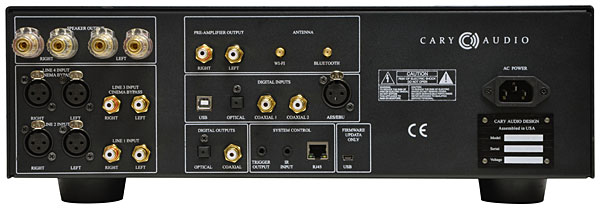
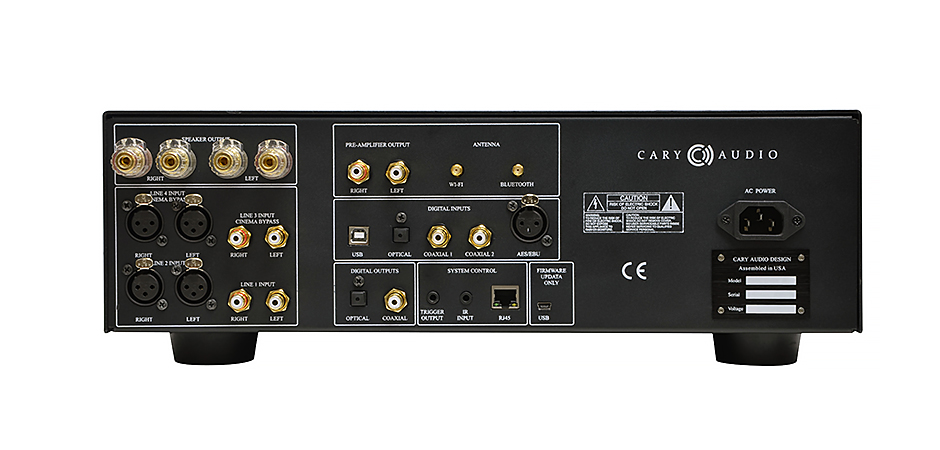
The rear panel is even more densely packed. At top left are two pairs of speaker terminals, and below them the four analog Line inputs: Line 1 and 3 are single-ended (RCA), Lines 2 and 4 balanced (XLR); Lines 3 and 4 are the Cinema By-Pass options. In the center bay, from top, are the right and left preamplifier/subwoofer outputs, and jacks for WiFi and Bluetooth antennas. Below these are the digital inputs, from left to right: XMOS USB (“capable of True native DSD up to 256 and PCM/DXD up to 32-bit/384kHz,” Wright told me), Optical (TosLink), Coaxial 1 and 2 (RCA), and AES/EBU (XLR). Below those are the Optical (TosLink) and Coaxial (RCA) digital outputs, the DC Trigger Input and IR Output, an RMS Ethernet jack, and a USB port labeled Firmware Update Only. On the far right, all by itself, is the IEC inlet for the supplied power cord.
From its Bluetooth, WiFi, and home-theater options to such very useful functions as a Mute, a sample-rate converter (SRC), a Balance control (on the SI-300.2d’s aluminum-faced remote handset, included), a Mode button that increases the output by 6dB when using low-output sources (also on the handset), and its very own iOS and Android apps, the SI-300.2d is the most feature-packed product I’ve ever used. And talk about multitalented: the SI-300.2d can be used as only a preamplifier, and can accept an external DAC to bypass its onboard DAC. It’s the whole megillah.
Setup and installation
While attaching cables to the SI-300.2d’s rear panel, I found that adhering to simple logic paid off—everything worked as labeled, without my having to refer to the manual. But if you do have to open the manual, you’ll find it written with refreshing clarity, and devoid of confusing geek talk and bad grammar.
The Cary SI-300.2d requires good ventilation; it ran warm but not hot to the touch—a thing to be thankful for during one of New York City’s brutally hot, climate-change summers. If you plan to use it for a long time in only one system, I can almost guarantee that you’ll be able to set it and forget it.
Listening: Music Hall, Heed, Cary, Elac
This was a match made in hi-fi heaven: the Cary’s vast power and unerring resolution, coupled to the Music Hall MMF-7.3 turntable’s flow—and the soulful, swinging sound of Heed Audio’s best-selling phono stage, the Quasar ($1199), chosen for being close, in circuit and sound, to the phono section of the Heed Elixir integrated amp that I reviewed in November 2016. These components, coupled with the chameleon-like Elac B6 monitors, made possible a magnificent LP party. I was a bit tough on the Ortofon 2M Bronze cartridge in my review of the MMF-7.3, but through the Cary it really came into its own. Revealing extraordinary resolution, power, naturalness, and dynamics, the Music Hall–Heed–Cary–Elac trio had me spinning discs late into summer evenings.
First up, on a tip from vinyl guru Michael Fremer, I bought—from Milltown, New Jersey’s Revilla Grooves and Gear—the 45rpm reissue of Nat King Cole’s Just One of Those Things (2 LPs, Capitol/Analogue Productions APP 903-45). It’s stunning in every way, from the placement of Cole’s voice—big, booming, natural, and dead center—to Billy May’s arrangements, which wrap around the singer. Cole’s voice is so rich, present, and swinging that it will make you reevaluate his place in the history of singers of the Great American Songbook, if you don’t already hold him in as high regard as Frank Sinatra and Ella Fitzgerald. Throughout this album, I can almost see the smile on Cole’s lips. The Music Hall–Heed–Cary–Elac team presented rock’em, sock’em dynamics, a huge soundstage, and effortless musicality from these discs. It was hard to stop spinning LPs, day after day, week after week, so I didn’t!
Another excellent 45rpm reissue purchased from Revilla: a remastering of Miles Davis’s Sorcerer (2 LPs, Columbia/Mobile Fidelity Sound Lab 2-435). Recorded at Columbia’s 30th Street Studio in 1967, Sorcerer, like all of Davis’s original Columbia recordings with his second great quintet—Wayne Shorter, Herbie Hancock, Ron Carter, Tony Williams—can sound small, foggy, and lacking resolution and clarity. The MoFi changes all that, and again, the Music Hall–Heed–Cary–Elac system provided thrills and chills. Re-creating the beautiful depth of the 30th Street Studio, every scintilla of note action, decay, dynamics, and texture was also richly re-created. Williams’s drums shattered the pulse, and Carter’s double bass drove the quintet like a night-terror of intent.
One trait of the SI-300.2d became increasingly evident: extreme resolution, and never at the cost of tonal richness or spatial substance. Even in my smaller system, to which I listen in the nearfield, the Cary created engrossing dynamics from a dead-quiet, deeply layered, dead-silent background. Each disc I played led to more discs, more revelations. Even lesser recordings, such as a new reissue of Dizzy Gillespie’s 1951 bebop treatise, The Champ (LP, Savoy SVY 16068), sounded resolute, dynamic, natural. The sound was as transparent as a fall sky, and as tonally even-keeled as I’ve heard in my nearfield setup.
Listening: MacBook–Audirvana Plus, Cary, Elac
I used the SI-300.2d’s remote control to switch from the Line 1 to the USB input, and the Cary quickly recognized my MacBook. I opened the Audirvana Plus software to Charlie Haden and Pat Metheny’s Beyond the Missouri Sky (Short Stories) (AIFF from CD, Verve 9808050). In Johnny Mandel’s “The Moon Song,” Metheny’s glistening touch on acoustic guitar was palpable, and as never before, every last note of the late Haden’s double bass was deeply tactile and toneful. I’ve enjoyed Haden’s solo in Metheny’s “Message to a Friend” hundreds of times. When he plucks very low notes, most systems inevitably turn them into confused mush. The Cary resolved each note beautifully and cleanly, the round texture and warm tone of each string speaking with stunning articulation. I was dumbfounded. The Cary’s clarity and resolution also benefited the nuances of Metheny’s guitar technique.
Unfortunately, I couldn’t evaluate the Cary’s upsampling options, as Audirvana Plus doesn’t support that feature. Billy Wright told me that “USB sources cannot be upsampled because, when using the USB input, the computer the SI-300.2d is connected to is using media player software. We feel if one is a USB DAC customer, which requires a USB connection with a computer, then they most likely prefer to do the upsampling within their chosen media play software.”
Listening: MacBook–Audirvana Plus, Cary, DeVore
Using my MacBook to play digital files and the Cary SI-300.2d to drive my DeVore Fidelity Orangutan O/93 speakers opened yet another, quite different window on the music. I’d wanted to hear the Cary work the DeVores’ big 10″ woofers, and L.A. rockers No Doubt seemed the logical choice. “Hella Good,” from Rock Steady (AIFF from CD, Interscope 4935162), has a huge, buzzing soundstage of churning synthesizers, woozy bass, and edgy, processed drums behind Gwen Stefani’s silken schoolgirl purr. Guitars and bass functioned within a generally dry, airless production, and here the Cary was all business. This was not the sound of your father’s Cary tube amp. Where I’m used to hearing midrange bloom and deep, enveloping bass from my Shindo Allegro preamplifier ($10,000) and Haut Brion power amplifier ($11,000), the Cary was less effusive in those regards while masterfully achieving its now trademark resolution maneuvers. Presenting large, solid images on a soundstage of exquisite transparency, the Cary was nonetheless a bit two-dimensional. Music reaches out and caresses me via my Shindos, but through the Cary it was more resolute—and forceful. The Cary presented its truth with total conviction.
“Nat,” from Danish guitarist Jakob Bro’s Time (AIFF from CD, Loveland LLR013/014), is a beautifully cascading tapestry of dual chiming guitars, mournful also sax, and bass. It was portrayed in clean, precise, warm images via the Cary: highly accurate, smooth, and crystal clear, the Cary’s sound left nothing to the imagination. And through the SI-300.2d, the soaring instrumentals on Pat Metheny’s Speaking of Now (AIFF from CD, Warner Jazz 9362480252) were well-balanced, powerful, and, note for note, as highly resolved as I’ve ever heard them, with concrete if lightweight bass reproduction. Perhaps I was missing the extension and bloom of a tube amp, or maybe the Cary’s sound was the more accurate, literal reproduction of the ones and zeros filed away on my hard drive.
Compared to the Cary’s own internal DAC on the DeVore speakers, PS Audio’s NuWave ($1299) presented a tad more air and better note decay, but less resolution. The NuWave’s images were smaller than the Cary’s, but somehow fuller. The NuWave sounded more like a tubed device, with a sweeter tonal balance; it also played music with slightly greater drive.
Listening: Cary, Shindo, DeVore
This trio produced yet another, very different result! Playing everything from Pat Metheny to No Doubt to Keith Jarrett, I heard greater leading-edge clarity and air around instruments than with my Shindo Allegro preamplifier, cushioned on a richer-sounding low end that was undoubtedly the result of the Haut Brion’s 6L6 power tubes. The soundstage was more enveloping, and darker overall. With the Cary’s power-amp section bypassed, No Doubt’s “Hella Good” lacked its previous low-end pump, yet its midrange was more tart. “Underneath It All,” also from Rock Steady, sounded liquid, flowing, and downright groovy, with better dub-worthy note decay in the bass, yet with a generally lighter sound than through the Cary’s amp section.
Conclusions
Cary Audio’s SI-300.2d Digital Integrated Amplifier is an incredibly sophisticated component from a company with the apparent resources and brainpower to bring to market whatever Billy Wright and crew desire. With the SI-300.2d, Cary has created a 21st-century Swiss Army knife of sound that can be configured to match any need or whim of today’s music lover. Want power in spades to create outstanding dynamics? Check. An internal DAC that’s the equivalent of outboard units costing in the neighborhood of $1500, one-quarter the Cary’s price? Sorted. The SI-300.2d can upsample your digital files and play DSD, assuming you have the matching software, and Cary suggests that it’s readily adaptable to new formats (hello, MQA). And best of all, it delivers more bang for the audio buck, with greater resolution and power, than any $5995 DAC-integrated has a right to.
Thank God that I’m still, at heart, a North Carolina country boy. And thank Him or Her that Raleigh-based Cary Audio still produces such fine music-playback machines. Long may they reign.
Related products
-
T+A P3000 HV Preamplifier
R365,000.00 Add to cart -
Electrocompaniet ECI6 DX MK2 Integrated Amplifier/DAC/Phono (NEW)
Original price was: R212,000.00.R118,000.00Current price is: R118,000.00. Add to cart -
Perreaux 350 Stereo Amplifier – NEW
R164,000.00 Add to cart -
Audio Research Reference 210 Monoblocks
Original price was: R380,000.00.R108,000.00Current price is: R108,000.00. Add to cart