I don’t think that the B&W 804 Diamond, in any of its incarnation, gets its due respect. As the smallest floorstander in B&W’s elite 800 series, it has historically been overshadowed by its larger brethren and outmaneuvered by the smaller, stand-mounted 805. However, the 804 Diamond is unique, and deserves special attention for reasons I discovered when I chose the earlier 804S for the surround channels of my 5.1-channel surround system.
The first of these reasons: The three-way 804 Diamond takes up no more floor space than the two-way 805 while also having two 6.5″ woofers, which greatly expand its power handling and bass extension. In fact, it was my wife who, when I consulted her about choice and placement, asked why one would even consider the smaller speaker when the bigger one took up no more floor space and looked better. Second, in the 804, the same 6″ Kevlar-cone mid/woofer used in the 805 is relieved of all bass responsibilities and works purely in the midrange, as it does in the 800 Diamond.
The third reason—perhaps a corollary of the second—is that dedicating the Kevlar driver to the midrange means that it can be used with B&W’s proprietary Fixed Suspension Transducer (FST) technology, which was designed to better control and define the breakup patterns of relatively nonrigid diaphragms. The use of Kevlar in the 805’s mid/woofer demands a more traditional surround that imposes the uncontrolled radial breakup patterns that the use of a Kevlar diaphragm was intended to avoid. Note, also, that B&W uses diaphragms of Rohacell, which is stiffer than Kevlar, in the woofers (ie, not mid/woofers) of all its 800-series models, including the 804.
Finally, although the B&W 804 Diamond is not endowed with B&W’s iconic Marlan head, as in the 800 Diamond, the 804’s midrange driver is still enclosed in an internally tapered enclosure, and scores over the larger but similarly configured 803 Diamond in having a narrower cabinet, which, potentially, would not have as great an impact on midrange dispersion. It might also be effective in minimizing the kink in the horizontal off-axis radiation pattern that John Atkinson has discovered in the transition from the woofers to the midrange drivers of the Marlan-topped 802 and 800 Diamonds.
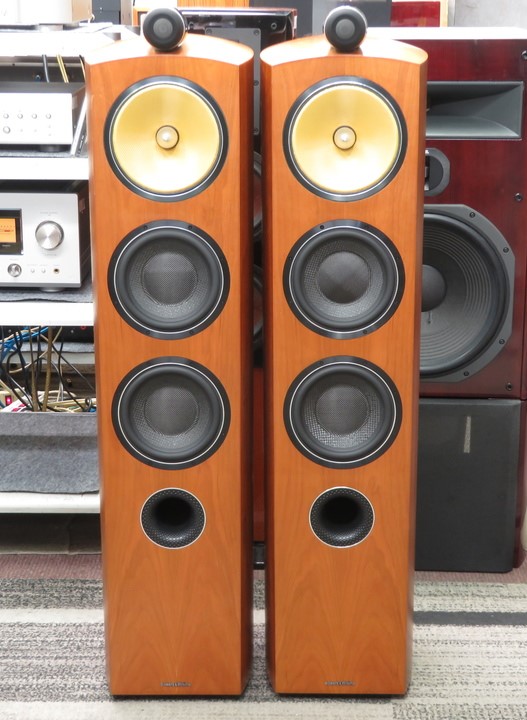
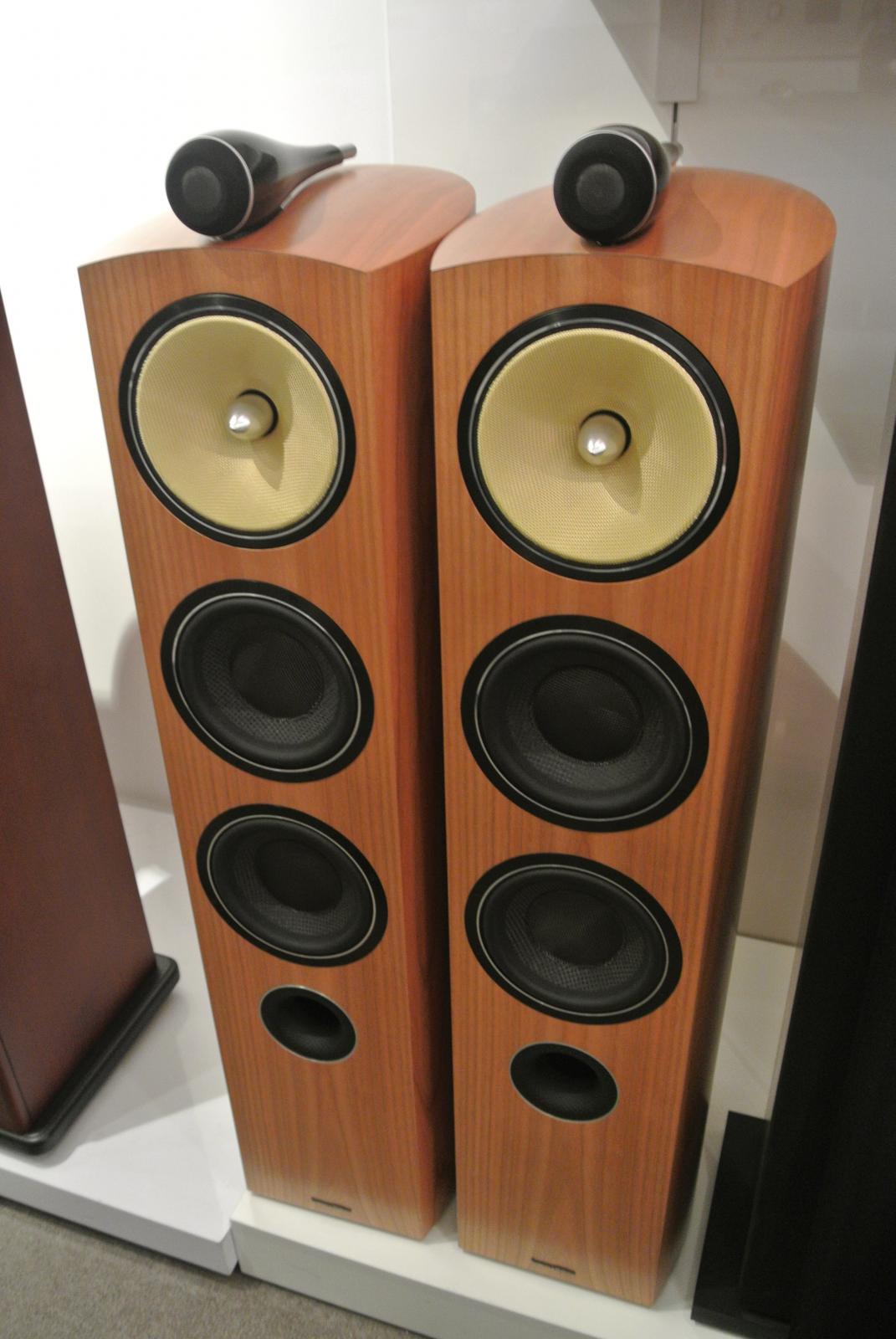
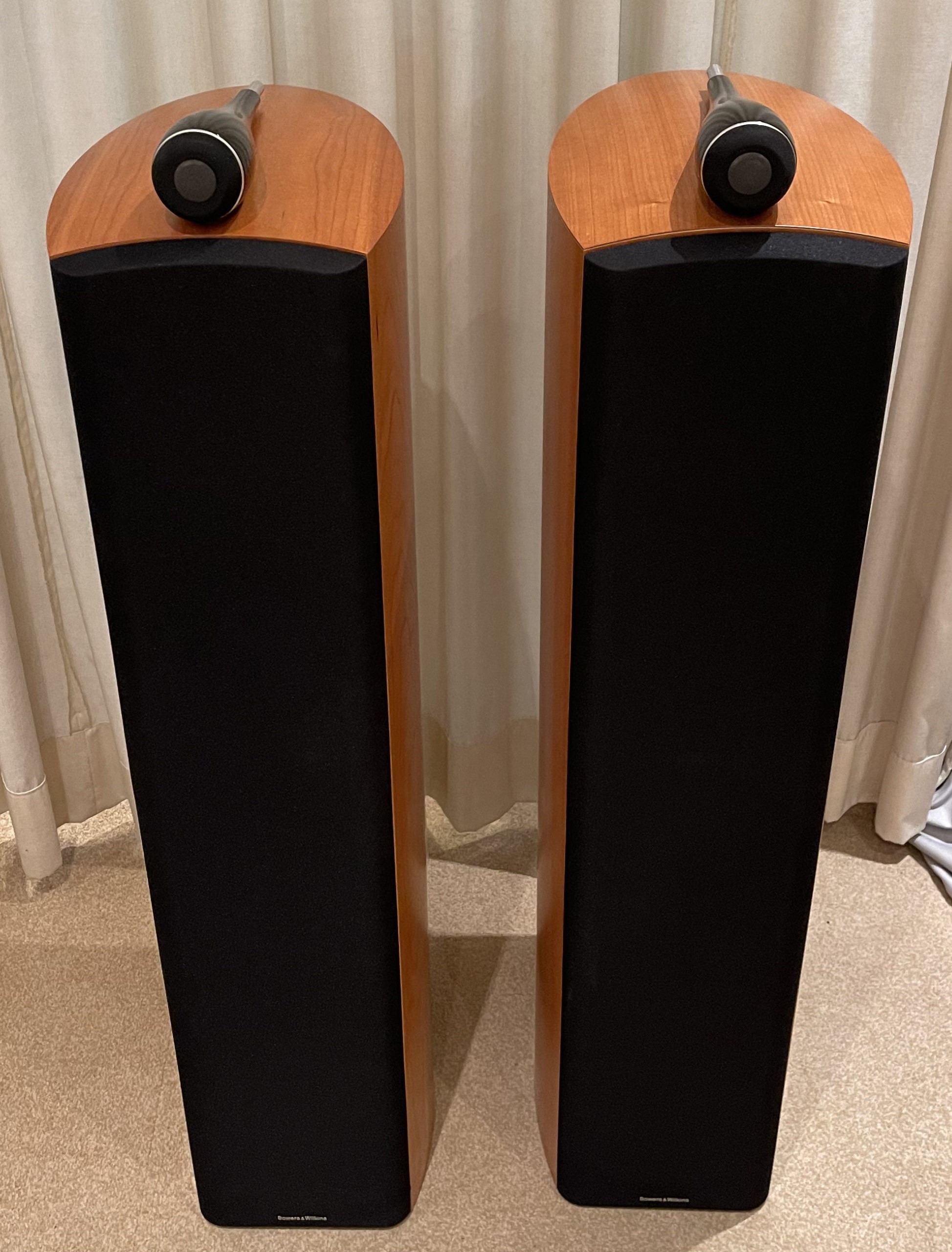
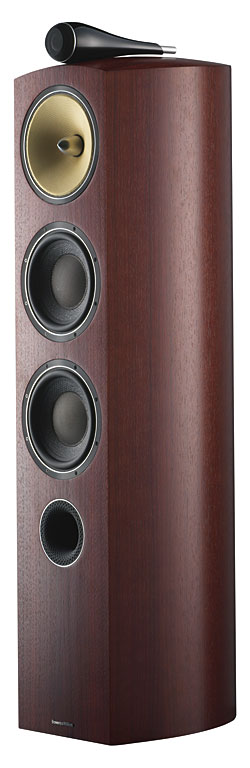
Arrival The 804 Diamonds arrived in substantial packaging that lacked the forklift-accessible plinths needed for the 800 Diamonds. I was grateful for the unpacking instructions printed on the outside of the box; I was able to unpack and set them up with little effort and no assistance. Both spikes (for carpet) and plastic feet (for hardwood floors) are provided. I chose the latter. The slim, graceful cabinet is oval in cross section, except for the flat front panel; my review samples were finished in Rosenut veneer. (Cherry and Piano Gloss Black are also available.) A black front grille attaches magnetically—when the grille is removed, no securing devices mar the speaker’s appearance.
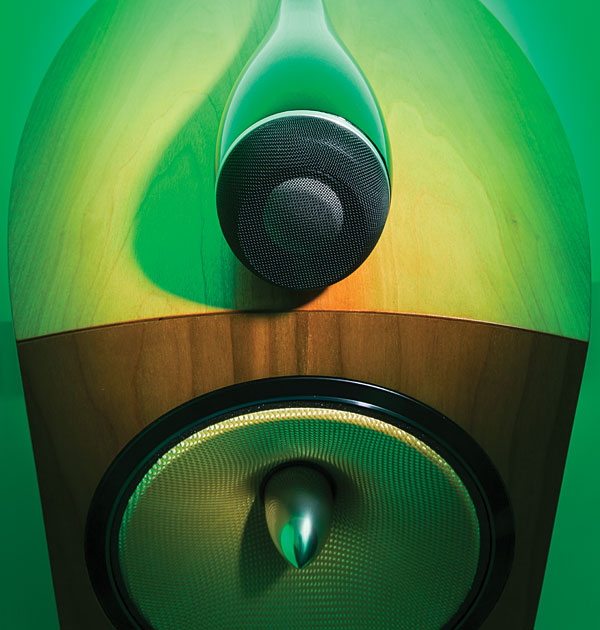
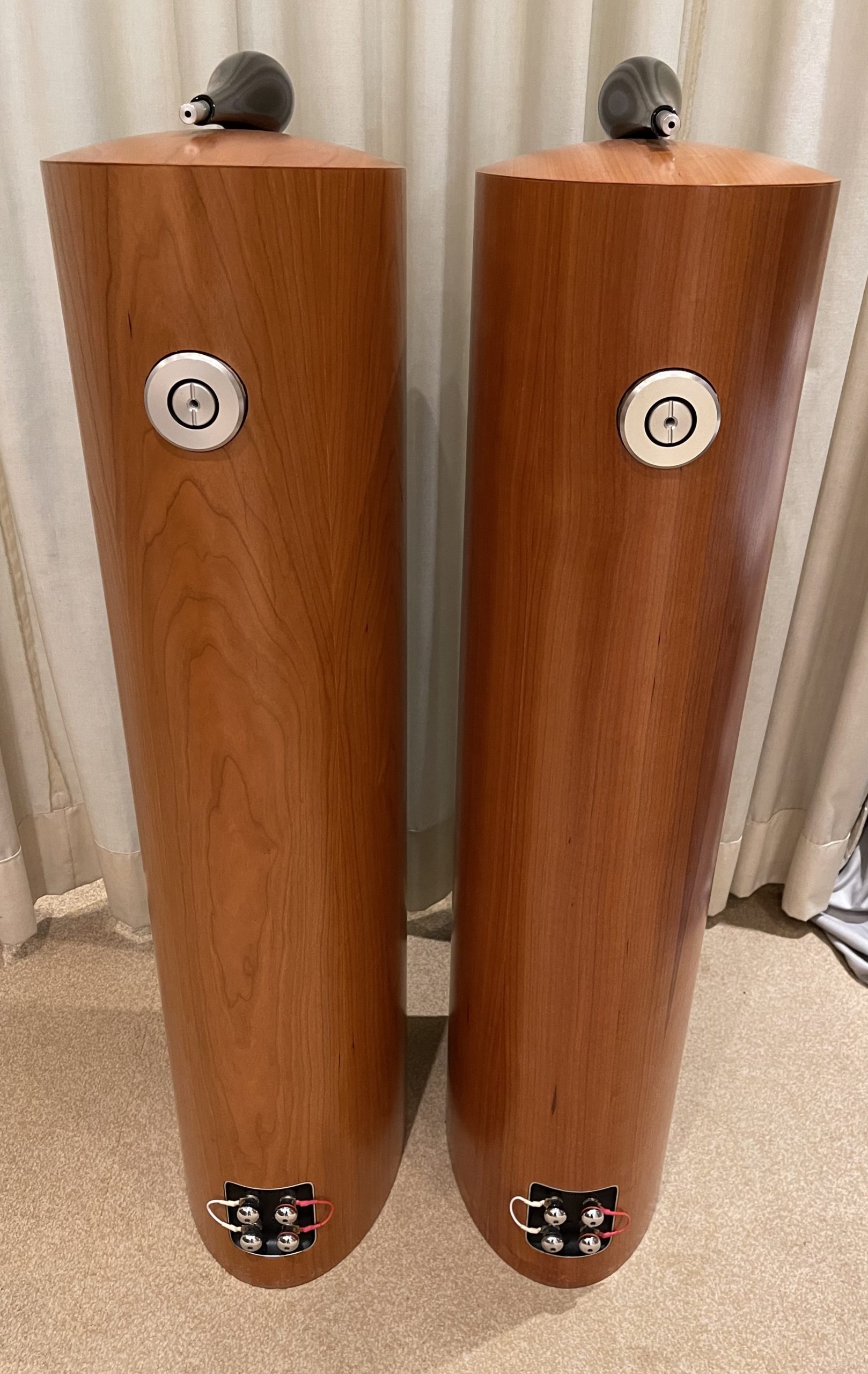
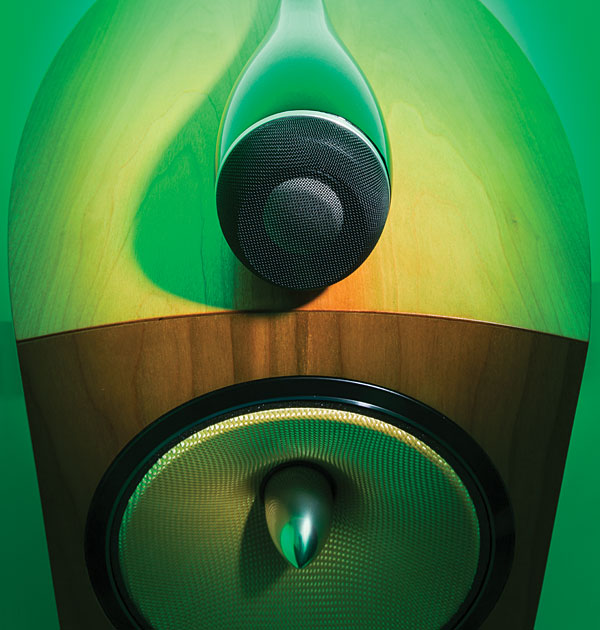
On top of the cabinet, lying in a shallow niche, is B&W’s iconic enclosure for its diamond tweeter and its tapered tube. Below that is the yellow, woven-Kevlar diaphragm of the FST midrange driver, which is installed through the front panel and secured by a shaft to a compliant support in the rear, just as the FST midranges in the 802 and 800 Diamond models. (A plastic disc must be removed from the rear of the midrange enclosure, which opens to the speaker’s rear, before listening.) Below that are the two Rohacell-cone woofers and a low-turbulence port, dimpled and flared, and similar to the one hidden on the underside of the bigger models. Protruding from near the top of the rear of the cabinet is the adjustable mount for the midrange; near the bottom are two pairs of speaker binding posts of a new design that accommodates easy tightening by hand. Biwiring and biamping are thus made possible; jumpers are also provided. To meet EU requirements, the center bore of each binding post is occupied by a plastic plug; I removed these in order to use cables terminated with banana plugs.
 Set-up
I was able to lift and lower each 60-lb 804 Diamond into position by using its bass port as a grip. At first, I set them up in the precise spots just vacated by my 800 Diamonds. In these positions, the 804Ds seemed to sound somewhat thin and bright, but some expectation bias is inevitable: I was consciously aware, from both sight and aching muscles—I’d just moved the big 800Ds out of the way—that I had just replaced two very familiar, very large speakers with a pair of small towers fresh from the farm. Apparently, I adapted as I adjusted the setup. The 804Ds ended up about a foot closer to each other than where they started out, toed in by no more than 10°.
Comparisons can be odious
That doesn’t mean that comparisons smell bad, but making direct comparisons can lead to various problems. In the case of speakers, it’s all too easy to describe how one speaker sounds different from another, but 1) that doesn’t tell us a lot about which speaker might be better or more accurate, and 2) a specific character of one speaker might constrain an accurate description of another. So, although I can’t ignore comparing the 804 Diamond to its 804S forebear or to its big brother, the 800 Diamond, both of which I had on hand, I’ll first describe the 804D’s sound as I found it, independent of comparisons.
I listened casually to the 804 Diamonds for a couple of weeks before sitting down to do more careful listening. During that time they evinced good tonal balance and great stereo center fill. FM broadcasts sounded good, with no emphasis of hiss with weak signals, and Internet radio sounded fine without obvious dulling due to the limited bandwidth. As I sat down with my favorite discs and downloads, my expectations were rising.
The 804 Diamond was quite beyond criticism in the treble, with clarity and fine detail. Cymbals and triangles sizzled and tingled appropriately, but, more important, E-string fiddling was sweet and pure. Voices, too, were lifelike, whether solo or in chorus. One of my new favorite vocal recordings is a 24-bit/192kHz PCM download of Marianne Beate Kielland’s recital disc Come Away, Death (SACD/CD, 2L 2L-064-SACD). Following a tonally convincing introduction by pianist Sergei Osadchuk, Kielland’s silken mezzo-soprano appeared eerily between the 804 Diamonds with such presence that I got up to check that my (presumably) idle center speaker was, in fact, silent. The effect expanded with multiple voices—as on Dixit Dominus, a disc pairing Handel’s and Vivaldi’s settings of Psalm 109, with David Bates leading La Nuova Musica (SACD/CD, Harmonia Mundi HMU 807587): the choristers’ voices were arrayed in space between and above the 804 Diamonds.
Moving down the spectrum to winds and guitar, the presences, placements, and harmonic balances of those instruments were exquisite. Stefano Grondona’s guitar in Francisco Tarrega’s Capricho árabe, from Grondona’s La Guitarra de Torres (CD, Divox CDX-29701), is intimately recorded—the touch of his fingers on the strings is easily discerned from the rich supporting resonances of the instrument’s body. Each repetition of the familiar theme offers another serving of mesmerizing harmonies.
Lower-pitched male voices and cello, however, demanded greater scrutiny—speakers the size of the B&W 804 Diamond often lack the true low bass of bigger speakers. How and where the low end rolls off can pull the rug out from under low voices, robbing them of weight and warmth. I pulled out my Hans Theesink and Leonard Cohen discs, just to confirm that their voices sang out with focus, depth, and grit. More critically, Gavriel Lipkind’s 1702 Garani cello spoke in a single voice across its range, from the soprano sweetness of the A string to the baritonal warmth of the C string, in Lipkind’s recording of J.S. Bach’s Suites for Solo Cello (SACD/CD, Lipkind Productions S04), indicating bass extension entirely sufficient for realistic tonal balance. It was, therefore, no surprise that the plucked lower strings in Boccherini’s La Musica Notturna della strade di Madrid, from the Stuttgart Chamber Orchestra’s Die Rohre—The Tube (SACD, Tacet S 074), were rendered with appropriately plosive effect.
At the very bottom, the 804 Diamonds were capable of playing everything creditably, if not imposingly. I noticed this first when playing a 24/96 download of “Malena,” my favorite track from Será Una Noche (MA Recordings M052A). It was delightfully atmospheric, as always, but the rhythmic percussion didn’t seem to anchor the tempo as solidly as I had expected. The footfalls of the Cosmic Hippo, as depicted by Victor Wooten’s bass in the title track of Béla Fleck’s Flight of the Cosmic Hippo (CD, Warner Bros. 26562-2), were weighty but less than thudding, and the heartbeats in Pink Floyd’s Dark Side of the Moon (SACD/CD, Capitol CDP 5 82136 2) were audible but not palpable.
S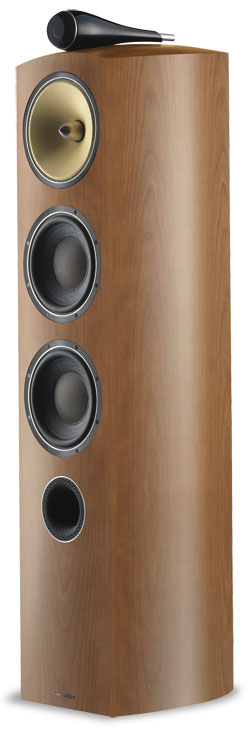 till, the bass was certainly good. Had I not savored these tracks before through bigger speakers—such as the 800 Diamonds—I probably would not have noticed anything missing. Those who delight in the open soundstage and pinpoint imaging of minimonitors will find that in spades with the 804 Diamonds, whose significantly greater bass extension endowed the sound with a natural balance often sacrificed by the smaller speakers in the pursuit of those other qualities. As a result, the lack of really deep, powerful bass from the 804 Diamonds is, to me, a minor issue overall. I found that, unlike stand-mounted minimonitors, the 804Ds could deliver a full orchestra of appropriate balance and size, as was demonstrated when I played Dmitri Kitayenko and the Cologne Gürzenich Orchestra’s recording of Tchaikovsky’s monumental Manfred Symphony (SACD/CD, Oehms Classics OC665). And if you demand that the impressive bass-drum whacks also hit you in the chest, or that the organ in the final movement also shake your room . . . get a subwoofer.
Audible differences
I began this review by saying that B&W’s 804 models have not gotten as much attention as they deserve. I, too, was guilty of this. When, a decade ago, I transformed my main system from two to 5.1 channels, I chose the B&W 804S for surround duties without ever having heard them as a stereo pair—and there they sat in the background ever since, until I pulled them out to compare them with their successors. With the 804Ses ($4000/pair when last available) plonked down next to the 804 Diamonds ($7500/pair), I often found it difficult to distinguish between them by eye or ear, but there were differences. Other than the 804D being three pounds lighter than the 804S, B&W’s specifications for the two are identical. Careful study reveals that the 804D sports a silver ring around its now gloss-black tweeter housing, has mushroom-shaped terminal knobs, and replaces the grille’s tabs with magnetic attachments.
The two models sound similar, too, though I easily heard the differences in an A/B comparison. There is some improvement of bass definition at the extreme bottom of the audioband, the 804 Diamond offering a somewhat sharper edge to LF transients, particularly noticeable with bass guitar. There was also significantly more detail in the critical upper midrange, around the upper crossover frequency of 4kHz, which is also in the range of the human ear’s greatest sensitivity. B&W’s use of gold-silver-oil Mundorf capacitors in the HF crossover filter and the Diamond tweeter—which were used only in the 800 Diamond in the previous generation of models—is probably paying great dividends here.
Compared with other speakers that have occupied this room, the 804 Diamond sounded like a nimbler version of the 800 Diamond ($24,000/pair), or a compact version of the Aerial Acoustics 7T ($9850/pair). In the first case, a comparison of the specs (and ignoring their differences in size and weight) revealed that the 800 and 804 Diamonds differ in only two performance parameters: low-frequency extension/THD and maximum power handling. So, granting the very real sonic differences at the low end of the audioband, I found that the 804 Diamonds produced a closer, more intimate sound in my 26′ by 15′ room, perhaps due to the effects of their narrower cabinets on midrange radiation and room interaction. The Aerial 7T’s bass capabilities, too, are greater than the 804 Diamond’s, with the latter’s smaller drivers and enclosure, while the Aerial’s midrange is equally detailed and a bit smoother. The treble was a toss-up. Overall, the slightly bigger and more costly 7T differs only slightly from the 804 Diamond, and its advantages would not be substantial in smaller rooms.
Conclusions
In general, I had become so accepting of the generous size and sound of the bigger, pricier speakers I’ve been using that I was surprised by how satisfying the 804 Diamonds were. I should not have been—for $7500/pair, one should expect superb performance across the board. B&W has trickled down their unique technologies to the entire 800 Diamond range, and the 804 Diamonds incorporate all the most important ones. In fact, with the 804 Diamonds replacing the 800 Diamonds for the front left and right channels—a third 800 Diamond remaining for the center channel, and 804Ses as surrounds—they gave up little in multichannel performance. And the 804 Diamonds sounded excellent as a stereo pair, leaving me in no rush to relegate them to surround duties. For the money, I don’t feel you can do much better—different, maybe, but for making music, not better.