Krell KSA 250 Reviews
I still have fond memories of my first Krell amplifier, a KSA-50. Back in those days (date purposely omitted), my principal source of audio equipment reviews, aside from Stereophile and The Absolute Sound, was Hi-Fi News & Record Review, which I read voraciously from cover to cover every month. One fateful day while sitting by our community swimming pool, I happened upon an enlightening review of the KSA-50 written by none other than our own John Atkinson, editor of HFN/RR at the time. His words describing “the steamroller-like inevitability of the bass with this amplifier” haunted me for weeks, until I got up the nerve to audition, and ultimately purchase, my first Krell product.
JA was right. That amp, in defiance of its diminutive power rating, drove my KEF 105 speakers like no other had before. It was indeed a musical gem which I foolishly sold a few years later in order to move into the tube domain and further feed my nearly terminal case of audiophilia nervosa. I recently heard through the local audio grapevine that the lucky person who bought my old KSA-50 amp is still very happy with it. At least it has a good home…
So much for nostalgia. That was then, this is now. And have I got an amp to tell you about! The mother lode of Krell amplifiers has arrived, and its name is the KSA-250. If the KSA-50 had the weight of a steamroller, this one has the impact of an atomic bomb. Krell amplifiers have always been known for their superb stability and bass control, but have been, in my opinion, somewhat short in the department of musical finesse. Of course the KSA-100 and -200 and the KMA-80 and -160 were superb amplifiers, but there were competitors who gave up very little in the bass region and offered much more harmonic and musical honesty. In this respect, the KSA-250 is a landmark product for Krell; unquestionably their most refined amplifier to date, and possibly the most successful blend of solid-state and vacuum-tube virtues to come down the pike. No, it doesn’t do everything perfectly, but in terms of overall sonics, and especially price/performance ratio, it’s a winner.
Technical highlights
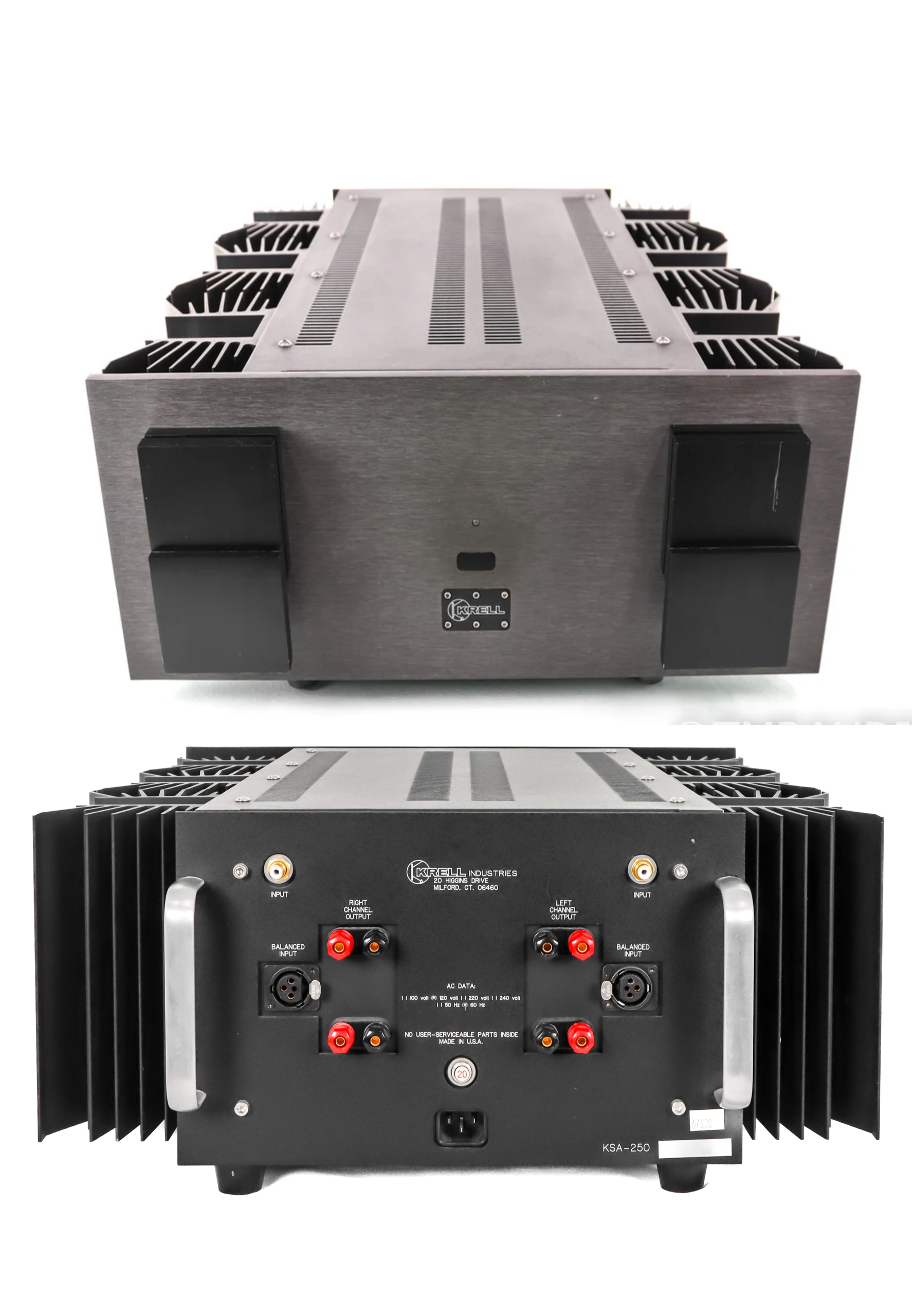
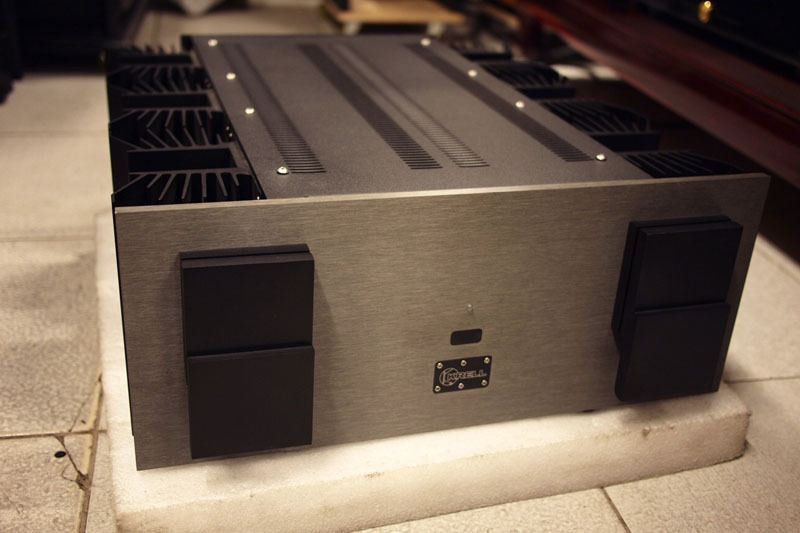
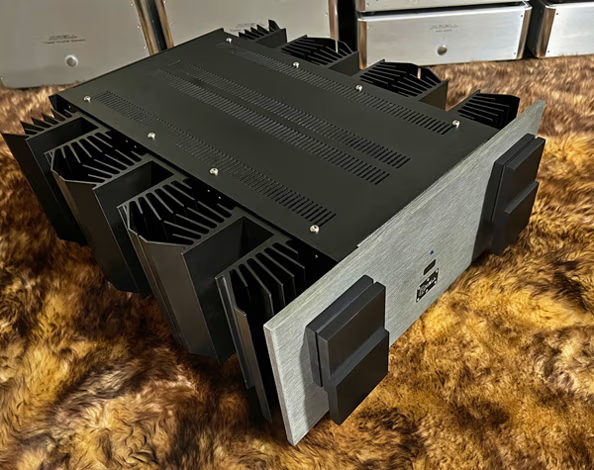
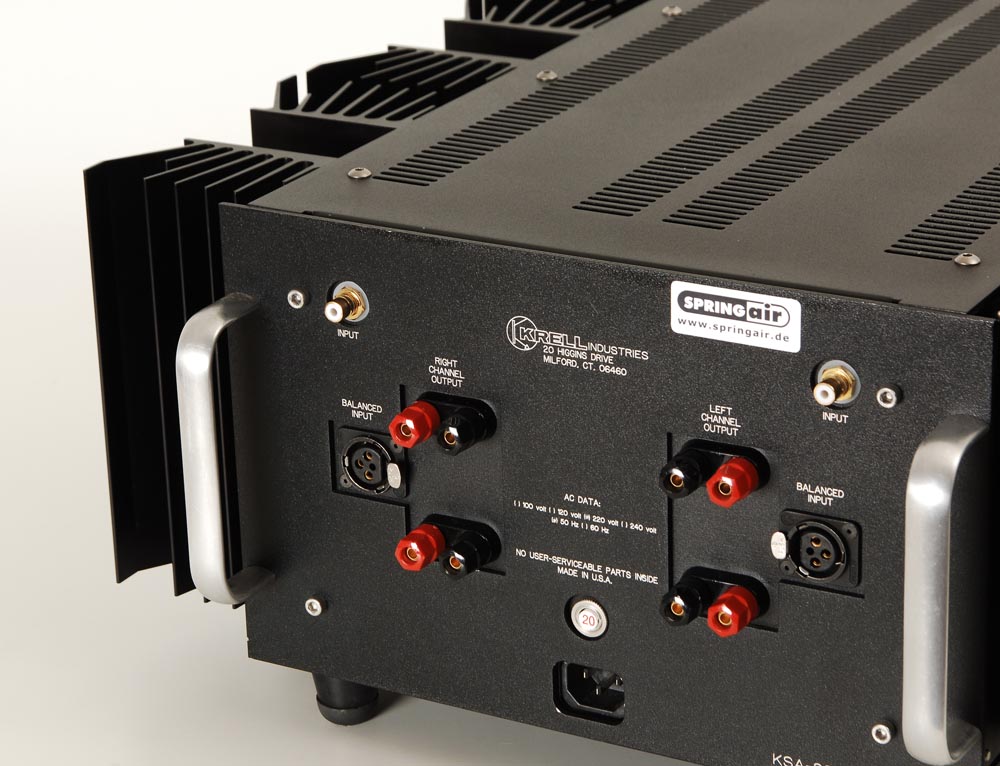
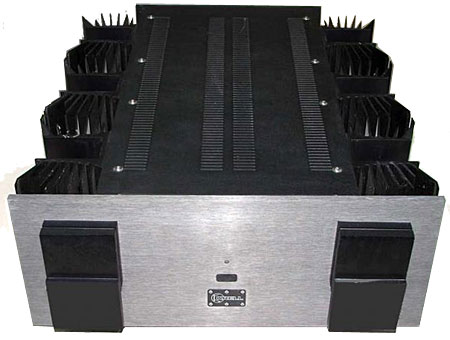
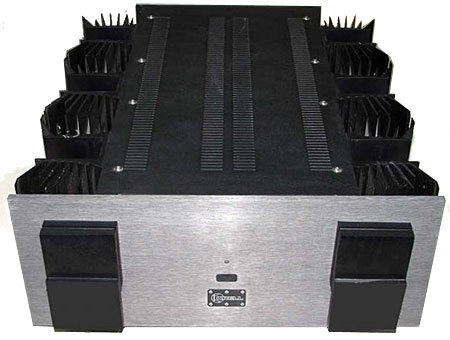
The Krell KSA 250 is, without a doubt, the most visually appealing amplifier that Krell has yet marketed. Though large and very heavy, the presentation is one of stoic grace rather than imposing high-tech visual intrusion. The amplifier body is finished in flat black, with heatsinks externally lining both sides from front to back. The rear panel is neatly laid out, with single-ended phono sockets and balanced female XLR connectors on either side. Additionally, there are two sets of five-way binding posts for loudspeaker cable connections, which makes speaker bi-wiring a breeze. The front panel is finished in an elegant brushed-gray finish with large, black, attractive, downward-facing handles. The feather-touch power switch is located in the center of the front panel, just above the ubiquitous Krell logo. A blue LED power tally light is positioned just above the switch. All in all, a very nicely designed package.
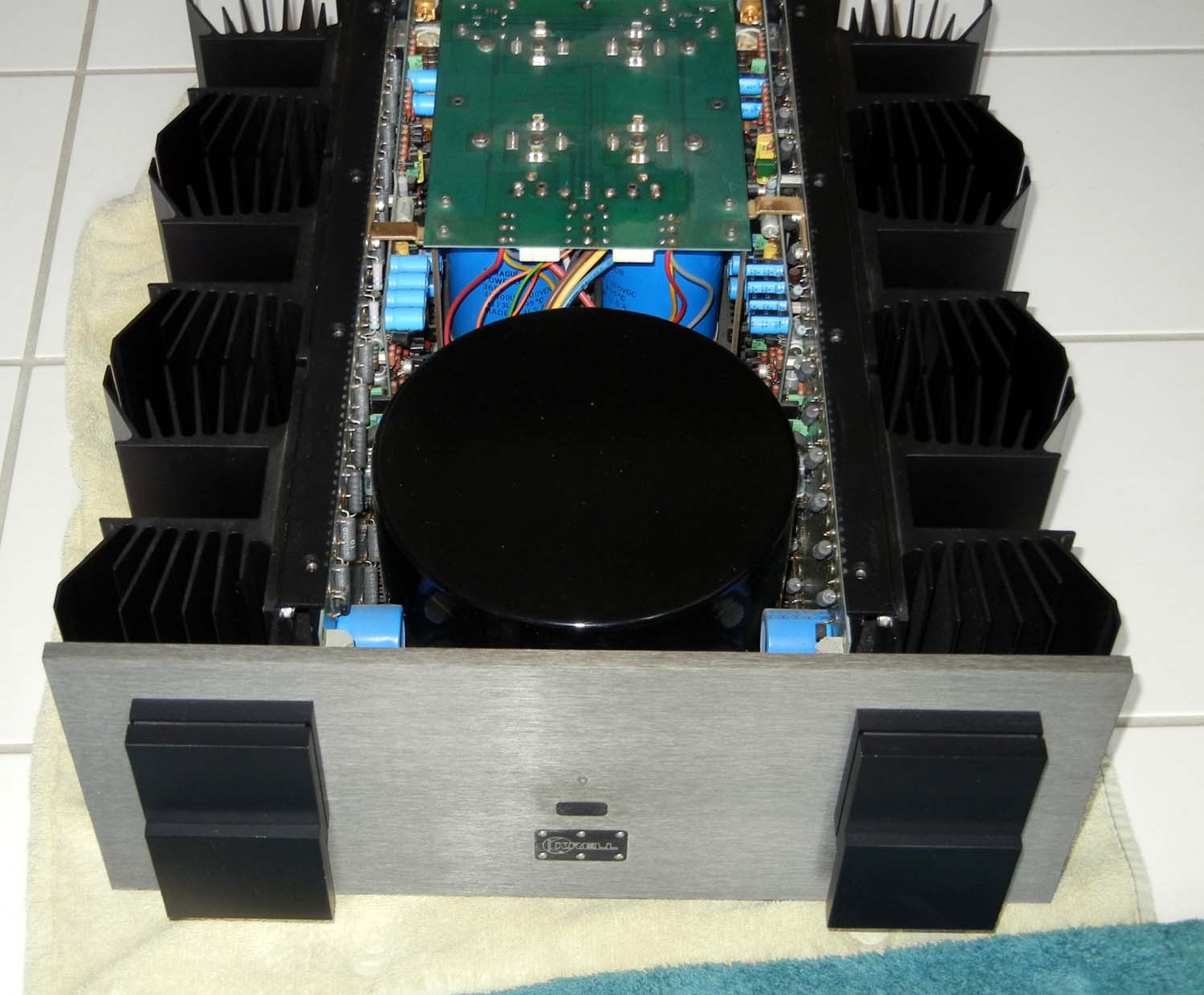
Internally, the KSA-250 is a study in simplicity as well as a technological tour de force. The 4.5kVA transformer, which by itself weighs 85 pounds (!), is located just behind the front panel, and is in turn followed by four 47,000µF capacitors covered by a printed circuit board. It is important to note that there is no wiring in the signal path, all connections being made via the pcb in the front end, and gold-plated copper-beryllium busbars in the output stage. There are 24 output devices per channel, all operating in class-A mode down to 3 ohms, where the amplifier reverts to class-AB (see Sidebar 3). The KSA-250 utilizes class-A circuitry throughout the audio and power-supply regulation stages, and can actually generate 320Wpc into 8 ohms. It is DC-coupled throughout, without any capacitors in the signal path, and is a fully modular design employing gas-tight pressure connections between all subassemblies, allowing quick and easy servicing in the field.
According to Dan D’Agostino—the driving force behind every Krell product—the deletion of wiring within the signal path yields several benefits, including lack of coloration, long-term stability over many years (no possible oxidation or other internal wiring degradation), and reduced interaction between the output stage and external speaker wiring. Additionally, according to Dan, modular design and wireless direct internal connections produce far greater sample-to-sample consistency than was previously attainable.
The KSA-250 automatically corrects for DC offset, and also has an auto biasing circuit that keeps the amplifier within proper operating parameters even if the AC mains voltage fluctuates as much as 20% (100–130V). This important feature will no doubt benefit those who live with the common problems of urban AC mains-line fluctuation. With this much stored energy it is imperative to have bulletproof protection; if something does go wrong, you won’t find your woofer cones blown into orbit. A series of opto-coupled circuits, out of the signal path, constantly evaluate the amplifier’s operation, and will shut the unit down if they see excessive DC offset, short circuit, oscillation, AC power anomalies, high ground resistance, and out-of-phase ground. The manufacturer further claims that this protection will prevent damage caused by other defective components, faulty wiring, mishandling of the system, or amplifier failure. In other words, you’d have to try damn hard to blow up this amp.
One very nice feature of the KSA-250, as with all other current Krell amplifiers, is that it can be converted to mono-differential operation with balanced signal from input to output. Conversion into mono-differential form (designated as the MDA-500) will be done for no charge by the Krell factory, and returned to the purchaser with a new second amplifier (which does cost) already configured for mono operation. This is indeed clever marketing on Krell’s part, as a KSA-250 owner can upgrade without having to pay for modifications or trade-in existing equipment.
This amp draws an enormous amount of current (12A continuous, a not so pleasant side-effect of class-A operation), and should be, according to Krell, placed on its own dedicated 20A AC circuit. I would have to say, after listening to the KSA-250 in several AC mains modes (dedicated 15A and 20A lines, and non-dedicated lines) that their suggestion should be taken seriously.
Something else you might take into consideration before purchasing and installing a Krell KSA 250 is the amount of heat produced. All class-A amps run hot, and this one is no exception. Even with the cool fall weather outside, our listening/family room turns into an inferno within 45 minutes after powering up. The addition of a KSA-250 to the family could forseeably cause significant domestic social strife (unless, of course, you’re lucky enough to have a dedicated listening room barred to all parties but the most hard-core audiophiles).
Murphy’s Law strikes again
One hundred and forty pounds is a hell of a lot of amplifier to haul around, especially when it arrives at the front door 30 minutes before I have to be at a symphony rehearsal. What makes the situation even more maddening is when the darn thing doesn’t work. That’s exactly what happened with the first review sample. The first thing I noticed was that both positive five-way binding posts at the left channel output were defective, and would slip upon tightening, therefore preventing a solid connection. Perhaps that’s why the sound was so covered, and the amplifier soundstaged so poorly. Even after six hours of warmup time, the situation had not changed, so I called Dan at Krell, and was instructed to immediately return the unit. That evening I was admitted to the hospital, since I could not walk, sit, or stand up. Don’t carry this amplifier by yourself.
About four weeks later, the second review sample arrived. This time around, I paid the air freight driver to wreck his back, so that I could listen pain-free. From the first moment after startup, I could tell that this was a beast of another color. It worked.
Apples to apples
Perhaps the best way to describe the KSA-250’s overall sound would be a comparison with previous amplifiers from this manufacturer. Historically, all Krell amplifiers have shared a common sonic signature: very prominent, tight, deep bass, a notably more laid-back midrange, and a slightly more forward high end. In other words, a rather sectionalized sonic palette that, while not necessarily unpleasant (quite the opposite, in fact), was not entirely musically honest. While I appreciated the ability of all Krell amplifiers to drive hideously difficult loads, and effectively “throw the speakers across the room” with their rock-solid, tightfisted control, the strong colorations that came with these audio powerhouses left me a bit cold.
Now comes the Krell KSA 250, and a whole new ballgame. I am a musician, not an engineer, so I can’t tell you in technical terms what Dan D’Agostino has done to design such an incredible amplifier. What I can tell you, however, is that it is the most musically convincing product of its type to hit my ears, either tube or solid-state. While the Jadis tube amplifiers surpass this product (or any others, for that matter) in harmonic honesty, I don’t know of anything else, for any price, that offers such a natural musical presentation. Gone is the sectionalized bass/midrange/high-frequency Krell trademark. Total integration from top to bottom has now been accomplished, but not at the expense of that wonderful Krell clarity and impact. One might describe the overall sonic signature as almost tubelike, while retaining the attributes of the finest solid-state designs.
In direct comparison with my reference Mark Levinson No.23 amplifier, the Krell KSA 250 wins in all categories, except possibly for the 23’s uncanny ability to specify the leading edges of instrumental and vocal attacks. While the KSA-250 dynamically eats the No.23 for lunch and spits out the bones, it does not give me as much “you are there” feeling with the performers on stage. In this respect, the No.23 offers a more hands-on perspective (which some members of the Stereophile staff call “forward”), but, at the same time, is not nearly as dynamically realistic. While soundstaging with the ML No.23 is excellent, it is totally outclassed by the KSA-250. In fact, with the recent arrival of the spectacular B&W 800 Matrix monitors, I can hear the vertical and horizontal edges of the No.23’s soundstage, in comparison with the much more open and realistic three-dimensional image projected by the KSA-250. The No.23 sounds almost “small” (it isn’t) in comparison, compressing the outer edges of the orchestra into a more constricted frame than the KSA-250. The immediacy of the No.23 still appeals to me, but the Krell is definitely more neutral, harmonically accurate, naturally spacious, more extended on top and bottom (the legendary Krell bass), and, last but certainly not least, more dynamic. The No.23 is certainly no wimp, but it does appear to run out of gas on full orchestral transients when compared to the KSA-250.
I’ve encountered one problem with the Krell that is not an issue with the Mark Levinson: hum. The No.23 is dead quiet, either with the three-conductor grounded power cord or the two-conductor Distech Power Bridge II cord I use. The KSA-250 always produces some hum (audible only with the ears an inch or two away from the speakers), regardless of three- or two-conductor power cords (floating the ground with two-conductor seems to help). There’s no way I’m getting a ground-loop problem from somewhere else in the system, since the hum is present even without any input connection. Dan at Krell has suggested that I’m a victim of very dirty and RF-contaminated AC mains. He’s probably right, as I’ve experienced significant improvement to some front-end components through use of an Adcom ACE-515 AC Enhancer. Krell has suggested I try power stabilizers from Tice and Titan to eliminate the power-amplifier hum problem. If and when this occurs (depending on the status of my bank account, as well as available floor space), I’ll be sure to let you know.
A matter of perspective
When it comes to audio, musicians are an enigma. We listen to live music just about every day of our lives, and are probably among the most qualified critics of audio equipment. On the other hand, we often listen to music from a perspective not necessarily suited to honest judgment. As a bassoonist, I sit in the middle of the orchestra; not quite the ideal place for evaluating soundstage. On the other hand, I often listen to the orchestra from the audience in order to gain insights into “what I need to do on stage to make it sound right out in the hall.” I don’t want my system to sound as if I’m in the middle of the orchestra, but I do want to be able to feel the human kinetic energy being projected from that stage. Too many pieces of audio equipment launder this energy from the music, giving the listener a washed-out skeleton of the original performance. That is exactly what the old Krell amplifiers did, and is the antithesis of the KSA-250. This amplifier conveys the life of the music, not just the sonics. But it accomplishes this without a forward perspective, something that some of my National Symphony fellow audiophiles cannot swallow.
During one particularly heated listening session, we had a vividly divided camp as to which amplifier best represented the musical performance. Bob Kraft, bass trombonist, and Ken Harbison, percussionist, both felt that while the KSA-250 was more “dynamically impressive,” it didn’t have enough “meat on the bone,” and lacked the immediacy and warmth of the ML No.23. Their priorities, and desired perspective, leaned more to “I want to hear it from the stage.” They both felt that while the Krell had more impact, along with broader, higher, and deeper soundstaging, its leaner harmonic character and more distant perspective produced a less involving experience than the 23.
Al Merz, another NSO percussionist, and I felt differently. While we both loved the sound of the No.23—it represented more of what we heard while on stage—the KSA-250 gave a much more honest picture of what music sounds like from the audience. As I mentioned a long time ago in another amplifier review (Rowland Model 7, Vol.11 No.7), the further away from the stage one gets, the leaner and more transparent the sound. In purely sonic terms, one could say that the No.23 has more lower midrange and midbass energy per unit of sound than did the KSA-250. After hearing the new Krell every day for the past several weeks, it has become apparent to me that this amplifier is indeed more honest, though possibly less satisfying for the listener who wants to be in the middle of it all.
I strongly recommend operating the KSA-250 in balanced mode, if at all possible. Listening tests in both single-ended and balanced configurations using double sets of identical interconnects (Madrigal HPC and Straight Wire Maestro) indicate that soundstaging and dynamics are significantly improved in balanced configuration. Even though signal/noise ratio is only improved by 6dB in balanced mode, the far greater dynamic extensions on either end of the scale indicate that there are many more benefits to balanced operation than simply a lower noise floor. I have had similar experiences with amplifiers from Mark Levinson, Rowland, and Burmester, which lead me to believe that, in general, one should try to utilize balanced operation, if given the option.
Dan D’Agostino made it perfectly clear that the KSA-250 needs only 15 minutes to reach full operating potential. It just ain’t so. There is a definite “brown,” thick, nasal coloration during the first 30 minutes after power-up, which totally disappears after a minimum of 45 minutes to an hour. By that time, the sound opens up, all colorations disappear, and the amplifier comes to life. In fact, best results appear to come after two to three hours of playing time. I’m not suggesting that you leave this amplifier on all the time (unless you need a space heater), but any serious listening should not be done with less than 1½ to 2 hours’ warmup.
The term “awesome” is definitely overused nowadays. But I can’t think of another way to describe the KSA-250’s sound: a huge soundstage, far exceeding the lateral and vertical speaker boundaries, with a breathtakingly natural sense of depth. So clear, so open, so transparent, so powerful, yet so refined. The sense of reserve power is immediately obvious to the listener, but not in the same way one would normally associate with such an enormous amount of stored energy. This amplifier does the best job, so far, of reproducing the realistic size and dynamics of a live symphony orchestra in my listening room. Yes, the No.23 is excellent, but until you’ve heard the KSA-250, you haven’t heard real dynamics. A perfect example is the beginning of Eliahu Inbal’s performance of Mahler’s Symphony 5 (Denon CD CO-1088). The visceral weight coming out of the 800 monitors at that first orchestral climax was closer to the real thing than I ever thought possible. Compared to this, the No.23 came off sounding like a peashooter.
Dynamics are just part of the story. Musical transparency is just as important, although it is something usually only found in the finest tube amplifiers and a few solid-state designs. In this area, the Krell and Levinson No.20.5 are surprisingly similar, even though they are class-A designs from different manufacturers. They are both very transparent, allowing the listener to follow each musical line, even within the most complex passages. The principal difference, in this case, is the amount of power and spectral balance. The Levinson is a bit sweeter and more transparent than the Krell, but can’t handle full orchestral tuttis without some sonic congestion.
Two good examples here would be Arnold Bax’s Symphony 3 (Bryden Thomson/LPO, Chandos CD 8454) and Handel’s Water Music (Nicholas McGegan/Philharmonia Baroque Orchestra, Harmonia Mundi CD 907010). Both the KSA-250 and No.20.5 do an excellent job of unraveling the complex woodwind passage in the beginning of the Bax, but when the orchestration becomes more heavy and thick, the Levinson becomes congested, while the Krell retains its clarity and overall musical integrity. On the other hand, the tables are turned with the Water Music, which sounds much more convincing with the No.20.5, mainly because it can delineate the leading edges of all instrumental attacks more clearly than the Krell (as can also the No.23). Which amp is better? Do you prefer chocolate or vanilla? For baroque, chamber music, solo piano, and solo voice, I’ll take the Levinson 20.5. But pull out the big orchestral guns, like Mahler and Shostakovich, organ music, full chorus, or just about any pop, from rock to big band, and I’ll go for the Krell KSA-250. In other words, the Krell is the more versatile of the two, giving up a little musical delicacy to its more expensive competition.
Another area in which the KSA-250 excels is the accurate recreation of acoustic envelopes surrounding instruments and voices. Up until this amp came along, the only way to get this right was with tubes. Even then, they often can’t adequately deal with spatial information at the frequency extremes. The No.20.5 gets it 90% correct, but can’t quite resolve that last bit of resonant information surrounding instruments and voices. The No.23 does a little better, but only at the front of the soundstage. The KSA-250 gets it absolutely right, allowing the listener to hear how the instrument or voice interacts with the surrounding space, anywhere in the soundstage, just as in live music. For example, in the fourth selection of Antiphone Blues (Arne Domnerus, saxophone; Gustaf Sjokvist, organ; Proprius CD 7744), the acoustical environment of the recording creates standing waves with the saxophone that are clearly audible with the Krell but almost nonexistent with the Levinson No.23 and 20.5 amplifiers. With the Krell, you not only hear the saxophone in space, but the “ring” of the church acoustic as well. This recreation of ambient information draws the listener into the recording acoustic, not in a forward sense, but almost as if in a surround-sound environment. If you like to be inside the ambient soundfield, rather than outside looking in, the KSA-250 may be for you.
Which brings us back to the question of perspective and soundstaging. Many musicians, including myself, take a rather dim view of the unnatural, bigger-than-life soundstage record producers like to create, often at the expense of our artistic efforts. This is not to say that live music sounds as flat as a pancake. It doesn’t. There are those few wonderful recordings in which “more real than life” soundstaging is effective. We all know that tubes are considered the best at this, giving the listener lots of depth and space. But overly exaggerated depth in amplifier design is as much a sin as midrange glare, and has no place in accurate musical reproduction. This is where the KSA-250 weaves its magic—a soundstage so real one can reach out and touch the performers; palpable realism that beats the tube guys at their own game, without creating a false sense of depth. The KSA-250 is better than the Levinson 20.5, which gives good frontal soundstage but becomes somewhat indistinct and truncated toward the rear. The 250 doesn’t just offer dimensionality, but clear focus of each individual voice in the choir or orchestra, as it is heard in the concert hall.
Sonic honesty
Some amplifiers tolerate a certain number of sins upstream without becoming upset. Not the KSA-250. It scrutinizes everything, good and bad. It didn’t like the upper-midrange glare with the Madrigal HPC interconnect, nor the nasality of the plastic fiber-optic digital cables I tried with the Esoteric and Krell Digital products. Small differences (good and bad) I heard with cables, digital drives, and preamps with my reference No.23 amplifier were greatly magnified by the KSA-250, often to the point of distraction. In this respect, the Krell is very similar to the very honest and transparent B&W 801 Matrix and 800 Matrix Monitors; with garbage in, you get garbage out.
Shortcomings
The KSA-250 is not perfect. It is harmonically bettered by the Jadis tube electronics, and does not resolve leading edges of instrumental and vocal attacks as well as the Mark Levinson No.23. It produces a constant low-level hum through the speakers, which could probably drive some people nuts. It runs extremely hot, and sucks juice out of the wall like a sponge. So what? Audiophiles are supposed to suffer a little, aren’t they?
Conclusion
The Krell KSA-250 is a truly extraordinary piece of audio equipment. It is ruthlessly revealing of everything upstream and is, in this respect, the finest reference amplifier currently available. It will drive virtually any load, and is the first amplifier this listener has heard that successfully combines ultimate musical finesse with sheer dynamic brawn without sacrificing much along the way. While the KSA-250 does not quite measure up to the finest tube electronics in the area of harmonic accuracy, and falls somewhat short of the best solid-state in the ability to resolve vocal and instrumental attacks, it wins the prize in overall musical and sonic honesty. But if you’re thinking about buying one of these, be darn sure that your front-end electronics are the very best, or else you may be disappointed.
If you’re in the market for a great amplifier (or even if you’re not), you owe it to yourself to audition the KSA-250. It doesn’t get much better than this, folks, so find the checkbook, put off painting the house until next year, and get to your local Krell dealer. Now, how am I going to explain to my wife that we need to buy a new amplifier…?—Lewis Lipnick