Koetsu Onyx Long Body Reviews
NOTE: This is a rare and possibly UNUSED find. Its sent overseas to be inspected and certified new.
Is it everything “they” claim it is?
If you’re of a certain age you probably remember the L&M cigarette TV commercial jingle “They said it couldn’t be done!” What couldn’t be done? Create a filtered low tar cigarette with more taste to it! What a miracle! Of “Mad Man” era television advertising anyway. Younger readers are probably thinking what the hell is tar doing in cigarettes?
Because it was such a swell slogan, “They said it couldn’t be done” was later borrowed by VW/Audi and many others and here I am using it in 2026 for this Koetsu Onyx Platinum moving coil cartridge review.
Why? Because when Fumihiko Sugano passed away in 2023 at age 82 the family decided to cease production of a legendary cartridge line started decades earlier by his father, the late Yoshiaki Sugano—an unlikely candidate for cartridge designing greatness. Sugano was a sword maker, a boxer and for most of his career worked for Toyota, the automobile manufacturer whose ‘80s era slogan, coincidentally was “Oh, What a Feeling”.
Could there be a better slogan for Sugano’s retirement age mission designing and building phono cartridges, the brand name honoring the Japanese artist, Honami Koetsu? Not likely, as Koetsu enthusiasts will tell you: “Oh what a feeling” perfectly describes the Koetsu listening experience.
Now Koetsu cartridges are back, though everyone said, well you know what they said, but Arturo Manzano said it could and he has done it. How? Wow, well here’s the most offensive idiomatic expression ever in this context but I’m going with it anyway: Manzano “knew where the bodies were buried”.
By that I mean that for 30 years he was the original Koetsu importer and distributor in America and throughout much if not all of Asia as well. I interviewed him at AXPONA 2025 when he first announced the Koetsu rebirth and it was met with skepticism. Then again at AXPONA 2026 where he proved that yes, it could be done and he’d done it! Some objected to what he did and how he did it but that’s not the subject here.
How did he do it? Manzano knew all the people who worked for the Suganos and they were eager to continue working. He knew the sources of the parts, and the suppliers were eager to provide them. The Sugano family apparently was less than eager, but Manzano did a workaround of some sort to procure the Koetsu name and organize the original team and suppliers. Within a year of attempting the start-up, Koetsu was started up, beginning first as a repair and re-tip service and now as a full fledged Koetsu cartridge manufacturer offering many though for now not all of the former line.
Let’s Get Stoned! The Koetsu Onyx Platinum
I have this friend Larry Marcus. I met him decades ago when he first got into this business, buying the wood cabinet maker CWD. Fast-forward the decades and Larry owns Ann Arbor Michigan based Paragon Sight and Sound, a powerhouse midwestern high performance audio and video dealership.
Like a broken record, whenever I would tell Larry about a new cartridge brand or a design using new technology like Selective Laser Melting for instance, he’d say “Koetsu Coralstone” (which Koetsu “retired” in 2022). That was it for him. And I’d say, “But Larry, it’s just a conventional cartridge design tucked into a stone body!” and he’d say, “Right”.
 Onyx Platinum
I remained skeptical. I’d heard and reviewed the Rosewood and later the Urushi Vermilion a rosewood bodied design, hand-painted with a dazzling red lacquer produced from the caustic sap of the indigenous Urushi tree.
The sound was “fast and detailed” yet it was also lush and sweet. Very seductive. I bought! But once the required “you buy it you own it” period Stereophile policy demanded, had ended, I sold it. It was nice and I understand what drew me to it and what others love about its sonic performance, but for me it didn’t have the necessary “get up”, so it had to go.
I’d never heard a Koetsu Onyx Platinum cartridge under controlled conditions, but I remember what my late friend Art Dudley said about it and what he wrote in his review. The usually cautious Art was unabashedly enthused, especially about the Onyx’s rich tonality and textures, so getting one to review from the first “new Koetsu” production run was exciting.
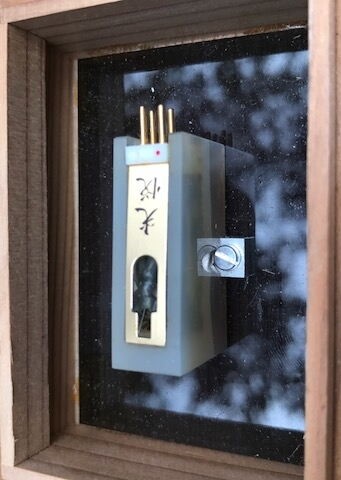
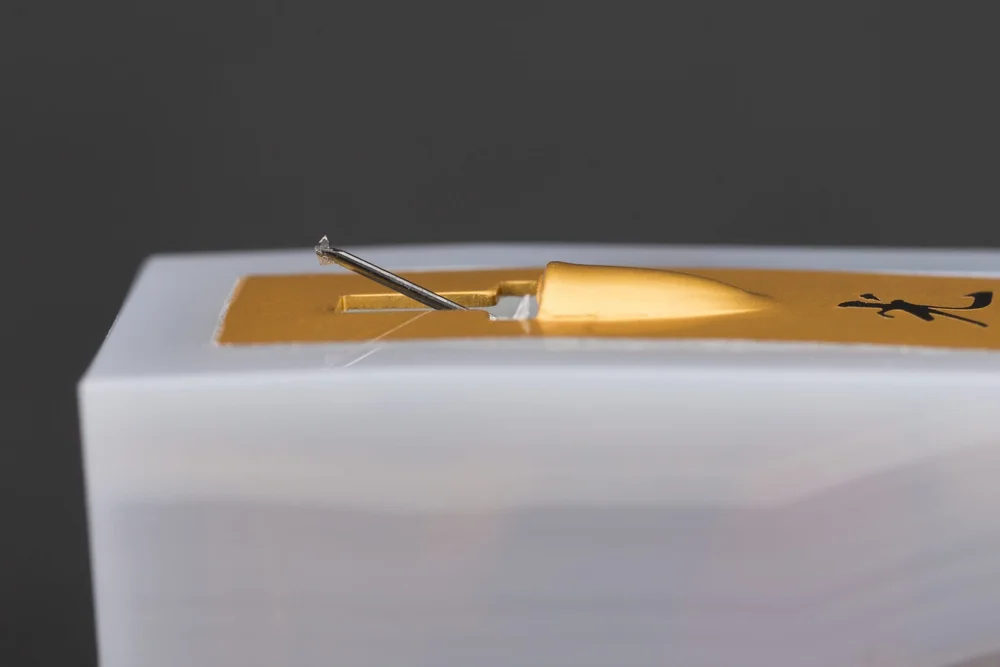
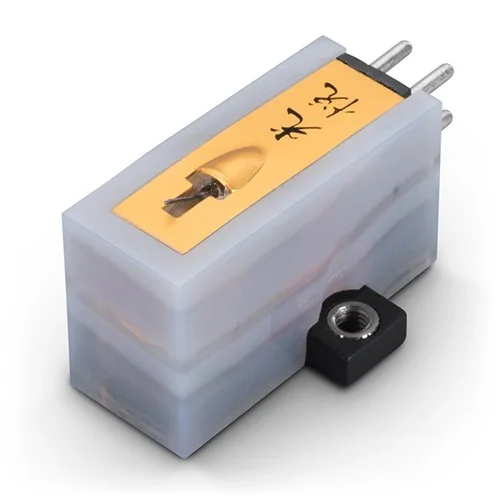
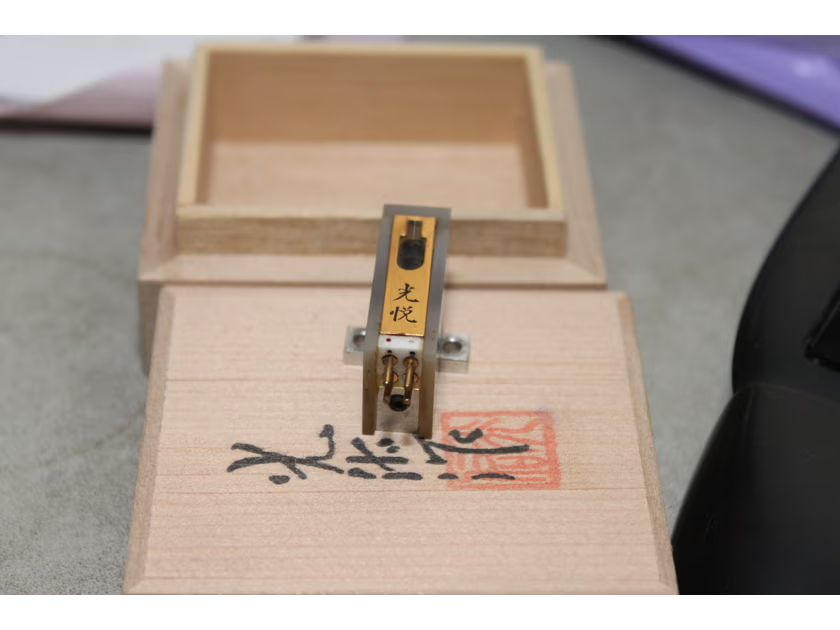
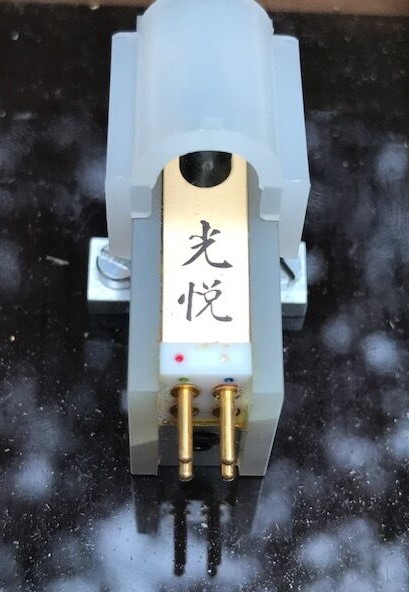
The Onyx Platinum features an Onyx stone body (of course), “the most tightly matched silver sheathed” copper coils and cores”, platinum magnets and a boron cantilever. No further construction details are offered. Output is .3mV, weight is 12.5, recommended tracking force is 1.8-2.0 grams, and the recommended resistive load is a rather wide to accommodate a wide variety of tastes and associated gear 75Ω-500Ω. Koetsu doesn’t list the cartridge’s internal impedance. So old school. Nor do they reveal the new model’s stylus profile, but the original was a line contact type from Ogura and this one looks to be that as well.
I set it up in the SAT CF1-12 arm and used an oscilloscope to set azimuth with tracking force set to 1.9g. Max L-R, R-L separation and channel balance was with the cartridge ever so slightly tilted to one side where I measured 27.0 and 27.5dB separation. Slight tilts produced major azimuth changes, so it’s best to at least use the Fozgometer v2, which comports closely with the oscilloscope. With the arm parallel to the record, VTA/SRA was 93 degrees so done! The precision build you expect but don’t always get for $15,495!
I realize that’s a huge sum of money for a phono cartridge designed to wear out (or break) but many people have the means and are willing to spend that much.
Once it had broken in, (though it sounded unquestionably great out of the box), I tested tracking ability using Ortofon’s test record. It sailed undistorted through the 90µm peak track —the record’s second most highly modulated—but slid off the track and crashed into the grandstand at 100µm, which is outstanding MC tracking performance.
How Do You Measure Intent?
Intent isn’t among the cartridge measurables and it wasn’t among the items I was listening for, but there it was. It was among the first things I noted. The musician’s, or the orchestra’s or the conductor’s intentions seemed more fully communicated even on the most familiar records, and that sensation began immediately with the first one, which was The Royal Ballet (RCA LDS 6065). It’s a useful “go to” for evaluating any cartridge’s sonic performance. It pretty much covers every base save for male and female vocals, electric guitars and synthesizers, and from what it tells you about orchestral instrumental tonality, you can accurately predict what a cartridge will do with voices—at least that’s been my experience.
I’m fortunate to have an original as well as the Classic Records 33 1/3 two LP and 45rpm box set. The original always sounded somewhat murky and caught up more in the Kingsway Hall sound rather than what’s happening in the orchestra, at least compared to the reissues.

I started with the original and it’s never sounded so correct and not at all murky. The Koetsu was not adding warmth. Had it done so, the presentation would have been thick and tonally over-saturated.
Instead, massed string tone was sensational: rich but not occluded. Airy, delicate woodwinds floated freely in the expanse of Kingsway Hall, the brass—horns, trumpets, trombones, and tuba had bite and “full burnish” weight. You could see and feel the instruments behind the sounds they were producing. I realize that’s over the top, but the physical gravitas was overwhelming.
I’ve heard “La Boutique Fantastique” so many times over the years but this performance was in another sonic zone! The percussion, especially the triangle, bells and xylophone were “razor sharp”—transient perfect, precisely drawn and spectacularly tiny —as they’d sound live—against the warmth of the strings and the wide, super deep stage behind. I’d never before heard it like that.
The rhythmic flow, the way notes and musical gestures followed one another with unusually unforced ease produced a buoyant sensation that’s usually the result of a turntable improvement not a cartridge’s but here the cartridge was producing the rhythmic thrust and delivering intense microdynamic shifts that were at the heart of the Onyx Platinum’s communicative excellence—something that took a while to fully grasp.
Playing familiar records and experiencing new pleasures instead of analyzing what produced them was a lot more fun. But when it was time to figure out “what the hell was going on” to quote a notable non music lover, the reasons became clear.
First off, this cartridge slams Thor’s hammer down on bass notes. It’s not at all polite on the big ones—tympani hits for example, yet the control is absolute. No “hangover” or added warmth. Attack is nimble and sustain generous, helping to produce the textures.
Once that was noted, out came the bombastic recordings like the DGG Original Source Series “Rite of Spring” with Abbado conducting the LSO (2530 635). Things moved so quickly I had to check the speed! Like I said, this cartridge moves things along! There was nothing polite about the Onyx Platinum’s delivery of the brass, but especially the tympani, which were presented full weight. On this recording the tympani strikes are powerful but not “depth charge” deep. The spatial presentation was vividly three-dimensional and precise.

As with the Royal Ballet recording, individual instruments appeared in their full rounded glory, seemingly surrounded by an “acoustic envelope” that helped produce three-dimensional, palpable, texturally complete harmonically saturated images. I could list half a dozen recordings and repeat myself but what’s the point if you get the point?
Tonearm Change Mid-Review
SAT is about to introduce a new version of its CF-1 series called (wait for it) the CF-2. One arrived mid-review and though it was a “drop in” process there’s a new head shell so the cartridge needed to be re-installed. Not a big issue. The new version is heavier, has a series of rigidity improvements and now the counterweight clamps to metal instead of to carbon fiber. There are other changes best left to the arm review.
Before making the change, I concentrated on a few recordings with powerful bass (not necessarily deep bass), took notes and then after making the arm change, played them again.
Low frequency performance improved though I didn’t think that was possible. Kingsway Hall’s “room sound” became even greater, which further opened and deepened the soundstage. More hall rumble, and yes, you can occasionally hear the subway trains rumbling through under the hall, though I never heard what Harry Pearson claims he heard: two trains traveling in opposite directions. Maybe I need big subs for that. As good as the original CF1 is, the CF2 improves the sound, mostly around the margins. That is, it’s incrementally better in every way as opposed to being a “sonic revelation”, which is what the original SAT arm was for me. The price hasn’t been announced. The greatest takeaway from this is that the Onyx Platinum’s low frequency power demands a tonearm capable of harnessing the energy. Otherwise you’re wasting your money.
I bought a copy of Analogue Productions’ Van Morrison’s His Band and the Street Choir (APR-027-45) a double record set mastered by Matthew Lutthans and pressed at QRP from the same equalized master tape used for the original. So, unlike the previous two Vans on AP, this one is AAA.

First, I played the original Radio Station Service copy that’s always sounded spectacular, engineered by Elliot Scheiner, special thanks to Ed Anderson who I knew from Lion’s Gate dubbing stage in Santa Monica, CA and to “the coffee at A&R” so we can assume the album was recorded there.
The original mastered by Bob Ludwig at Sterling Sound though always sounding superb, also seemed a bit tipped up on top and slightly bass shy (not the typical RL sonic signature), but through the Onyx Platinum from the first vibrant rim shot “pop” it was clear that everything noted in Kingsway Hall was here too! The timbral balance was ideal in my system and perfectly convincing.
I could feel drummer Dahaud Elias Shaar propelling the ensemble forward as I don’t recall sensing before. Van was there not as a recording but there as a full body experience. The bass grip was intensely muscular and the kick drum, always a bit “thuddy” was tight and “punchy” though the attack was still somewhat ill-focused. Perfect!
But let me concentrate on “Crazy Face”. It starts with the piano part, then there’s guitar and a powerful bass line. The piano and organ are not super upfront in the mix, but the cartridge laid them out so clearly and effortlessly in the backdrop yet without added edge. How many times have I heard Van’s fluttering tenor sax on that track? A hundred? I swear to you I’ve never heard it so vividly and I’ll repeat the word effortlessly presented three-dimensionally, nor has the instrument’s “reedy” quality been so palpable. Maybe the “P word” is the key to all of this. As the song concludes Van sings “Ladies and Gentleman the Prince is late!” First play through the Platinum Onyx brought Van’s exclamatory insistency to a new intensity level. I understand that this is starting to sound like “hype” but I’m just describing my honest reactions.
Yet the cartridge accomplished all these notable notables not by hyper-dramatizing anything tonally by adding brightness or false detail. Just the opposite. On “Call Me Up In Dreamland” there were those “live in the room” cymbals properly sized and so clean and shimmery, like the percussion in Kingsway Hall. And again, Van’s tenor sax part has never moved me that much. When he sang “Here it comes!” I almost ducked to get out of the way!
I’m thinking can the double 45 cut from the same tape, but decades later actually sound better than this? I always say “Never bet against a Bob Ludwig RL Sterling original”. Here you have that versus a 45rpm cut by Matthew Lutthans on the TML tube driven cutting system. Mat’s cut is true to the original and that’s key to its success. No boosted or cut frequencies. Trying to best a great RL cut is a fool’s errand.
The 50+ year old tape has lost a bit on top and the tube system slightly softens transients but overall, the double 45 is comparable to the original and at 45 and spread onto four sides maintains its consistent excellence throughout. I can’t say it beats the RL original—at least not my very early radio service pressing! It effectively competes with it.

The MJQ’s European concert (Atlantic 2-603) has long been a favorite but not played in a long time. The “performance” exceeded my highest expectations. First the opener “Django” felt jet-propelled though of course the record spun at the correct speed. The sense of musical propulsion was hyper vivid. You could feel Percy Heath pull on the bass strings. Every Jackson mallet hit had a shimmering three-dimensional shape and color. John Lewis’s piano on this record often got lost in the background but not on this play. Connie Kay’s cymbals and especially his snare pops moved air in the hall and they did same in my room. The attack, the sustain and the decay of all four instruments were so right and so precise against a black background. Lewis’s piano solo on “I Should Care” has always sounded somewhat soft and gauzy, but here each note rang out as important, and when Heath concluded the tune with his arco bass bow the finality of it dug deep.
Oh, and Ella sounded natural and life-like, not tipped up on top on Clap Hands, Here Comes Charlie! (V6-4053) recorded 65 years ago at Radio Recorders in Los Angeles. BG did an outstanding mastering job on the 33 1/3 version for the Acoustic Sounds/Verve series edition. There was no added edge to her voice.
I’ll stop now.
Early Warning System!
In the queue:
Grado’s latest moving iron cartridge the Epoch 4 ($9,995)
Etsuro Urushi Bordeaux ($7500)
The Ortofon Vertex ($16,999)
The Audio Technica MCD1 ($11,000)
The Wilson Benesch Tessellate Ti-D ($18,500-$23,000 depending upon finish)
Ortofon X50 ($1600).
How will the top most (price wise) among these cartridges compare to the Onyx Platinum? I don’t know! Stay tuned. On the other hand if you like what you just read and have the means, you really can’t go wrong here.
Conclusion
When I began listening, before the Onyx Platinum had broken in, it immediately made its overall excellence and impressive spectral balance known. Sure, smooth timbral balance top-to-bottom was obvious—no warmth bumps on bottom and no sizzle on top. No hyper-edge transients or soft blunted ones either.
The balance was and remained observationally smooth and linear, with deep bass extension and control, notably exceptional high frequency transient precision and a rich, naturally lush midrange.
But this cartridge’s greatness is far more than a collection of audiophile check list items (soundstaging, imaging, three-dimensional image solidity, dynamic contrasts etc.) or measurable ones. The very first time I said to myself, (which happened almost immediately) “Oh, that’s what he meant” is when I knew the Onyx Platinum’s reputation for musical communicative greatness wasn’t hype.
That odd but pleasing experience as record after record delivered greater musical intent is inexplicable. Is it the Platinum magnet? The coil wire? The stone body? Or the combination of all those things and “tuning” by artisans? II don’t know.
I’m more than happy to conclude this with a quote from Art Dudley’s Koetsu Onyx Platinum review, both as a tribute to Art and to assure anyone wondering if this new Koetsu is the same as the old Koetsu and not just a Koetsu in name only. Art said, “All in all, the Koetsu Onyx Platinum communicated color, texture, touch, and musical nuance to an extent and in a combination that I’d never before heard.”
That’s also what I heard—and believe me, the Wilson Benesch Tessellate Ti-S mounted on the Graviton arm is no sonic slouch!.