Marantz Model 250 Stereo Power Amplifier Review
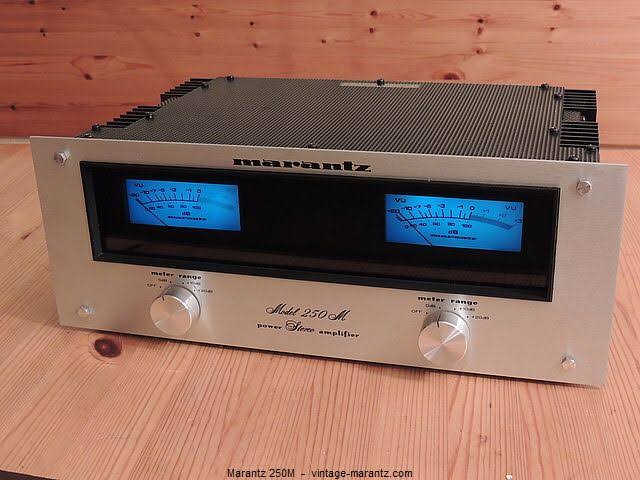
The Marantz Model 250 is a classic solid-state stereo power amplifier from the early 1970s (primarily 1972–1974, with some production overlapping into later years). It was part of Marantz’s professional/high-end lineup during the golden era of American hi-fi engineering, before the company shifted more toward mass-market and later Japanese production. Original retail price was around $495.
Key Specifications
- Power Output (both channels driven, 20 Hz–20 kHz at rated distortion): 125 W RMS per channel into 8 Ω 150 W RMS per channel into 4 Ω 64 W RMS per channel into 16 Ω (Typical measured output often higher, e.g., around 140–150 W into 8 Ω before significant rise in distortion.)
- Total Harmonic Distortion: < 0.1% (typically ~0.05%) at or below rated power.
- Intermodulation Distortion: < 0.1%.
- Frequency Response: 2 Hz–100 kHz (+0 / –1.5 dB); ±0.1 dB from 20 Hz–20 kHz.
- Damping Factor: > 100 at 8 Ω.
- Input Sensitivity: 1.5 V for rated power.
- Signal-to-Noise: Better than 106 dB below rated power.
- Dimensions: Approx. 15⅜ × 6⅛ × 9½ inches (391 × 156 × 241 mm).
- Weight: 28 lbs (12.7 kg).
- Features: Dual power meters (on many units), protection circuitry, robust construction with discrete complementary circuitry, and easy conversion between 120 V / 220 V operation.
A related later variant, the Model 250M (mid-to-late 1970s), is very similar in core performance but often features distinctive cobalt-blue illuminated meters and slight refinements.
Build and Design
The Model 250 is a substantial, no-nonsense power amp with a clean, professional appearance typical of Marantz separates of the era. It uses a fully discrete complementary design with carefully selected transistors, independent circuit boards to minimize interference, and a hefty power supply. Owners and restorers frequently praise the quality of the transformers, capacitors, and overall construction. Like many vintage high-power amps, it benefits greatly from a full recap, bias adjustment, and (if needed) output transistor replacement for long-term reliability.
Sound Quality
Contemporary lab tests (e.g., Audio magazine, 1972) described it as a “superb unit” with exceptionally flat frequency response, very low distortion well below rated power, and clean performance even at high output levels. Listening impressions from the period highlighted clean, smooth sound with excellent control and the ability to drive speakers to high SPLs without strain.
Modern owners and restorers often call it one of the better-sounding Marantz power amps of the era. Common descriptors include:
- Deep, well-controlled bass with good weight and extension.
- Natural midrange with good presence.
- Clear, detailed highs (sometimes noted as slightly less refined than certain tube or higher-end solid-state contemporaries, but still excellent).
- Overall musical, dynamic presentation with the classic Marantz warmth and authority.
It pairs well with efficient or moderately demanding speakers and has enough current delivery and damping to handle lower-impedance loads (though prolonged hard use into 4 Ω should be approached carefully on unrestored examples). Many users report it remaining highly competitive when properly maintained.
Pros
- High continuous power with excellent measured performance for its time.
- Robust build quality and strong reliability when serviced.
- Engaging, powerful, and musical sound.
- Relatively compact and practical for a high-power amp of the period.
- Strong collector and enthusiast following.
Cons
- As a 50+ year-old design, most examples need restoration (capacitors, possible transistor work, meter lamps, etc.).
- Limited features by modern standards (no balanced inputs, basic protection only).
- Heat and bias stability can require attention on older units.
- Finding a clean, fully original example at a reasonable price has become harder.
Verdict
The Marantz Model 250 remains a highly regarded vintage power amplifier that delivers serious power, low distortion, and an enjoyable musical character. When restored, it can still hold its own against many modern mid-to-high-end amplifiers and offers a classic 1970s high-end experience without the bulk or complexity of some contemporaries. It is especially appealing to enthusiasts who appreciate discrete solid-state design, strong dynamics, and the Marantz house sound of that era.
Recommended for: Collectors, restorers, and listeners seeking a powerful, musical vintage power amp to pair with a quality preamp. Not ideal as a “plug-and-play” modern solution without servicing.
If you’re considering one, prioritize units that have been professionally restored or plan for a full service—the results are usually very rewarding.