“Gotta get my hands on these!”
Before the 1999 CES, I had never heard of the Soliloquy 5.3, but “this slim, 38″-high obelisk was among the most open- and transparent-sounding speakers at the Show,” as I said in my April ’99 Show Report. As I slogged from room to room, never able to spend enough time with things (and people) that entertain and inform, and rarely able to avoid exhibits of even minimal interest, it was absolutely wonderful to stumble on something both novel and satisfying.
 Skimming Soliloquy’s website, I learned that Dennis Had of Cary Audio Design put about four years into the development of the original Soliloquy as a labor of love, and in an effort to allow his electronics to fully express their talents. Not wishing to divert focus from his electronics business, Had sold his interest in the design to Bernie Byers, who then established the Soliloquy High Fidelity Loudspeaker Company.
I don’t know how much of a hand Had had in the 5.3, but its family resemblance to its forebears is clear. Other models on view at the website include the Models 5.2 (stand-mounted, 5″ low-mid, 1″ silk-dome HF) and 8.2 (floorstander, 8″ low-mid, the same HF dome). The 5.3—a floorstander with two 5″ midrange/woofers and the 1″ dome—seems to be their offspring. All Soliloquies have narrow faces, that silk HF dome, and rear-ported enclosures. Moreover, I’m told that all have been developed via an arduous, reiterative process of “design-produce-listen-redesign…repetitions.” (Now, where have I heard that before?)
Setup and Break-In
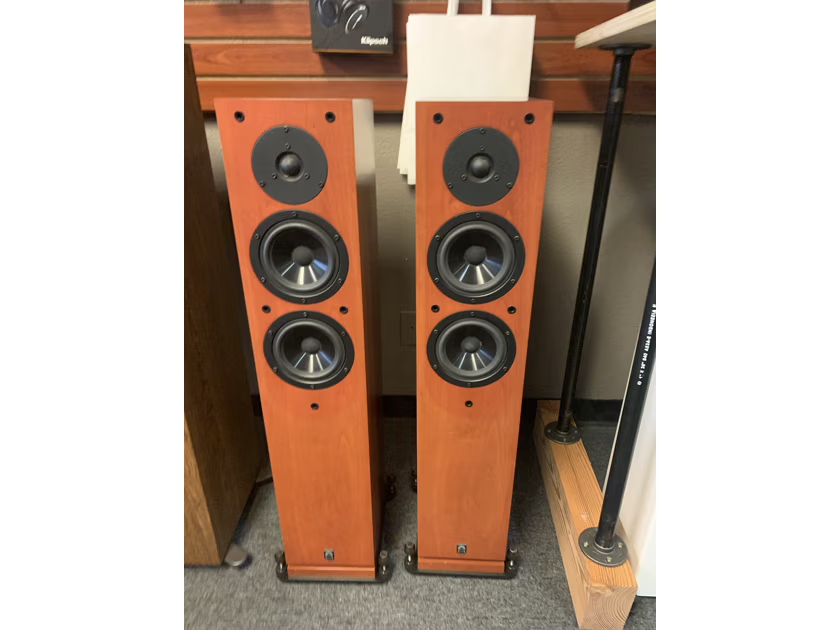
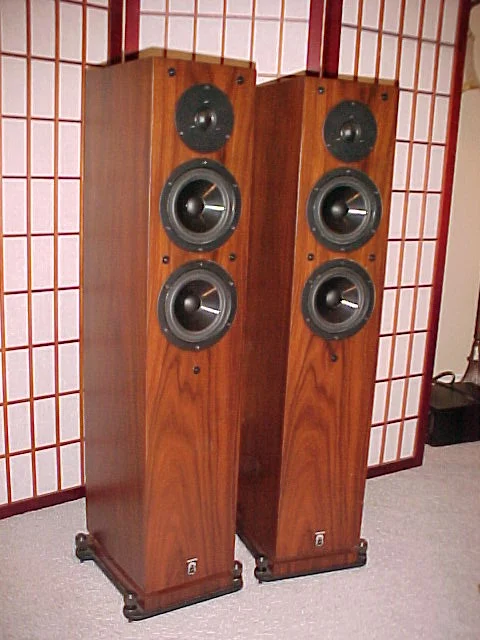
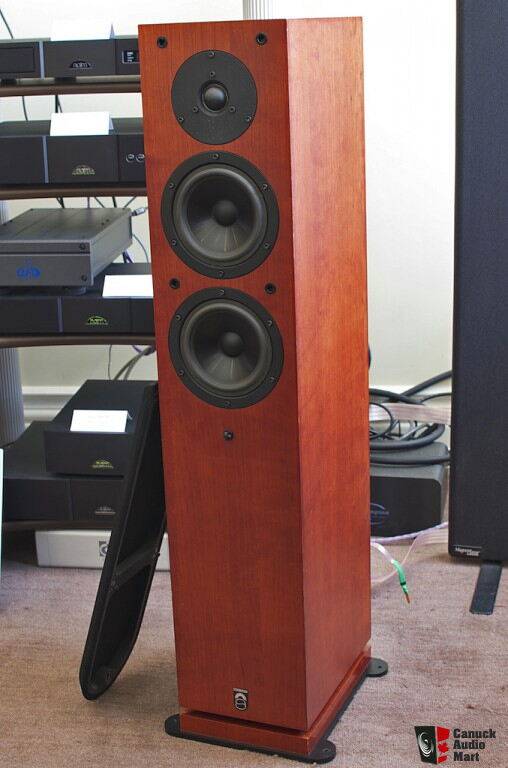
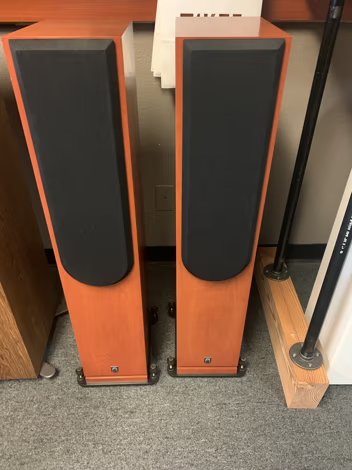
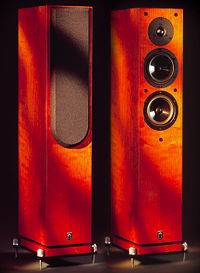
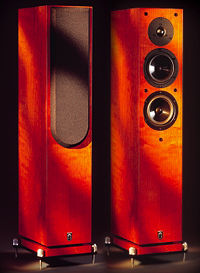
The 5.3s arrived double-boxed. Unpacking and maneuvering was easy—the tall, slim cabinet can be slid or walked on its steel base-plate. The cabinet itself is pretty solid, its rosewood finish is beautifully matched on all visible surfaces, and, with or without the grilles, the 5.3 slips graciously into domesticity. Fit and finish are above reproach.
Once the speakers were in place, I screwed down their massive, beautifully machined spikes through the base plate to ensure a solid, level footing. Even with the spikes in place, I could still move a 5.3 by carefully tilting it onto one spike at a time and walking it about.
The 1″ silk-dome tweeter is near the top of the front panel, the two 5″ drivers directly below. The internal crossover is third-order (18dB/octave) at 2.4kHz. Interestingly, the 5.3 is said to have an electrical phase response within ±45 degrees over the entire audible bandwidth. The large-diameter port on the enclosure’s rear extends to within 2″ of the front panel, which, in the visible area near the port, appears undamped. This close proximity of the front panel and the input of the port suggests high-pressure loading of the port. Polyester stuffing is just visible above and below the port. A nicely inset identification and connection panel toward the bottom of the rear panel bears four heavy-duty, gold-plated five-way binding posts. Gold-plated jumpers are provided for use when not biwiring.
By the time the 5.3s arrived, I had forgotten almost everything about them except that it was I who’d written so favorably about them in my CES report. Whether I hooked them up to the hotrodded McCormack DNA-1 or the Sonic Frontiers Power-2 via a pair of Straight Wire Maestro II cables, the 5.3s sounded bright and boomy. There certainly was evidence of clarity and resolution, but the highs seemed excessive. At the other end, the bass was overripe, and the lower mids tended to bark when driven at anything approaching useful levels. Radio announcers were more difficult to tolerate than usual. Clearly, I had made an error of judgment at CES, the guys at Soliloquy had somehow screwed up, or—just mebbe—these babies were too new to be housebroken.
The instruction manual does say that 500 hours of break-in are needed. While you might not be able to put off listening to your new acquisitions that long, please reserve judgment for a few hundred hours.
Over the course of the next few weeks I moved the 5.3s closer together, then farther apart, all the while experimenting with their distance from the listening seat. I tried to reduce the bass bark by stuffing their rear ports with polyester batting. Nah—that only muffled the bass. Besides, the Soliloquies demonstrated their disdain by blowing the batting out with an emphatic PFOOOT! Finally, thinking that the drivers might be wired out of phase, I removed the jumpers from the binding posts and biwired the 5.3s for easy phase reversal. Which only made things worse.
Not knowing how to live without music, I left the 5.3s biwired to the Power-2, but with the recommended phasing. At this point the 5.3s stood more than 9′ apart and less than 3′ from the front wall—significantly farther from each other and the listener than is usual for speakers in my listening room. Toe-in was minimal, at about 5 degrees. Other large reflecting or absorbing objects were kept well away.
Weeks passed. Gradually, it dawned on me that WQXR’s announcers no longer seemed to be swallowing their mikes, and surface noise from my thrift-shop LPs seemed smoother and less obtrusive. After seven weeks, the 5.3s had matured enough for me to remember why they’d so impressed me in Las Vegas.
Listening
After that break-in period, the Soliloquy 5.3 was an absolute delight. The immediate impression I got was of great transparency and space. With the spatial trickery of the Willow soundtrack (Virgin 90939-2), the 5.3s put the pan flute front and center, spread the strings widely across the room, hurled the percussion from various directions, and summoned up the chorus from somewhere back in the Meadowlands of New Jersey. (When listening, I face west.) Imaging was stable and natural, but not “pinpoint.”
James Horner’s less varied score for Glory (Virgin/Classic DAD 1008) has benefited from full 24/96 treatment, its rolling drums and ethereal chorus seeming entirely liberated from the equipment. There was no “sweet spot”—I could get up, walk around the room, stand up, or sit down, and transparency and tonal balance remained constant. Bass was not Stygian, but adequately extended.
The magic was not restricted to contrived recordings, but was lavished equally on voices and instrumental ensembles. I tried all my standard voice tests, from Diana Krall and Holly Cole to Jerry Hadley and Thomas Hampson, and the 5.3 presented them as purely and naturally as any speaker yet to visit my listening room. Latin flavors, from The Buena Vista Social Club to Los Lobos’ Kiko, were pungent and incisive. Jazz ensembles were particularly well served by the 5.3s’ generous soundstage and lack of coloration.
Dick Cary’s Tuesday Night Friends’ Catching Up (Klavier KD-77024) seems to have taken up permanent residence in one of my CD transports—I can’t resist playing it almost daily. This disc is a model of how to record a jazz band with the rich, warm brass retaining their bite. On my favorite cut, “Recado,” the 5.3 deliciously delineated all the brass and woodwind counterpoint while maintaining ensemble cohesion. The interplay of keyboard, bass, and percussion was clearly revealed, as the bass performance of the 5.3 extended down to near 40Hz. And George Faber’s “Count the Tears,” from Sure Beats Workin’ (PopeMusic PMG 2032-2), had all the requisite slam.
The two cone drivers handle everything up through the midrange, so there were none of the discontinuities that so plagued the Coincident Super Conquest Series II (Stereophile, June 1999). Thus, although the Super Conquest had more extension and power in the lowest bass, the 5.3 had more useful impact and kick in the range just above—especially notable on piano recordings. Throughout the rest of the range, it was no contest—the 5.3’s transparency made it super-seductive.
It was harder to compare the 5.3 with the newly arrived PSB Stratus Gold-i. The PSB has a richness and a solidity, without boom, that the much smaller 5.3 could not approach. On the other hand, I was more conscious of the presence of the PSB, from both visual and auditory cues, than I ever was of the Soliloquy, which seemed to disappear into the music. But take that last comment with a big grain of salt—I’m only beginning to become familiar with the PSB.
The use of small drivers in a small enclosure means that the Soliloquy is limited in how much air it can move. It couldn’t blow me away with huge symphonic and choral monsters, as can the Stratus Gold-i. In fact, my Paradigm Reference Esprit/BP, with a pair of 165mm drivers but with a 60% larger enclosure, is more capable of shaking the timbers than is the 5.3. But when listening to Mahler, as is my habit, I found the Soliloquy ever-so-nearly excellent. It handled everything in Symphony 4 (Salonen/LAPO, Sony Classical SK 48380) with aplomb, and did just fine with Symphony 3 (Horenstein/LSO, Unicorn-Kanchana UKCD 2006/7), because the scoring is pretty open. The denser, deeper Symphony 2 (Rattle/CBSO, EMI 47962) and 6 (Zander/Boston Philharmonic, IMP DMCD93), however, simply demand more weight than the Soliloquy could load into my room.
The 5.3/Power-2 combination was ever so refined in its depiction of detail, harmonics, and microdynamics, but macrodynamics were merely okay. It wasn’t just a matter of SPLs—switching to the hotrodded DNA-1 afforded more volume and punch, but no more heft. Besides, the 5.3s were simply succulent with the Power-2. In fact, the 5.3s were so good and so coherent that I’d hesitate before gambling on a subwoofer. (Soliloquy does offer one, along with a center-channel speaker, to fill out a home-theater setup.)
The Soliloquy had only minor failings. Because my listening room is fairly warm, the 5.3’s slight prominence in the upper midrange (4-6kHz) troubled me but little—placed at the live end, the speakers effectively balanced that warmth. (If your room is a bit hard overall, the 5.3 should be auditioned at home before purchase.) Bass-rich sources can still evoke a bit of a bark from the 5.3. For example, when listening to music at healthy levels on well-miked FM broadcasts, I often had to jump up and quench the volume when the close-miked announcer came on. Both of these characteristics seemed to fade with continued use, but I wonder if the low-end characteristic could be caused by turbulence in the duct system. Finally, the 5.3s needed breathing room. Their bass became thumpy, and their image depth compromised, when I moved the Stratus Gold-i’s down to the same end of the room.
A truly lovely recording is Flamenco Mysterio (FIM GSCD 016), featuring Gino D’Auri on guitar, accompanied by percussion (tabla!), strings, and assorted keyboards. It’s far from traditional flamenco, but nonetheless exudes style and spirit. Recorded by Stephen Hill and re-mastered by Doug Sax, the recording presents D’Auri’s instrument with lifelike presence, precise transients, and warm resonance. Over the Soliloquies, D’Auri sat across the room from me, the sounds of his fingers on strings and fingerboard just audible under the rich tones emanating from the gut and wood. I got up and walked over to him. Remarkably, the balance between the sounds produced by the instrument and those directly on it shifted as I sat down directly in front of him. Although I moved, he was still in the same relationship to the supporting instruments in the nicely reverberant soundstage. This rare experience was made possible by the Soliloquy 5.3s—speakers with little if any grain, and with extremely fine resolution.
Conclusions
I have avoided discussion of price, since the remarkable Soliloquy 5.3 deserves to be judged solely on the basis of its superb performance and construction, and on its suitability for your room. Their spatial presentation is excellent, and voice and instrumental balances are natural and satisfying. Mated with a sympathetic amplifier and decent source material, the 5.3s can be an open window into the recording venue. Their dynamic limitations are a bit restricting with post-Romantic blockbusters, but that is merely concomitant with their size.
So it ain’t perfect, but neither is any other small speaker in that regard. Otherwise, it’s as good (and as good-looking) as you can get for the price, not to mention a fair bit more.
“Gotta get my hands on these!”
I’m very glad I did.