On March 27th, 1983, the New York Times published an article titled “Sound; Tonearms: Is Linear Better?”. The article read like a technical paper, more sophisticated than some of today’s articles found in Audiophile magazines. Without too much introduction, the article jumped right into contrasting the pros and cons between tangential versus pivoted tonearms as if it was normal kitchen table talk. But when Sony released the first commercial CD player in 1982, the sale of turntable equipment dwindled in popularity together with vinyl, and the article was the last time mainstream media provided technical coverage on turntable technology.
Tonearm technology, however, never ceased to progress and continued to develop throughout the CD-dominated era of the ’90s and on into the current era. That is, the subject of the New York Times’ 1983 article is still relevant today.
Most tonearm designs fall into one of two categories: Pivoted Tonearms and Linear Trackers. Pivoted tonearms, as the name suggest, swings across the record surface swiveling on a single point. They are usually simple in design and have the advantage of having few moving parts other than the bearings. But due to the offset angle of the cartridge, the stylus’ does not remain tangent to the record surface as it moves from the outer edge towards the label. The number of degrees by which the cartridge angle differs from true tangent at any particular moment of the play is called the tracking error. This difference makes the stylus ride askew in the record groove, causing distortion, and is somewhat analogous to the sideways drag caused by bad wheel alignment in a car. This distortion can sometimes be audible, where you can hear the sound “breaking up” as it comes out of the speakers.
Linear tracking tonearms, in contrast, do not swing across a record. Instead, the arm slowly crawls over the record in a straight radial line, inching its way toward the center label. The stylus remains tangential to the groove walls, and the angle stands constant, eliminating tracking errors (at least in theory), but that’s not the only benefit. Linear tracking also eliminates the side-thrust called the skating force, which makes conventional arms lean harder against one side of the groove than the other. This force is caused by the offset angle for the headshell in pivoted arms. Linear arms have no such offset angle, so the problem never arises in the first place (again, at least in theory) so they require no anti-skating adjustment.
Yet, linear tracking tonearms are not without their shortcomings. It takes a complex mechanism to guide the linear arm across a rail (in order to maintain that “correct” angle), and the vast majority of such implementations require complex air bearings, pumps and pressure monitors, and an air compressor. Manufacturers of “air bearing” tonearms will often claim they are frictionless, but regardless of their claim, the ability of the arm to glide across the rail rest solely on the record grooves and the stylus resting at an angle least efficient for energy transfer, typically at 90 degrees. Over time, the stylus on many linear tracking arms are found to have uneven wear on one side of the diamond, and some cartridge cantilevers are also found to be skewed towards one side.
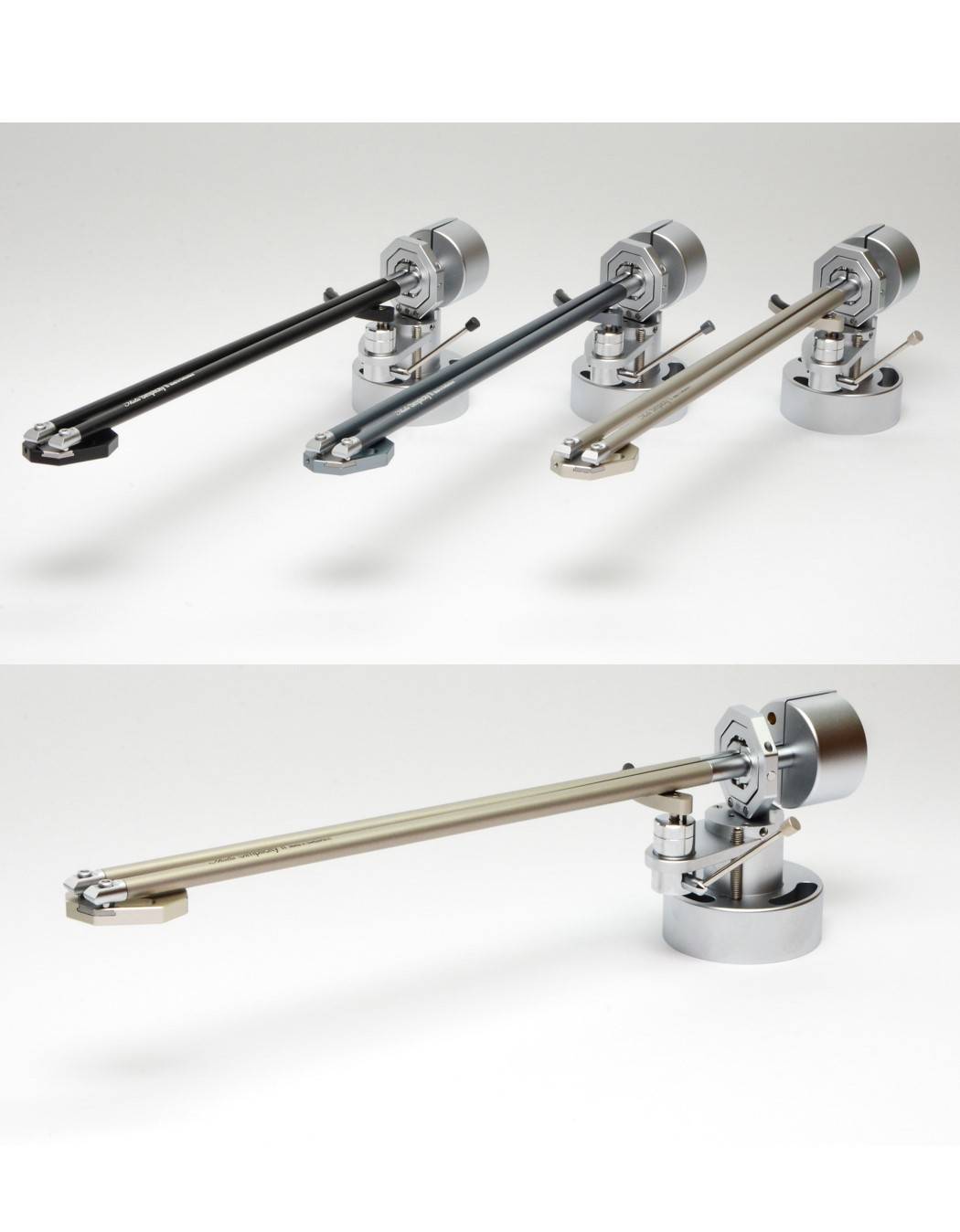
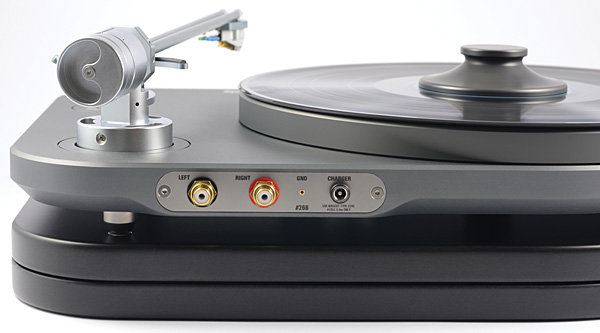
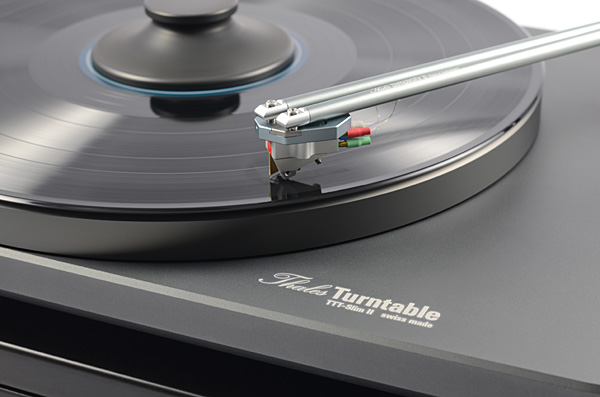
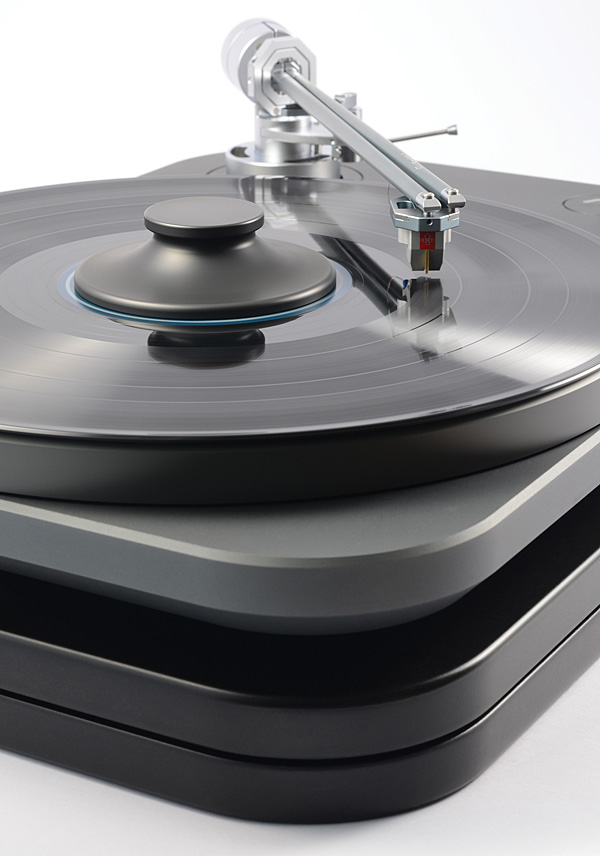
There is a third alternative, which brings us the subject of our review today: Pivoted Tangential tonearms, namely the Thales Simplicity II (US$ 9,450).
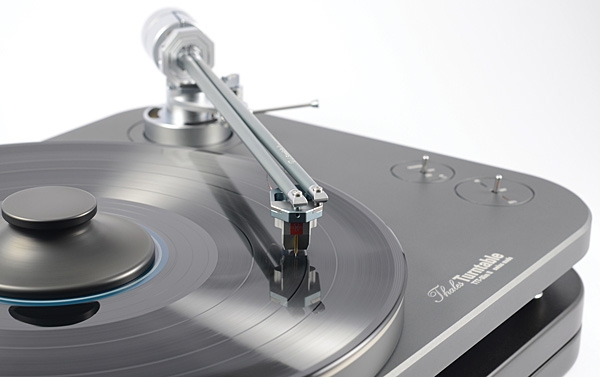
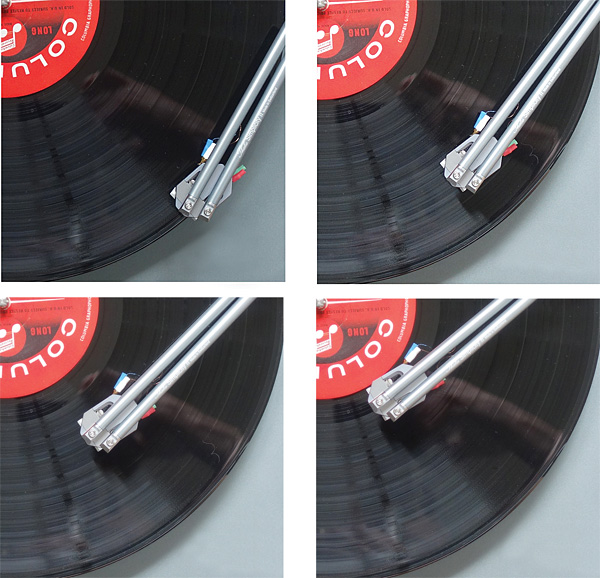
In Asia, Thales’ pivoted tangential arms are nicknamed “the Chopstick Arm” for good reasons. By using two armwands instead of one, pivoted tangential adjust the position of the headshell as it swings across the LP so that the stylus always maintain a tangential position. The tracking error is said to mimic tangential arms almost completely. On the Thales Simplicity II and the statement, the tracking error is said to be only 0.006 degrees.
The concept may seem very advanced, but Thales is not the first to come up with this concept. The design was introduced as early as 1956 by ESL BJ’s “Super 90” tonearm which employs the same technology. The owner’s manual of the ESL BJ arm gave a very comprehensive explanation of the pivoted tangential concept together with diagrams:


While both the BJ Arm and the Thales arm employs 2 armwands, the BJ Arm is based on the “Tetragon” geometry while Thales arm is based on the “Triangle Geometry”, which reduces tracking error to a level much lower than the BJ arm.
Aesthetically, the ESL BJ “Super 90” has a 1950s chic; it looks like a ’70s Star Trek Klingon spaceship guided in front by a flying cockroach. Regardless of how amazing it may sound, you will never catch me with a BJ arm playing on my table, especially with the letters “BJ” (signifies the designer’s name Burne Jones) is printed big right on the headshell. Lets’ just say that the “aesthetic joy” is relatively low.
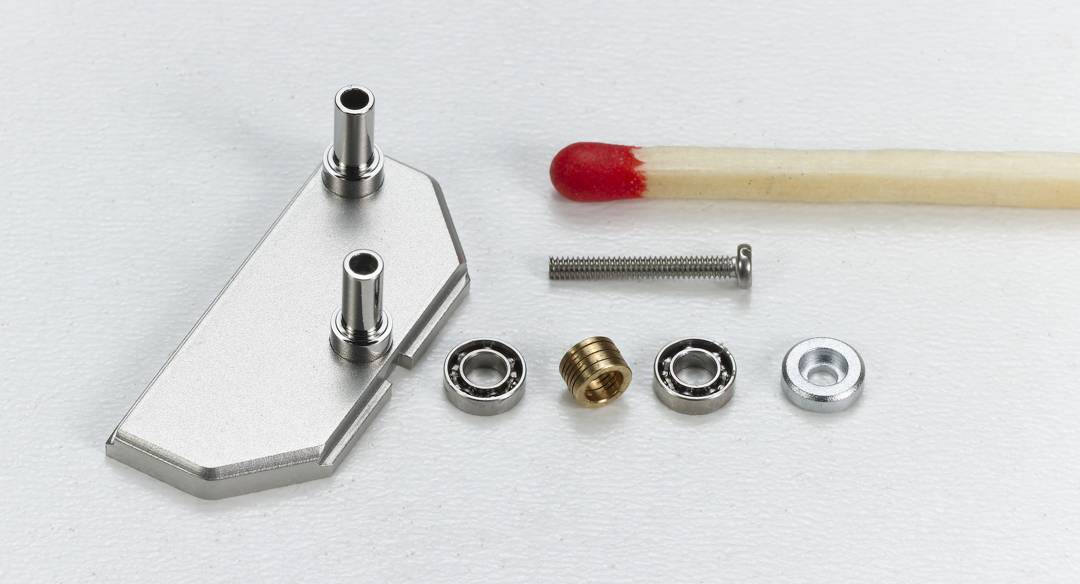
The Thales Simplicty II, in contrast, is a modern work of art, which combines Swiss elegance with high precision machining. I must admit, as soon as I opened the box, I was captivated by the looks of the Thales Simplicity II and immediately purchased the review sample before I even mounted it.
Mounting the Thales Simplicity II
As the model name suggests, the Thales Simplicity II is one of the easiest tonearms to mount, and it comes a detailed instruction manual. It comes with an acrylic mounting guide which locks the arm into 1 position with no play whatsoever. You simply swing the arm-board to a spot where the mounting guide locks the arm into place. The tonearm comes with 3 counterweights which supposedly will give you infinite possibilities with cartridge matching. It took me quite a while to find the right combination for my Clearaudio Titanium II cartridge.
Unlike conventional tonearms, the cartridge mounting process does not require a mounting template such as the SMARTractor, or Feickert Protractor. It comes with a device which Thales calls the “Sight Unit”. You are to insert the cartridge onto the headshell and then align the cartridge’s proper position by viewing the position of the cantilever versus the grid lines on the sight unit.

Be cautious that you do not tilt the sight unit because the headshell can easily slide out. I tilted the unit and it came sliding out unexpectedly, and if had landed on the cantilever it surely would have been snapped! I recommend taping the end with green tape to prevent an “Oh Shit” scenario.
This alignment process is tantamount to the accuracy of the entire setup, as the proper implementation of the pivoted tangential theory rests entirely upon this very step. If the alignment is wrong, it will cause the stylus’ tracking angle to be wrong throughout the entire record surface. The stylus’ “bulls-eye” on the Sight Device is a round circle 1mm in diameter, I would much prefer to see a tiny dot, or a crossing of the gridlines on the acrylic surface the same way Acoustical System did with the SMARTractor, which in my opinion will greatly improve accuracy. With a round circle, it makes sighting the exact location of the bulls-eye a little tricky. It took me nearly 20 mins of wiggling the cartridge back and forth before I locked it into position. Once locked into place, the headshell slides easily onto the tonearm’s headpiece and is secured with a 0.9 size tiny Allen key.

Because no alignment is performed at the tonearm level, you can quickly change to another cartridge by simply sliding in another headshell. Extra heahshells can be purchased from Thales at US$ 350.
Azimuth, VTA and the Whole Enchilada
Azimuth adjustment on the Thales tonearm is not as easy as the mounting process. You need to use the provided, long but small-sized slotted screwdriver to loosen the two tiny screws in front, azimuth is changed when you turn the set screw on the side with an Allen wrench. A spring is loaded on one side only, so it makes adjusting one direction easier than the other. However, adjusting the azimuth changes the entire plane of the multiple bearing pivots on the column, once it is adjusted out of position, it takes a bit of patience to get it back to perfectly horizontal position. The set screw also travels more on one side, which allows you to tilt the cartridge a lot more to the right but not so much to the left.
The vertical tracking angle is fairly easy to adjust, and it employs the same mechanism as DaVinci Virtu and Grandezza. You basically adjust the height by changing the setscrew. However, it is important to note the Azimuth will remain perfectly flat in one single VTA position only, due to the offset angle of the headshell, as soon as you change the VTA the Azimuth angle will no longer remain the same, and you will need to realign the Azimuth. This is true for all tonearms with a cartridge offset angle, but with the dual armwand design the effect appears to be slightly more pronounced on the Thales Simplicity II so care must be taken to re-adjust azimuth after changing the VTA level.
Even though the Simplicty II do track tangentially, their offset angle will require compensation of the skating force. The Thales Simplicity II is designed with a fixed amount of anti-skating force which is not user adjustable, which basically means you are at the mercy of the inherent fixed setting. Using the AnalogMagik alignment software, there was a negligible amount of distortions between L and R channel using the Anti-Skating function on my Clearaudio Titanium II and Goldfinger Statement cartridge which suggests anti-skating force is not needed (Both cartridges track at 2.87g). But on the Kondo IO-M as well as the My Sonic Lab BC, there was an imbalance in total harmonic distortion between channels which meant it could benefit from an adjustable anti-skating.


Lastly, it is important to pay attention to the position of the rotatable “U” shape eccentric counterweight. Due to the dual armwand design of the tonearm, the stylus tracking force may be uneven across the LP surface. If the tracking force increases or decreases towards the center, you can counterbalance it by rotating the eccentric counterweight. You will need to measure VTF on multiple points on the platter, the entire process took me a bit of time to achieve a somewhat balanced level of VTF across multiple measuring points.
The Sound of Simplicity
I first mounted the Thales Simplicity II onto my TW Acustic Raven AC with the Black Knight copper platter and a Tenor Phono stage. It is a combination which I have tried over 30+ tonearms and 30+ cartridges with, so I am quite capable of detecting the slightly sonic changes brought on by any new equipment. I first mounted the ZYX Universe Optimum 1 Ohm cartridge onto the Simplicity II. The sound is unmistakably conservative yet composed, it reminds me of the sonic signatures of the Triplanar tonearm. It is not as lively or as extended as the 12” Schröder Reference Ebony, or the Graham Phantom II Supreme B52 12”, both of which which sits beside it on the TW Raven AC. At the same time, it is not so