Analysis Audio Amphitryon Planar/Ribbon Loudspeakers — Review
Overview
The Amphitryon is the flagship-adjacent model from Analysis Audio, a boutique manufacturer specializing entirely in planar-ribbon dipole loudspeakers built in-house. Standing nearly seven feet tall, it’s a genuine reference-level statement speaker, and reviewer Wayne Donnelly — who had already given the smaller Analysis Omega a rapturous review — described the Amphitryon in equally strong terms: the greatest two-channel music-listening experience of his reviewing career, one that came closer to true perfection than any speaker he’d encountered, including six-figure exotics.
Build & Design
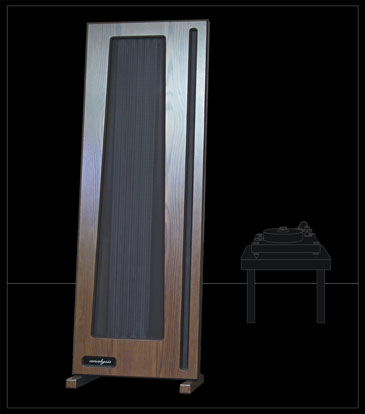
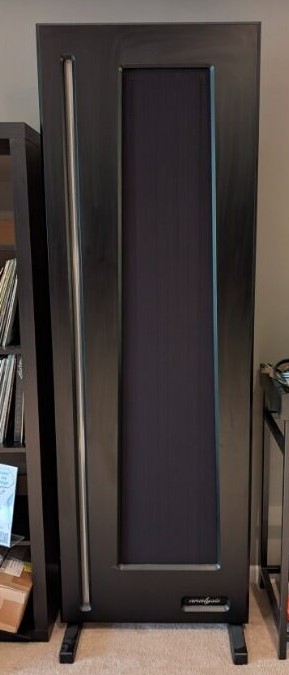
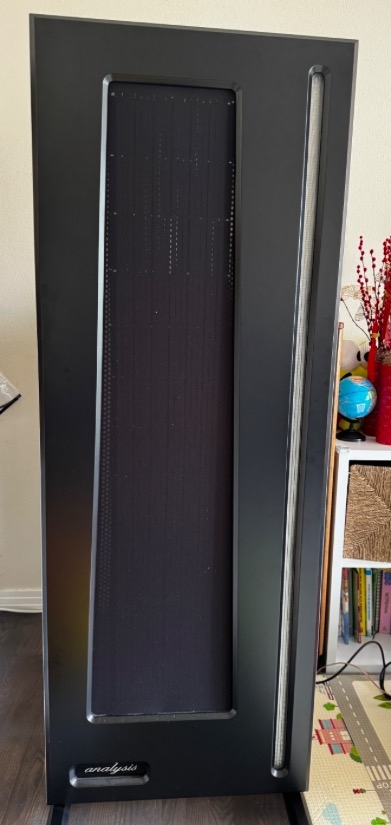
The Amphitryon is a two-way floorstanding planar-ribbon dipole, standing 83 inches tall, 28 inches wide, and just 2.8 inches deep, weighing 190 lbs per panel. Each speaker is a mirror-imaged pair (ribbons facing inward) supported on sturdy feet that lift the panel about three inches off the floor, finished in solid black, gray, or natural wood frames with black cloth covering the bass panel — a visual presence one reviewer compared to a “2001: A Space Odyssey” monolith.
What sets Analysis Audio apart from other planar and electrostatic designs is the bass panel’s suspension: rather than clamping the membrane rigidly to the frame like most planar competitors, Analysis floats it on flexible rubber dampers around its entire perimeter. This lets the panel move through unusually large excursions while keeping stress on the driver foil to a minimum — the company’s proprietary answer to the excursion limitations that typically constrain planar and ribbon designs. The woofer panel offers 840 square inches of radiating area, paired with a direct-coupled ribbon midrange/tweeter with a 62-square-inch effective area and a ribbon length exceeding 200cm — one of the longest ribbons used in any commercial loudspeaker.
Performance
Specified frequency response reaches all the way down to 22Hz, with a first-order (6dB/octave) crossover at 650Hz that Donnelly found seamless — in extensive listening across both the Omega and Amphitryon, he reported never detecting any audible discontinuity at the crossover point. Rated sensitivity is 86dB/W/m and impedance is a flat 6 ohms, which — combined with the large radiating surface area reducing distance-based amplitude loss compared to conventional point-source tweeters — allows the Amphitryon to play convincingly loud even with modest tube amplifiers in the 50-60 watt range, something almost unheard of among full-range planar-ribbon designs. Analysis recommends amplification between 50 and 600 watts, and the panels have also been driven successfully with 800Wpc monoblocks without any sense of strain.
In listening, Donnelly described bass that, while not delivering the familiar “box boom” of a sealed or ported cone speaker, offered exceptional speed, resolution, and seamless tonal coherence from top to bottom. He specifically noted needing 400+ hours of break-in before the bass panels fully opened up — considerably longer than the roughly 150 hours he’d needed with the smaller Omega — but found the payoff was a genuine step up in bass grip, amplitude, and room-filling authority for large-scale symphonic and operatic material. Smaller-scale, intimate performances were rendered just as convincingly, with reviewers repeatedly struck by the speakers’ ability to reveal recording-venue size and microphone technique. As a line-source dipole design, the Amphitryon also produces very little floor, ceiling, or side-wall reflection, contributing to unusually stable, wall-to-wall imaging that Donnelly described as seeming to dissolve the room’s boundaries entirely.
Owner and forum consensus echoes the professional reviews: one Audiogon listing from an owner who’d also owned Magico Q5, Raidho D-3, and Loiminchay horn speakers called the Amphitryon the best speaker they’d ever owned, describing it as more transparent than the Quad ESL with genuinely deep bass extension — a rare combination.
Features
Bi-wire, 5-way speaker terminals are located at the bottom rear of each panel. As a full dipole design, room placement and treatment matter significantly — Donnelly noted that reflective surfaces like large windows behind the speakers can add unwanted brightness from the rear wave, correctable with heavy curtains or blinds, and that a solid, untreated back wall is important for realizing the design’s full bass potential.
Value
At $24,000/pair (as reviewed), the Amphitryon sits solidly in flagship territory, but reviewers and owners alike consistently argue it competes with or outperforms speakers costing considerably more. Given the rarity of the design and the small manufacturer behind it, used examples surface only occasionally, typically in the same general price range as new units.
Verdict
Pros: Exceptionally fast, well-resolved, deep bass with genuine 22Hz extension; seamless top-to-bottom coherence with an inaudible crossover transition; remarkably easy to drive for a full-range planar design, working well with amplifiers from 50W tube monoblocks up to high-power solid-state; extraordinarily stable, boundary-dissolving imaging; unique flexible bass-panel suspension not found in competing designs.
Cons: Requires a genuinely large, dedicated listening room given its 7-foot height and dipole radiation pattern; needs careful placement and room treatment (especially reflective rear walls) to perform at its best; very long break-in period before bass fully develops; flagship pricing and extremely limited availability through a small specialist manufacturer.
Bottom line: The Amphitryon is a genuine reference-class loudspeaker from a manufacturer most audiophiles have never heard of — and by the account of reviewers and owners who have heard it, that’s the audio world’s loss. For anyone with the room and budget to accommodate it, it’s spoken of in the same breath as the very best loudspeakers money can buy.