

Bring on the tubes!!!
Ever since I heard the highly underrated M-100 monoblocks (paired with an Audio Research SP-10 preamplifier) driving a friend’s Infinity RS-1bs 10 years ago (to date, one of the best Infinity-based systems I’ve ever heard), I’ve lusted for an all-tube ARC design I could afford. I was partially satisfied when, seven years ago, I bought my current reference, the Classic 60 (a tube/solid-state hybrid).
Unfortunately for me, the new VT-series amps didn’t fit the bill as potential review fodder. The problem is, ARC threw me a curve with the VT150 and VT130 amps. Like the later versions of the hybrid Classic Series, they had one set of inputs: balanced. And Bob here, partly by preference and partly to maximize review interface flexibility, has a reference preamp (the Audible Illusions Modulus L1) equipped with only single-ended outputs. I’ve criticized ARC for years for manufacturing products that were inherently incompatible with most of the preamps on the market. (Though they do manufacture a not-inexpensive single-ended-to-balanced converter, adding a solid-state Band-Aid and an extra set of interconnects to the front end of a tube amplifier does not strike me as an acceptable compromise.)
At the 1996 Winter CES, after recovering from hearing the spectacular debut of Audio Research’s new flagship Reference electronics driving a pair of Genesis 200 loudspeakers, I discussed the potential of future trickle-down designs with ARC’s Mike Harvey (who has since departed the company for warmer climes than Minnesota). Harvey explained, “You know, the magic behind the Reference amplifier is not in the 600W. That was Johnson’s choice, as this was intended as a cost-no-object design. It may be possible to capture much of the magic of this amp in a lower-powered design for under 10 grand.”
“Of course, it will have balanced inputs, so I can’t review it.”
“Well, we still believe that balanced is best, and our engineers feel that providing both single-ended and balanced inputs would necessitate a sub-optimized design that may result in sonic compromise.”
We then discussed my obtaining review samples of the VTM120 monoblock amplifier, ARC’s first reasonably high-powered, affordable, all-tube design with single-ended inputs since the D125 from the mid-’80s.
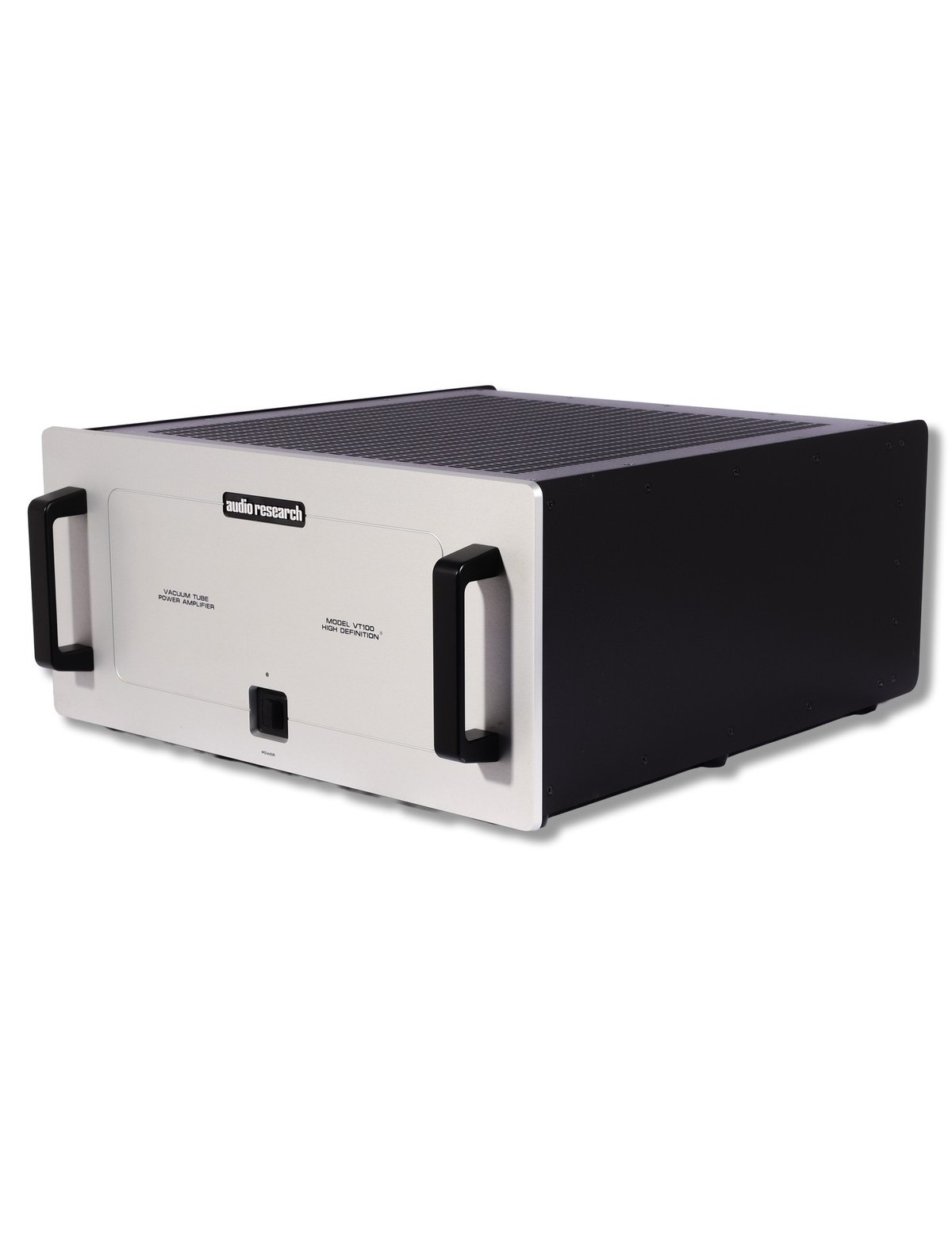
A few months later, Harvey called me regarding the review samples. “You know, Bob, we’re having second thoughts about sending you the VTM120. It’s a relatively old design derived from the VT60, and, frankly, we’ve concluded from a marketing standpoint that monoblocks really only sell well in our higher-priced product line. We’re not sure we’re going to keep the VTM120 in the line [it’s now available by special order only], but at HI-FI ’96 we’re introducing a new all-tube stereo amplifier called the VT100, which has the same power rating. You may like it better. Oh yeah—and at $4495, it’s our first amplifier which features trickle-down technology from the Reference electronics.”
“And the inputs?”
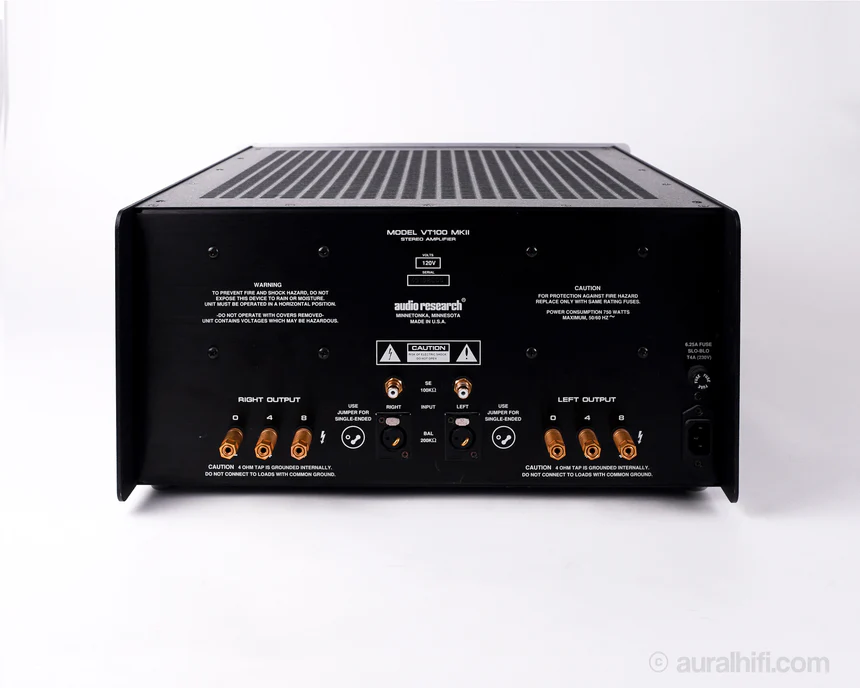
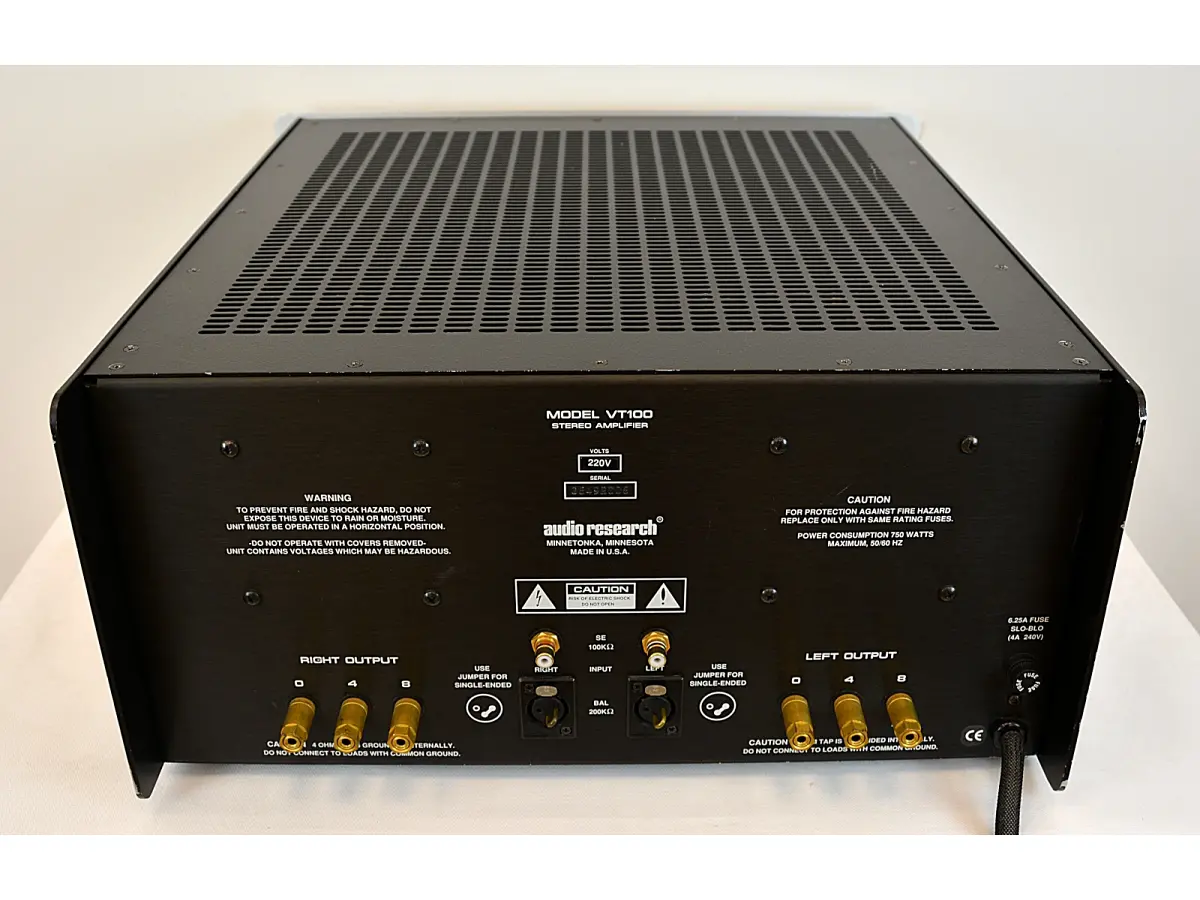
“The VT100 features both single-ended and balanced inputs.”
“I thought your engineers thought that would result in a sub-optimized design.”
“Well, they thought about the problem a little harder.”
At this point Harvey could hear me breathing heavily and clawing at the phone.
Bring on the latest affordable amp design from ARC!!!
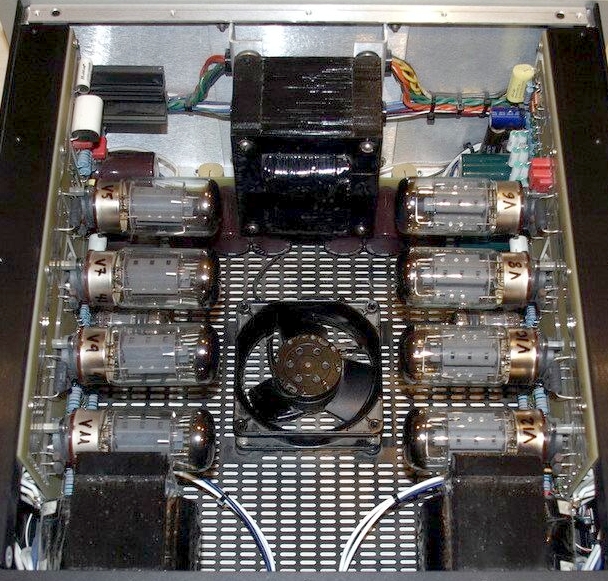
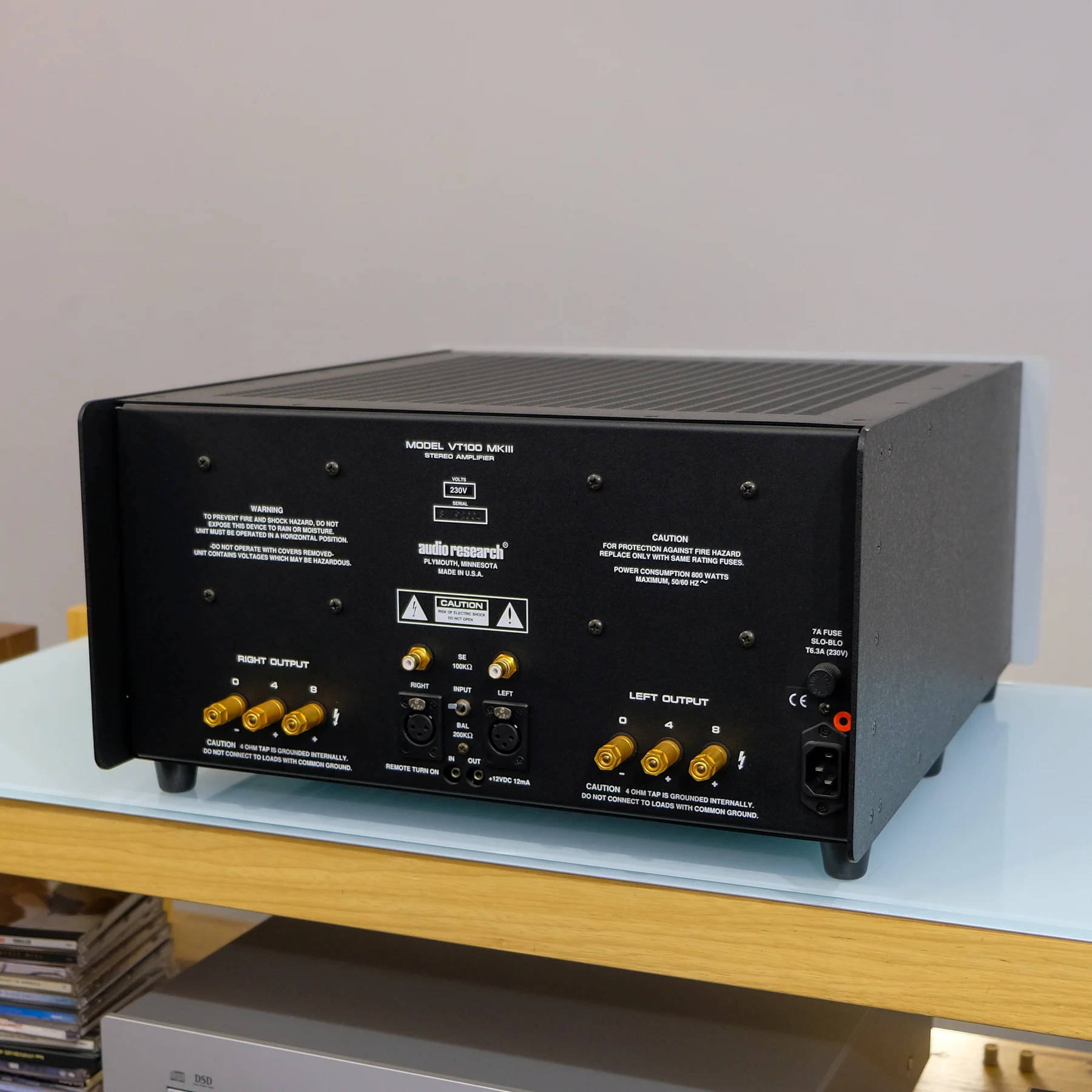
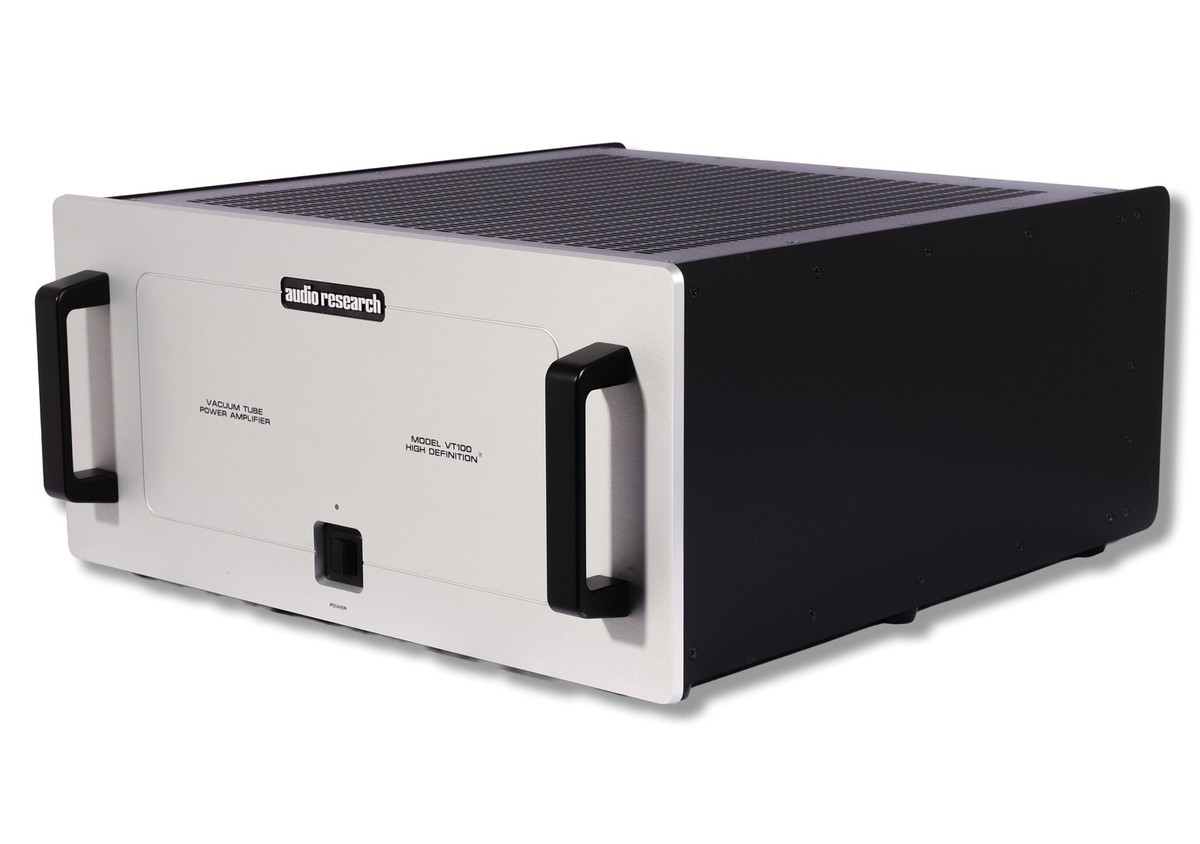
The VT100, a stereo amp rated at 100Wpc, uses four pairs of Svetlana 6550 output tubes and shares the more expensive VT130SE’s ultralinear-configured output stage (see Wes Phillips’s review), combined with partial cathode coupling designed for low output impedance and high current delivery. According to Audio Research’s Chief Engineer Rich Larsen, these circuits run the screens a little hotter than does conventional pentode operation, but still offer higher efficiency with less signal loss than triode designs. The amp’s fully differential, direct-coupled input and driver stages, derived from the Reference 1 preamp, feature 6922 dual triodes with FET constant-current sources designed to achieve a more accurate differential balance. As in the Reference 600 amp, the output tubes are mounted on vertical circuit boards, one for each channel, running along the left and right interior chassis walls. This results in a virtual dual-mono layout all the way back to the power transformer (with shared secondary winding), with independent, distributed energy storage and very short signal paths. The amp features the same heavy-duty, gorgeous speaker terminal posts (they’re actually enjoyable to use) as the VT130SE.
Bring on the boring reviews!!!
After 13 years in the reviewing game, I’ve learned there are two ways to make a rave review really boring. The first is to use the “sonic checklist” technique, wherein the reviewer lists every important audiophile attribute, and goes on and on about how the component excelled in every way: “The amp was tonally neutral from the lowest bass to the highest highs, had incredible dynamics, both micro- and macro-, was neither dry nor overly liquid in texture, revealed gobs of detail, and produced a wide and deep soundstage with perfectly placed images on the stage. Unlike any amp I’ve heard before, this amp has so many strengths, and I can’t seem to find any flaws.” With the exception of one possible shortcoming I’ll describe below, all of the above hold true for the VT100.
But that would make this a really boring review.
I could instead use the second sure-fire way to write a boring rave: the “I stayed up till all hours going through every record in my collection and, my God, it was as if I was hearing the recordings for the first time” method. I would go into gory detail about my favorite recordings, recapping why they sound so much better than ever before.
That also held true for my experience with the VT100. It would also make very boring reading.
Extraordinary Resolution of Detail: The noisefloor was significant lower than that of any other amp I’ve reviewed. The amount of information retrieved from very familiar recordings in some cases changed my reaction to the music. Over the last few months I’ve replayed Janis Ian’s Breaking Silence LP (Analogue Productions CAPPG 027) to the point where my wife no longer has any interest in a recording she bought for herself. But with the VT100, I noticed for the first time all the mistakes the guitarist makes. And, on Tomiko Kohjiba’s The Transmigration of the Soul, from Stereophile‘s Festival CD (STPH007-2), it was now obvious to me that those background noises during the soft passages were musicians walking around on stage. Now that I’ve heard it on the VT100, I can hear it with other amps if I focus on it. On the VT100, it’s downright distracting.
Lack of Electronic Artifacts: With the VT100, unlike every other amplifier I’ve heard in my house, I was not consciously aware that I was listening to an electronic reproduction of a musical event. The subtle electronic haze present with other amplifiers was lifted with the VT100—much like humidity on a windshield, background noise from an AM radio broadcast, carrier whine on a video monitor. This kind of haze is not noticeable until it’s gone.
Timbral Coherence: With the VT100 it became irrelevant to speak about how the amplifier recreated the bass, the midrange, the highs. The amplifier did not break down a musical event into its component tonal parts. Given a good recording, the VT100 recreated the timbral architecture of the voice or instrument as a single, coherent musical event.
Given a very good recording, the VT100 caused me to throw my notebook away. I recently acquired a bunch of Classic Records jazz reissues and, using the VT100, set out to undertake a comparison of the LPs with my originals. With each recording, I lost sight of my mission. By the end of the listening sessions, I realized I’d never even bothered to dig out the originals. The Classic reissues sounded so lifelike I didn’t care what the originals sounded like.
Still, I have not yet described the VT100’s two strongest attributes, ones which I’d never heard before from any amplifier, and which require some new terminology:
Dynamic Continuity: When a reviewer speaks about an amplifier’s dynamic-range capabilities, he discusses how well the component separates a performance’s subtle gradations of volume level. An amplifier with excellent dynamic range will reproduce many gradations of dynamics, and these gradations will be clearly separated and equally well presented at very low volumes and very high volumes. With the VT100, the gradations were not discrete but continuous, as in a live performance. On Cage’s Third Construction (from Pulse, Classic/New World NW 319), the struck metallic percussion instruments and subtle hand-drum articulations breathe in a constant ebb and flow. Comparing this amp’s dynamic performance with that of other amps I’ve heard is akin to comparing an analog waveform to a digitally sampled analog waveform.
(Incidentally, the short time I was able to spend with Audio Research’s Reference 1 preamplifier in my system was sufficient to determine that, in addition to having the best bottom-octave and high-level dynamic performance of any preamp I’ve heard, it shares with the VT100 this performance characteristic of dynamic continuity. The pair is an awesome combination, and not unaffordable.)
Transient Coherence: A transient musical event in real time can be broken into three linear events: the attack, the resonance, and the decay. The attack is the initial pluck of the string, the mallet striking the marimba. An amplifier should reproduce the attack without hardness, delay, or blunting. The resonance is the steady-state timbre of the instrument—the bowed violin, the clarinet—and should be reproduced without coloration or distortion. Finally, the decay—the sound presented after the note is released—should decay as in a live performance, and should take into account the resonant properties of the instrument and the acoustics of the recording venue. (A good example of a type of component that reproduces all three of these things poorly is early digital gear.)
The VT100 is the first amplifier I’ve heard that reproduces the attack, resonance, and decay of a musical event equally well—and, most important, presents the three combined as a single, coherent musical event. Again, listen to the Kohjiba composition on Festival. The composer likes to use solo instruments in quiet passages so the listener can focus on the delicate pitch-bendings she’s written for the flute, the marimbas resonating in the performance space, and the subtle dynamic and pitch variations of the timpani. The VT100’s transient performance enabled me to gain a deeper understanding of what the composer intended.
Bring on the rambling digressions!!!
Two personal anecdotes:
1) In the 1960s, my father, a tenor saxophonist, used to rehearse jazz standards with my two uncles in our basement. One thing that use to bug the hell out of me was how my Uncle Sam kept the skins of his drums inordinately loose. They had a certain hollow, resonant thunk which I assume he liked—you could hear them skins a-ripplin’ every time he hit them.
In drummer Billy Higgins’s extended minimalist solo on “Oleo” on Classic’s reissue of Sonny Rollins’s Our Man in Jazz (Classic LSP-2612), Higgins lets each drum shot resonate and decay into the air of the club. His skins, too, are very loose. Listening to this track with the VT100, I thought of my Uncle Sam. And when Rollins reentered after Higgins’s solo, his breathy, guttural tone in the tenor sax’s lower registers was not unlike my father’s. Suddenly I was transported to that basement. An amplifier that can reproduce a level of realism sufficient to dig up a childhood memory that had been buried for several decades is pretty special.
2) King Crimson’s double-trio “Thrak” tour from last summer was the most moving rock performance I’d seen in a decade (“Records To Die For,” February 1996). This past summer, during a family barbecue, my nephew Benjamin mentioned that he’d seen a fantastic rock festival in New York the night before, and had been particularly impressed by the King Crimson set. Hmmm, I thought. Haven’t tried Thrak (Virgin 40313 2) on the ARC amp yet. “Hey, Ben, I wanna play you something.” I cranked up “Vroom” and “One Time” at about 105dB.
Ben: “Yeah, this is the band. They played these songs, too. Uncle Bob, they had two guitars, two basses, and two drummers—they were great. Wow, this sounds just like the concert, huh, Bob? Bob…? Uncle Bob…?”
I couldn’t move. A uniform chill ran from my legs up through my arms. My eyes, half mast, welled up in tears as my head cocked slightly back. I was there again.
“Yes, Ben. I know.”
Bring on the straitjackets!!!
Before you send for the straitjackets, let me describe the VT100’s one shortcoming: It could use more high-level slam in the midbass. The lack of this detracts from the amplifier’s sense of authority on well-recorded music with considerable energy in that region. What’s odd is that the VT100 seems to lock in synergistically with my room in the midbass. My room has a resonance around the 100Hz region. With every other speaker/amp combination I’ve tried in this relatively new listening room (seven amplifiers, three speakers), there is an exaggeration in the 100Hz region at all but very low listening levels. With the VT100, however, at medium to loud levels the amp/speaker combination was actually flatter and more neutral than other combinations I’ve tried, as the amplifier excited my room resonances to a lesser extent.
I should compare the VT100 to my reference amp of seven years, the Audio Research Classic 60 (reviewed by JA in November 1990 and long since discontinued).
Although in my room the Classic 60 has (to my ear) beat out serious contenders from Cary, VTL, EAR, and Perreaux, and though I still prefer it overall to any currently available amplifier retailing for under $4500, its performance did not come close to the VT100’s. Aside from a slight metallic coloration in the lower high frequencies, as well as a tendency to compress when presented with high-level orchestra at full throat (on my speakers, that is), the older ARC is a very detailed, neutral, and overall first-rate performer. But the VT100’s level of detail resolution, articulation, neutrality, and sophistication made it the far better machine—because it rarely reminded me that I was listening to a machine. (I’d be curious to hear Wes Phillips’s thoughts on how the VT100 compares with the VT130SE, a more expensive but older design.)
Bring on the end of this lengthy review!!!
A few sound bytes:
1) The Audio Research VT100 amplifier has touched me in a way no other audio component has, and in a way I didn’t think any audio component could.
2) The three times I heard the Audio Research Reference 600 (at 1996 WCES and at HI FI ’96, driving Genesis and Alón speakers), I felt a sense of magic I’d never heard in an amplifier before. I heard that magic in my home with the VT100.
3) I’m afraid that every amplifier I review in the future could potentially be at a relative disadvantage now that I’ve heard this amplifier. Audio Research has raised the bar.
4) Although I prefer tubes to solid-state, throughout my reviewing career I’ve tried to remain unbiased. I’ve always believed that tubes and solid-state designers have minimized the amplifying devices’ inherent colorations over the years, and have converged toward an overall neutral sound. With a few exceptions, I don’t believe there is much of a tube vs solid-state controversy anymore among most designers. And I believe the VT100 has captured all of the strengths of traditional tube designs, but has managed to avoid tube designs’ traditional colorations. But this extraordinary amplifier is beginning to make me wonder if current tube technology may once again be edging ahead of solid-state in the race for ultimate sonic realism.
5) William Zane Johnson is a genius.