B&W DB1 Reviews
Bowers & Wilkins DB1 subwoofer
Although many high-end audio products are described as revolutionary and as breakthroughs in design when new, most audiophile components now on the market have not changed our way of relating to such products in the way the iPad has done. Once in a while, a new audio product does move in that direction by enabling the audiophile to do install a product and optimize its performance in a different way.
The last applies to the Bowers & Wilkins Group’s new DB1 subwoofer: In addition to its automated room-compensation system, which samples over a wider bandwidth and adjusts for more room modes than does that of the competition, the DB1’s menu-driven controls can be conveniently adjusted from a laptop computer rather than the user having to stretch to reach them on the sub’s front panel.
Externals
Like most subwoofers these days, the DB1 has its own amplifier, uses equalization to generate powerful deep bass output from a small enclosure, and contains a self-optimizing setup program. This approach has proven more popular with buyers than subs that rely on a large enclosure to generate deep bass.
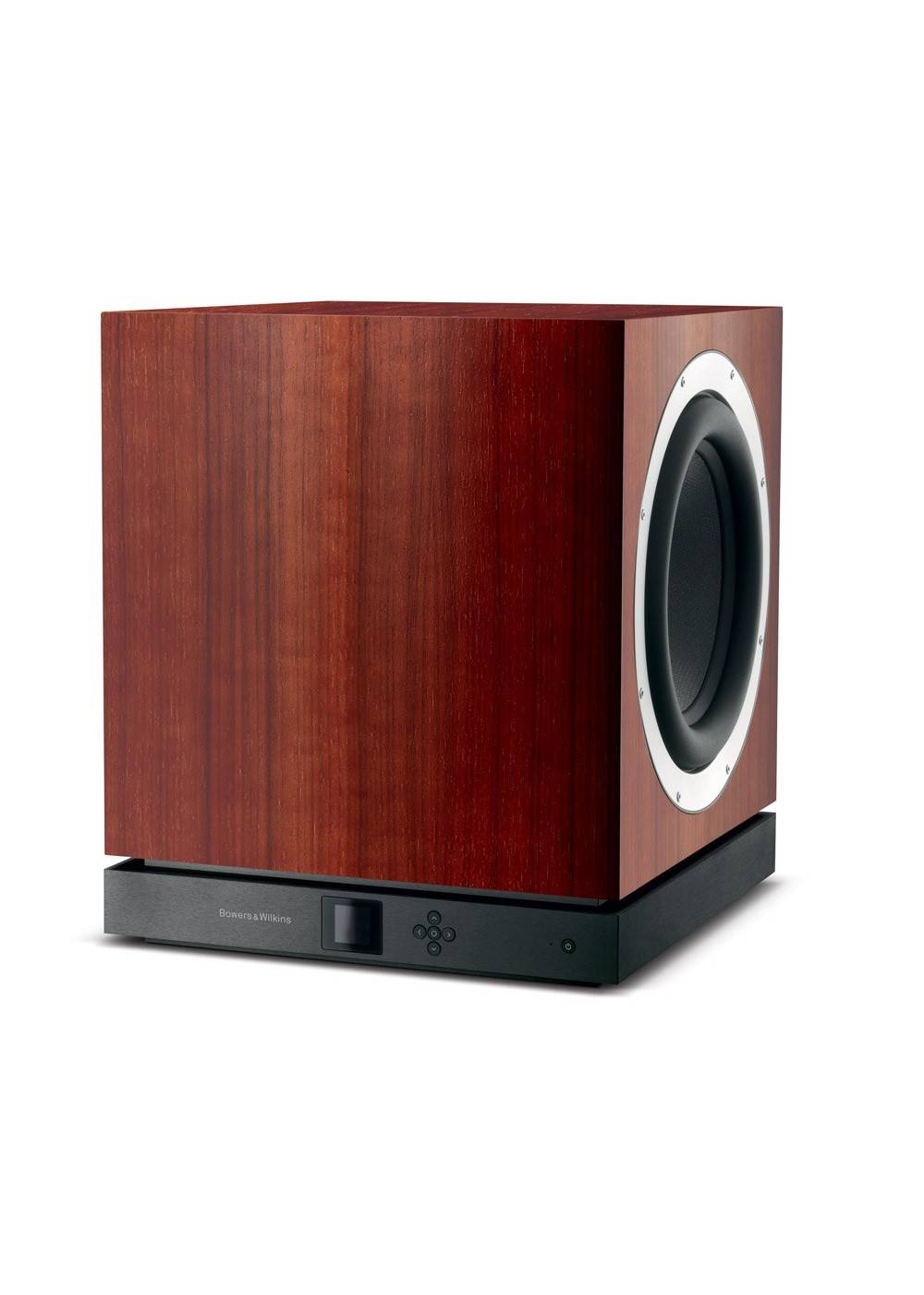
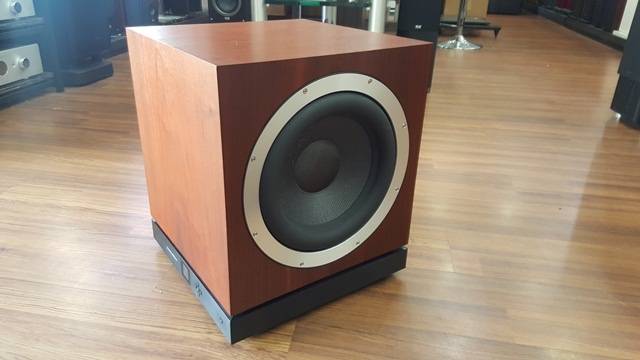
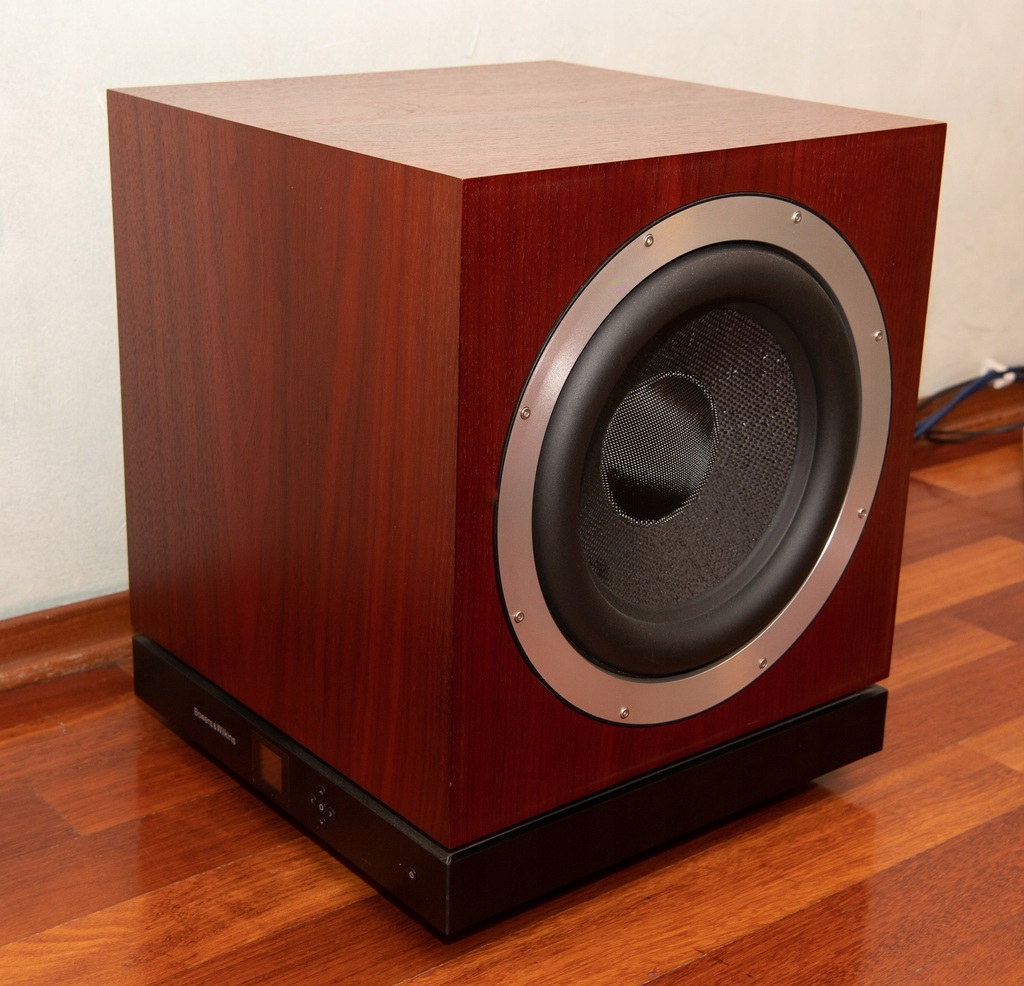
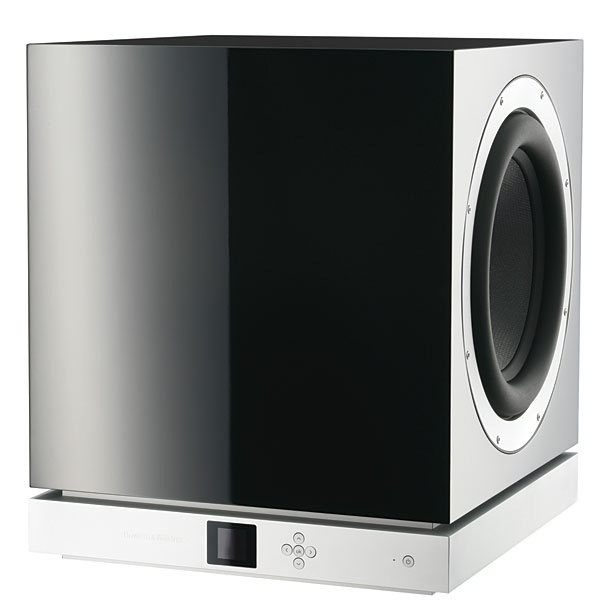
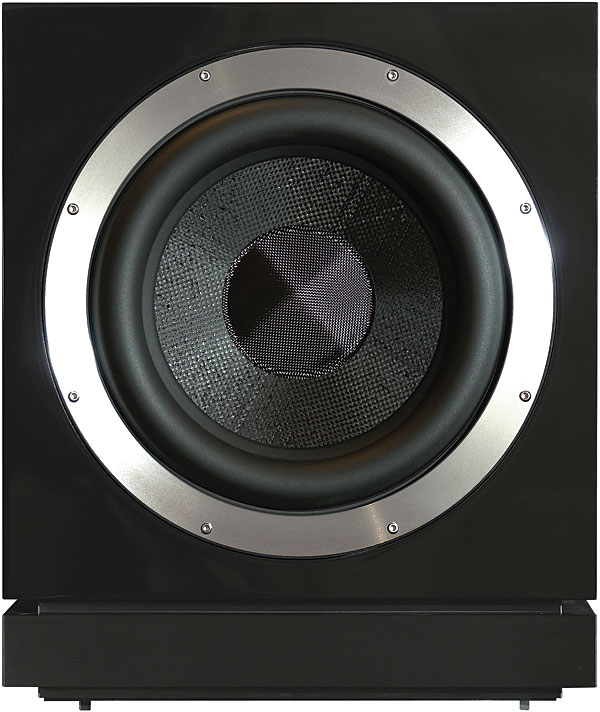
Measuring about a foot and a half wide and tall and 16″ deep, the B&W DB1has two opposed, 12″ drive-units. On the rear panel beneath the styling groove that runs all the way round the enclosure’s base are the input connectors: mono RCA for low-frequency effects (LFE) from a home-theater processor; stereo unbalanced RCA from a stereo preamplifier’s auxiliary main outputs; mono XLR; minijacks for a trigger on/off signal and for the room-compensation test signals from the system’s soundcard; a DB-9 serial input to receive control signals via RS232 from the owner’s PC (sorry, Mac users); and an IEC inlet for the detachable power cord.
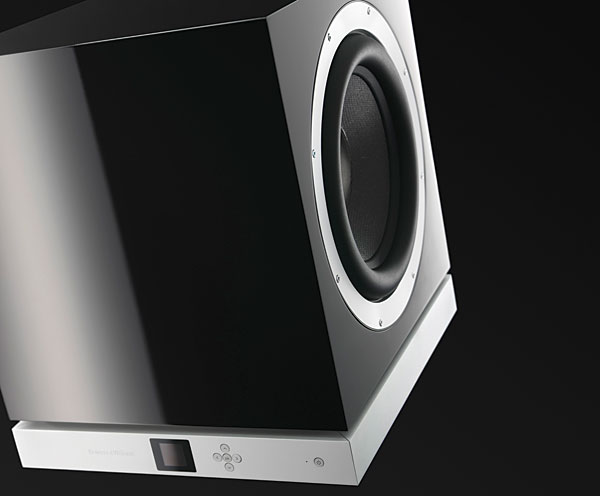
Beneath the groove on the B&W DB1’s front are the large on/off switch (with power-on LED) and the controls, grouped in a diamond pattern of five pushbuttons (up, down, left, right, and Set-Up), for navigating the various menu screens that come up on the extremely bright but tiny (1″ square) organic LED display next to them. When the DB1 is first turned on, the left and right control buttons can be used to toggle between different presets, while the up and down buttons control the subwoofer’s output gain. Pressing and holding the central button brings up the DB1’s setup mode. The left- and right-arrow buttons bring up various menu screens, while the up and down buttons select items within a menu, and the center button saves selections and moves on to the next menu. Selecting Audio from the Setup menu brings up a menu of adjustable output features, including choice of preset, low-pass filter settings (slope and turnover frequency), the input sensitivity level (a red LED flashes if you overload the input), gain, normal or inverted polarity, and phase. There is a separate menu for a five-band equalizer (20, 28, 40, 56, and 80Hz), each band adjustable from +5 to –10dB. With all the levels of the DB1 set to their default value of 0dB, the subwoofer has the THX standard sensitivity of 109dB spl at 1m for an input of 1V RMS.
Because I found its display panel difficult to see from my listening chair—my right-channel Quad ESL-989 speaker blocked my view—I controlled the DB1 with B&W’s SubApp program, which is compatible with Windows XP as well as Vista and Windows 7 (both 32 and 64-bit versions). Not shipped with the subwoofer, it must be downloaded from www.bwgroup-support.com. SubApp provides graphical user interface controls for the DB1’s gain, phase, polarity, and equalization, and enables two additional functions not available on the control panel: naming the presets, and launching the DB1’s Room Acoustics Compensation routine. The tools needed to run that last item—a calibration microphone, four connector cables, and a USB-connected soundcard that generates the necessary test signals—are included with the subwoofer. With SubApp, the DB1 can take measurements of the room, then adjust its internal equalizer to compensate for up to four room-mode peaks within its operating range.
Internals
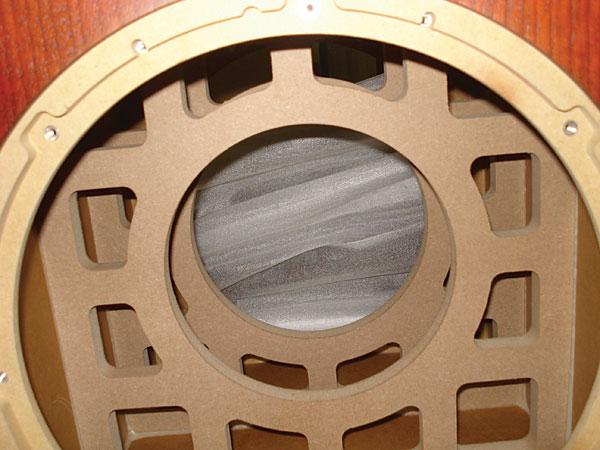
The DB1’s construction, fully described in a white paper posted at the B&W website, includes: two mechanically opposed 12″ woofers separated by a partially open internal partition; 1″-thick walls of MDF with ¾”-thick bracing panels to minimize vibration; digital signal processing (DSP) circuits to run the menu-based control system rather than physical switches; home automation capability; and the 1000W switching amplifier, equalized to produce linear output. Like the JL Audio Fathom f212, the DB1 lacks a high-pass filter to shape the bass response of the main speakers, it being assumed that this will be taken care of by the preamplifier/processor or A/V receiver’s bass management function.
B&W stuffed two 12″ drivers into the smallest enclosure possible and reduced the resistance of the drivers’ spiders and dampers at the extremes of the cones’ 1.6″ range of travel by using a pliable progressive-roll spider, a voice-coil of relatively small diameter (75mm). The woofer cones are made stiff by using a composite of carbon-fiber skins over a core of Rohacell. A highly flexible cable is used to prevent “tinsel fractures” from developing in the B&W DB1’s internal wiring from the drivers’ constant motion.
The DB1’s internal electronics include a signal input circuit board that converts the analog input to digital, a motherboard, a DSP board, the amplifier and its power supply, and an auxiliary power supply to run the digital circuits when the sub is in standby mode. The DSP functions are handled by an Analog Devices Sigma chip; this equalizes the subwoofer, provides low-pass filtering and phase control, adds a five-band graphic equalizer, runs the room-compensation software, and generates an “impact overlay” preset to enhance home-theater sound effects. The DB1 can store five user presets.
Automatic Room Acoustics Compensation
Other subwoofers I have reviewed—including the Velodyne DD-18, REL Studio III (October 2004), and Revel Ultima SUB-30 (November 2004)—have provided test tones and equalizer controls, but require the owner to interpret the findings and make the appropriate adjustments. More recently, JL Audio’s Fathom f113 (September 2007) and Fathom f212 subs (April 2010) are shipped with a self-adjusting firmware routine that uses calibration microphones and internal signal generators and processors to optimize the sub’s frequency response in the listener’s room by adjusting its output to compensate for a single peak room mode. However, only the B&W DB1 lets its owner run its automatic optimization program and adjust its set-and-forget controls (eg, gain, polarity, phase) from the listening chair—though it’s necessary to connect a PC to the subwoofer with the long line-level cables (supplied).
The DB1’s Room Acoustics Compensation program probes the listening room with a tone sent to the sub’s input, then samples its audio output in the room with eight closely bunched measurements taken by the supplied mike. After analyzing the results, it applies four-band equalization to correct the four most prominent resonance room peaks in the sub’s range by reducing its output in a narrow band around each peak. The procedure gathers information over a passband of 30–140Hz, and gathers additional information below 30Hz. However, the DB1’s ability to adjust for more than one peak is inversely related to the size of the area in which measurements have been taken. The smaller the area, the greater number of peaks—up to four—for which the program can compensate. If the owner takes measurements over an area wide enough to include several listeners, the program will adjust for only the most prominent room mode.
The B&W DB1’s Room Acoustics Compensation program probes the listening room with a tone sent to the sub’s input, then samples its audio output in the room with eight closely bunched measurements taken by the supplied mike. After analyzing the results, it applies four-band equalization to correct the four most prominent resonance room peaks in the sub’s range by reducing its output in a narrow band around each peak. The procedure gathers information over a passband of 30–140Hz, and gathers additional information below 30Hz. However, the DB1’s ability to adjust for more than one peak is inversely related to the size of the area in which measurements have been taken. The smaller the area, the greater number of peaks—up to four—for which the program can compensate. If the owner takes measurements over an area wide enough to include several listeners, the program will adjust for only the most prominent room mode.
Setup
I unpacked the B&W DB1and moved it into the right corner of my living room, behind one of my Quad ESL-989 speakers, positioned so its control panel and display faced out into the room, and each of its two drivers faced one sidewall. The Quads sat 8′ apart, 5′ from the front wall and 3′ from the sidewalls, slightly toed-in to my listening chair and driven by a Mark Levinson No.334 dual-mono solid-state amplifier. My chair was 10′ from each Quad. The DB1 was connected to the outputs of my Bryston BP-26 preamplifier via two 6m, unbalanced, line-level interconnects.
The B&W DB1 has one of the easiest and quickest setup routines I’ve encountered with a subwoofer of this sophistication. Setup took less than 10 minutes, whether by ear or by gear. (See Sidebar, “B&W Room Acoustics Compensation”).
Sound
Keeping true to Darren Gum’s request in the sidebar, I evaluated the sound of the DB1 without the help of the Bryston 10B-SUB’s high-pass filter to restrict demands on the Quads to play very low bass. This helped maintain the Quads’ upper-midrange and treble transparency, but caused their protection circuits to kick in during loud bass peaks. For example, both Quads shut off at the beginning of Mark Flynn’s kick-drum introduction to “Blizzard Limbs,” from Attention Screen’s Live at Merkin Hall( (CD, Stereophile STPH018-2). However, I liked the Quads’ unfiltered, full-range sound so much that I dialed back the preamplifier’s volume to avoid triggering further shutdowns.
From the start, I enjoyed the B&W DB1’s ability to move air, its superb pitch definition, and its ability to integrate its own deep bass with the Quads’ midbass. I was most impressed with the DB1’s power while producing clean, tuneful low frequencies. The fortissimo( bass-drum strokes in the second movement of Stravinsky’s The Rite of Spring, with Esa-Pekka Salonen conducting the Los Angeles Philharmonic (SACD/CD, Deutsche Grammophon 00289 477 6198-2), seemed to jump out into the room with tremendous speed and impact. I heard the same punch from the bass percussion in another performance of Rite, by the Minnesota Orchestra under Eiji Oue (HDx DVD-R, 24-bit/176kHz, Reference RR-70). The DB1 captured the distorted, menacing bass synth that opens “Deeper Wells,” from Emmylou Harris’s Spyboy (Eminent EM-25001-2), as well as the stark impacts of the explosive timpani strokes in Yoshihisa Taira’s Hierophonie V, performed by the Kroumata Percussion Ensemble (CD, BIS BIS-232).
The B&W DB1’s tuneful bass power allowed it to not only reproduce the bass notes of pipe organs, but also to reliably create room lock: when an organ note massively vibrates the air in my listening room without boom. This clean depiction of deep bass power was apparent at even lower volumes, such as the soft but stunning deep pedal note that ends the excerpt from John Atkinson’s recording of Elgar’s The Dream of Gerontius on Stereophile‘s Test CD 2 (CD, Stereophile STPH004). The massive, almost infrasonic organ note that ends Timothy Seelig and the Turtle Creek Chorale’s performance of “Lord, Make Me an Instrument of Thy Peace,” from John Rutter’s Requiem (CD, Reference RR-57CD), was stunning in its power and beauty. The DB1 helped the Quads create a deep, broad soundstage on which deep pedal notes, full choir, and harp surged out from Rutter’s A Gaelic Prayer, on the same disc, and delivered the rumbling pulses that underpin Gnomus, from Jean Guillou’s performance of his transcription of Mussorgsky’s Pictures at an Exhibition (CD, Dorian DOR-90117). Mary Preston’s raucous interpretation of the Toccata of Widor’s Organ Symphony 5, on Organ Odyssey (CD, Reference RR-113CD), was equally dramatic with the DB1.
The DB1 also revealed the characteristic bass timbres of other instruments, such as: the taut, dense energy of Michael Arnopol’s double-bass in the introduction to “Too Rich for My Blood,” from Patricia Barber’s Café Blue (CD, Premonition/Blue Note 5 21810 2); the harsh shudder of David Hudson’s bass didgeridoo, which drives “Rainforest Wonder” on his Didgeridoo Spirit (CD, Indigenous Australia IA2003 D); the distinct tonal steps of Glen Moore’s plucked double-bass notes in “The Silence of a Candle,” from Oregon’s Beyond Words (CD, Chesky JD130); the delicate bass-guitar line that Jerome Harris threads among the other instruments in “The Mooche,” from the Jerome Harris Quintet’s Rendezvous (CD, Stereophile SPTH013-2); the double-basses playing the sustained low G in the introduction to Richard Strauss’s Also sprach Zarathustra, from Erich Kunzel and the Cincinnati Pops’ Time Warp (CD, Telarc CD-80106); and the fabric-covered mallet used on the bass drum in H. Owen Reed’s La Fiesta Mexicana, from Fiesta! (CD, Reference RR-38CD).
Comparisons
Listening also to the Velodyne DD-18 ($4999) and JL Audio Fathom f113 ($3600) subwoofers allowed me to better grasp the characteristics of the B&W DB1 ($4500). The similarly priced DD-18 has a high-pass filter and a larger driver (18″), and uses servo correction; its audible bass power seemed on a par with the DB1’s. The DB1 and Velodyne produced the most room lock. The less-expensive JLA Fathom f113 had slightly better pitch definition. I heard a deeper, wider soundstage when I had two f113 subwoofers playing in stereo, compared with the single DB1, but I didn’t have two identical pairs of DB1s or Velodynes to determine if either could do as well. Even with these differences, however, I could easily live with any of these subwoofers.
Conclusions
The B&W DB1 proved to be a real pocket rocket, producing from a relatively small enclosure taut, powerful deep bass with outstanding pitch definition. Add to that its fine cabinetry and the ease and convenience of running B&W’s Room Acoustics Compensation software and setup adjustments from my listening chair, and the DB1 really excelled.
As a two-channel guy, I would have preferred that B&W included a switchable high-pass filter for managing the bass, so that I could obtain that extra bit of dynamic range from my Quads without clipping, but the combination of DB1 and ESL-989s sounded so good that it more than offset my frustration with having to keep the volume lower. However, DB1’s ability to blend sonically with my Quad electrostatics, more than justifies its high asking price. And the ability to fine-tune its performance from the listening chair is a truly innovative step in making subwoofer setup easier, more feasible, and ultimately more reliable. These strengths put the DB1 on my short list of recommended subwoofers.