Cambridge Audio Topaz AM10 – Review
There is something particularly appealing about a well-designed budget integrated amplifier. It doesn’t need extravagant specifications, enormous power reserves or a collection of digital features to be good. What matters is whether it gets the fundamentals right: a clean signal path, a competent power supply, sensible connectivity and, most importantly, enjoyable sound.
The Cambridge Audio Topaz AM10 is a perfect example of this philosophy.
Introduced as part of Cambridge Audio’s entry-level Topaz range, the AM10 is a straightforward stereo integrated amplifier rated at 35 watts per channel into 8 ohms. On paper, that may not sound particularly impressive in an era when amplifiers routinely advertise hundreds of watts, but the AM10 demonstrates that sensible engineering can matter more than headline power figures.
Design & Build Quality
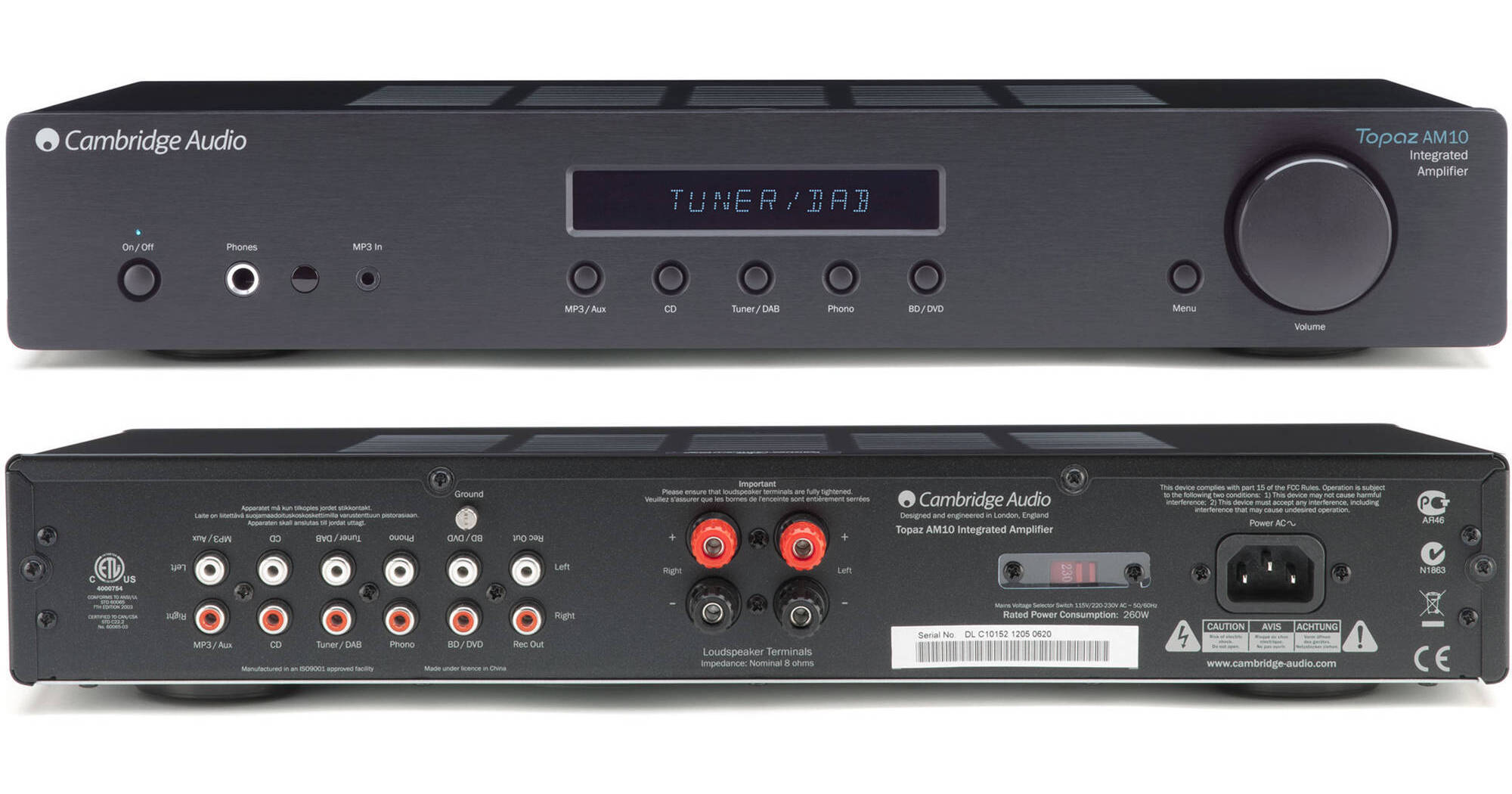
The Cambridge Audio Topaz AM10 has the understated appearance that has become closely associated with Cambridge Audio.
A brushed-aluminium front panel gives the amplifier a clean, understated appearance, while the chassis has a reassuringly solid feel. Cambridge also paid attention to mechanical construction, using a rigid wrap-around lid assembly intended to help control resonance.
The front panel is simple and functional. There is a large volume control, source-selection buttons and a clear display that provides information about the selected input and volume level.
It is not trying to look like an expensive statement amplifier—and that is arguably part of its charm. The AM10 looks like a serious piece of hi-fi equipment rather than a lifestyle product.
Connectivity
For a budget integrated amplifier, the Cambridge Audio Topaz AM10 is impressively well equipped.
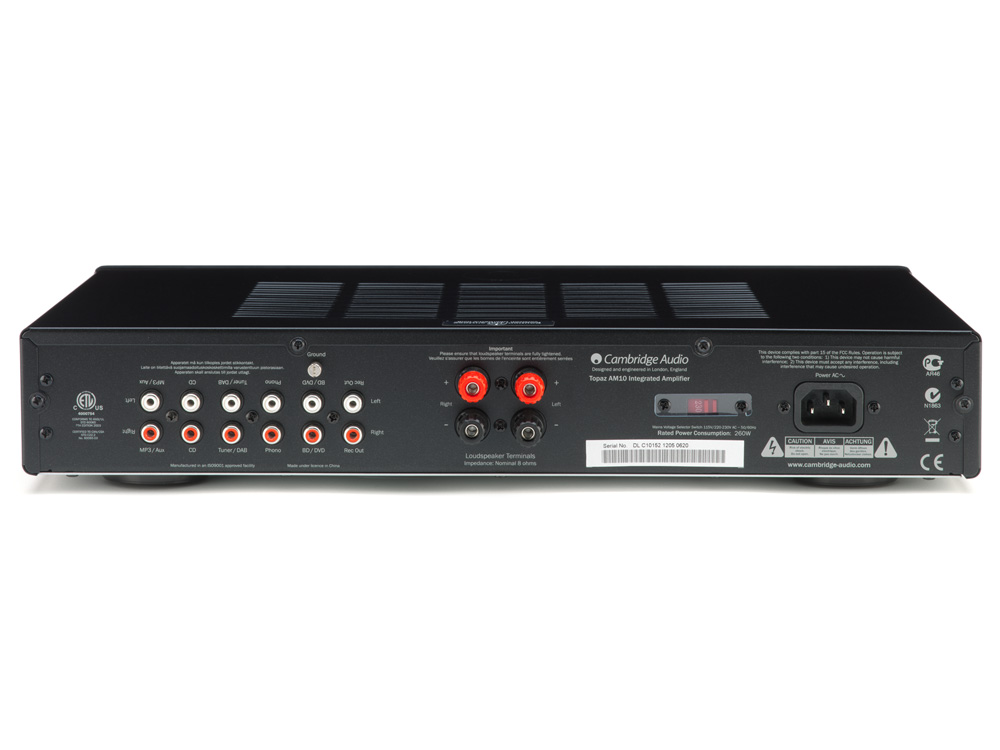
Around the back are five source inputs, including a dedicated phono input, while a front-mounted 3.5mm input makes connecting a portable music player or similar device particularly easy. There is also a record output and a full-size 6.35mm headphone connection on the front.
The built-in phono stage is particularly welcome. It means that a turntable can be connected directly without purchasing a separate phono preamplifier.
This gives the AM10 a versatility that makes it suitable for a traditional two-channel system containing a CD player, turntable and other analogue sources.
What you don’t get is equally important to understand. The AM10 is an analogue amplifier and does not include a built-in DAC, Bluetooth or network streaming. For someone looking for a modern all-in-one amplifier, that may be a limitation. For someone who simply wants a good analogue integrated amplifier, it keeps things refreshingly straightforward.
The Power Supply
The Cambridge Audio Topaz AM10 is rated at 35 watts per channel into 8 ohms, but Cambridge Audio didn’t simply build the smallest possible power supply around that figure.
The amplifier uses a custom low-flux toroidal transformer, with a maximum power consumption of 260 watts.
That matters because an amplifier’s ability to control a speaker is about more than its advertised wattage. A decent power supply helps the amplifier maintain composure when the music becomes demanding.
Contemporary testing also found that the AM10 could produce more than its rated 35 watts under laboratory conditions, with substantially greater output available into 4-ohm loads.
Of course, this doesn’t magically turn the AM10 into a high-power amplifier. It remains best suited to sensible speaker pairings and normal listening environments.
Sound Quality
This is where the Cambridge Audio Topaz AM10 becomes particularly interesting.
The amplifier has a sound that can best be described as smooth, musical and slightly warm, rather than aggressively analytical.
A contemporary review by The Absolute Sound praised the AM10 for its spacious soundstage, solid depth and stable central vocal image, while describing it as somewhat midrange-focused with a gentle softening toward the frequency extremes.
That description remains a good way of understanding the amplifier.
Midrange
The midrange is arguably the AM10’s greatest strength.
Vocals are presented with excellent presence and a convincing sense of body. Acoustic instruments have natural timbre, and the amplifier avoids making the upper midrange excessively forward.
This gives the AM10 an easy-going quality that makes it particularly enjoyable for long listening sessions.
Play well-recorded acoustic music, jazz, classical or vocal recordings and the amplifier produces a coherent and natural presentation without constantly drawing attention to itself.
Treble
The treble is clean and reasonably detailed but doesn’t have the aggressively bright character sometimes found in inexpensive amplifiers attempting to sound “detailed.”
Cymbals have sufficient definition and strings retain their texture, but the overall presentation remains smooth.
This characteristic can be especially beneficial when the AM10 is paired with speakers that have a lively or bright tweeter.
Bass
Bass performance is good rather than spectacular.
There is enough weight and control for normal listening, and the AM10 can produce a surprisingly convincing sense of scale when partnered with suitable speakers.
However, its modest power rating means it isn’t the ideal choice for driving difficult speakers in a large room at very high volumes.
Contemporary listening tests found that the amplifier’s limitations become more obvious with demanding rock music and material requiring large dynamic swings.
With appropriately sensitive bookshelf or floorstanding speakers, however, the bass can be tight and tuneful.
Soundstage
One of the AM10’s more impressive qualities is its ability to create a believable stereo image.
Rather than simply placing the music between the two speakers, it can create a reasonably spacious soundstage with convincing depth.
Vocals tend to lock firmly into the centre, while instruments occupy recognisable positions around them.
This is one of those characteristics that makes the AM10 sound more sophisticated than its modest price and power rating might suggest.
Phono Stage
The integrated phono stage is another strong feature.
Cambridge designed the input primarily for moving-magnet cartridges and high-output moving-coil cartridges, making it a practical option for many conventional turntable setups.
It won’t replace a high-end dedicated phono stage, but for an amplifier in this class it is a very useful inclusion.
For someone building a simple vinyl-based system, the combination of a turntable, AM10 and a good pair of speakers can produce a very satisfying setup without requiring a rack full of separate components.
Headphones
The front-mounted full-size headphone socket is another useful addition.
It makes the AM10 suitable for late-night listening without requiring a separate headphone amplifier.
Again, this isn’t intended to compete with dedicated high-end headphone amplification, but it adds considerably to the amplifier’s practicality.
Tone Controls
The AM10 includes bass and treble controls offering ±10dB of adjustment at 100Hz and 10kHz respectively.
This is useful when matching the amplifier to a particular room or speaker.
Some purists may prefer an amplifier with no tone controls whatsoever, but there is nothing inherently wrong with having them. In a real listening room, being able to make a small adjustment can sometimes produce a more enjoyable result than chasing theoretical purity.
Speaker Matching
Speaker matching is particularly important with the AM10.
With 35 watts per channel, it is best paired with speakers of reasonable sensitivity and a benign impedance characteristic.
A good pair of bookshelf speakers can make an excellent partner, particularly in a small or medium-sized room.
The wrong speaker, however, can expose the AM10’s limitations. A large, inefficient floorstander that demands substantial current at high volume is not the amplifier’s natural territory.
This is an amplifier that rewards sensible system building.
What I Like
- Excellent musicality for its price
- Smooth, natural midrange
- Very good vocal reproduction
- Spacious and stable stereo image
- Built-in phono stage
- Five rear inputs plus front 3.5mm input
- Full-size headphone output
- Useful bass and treble controls
- Good build quality
- Quality toroidal power transformer
- Compact and understated design
- Excellent choice for a simple two-channel system
What Could Be Better
- 35 watts per channel limits ultimate volume and speaker choice
- No built-in DAC
- No Bluetooth or network streaming
- Bass authority decreases with difficult speakers and demanding music
- Tone controls are menu-operated rather than traditional analogue controls
- Not designed for large rooms and extremely high listening levels
Verdict
The Cambridge Audio Topaz AM10 is a reminder that good hi-fi doesn’t necessarily require big numbers.
Its 35 watts per channel may look modest, but paired with an appropriate set of speakers, the AM10 delivers a refined, musical and enjoyable performance. Its greatest strengths are its natural midrange, convincing stereo imaging and smooth overall presentation.
It also succeeds as an everyday amplifier. The built-in phono stage, multiple analogue inputs, headphone output and remote control make it remarkably versatile for its class.
There are certainly more powerful and more technologically advanced amplifiers available today, but that isn’t really the point of the AM10.
The Topaz AM10 is aimed at the listener who wants to sit down, select a source and enjoy music—and in that respect, it remains a very successful design.
For a small or medium-sized room, a turntable or other analogue sources, and a pair of reasonably efficient speakers, the AM10 can form the heart of a wonderfully simple and enjoyable stereo system.
Overall Rating: ★★★★☆ 4/5
Sound Quality: 4.5/5
Build Quality: 4/5
Features: 4/5
Musicality: 4.5/5
Power: 3.5/5
Value: 4.5/5
Bottom line: The Cambridge Audio Topaz AM10 is a modestly powered amplifier with considerably more musical ability than its specifications might suggest. It won’t drive every speaker or fill every room, but with the right system around it, the AM10 delivers a wonderfully smooth, engaging and coherent performance that makes it an excellent entry point into serious two-channel hi-fi.