Carver C-4000 High Fidelity Control Console Preamplifier — Review
Overview
Released in 1982, the Carver C-4000 is one of designer Bob Carver’s most ambitious and idiosyncratic preamplifiers — a genuine departure from conventional preamp design philosophy. Where most preamps aim purely for transparency, the C-4000’s stated goal, according to its own documentation, was a dramatically higher degree of realism than had been achieved before in audio reproduction, built around a suite of proprietary processing features that go well beyond simple amplification and switching.
Build & Design
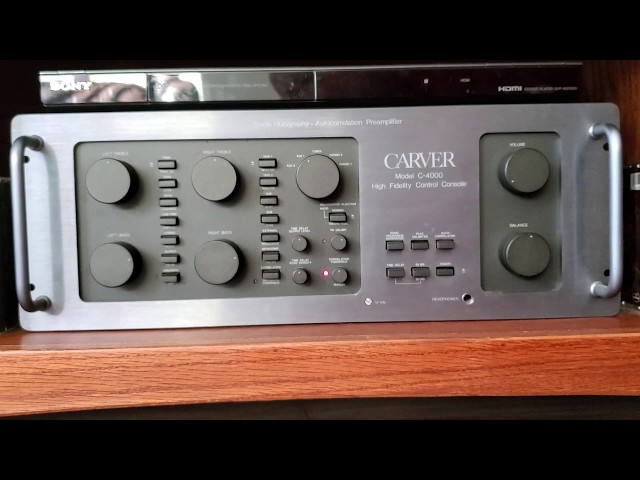
At its core, the C-4000 is a genuinely high-performance console preamplifier: precise RIAA phono equalization, low distortion, high slew rate, and wide dynamic range, paired with an unusually deep degree of control flexibility. One owner specifically praised it as one of the most configurable preamplifiers they’d encountered, with a genuinely capable phono stage including an MC cartridge input with variable step-up gain. The control layout carries a full set of tone controls, including separate bass and treble adjustment per channel — a level of granularity one long-term owner admitted they never found a practical use for, but appreciated as evidence of just how thoroughly Bob Carver approached the design. A recurring minor gripe across owner reviews: the C-4000’s control lettering uses a light-grey-on-dark-grey color scheme that can be genuinely difficult to read except in bright light — one reviewer joked you practically need a flashlight.
Distinctive Technology
What sets the C-4000 apart from ordinary preamps of its era — and from nearly everything made since — is its trio of signature processing circuits. The Peak Unlimiter is designed to undo dynamic compression baked into many recordings and broadcasts, aiming to restore the impact that gets squashed out in mastering. The Auto Correlator noise reduction system works to strip away low-level rumble and hiss that Carver considered a persistent barrier to realism. Most famous of all is the Sonic Hologram Generator, combined with a Time Delay circuit, which attempts to break past the physical limitations of two-channel stereo and typical room acoustics to create a more three-dimensional, out-of-the-speakers soundstage. Contemporary listening tests conducted by Stereo Review — with Bob Carver present alongside an audio engineer and two additional trained listeners — specifically evaluated the sonic holography function’s subjective impact, treating it as a genuinely novel and noteworthy feature worth serious critical attention at the time.
Performance
Reviews and owner impressions of the C-4000 are broadly, though not universally, positive. Audioreview.com’s aggregated owner score sits at a strong 4.6 out of 5 across 17 reviews. Several owners specifically praise its flat, linear tonal quality when run without its special processing engaged, along with an excellent phono stage that vinyl-focused listeners rate highly. One collector-condition listing described the sound as stunningly detailed and accurate, easy to listen to for extended hours without fatigue, and noted it performed just as well paired with non-Carver amplifiers as with Carver’s own.
That said, it’s worth noting real disagreement exists. At least one long-term owner, revisiting a C-4000 after years away, described the sound as weak in both bass and treble compared to more modern preamps in their system, initially wondering if something was wrong with the unit — a reminder that, being a decades-old design now, condition and capacitor age can meaningfully affect how a given example performs. Notably, one owner who fully recapped their unit (replacing roughly 95 electrolytic capacitors) reported a dramatic improvement, moving from a thin, shrill sound to one they found clearly superior to newer gear in direct comparison — suggesting that a well-serviced C-4000 and a tired, original-capacitor example can sound like genuinely different components.
Value
Originally priced around $1,000 when new (often discounted from MSRP even then), the C-4000 has held its value unusually well on the used and collector market, a point several sellers and reviewers specifically call out. For vintage-audio enthusiasts and Carver collectors, it remains a sought-after piece, both for its performance and for its historical significance as one of the more genuinely inventive preamp designs of its era.
Verdict
Pros: Genuinely unique signal-processing features (Sonic Holography, Auto Correlator, Peak Unlimiter) unlike almost anything else on the market; excellent, highly flexible phono stage with variable MC step-up; flat, accurate tonal character when run without added processing; strong reputation and resale value among vintage-audio collectors; extensive control flexibility for tone-shaping.
Cons: Now a decades-old design, so performance varies significantly with capacitor age and service history — recapping appears to make a substantial difference; dim, hard-to-read control lettering; unusual control layout that some owners find awkward; quality control was reportedly inconsistent even when new, given Carver’s small operation at the time.
Bottom line: The C-4000 remains one of the more fascinating and genuinely inventive vintage preamplifiers available on the used market — a design built around real sonic ambition rather than just accurate amplification. A well-serviced example, ideally recapped, is widely regarded as a genuinely excellent-sounding and historically interesting piece for the vintage-audio enthusiast.