


Linear Tube Audio has something quite special on their hands in my opinion. I tend to like tube amps that lean to the neutral and fast side of things, but I still appreciate the liveliness and richness they bring. There are only a few amps I’ve heard that pull this off, and the ZOTL is the newest member of that list.
Where the MicroZOTL excels is in its truthfulness and its value for the money. The MZ2 isn’t cheap, but I feel that it represents an excellent piece of gear for the asking price, and it’s’ something I would contemplate purchasing if I were in the market for a tube amp at the price.
Finds like this are rare in the tube world, where parts can be expensive and engineering tradeoffs abound – everyone is looking for that sweetspot of performance and price, and generally, only time, testing and listening will tell. In the case of Linear Tube Audio’s MZ2 I think we have a real sweetspot product. Get your ears on this one if you’re in the market for a really balanced tube amp.
The Audio Beatnik (Review #1 & Review #2)
Music just seemed to float effortlessly in space without ever seeming forced or strained. The bass is rhythmic so that my system sounded very lifelike, but it didn’t add any extra warmth to the bass. Maybe the biggest surprise was its ability to portray tonal accuracy and purity with instruments and voices, and at the same time, it had the most detail, speed, and micro-dynamics of any amp I have ever heard in my system. I had come to believe that in order to get certain of these qualities in an amp, I had to sacrifice the others. This is not true with this amazing little amp.
In this context I could only marvel at its explosive dynamics. The range from soft to loud was negotiated with a world-class startle factor that exceeded the performance of the Audible Illusions L3A line preamp, and if memory serves me right, actually equaled the performance of the much-more-expensive Pass Labs XP-30 preamp in this regard. That made the microZOTL2.0’s presentation visceral and involving, impossible to ignore. And as it turned out, it was far from being a one-trick pony. Bass response was spectacularly solid, extended, and pitch-perfect. And there was no denying that soundstage transparency bettered that of any tube preamp I’ve auditioned under $5k.
We listen to a lot of audio equipment here at TMS. There’s a constant train of gear trundling in and out of our offices. But this is one of the few pieces of gear which we were actually sneaking off to listen to on the weekends, or late at night.
The sheer joy of realising what it did to our music collection, having to wait for it to heat up, sliding on the headphones knowing – knowing – that we were going to hear something special, was just a revelation. What does it sound like? It sounds like a gift from God. That’s what it bloody well sounds like.
It’s not just that we could hear every single element in the mix of whatever we listened to. It’s that every single one of those elements had an indescribable richness to them. No matter what we threw at it, it continued to treat each instrument like a precious, fragile jewel, something to be wrapped up in layers of soft velvet. As tube amps go… it was glorious.
I rarely play my music loud—just 88dB on average—but it took only a few recordings before I forgot completely that the microZOTL2.0 was putting out less than 1W into the 10-ohm load of each DeVore O/93. If you have a small room and listen at modest levels, this is a truly magical combination.
When I put the MicroZOTL2.0 in my reference system, in place of a $24,000 preamplifier, I was patently shocked with what effect it had over the performance of my system. In listening to John Coltrane’s album Ballads (Impulse), what was immediately striking to me was the beauty of the timbres and tonality of his tenor saxophone. The MicroZOTL2.0 produced the best colors and tones of any preamplifier that I have ever had in my system. The timbres of the other instruments (such as the piano, acoustic bass, and drums) were the most life-like that I had ever heard from this disc.
My recent acquisition of the LTA MicroZOTL 2.0 is like a dream come true, in more ways than one… The LTA amp could do no wrong, with any material. Even if I have only tested it in one of its three roles, it is already the best thing I have bought in quite a long time…
If the OTL is supposedly more direct and gives you more of the music, the LTA most certainly is. It plays everything well, so much so that I have yet to find an album that I do not like… The LTA is that very rare thing, gear that gives great detail and yet is forgiving
This is a true story about a surprising 1W integrated amplifier—a push-pull, class-A, output-transformerless tube amp—that drove my DeVore Fidelity Orangutan O/93 speakers to 90dB average levels with grace, spiderweb detail, liquidity, and—unbelievably—a small degree of bass slam.What the hell is it?
Have you ever observed an object for which you had no name? I mean, no whatchamacallit name at all? In the anthropological story of humans, the act of naming has powerful significance. In our everyday world, humans, objects, and forces don’t fully exist for us until they’re baptized, anointed, given a proper name. (“It’s a girl!”) Naming is transformative—it categorizes. (“It’s a miracle!”) Names generate pictures and memories. Names provoke feelings. (Think women named Bridget, Beyoncé, Barbie.)
Like those B-names above, names preform and deform our direct experiences. How? By their very nature, names assign virtue and value to our experiences before we even experience them. Worse, they convert pure sensory data into something that is mostly a cultural and emotional projection. Do I need to explain how much this naming game has corrupted our sacred hobby of listening to reproduced music in our homes?
Every adjective I use in this review has been predefined and precolored by my reviewing ancestors. Thank you, Gordon and Harry! So let me start again . . .
This is a true story about a surprising 1W integrated amplifier—a push-pull, class-A, output-transformerless tube amp—that drove my DeVore Fidelity Orangutan O/93 speakers to 90dB average levels with grace, spiderweb detail, liquidity, and—unbelievably—a small degree of bass slam.
This is a true story about a new tubed headphone amplifier that plays every set of ‘phones I tried with extraordinary levels of liquid transparency, detail, and tuneful ease.
This is a true story about a world-class line-level preamplifier designed by a venerable audio designer named David Berning and manufactured by a company named Linear Tube Audio, founded in 2015 by inspired engineer and product designer Mark Schneider.
Linear Tube Audio has christened this futuristic trident of amplification the microZOTL2.0 ($1100).
David Berning
I have admired David Berning since the 1970s, when I enjoyed his EA230 tube amplifier. The EA230 was a sonically well-balanced variation on the classic Williamson circuit (a push-pull amplifier, made with carefully designed output transformers and using global negative feedback), which sounded especially good with electrostatic speakers.
In 1995, after more than 20 years of designing tube amps, Berning rejected what he believed were the limitations of output transformers. Hoping to take thermionic valves to a new, less “tubey”-sounding level of performance, Berning introduced his patented zero-hysteresis output-transformerless (ZOTL) circuit. He says that his ZOTL circuit is an “impedance converter” that replaces a traditional tube output transformer by using “DC-DC switching converters operating at fixed frequencies well above the audio frequencies. The actual voltage and current impedance transformations are done via special high-frequency transformers. This is an RF carrier system that eliminates the frequency-dependent distortions present in audio transformers, and can enable the amplifier to have a wider frequency response and be DC coupled.”
OTL, SCHMOTL . . .
I’ve owned a few output-transformerless (OTL) amplifiers, including Julius Futterman’s H3aa and a pair of New York Audio Labs OTL1s. But for me, OTLs never really solved the frequency-extreme problems of output transformers. Even with my beloved Quad ESL 57s, I thought, The cure is worse than the cold. My sensitive audio sensitivities didn’t appreciate the anxious feelings, oscillations, and circuit failures caused by all the feedback required to make row upon row of hot tubes achieve a low enough output impedance to drive even a pair of 15-ohm BBC LS3/5a‘s.
Description
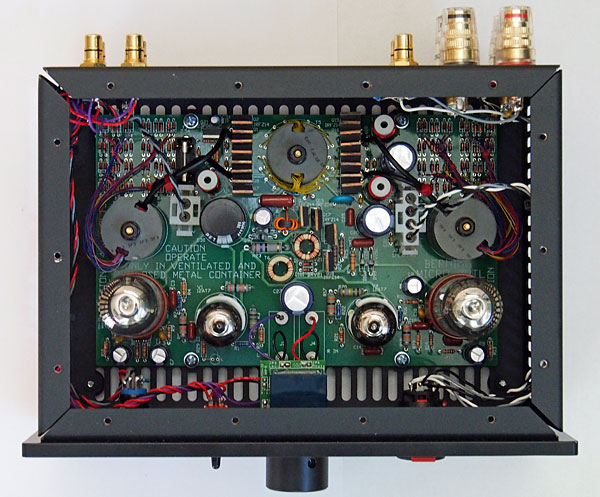
David Berning introduced the original low-power, modestly priced microZOTL ($680) in 1998. He called it a “personal amplifier,” and it included a headphone output jack. It was discontinued in 2007. Then, in 2015, smart guy Mark Schneider licensed the design for the inaugural product from his new company, Linear Tube Audio. Schneider added a few wise touches—a nicer case, a second line-level input—but kept Berning’s original circuit. This uses half of one 12AT7 dual-triode tube as a voltage amplifier, and the other half as a split-load phase inverter. Surprisingly, this common configuration drives not a pair of EL34 or KT120 power pentodes, but a 6SN7 medium-mu twin triode—as a single-tube push-pull class-A output stage!
Antiphase waveforms from the two halves of the 6SN7 are superimposed on 250kHz carrier waves, and the voltage difference that results is impressed across a radio-frequency (RF) converter transformer with a turns ratio of 168:1. This unusual strategy produces 1Wpc into 4 ohms with no global negative feedback, and an output impedance of only 2 ohms.
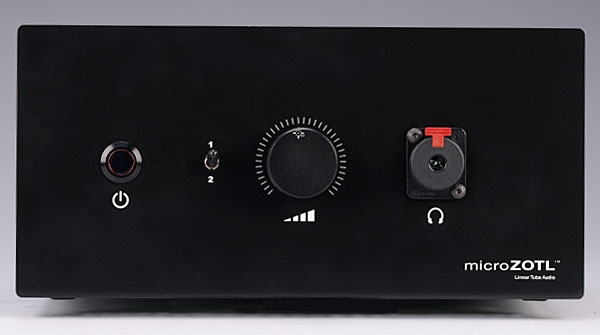
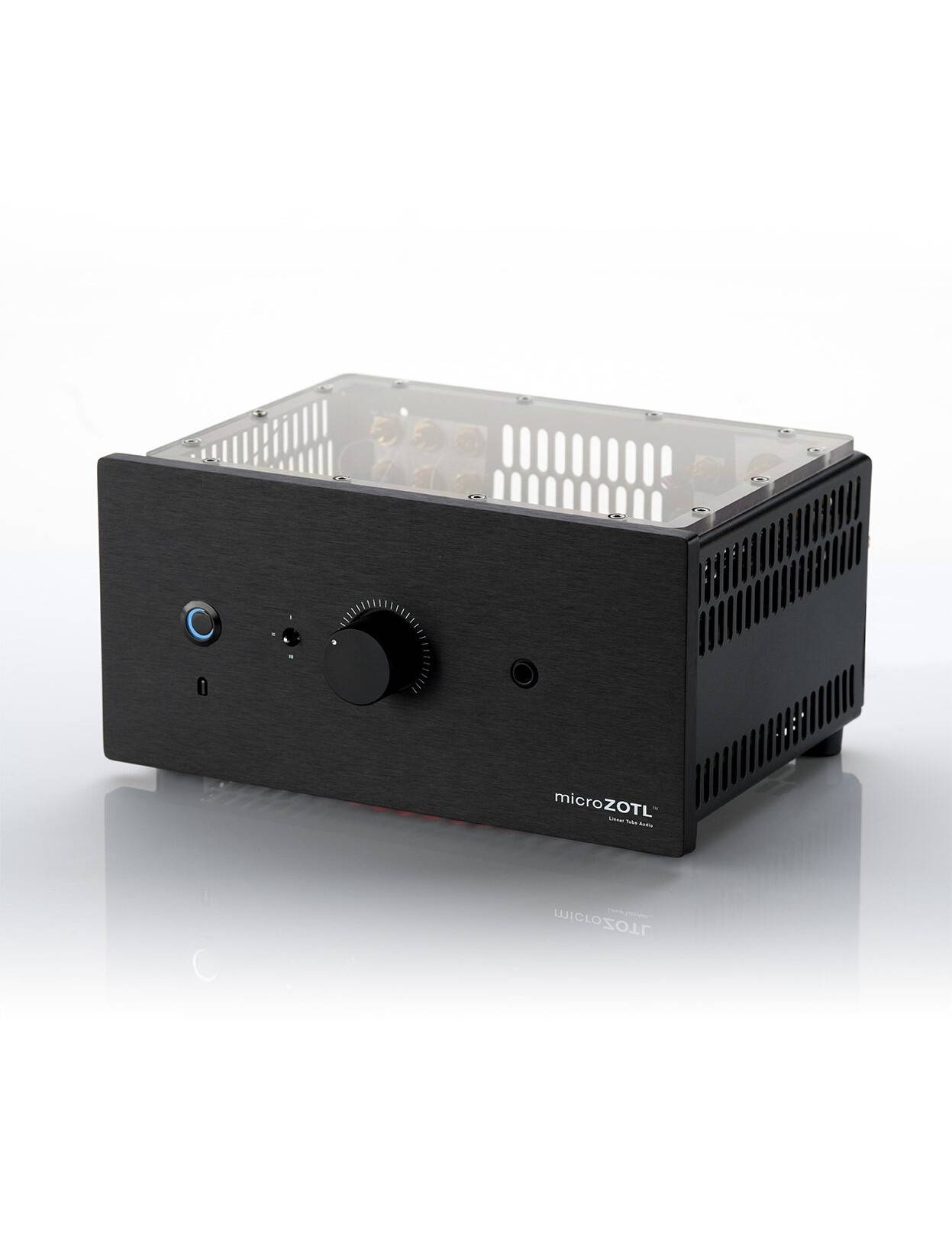
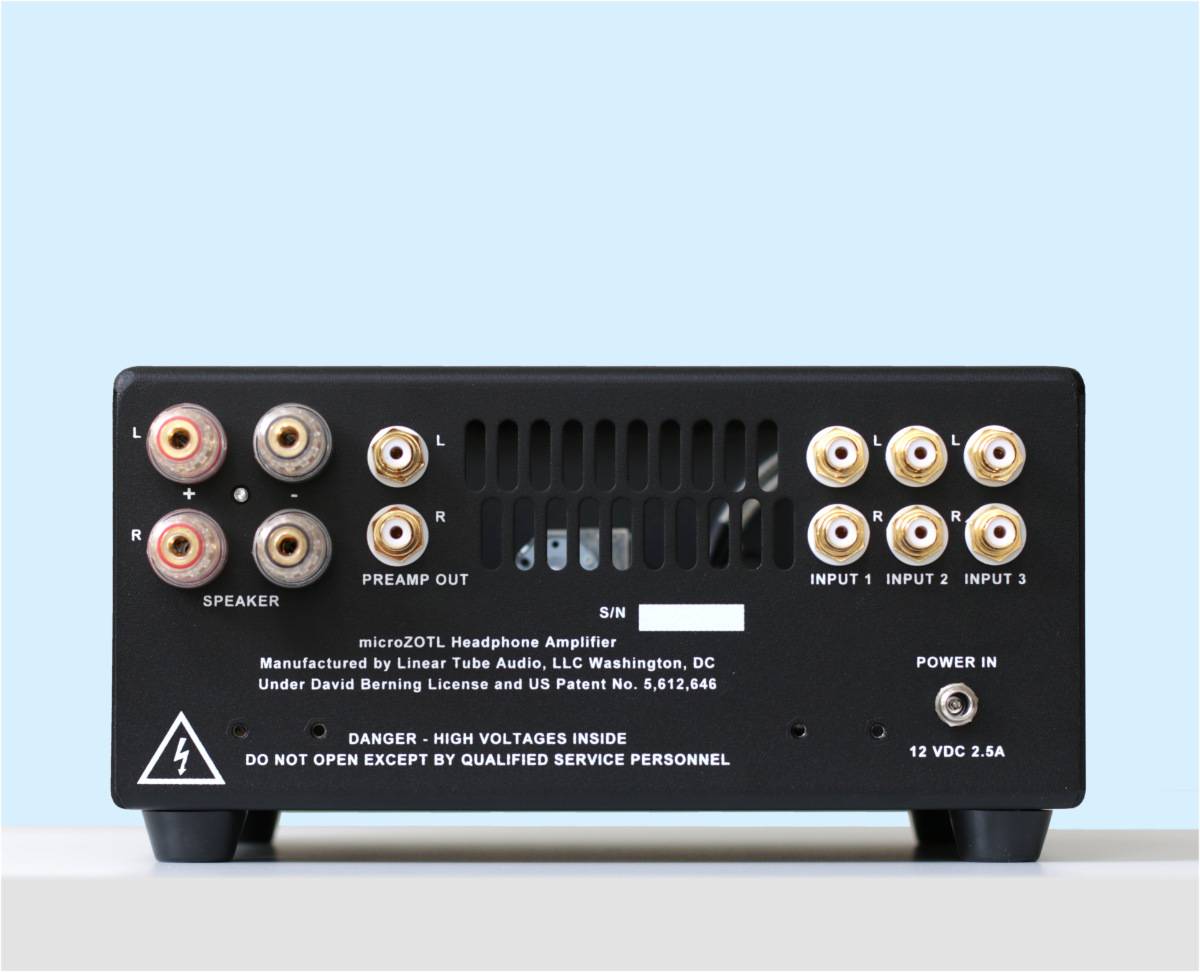
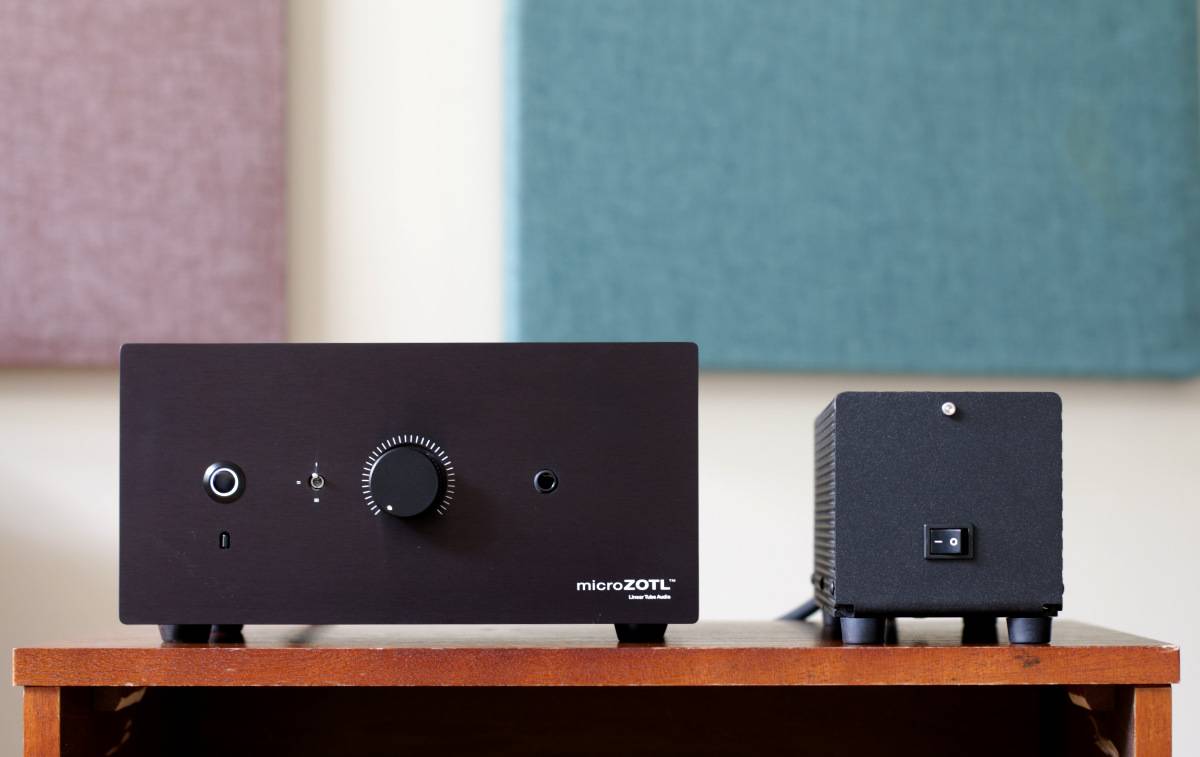
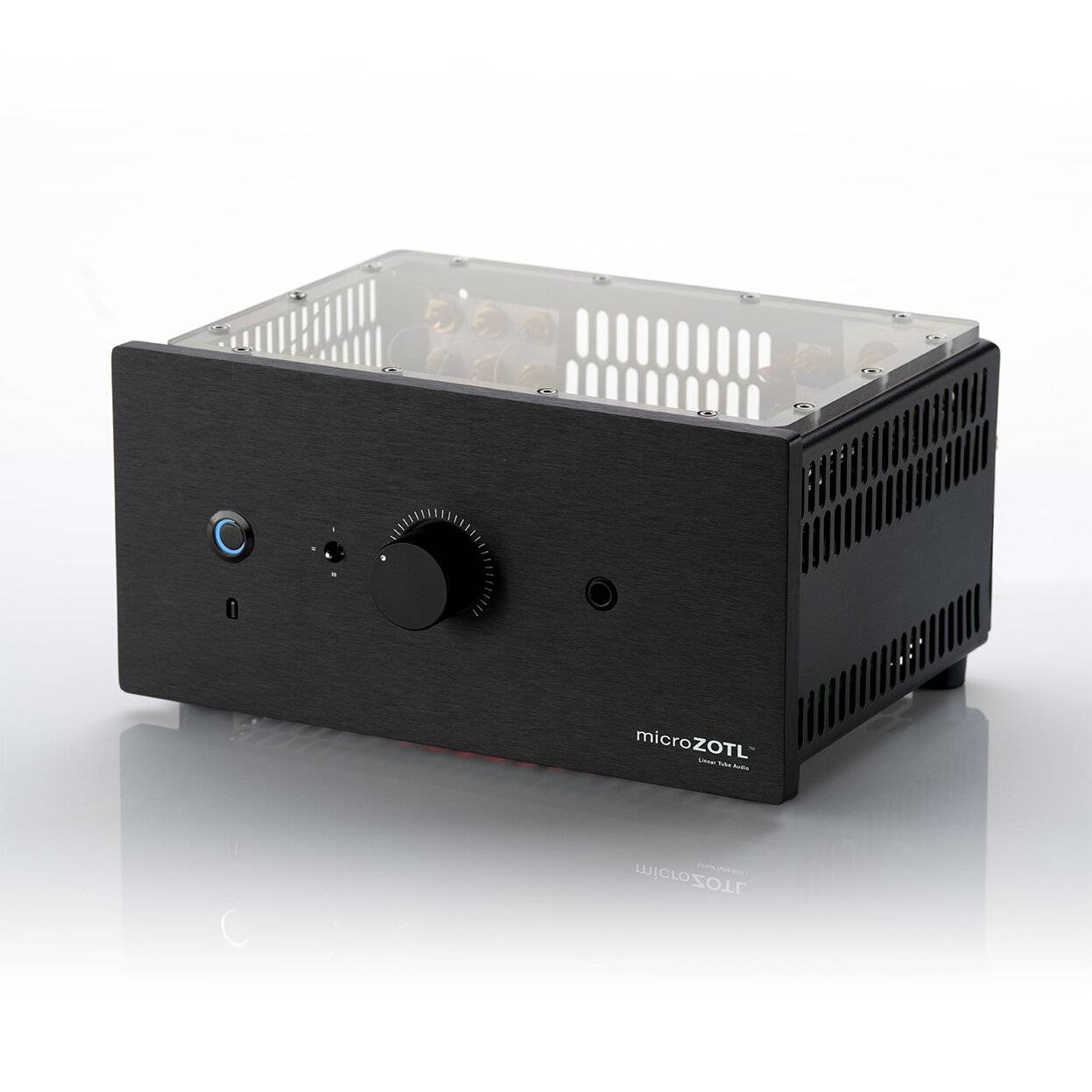
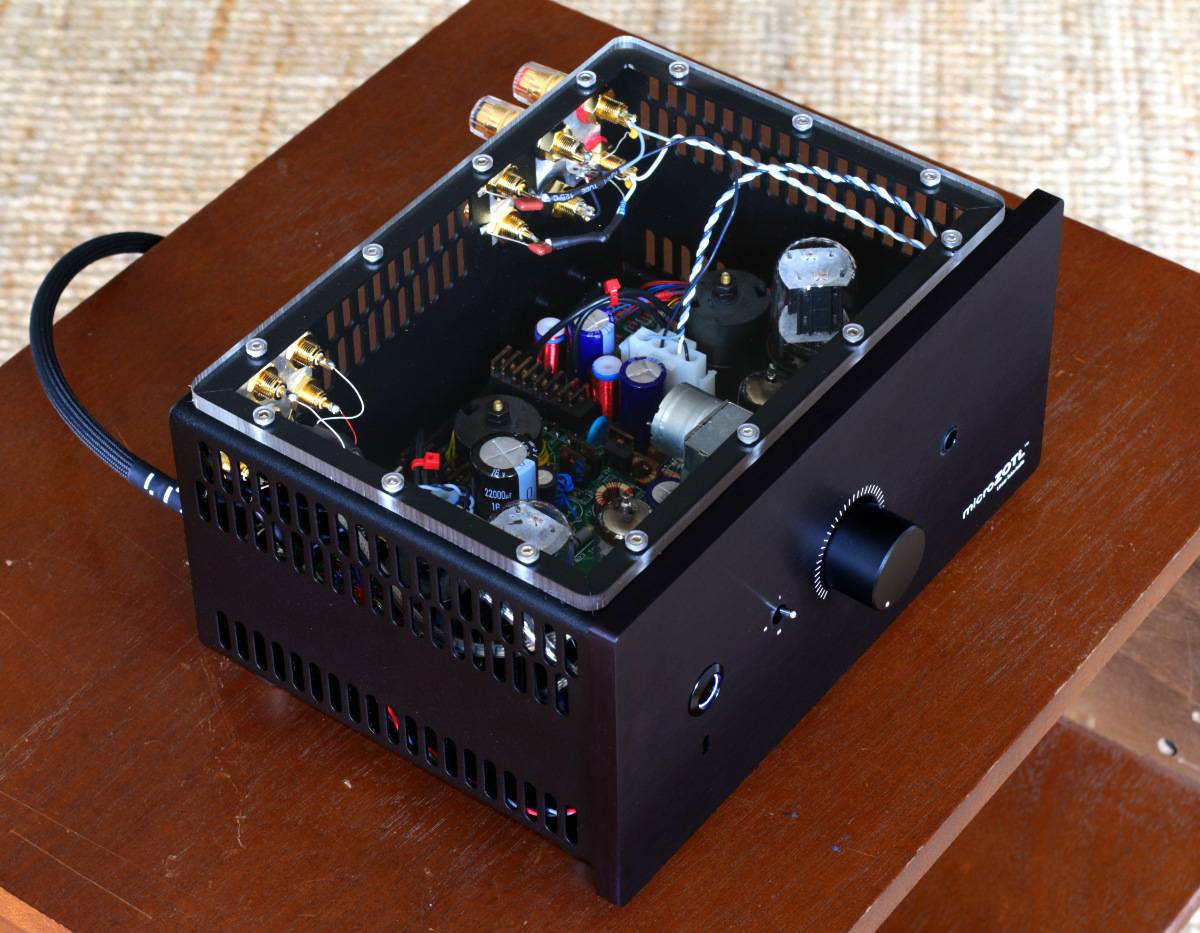
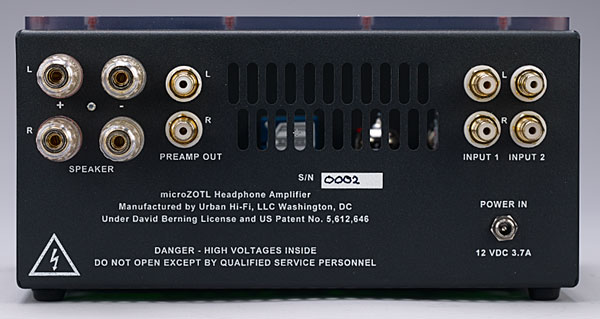
The original microZOTL came in bright blue casework with a store-window glass front so that the listener could admire the glowing tubes. The power switch, volume control, and headphone jack perched awkwardly at the top rear. Schneider’s microZOTL2.0 sits on your desk or equipment rack with considerably more high-tech presence and subtle masculinity. Its case is made of black anodized aluminum, with a top plate of clear Lexan, a polycarbonate. The Power button on the faceplate is elegantly encircled by red light when the amplifier is switched on. To the right of this is a toggle switch whose two positions are labeled 1 and 2, for the two line-level inputs; then comes an Alps volume pot with silky-smooth action, and a locking ¼” headphone jack. The rear panel, too, is simple, with high-quality speaker-binding posts, those two line-level inputs (RCA), a preamp output (RCA), and a jack for the 12VDC power supply.
Listening: DeVore Fidelity Orangutan O/93s
Allegedly, a journalist asked Beethoven, “What does your D Minor piano sonata mean?” The master replied, “Read Shakespeare’s The Tempest.” Surely, Beethoven understood: art does not have meanings; it has uses, and Beethoven’s provocative Piano Sonata 17 in d, Op.31 No.2, “Tempest,” is proof. Among its range of uses: the Sonata in d can serve as a primer in the German literary movement (ca 1770) Sturm und Drang (tempest and drive). The repeating theme of first one, then two notes sounds almost like the composer speaking the words storm and urge. Artur Schnabel plays Sonata 17 with a unique range and balance of contrasts—calm vs excited, loud vs quiet—masterfully used as tools to express not only Beethoven’s musical invention but his vision of the century that lay ahead (CD, EMI CDHH 63765). I don’t know how, but driving the 93dB/W/m DeVores, the 1Wpc microZOTL2.0 showed me more pianistic power and subtlety from this recording than ever before. The sonata’s—and Schnabel’s—dynamic contrasts felt radically enhanced and more obvious than through any other amp I’d used with these speakers. When I say power, I don’t mean loudness; I mean tensile strength, clarity, and the effectiveness of dynamic contrasts.
I rarely play my music loud—just 88dB on average—but it took only a few recordings before I forgot completely that the microZOTL2.0 was putting out less than 1W into the 10-ohm load of each DeVore O/93. If you have a small room and listen at modest levels, this is a truly magical combination.
Listening: Zu Audio Soul Supremes
The microZOTL2.0 played Zu’s Soul Supreme speakers with a bell-clear, pure-water transparency that gripped my mind and would not let go. I believe the Soul Supreme ($4500/pair, review in progress) to be of even higher impedance than the DeVore O/93—slam and wham were reduced even further, but, if anything, transparency and grainlessness were enhanced. Musical flow seemed more slippery and alive, like a trout in a clear mountain stream.
Later, when I inserted in front of the ZOTL—which I now used as a tubed line stage—PrimaLuna’s ProLogue Premium, a 36Wpc tubed amplifier ($2199), the slam pinned my psychic VU meters, but transparency and flow weren’t diminished at all. If you’re a freak for pace, rhythm, and timing (aren’t we all?), the Linear Tube Audio amp can shake, boogie, and run with the best. Oh, yes—and it plays Schubert lieder as sung by Elly Ameling, and Robert Johnson’s “Walking Blues” as performed by Paul Butterfield!
The combo of microZOTL2.0, ProLogue Premium, and Soul Supremes played music in a uniquely natural and lifelike manner—especially in the purity with which it reproduced women’s voices.
I’m just now beginning to appreciate the music of Jean-Philippe Rameau (1683–1764). I’m not yet a fan of Italian opera, but something about Rameau’s small French operas seems richer, more earth-based than those Italian wedding cakes. Rameau is more holy spirit than ego—less about tenors and divas and more about worldly relations. Rameau’s characters dance and have real (not ersatz) feelings. By no means do I pretend to understand Rameau’s creative intentions, but I’ve never felt closer to them than I did with microZOTL2.0. I got music-drunk playing excerpts from his Zoroastre: A Lyric Tragedy, with Richard Kapp conducting the Hamburg Chamber Orchestra (LP, Vox-Turnabout TV-S 34435). American soprano Lou Ann Wyckoff, mezzo-soprano Nancy Deering, and heroic tenor Bruce Brewer captured days of my life, simply because the microZOTL2.0 wouldn’t let me put the disc back in the jacket. The clean-water beauty of the microZOTL2.0’s mids and highs let me fully access the intensity of joy behind Wyckoff’s singing and the humanity of Rameau’s art.
Headphones: JH Audio Roxanne
Late one night after David Bowie died, I lit a red votive candle and lay on my apartment’s cold wooden floor, listening to his final album, Blackstar (LP, ISO 88875173871). The dark mysteries of his last music let me feel the man who fell to Earth in the room with me—together, it seemed, we were at “the center of it all.” Blackstar is surely Bowie’s greatest creation, and the darkness, the solitary candle, and the inner-ear soulfulness of the 15-ohm Jerry Harvey Audio Roxannes ($1299) combined to make me sob with happiness that I was able to share this world with an artist of Bowie’s magnitude. No other in-, over-, or on-ear ‘phones of my experience reproduce music in a more naturally balanced or holistic manner than do the Roxannes. These in-ear monitors aren’t amped up in any part of the audioband. They might be a smidgen rolled off in the high frequencies, but who cares? With the ZOTL, the midrange was pure and right. With Bowie’s Blackstar, the microZOTL2.0, and the Roxannes, there was no hi-fi, ear-fi, or super-audio in my experience—just shared human reverie.
Headphones: AudioQuest NightHawk
Listening deeper into Blackstar, I thought, The more I use the AudioQuest NightHawks, the more I recognize how uniquely natural and organic their sound is. AudioQuest must be applauded for hiring Skylar Gray to design these headphones, which are like no others. A semi-open-backed design with pulp-cone drivers, these $599 dynamic headphones present recordings with a bare-feet-on-black-soil naturalness that makes most other ‘phones sound mechanical. Besides their extraordinary tonal character, the illusion of space they generate is totally compelling, and has a singular, almost indescribable transparency. In fact, in terms of how Bowie’s intricate masterpiece presents itself spatially, the NightHawks sounded more microarticulate and properly scaled than they ever had. With LTA’s microZOTL2.0, big was really BIG, and small was teeny-tiny. In between was a distinctively tangible space filled with fine textures and delicately rendered light and shadow. Because of this extraordinary space, “near and far” delivered a special joy that’s rare in headphone listening.

The first time I heard Blackstar, I immediately thought of Scott Walker’s “The Electrician,” from the Walker Brothers’ Nite Flights (LP, GTO MOVLP 1356)—which, I’m now certain, was one of Bowie’s inspirations for the tone and imagery of his carefully executed soliloquy. On this DDA reissue of the Walkers’ 1978 LP, this powerful track proved that every pair of speakers and headphones sounds unsubtly different with every amp I connect it to. In this case, the AudioQuest NightHawks loved—and came alive with—the microZOTL2.0, and vice versa. The strange beauty of “The Electrician” was mesmerizingly rendered. Its off-kilter otherworldliness was never more spine tingling.
Headphones: Audeze EL-8
As I declared above, a given loudspeaker or pair of headphones can sound radically different, depending on the amplifier driving them. The truth of this showed itself when I connected Audeze’s EL-8 planar-magnetic headphones ($699) to the microZOTL2.0. The EL-8s usually present music in what seems to me to be a more neutral or accurate manner than the NightHawks. However, with the microZOTL2.0, “The Electrician,” “Blackstar,” and every other recording I tried sounded excessively dry and bare-bones. This was dumbfounding—earlier that same day, playing Ali Akbar Kahn’s Artistic Sound of Sarod (CD, Chhanda Dhara SN 3386) through the Schiit Audio Asgard headphone amp ($249), the EL-8s sounded delightfully detailed, moist, and sumptuous. Obviously, the microZOTL2.0 didn’t mate well with the usually neutral-sounding Audezes.
Headphones: AKG K812
It’s reasonable to say that Bob Dylan’s art looks backward, musically and spiritually—perhaps as far back as the Old Testament. In contrast, David Bowie’s art, and especially Blackstar, looks forward, perhaps as far as Revelation—except that there’s no Whore of Babylon, or final judgment, or apocalypse: just peace and prophecy. Blackstar unfolds like a mass or sacred cantata. As Bowie sang, I sensed that death was in the room with him. No audio devices at my disposal revealed this specter of death better than the microZOTL2.0 and AKG K812s ($1500). As the end of the album approached, the K812s spoke only truth.
More than any other headphone amp I have in-house, the microZOTL2.0 revealed the strikingly neutral AKGs’ basic nature: not too dark or light, detailed but never etched, not bright in the highs or soft in the lows—just plain old-school audio realism. True to its character, the microZOTL2.0 showed me a bit more of the K812s’ soulful side, which tends to stay hidden with anything less than the best headphone amps. In return, the AKGs showed me a bit more of the LTA’s analytical nature, which can be hard to hear with anything less than the best headphones. This amplifier-headphone coupling made a fine match.
Conclusions
I am a major fan of fusion audio components. Now that LPs are truly back, and DACs are getting smaller and improving with extreme rapidity, components like Linear Tube Audio’s microZOTL2.0 seem prophetic—equally at home in desktop systems or full-scale audiophile rigs. Almost unbelievably, the microZOTL2.0 delivered top-level sound quality as: a 1W integrated amplifier; a line stage that, because of its radical transparency, would hold its own in a cost-no-object system; and a headphone amplifier that could hold its own at thrice the price.