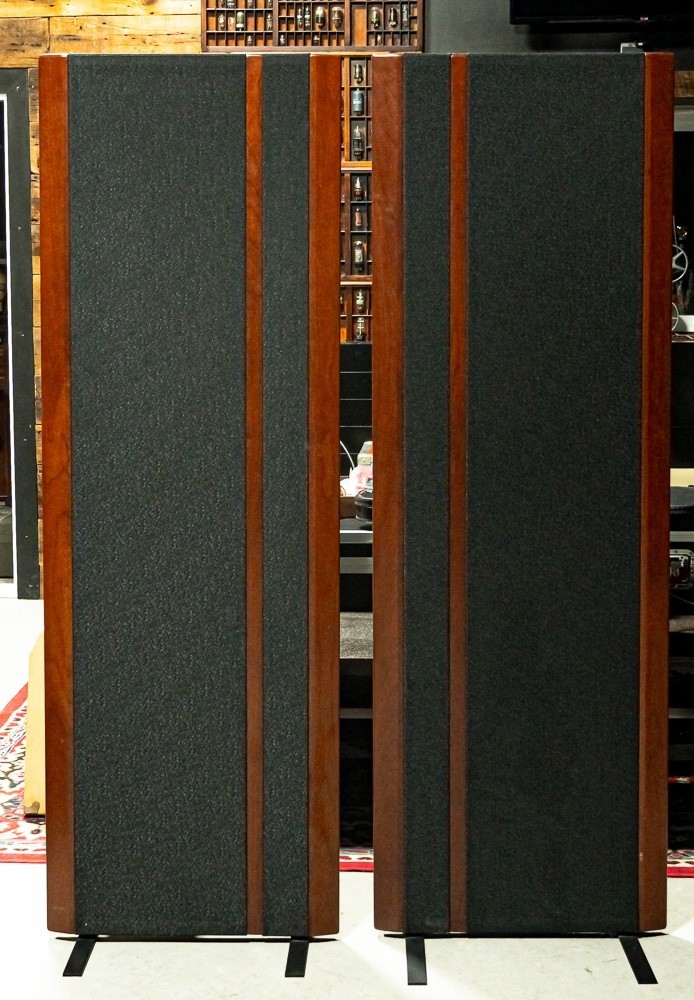
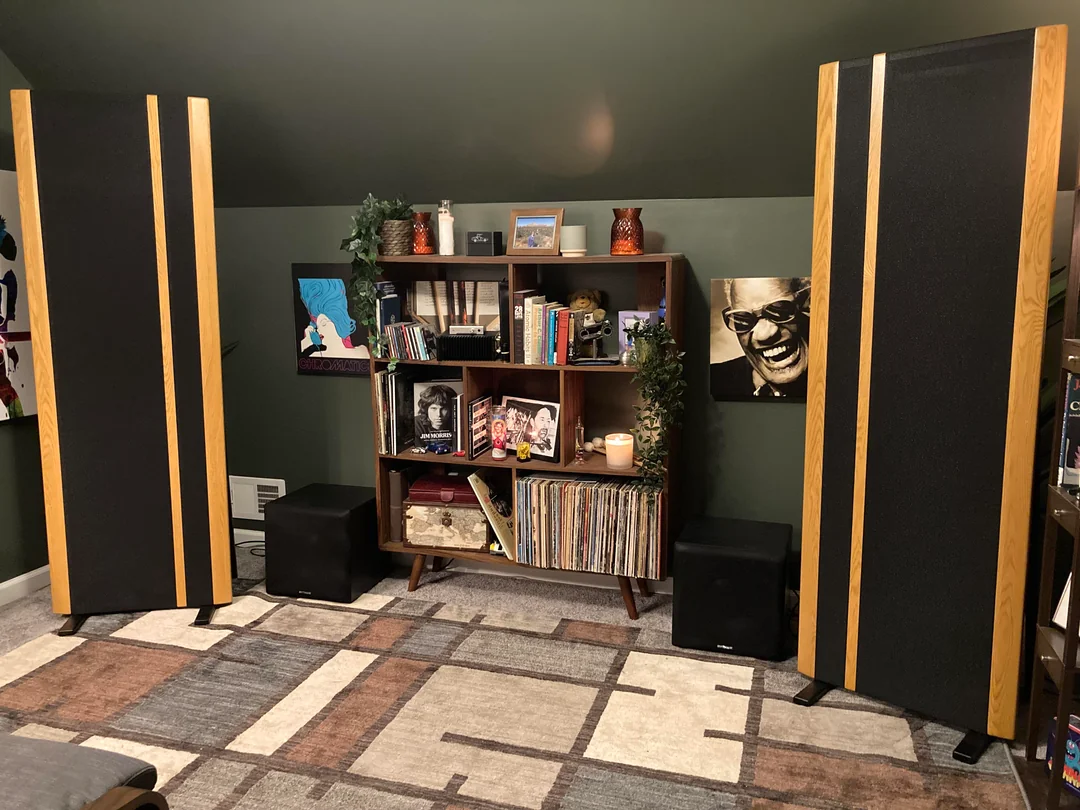
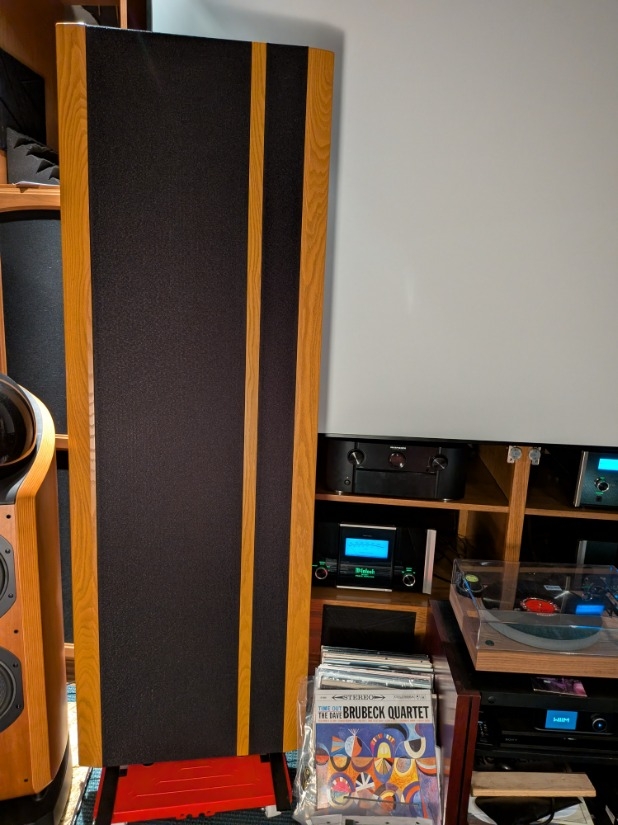
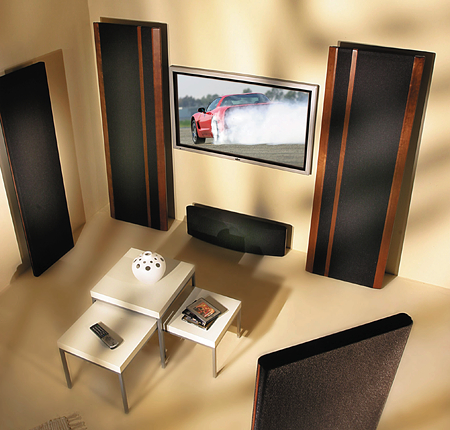
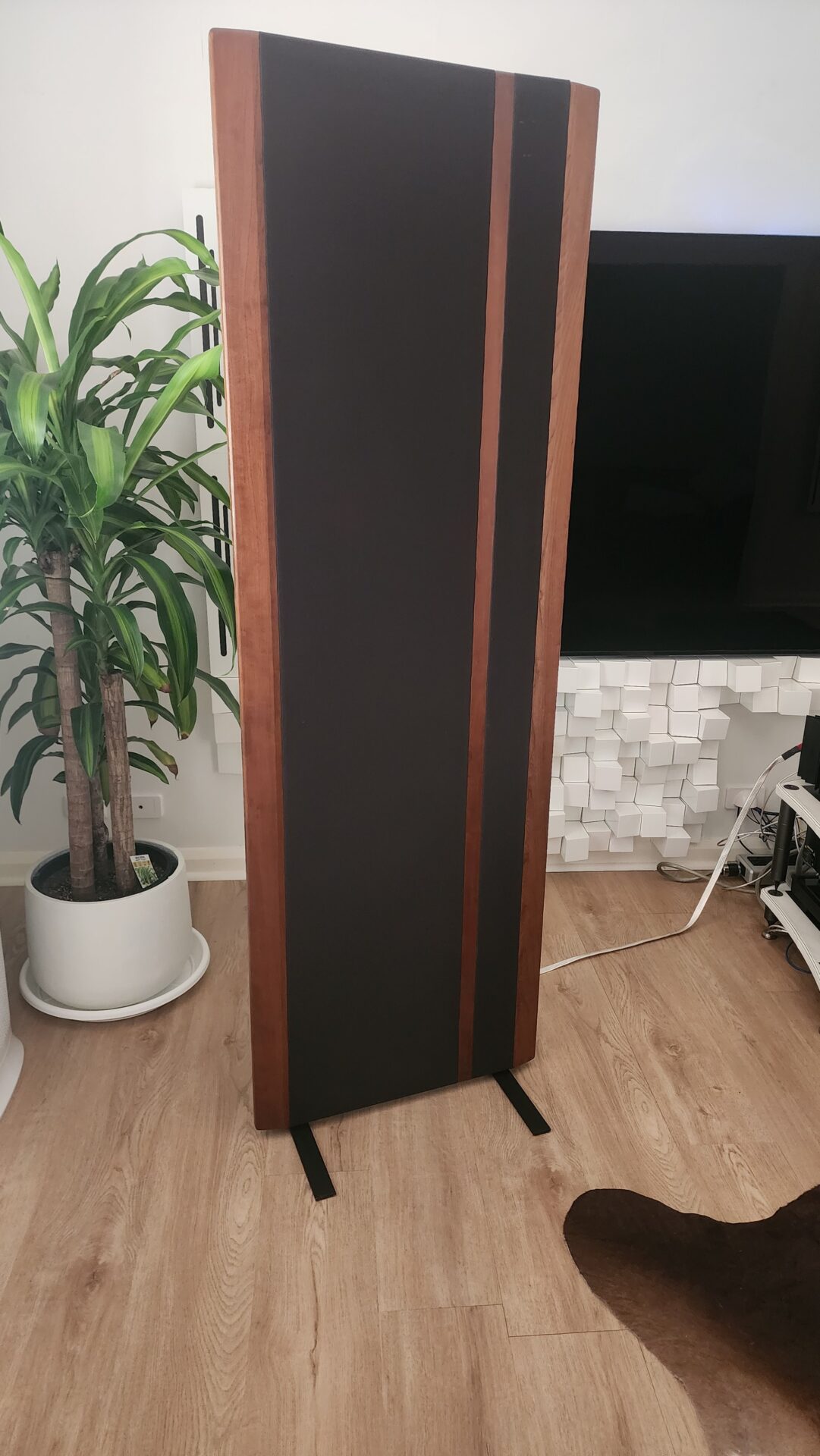
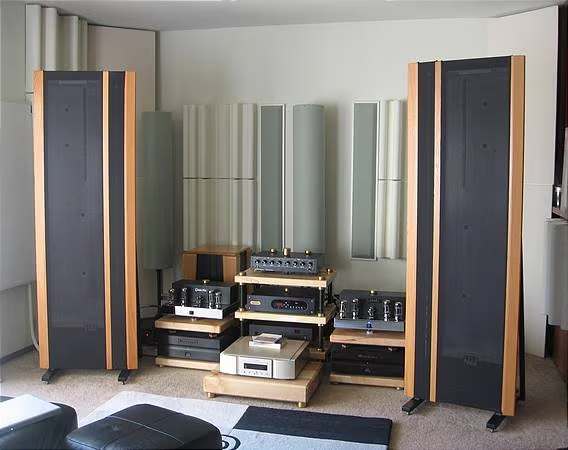
Magnepan Magneplanar MG3.6/R loudspeaker
Original price was: R122,000.00.R29,000.00Current price is: R29,000.00.
- Driver Technology: Uses thin-film diaphragms (Mylar) rather than conventional cones, with a true ribbon tweeter that provides high-resolution treble up to 18 kHz+.
- Design: 3-way dipole design (radiates sound front and back), requiring space from the front wall.
- Sound Profile: Known for extreme transparency, low coloration, and a fast, open sound.
- 3.6/R Improvements: The 3.6 improved upon the 3.5/R by using a larger midrange panel, improving bass integration and articulation.
- External Crossover: The speaker uses an external crossover box, allowing for easier, optional active bi-amping.
- Amplification: While rated at 85dB/500Hz/2.83v sensitivity, they are demanding and perform best with powerful, high-current amplifiers.
- Positioning: They are sensitive to room placement, usually needing significant space from walls and precise “toe-in” to blend the tweeter and woofer effectively.
- Mirror-Imaging: The panels are mirror-imaged, generally placed with the ribbon tweeters on the outside or inside depending on the room.
- External Crossover Upgrades: Enthusiasts often upgrade components (capacitors/inductors) in the external crossover box.
- Tweeter Modification: A popular, reversible modification involves bypassing the stock midrange crossover to feed the tweeter directly for enhanced speed.
Type: Three-way, planar/ribbon
Driver complement:
55″ long ribbon tweeter
199 square inch planar-magnetic midrange
500 square inch planar-magnetic bass
Frequency response: 34Hz to 40kHz (+-3dB)
Crossover points: 200Hz, 1700Hz
Sensitivity: 86dB/W/m
Impedance: 4 Ohms (nominal)
Hookups: Bi-wirable / bi-amplifiable
Recommended Power: 75 to 250 Watts
Warranty: Non-transferable ribbon foil element 1 year, balance of speaker 3 years
Weight: 70 lbs. each
Size: 24 x 71 x 1 5/8 inches (WxHxD in inches)
Price: $4375 in Oak and Black Wood ($4675 in Dark Cherry Wood)
Description

The MG3.6/R’s immediate predecessor, the MG3.5/R, was a breakthrough product for Magnepan. It was a huge commercial success, and established a spectacular new level of performance for Magnepan in terms of dynamics and transparency. As if that weren’t enough, the 3.6/R comes right on the heels of the MG1.6/QR, another huge success, and an industry-wide benchmark for performance in a $1500 loudspeaker. I reviewed the 1.6/QR in January 1999; it is the least expensive speaker in Class B of Stereophile‘s “Recommended Components,” and one of the least expensive to ever appear there.
Months before the MG3.6/R was even introduced at the 1999 WCES, a buzz permeated the Internet about “the new Magnepan,” and I received a steady stream of e-mail messages asking about it. “Is the 3.6 as good as I’ve heard? Is it really all of the updates developed for the 1.6, now applied to the 3.5?”
Nowhere were expectations greater than at Casa McKenzie-Damkroger. I’ve been listening to Magnepans evolve for two decades. I’ve admired their coherence and loved the uncanny way they could capture the sense of real instruments playing in a real space. Conversely, their lack of dynamics and slight opacity were always barriers between the music and me, barriers diminished in each succeeding generation, and nearly eliminated in the MG3.5/R and 1.6/R. Now comes the MG3.6/R, so maybe…?
Great expectations, indeed.
Basic Technology: What is an MG3.6/R?
Several Magnepan loudspeakers have been covered in these pages, including two of the MG3.6/R’s predecessors, the III and IIIA. The 3.6/R carries forward the same configuration, layout, and driver technology. It’s a three-way design with crossover points of 200Hz and 1700Hz. The planar-magnetic driver is a 0.5-mil-thick Mylar diaphragm, onto different areas of which have been fastened separate, current-carrying wire grids for the bass and midrange. The top end is handled by Magnepan’s unique, 55″-long ribbon—a true, free-standing ribbon in which the current-carrying aluminum ribbon is also the driving element.
The 3.6/R is cosmetically identical to the 3.5/R: a slim, elegant tower approximately 6′ tall by 2′ wide by 1.5″ deep. My pair was covered with an oatmeal-colored, open-weave fabric, with dark cherry strips flanking the panels and separating the tweeter and midrange-bass sections. The panels are mirror-imaged, with the planar-magnetic driver located to the inside in the recommended setup, and the ribbon tweeter to the outside (footnote 1). Connections (single or biwire) are made via banana plugs to an external crossover box that plugs into the panel’s rear. Magnepan also makes an optional crossover for bi-amping, but I did all of my listening with the standard unit.
Although it retains the 3.5/R’s basic configuration, appearance, and driver technology, the 3.6/R differs slightly in some system parameters. The changes reflect both a response to perceived shortfalls in the 3.5/R and lessons learned in the successful transformation of the 1.5/QR into the giant-killer 1.6. The goals for the 3.6/R were to improve low bass power and articulation, smooth the in-room midbass smoothness, and better integrate the drivers. The first was accomplished by increasing the midrange panel’s area from 170 to 199 in2, allowing the bass/midrange crossover point to be lowered, and the bass panel’s tuning to be optimized for a narrower frequency range. Better integration and smoother in-room response were achieved primarily by careful optimization of the tensioning, damping, and partitioning of the diaphragm—the “black art” responsible for much of the transformation of the 1.5 into the 1.6.
I did all of my listening in my main 17′ by 23′ listening room, with the Maggies firing across rather than down the room’s length. The setup put them approximately 3.5′ out from the front wall, and the speakers’ outer edges approximately 7′ 10″ from the left wall and 4′ 11″ from the right. The speakers’ inside edges were about 5′ 8″ apart, their centers each about 13′ from my listening position. I settled on a slightly toed-in configuration, with the speaker axes crossed at a point approximately 6′ behind the listening position.
My past experience with Magnepans led me to expect a fairly easy setup and optimization process, and that proved to be the case. A few things are worth noting, however. The MG3.6/R’s radiation patterns—dipole for the bass, a line source for the midrange and tweeter—reduced bass problems with room boundaries, but made sidewall interactions a bit more of a concern. Positioning too close to a side wall could cause the image to come forward along the side walls, distorting stage placement and image size. In my room, with a 23′-long wall behind the speakers, it wasn’t an issue. It’s also been my experience that Maggies in general work best when backed by a solid but irregular wall. Hard plaster and adobe are good, brick and stone are better. None was an option for me, so I had to make do with drywall and lath over concrete block.
Another consideration is that although the 3.6/R is a benign load—mainly resistive and a fairly flat 4 ohms—at 86dB/2.83V/m they’re not terribly sensitive. The VAC Renaissance 70/70 is an unusually strong 70W amp, but wasn’t really enough to make the Maggies sing. The Mark Levinson No.20.6s, VTL Ichibans, and Classé CAM-350s all did better jobs of resolving low-level dynamics and detail, and opened up the soundstage noticeably. I spent time with all three, but ended up preferring and doing most of my listening with the Classé monoblocks, which are rated as delivering 700Wpc into the Maggies’ 4 ohm load.
The rest of the system remained constant throughout the review period: my VPI TNT IV/JMW Memorial turntable/tonearm combo with Grado Reference cartridge, SimAudio’s new Moon Eclipse CD player, and a VAC CPA1 Mk.III preamplifier at the center of it all. Nirvana’s new S-X interconnects arrived mid-review and immediately claimed their territory. I biwired the MG3.6/Rs with Synergistic Research Designer’s Reference when the Classés were in use, and used Kimber’s Bi-Focal XL with the VTL and Levinson amps.
Bright Star’s Rack of Gibraltar and Air Mass, Big Rock, and Little Rock isolation products kept everything stable and quiet, and AC was fed through an MIT Z Stabilizer (amps) and Z System (front end), with a Nirvana isolation transformer providing an extra measure of isolation for the Moon Eclipse.
I ended up using only a minimum of room treatment—a single 14″ ASC Tube Trap in one front corner (reflective side out), an EchoBuster diffuser panel in the other, and a combination of EchoBuster BassBuster columns and homemade panel resonators in the rear corners. EchoBuster absorbers were mounted to the rear wall, behind the listening position.
Use and Listening: Can Great Expectations be Met?
Great Expectation No.1: A huge, open, holographic soundstage. Magnepans have always gotten “the space thing” right. Whatever their other pluses or minuses, they’ve been able to create a more realistic soundstage than most speakers, and better capture the sense of real instruments playing in a single, coherent acoustic environment. The 1.6/QRs were very good in this regard; the MG3.5/Rs were outstanding.
The MG3.6/Rs didn’t disappoint me in the least. Their soundstage was huge—extending well outside the speakers, and the deepest of any speaker I’ve used. Front-to-back layering was superb; in fact, the 3.6s set a new standard in this regard. They didn’t just clearly define the position of the instruments on the stage and the surrounding hall boundaries, or even do so with a greater degree of precision and specificity than other speakers—they also quite clearly described the spaces between the performers, and between the instruments and an adjacent hall boundary. A lot of speakers can do this in the lateral plane, but none—in my experience—can do it so well with respect to the front-to-back distances.
The effect is particularly riveting on naturally recorded works, where the hall ambience is discernibly woven between the instruments. For a dramatic example, try John Eliot Gardiner’s recording of Henry Purcell’s The Tempest, with the Monteverdi Choir and Orchestra (Musical Heritage Society 4479). Most speakers can assign the correct depth cues to the orchestra and various singers, and correctly place the images on the stage. Good speakers clearly track the singers as they move forward and backward on the stage.
Great Expectation No.2: Pinpoint precision and extraordinary detail. While Magnepans have always done a good job of soundstaging and their images have always been wonderfully coherent with the surrounding space, they’ve never had quite the precision of the best cone-type speakers. Each succeeding generation of Maggies has improved on their performance in this regard, and both the MG3.5/R and the 1.6/QR were dramatic improvements over their predecessors. But the picture was still a little diffuse—certainly not a Monet, but not quite a laser photograph either.
The MG3.6/Rs didn’t noticeably improve on the 3.5s’ performance in this area. The performers’ images were natural, and there was sufficient detail to resolve, in a general sense: individual instruments within an orchestral section, even within dense, complex passages. Similarly, the images’ edges interacted naturally with the surrounding space, the notes blooming and expanding, the overtones dissolving into the background ambience. However, there weren’t the layer upon layer of fine detail, the complexity, or the density with which speakers like the best Thiels and Avalons can imbue an image.
The situation wasn’t perfectly black-and-white, however. I typically sit somewhere mid-hall at local symphony and chamber orchestra performances, and the perspective there isn’t terribly dissimilar to the Maggies’ slightly diffuse portrayal. Conversely, the added detail that the Thiel CS7.2s provided (se February ’00, pp.119-127) unquestionably made voices and instruments more vibrant and alive.
A great example was “Chuck E.’s In Love,” from Rickie Lee Jones’ live acoustic album, Naked Songs (Reprise 45950-2). Through the MG3.6/Rs, her guitar and vocals, even the audience sounds, sounded very natural, nicely detailed, and dimensional. With the big Thiels, however, the extra detail and complexity seemed to supercharge the images and make them breathe, and gave the performance a presence and life that had me turning out the lights and sitting spellbound in my chair.
Great Expectation No.3: Seamless top-to-bottom consistency. This is another traditional Magnepan strength, and an area in which the MG3.6/R proved a solid improvement on its predecessor. The 3.5/R is wonderfully consistent across the frequency range, but if you listen closely, it loses a bit of articulation in two areas: from the midbass on down, and in the upper midrange to lower treble, just before it transitioned to the ribbon tweeter.
The 3.6/R was every bit as seamless and consistent as the 3.5. There was a slight warmth to its tonal balance in my room, probably reflecting a boost in the upper-bass region, but no overt discontinuities in character or distortions—nothing to draw attention to the speaker. Both instruments and soundstage remained consistent—cut from a single cloth, if you will—across the entire range of frequencies and levels.
The 3.6/R’s bottom end was an improvement over the 3.5’s, remaining powerful, clean, and articulate all the way down to about 35Hz in my room. The fast electric bass runs on Fourplay’s “Bali Run” (from Fourplay, Warner Bros. 26656-2) are a true torture test. The 3.5/R got muddy and confused during these passages, but the 3.6/R sailed right through them. There wasn’t the absolute power or last bit of detail at the very bottom that I hear from the Thiel CS3.6 and CS7.2, but the Maggie had a goodly amount of slam, with crisp, fast transients and excellent pitch definition.
The 3.6/R’s upper-midrange performance was excellent as well, with no perceptible loss of detail or obvious transition to the ribbon tweeter. Piano recordings showed this off well, and Dick Hyman’s In Recital (Reference Recordings RR-84CD) is a particularly good example. This very natural-sounding recording has a slightly distant perspective and a very well-defined portrayal of both the instrument and its interaction with the surrounding space. With some speakers, the piano will sound slightly different as its pitch moves up and down, or its size and placement within the recording space will seem to change. With the Maggie, the piano’s tonal balance and the combination of the notes’ attack, bloom, resonance, and decay were entirely consistent across the instrument’s range, as were its size and placement.
Great Expectation No.4: Pure, articulate upper bass and midrange; airy, detailed highs: The MG3.5/R is superb in these areas, but the MG3.6/R was probably just a bit better. Vocals were treated well, with a natural mix of chest, throat, and mouth tones, but strings really showed off the Maggie’s upper bass and midrange best. One of my favorite albums is Franz Helmerson’s performance of solo cello works by Bach, Hindemith, and Crumb (BIS BIS LP-65). Listen carefully to some of the slower passages in Bach’s Suite No.2, in particular. When Helmerson draws his bow across the string, I could hear the combination of sounds that were layered on each other to build each note. The bow’s initial contact, the resinous draw across the string, the string’s vibration, and, finally, the resonance building within and expanding out from the cello’s body—all were exactly right in their balance and timing. The result was a beautiful, almost heartbreakingly pure cello sound.
Great Expectation No.5: Dynamics! From the subtlest micro-shading to the most explosive crescendo: Another longtime Magnepan bugaboo has been the need to play them loud to get a sense of realism. The MG3.5/R and 1.6 were dramatic improvements over the previous models in their ability to reproduce large dynamic transients, but they still lacked the nth degree of resolution at the pppp end of the scale. With the MG3.6/R, Magnepan seems to have eradicated this shortcoming. Big crescendos were startling in their power, as were drum sets, particularly rimshots and toms.
At the other end of the scale, when the 3.6/Rs were paired with a muscle amp like the Classé monoblocks, they did a first-rate job of capturing microdynamic shadings. On “What a Dif’rence A Day Made.” from her Never Make Your Move Too Soon (Concord Jazz CCD-4147), Ernestine Anderson often floats the faintest, subtlest traces of vibrato on the very last breath of notes. A lot of speakers, even some excellent dynamic models, can’t capture that vibrato, but the 3.6/R did it beautifully. I’d often find myself holding my breath, just to make sure I didn’t miss these delicate whispers.
Great Expectation No.6: Transparency: no opacity, no texture: For all their great strengths, Magnepan speakers have always suffered from a slight opacity. The MG3.5/R and 1.6/QR were spectacular advancements in this regard, retaining only faint vestiges of a slightly filmy texture. The 3.6/R is another big step in this direction, its transparency rivaling that of the best cone-type speakers I’ve heard. This showed up in added purity through the midrange and upper midrange, slightly more complex harmonic mixes, and improved dimensionality. The improved transparency was most apparent, perhaps, in how it helped expand and remove congestion in the back half of the soundstage. The MG3.6/R was the best I’ve heard at opening up the spaces between trumpets, for example, and maintaining their size and detail.
The flip side of the 3.6/R’s transparency, however, was that it wasn’t nearly as forgiving as earlier Magnepans. Even the 3.5 wouldn’t penalize a listener too much for their choice of upstream components, as long as they included a clean, powerful amplifier. With the 3.6/R, I had to be a lot more careful. My Ultech and Parasound CD players just didn’t cut it, for example, and until the SimAudio and Oracle players showed up, I listened almost exclusively to vinyl—and had to scrupulously level, adjust, tweak, and warm up my TNT. Selecting cables became an agonizing series of trials and tradeoffs. Even my beloved VTL Ichibans became a limiting factor, ironically contributing a touch of haze of their own. Ditto the Mark Levinson No.20.6s, which had a slightly dark, liquid presence. It was only when I installed the Classé CAM-350 monos and optimized the setup around them that I truly appreciated the MG3.6/R’s transparency.
Summary
Okay, I’m a Magnepan guy. I’ve owned several pairs over the years, and I absolutely flipped over the MG3.5/R. In these pages, I pronounced the 1.6/QR “one of the great audio bargains.” Nowhere were expectations for the MG3.6/R higher than in my listening room. And, point by point, the 3.6/R delivered.
The 3.6/R builds on the great strengths of the 3.5/R, and successfully incorporates some of the magical touches that transformed the 1.6/QR into such a small wonder. Its re-creation of the original soundstage and recording environment are incredible, and with the latest improvements, its dynamics, resolution, and transparency approach those of the very best speakers I’ve heard.
The 3.6/R does need to be driven by a good, powerful amplifier to sound its best, and will clearly reveal the weaknesses of upstream components. But when all the pieces are in place, it’s magic.
The 3.6/R is unquestionably better than the 3.5/R—stronger, more articulate, and better integrated. It’s not a quantum step, though, so 3.5/R owners needn’t feel the need to immediately dump their speakers in the “garage sale” pile and upgrade. Similarly, the 3.6/R is a substantially better speaker than the 1.6/QR, in every way. It’s flatter, more refined, much better at the frequency extremes—the list goes on. However, if bucks are really, really tight, I suggest you opt for the 1.6/QR, invest the difference in upgrades elsewhere in the system, and not lose any sleep about it.
Taken on its own, however, the Magnepan Magneplanar MG3.6/R is a sensational speaker, and, at $3750/pair, very reasonably priced. In some respects it’s the best speaker I’ve heard, period. Even in the areas where it’s perhaps not the very best, it’s awfully close—even when the very best is several times more expensive. Some speakers I admire, some I like…the Magnepan MG3.6/R, I think I’ll keep. Very highly recommended!
Loudspeakers come in all shapes and sizes. From small stand-mounted mini monitor to the huge room hogging 500 lbs. monolithic “Dream Reference Statement”. Virtually every high-quality speaker has many areas it excels in and areas it leaves a bit to be desired. For it is only you who knows which part(s) of the music you can live with and without. Nothing is perfect my friend. Bassheads need not venture into Minimonitor Land while small jazz ensemble lovers probably can do without the 32 drivers per channel “Dream Reference Statement.” Then there are people such as myself who want it all. From small duets during the quiet moment in life to big rave club action for those Saturday night techno parties. Can one pair of speakers suit all my needs… or yours? In the end is it true what they say, “size matters?”
It is well known the optimum driver would be of extremely little weight, extremely rigid, and can respond to electrical signals at blindingly fast rates without over or undershooting. According to the company’s website, “Magneplanars use ultra-low mass components. For example, the Magneplanar ribbon element is so thin, that on edge, it is invisible to the naked eye. It is so light that when a piece of it is dropped from a height of 6 feet it takes an average of five seconds for it to reach the floor.” Their old University website goes on with a bit more detail in saying “Using a 0.0005″ Mylar diaphragm and a 0.001″ ribbon this dipole, cabinet-less design leaves the sound absolutely uncolored by box resonances.” Box resonances have been an audiophile buzzword for many years now. There are a few ‘schools of thought’ concerning cabinets. One is to have the most solid, heavy, inert, and cross-braced cabinet. Another, employed by legendary Snell and Audio Note designs, is to take advantage of a cabinet’s resonances as part of the design. Still, another would be to have no cabinet at all, as experienced with Magnepan loudspeakers.
Other design concerns regard impedance. In my opinion, lesser designs have an impedance that dips below 3 Ohms in the bass and goes above 12 Ohms in the uppermost ranges. While this type of design provides an average of 8 Ohms impedance, bass notes and very demanding on an amplifier and may cause problems with lesser amplification that does not also provide good current. Another school of thought is to have a high, 16 Ohm impedance as seen in the old Rogers LS3/5a that is easy for an amplifier to drive. The other is a smooth, virtually flat 8 or 4 Ohm impedance curve. While a good amplifier is necessary to drive the 3.6 speakers that present a flat 4 Ohm resistance, I flirted around with a small 25 Watt at 8 Ohm solid-state amplifier to good effect and also a multi-hundred Watt solid-state amplifier with great current drive.
Physical Aspects
This seemingly large speaker is 71″ high and 24″ wide, though only upon fully studying the speaker did visitors into my humble abode learn the 3.6 is a skinny 1 5/8″ deep! Like all Magnepan speakers, a special ribbon tweeter is used for the upper frequencies while planar technology provides the lowermost audio spectrum. This model uses a 55″ long (5/32″ wide) ribbon tweeter, a 199 square inch planar midrange and 500 square inch bass unit. Why use planar technology instead of normal dynamic driver (cone) units? For now here are the basics.
The Magnepan 3.6 speakers differ from the older 3.5 models in that the 3.6 uses a larger midrange panel. This, in turn, allows for a lower crossover point between the midrange and bass unit. The remaining improvements are primarily in the blending of drivers and good ol’ audiophile speaker designer “toil and trouble.” The 3.6 is bi-wireable for those of us with four channels of matching amplification or wire-heads like myself to have fun! An external crossover is used so those of you with really tweaky intentions can use many types of external crossovers and amplification configurations until musical nirvana is achieved.
For amplification, I first used wonderful 47 Labs Gaincard (25 Wpc, reviewed here) until the Magnepan suggested super powerful Bryston 7B ST (500 Wpc.) arrived. While the Gaincard excelled in delicacy and small ensemble music, it did not have enough power to really drive the speakers when higher dynamic levels were desired. My guess is that the single chip amplifier within the Gaincard did not have enough current to truly handle the Magepan’s 4 Ohm load. This is where the Bryston amplifier has more than enough brute force power. In fact, while using the Bryston 7B ST, the tweeter protection fuse within the Magnepan 3.6 blew a few times during my heavier usage. When I say “heavy”, this is in reference to techno jams reaching louder-than-necessary levels.
As for speaker wire, I eventually settled on using either the Nirvana S-L or Kimber Select KS-3035. The Nirvana had better overall clarity while the Kimber rendered a bit fuller sound in the midbass. Front end was either my VOYD turntable / Audio Note silver-wired tonearm with Clearaudio Insider Reference wood body cartridge (mind-numbingly good folks) or my custom mastering-type system, which hardly resembles anything commercially available. Interconnects were either Audio Note AN-Vx all silver Litz or Kimber Select KS-1030.
Is Bigger Better?
My very first memory of Magnepan speakers was at the House of Stereo in Jacksonville Florida. I was done auditioning a preamplifier and was heading out the door when I heard some drums. It sounded like real drums! Oh, joy! As a drummer myself, I always enjoy hearing drums and wanted to check out who was playing those tasty chops. Lo and behold it was the Sheffield Drum Test CD playing through, now get this, a Yamaha 5-Disc changer, Yamaha receiver, and about five-foot tall Magnepan speakers. I was in awe of how such an inexpensive system could sound so good. Sometimes being a music lover contemplating buying a $4,000 preamplifier can be hard. That experience really shook me for months. How can not so “high-end” gear sound so very good? Is it legal?
Legal it is my friends as many years have come and gone since that first experience. I sit here today having had the pleasure of reviewing Magnepan’s pride and joy 3.6. If there is one thing this review is filled with is memories. I remember how bad and metallic the Infinity EMIT ribbon tweeters sounded with acoustic music, but great with techno/electronica. In my humble opinion, one of the biggest strengths is that the 3.6’s long ribbon tweeter delivers mind-blowing transparency and very delicate upper frequencies. This is not just that “see-through” clarity we have all heard about. This is in a league of its own!
This type of tweeter must be experienced in a proper high-end audio system to be understood in my humble opinion. Why? Because it is not just a high-frequency reproducer like a dome or smaller ribbon tweeters. The Magnepan ribbon covers a very wide range of frequencies, from 40kHz to below 2kHz to be exact. Going down to 2kHz is quite low for a tweeter yet it never seems to suffer from breakup as I have heard from lesser drivers. What does this all mean to you? It means incredibly smooth upper-frequency reproduction without all those peaks and dips due to crossover parts or horribly designed crossover networks getting in the way of the music. In fact, the crossover for the 3.6 is extremely well designed and the icing on the cake is that it presents an almost flat 4 Ohm load to your amplifier.
I make no secret that my favorite inexpensive (around $2,400 when new, now available used for under $1,000) dynamic cone speaker is the KEF 104/2. This speaker, like the 3.6 presents a very flat 4 Ohm impedance curve. What seems to happen in Audiophile Land is that once someone buys a speaker with a wide impedance curve they are forever going to Amplifier City buying new boxes. This can also usually be said about speakers that use very complicated crossover networks. If you can not count the individual crossover parts on two hands I try to strictly avoid these designs in general. Maybe my experiences are different than yours, yet in-home auditioning over ten different speakers within this past year has taught me something (I hope). Beware of wide impedance curves and complicated crossovers! This way may lead to Audiophile Neverosa.
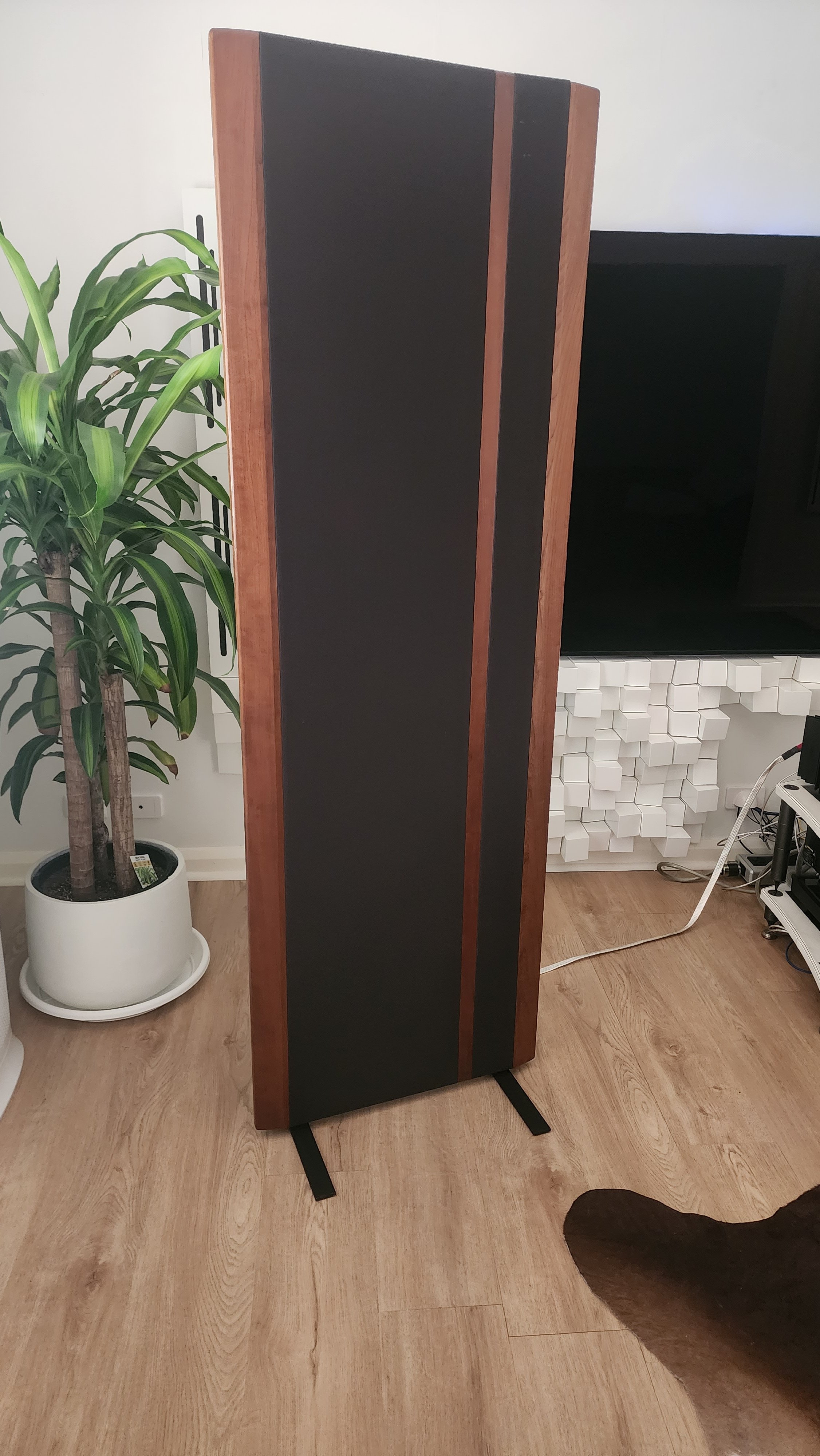
The midrange and bass panels are also impressive on the Magnepan 3.6, though maybe not to the extent of the tweeter. While the various other manufacturers’ panels I have heard sound more transparent than the Magnepan, the 3.6 does not have that overly sterile sound. There seems to be nothing “missing” with the 3.6 speakers as far as musicality. The music is whole in nature while, like any good panel, the imaging and soundscape are exceptionally impressive. Like all panels, the “sweet spot” is also more narrow than a dynamic driver (cone) based design. You know what they say, “no pain, no gain.” As large as the Magnepan 3.6 loudspeaker is, they never seemed to give clues as to their true size. Hmmm, perhaps in this case bigger is indeed better. Dynamic cone monoliths of this size generally give hints as to their size. Maybe the bass is low in the soundscape while the highs are near the ceiling. Most of us have heard large speakers where the drivers’ positioning is obvious.
The supplied owner’s manual gives very good detailed information about setup. Once they were properly positioned there was a seamless melding of all the frequencies. No “highs way up here and bass way down there” sound. The panels simply reproduced the music and the ambience on the software dictated the soundscape’s size and shape. Because panel speakers are bipolar, emitting sound from both the front and rear, proper acoustic dampening of the listening room can yield a wonderfully natural balance between hall ambiance and precise imaging. As it wisely says in the owner’s manual, “Moderation is the word.”
Maybe Size Doesn’t Matter After All
It is amazing how much physically large speakers can handle small ensemble music so very well. Virtually all big speakers seem to sound, well… big. Too big in fact when the music is on a smaller scale. How many of us have heard those super-wide super-high solo guitar music reproductions? American audio shows seem to be infamous for this “bigger is better” sound. While it is impossible for one pair of speakers situated in one position to reproduce the appropriate size of all music, the 3.6 speakers seem to get more right than others. For instance, while playing the Sara K. Hobo DVD [CHDVD177], all those small and subtle highs were transported into my room with such delicacy that I sat there in awe. Stringed instruments were brought forth with uncanny natural vibrancy. Some days it feels good to be a reviewer.
On other relatively small-scale music such as the much (and rightly) raved about Patricia Barber Modern Cool [PREM-741-2], all the small timing cues are there as is the wonderful voice and piano playing of Patricia. This CD is a must-have for anyone looking for spectacular musicianship mated with refreshingly clever lyrics. Also, the CD from Chesky titled The Unknown Piazolla [CD 190] may be solo or duet pieces, yet some songs are dynamic dynamite! The musicianship here is, as on the Patrician Barber CD, nothing short of magnificent! The lower registers of the piano were very well defined, as one would expect with a large panel speaker such as this. So what about large-scale full orchestra pieces you ask?
With so much sheer size these large panels easily play large-scale music without a hint of strain. It seems the fuses blow before you really hear the panels strain. During one of my hard block rockin’ beats the tweeter fuses blew. (Sigh) Well, maybe these speakers are not for those with over-eager SPL tendencies from time to time. For instance, the audiophile fave Berlioz Symphonie Fantastique [Reference Recordings RR-11CD] with its scary stringed parts takes on an even more spider web-like subtle glistening. The highs seem to dance and play as was intended by Berloiz. While I have mainly been praising the upper frequency registers it is now time for a bit of harsh reality.
As much as panels are considered to be extremely transparent, the Magnepan 3.6’s main tradeoff seems to be in the below 500Hz or so transparency. While not as a rain cloud on a wonderfully sunny day, it is more like very thin shading. Stringed bass and larger wind instruments seem to be ever so slightly veiled. On my favorite version of Tchaikvosky’s 1812 [Teldec 4509-90201-2] by the Israel Philharmonic Orchestra, the cloudiness also manifests itself in slightly shortening the rear part of the front soundscape. While nothing to really be alarmed about in my humble opinion, it is my job to report what I hear. I was very happy with the more “warm sounding” midbass which gave a wonderful sense of fullness. It was only during more modern music with extremely deep bass did I found the need for adding a subwoofer for that “gut-pounding” bass. Still, there was something not quite Kosher in the frequencies below 500Hz or so. It took some time for me to realize why this ever-so-slight lack of clarity was so easily heard.

This One Is Just Right
No, I am not going to play the ego trip of how well I hear or how good the upstream equipment is (or how good my room / power / lighting / exotic parrot / lover is). From what I can tell it is due to the extremely clear upper registers that this slightly less than totally translucent lower-frequency reproduction seems more apparent. No speaker is perfect. I do not care if it retails at ten times the price of these speakers! For it is only you who knows the weakness you can live with (and without). As for myself, I would take the Magnepan 3.6 speakers in a New York second over sterile sound any day of the week.
Without pulling any punches I will say the Magnepan 3.6 loudspeakers are one of the most amazing speakers for both large and small-scale music. For those of us who hate harsh or hard upper frequencies, the Magnepan 3.6 could be exactly what the doctor ordered… and the rest of the frequencies are no slouch either. While large, these visually attractive units are among the very few speakers I could live with for many years without that nagging “upgrade me soon” feeling. My main caveats are the slight opaqueness below 500Hz and the SPL limitation. Not everyone is looking to have a techno/house dance club in their listening room. Many audiophiles will probably audition for the Magnepan 3.6 and fall in love for many years. By producing such wonderful sound and handling both large and small-scale music so very well how could you not fall in love? Beauty is in the eye and the ear of the beholder. Of course in the end what really matters is that you…
Related products
-
Monitor Audio Platinum 200 (Piano Black 2nd Generation)
Original price was: R136,000.00.R44,000.00Current price is: R44,000.00. Add to cart -
Zingali Twenty Evo Plus 1.2
Original price was: R367,000.00.R192,000.00Current price is: R192,000.00. Add to cart -
Zingali Zero Sei (NEW, Pick ANY color)
Original price was: R126,000.00.R77,000.00Current price is: R77,000.00. Add to cart -
Definitive Technology Mythos 10 Center Speaker (NEW)
Original price was: R23,000.00.R9,500.00Current price is: R9,500.00. Add to cart