Modwright LS 100 Tube Preamplifier (NEW)
Original price was: R168,000.00.R89,000.00Current price is: R89,000.00.
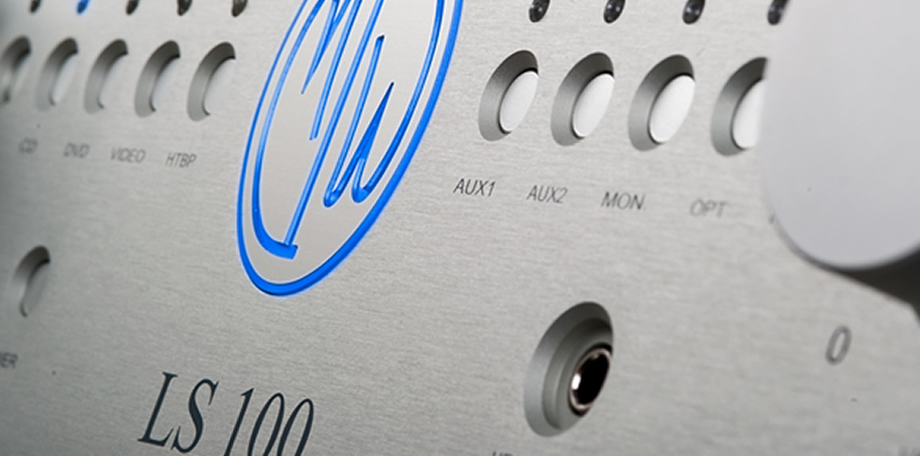
New LS 100 tube single-ended preamp from ModWright Instruments!
The design goal of the LS 100 was to pick up where the 9.0SE, our first product to be produced, over seven years ago, to the next level. We strove for improved sonics, aesthetics and functionality.
We Succeeded!
Single-ended design with 10 function remote control, (2) 6SN7 (Driver) and (1) 5AR4/GZ34 rectifier. Single gain/buffer stage, phase inverting, five standard inputs, one Monitor input and tape output, one Home Theater Bypass (HT/BP) input and three main sets of RCA outs.
Remote Control Functions Include:
- Power.
- Two remote trigger outputs.
- Selectable balance control, may be bypassed for cleaner signal path.
- Volume control.
- Mute.
- Input select.
- Monitor input select.
Preamp Functions Include:
- Upgrade slot for Optional in-board Phono stage.
- Built in headphone amp fed via tube driver stage.
- Home Theater Bypass.
- All pushbutton control, no toggle switches.
LS 100 Tube PHONO OPTION:
- One pair RCA inputs.
- Tube Design: (1)12AX7, (1)12AU7
- MC: Total gain = 63dB (including preamp stage)
- MM: 12AX7 replaced with 12AU7 = 48dB gain.
- Loading: 50, 100, 500, 1K, 47K, 100pf via internal dip switches.
[USER/DEALER INSTALLABLE OPTION]
The LS 100 is built in the same size enclosure as the KWA 100 amplifier and has the same lines and aesthetics, including backlit logo. Taller enclosure (5”) allows for greater range of rectifier tubes to fit inside the enclosure.
Sonically, the LS 100 offers a greater control, ease, musicality and resolution, all perfectly balanced for the ideal musical experience. Frequency response is flat from 20Hz to well beyond 100Khz. Soundstage is extremely wide and detail and microdynamics co-exist with a tube warmth and natural musical presentation that must be experienced!
Technical Specs
Tube Complement: (2) 6SN7 driver tubes; (1) 5AR4 rectifier tube (may also use 5U4GB and 5V4GB).
Internal tube rectified, solid state regulated power supply.
Features: Four sets of RCA inputs.
One set of XLR inputs (wired single-ended).
Two sets RCA main outputs.
One set of XLR main outputs (wired single-ended).
One set of RCA Tape outputs.
One set of RCA Monitor Inputs.
One set of RCA Home Theater Bypass (HT/BP) inputs.
Two 12V remote trigger outputs.
Gain: 11 dB
Input Impedance: 38Kohms.
Output Impedance: 300 ohms.
Frequency Response: 20hz – 100Khz (+/-1dB).
Max input signal level: 10 Vrms
Max output signal level: 37 Vrms
Headphone Amp Power: 1.5 Watts (32 ohm – 600 ohm load).
Phono Option: MM/MC (Gain = 48dB/63dB).
Tube Compliment: (1)12AX7; (1)12AU7.
Loading: 50, 100, 500, 1K, 47K, 100pf.
Inputs: One pair RCA.
Dimensions: 17.75Wx17.5Dx6.5H
Weight: 25 lbs. (31 lbs. shipped)
Description
Introductory offer – 40% !!
|
|
||
 |
||
I wasn’t counting but. At the conclusion of my ModWright KWA100SE review, I’d contacted the maker to book the return shipping of the standard version. “I will arrange to have the KWA100 picked up. I would also like to send you a LS100 preamp to use with the KWA100SE. If you want to review it I would of course be grateful. If not I want you to keep it regardless because I feel it only appropriate given that you traded the KWA150 for the lesser cost KWA100SE and covered the associated shipping costs of returning the KWA150. I am confident that you will find the combination of LS100 and KWA100SE quite enjoyable. There are no strings attached. It is up to you if or when you choose to review it. I just want to do the right thing.” |
||
|
||
| I’m an unrepentant headphone slut after all. My three favorite cans—ALO Audio recabled Audez’e LCD-2, Beyerdynamic T1 and Sennheiser HD800 in that sequence—happen to be 50Ω, 600Ω and 400Ω designs respectively. The 1-watt rating into 50Ω promised to be perfect for the orthos. It was rainy October by the lake when Dan’s email arrived but felt like early Xmas with sparkly snow on nearby picturesque peaks. | ||
| Instead of output transformers behind the tube front end, this headphone circuit uses a discrete FET current buffer for impedance conversion. This avoids the cheaper and thus far more common op-amp solutions with their high feedback. Dan’s 6.3mm headphone socket says no to NFB in invisible ink. The FET buffer is powered from the same 12V transformer windings as the tube heater circuit but the output voltage is of course separately regulated. | ||
 |
||
| The preamp circuit is a single gain stage/buffer affair to invert phase (PureMusic’s polarity control would account for that). Socketry is quite exploded. There are five standard inputs, one monitor loop, one HT bypass input and three paralleled pre-outs. While one i/o pair is on XLRs, the LS100 is no balanced circuit. That’s reserved for the top model. Exploded too over the one-box predecessor are remote functions of power, bypassable balance control, volume control, mute, input and monitor select plus two remote triggers. There’s also an upgrade slot with twin 20-pin ribbon cable headers for an optional DAC or phono stage. Frequency response “is flat from 20Hz to well beyond 100kHz”. Instead of the earlier toggles, all control switches are sleeker push buttons. The inside chassis height of 5 inches allows for a greater range of rectifier rolling including 5U4GB, 5V4GB, 5U4G and 5V4G. My giant EML 5U4G obviously wouldn’t fit. | ||
|
||
 |


|
||
| “The LS100 uses our MWI caps in all critical locations as well as the Takman Japanese carbon film resistors. Relative to your findings between KWA100 and KWA100SE, it is interesting to note that the input stage design between them and the KWA150 is the same. Over the 100 we did of course improve the caps and resistors in the SE. The doubling of capacitance and increased output pairs really made a big difference in the overall control and I believe speed of the unit. The parts upgrades added to the refinement, overall clarity and detail. Our ModWright Instruments capacitors are remarkably good. I didn’t realize just how much of a difference they would make over the Wima capacitors. So naturally they also ended up in the LS100. Circuit gain here is 11dB, Zin is 38KΩ, Zout 300Ω. About the 6SN7 double triodes, we use just one half per channel. This gives the advantage of extended tube life as you can channel swap the tubes to use the other two halves. Theoretically we could have used a single 6SN7. In the case of our phono board, we do use a single 12AU7 and 12AX7 for two gain stages, again half a tube each per side.” | ||

|
||
|
Photos of ModWright’s audition room by Marco Prozzo
|
||
| Very interesting was Dan’s choice of 6SN7/CV181 over the 5687 in the predecessor or the 6H30 in my two-boxer DM 36.5. In tube terms the 5687 sounds very transistorized. The 6H30 despite widespread popularity meanwhile is somewhat forward and dry. If you fancy a tube pre with more overt tube tone virtues and fluffier textures, the big-tone 6SN7 should have your attention. I use the fantastic Esoteric C-03 preamp for transistor strengths and the equally masterful Bent Audio Tap X autoformer volume control for a true passive. A one-box valve preamp not shy to wear its glowing bits on the sleeve was a fine proposition in my book. The option of an onboard DAC with USB should merely prove further incentive for PC-audio listeners who are keen on reducing their hifi box count. | ||

|
||
| “I am still working with my digital engineering consultant Alex Dondysh on how best to implement the DAC board, i.e. USB and S/PDIF or just S/PDIF. USB is necessary from a marketing standpoint even though it doesn’t sound as good. I hope to have the upgrade available by year’s end. The upgrade board will be easy to install for any end user.” By 2.15.11, this option had firmed up to be 24/192 coaxial and 24/192 asynchronous USB for a retail of $995. | ||
| Given my prior suspicion covered in the KWA100SE review—that had I not returned the KWA150 before its smaller replacement arrived, a direct A/B very likely would have had my tastes declare the cheaper amp the winner—was there a similar chance at upsetting predictions now vis-à-vis my DM36.5? Committing to a review which the maker specifically didn’t expect is what any enthusiast reviewer would do. It’s our contribution to the hifi community where each member must pitch in according to their gifts to keep things afloat. | ||
 |
||
| Clear on specifications alone was that for just $300 more than the SWL9.0 Signature predecessor, ModWright’s LS100 replacement offered improved aesthetics; improved functionality with RCA and XLR i/o ports (the latter wired SE); defeatable balance control; 12V triggers; a dedicated headphone amplifier; more comprehensive remote control; and a dual upgrade path for phono or DAC modules. Such added value seemed quite anti inflationary. Promised sonic improvements would be mere icing on the cake. |

| Delivered in a stout carton with massive foam cradles, the Russian Tung-Sol reissue 6SN7s and Sovtek 5AR4 arrive uninstalled. An included nicely long 5/64″ hex driver with cross grip removes the cover to mount the three valves in quality ceramic sockets with silvered contacts. As in the KWA100, the power toroid—here with 14 leads—mounts upright against a blue aluminum bracket. That sits right behind the front cover to place it at max distance from the output tubes. | |||||||||||||||||||
 |
|||||||||||||||||||
| The optional phono or DAC module docks atop two 20-pin sockets on an unoccupied section of the single circuit board. The add-on two chassis-mount connectors then occupy holes covered in the stock unit by a removable plate. This input is selected with the ‘Opt’ button on the front or by toggling sequentially through all inputs from the remote. | |||||||||||||||||||
 |
|||||||||||||||||||
|
|||||||||||||||||||
| Fit + finish + build quality inside and out are quite superlative. ModWright really seems to push the envelope at this price level and beyond. The modman’s dress code has gone way uptown. | |||||||||||||||||||
 |
|||||||||||||||||||
| The execution of the now trademark perforated metal work which creates back-lit logos on front and top is exquisite. It should send many competitors back to the drawing board. | |||||||||||||||||||
 |
|||||||||||||||||||
| The innards are neither crammed nor maximally dense with parts to reflect a simple circuit. | |||||||||||||||||||
 |
|||||||||||||||||||
| Again, the single gain stage inverts polarity for all outputs including the buffered monitor input except for the non-buffered (fixed) tape output whose polarity is non-inverted. | |||||||||||||||||||
 |
|||||||||||||||||||
| A thoughtful feature on the business end are the bidirectional identifiers. You ran read which socket does what from above and not just below. No more Exorcist-style head turns. | |||||||||||||||||||
 |
|||||||||||||||||||
| The turn-on sequence undergoes a 45-sec cycle during which the motorized volume control reverts to zero and the outputs are muted. When the circuit has stabilized to go live, the mute LED extinguishes. The ‘Bal’ button inserts the second Alps attenuator into the signal path. This can also be activated by remote. The non-motorized balance pot itself must be operated manually however. When not inserted, it’s neither in the signal path nor operational. A center indent confirms neutral. | |||||||||||||||||||
 |
|||||||||||||||||||
| The only functions not working with the LS100’s 10-button remote wand with MW logo are polarity inversion and standby. The ‘phase’ control remains reserved for the fully balanced LS36.5 which accomplishes polarity flips with its balancing transformers. The standby function is reserved for other models. Dan Wright: “2010 pricing for the LS100 remained at $3.295 but 2011 had to see a price increase to $3.495 due to increased material costs which forced us to increase prices across the board. Importantly all orders taken in 2010—even if shipped in 2011—were invoiced at 2010 pricing.” | |||||||||||||||||||


| Truth serum: For linestage assignments and a firm reality check, any serious reviewer really ought to keep a superior passive on hand. Mine is John Chapman’s brilliant but now discontinued Tap-X autoformer control with 61 x 1dB steps and comprehensive remote control including balance. John’s very classy all-metal wand happens to run the same IR codes for ± volume and mute as Dan’s plastic version. This graced me with a free luxury upgrade for the LS100. Sweet. Signal paths for this comparison were iMac with PureMusic 1.74a in hybrid memory play and pre-allocated RAM; Burson Audio HA160D with volume control bypassed; LS100/Tap-X; KWA100SE; Tango R speaker. All low-level devices except for the computer plugged into the Polish GigaWatt PF-2 power bar, the amp into an equivalent Furutech RTP6. | ||
 |
||
| Instead of pretending at subtractive/additive comments, I’ll only describe how the tubes distinguished themselves from a proven autoformer volume control for which at least theory would predict the least amount of signal loss/manipulation. Going in one expects differences. Why otherwise bother with tubes? It’s not as though most modern source/amp combos require any added gain. If you figured on big enhancements here you’d be surprised. In the LS100 the 6SN7’s fatty big-tone rep at least with my Create/Synergy glass—Shuguang’s Black Treasures ought to be quite comparable—was played down. Against the Bent the ModWright was less sculpted on dimensional relief. Its noise floor with ear on drivers was a bit higher than the passive which for all intents and purposes wasn’t on. The LS100 would cloud over sooner at ultra-low midnight whisper levels. Conversely the LS100 had the slightly weightier bass and the overall meatier balance. It also traded the Tap-X’s drier starker but more holographic take for more liquid textures plus some connective tissue (harmonic distortion).The passive was airier and more lit up on top. Instead of fluffier textures however as those qualities often create, the autoformers were clearly less moist than the tubes. The 6SN7s were darker and warmer but far less guilty of the opacity filter which my best 300Bs had inserted in a comparison between PX4 and 300B in an earlier review of the Eddie Current Balancing Act preamp. On dynamic scaling if not speed the LS100 seemed to lead the Tap-X but it was impossible to determine whether that was actually amplitude swing or simply greater perceived mass. Importantly the magnitude of these differences was less than expected. | ||
 |
||
| If the Tap-X was my shot at max resolution, the LS100 took away and added. Naturally I couldn’t measure percentages. I can reflect only on what seemed subjectively more important. With the KWA 100SE, the less stark (softer?) textures, the slightly heavier bass, the more forceful apparent dynamics and the more fluid rather than charged progression better supported the believability of the hifi illusion. The more expansive treble and the dimensionally more crystallized depth perspective of the passive were more spectacular but also more aloof and cool. Incidentally I’d feel quite the opposite with my 300B, EL84 and 6550 valve amps. There the passive qualities are the better match. When applying these particular descriptions the operative term is quite gently. The LS100’s harnessing of tube-based tone is more of a distillation than wholesale exploitation. The softening and thickening action so typical for valves is quite mild. Here it builds out a bit of body and coats the sounds in mild sheen like morning dew but does both without dragging down perceived timing. | ||
|
||
| Audiophile check list in hand there was no question that the DM36.5 is more resolved and dynamically superior. Even so certain applications—the KWA100SE being one of them for me—could prefer the LS100. Switching DACs from Burson to Weiss diminished the inherent mild warmth and upshifted the presentation towards just a tad more DM36.5-type light whilst giving up midband density. Bottom line, against the Swiss neutrality of the AVC the DM36.5 was more honest but the LS100 more beautiful. | ||
| In these comparisons centered on ModWright’s Mosfet amp the LS100 struck me as perfectly matched. Obviously that’s no coincidence. I was simply happy that my ears and those of the designer agreed once more. With a respectful nod at the LS/DM36.5 for its higher fidelity, it does seem due for a cosmetic makeover to match the growing lineup on the backlit logo, the new bigger rotary controls, the recessed push buttons and the revised footprint. In my stable the Tap-X already—and still—occupies the top spot on lucidness, speed and magnification power. On that flavor I’m all set. The LS100’s more audible 6SN7s and tube personality thus serve me better than the more neutral 6H30s in the dearer two-chassis model. For me the LS100 is subjectively better then. Time to retire the DM36.5 and clear some shelf space. This hasn’t yet touched on headphone drive nor the forthcoming $1.000 DAC module whose 24/192 asynchronous USB input run through the preamp’s tube output stage should have the PC audio crowd’s (and my) attention. The design will also include proprietary data input clocking and buffering to maintain jitter levels below 20ps. An external DAC design also tube-based will be offered after that and is projected to come in below $3.000. |

| As headphone amp: Unlike most such arrangements when a headphone slips into a ¼” jack, the LS100 does not mute its main outputs. This eliminates potentially sound-degrading auto-mute circuitry. It also means you’ll have to power down your speaker amp. Easy. How much ‘power’ the LS100 can parlay into various headphones depends on the output voltage of your source—from a docked iPod’s 1V to a CD/DAC’s industry-standard 2V to non-standard outputs like my 5.45V max Weiss DAC2 and 10V max Burson HA160D—plus headphone impedance and sensitivity. The higher the headphone impedance the less efficient the power transfer. Just how far one has to turn up the volume for any given headfi load additionally depends on the taper of the pot.
The 50Ω HifiMan HE-6 planarmagnetic/orthodynamic is currently one of the most power-hungry such loads available. With a standard 2V source it’ll fully max out the LS100 to 5:30 on the dial. Most could find those SPL sufficient on most music. Some might want more. Call it borderline. But a rough doubling-plus of source voltage will already afford ear-bleeding levels as the equivalent setting to 2V now becomes 2:30. This builds in sufficient headroom. |
 |
| With a 2V source, Audio-Technica’s efficient W-5000 ‘Raffinato’ achieves the same levels at 11:00. The Audez’e LCD-2 and Sennheiser HD-800 get there at 1:00. beyerdynamic’s T1 and AKG’s K-702 take until 3:00. Whilst loudness is a personal matter it seems fair to say that HifiMan HE-5LE/6 excepted, all current full-size headphones should be copasetic with the ModWright from standard digital sources. Once source output voltage doubles to 4V or beyond, even the most hard-of-hearing orthos can turn head bangers to become unconditional. That makes the LS100 an essentially universal hybrid headphone driver where, per ear, half a 6SN7 triode for voltage gain combines with a FET current buffer and a power supply that would seem massively overbuilt for the occasion.Given sheer size and price it’s of course unlikely that anyone would acquire the ModWright just to power headphones. Its footprint is so over-dimensioned that I bolted three pointy metal footers into the provided bottom-plate threads (that’s exactly how the matching KWA100 is delivered). Being set back farther from the edges than the four stock rubber footers, the resultant shallower footprint suited my 40.5cm deep ASI HeartSong rack better. The rubber footers overhung by half front and back. That was a bit precarious. Any stock footer setup will want a shelf at least 45cm deep.
With seven headphones and more than 10 headphone amps in my collection, this part of the assignment asked for selectivity to keep focused. I thus picked the Audez’e LCD-2 and Sennheiser HD-800 as opposing yin/yang flavors to represent true top echelon headphones. For amps I settled on three tubed competitors: the Trafomatic Audio Experience Head One with 6S45Ps rectified by an EZ80; the mighty Woo Audio Model 5 with two 5U4G supplying 6SN7-driven 300Bs [all glass by Create Audio/Synergy Hifi]; and Schiit’s new high-output hybrid 6922/Mosfet Lyr. |
 |
|
Trafomatic Audio Experience Head One with ALO Audio recabled Sennheiser HD800 on Sieveking Sound Omega stand
|
| The general verdict is that inherently lit-up speed-freaky lean-ish and emasculated earphones of uncorrected HD800 flavor—a proper after-market leash pays huge dividends on these—are predestined for the LS100. Its mellowing relaxing action and parallel fattening up are perfectly complementary and compensatory to the stock Senn archetype. While the 6SN7s are admittedly not the last word in top-end air, transient zing and ultimate detail, the HD800’s extra helping of those ingredients more than makes up for it. Such pairings exploit the old fire ‘n’ ice tactic. One strategically splits the difference to arrive somewhere in the middle.An inherently darker ultra-moist and rich presentation as one finds natively in the Audez’e might for some tastes veer too deep into density and opulence with the ModWright. Others could pursue that exact pairing for how it celebrates that flavor. Though musical flow decelerates a bit, dynamics (already a very strong suit of this push/pull flat-membrane device) receive an extra infusion. Nothing thus tips over into the portly/soggy polarity. Think 80% cocoa chocolate with a hint of cayenne – dark and rich yet not really sweet, well developed flavor complexity with real kick. This pairing would be a rather magnified polar opposite to running the Sennheisers with stock harness off Burson Audio’s transistor HA160. |
| LS100 vs. Head One: Texturally and dimensionally, the Serbian was drier and smaller, the American fluffier and grander. The 6S45Ps made for a more focused and compact presentation. It had more top-end extension but applied more overall damping against the ModWright’s more opulent dimensionality. This latter feature’s distinctiveness—the degree of difference—was maximized by the planar headphone. It sounded noticeably larger and more voluptuous with the LS100. The HD800s didn’t respond alike. Their innate airiness was underlined more with the Head One. Those elements usually grouped under the PRaT catch-all also firmed up more. The 6SN7s played it structurally looser. The upshot was that with the Audez’e the ModWright was the clear winner. With the Sennheisers meanwhile the amps were on the same plateau but the Serbian amp seemed to play a bit more to their particular personality strengths. |
 |
|
Schiit Lyr with stock JJ 6922
|
| LS100 vs. Lyr: Here the Schiit with stock tubes stepped into the foot prints of the Serbian, then added bandwidth particularly on top, revved up subjective resolution magnification and further built out the theme of control/damping. Thus the flavor difference stretched out. It became more overtly about dark/lush/relaxed vs lit-up/energetic/driven. Those attracted to the Sennheiser for its obvious virtues would find the Lyr to maximize them, the LS100 to deliberately mellow them out (which in this context equates to downplaying and diluting).With the Audez’e the primary difference was the wholesale injection of air and illumination from the midrange on up. While acting as mostly equals on low-down grip and manly fortitude, the Lyr added a fresher more piquant flavor higher up. Many should find this livelier and certainly more informative. The flip side is a higher degree of sharpness and glassiness on usual overcooked Pop productions. High-noon lighting with its lesser shadows and starker contrasts makes for very crisp visibility. There warts & Co are exposed more mercilessly. On raw resolution in the range where human hearing is most acute the Lyr was definitely victor. It was adrenaline to the LS100’s comfort zone. In this juxtaposition of amps, the Schiit would be properly called a modern high-resolution device. The ModWright becomes a darker denser comfort sound closer to current notions on vintage (just don’t imply limited 50Hz to 15kHz bandwidth). |
 |
|
Woo Audio Model 5 with all optional parts upgrades [$4.000 total package]
|
LS100 vs. Model 5 SE: With the same Chinese 6SN7s in either amp—one pair ‘routed’ through Mosfets, the other through direct-heated triodes—and even 5AR4s sourced from the same supplier, these machines were virtual stand-ins on sound and price. The aural milieu was a virtual overlay, quite shockingly so to beliefs which would grant the 300B a mythical goal that’s not approachable by other means. If I would ultimately give the Woo a very faint nod on textural sophistication and that very organic expand/contract sense of breath riding on a strong swell, it has to be understood as a very small lead indeed. In realsization mode I’d sell off the Woo as cloning the ModWright’s flavor too closely. In that world there’s no sense in owning two of a kind when the whole fun of multiples is the broadest possible variety without duplicates. |
 |
| The Sennheiser and Audez’e cans responded alike which is to say they nearly couldn’t distinguish between these amps. This was unexpected. My accountant—the one on permanent unpaid vacation—would undoubtedly applaud and point out the sagacity of investing into the LS100 as it includes a free $4.000 headphone amp. Put this way it gives one pause to reflect on Dan Wright’s chops as a very crafty and astute designer. |
| Cannery Row: To wrap up headphone impressions, the LS100’s 6.3mm jack was essentially tacked onto a voltage gain stage optimized to drive power amps and long interconnects. It thus benefits from a power supply that likely would be a lot smaller if transferred to a discrete headphone amp. Grafting onto the octal triodes a Mosfet buffer was a flash of genius as it isolates the glowing bits from the actual load, lowers the output impedance, avoids the high feedback of operational amps and runs devices which mimic valve behavior. The big potential issue of noise in this repurposed scenario was handled beautifully to be no issue at all. The upshot is top-class 300B sound without the expense and maintenance. When I say 300B sound, I’m referencing headphone drive with its high impedance, millivolts, no crossovers and one driver of two inches or less, not the usual miss-ery of attempting to control multi-way speakers with big woofers and reactive phase angles from such devices. 300B sound refers to how direct-heated low-power triodes perform under rather more idealized conditions. |
| Tubes/transistors vs. transistors/tubes: Listeners keen on the presence of valves somewhere in the signal path but reluctant to go all out routinely face the question whether to stick the glowing bits in the preamp or power amp. Common arguments supporting either choice would include the voltage/current situation—valves are perfect voltage gain devices, transistors excel at current gain and the latter is what speakers need—and the seniority of the amp/speaker interface where valve contributions will be dominant over low-level applications (preamp or source). Dan Wright clearly sides with the first argument. His LS100/KWA-100SE combo harnesses tube flavor for low-level voltage gain whilst muscular transistors deal with reactive speaker loads. |
 |
| As it happened Living Voice’s top Avatar model the OBX-RW with outboard crossovers was in for review. This presents us with a deliberately valve-optimized load which was conceptualized and developed around Art Audio, New Audio Frontiers and Kondo tube electronics (brands carried by the Definitive Audio distribution/retail arm of Living Voice). During a weekend of delivery, setup and hardware substitutions designer Kevin Scott and his wife Lynn had most favored my Esoteric C-03 preamp/Trafomatic Audio Kaivalya combo. Having heard the OBX-RW in their UK residence driven from a Kondo Ongaku I was in full agreement. To make the Living Voice house sound their speakers plainly wanted to see tubes directly, not—just—upstream somewhere. |
 |
| Though clearly no apples-to-apples scenario (the class A push/pull IT-coupled 6P14P-EV/EL84 make 30 watts, Dan’s Mosfets well over 100), the OBX-RW’s ‘to spec’ performance with the valve monos as signed off by the designer erased concerns over power inequality. For an educational exercise on the subject, I thus decided to report on what qualities one might trade by substituting transistors/tubes for tubes/transistors. Having played such musical chairs many times with different speakers before, I’m quite confident that the core tendencies apply to most single-amp systems with passive crossovers (active multi-amp setups are a completely different proposition where power tubes can be exploited under more strategic idealized conditions). |
| About which, humans breathe. That obviously goes for musicians as well. While only singers and wind instrumentalists literally carry sounds on their breath, good musicians coax bel canto qualities also from piano and strings. The essential quality here is a tacit sense of expansion/contraction or ebb and flow. This operates in both the amplitude and temporal domains. Movement occurs as dynamic shifts, as rhythmic irregularities over time and as a progression of sounds and gaps of actual or virtual inhales. All of this could be captured by terms like fluidity and elasticity. The counterpoint is metronomic. Successive damping—literal or virtual—minimizes fluidity. Temporal progressions become more rigid. Dynamic progressions occur as stutter steps rather than seamless swells. Here power tubes are more elastic than transistors. It’s probably the key reason why listeners refer to valves as ‘organic’. |
 |
| The better damping and superior current delivery of transistors nearly invariably means superior control. This manifests as greater bass intelligibility, better differentiation/articulation and more weight. While the twin 6.5-inch drivers of the OBX-RW were good for a solid 40Hz with the white tube monos, the ModWright KWA-100SE built things out downstairs particularly with the LS100. Comparing 6SN7s to the autoformers of Bent Audio’s Tap-X, this frequency range seemed noticeably beefed up. On my customary ASI Tango R with their thrice-paralleled 8-inch woofers, the ModWright duo even for my large space becomes nearly too bass potent. I’m uncertain why. The KWA-100SE doesn’t respond alike with my Esoteric C-03 with active gain. Even so it’s been a very repeatable observation with the LS100. Into its stable mate’s Mosfets bass is truly boffo. |
 |
|
ModWright at CES
|
| Power tubes in general inject higher harmonic distortion. It’s often equated with tone but also translates into what I call connective tissue or ‘stuff between the notes’. On structurally simple music it appears as greater density. On structurally complex music it congeals, blurs and rather than stay separate and discrete gets confused and homogenized. At the levels I listen to, into loads like the OBX-RW and with the non-bombastic music I favor these liabilities manifest less but still could be noticed as light distillates versus the Mosfets. To extricate just the tone/timbre constituents I felt that the LS100 vs. the Tap-X passive or Esoteric C-03 did a very good job. Things got fleshier and texturally fuller yet the dreaded shadows of thickness, opacity and subliminal blurring were barely evident. Yes the Tap-X was more quicksilvery, lit-up and contrasty but it was tonally also paler, rhythmically less supple and down low distinctly leaner.Bottom line, Dan Wright’s strategic combination of 6SN7s (preamp) and Mosfets (power amp) offers a high degree of tube tone, a lesser degree of tube texturing aka warmth, then superior foundation detail and mass, greater dynamic range and a more lucid upper treble than power tubes. And, the latter’s organic on-the-breath fluidity becomes more solidified and firm. Particularly owners of speakers not carefully optimized by their designers for tube drive who are still desirous of some ‘breath’ and ‘tone’ will be far better off pursuing the tube/transistor route than attempting the inverse. Here ModWright’s combination of LS100 + KWA-100SE becomes very compelling. It’s a very far cry from the lean nervous chalky pedantic archetype which valve lovers occasionally love to apply wholesale to transistor-based systems. |
| Summary: Of all hifi components the linestage is most challenged and questionable. To justify its existence and expense in the face of functional redundancy where no switching is needed, where a source handles volume and where overall system gain means one operates exclusively below unity gain—very common indeed!—a linestage must unequivocally exceed a quality passive. That’s easier said than done. As good as the LS100 is, it’s not yet unequivocally superior to a premium passive of Tap-X caliber. That requires more than what ModWright charges (and more than my $10.000 Esoteric which on raw lucidity and suchness also still trails the $2.000 Bent). |
 |
| That admitted, the LS100 trades ultimate magnification power, contrast ratio and immediacy for textural sophistication, richer tone and structural suppleness. Particularly with solid-state amplifiers those qualities are often not fully accounted for. As unexpected bonus the ModWright then adds real bass muscle. While involving a trade-off in ultimate terms it will be an attractive trade-off in many instances. Very well built, cosmetically opulent and truly full-featured, ModWright’s remote-controlled LS100 preamp with top-notch headphone socket, optional phono stage (or 24/192 S-PDIF/USB DAC module) is another winner from a designer who has paid his dues modifying other people’s gear to now be apparently incapable of doing wrong; or simply exceptionally careful not to. He continues to author fairly priced electronics which nearly unanimously win high praise even at trade shows. There very temporary hotel-room showings are notorious disappointments. With amongst or outright ‘best of’ show votes across multiple publications, the LS100 has acquitted itself before a far larger audience than yours truly already. I’m merely the latest individual to add myself to the list of admirers. No wonder the LS100 is back-ordered… |
Related products
-
Valve Audio Whisper Phonostage (Silver)
Original price was: R46,000.00.R22,000.00Current price is: R22,000.00. Add to cart -
Plinius Kaitaki Preamplifier (Black/Mint)
Original price was: R108,000.00.R42,000.00Current price is: R42,000.00. Add to cart -

Musical Fidelity Nu-Vista VINYL Phono Stage (WOW!!)
Original price was: R112,000.00.R44,000.00Current price is: R44,000.00. Add to cart -
dCS Paganini – Complete set – Silver with Crystal Cable
Original price was: R1,450,000.00.R210,000.00Current price is: R210,000.00. Add to cart