Plinius SA-103 Stereo Power Amplifier (Silver)
Original price was: R180,000.00.R78,000.00Current price is: R78,000.00.
Description: Solid-state, two-channel power amplifier with an output stage that can be operated in either class-A or class-A/B.
Maximum output power (both channels driven, 20Hz–20kHz, at 0.05% THD):
125Wpc into 8 ohms (21dBW),
220Wpc into 4 ohms (20.4dBW); switched to bridged mono mode,
400W into 8 ohms (26dBW), 730W into 4 ohms (25.6dBW).
Frequency response: 20Hz–20kHz, ±0.2dB, 0dB at 1Hz and –3dB at 70kHz.
Distortion: typically 0.05% THD at rated power, 0.1% THD and IM worst case prior to clipping.
Current output: 50A short-duration peak per channel. Input impedance: 47k ohms.
Voltage gain: RCA inputs, 32dB; balanced inputs, 38dB.
Power/Current consumption: 485W/2.1A, class-A Idle. 92W/0.4A class-A/B Idle/Standby.
Dimensions: 19.75″ (500mm) W by 8.75″ (220mm) H by 18″ (455mm) D. Weight: 83 lbs (38kg).
Description
One of the dangers of being a sexually promiscuous person, besides strange spots on your privates, is that it can lead to a perpetual state of falling in lust. And when you become a lust junky, it’s hard to recognize, let alone sustain, deep and meaningful love. I think the same can be true for audio reviewers. Because reviewers rarely have to commit to any given product for more than three months, we fall in love too easily and too frequently—and then we write about it. But what passes for love in an audio review is often merely the lust du jour.
On the other hand, most audiophiles (our readers) have the opposite experience while building their systems. Before buying any new component, most buyers I know search, yearn, agonize, scrimp, and save. Such folks properly court a product, fall in love, and then marry it. It’s no wonder so much venom is poured out in audiophile forums when a magazine gives someone’s favorite brand or model a slightly sniffy review: It’s like having someone point out your wife’s buck teeth in an international journal. Some of us in the press have lost sight of how deeply committed most audiophiles are to their gear.
So if reviewers are just audio gigolos, how do we know when we have really and truly fallen in love—not lust—with a product? During my time with the Plinius SA-103, the question really nagged at me.
When Scot Markwell of Elite Audio/Video Distribution contacted me out of the blue to see if I’d like to review something from Plinius Audio, I was only casually aware of the company. Based in Christchurch, New Zealand, Plinius was founded in 1980 by Peter Thomson to make power amplifiers and preamplifiers. After 1987, when Plinius merged with Craft Audio Limited and its chief designer, Gary Morrison, the expanded company began to get noticed for its designs. They now also make phono preamps and a CD player.
Wes Phillips reviewed the Plinius SA-100 Mk.II (a forerunner of the SA-103) in the April 1997 Stereophile (Vol.20 No.4), and Paul Bolin reviewed the SA-Reference in May 2006 (Vol.29 No.5). Both WP and PB noted that Plinius had not received the sort of widespread recognition in the High End that it deserves, which made me feel a little better about not knowing more about them. The SA-103 immediately caught my eye as a prime review subject because, first, I’m rather sweet on class-A–biased, solid-state amplifiers; and second, its price of $7830, while on the high side, seemed quite reasonable for what looked like a beautifully made amp that could put out a peak current of 50 amps per channel. While I’ve been trying to keep the prices of gear I review in the sane range, this time I thought I’d splurge a bit. I e-mailed Markwell and asked him to send me an SA-103.
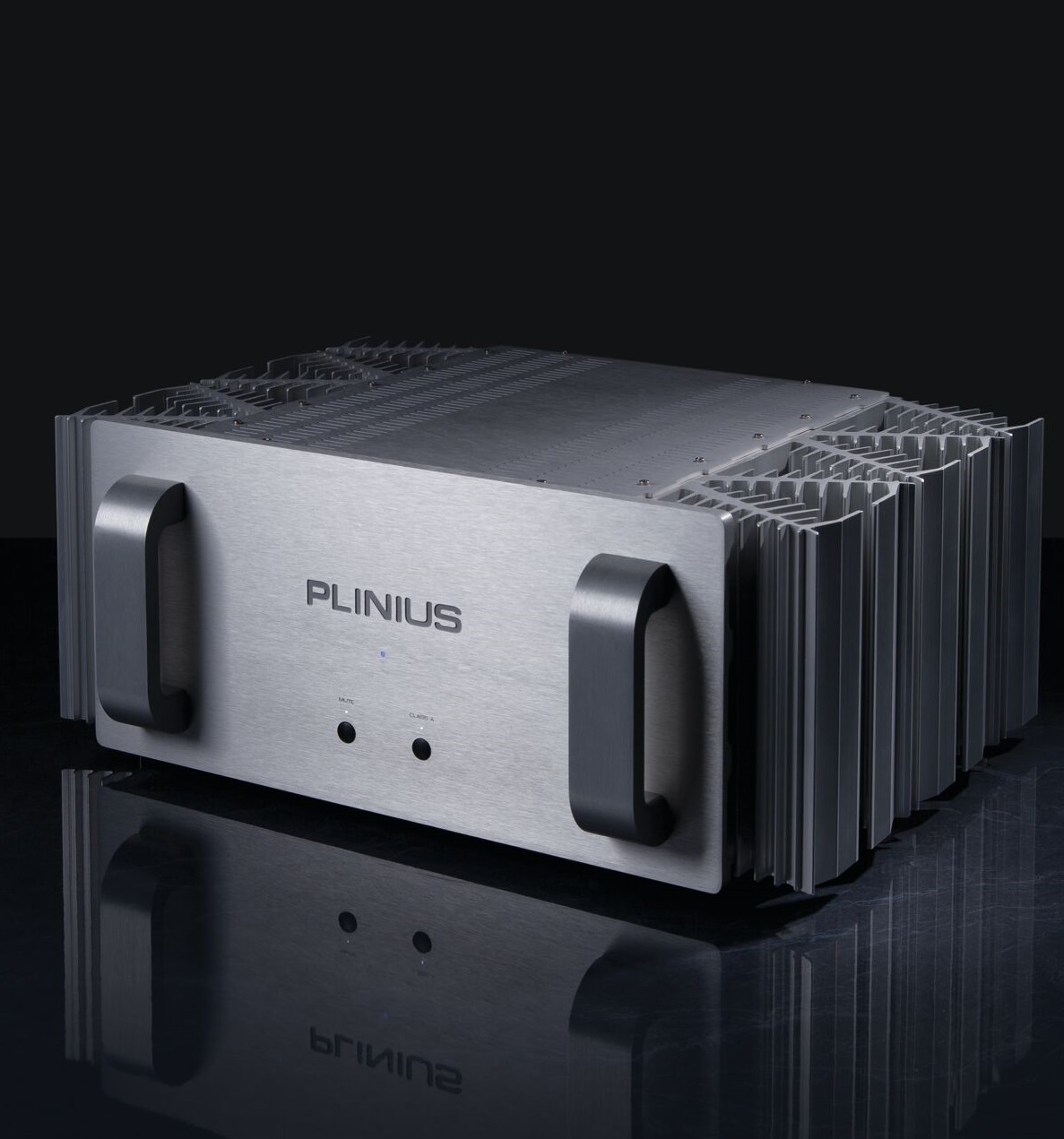
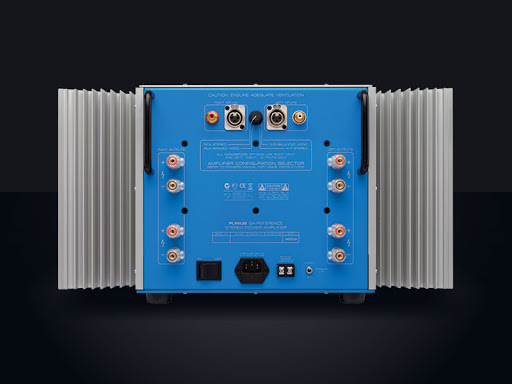
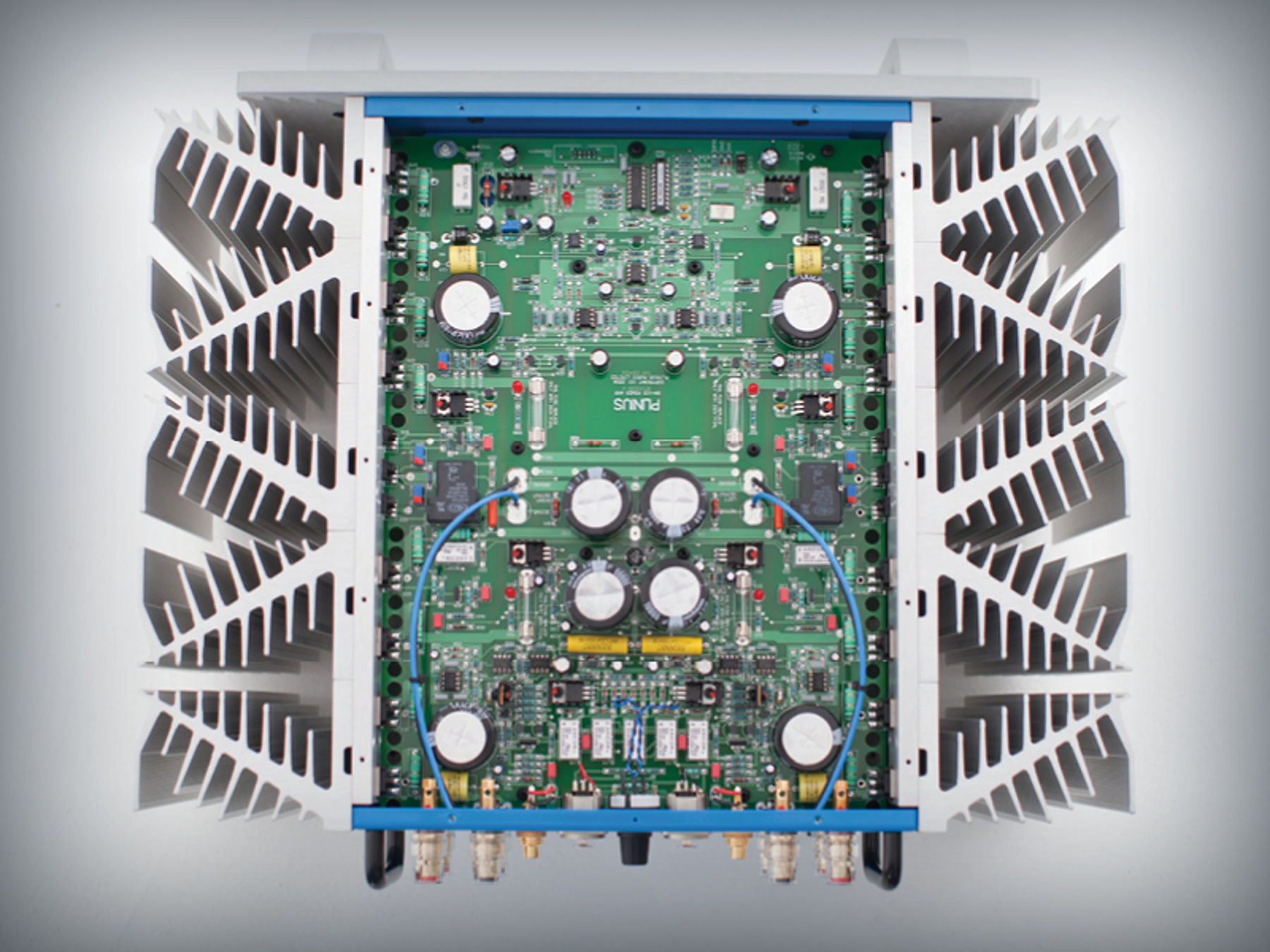
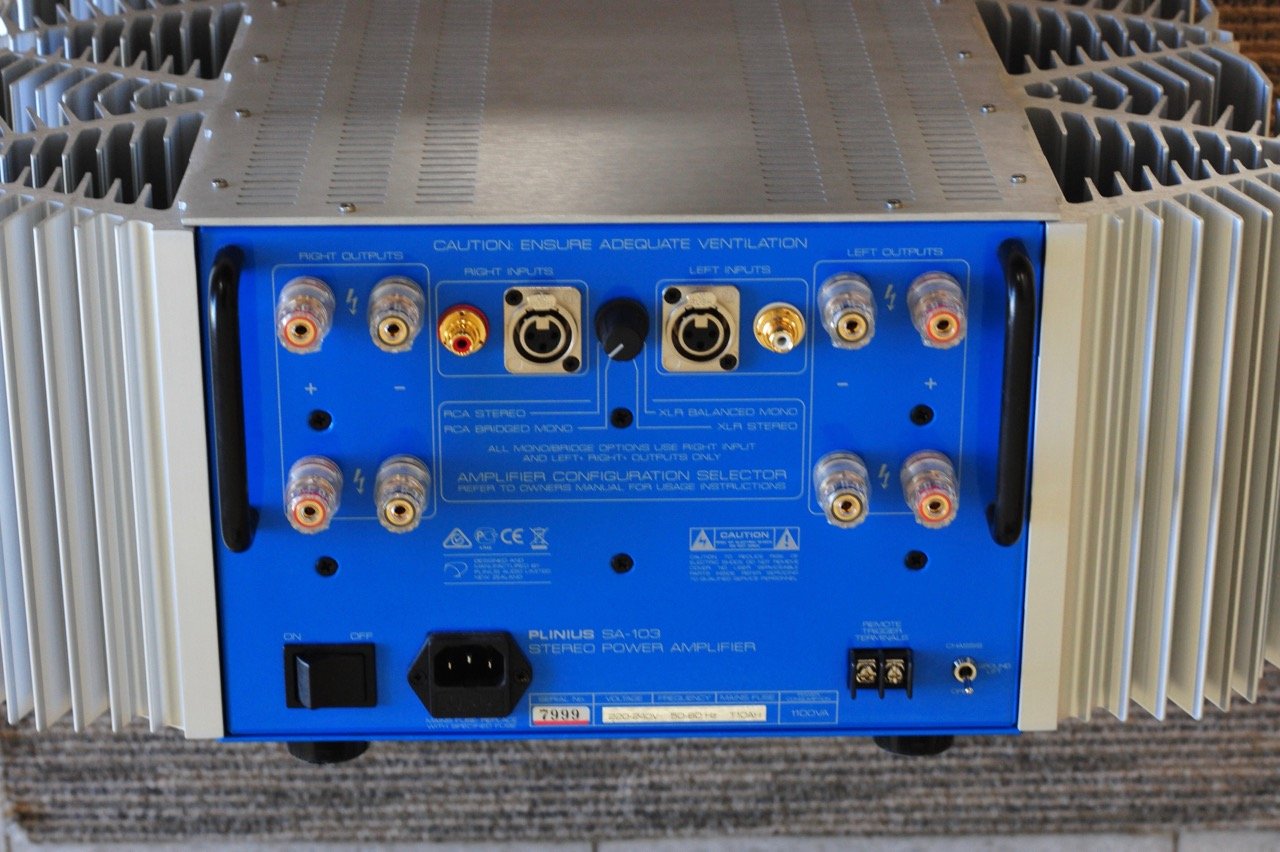
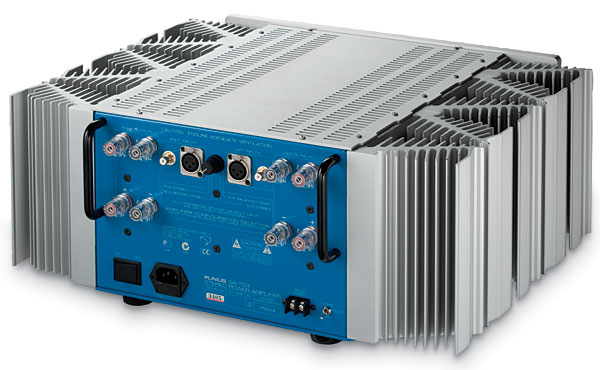
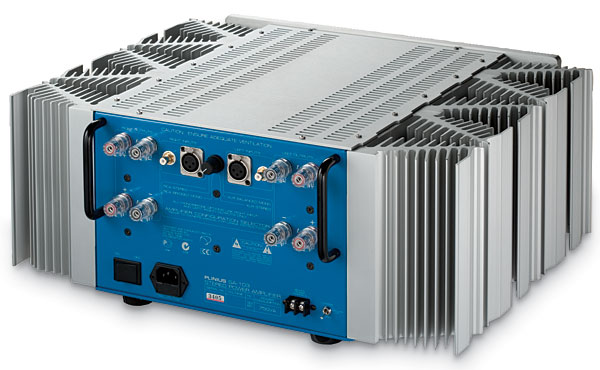
The Plinius SA-103 is a classic solid-state design with some decidedly modern touches and flourishes. It’s claimed to output 125Wpc of class-A–biased power into 8 ohms, or 220Wpc into 4 ohms. It can also be bridged for mono operation, in which mode it kicks out a whopping 400 class-A watts into 8 ohms. A knob on the rear panel lets you select which input and output mode you want to use: RCA stereo, RCA bridged, balanced stereo, or balanced bridged. When in balanced mono mode, the SA-103 operates in fully balanced mono from input to output. Also on the rear panel are four sets of speaker binding posts, to permit biwiring. Plinius says that premium parts are used throughout, including internal wiring by Siltech. The layout of the rear panel is clear, clean, and concise. On the front panel are pushbuttons labeled Mute and Class A.
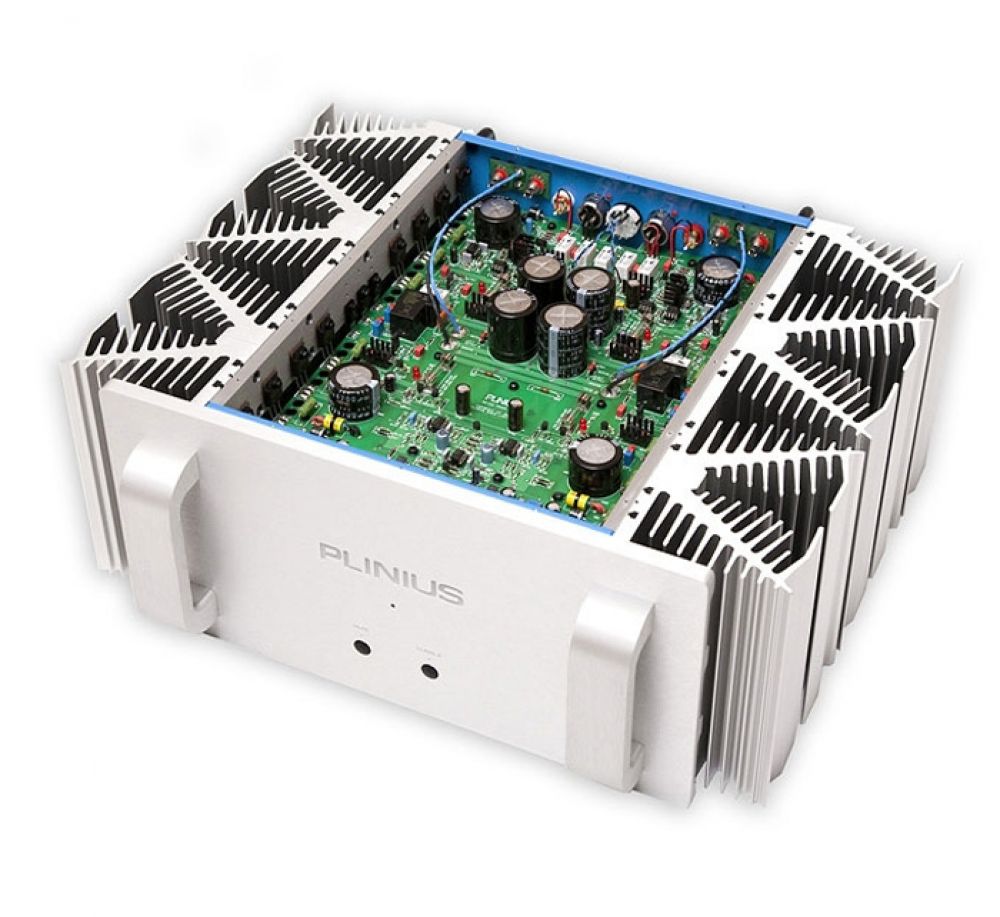
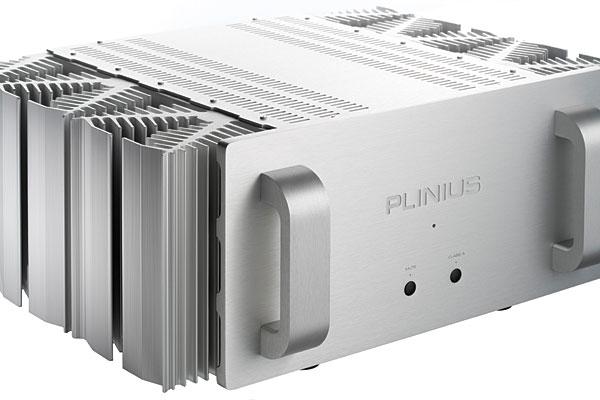
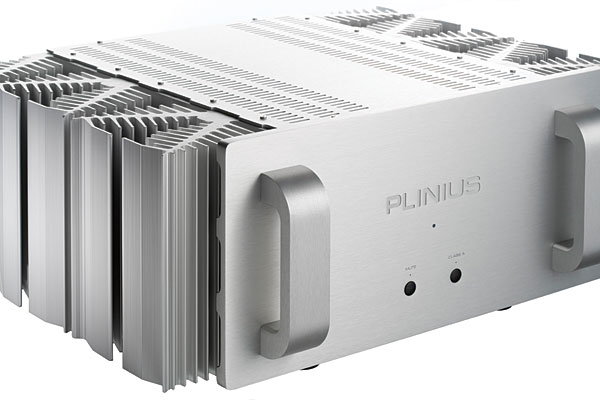
At first glance, the SA-103 looks like a quintessential Man-Amp, but of the amps that have shacked up with me, it’s one of the more sexy looking, and in ways that entirely serve its function. The silvery aluminum of the thick faceplate has an elegant satin sheen, and the aluminum top plate is particularly robust. Two large handles dominate the front, conveniently paired with two smaller handles on the rear. Four handles on an amp that weighs 83 lbs is a useful touch. However, the visual star of The SA-103 Show are its heatsinks. Each unfurls from one of the amp’s side panels like a frond of fern, reminding me of one of the most recognized symbols of New Zealand: the silver fern. These aluminum fronds not only provide a large surface area from which to dissipate the considerable heat generated by a class-A amp, they’re also beautiful, and create a much more inviting look than is offered by most big, spiky amps.
Setup was very straightforward: Lug the beast into place, attach the speaker and interconnect cables, select the mode and input, and switch on the main power toggle on the rear panel. The SA-103 turns on in muted standby mode. You then press the Mute button on the front panel; the SA-103 will now play music, but in class-A/B mode. You can also use Mute to swap out input and speaker cables while the amp is on—a nice tool for reviewers. To switch to class-A, hit the button so labeled. I listened to the SA-103 only in balanced stereo mode.
Plinius intends for the SA-103 to be left on at all times, and left in class-A/B mode when idle. If you forget, an internal switch can be set to automatically switch the amp in class-A/B mode after 15, 30, or 60 minutes of no signal, thus saving on heat dissipation and your electric bill. If you’re a control freak, you can turn off this feature entirely, but remember: In class-A mode, the SA-103 sucks almost 500W continuously. I loved being able to leave it on all the time without having to remember to power it down to class-A/B. This let the SA-103 continuously charge its capacitors and to get to its optimal class-A operating temperature—and best sound—much more quickly than from a cold start. Nor did I notice any big increase in my electric bill during the amp’s time at my house.
Plinius recommends that all serious listening be done in class-A only, and that’s what I did. However, if you’re throwing a summer dinner party and don’t want to heat the house to get some background music, the SA-103 will work nicely in class-A/B. I let it run in, in class-A mode, for about 100 hours before doing any analytic listening.
Where has this bass been all my life?!
Such was my initial impression of the Plinius SA-103’s sound. I have used the same loudspeakers, a pair of Revel Performa F30s, in the same positions in the same room, for some 10 years now, but never had I heard from them such depth, slam, articulation, and texture in the bass. Nor could my friends, who know my system almost as well as I do, believe the musical foundation the sound now had. Consequently, the Plinius kept me on a steady diet of bass-head treats.
Pantha du Prince’s Black Noise (CD, Rough Trade RTAADC544) was in constant rotation, and this wonderful recording of rather minimalist electronica was beautifully served by the SA-103. On much of the album, electronic bass notes are used instead of drumbeats to kick out the jams. In other words, the bass notes also provide the music’s rhythmic drive. To correctly reproduce this music, a system must have not only great pitch definition, but impeccable timing and control. The SA-103 locked on to my F30s’ woofers in a way no other amp has, combining roundness and generosity of tone with incredible control and articulation—usually, I’ve been able to get only one or the other of those pairings. For tube amps, my Rogue Audio M-180 monoblocks do a great job in the bass, and give me a feel similar to what the Plinius SA-103 provided, but they just can’t grip the speakers with as much control or dynamics, or play as loud.
Bass-drum thwacks and orchestral dynamics were ably served by the Plinius’s bass control and drive. The recording by conductor Ants Soots and the Estonian National Male Choir of Veljo Tormis’s Curse Upon Iron (CD, Alba NCD 35) is undoubtedly the most hair-raising performance of the most terrifying choral work ever written. The work is scored for shaman drum (in this case a very large hand drum) and male choir, and its compositional core is the interval of the tritone, so abhorred in conventional harmony. The choir sings, sometimes screams an ancient Estonian text cursing iron, the material of swords and war. Not only did the Plinius get the enormous drum thwacks right, with the correct amount of weight and speed to each stroke, the SA-103 also delivered a rich, detailed, full-bodied rendering of the choir’s voices. The overall effect of this performance and recording of this work is similar that of viewing Picasso’s Guernica—the horrors of war are laid bare in a way that is, at the same time, beautiful and terrible. It’s the sort of music whose emotional impact on me is so strong that I can listen to it only once in a while. When I listened to it this time, I was very glad it was through the Plinius SA-103.
Men’s voices also sounded lovely singing less raucous fare. To my ears, audio systems have a hard time reproducing male voices. Room effects and speaker crossovers do their best to screw up the sound, and many amps can present either a voice’s body and warmth or its detail, but seldom both. The Plinius did a fine job of conveying the years of joy, pain, and experience in the desiccated voice of the late Johnny Cash as he sang “Give My Love to Rose,” from American IV: The Man Comes Around (CD, American 440 063 339-2), but also offered hints of the former richness of his bass-baritone. The more youthful sound of the late Isaac Hayes singing with Dionne Warwick, in concert, a medley of “By the Time I Get to Phoenix”/”I Say a Little Prayer,” from Ultimate Isaac Hayes: Can You Dig It? (CD, Stax 35CD-88043-2), gave me exactly what a close-miked male voice should sound like, with equal amounts of body and detail. Hayes was a lot more than Chef (the South Park character whose voice he provided) and “Shaft,” and his singing and arranging on this track prove it amazing.
But the Plinius SA-103 also loved the ladies. Soprano Barbara Bonney singing songs by Hugo Alfvén, accompanied on piano by Antonio Pappano, from her Diamonds in the Snow: Nordic Songs (CD, Decca 289 466 762-2), was rendered with just the right perspective, tonal balance, and liquidity through the SA-103. Hearing Bonney sing “Skogen Sover” was a little slice of heaven.
Through the SA-103, the top octaves were open, sweet, and extended. During my time with the Plinius I bought a mix CD compiled by record producer Peter Kruder, Peter Kruder: Private Collection (CD, G-Stone GSCD036). It’s a grab-bag of some of the weird, wild, wonderful music he’s collected, with tracks by artists such as Tom Waits, Bernard Herrmann, Talk Talk, and my favorite band you’ve never heard of, Stargard. The sound varies a bit from track to track but is generally quite good. The unforced treble extension on Waits’s “Clap Hands” and Rokia Traoré’s “Mariama” was a thing of beauty. This treble, done in such an unhighlighted way, showed the Plinius to have an extremely open and revealing character, as well as a rich midrange and full, articulate bass. My overall impression of the SA-103’s sound was of warm, open, powerful neutrality.
In terms of soundstaging, the Plinius SA-103 proved to be one of the best solid-state amplifiers I’ve heard. Some amps are good at presenting an illusion of soundstage depth by adding to the signal a character that embiggens (pace Jebediah Springfield) the sound of instruments and places them at a greater sonic distance from the listener. Other amps are surgical in their rendering of space, often giving a hyperdetailed, exciting, yet etched quality to the sound. In this regard, the Plinius SA-103 was an amp Goldilocks would have loved: it was juuuuust right.
When called on to present an upfront and vivid soundstage, such as that of Jean Knight’s “Mr. Big Stuff,” from Stax: 50th Anniversary Celebration (CD, Stax STX2-30203-2), the Plinius put very little space between me and the performers, and placed the instruments squarely in my room with startling immediacy. However, the SA-103 also ably transported me to the sunken-cathedral acoustics of the enormous spaces in which Gavin Bryars’ The Sinking of the Titanic was recorded (by Christopher Barnett and the Gavin Bryars Ensemble; CD, Philips 446 061-2). In terms of soundstaging, the Plinius gave what it got.
Nothing Compares 2 U
A number of amps have come through my doors in the past year or so. Against the similarly powered Rogue M-180 monoblocks outfitted with KT90 output tubes, the Plinius did very well, sharing with the Rogues what I would normally call “tube magic.” I love what tubes can do in the midrange, and I expected the solid-state Plinius to leave an empty spot in my heart that pined for more of that tube magic. But the Plinius’s midrange was as fleshy as I like it to be. Though the Rogues did a fantastic job of presenting the illusion of a three-dimensional space, they lacked some of the SA-103’s resolution and clarity. In terms of dynamics, while the Rogues are good, the Plinius was great. In this category, tube amps just can’t compete with a class-A amp putting out up to 50 amps of peak current—the Plinius’s balance and voicing really held together at high volumes, inviting me you to do some crankin’.
Though the class-A–biased Pass Labs amps I’ve spent time with, the Aleph 3 and XA30.5, have sweet trebles, I’ve also found them slightly closed-in at the top of the audioband, the XA30.5 having a slight emphasis in the low to mid-treble. The Plinius SA-103 matched this sweetness, but offered a more extended bandwidth at both ends of the audioband than did either Pass model. The Plinius was also a higher-resolution design than the Passes, with blacker backgrounds, less noise, and greater texture and delineation throughout the audioband. The SA-103 was also more dynamic and more timbrally neutral than the similarly priced Pass Labs INT-150 ($7150).
Why Can’t This Be Love?
So—have I fallen in lust with this amp, or is it love? Certainly, there must be other amps out there that might trump the Plinius’s performance in certain areas. The single-ended tube crowd won’t get quite enough of that tube magic to keep them from crossing the SA-103 off their list. And those who crave the hyperdetail of a solid-state Halcro amp might not find what they’re looking for in the Plinius. Those who need absurdly priced audio jewelry will also look elsewhere—the Plinius just isn’t fancy or costly enough.
But if, like me, you’re looking for a power amplifier that can bring you a great deal of the performance that each of these kinds of amplifiers can muster, the Plinius SA-103 may be for you. The best way I can recommend the SA103 is this: If you’re considering spending a bit less than the Plinius’s price, try instead to splurge on the SA-103. If you’re thinking of spending a great deal more, at least give the Plinius a listen before laying down your dough.
The Plinius SA-103 offers a natural, neutral tonal balance, just the right amount of musicality, superb bass performance, plenty of current to drive the most piggish speakers, functional and tasteful design. It is (dare I say it) a good value at its price, considering its performance.
Perhaps, when the next hot amp comes through the door, the SA-103’s spell will have worn off. In a few months, maybe the Plinius and I will have to have “the talk.” I’ll phone it up and tell it, “I’m just not that into you,” and “I’ve met someone else.” Perhaps I’ll even say, “Baby, it’s not you, it’s me.” After all, I am a promiscuous audio reviewer. I love ’em and leave ’em and never look back. But I highly encourage you to at least take a Plinius SA-103 out on a date. It could be the beginning of a beautiful relationship.

The Plinius could also give me hell if I wanted it. My wife loves The Knife, but it has taken me a long time to get into the band’s sound. I really like their songs and production, but they consistently use octavizers and pitch shifters on the voice of the already shrill-sounding Karin Dreijer-Andersson, and it gives me the willies—she sounds a bit like the Linda Blair character in The Exorcist and makes Bjîrk sound like Leontyne Price. The Plinius actually helped me better understand and appreciate what The Knife was going for in the chaotic studio treatment they gave the vocals on Deep Cuts (CD, Rabid/Mute 9339-2): I could hear each bending of pitch and shift of octavizer, the latter sometimes adding a parallel fifth to the melody, sometimes dropping the octave. I still don’t know if I like this band, but I play the album because it’s good to let my wife enjoy my stereo—I mean, our stereo.
Through the SA-103, the top octaves were open, sweet, and extended. During my time with the Plinius I bought a mix CD compiled by record producer Peter Kruder, Peter Kruder: Private Collection (CD, G-Stone GSCD036). It’s a grab-bag of some of the weird, wild, wonderful music he’s collected, with tracks by artists such as Tom Waits, Bernard Herrmann, Talk Talk, and my favorite band you’ve never heard of, Stargard. The sound varies a bit from track to track but is generally quite good. The unforced treble extension on Waits’s “Clap Hands” and Rokia Traoré’s “Mariama” was a thing of beauty. This treble, done in such an unhighlighted way, showed the Plinius to have an extremely open and revealing character, as well as a rich midrange and full, articulate bass. My overall impression of the SA-103’s sound was of warm, open, powerful neutrality.
In terms of soundstaging, the Plinius SA-103 proved to be one of the best solid-state amplifiers I’ve heard. Some amps are good at presenting an illusion of soundstage depth by adding to the signal a character that embiggens (pace Jebediah Springfield) the sound of instruments and places them at a greater sonic distance from the listener. Other amps are surgical in their rendering of space, often giving a hyperdetailed, exciting, yet etched quality to the sound. In this regard, the Plinius SA-103 was an amp Goldilocks would have loved: it was juuuuust right.
When called on to present an upfront and vivid soundstage, such as that of Jean Knight’s “Mr. Big Stuff,” from Stax: 50th Anniversary Celebration (CD, Stax STX2-30203-2), the Plinius put very little space between me and the performers, and placed the instruments squarely in my room with startling immediacy. However, the SA-103 also ably transported me to the sunken-cathedral acoustics of the enormous spaces in which Gavin Bryars’ The Sinking of the Titanic was recorded (by Christopher Barnett and the Gavin Bryars Ensemble; CD, Philips 446 061-2). In terms of soundstaging, the Plinius gave what it got.
In class A mode I also couldn’t shake the impression that an imaginary zoom lens had moved the listener a tad closer to the protagonists. That’s because the atmosphere gained in proximity and intimacy. The goose-bump factor became more intense too. Crediting the Anglo-Saxon belief that ‘there’s no such thing as a free lunch’, I also registered a somewhat less controlled bass register. The firm grip so admired in class A/B mode had loosened up. Because staging compacted as well, the combined effect was that large-scale orchestral extravaganzas like Denon’s Onepoint recordings of Mahler’s Symphonies with The Frankfurt Radio Sinfonie Orchester under Eliahu Inbal exhibited diminished raw spectacle and the concert hall’s flooring showed shorter decays beneath the large kettle drums. I’d thus favor class A/B operation for grandiose symphonic works and bass-heavy Rock. Wherever material demands maximal micro resolution and nuanced exposition however, class A becomes the first choice.
Conclusion. Fortunately I did fess up to personal bias favoring class A and valve amps early on. It thus won’t come as a surprise that we end on a highly laudatory note for our two Kiwi kids. Personally unexpected was how this endorsement would migrate without reservations to operating the SA-103 power amp in class A/B mode. Compared to the many competing options on the market, the nuanced well-resolved approach of these Plinius electronics should appeal to listeners who not only wish to follow an annotated musical score but simultaneously lust after an unusually realistic sonic aesthetic. Put bluntly, these electronics now join my prior top picks of Tenor Audio 75-Wi mono amps and Hegel’s P30/HE30 pre/power combo as most welcome direct alternatives.
Psych profile for the Plinius M8 and SA-103…
• Both are very robustly built and well finished in expert machine shop rather than filigreed jeweler’s fashion.
• Timing, dynamics and soundstaging will convince even critical listeners.
• Precise believably embodied imaging operates on a high level though more remains possible. Unusually broad stage dimensions are augmented by less generous depth and height information which nonetheless remain perfectly adequate for this class.
• Both machine but particularly the SA-103 run in class A bias reside a hand’s width on the warm side of the fence though this has as little in common with euphony as sushi has with pickled herring. The midband is very compelling and the treble integrates harmoniously.
• This slightly warm voicing impressed me because it didn’t compromise resolving power. In fact both machines divulged oodles of detail. They simply didn’t apply any spot light on it which tends to fatigue prematurely. This isn’t something Plinius owners will ever suffer.
• Many amps descend low without any issue but then fall short of painting in full colour. Descriptions of ‘black bass’ often disguise a mostly monochromatic low register. Here the M8 and SA-103 demonstrated how even well below 100Hz there are many tone colors, shadings and gradations to discover.
• Where the SA-103 power amp makes for an already excellent choice in its price class, the switch to class A bias ups its game particularly in the midrange and treble which gain in glow and fluidity to approach even very good valve amps. This is paid for with a small loss in bass control and somewhat less generous soundstaging but both remain perfectly acceptable.
Related products
-
Electrocompaniet ECI6 DX MK2 Integrated Amplifier/DAC/Phono (NEW)
Original price was: R212,000.00.R118,000.00Current price is: R118,000.00. Add to cart -
Quad II Forty Monoblocks
Original price was: R112,000.00.R29,900.00Current price is: R29,900.00. Add to cart -
Perreaux 750p Mono blocks – NEW
R180,000.00 Add to cart -
Synthesis Metropolis NYC200i Integrated Amplifier (Black)
Original price was: R478,000.00.R138,000.00Current price is: R138,000.00. Add to cart