Rotel RMB-1075 Reviews
We at SGHT are no strangers to Rotel products. In the October 2000 issue, Michael Fremer reviewed Rotel’s RTC-965 surround processor/tuner with the RB-985 Mk.II power amplifier, and in February 2001, Robert Deutsch waxed enthusiastic about the RMB-1095 power amp. Both writers lauded these products’ value, and RD spoke of Rotel’s consistency in product and circuit design, something he’d noticed through the years. He declared the RMB-1095 “one of the best buys in a multichannel amplifier.”
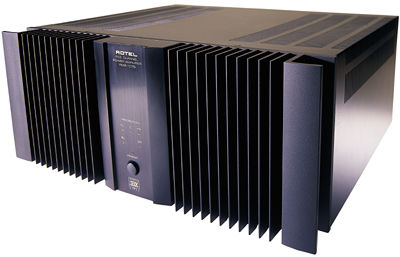
Rotel might have taken that as a challenge. I won’t say that the RMB-1075 is the best thing to happen to amplification since Bardeen, Shockley, and Brattain knocked their heads together at Bell Labs inventing the transistor, but as far as practical value is concerned, the RMB-1095’s little brother would certainly have made those men proud of what their little electronic switching creation has made possible.
Physical Description
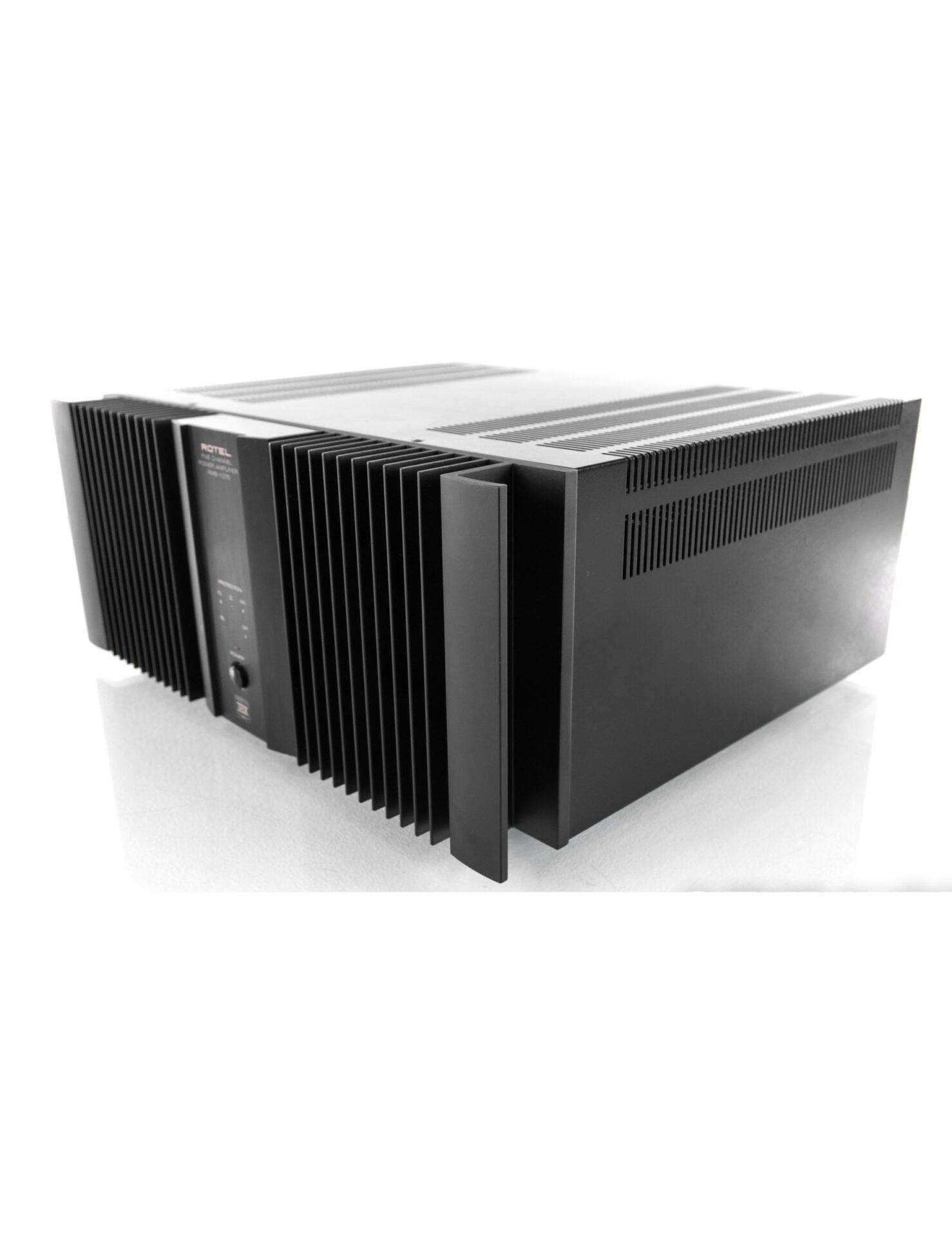
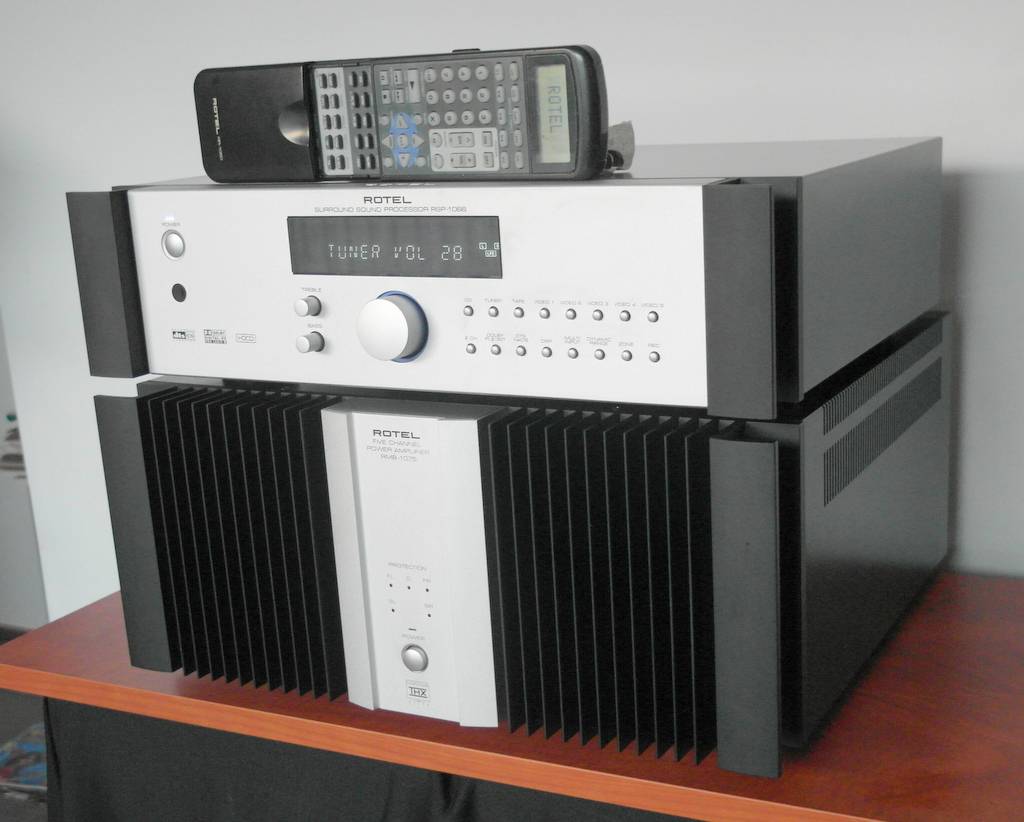
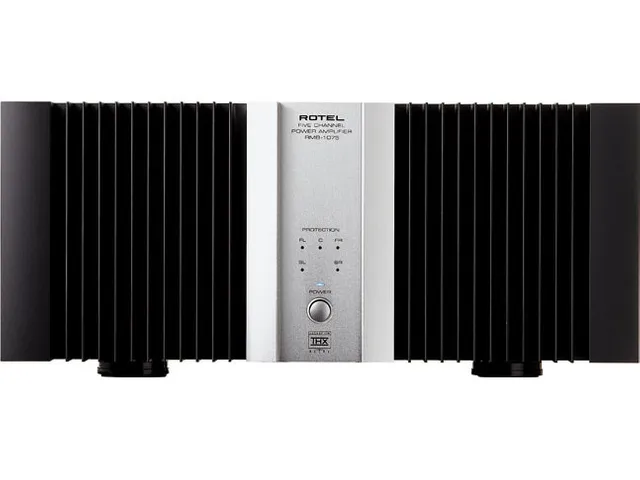
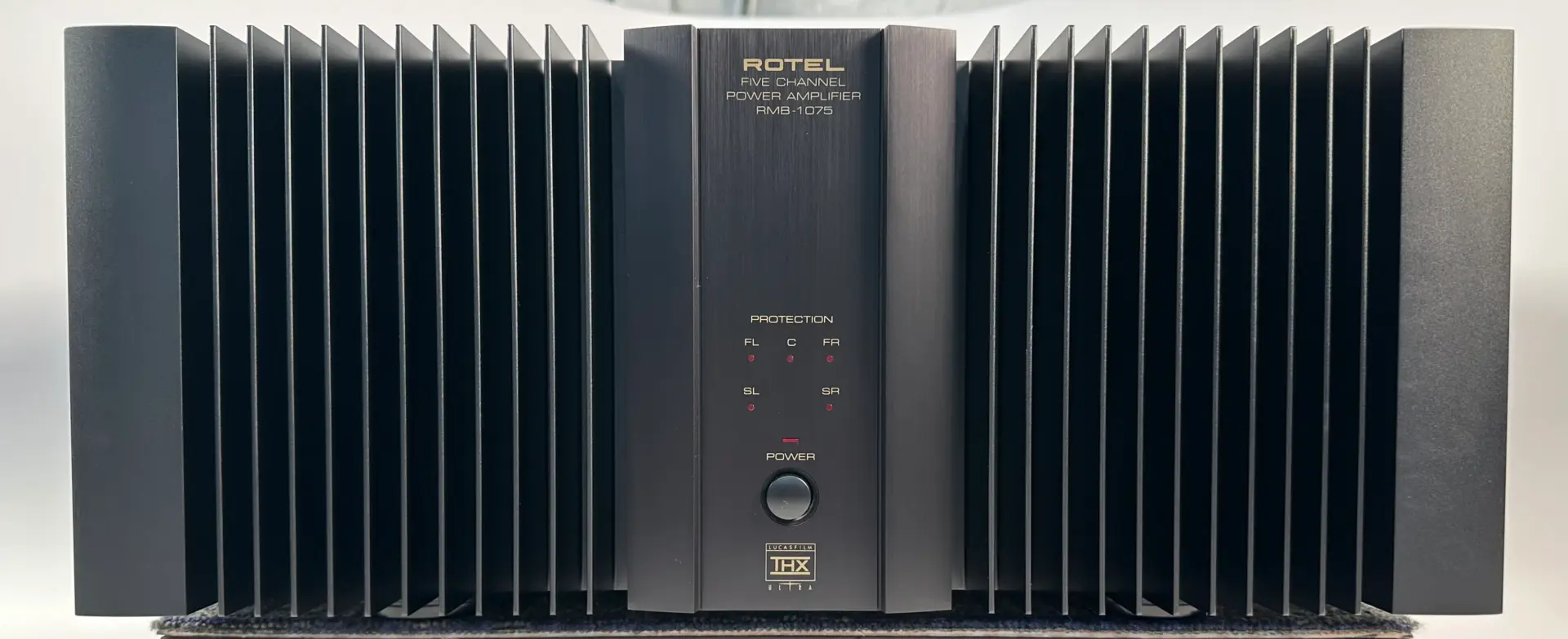
There’s no mistaking the RMB-1075’s membership in the Rotel family. It’s THX-certified, and its front panel is covered with the same vertical heatsinking as its brothers, although its increased cooling area is one of the ways the RMB-1075 is an improvement over the now-discontinued RB-985 Mk.II. These fins did their job during all of my listening sessions; the RMB-1075 was never more than slightly warm to the touch. The center of the front panel sports the same solitary Power button as other Rotel amps. Above it are five LEDs that light up if any of the amp’s five channels are forced into protection mode.
The relatively compact RMB-1075 is smaller than any other amplifier I currently have in my studio, and, at a mere 43 lbs, the most manageable. But while small in stature, it couldn’t be called a lightweight—like that weight-lifting boy who used to show up in all our comic books, the RMB-1075 had strengths that belied its size.
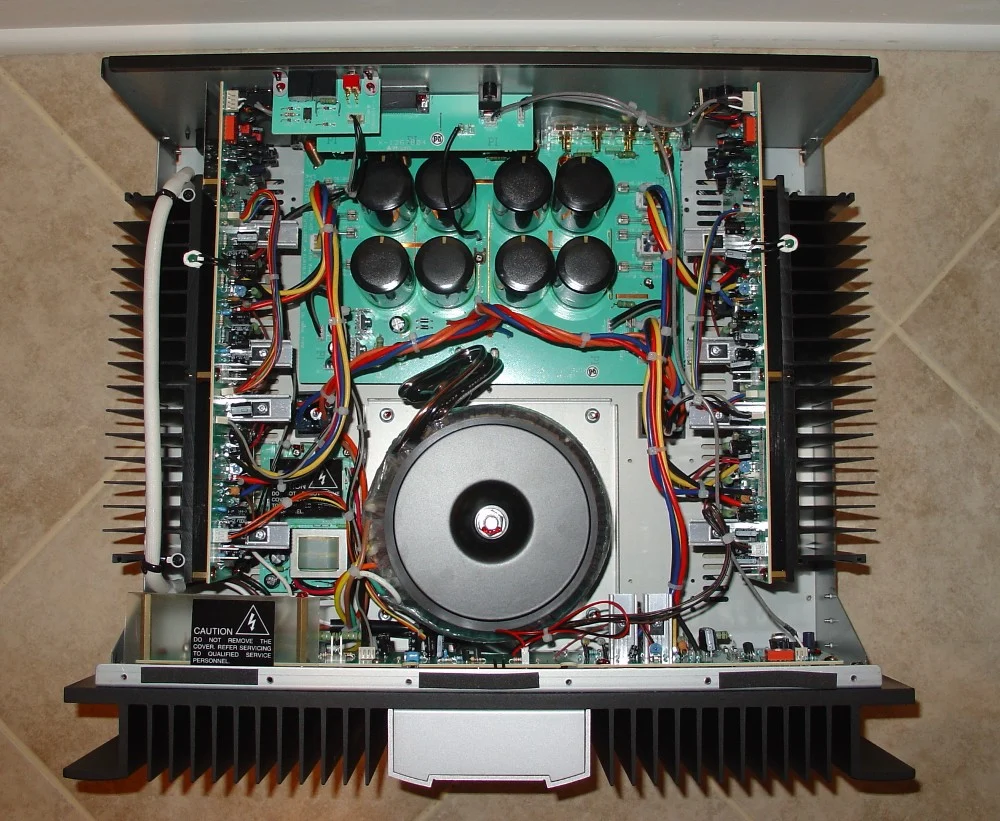
A quick comparison of the RMB-1075’s internal parts shows how Rotel made this less expensive version of their RMB-1095. The RMB-1075 uses only one 1.5kVA toroidal transformer instead of the RMB-1095’s two 1.2kVA devices. The power supply includes eight 10,000µF slit-foil capacitors, vs. eight 22,000µf devices in the larger, more powerful amp. The output amplification comprises twenty 130W/15-amp transistors, down from the larger unit’s thirty 150W/15-amp devices.
Audio Pro Sessions
I noted in my review of the Audio Pro Black Diamond (October 2001) that the combination of that Swedish speaker with the Rotel RMB-1075 was a good one. The Black Diamond’s minimal crossover allowed the RMB-1075’s controlled performance to sing through without restriction, and the speaker’s above-average efficiency made the most of the Rotel’s power output. Dynamic transients had proper attack, and front-to-rear soundstage layering was precise. Film soundtracks sounded eerily live.
The Black Diamonds are unforgiving of harsh or strident electronics, and the RMB-1075’s smooth performance proved a heavenly match. I had switched to the RMB-1075 after packing up the 7-channel Integra Research RDA-7 amplifier to send it to our Home Entertainment 2001 show in New York, and was slightly bummed that the Rotel had only five channels. After a few listening sessions, I wired a second set of monopole rears in parallel for a more enveloping surround “bubble.”
The RMB-1075 didn’t complain about this extra load for days. Then, walking through my studio one night, I tripped on a speaker wire, possibly shorting it out. Later, I noticed that one of the amp’s protection LEDs had lit up. I removed the cover, found a blown fuse, and replaced it. But the replacement’s instant demise in a bright flash proved that the wound was deep.
Rotel quickly sent another unit, and my evaluation continued—all speaker cables now safely affixed to the floor with wide black gaffer’s tape. When I talked with Rotel’s service department, we couldn’t decide exactly which part of my stupidity had caused the problem: the possible short, or my having wired the speakers in parallel, which presented a load to the amp lower than it should be asked to handle. Please learn from my mistake—this is only the second amp I can remember having blown up.
B&W Sessions
Lingering in Tom Norton’s review queue were the B&W CDM-1NT monitors and CDM-CNT center-channel—the entry speakers in B&W’s CDM series. I borrowed them because I wanted to see how the Rotel RMB-1075 might handle a load slightly less efficient than the Audio Pro Black Diamonds.

The RMB-1075 lit up the B&Ws as it had the Audio Pros: The sound was no-nonsense accurate, with dynamics to spare. The combination had the character of Joe Friday—just the facts—and led to some seriously enjoyable music investigation.
But the RMB-1075 didn’t just deliver the goods—it had a major-league windup. I didn’t get only the transients, but sensed their delivery in a way that made the actual sound more thorough—drum rim-shots and bass-guitar plucks had palpable presence. Everything was rendered with a matter-of-fact solidity that I sometimes found startling.
All Amps Sound the Same?
I compared the Rotel RMB-1075 with two other amplifiers: Theta Digital’s Dreadnaught and B&K’s AV6000. And because the output level of the Integra Research RDC-7 surround processor can be adjusted in increments of 0.5dB, I was able to get the playback levels quite close at 1kHz, as measured with the Goldline DSP-30 Real Time acoustic analyzer.
I switched between the Rotel and the Theta Dreadnaught to see what’s available at four times the price and nearly twice the rated power. The Theta had better extension at the frequency extremes, and smoothed out vocal sibilance—those high-frequency s and t sounds so often “enhanced” on pop recordings. Jennifer Warnes’ Hunter (CD, Private Music B00002487W) exhibited the differences plainly: The upper highs of her voice on “Somewhere, Somebody” were less harsh through the Theta, but the Rotel was not so bad as to drive me to the power switch. The RMB-1075 also added a slight sheen or glare to her voice. In addition, the Theta’s bass had a firmness that could not be matched by the less powerful Rotel. On “Way Down Deep,” the bass line in the midst of some extremely close-miked bongos proved that the RMB-1075 was no match for the Dreadnaught. I didn’t exactly expect the little guy to hang with the Theta monster, but it was good to hear the differences that quadruple the cash can buy.
I then dug out my old B&K AV6000 amp (1999 price for the slightly newer AV6000 Series II: $1498), to compare the RMB-1075 to something a bit closer to its price range. Sure enough, the overall sonic characters of the two amps were more similar than in the previous comparison, but each retained its own signature. The B&K presented a soundstage larger in both width and depth; it blended the music pleasantly, creating a continuity of sound that filled the space between the speakers. The Rotel was more forward with everything, but more distinct as well—each performer was surrounded by a bit more breathing space. I could live happily with either one.
Conclusion
The RMB-1075 is a competent performer with qualities of build and sound that belie its low price. More money will buy you extension at both frequency extremes, but for reasonably priced speakers in the average listening space, this amp is a winner. It’s another of Rotel’s best buys in multichannel amplifiers, and one of the best buys in this category, period. Highly recommended.
|
Specifications:
Power: 120 Watts RMS X 5 into 8 Ohms
MFR: 15 Hz -100 kHz (-0.5 dB/-3 dB)
THD: 0.03%
Size: 7 1/2″ H x 17″ W x 15 1/2″ D
Weight: 39 Pounds
MSRP: $1,295 USA |
| Rotel of America, 54 Concord Street, North Reading, Massachusetts 01864; Phone 978-664-3820; Fax 978-664-4109; Web http://www.rotel.com |
Introduction
Rotel has long been a respected name in European hi-fi components, and they have made significant inroads to North America because of their fine, and very competitive products. The RMB-1075 is a follow-up to the successful RB-985 and RB-985 MK-II, which sold for $1,000. The 1075 adds a beefier power supply and ups the power output from 100 watts per channel, to 120 watts per channel.
As you can see from the photo above, there are heat sinks on the front panel. This is very distinctive of Rotel’s latest amplifiers, and I really like the look. However, the design is more than just cosmetic. The inside of the chassis (photo below) has heat sinks too, on both sides. The large toroidal transformer powers eight 10,000 �F capacitors � 63 Volts (total of 159 Joules of energy storage) which feed the various channels. Two channels are on each side, and one is in the front. Thus, the three arrays of heat sinks. Four output transistors drive each channel. The front panel has a push-button on/off switch and LEDs which turn on if the amplifier is driven into protection mode (indicating shutdown of the channel that is overdriven).
The rear of the 1075 (photo below) has RCA jacks for each channel, along with a DB-25 jack for use with processors that have DB-25 output jacks (all the Rotel processors and some other brands), and color-coded five-way speaker binding posts. The detachable AC connection is non-grounded, but fits a standard grounded AC cable.
The Sound
I tested the RMB-1075 with our Toshiba SD-6200 DVD Player, Theta Casablanca II Processor, Krix Esoterix I Mk II Speakers, Threshold ES-500 Full-Range Electrostatic Speakers (ESLs) , and Nordost Cables. A PS Audio P1200 served for clean AC supply. Although the manual says to use speakers with no lower than 4 Ohm impedance, I still like to use the ESLs just to see what a product can do under stress.
I have to say that I was delighted with how the 1075 performed, because it is so great to have affordable home theater amplifiers to choose from when you can’t afford the big Krells, Cinepros, and others of that caliber. The Rotel RMB-1095 that we reviewed a while ago had a laid back high end, and the 1075 continues in that mold. This is probably because Rotel is thinking of all those harsh DVD sound tracks, and it means you can listen at higher volume levels without grimacing. Indeed, I, like most fellows, really enjoy action films, and lots of watts are required to do the job right. For example, Stallone’s “Daylight”, although a lousy movie, is great for demonstrating amplifiers and subwoofers to friends (chapter 8, the tunnel scene). Of course, “The Matrix” is not only a wonderful movie, but several chapters make fantastic demo material. Chapter 29, where Neo (Keanu Reeves) and Trinity (Carrie-Ann Moss) shoot up the lobby, just blows me away every time I watch it. My neighbor uses that scene whenever he feels depressed, just to get his juices flowing again. Chapters 4 and 11 of “True Lies” are also very demanding, with action going on in every channel. The 1075 took all this stuff in stride with tons of easy-to-listen-to sound.
The 1075 did just fine with my two ESLs as well, so it might just be a good match with some of the surround sound sets of ESLs that are coming on the market, such as the Final 0.2s that have just been released. I used the DTS Sampler with Tchaikovski’s 1812 Overture, Alan Parsons, and other such amplifier busters, but the 1075 maintained its composure.
The 1075 has an inductor on the output connection of each channel (yellow arrows in photo below, left) which makes the amplifier more stable with capacitive loads (I guess they figured someone like me would come along and connect it to some ESLs). However, this does not appear to limit the bandwidth very much, because I measured the – 3 dB down level at 153 kHz. The 10 kHz � 10 Volt square wave (photo below, right) is very good too. More and more amplifier designs are incorporating the output inductor. Having such things in the signal path is loathed by purists, but as we get more and more powerful amplifiers, and crank the volume higher and higher, the inductors form a safety net, so they are not likely to go away.
Conclusion
Rotel has done it again with the superlative RMB-1075. I think this product represents one of the best values in home theater amplification on the market right now, and recommend that you put it on your short list when shopping for upgrades. It would be a fabulous addition to the pre-outs of any surround sound receiver, bypassing the often less-than-adequate power amplifiers they have, and especially when you migrate your system to DVD-A and SACD. But, also, it would be wonderful to pair it with any dedicated processor out there. I have been working on this review for quite a while, but I have had so much fun showing it to friends, and enjoying it here in the lab, I put off publication because I did not want to send it back.