Shelter 901 MkII: Something Old, Something New
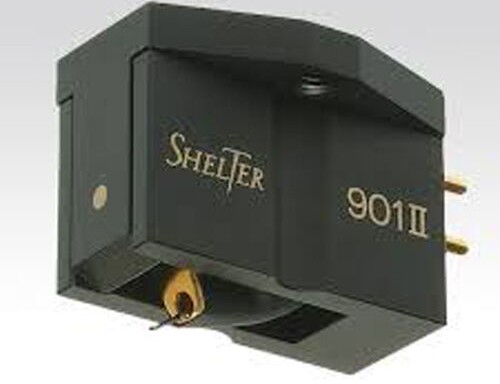
The 901 MkII sells for $2100 (placing it directly between the Shelter 5000 and 7000 in price), and it is quite literally the result of combining something old with something new. Specifically, the 901 MkII combines the old-style body of the original 901 (which is smaller and lighter than the massive, anodized aluminum bodies of Shelter’s later models), with a motor assembly containing all of the updates found in the “thousand-series” Shelters. As I noted in my review of the 5000 and 7000, those updates include “new front yoke assemblies, redesigned bobbins, and improved internal wiring,” along with “boron cantilevers fitted with … ‘nude’ elliptical styli.” I asked Shelter importer Arturo Manzano of Axiss Audio if the 901 MkII’s configuration should be taken to mean that the cartridge was a virtual “Shelter 6000” by another name.
“No, I don’t think so,” he said. “You’ll have to judge for yourself, of course, but I think the 901-style cartridge body has a bigger impact on the sound than you might expect.” And Arturo was absolutely right; the 901 MkII looks and sound like a best-of-two-worlds design. On one hand, it carries forward much of the vibrancy, lushness, and grace of the original 901, while at the same time exhibiting the heightened transparency, transient speed, and dynamic snap of the “thousand-series” Shelters. This, as you might expect, is a highly appealing combination of virtues, because it makes the 901 MkII at once extremely revealing and evocative to listen to, while enabling it to be at least somewhat forgiving of imperfect recordings. Let me provide some musical examples to show how these characteristics play out with real-world recordings.
Let’s first look at the 901 MkII’s sound on an old but very well done studio recording: James Taylor’s “I Was Only Telling a Lie” from JT [Warner Bros.]. This track exposes a deeper, darker part of Taylor’s vocal range, which the Shelter conveyed with excellent warmth, while capturing the unmistakable touch of sardonic humor in Taylor’s voice (the song is about a driver who woos and then promptly abandons “truck-stop cuties”). Providing perfect backing for the track is Danny Kortchmar’s scorching, swamp-inflected electric guitar, whose sound the 901 MkII simply nails, capturing the instrument’s gleeful, energetic howl. But the twin engines that really drive the song forward are the funky, syncopated, and perfectly intertwined sounds of Leland Sklar’s bass and Russ Kunkel’s drum kit. The Shelter did a beautiful job of expressing the granite-like solidity and weight of Sklar’s bass, while conveying the jaunty bounce, pop and shimmer of Kunkel’s kick drum, snare, and cymbals. At every turn, the cartridge captures not just the sound but also the “feel” of the singer’s voice and of the backing instruments—all with a presentation that is full of dynamic energy and life.
Yet the 901 MkII is just as adept at reproducing more serious classical fare, as I discovered when playing the David Oistrakh, Maxim Shostakovich, New Philharmonia Orchestra performance of the Nocturne (Moderato) movement of the Shostakovich’s Violin Concerto No. 1 [EMI]. Several things made the Shelter’s rendering of the performance memorable: the dark bass section sonorities at the start, the plaintive voices of the woodwinds as the movement unfolds, the clear yet very smooth and full-bodied tonality of the string section throughout, and the delicate and haunting sound of the celesta, which seems ethereal and almost crystalline in its clarity even though it is heard as a background instrument and not as a lead voice. But perhaps the most compelling element of all is the manner in which the 901 MkII reproduces the purity of Oistrakh’s violin sound, which expresses Shostakovich’s themes with tremendous angularity and incisiveness, yet never falls into brittle edginess or stridency. In fact, through the Shelter Oistrakh’s violin always retains a signature touch of sweetness, albeit one that is subdued in this piece, with fantastic clear overtones on upper-range notes. Though the movement makes a broad range of dynamic demands, I found that both its macro- and micro-dynamic extremes fell comfortably within the 901 MkII’s performance envelope. Overall, the 901 MkII’s presentation is full of rich tonal colors and dynamic delicacy and power, while retaining that elusive element of graciousness that enables it to complement most types of music (and imperfect recordings).

Shelter 9000: Top of Shelter’s “Thousand-Series” Range
The 9000 ($3500) is the finest of Shelter’s “thousand-series” models, which means it is, hands down, one of the two most revealing and transparent-sounding cartridges the company has offered to date (the other is the Harmony MC, which we’ll discuss in a moment). Having now heard the 5000, 7000, and 9000 in my system, I can say with confidence that there’s a predictable, linear progression upwards in performance (and, of course, price) among the three models in the range. At each step along the path you pay a bit more and in return receive solid, incremental improvements in detail, resolution, textural and timbral refinement, dynamics, and tracking capabilities. Given how good the 5000 and 7000 already are, this means the 9000 is a highly accomplished cartridge—one that does most things extremely well, with few if any significant drawbacks. What makes the 9000 very special, though, is the fact that it offers significantly heightened levels of purity and transparency without losing that underlying quality of musicality that is the hallmark of all Shelter designs.
By way of trying to understand the differences between the 901 MkII and the 9000, I put on one of my favorite and most realistic-sound jazz recordings: Charlie Haden’s Closeness [Horizon/A&M], a series of duets featuring Haden and fellow jazz musicians. First up was the track “Turiya,” where Haden teams with jazz harpist Alice Coltrane. What immediately enchanted me was the lilting, almost floating sound of Alice Coltrane’s harp, which the 9000 reproduced in a masterful way, creating a vivid sonic impression of the instrument’s large, arched frame, and of Coltrane’s fingers flinging over the strings to set them in motion. In contrast, the Shelter enabled Haden’s bass to sound deep, sonorous, and woody, so that the music was infused with a sense of quiet dignity and gravitas that appealed on both soulful and cerebral levels. Haden’s very subtle fingering/tapping noises near the end of the track were mightily impressive, too—so that the 9000’s sound crossed the line between superb imaging (which is, of course, a fine thing in its own right) to achieve a heightened level of “the-artist-is-present-in-the-room-with-you” realism.
As I moved on to a second track from the same album, one entitled “O.C.”—for Ornette Coleman, the differences between the 9000 and 901 MkII became easier to discern. Through the 901 MkII, the overall presentation sounded extremely clear and was infused, again, with a subtle vibrant lushness. Through the 9000, however, the upper midrange voice of Ornette Coleman’s horn sounded noticeably more realistic and harmonically complete. On well-recorded material like this, the 9000 can really strut its stuff so that musically speaking there is more “there” there, though perhaps at the expense of losing at least some of the ease and grace of the 901 MkII. On “O.C.,” Haden’s bass solo is, somewhat uncharacteristically for him, fast paced and a little bit angular—perhaps because of the lively interplay with Coleman—and the 9000 kept pace with Haden’s fleet fingering shifts without ever putting a foot wrong. Importantly, and unlike any number of more analytical-sounding high-end cartridges on the market, the 9000 always preserved the quintessential weight and warmth of Haden’s bass tone. (Some cartridges render Haden’s tone with an icy, almost blueprint-like precision that some mistake for “accuracy,” but that does not ring true to the actual sound or “vibe” of a real acoustic bass.).
Like the 901 MkII, the 9000 proved quite fearless in tackling challenging classical or chamber music pieces. A good example would be the Charles Wourinen/New Jersey Percussion Ensemble performance of Wourinen’s Ringing Changes for Percussion Ensemble [Nonesuch].
This record, which features radical moment-to-moment shifts in energy levels, reveals the 9000’s overall dynamic acumen (the 9000 can go from zero to ffff and back again in an eyeblink), and also showcases the cartridge’s authoritative way of handling the leading and trailing edges of notes—even ones featuring downright violent transient attacks. The composition features an astonishing array of percussion instruments, and is arranged, says composer Charles Wourinen, with “the music divided between pitched and non-pitched voices.” The result is a difficult-to-reproduce yet strangely beautiful piece of music that ranges from moments of whisper-quiet intimacy to explosive and at times bombastic percussion outbursts. Impressively, the 9000 handles Ringing Changes with almost offhand ease, capturing the shimmering ring of small cymbals and gongs alongside titanic drum thwacks as if both were child’s play. While the 9000 may offer a slightly more analytical and therefore less easygoing and forgiving sound than that of the 901 MkII, it more than compensates by serving up heightened levels of transparency and dynamic agility.
Shelter Harmony MC: Welcome to the Next Level
Because the external shape of the Harmony MC’s body resembles that of the “thousand-series” models, you might be tempted to think of the Harmony MC as an “über 9000” of sorts, but one done up in stealth colors (this is the Shelter that Darth Vader would buy—not because it pulls you toward the dark side of the Force, but because it’s just so…black). But look closer and you’ll discover that differences run much deeper.

For starters, the Harmony MC is one of very few cartridges to use a body built of solid carbon fiber (not just a carbon-fiber wrap applied to some other base material). From the outset, this construction feature means that the Harmony MC’s body is light, strong, and incredibly rigid, and possesses terrific internal damping—qualities that make it an ideal mounting platform for the cartridge’s motor mechanism.
Designer Yazuo Ozawa has made two other key changes in the Harmony MC vis-à-vis his earlier designs. First, in what may seem a counterintuitive choice, Ozawa has given the Harmony an aluminum rather than a boron cantilever (the other top-end Shelters use boron cantilevers). According to Arturo Manzano at Axiss Audio, the aluminum cantilever was chosen because it transfers energy from the stylus to the coil bobbin even more efficiently than a boron cantilever does. Second, Ozawa has fitted the Harmony MC with a thin, blade-like, line-contact stylus rather than an elliptically shaped stylus (most other Shelters use elliptical styli). The line-contact stylus was chosen in the interest of improving the cartridge’s groove-tracing capabilities, albeit at the expense of a making the Harmony MC somewhat more finicky with respect to vertical tracking angle adjustments.
Together, these changes make for a cartridge that has a very low internal noise floor, whose stylus can and does follow groove undulations faithfully, and whose motor assembly more accurately translates stylus movements into output signals. As a result, the Harmony MC not only surpasses the strengths of the other Shelters by noticeable degrees, but also opens the door to a fundamentally different and better kind of performance. I say this because the Harmony MC is an extraordinarily quiet cartridge (in the sense that it appears to dramatically reduce the internal resonances and vibrations that to some degree afflict most other phono cartridges), and as a consequence lets you hear way down deep into the interior details of the music. Thus, low-level musical information that, I suspect, typically gets masked or obscured by noise in other cartridges suddenly becomes available to you with the flagship Shelter in play. Even so, the Harmony MC never overwhelms you with detail and never sounds sterile or antiseptic in its presentation; instead, it keeps its eye on the prize, always maintaining Shelter’s consistent, signature thread of innate, organic musicality.
The only catch is that the Harmony MC is arguably more particular about the quality of the recordings it is fed than other Shelter cartridges typically have been. This doesn’t mean the Harmony MC will punish you if you choose to play mediocre-sounding records, but neither will it treat second-rate material as gracefully as, say, the 901 MkII might do. Also, be mindful that for best results you’ll want to experiment to find the just-right VTA settings for the Harmony MC, since as a general rule line-contact styli don’t take kindly to be tracked at the wrong angles (just take your time during initial setup and know that your patience will be richly rewarded).
To hear concrete examples of the Harmony MC’s rich yet naturally sounding detail, try putting a classic live jazz recording such as the Bill Evans Trio’s Waltz for Debby [Riverside]. Then, listen very carefully both to the sounds of the instruments and also to ambience cues from within the interior of the club (in this case, the Village Vanguard). From the outset, the Harmony makes Evan’s piano sound exceptionally realistic and believable, partly because it effortlessly allows you to hear—to borrow Jonathan Valin’s term—the “action” of the instrument at work. In turn, the sound of Paul Motian’s brushes on his cymbals and snare drum head becomes astonishingly alive-sounding and complete. You can easily make out the wiry sound of the brushes sweeping over the textured surface of the snare drum head, or gently activating the cymbals so that their dynamic envelopes expand into a golden shimmer and then gradually taper back towards silence. All too often, phono cartridges mange to make cymbals sound like bursts of white noise, but not the Harmony MC; it gives you the real thing—the plainly metallic sound of hammered bronze-alloy discs being stroked by brushes and then allowed to resonate sweetly as their notes hover gently on the air. Finally, the supreme Shelter flat out nails sound of LaFaro’s fleet-fingered bass solos in a highly compelling way—partly because the string and body sounds of the large, wood-bodied instrument seem so right, but also because the sounds of LaFaro’s hands and fingers on the fingerboard are so wonderfully consistent with the way a real acoustic bass sounds in the hands of a master. What the Harmony MC does better than most if not all other top-tier cartridges I’ve heard is both to retrieve exceptional amounts of low-level detail, and then integrate those details within the context of the larger musical whole.
Shelter’s 901 MkII, 9000, and Harmony MC are each polished and accomplished performers, but ones that offer differing performance profiles and combinations of strengths, as I hope I’ve shown in this review. Yet for all their audiophile prowess, perhaps the best news of all is that these cartridges manage, each in its unique way, to remain true to Yazuo Ozawa’s passion for putting the music first.