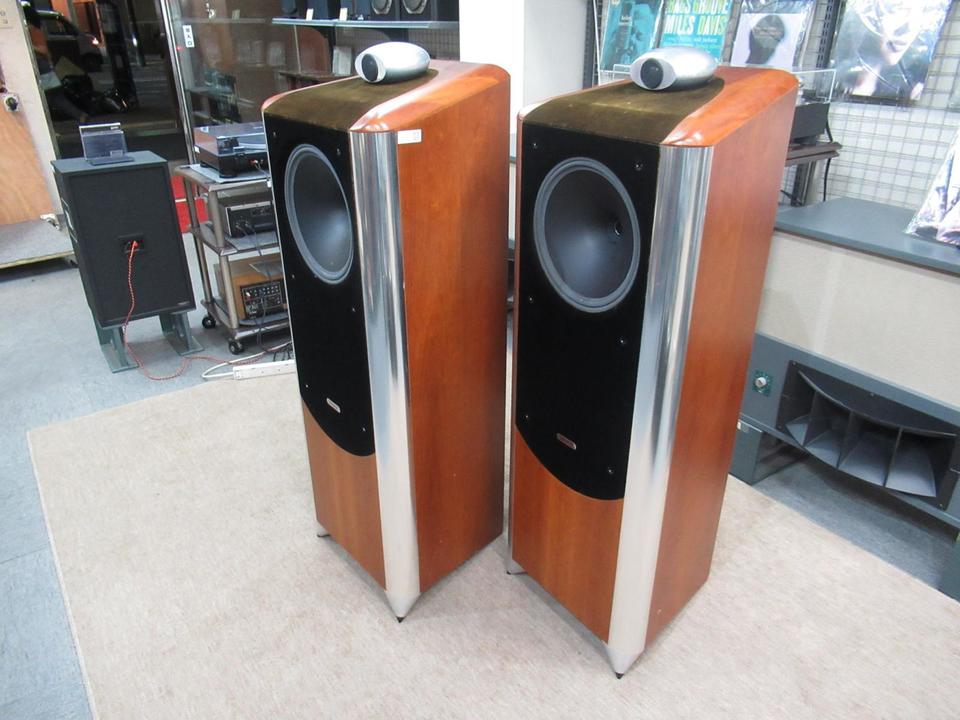
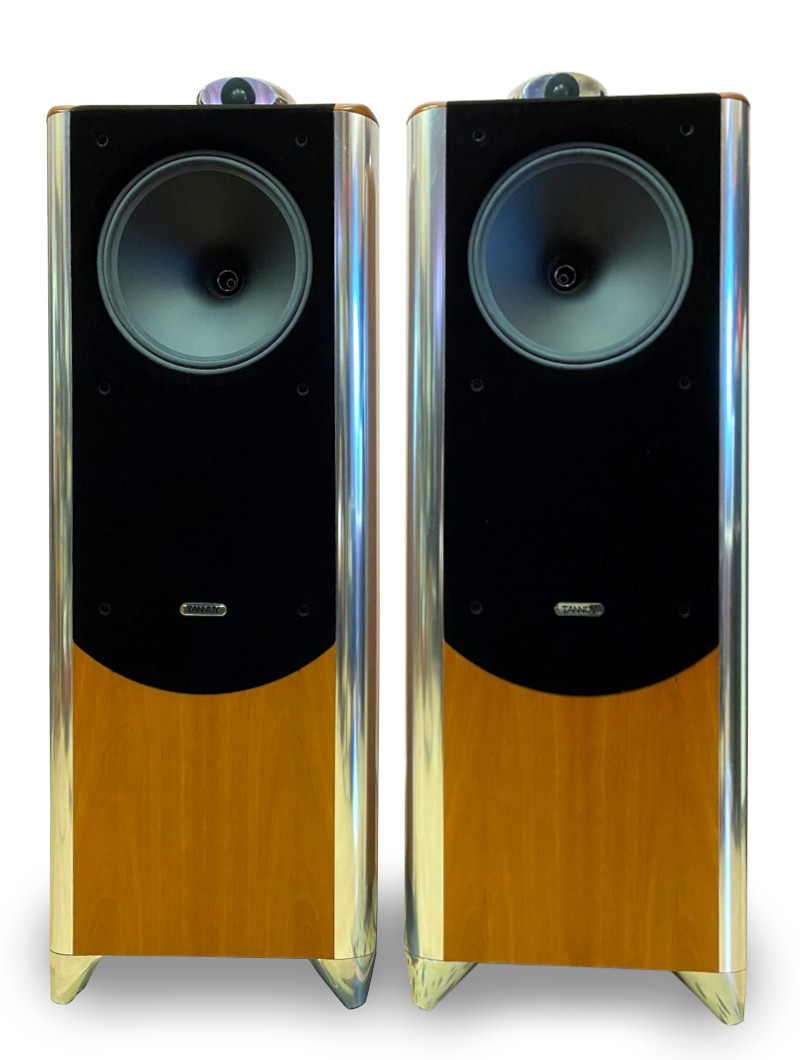
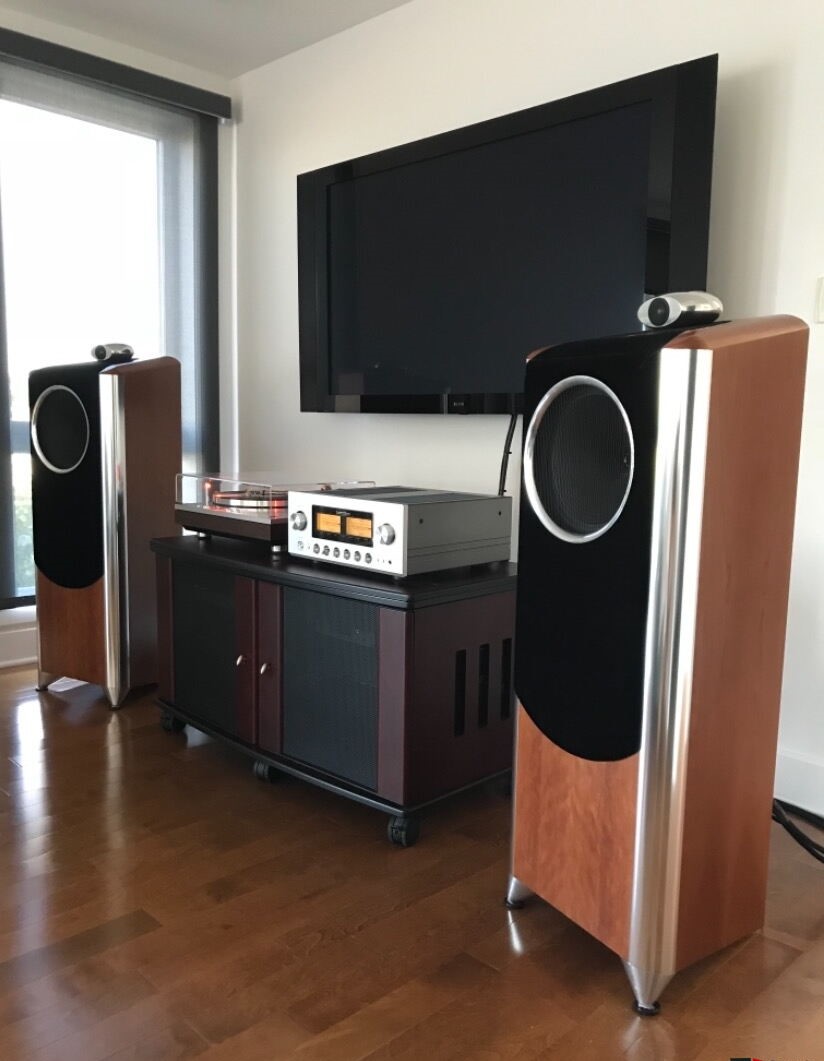
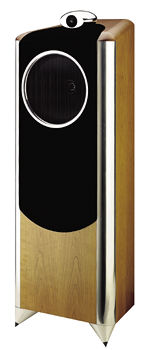
Tannoy Dimension TD12 loudspeaker
Original price was: R290,000.00.R90,000.00Current price is: R90,000.00.
- Driver Configuration: Three-way with a 12″ Dual Concentric (coaxial woofer/tweeter) and a 1″ Titanium Dome SuperTweeter.
- Cabinet: Large, reflex-loaded floorstanding design, often with asymmetric styling, using updated enclosures.
- Performance: High sensitivity (e.g., 92dB), wide frequency response (e.g., 30Hz-54kHz), and substantial power handling, delivering dynamic sound.
- Technology: Utilizes Tannoy’s point-source Dual Concentric technology, aiming for accurate sound projection.
- Sound Profile: Known for powerful, dynamic presentation, deep bass from the large driver, and detailed highs, though some tests show measurement inconsistencies.
The TD12 is part of Tannoy’s high-end Dimension series, built to deliver serious performance in home audio, often paired with matching subwoofers (TDSub) for full-range sound.
| Specifications Technical Details |
|
| Encoding designation |
|
|---|---|
| Name System Designation |
Tannoy Dimension TD12 |
| Alternative Designation |
Tannoy TD 12 |
| Series Name Model Range |
Dimension |
| System Purpose |
Home Cinema Hi-Fi Front Channels Loudspeakers |
| Driver Emitter |
|
| Driver Emitter |
300 mm Tannoy Dual Concentric Full Range System Type 3150 12″ Tannoy Dual Concentric Full Range System Type 3150 |
| Auxiliary UHF driver |
25 mm Tannoy System Type 0277 (7900 0587) 1″ Tannoy System Type 0277 (7900 0587) |
| Crossover frequency filter |
|
| Crossover filter frequency filter |
Tannoy Crossover Unit Type 1319 |
| Crossover Frequency |
1100 Hz, 14 kHz 1100 Hz, 14 kHz |
| Filter type: Crossover type |
1st order HPF, 3rd order LPF, additional 3rd order HPF HF 1st order, LF 3rd order, UHF 3rd order |
| Electrical and acoustic characteristics |
|
| Frequency Response (±3 dB) (-6 dB) |
30 Hz—54 kHz 38 Hz—54 kHz |
| Nominal Power Handling |
130 W 180 W |
| Nominal Impedance |
6 Ohms |
| Sensitivity (1W @ 1m) System Sensitivity (1W @ 1m) |
92 dB 92 dB |
| Enclosure Cabinet |
|
| Finish |
American cherry or rose-nut natural veneer |
| Acoustic Enclosure |
Double -ducted port bass reflex |
| Internal Volume |
110 l 110 liters |
| Dimensions |
1254 × 435 × 435 mm 49.4 × 17.1 × 17.1 inches |
| Weight ( each ) |
52.5 kg 115.7 lbs |
Description
My friend Harvey Rosenberg, who had more clever ideas in a day than most of us have in a lifetime, was a Tannoy loudspeaker enthusiast. I, on the other hand, had little experience with the brand before 1995, when Harvey invited me to come over and hear his then-new Tannoy Westminster Royals.
 I’m not sure what I expected, although I remember I had to be corrected as to Tannoy’s origins: Something about the sound of the name had always led me to think, dully, that the brand was Japanese. As it turns out, Tannoy began life in south London in 1926 when its founder, a man with the improbably colorful name Guy R. Fountain, started making electrolytic rectifiers by combining tantalum and lead alloy—and there you go. (In my defense, the mistake might have been fueled by the fact that Tannoy’s biggest and most expensive loudspeakers have always been popular with the audio cognoscenti of Japan. In fact, Japan imports more Tannoy speakers than any other brand.)
But getting back to Harvey and his Tannoy Westminster Royals: My first listening impression may or may not have been conditioned—I mean this seriously—by the fact that, when I first laid eyes on them, I wasn’t entirely sure the speakers I had traveled to hear were speakers at all. The well-crafted, unabashedly wooden Westminster Royals looked like very heavy china cabinets. But where one might otherwise expect to see an entire row of commemorative plates—perhaps featuring the likenesses of Ron and Nancy Reagan, the crew of the spaceship Challenger, and Diana, Princess of Wales—each Westminster displayed on its single shelf a single plate. On closer inspection, the single plates were single drivers, each marked with insignia in gold leaf.
That first listening impression was extremely positive: For the first and possibly last time in my life, I heard a stereo sound every bit as dynamic as real music. I wound up spending the night at Harvey’s, sleeping on the couch in the same room as the speakers, listening until I couldn’t hold my eyes open any longer.
That’s velvet, isn’t it?
The new Tannoys I was sent for review, the Dimension TD12s, don’t look like china cabinets or anything else. They are products of modern thinking. (A bit later, I’ll tell you what my wife thought of their impact on our living-room décor.) The important thing for now is that the TD12 retains a link to Tannoy’s past: one of its drive-units is actually two drivers in one—a Dual Concentric, to use Tannoy’s trademarked phrase.
From the earliest days of their involvement with domestic audio, Tannoy believed that one of the great impediments to making a convincing full-range loudspeaker was the fact that different drivers, covering different portions of the audible frequency spectrum, create wavefronts that tend not to blend well: Their dispersion characteristics clash. They aren’t properly time-aligned with one another, meaning that various subcomponents of the resulting complex wave are out of phase with each other as compared with the original. And because these wavefronts are launched from different physical points, the listener’s perception of music playback as a spatial event is a hit-or-miss affair, depending on where he or she sits in the listening room. Egad.
Tannoy introduced their solution to those problems in 1947, when Sam Tellig was but a wee lad and the end of World War II made it possible for England to redirect her wartime technologies toward more peaceful things: a one-piece woofer and tweeter, arranged coaxially. In the interest of physical time alignment, its high-frequency driver was positioned behind the throat of its low-frequency cone, thus distinguishing the Tannoy from other coaxial loudspeakers, then and now, where a tweeter is suspended in front of the woofer dustcap. And it differed from its contemporary, the Voigt driver (footnote 1), in that the Tannoy’s two vibrating elements were physically and electrically separate from one another: The tweeter neither rode piggyback on the woofer nor shared its voice-coil. Thus: Dual Concentric.
Notwithstanding the refinements afforded by such things as computer-aided design, metal-depositing techniques, and various new polymers, Tannoy’s best speakers of today have the same Dual Concentric technology at their core. The TD12 is built around a driver that combines a 1.25″ aluminum-dome tweeter with a 12″ pulp bass/midrange cone. The dispersion of the former is controlled by a stationary waveguide and by the woofer cone itself, which acts as a horn, the flare rate of which is best described as “compound.” In addition to keeping electrical sensitivity high, that probably makes for a much smoother resulting impedance curve than would otherwise be possible. The woofer cone, for its part, has a relatively stiff surround made of impregnated fabric, and it’s reflex-loaded via two ports on the back of the cabinet. As supplied, these are filled with foam to provide resistive loading.
On paper, the two diaphragms appear to have been engineered as one with the greatest of cunning—yet because they’re electrically and physically separate, some form of crossover is required. Luckily, this has been kept simple: a combination of a third-order low-pass filter with a first-order high-pass, all hardwired, and with a center frequency of 1.1kHz. The result is something that sounds impossible: a single-driver loudspeaker that can be biwired.
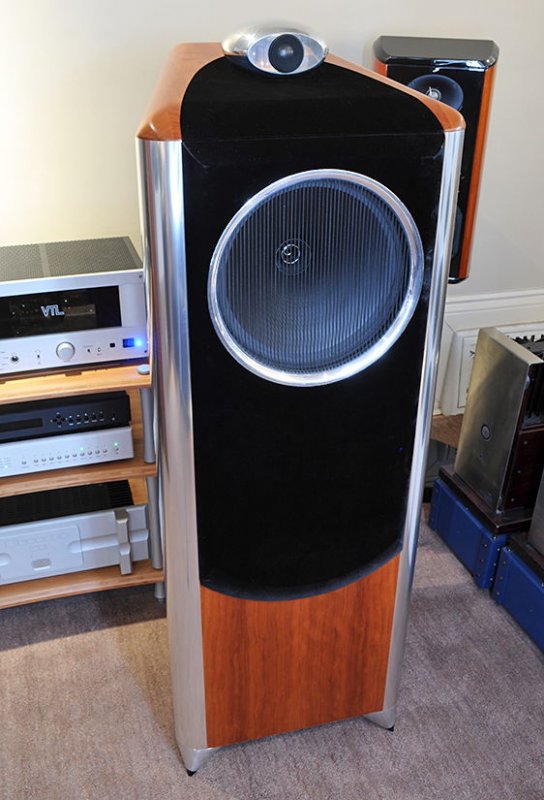
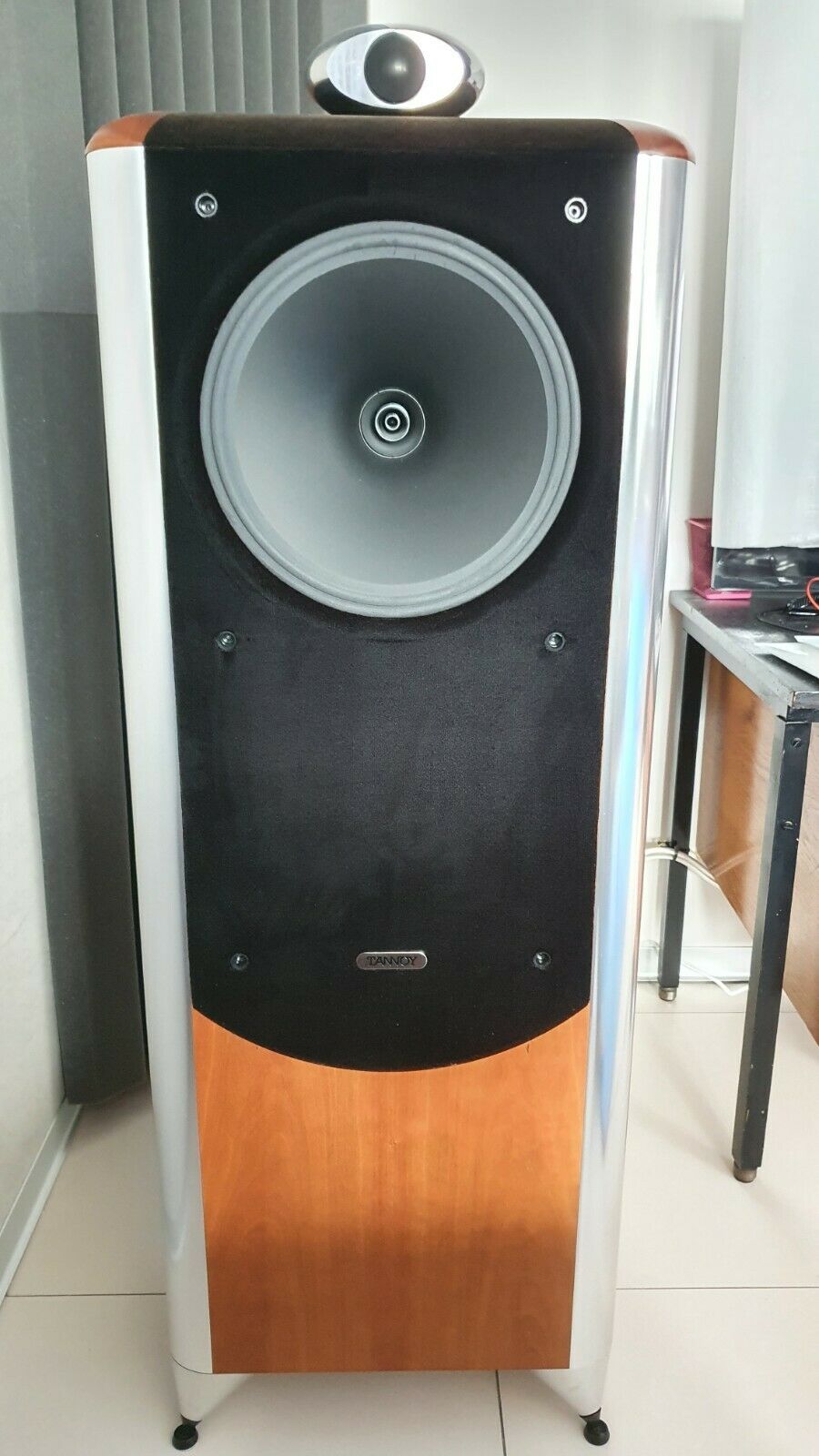
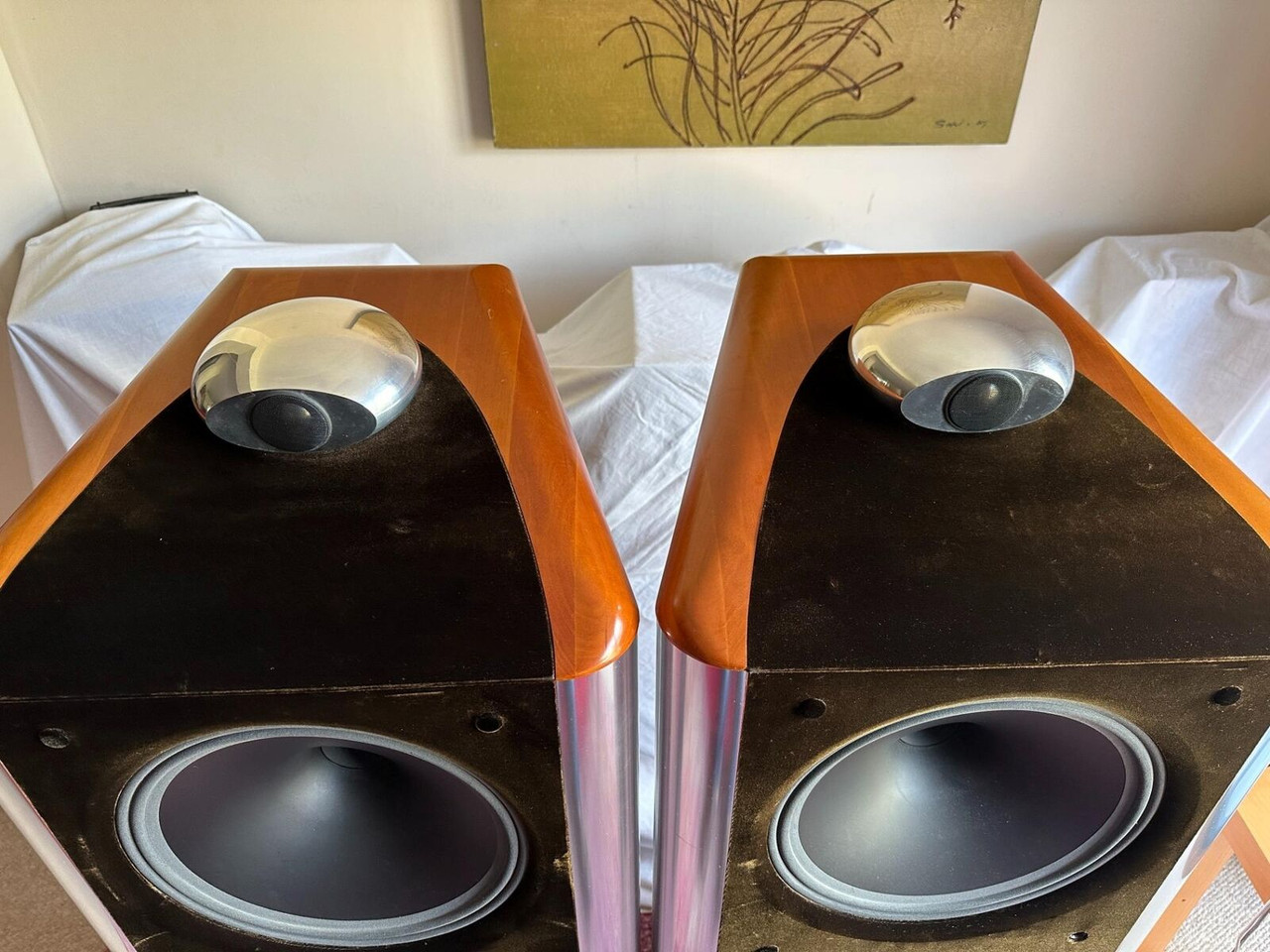
But here’s another twist: The TD12, like the other models in Tannoy’s Dimension series, isn’t a single-driver speaker at all: Tannoy has equipped it with their new SuperTweeter, a 1″ titanium dome with a neodymium magnet. The Dual Concentric driver is allowed to roll off naturally at the top of its range, and the SuperTweeter blends in with the aid of a third-order high-pass filter. The center frequency of this compound (acoustical plus electrical) crossover is 12kHz, and the response of the TD12 is claimed to extend way the hell out to 54kHz, where boy bats whistle at girl bats. The SuperTweeter sits in a chunky ovoid housing machined from aluminum alloy and mounted on the main cabinet in such a way that its voice-coil is the same distance from the listener as the other two.
And what a cabinet! Its lines slope and curve, with few parallel surfaces in sight. A cherry veneer that wouldn’t look out of place on an expensive Stickley table shares space with metal trim and a black velvet apron, the latter ostensibly to absorb and tame unwanted high-frequency reflections. And because it’s constructed entirely of Baltic birch plywood—the baffle is 1½” thick, with 1″ wood used for everything else—the TD12 is unusually heavy for its size: a whopping 108 lbs each. Since I have no friends and most of our floors are hardwood, I wound up moving the TD12s around by “walking” them onto a little area rug, sans spikes, then pulling them from room to room like a child pulling a very large toy.
Now I’ll tell you why I had to move them at all.
Big speaker, big room
The room in which I do most of my listening—which, in its previous lives, before I bought the house, served first as a master bedroom, then as a dining room—is 12′ wide by 19′ long, with an 8′ ceiling. I place loudspeakers at the far end of this room, firing down its length, and when I install a new pair I rely on both my ears and my AudioControl Industrial SA3050 spectrum analyzer to achieve both the best bass extension and the smoothest overall response.
I started out using my Naim separates with the Dimension TD12s: Playing a 92dB speaker in a medium-small room with 35W or so seemed reasonable to me, and there were no technical clashes I could see. The first record I listened to was the Peter Maag/London Symphony recording of Mendelssohn’s A Midsummer Night’s Dream (LP, Decca/Speakers Corner SXL 2060). I was a little disappointed. Even with the Tannoys well into the room and away from the walls, the sound was more colored than that of the similarly priced Quad ESL-989 speakers, whose places they’d taken: boomy bass, and odd dips and peaks throughout much of the midrange. Voices and some instruments sounded dark, and the whole presentation had a slightly hollow quality: obviously, not the results I or anyone else was striving for.
I tried a more delicate record: Joni Mitchell’s Blue (LP, Reprise MS 2038). That one fared better, arguably thanks to its comparatively limited frequency range. But still, Mitchell sounded darker and thicker than usual, especially toward the bottom of her singing range, and the piano, which sounds a bit glassy on some of the album even under the best of circumstances, now sounded glassy and thick. Still, I couldn’t help but enjoy the music. Rhythms and pitches were just fine.
Setting aside for a moment the matter of tone, I thought the sound of Levon Helm’s snare drum on The Band’s Music from Big Pink was better than I’d ever heard: The Tannoys did an amazing job of getting across the idea that I was hearing a real human being whap a wooden stick against a drumhead with considerable force.
I returned my attention to speaker placement, paying careful attention to the changes, both measured and heard, as I went along. More than anything else, I noticed that small shifts in loudspeaker and microphone position yielded greater measured differences than I’d expected—although the octave between 125Hz and 250Hz was consistently elevated by at least 3dB relative to the rest of the midband, which may have accounted for the dark quality. It was easy to get flat bass response all the way down to 25Hz, although not so easy to do it without bringing a 6dB peak at 31.5Hz along for the ride. I dealt with a slight (3dB) peak at 4kHz by aiming the speakers more or less straight ahead, rather than toeing them in drastically toward the listening seat.
Thinking such finicky behavior might be mitigated in a larger room, I brought the TD12s—as well as the sources and electronics I’d been feeding them—into our living room, which measures a comfortable 28′ by 21′, again with an 8′ ceiling. Décor, or what passes for it, required me to arrange the speakers along the long wall, spaced a healthy +14′ apart and firing across the room’s short dimension.
Bingo.
I don’t feel constricted in a room of less than 230 square feet, but the Tannoys apparently did. Giving them more breathing space made a significant difference in the TD12s’ overall tonal performance and the cleanness of their bass response—although I found it interesting that the spectrum analyzer still found small peaks at 31.5Hz, 4kHz, and 160-200Hz, again varying somewhat with microphone placement. Of those artifacts, the only one that proved persistently audible in the larger room was that lower-midrange hump—and then only slightly. Given enough room, the Tannoys distinguished themselves as great speakers with a darkish midrange, not as loudspeakers with an objectionable coloration.
Whatever dark quality remained was most audible on voices, male artists taking on more thickness than I’m used to—as I heard from Frank Sinatra on Moonlight Sinatra, my favorite of his Reprise-era records. And alto Kerstin Meyer, doing the honors on Barbirolli’s recording of Mahler’s Symphony 3 (BBC Legends BBCL 4004-7), sounded slightly chesty. But the sheer presence of well-recorded voices wasn’t dimmed in the least; in fact, I enjoyed vocal music of all sorts at least as much as usual through the Tannoys: This was just how they sounded.
It was clear sailing from there. Spatial performance was superb, with surprisingly good depth from far left to far right, even when I had the TD12s fairly close to the wall behind them. Perhaps most significant of all, the Tannoys had a tremendous sense of scale, as good as any horn I’ve tried at home. Whereas my Quad ESL-989s are large speakers that behave like small speakers when it comes to the spatial aspects of stereo reproduction, the Tannoys are large speakers that behaved like large speakers. Imaging precision, and even the ability to sound tidy when called for, were not beyond them—the Joni Mitchell disc and others like it never sounded freakishly big—but the TD12s fairly lived to play orchestral music. They helped bring my enjoyment of Ein Heldenleben and other Strauss tone poems to a new level, letting me appreciate the physical aspects of the big, often gaudy arrangements in a way I hadn’t before.
Yet the TD12s did something else I’ve come to associate with efficient speakers: They played music convincingly at low levels. Sometimes I want to hear orchestra music at less than orchestral volumes—but I still want color and presence and scale. The Tannoys did all of that with apparent ease. At volumes where conventional loudspeakers can’t manage a convincing center image, the TD12s filled the imaginary stage with real, involving music that just happened to be quieter than real. I remember listening one afternoon to Curzon and Knappertsbusch play the Adagio un poco moto from Beethoven’s Piano Concerto 5, the “Emperor” (LP, Decca/Speakers Corner SXL 2002, one of the loveliest records ever made), at a very low volume, just because that’s the way I wanted it. The Tannoys sounded wonderful. As I’ve said before, hi-fi is good only when it does what we want. This was very good.
The TD12s were supremely dynamic, playing all sorts of music with realistic amplitude contrasts and, consequently, a fine sense of drama. Were they as capable of startling a listener as Harvey’s Westminster Royals—or other fine horns, for that matter? Probably not. But they were more satisfying than most, and for sheer physical impact of drum sounds on well-recorded rock, they had few peers. When the kick drum and electric bass came in near the beginning of Procol Harum’s “Shadow Boxed” (The Well’s On Fire, Eagle ER 20006-2), I could feel it in my sternum—yet pacing wasn’t the least bit slow. Utterly, utterly cool.
Drawbacks? For one, I wound up thinking the Tannoys sounded better—more open, even more neutral—with their grilles removed. It had nothing to do with the blocking of this or that frequency range; the structure that covers the main driver itself is a row of regularly spaced strands or strings. (Think whale’s mouth and must strain plankton.) The very heavy grille panels—11 lbs each, which is more than some speakers weigh—might be storing resonant energy. Just a guess.
Neither my wife nor I cared much for the styling. All that black velvet picks up dirt too easily. The chrome-like trim and the eye-like tweeters are jarring, especially next to the nice cherry veneer. Putting the bad grilles in place adds a chrome porthole to the mix, making it look like the sort of thing that has Ted Williams’ head in it. You may respond differently; in any event, the Tannoy’s very high build quality is indisputable.
Little amp, little room
Harvey Rosenberg, who passed away shortly before the destruction of the World Trade Center, was led to Tannoy by his nascent interest in low-power amplifiers: His horn-loaded Westminster Royals had a sensitivity rating of 100dB. Still, it’s fair to say that all the company’s Dual Concentric speakers are more efficient than average.
Before sending the Dimension TD12s back, and acknowledging my own fondness for the breed, it made sense to try them with a couple of single-ended triode (SET) amplifiers.
Dragged back to the smaller room, powered now by my 300B-tubed Audio Note Kit One (about 7Wpc on a good day), the Tannoys did all right, but just. Heldentenors and loud pianos pushed the envelope, taking on that distinctive, clipped-tube mushiness. My Fi 2A3 amp sounded beautiful through the Tannoys, but only at consistently low volumes. I didn’t even try driving the Tannoys with SETs back in the big room, where the 35W Naim was itself getting into a peck of trouble here and there. While the TD12 is undeniably efficient, then, I wouldn’t buy a pair for only that reason.
But if my musical diet leaned heavily toward large-scale orchestral music, and I wanted to build a dramatic, dynamic, and altogether engaging music system into a large living space, the TD12 would be at the top of my list—exceeded only by my abiding interest in building my own ridiculously large horns some day, and knowing in the back of my mind that my wife would never let me spend $23,000 on Westminster Royals. Money I don’t have anyway, and probably never will.
Most readers look at review conclusions the wrong way, if you don’t mind my saying so: Either the reviewer wishes he or she owned the thing under review, or they don’t—the latter constituting various and imagined different shades of black. That’s silly, of course, and in spite of how we might want the hi-fi marketplace to work, nothing’s that simple. So the truth will just have to do, and the truth is this: The Dimension TD12s may be a little too colored for a reviewer to use, but they’re also a little too entertaining, exciting, and involving for a reviewer to use: He’d never want to put anything else in their place. Strongly recommended for music-lovers who know what they like—and are comfortable with it.
This review looks at the Tannoy TD12, EISA award winning High End Product of the Year 2001/2002. This is the flagship of the Tannoy Dimension (TD) range. Tannoy’s TD12 is a massive, costly high-end design using updated Dual Concentric drive units with updated asymmetric designer enclosures. The statistics are little short of awesome — 1030mm tall, 108 lbs weight, 92dB sensitivity (you can use this giant with a good 8 Watt single-ended triode if this is what turns you one, but feel free to use 250+ watt solid state power houses as I did for this test) a frequency bandwidth (-6dB) extending from 30Hz all the way to 54kHz, and a price tag of $10,000 a pair!
 For those who have not encountered Dual Concentric, it is a proprietary Tannoy technology in which the tweeter – in this case a 25mm alloy dome — is positioned just behind the bass cone, which is open in the center where you’d normally expect to find the dust cap. The sound output exits via the Tulip-like arrangement of concentric waveguides, and is horn loaded by the bass cone which surrounds it, in effect giving a single point source output. The tweeter magnet assembly rides piggyback on the main magnet. The Dimension range also features Tannoy’s 25mm ultra-lightweight dome ultra-high frequency SuperTweeter. This is another proprietary technology, a tweeter which is designed to extend the bandwidth of the system to well in excess of 50kHz, and which is housed in a solid aluminum case bolted to the main structure of the speaker. This is old ground, but again for those who are not familiar with the SuperTweeter, the basic idea here is less to extend the frequency response to match the extended bandwidth of the new digital media like DVD-Audio and SACD, but to reduce high frequency phase distortion and to improve transient response, factors that are known to influence low frequency reproduction too. Hence the claim that the SuperTweeter improves the bass, and they’re right.
The physical aspects of the Dimension TD12 are as distinctive as the aesthetics. The enormous enclosure has a trapezoidal cross-section, with a canted top that is shaped at its apex to accommodate the solid metal housing for the supertweeter, which is a version of the ST-200 that was introduced as a general-purpose add-on for existing speakers about a year ago. The base of the enclosure is also tilted, but in the opposite sense to further reduce any symmetry that might encourage internal reflections, with the enclosure vertical orientation established by a fully integrated pair of inverted cone shaped aluminum feet, tapped for spikes, that are extended vertically to form the low diffraction wide radius vertical cabinet edges.
Rather than using enormously thick chipboard panels to deaden the enclosure, Tannoy has taken the more intelligent route of building the carcass from birch ply, 25mm thick for the main panels apart from the baffle, which is 38mm thick. The laminations provide high levels of damping, but the enclosure is further stiffened by an extensive system of shelf bracing and by using different materials in combination, an idea that Tannoy calls DMT (Differential Materials Technology). The supertweeter is set well back from the tweeter, and a layer of black velvet material is used to inhibit early reflections from the near horizontal section at the top of the enclosure, and the felt is extended down the front to surround the main Dual Concentric driver. The massive enclosure is rear vented with two large ports which are fitted with removable reticulated foam bungs which help damp the port resonance, though with the very open grade of foam provided, the damping effect is not large.
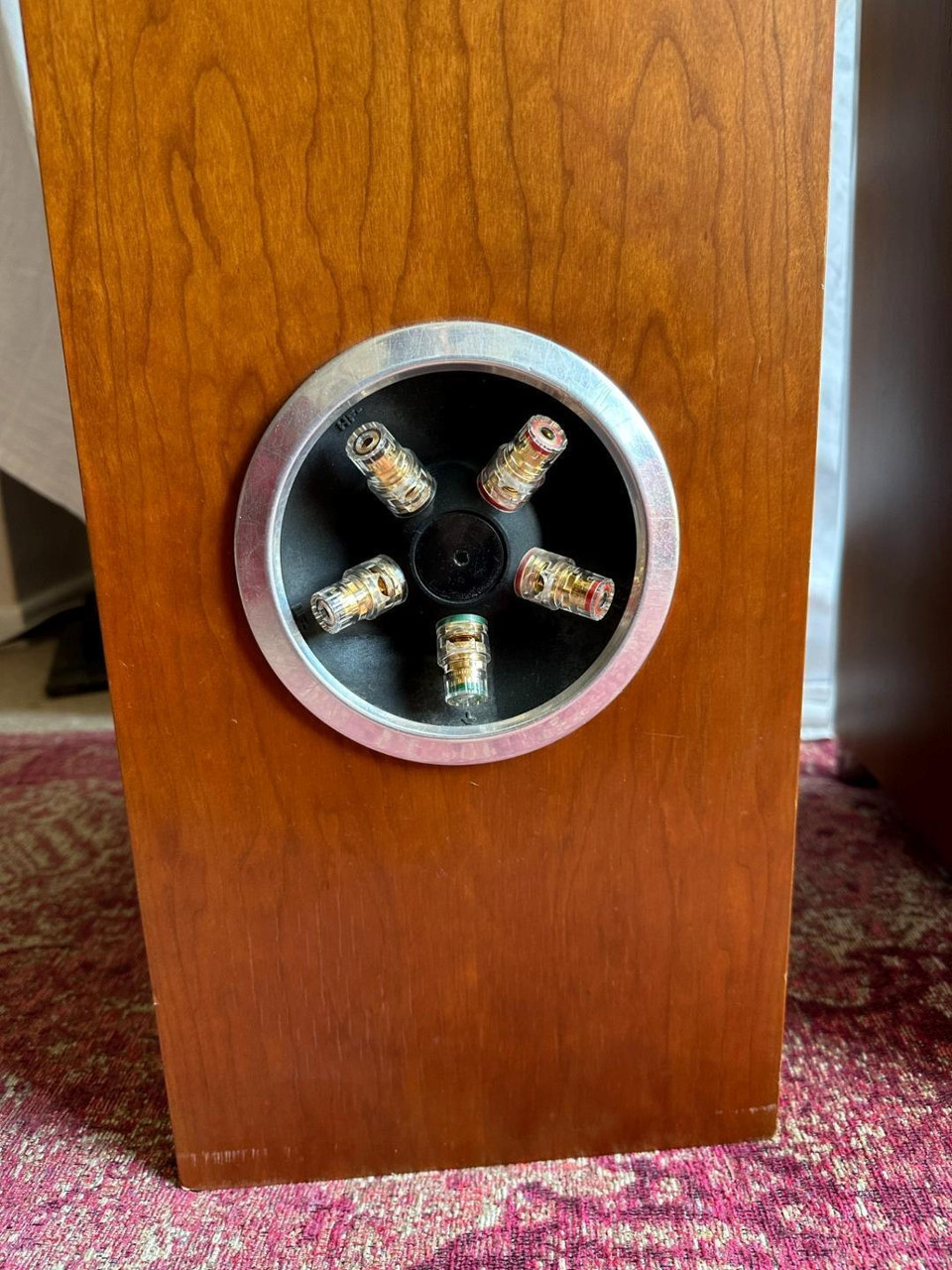
Viewed from the side, the SuperTweeter is positioned behind the apex of the 30.5cm Dual Concentric bass cone, an arrangement designed to provide time alignment in the forward listening plane. In fact the picture is somewhat more complex than this simplistic description implies. The main bass/midrange crossover in the Dual Concentric unit is at 1.1kHz, about an octave and a half lower than in a conventional speaker crossover, and because the two units are concentric and time aligned, and thanks also to the directional properties of the Tulip waveguide in front of the tweeter, the unit has a phase correct transition, not only on the primary listening axis, but over a wide solid arc. Of course if you listen from off to one side, the level of treble eventually falls off, but the critical crossover region is largely free of the usual interference peaks and troughs caused by phase reinforcement and cancellation, and this characteristic has been enhanced in this version of the unit, thanks to the new lightweight pulp bass cone, which has a much smoother output over the top of the passband than the polymer cones used in the previous range of Dual Concentrics. The drive unit chassis are linked by a ground wire, which can be connected back to system ground via a fifth terminal on the WBT bi-wire terminal block on the rear, and while I couldn’t reliably detect a benefit using the partnering equipment to hand, it is quite possible that amplifier earthing arrangements other than the one involved with the Musical Fidelity A3CR and A300CR pre/power amp used for most of the test will show some benefit.
Of Music And SuperTweeters
Although the supertweeter is time aligned as previously described, it is axially displaced, and the alignment will only hold on one axis, and because the transition from the tweeter happens at a very high frequency – around 12kHz – the phase response is bound to be all over the place, when even only slightly off axis. In addition, the supertweeter is not claimed to have a completely smooth output within its passband. It is claimed to be more or less flat out to 30kHz or so, with -6dB at 54kHz, and ‘useful’ output to around 100kHz (-18dB). In practice the SuperTweeter output is barely audible as such, but make no mistake about the effect it has on the sound at a whole, which tends to be most apparent when it is removed from circuit. Although its contribution may be negligible when the whole system is running (it’s almost inaudible even when auditioned on its own, as I discovered when I tested the stand-alone ST-200 on its own some time ago), covering the tweeter with gaffer tape has a significant and adverse effect on the sound, which becomes oddly boxy and compressed, as well as sounding less detailed and slower. Further, prizing away the magnetically secured mesh covers that protect the fragile dome has an additional beneficial effect on the sound. The SuperTweeter is extremely directional, and listening on axis really works, subtly but unmistakably.
It took about two days for the previously run in but extremely cold test pair to come fully on song, and although orientation and positioning was remarkably uncritical, presumably thanks to the wide, even dispersion over the main part of the audio frequency band, removing the baffle covers is an absolute necessity. Once this has been taken care of, it became clear that this is a very special loudspeaker, with a unique set of aural attributes. In many ways indeed it is in a class of its own, but unlike the JMlab Mezzo Utopia which I have standardized on (previously reviewed – check archives) it could be criticized for lacking the ultra fine resolving ability, refinement and superbly articulated micro-dynamics that are the hallmark of that design.
But living with and listening to the TD12 was full of incident, almost all of which were life (or at least music-) enhancing. I confess that I had my previous experiences of Dual Concentric in mind when I started using the TD12. This didn’t mean I was prejudiced against them: I have long admired the breed for their consistency and dynamic ability, and the very easy way in which they seemed to take up residence in real rooms, making the best of the available acoustic thanks, in the main, to a good off-axis phase response. It is the off axis radiation that energizes the room, and which comes back at the listener as an acoustic halo around the sound, though it is rarely perceived independently from the first arrival direct sound, of course. The downside with Dual Concentrics, however, has always been a certain coarseness and wiriness that tends to make music sound rather inexpressive and occasionally clumsy and brittle edged. At high volume levels the effect tends to load up, and the result simply lacks the finesse or dynamic consistency that I look for in a loudspeaker.
As the Dual Concentric bass cone is larger than other Dual Concentrics I have used in the past, I fully expected the TD12 to be worse in the crossover region – or I would have had it not been for the almost missionary zeal in which another reviewer which views I respect (thanks, Martin Colloms) had presented the TD12 in conversation. I am not big on proselytising or missionaries, which I automatically associate with the worst forms of religious bigotry, but I requested a review pair anyway, and was frankly astonished by what I heard.
Without wishing to make this sound like an unwarranted insult to others in the big high end loudspeaker business, the Tannoy seems to me to effectively overcome the shortcomings endemic with such speakers as a breed. They are frequently more than capable of projecting power, image scale and authority, but they too often tend to sound overbearing at the low frequency end of the spectrum, and muddled through complex passages. Of course this is not a universal complaint, but it is far from being an isolated one, and it serves to reinforce the proposition that as bandwidth is extended, design difficulties seem to increase exponentially.
Rules and Regulations
Tannoy hasn’t rewritten the rulebook, and there is still a suggestion of quintessential Dual Concentric-like mid and upper-midband coloration in the TD12, but they have tamed it’s worst manifestations. Rather than being exaggerated by the bass cone’s presumed inability to work cleanly at the upper end of its passband, the situation is exactly the opposite. The high power design of the TD12 is clearly in its element at that kind of volume levels that cause otherwise good alternative designs real grief, and there is little of the expected loading up of harshness as the volume level increased, at least not before the kind of sound pressure levels in my 3 x 8 meter that would have me quickly evicted from house and home. Actually this is not quite the whole story. There is a certain something about the upper midband, which tends to beam slightly, giving an impression of listening through a tunnel, and this does increase to an extent with level. But is happens slowly, and the effects rarely strays far above the lower limits of perception, and as a result it’s a largely static unvarying quality that is quickly learned and forgotten. Much more obvious is the fluidity of the sound, the broad, expensive way that images are formed, the rich, pungent yet tuneful and immaculately controlled bass, and its overall agility and propulsive timing. One particularly impressive quality is the way that the sound scales itself to the music. While orchestras sound larger than you may have thought possible from a hi-fi system in a normal room, chamber and solo music, or solo singing, when properly mic’ed, reproduced from a realistically smaller acoustic space.
The TD12 generated some of the most realistic orchestral tonality I have experienced in a long time, perhaps ever outside the concert hall, and the sheer physical breadth and scale of the sound came as a revelation. The hushed opening to the second movement of Vaughan Williams London symphony (in the Richard Hickox/LSO version on the Chandos label – a worthy winner in this year’s Gramophone awards) had a raptness and density of sound, along with and an exquisitely varied range of tonal values that bought the performance to vivid, glowing life. There was never a hint of any loss of density and passion even during the quietest moments.
This is also an extremely dynamic loudspeaker. The word dynamic is a multi-purpose adjective that can be used to cover a multitude of sins, so let’s specify by saying that the TD12 obeys the everyday meaning of the term, namely that it has the ability to reproduce the loudest and the quietest passages of a work in their correct relationship, better, arguably, and often more dramatically than with any other loudspeaker I can recall, and certainly at the price. But the TD12 is dynamic in another sense too, namely its ability to resolve low level information in the presence of louder events, and this is the kind of ability that is necessary to make sense of the complexities that are found again and again, not least in the previously mentioned Vaughan Williams recording.
The Roundup
Tannoy has a long history of making expensive singing wardrobes, primarily horn loaded designs aimed at the Far Eastern market. Many of them have been unevenly fine loudspeakers in many respects, but none to my knowledge has ever come close to demonstrating the technological sophistication of this endlessly fascinating design, and none I am convinced has its wide ranging yet fully rounded musical talents.
Related products
-
Dynaudio Special 40 in Birch Grey (WOW!!!) – Stands Included
Original price was: R90,000.00.R60,000.00Current price is: R60,000.00. Add to cart -
Unison Research Max-1 Speakers
Original price was: R190,000.00.R52,000.00Current price is: R52,000.00. Add to cart -
Harbeth P2ESR SE Bookshelf Speakers
Original price was: R62,000.00.R29,000.00Current price is: R29,000.00. Add to cart -
Zingali Zero Bookshelf (New, pick your own colors)
Original price was: R102,000.00.R64,000.00Current price is: R64,000.00. Add to cart