There are few reviews on the TDL reference standard speakers
Bass reproduction through the TDL RS was easily the deepest, most effortless, and most enjoyable I have heard through any system. They present low frequencies with power and impact only hinted at by other speakers.
…In addition to this remarkable LF extension, the tonal character of the lower octaves was very neutral, without a trace of tubbiness or boom. Bass was fast, detailed and articulate. …I found myself playing recordings that featured my favorite bass players, reveling in the satisfying combination of seemingly bottomless depth and tight, punchy attack.
just referred to a still-working pair of these “Reference Series” in another thread started by a countryman of yours. Seeing this pic actually reminded me that they were not IMFs as I had wrongly suggested, but TDLs, although both were designed by John Wright and shared a lot of construction/driver similarities.
Luckily, my carelessness in this other thread was not materially significant. (A “senior moment”, we call it here!)
Also, the bass drivers in those are not strictly KEF B139s as far as I know, but (IIRC) they looked like some ‘specials’ which I believe JW had made by Elac (!), but strangely they had exactly the same shaped cast alloy baskets, and one could physically interchange them, as I tried this out temporarily. This alternative manufacturer rather puzzled me, but if my belief is correct here, maybe they were made under license from KEF, but they did not have the usual ‘KEF’ lettering cast into the frames, I do clearly recall. Otherwise, I might have thought that JW had standard KEFs modified by Elac for some reason best known to him.
The most (and only!) obvious difference being that unlike the ‘conventional’ KEFs (at least the 2 slightly different cast-alloy framed B139 versions I am aware of) which had a rigid but very light expanded polystyrene flat-faced diaphragm, these JW versions had a more conventional paper cone with a circular dust cap. Another ‘oddity’ I also recall was that the 2 drivers in one cabinet had different impedances (probably 8 and 4 Ohm, but could have been 8 & 16 Ohm), and the associated X’over parts values were slightly different. I guess that this was an attempt to ‘separate’ any fundamental similarities/characteristics to give a better and more-even ‘spread’ to the bass response, and it could be that the 2 transmission lines were slightly different, to help with this too.
I re-built these massive speakers for the owner a few years ago, and they sounded very impressive when on song. Incidentally, I guess that they must have been one of the earlier implementations of the MTM arrays, which later became very fashionable, or at least I hadn’t seen this driver arrangement before seing these on dem in London many years ago.
Although it was a job I was paid for, I considered it to be a privilege to be able to do some work on these old mammoths, and I never thought that this would happen when I ogled at them with some amazement so many years earlier.
If you can replicate them successfully, I am sure that you would not be unhappy with the results, anyway, and they will fill a very large room with with a lot of enjoyable sounds.🙂
My guess is the same as Pinkmouse’s suggestion, and that the angles were intended to keep the width of baffle down as much as possible, and help reduce the diffraction effects with a less sharp transition to the side panels. The bass these monsters produce will not be very directional at those low levels, but this shape of enclosure gave rise to a mainly non-parallel sided transmission line, which is bound to have been good for the sound.
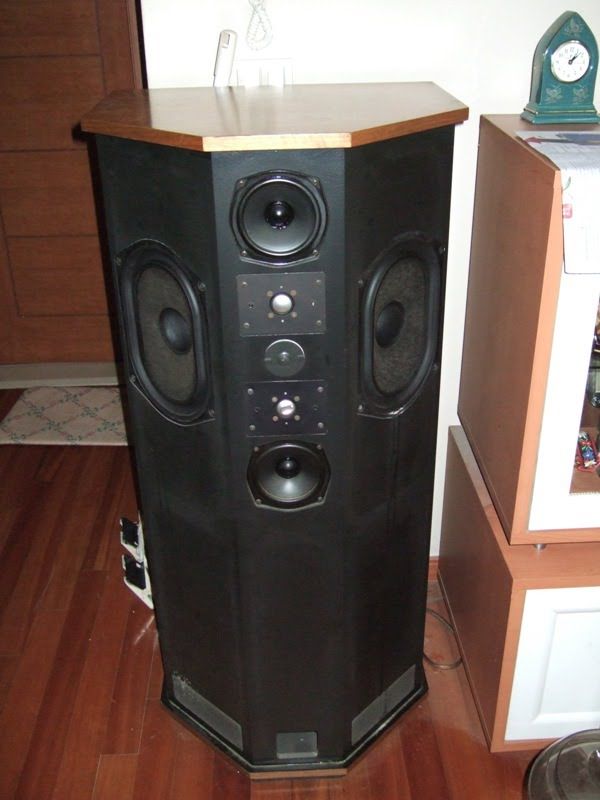
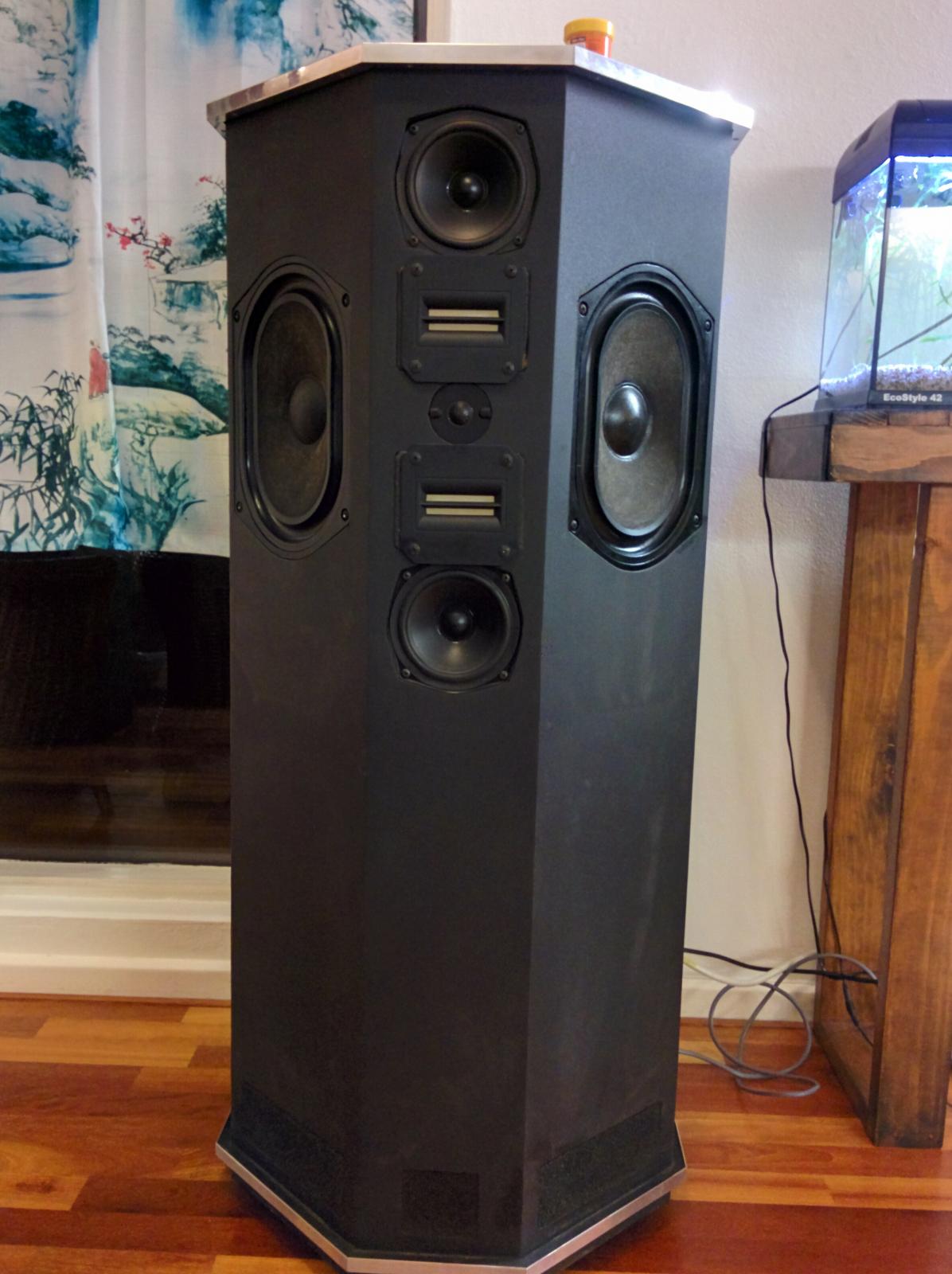
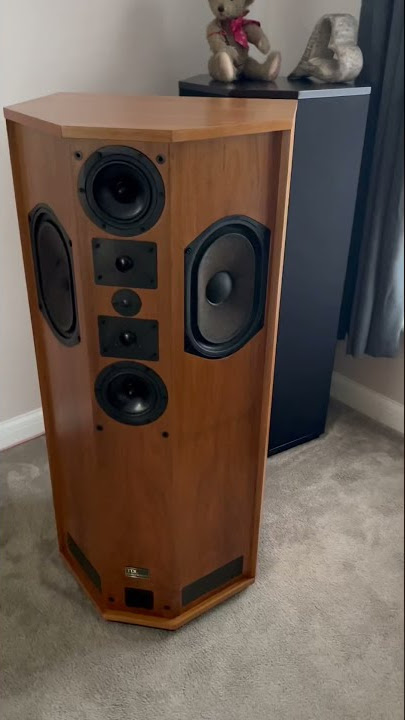
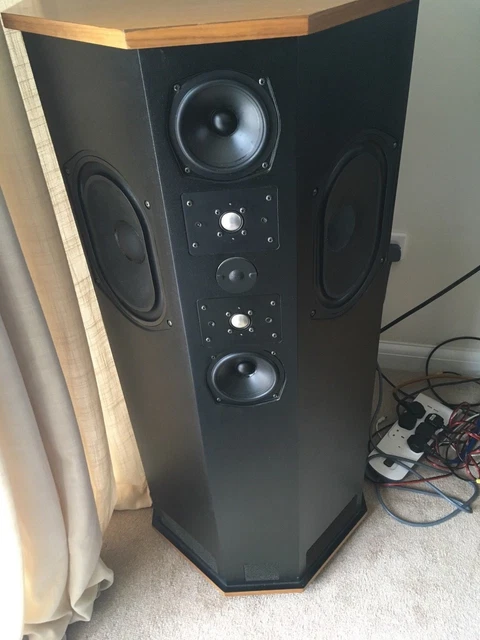
I have been running IMFs sinve 1976. I told all my friends “sooner or later, you will run IMFs” and many of them did. Ron Bliss was the North American importer and I became accquainted with him after buying his personal pair of IMF Professional Monitor MK III improved speakers in the “LAB GREY” colored cabinets. He always tells me he wants them back but the guy I sold them to in the early 1980s will never part with them. I currently own a pair of IMF professional Monitor MK IVs and the TDL Reference Standards. IFM could not get the KEF b139 bass units nor the mid-range drivers any more because KEF stopped making them. So, IMF started buying raw drivers from TDL. After IMF went out of business, TDL hired John Wright to design an all out transmission line speaker. The result was the TDL Reference Standard which used two woofers, two mid-range drivers, two tweeters, and one super tweeted in the same cabinet. The mid-range drivers as well as the tweeters were mounted on a narrow portion of the cabinet that was maybe only 7 inches wide. Trom there, the cabinet took a 45 degree turn on both the left and right side where they mounted the woofers, one on each side. To set them up, you would angle them inwards so that the 7 inch front where the mids and tweeters are, would cross paths just in front of the listener. The imaging on these speakers was astonishing. With metal drivers, they were very fast but never metalic sounding. All IMF/TDL professional grade speakers were very low in distortion and had full dynamics even at low listening levels. People would commonly say ‘THEY SOUND LIKE ‘QUADS’ WITH BASS”. I told my wife that she can bury me in the wooden crates they were delivered in. 🙂