

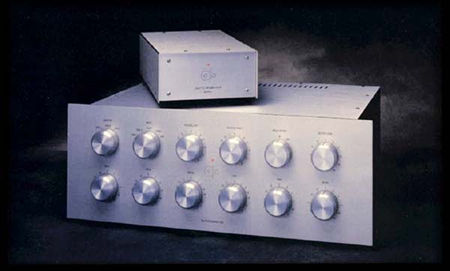
The Palette Preamplifier is a recent addition to the Cello line. Intended as a consumer version of the combination of the much more expensive Audio Suite preamplifier and Audio Palette equalizer (which together, including common power supply, now sell for approximately $30,000!), the Palette Preamplifier is the first Cello component intended exclusively for home use. Whereas the Audio Suite and Audio Palette use discrete circuitry and balanced inputs and outputs throughout their signal paths, the Palette incorporates integrated circuits, single-ended inputs, and is housed in a single chassis to keep costs down. While Levinson readily admits that the Palette doesn’t quite have the resolution and tonal accuracy of the Audio Suite/Palette combination, he feels that it performs much better than its four-fifths-lower cost would suggest. Since I haven’t had more than a few brief auditions of the Audio Suite/Palette, and those in unfamiliar systems, I can’t comment on this. However, I can say that the Palette is an extraordinary preamplifier.
Technical highlights
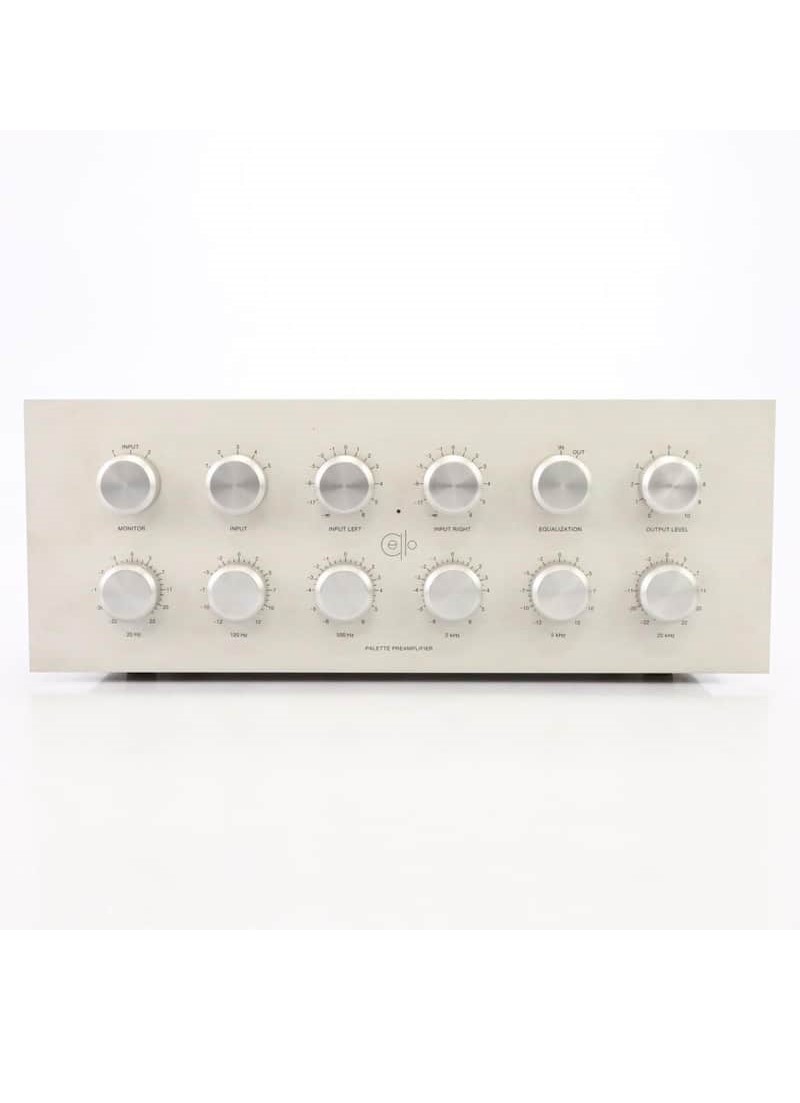
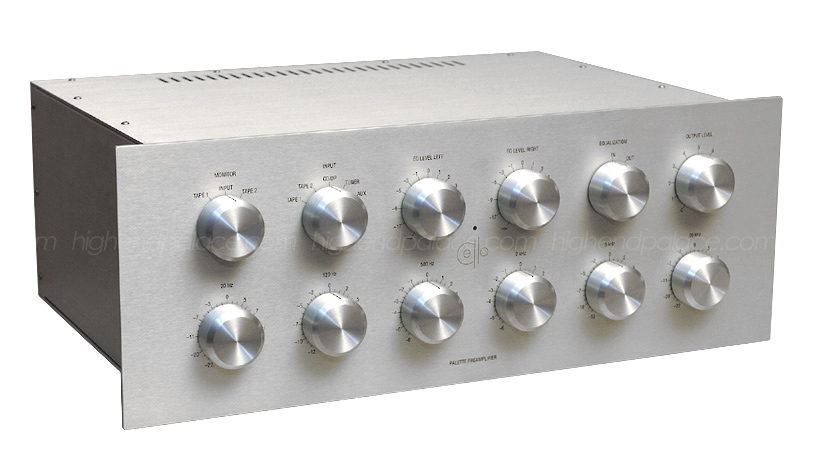
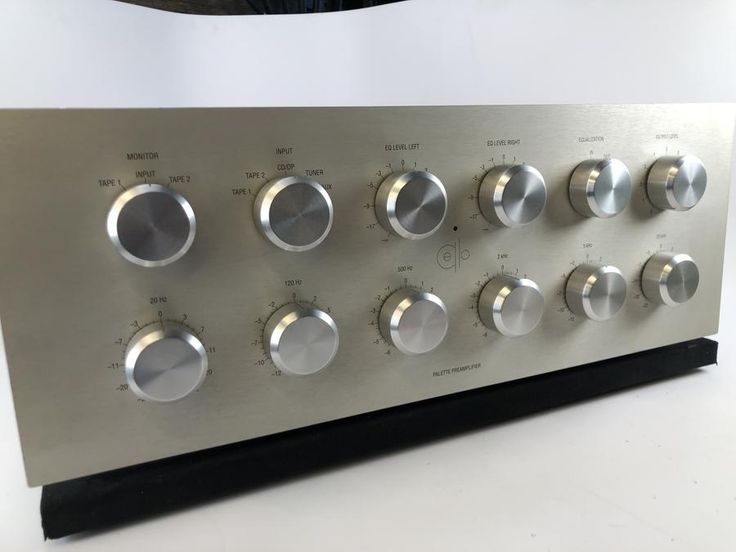
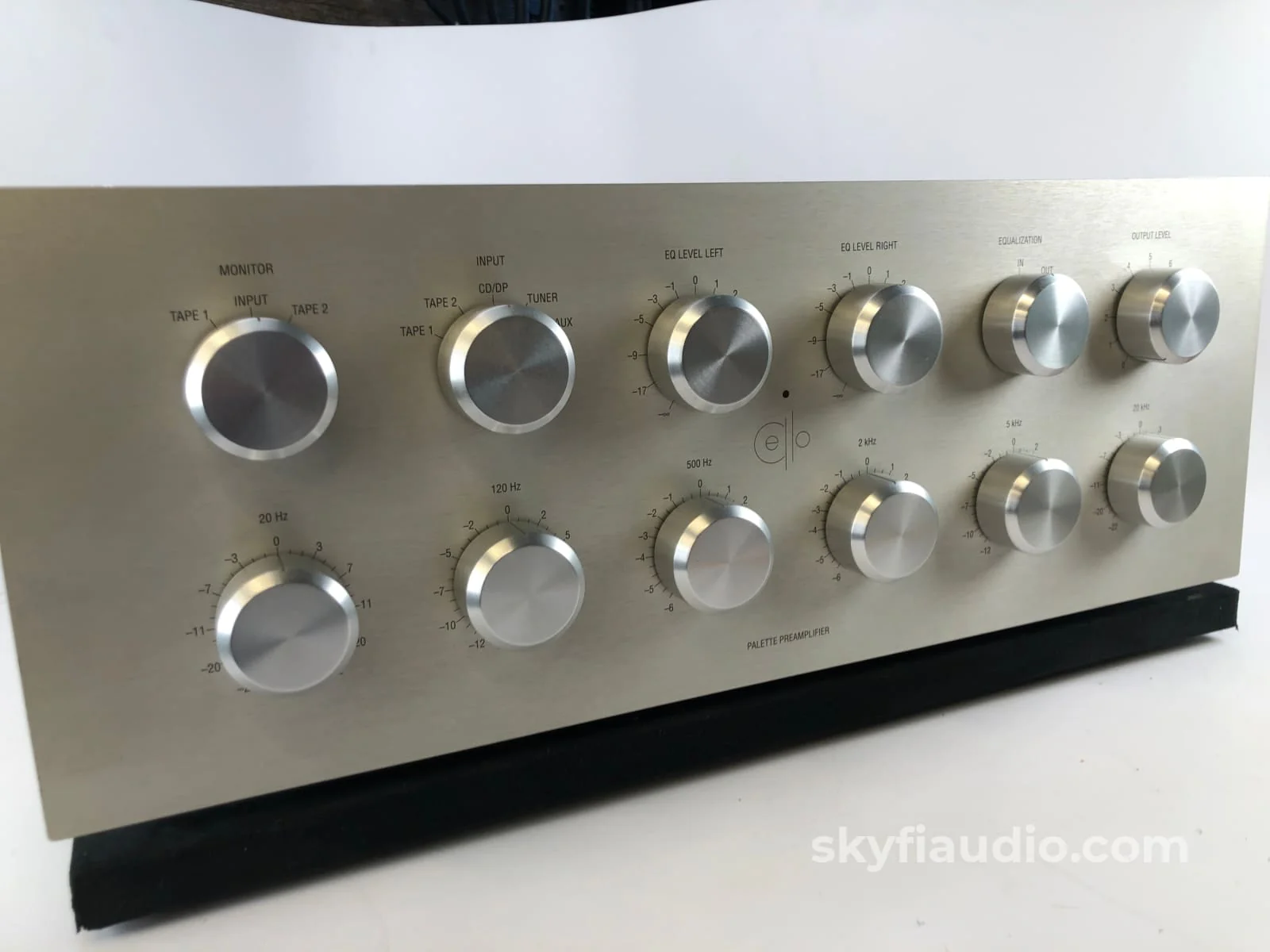
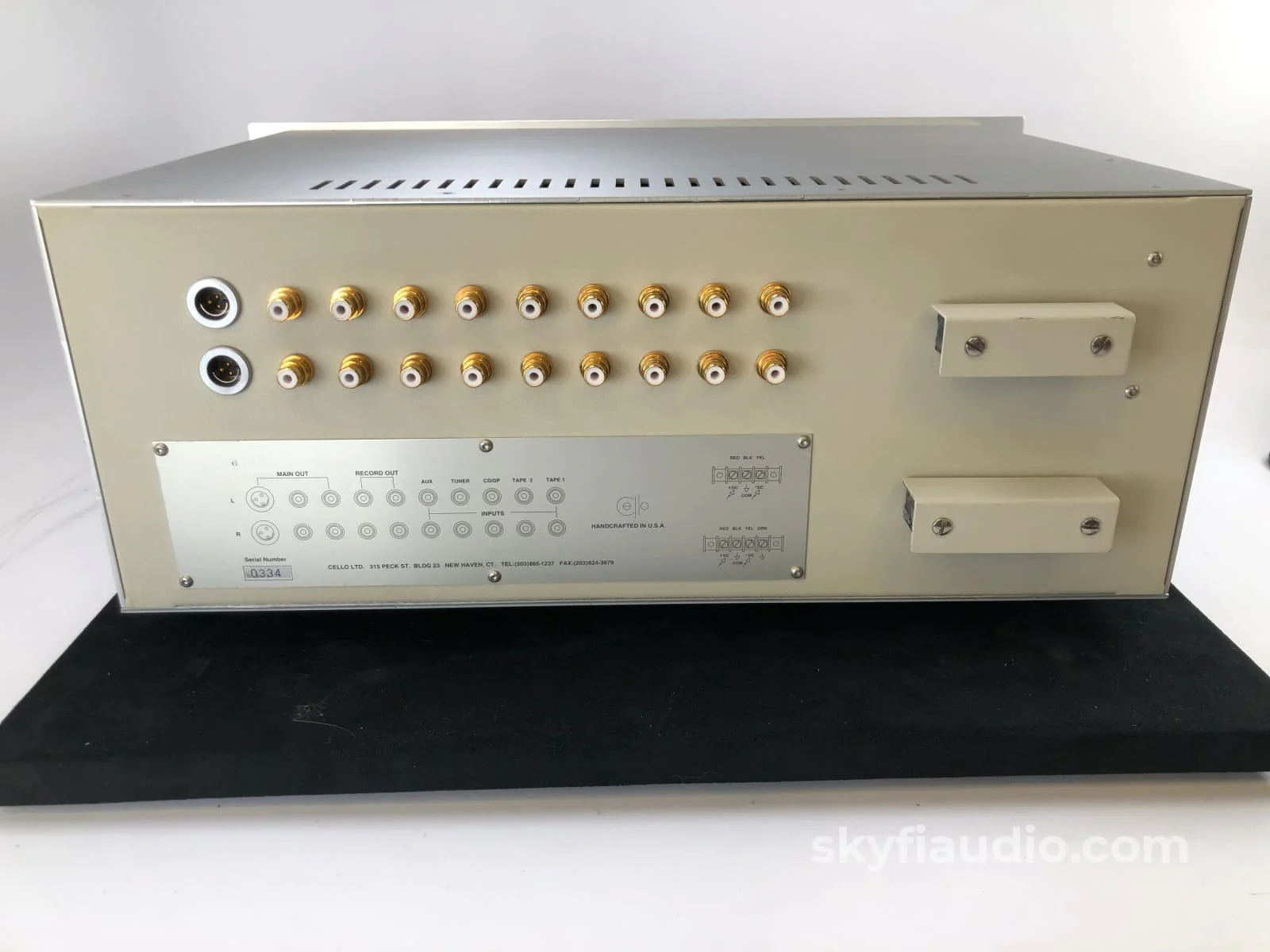
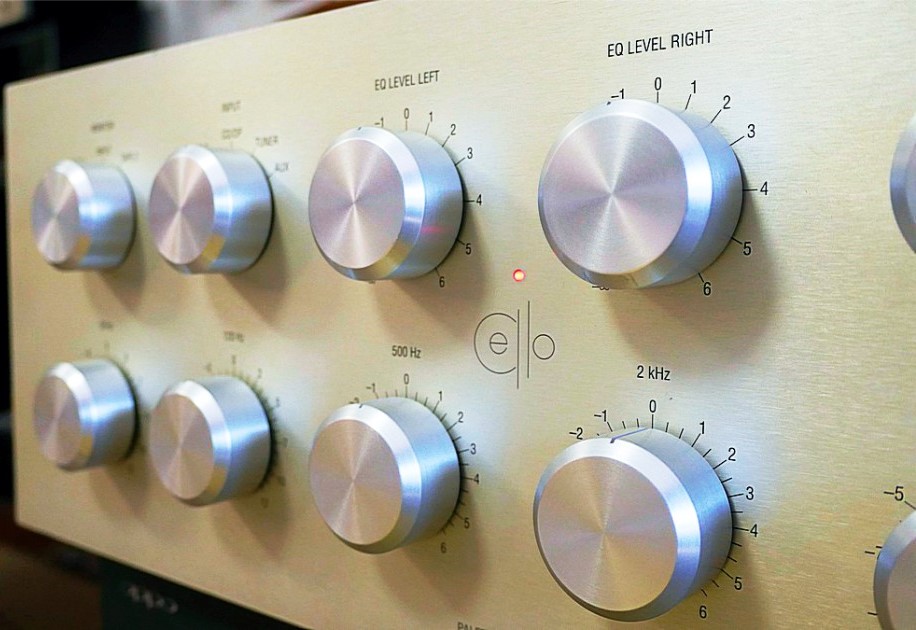
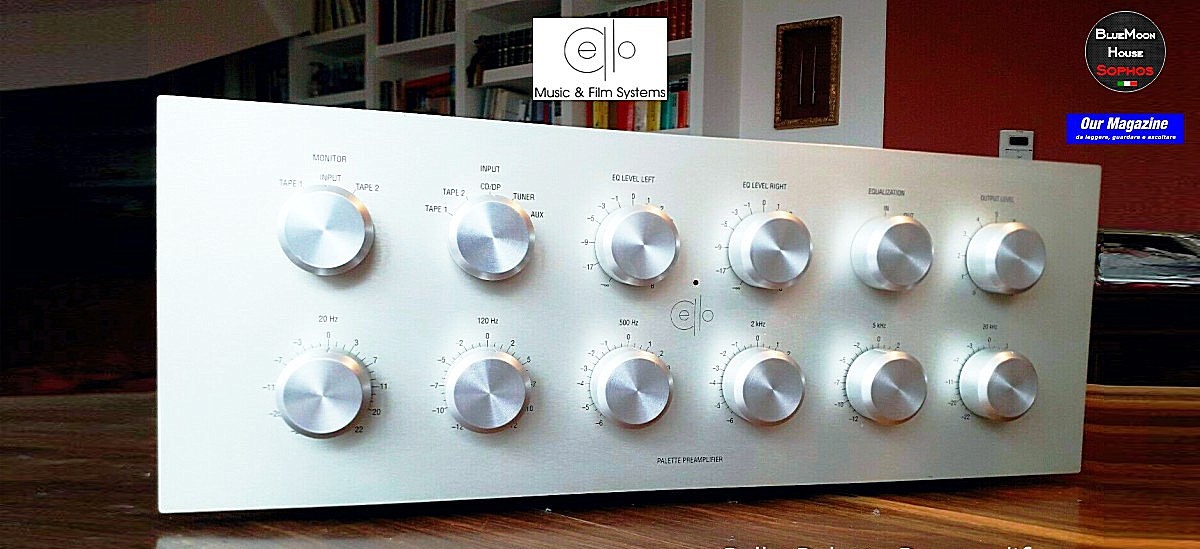
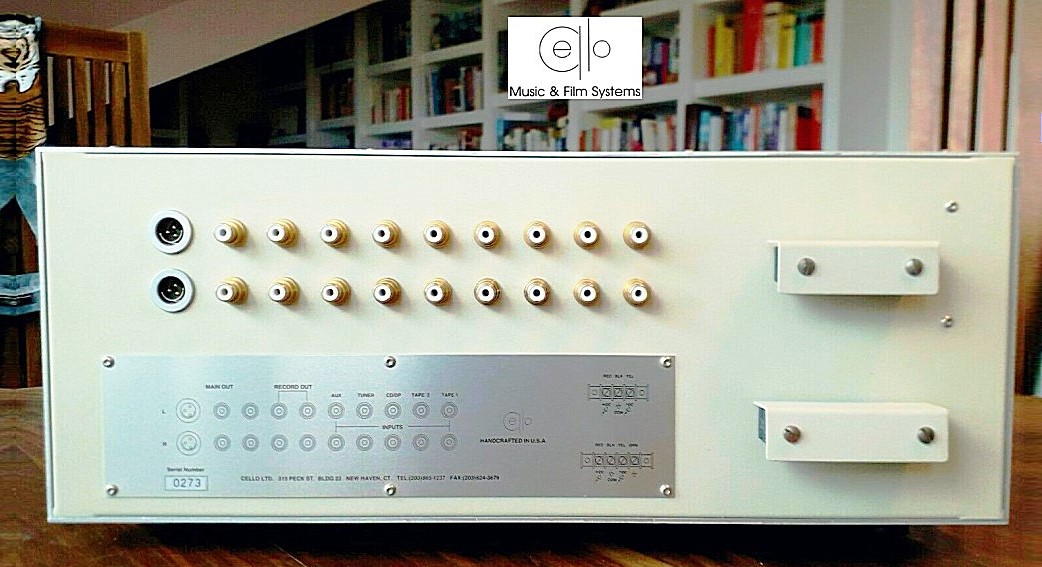
The Palette Preamplifier is visually similar to the more expensive Cello components: tall and boxy, with double rows of circular control knobs on its face. The top row of six knobs is dedicated to basic preamplifier operation (input selection, tape monitor, left and right input balance, EQ in/out, and output level), with the lower six knobs reserved for selected equalization points: up to ±22dB at 20Hz, ±12dB at 120Hz, ±6dB at 500Hz, ±6dB at 2kHz, ±12dB at 5kHz, and ±22dB at 20kHz. The rear of the unit offers five pairs of single-ended line-level RCA inputs, two pairs of single-ended RCA record outputs, two pairs of single-ended RCA outputs, and one pair of balanced outputs via Fischer connectors (Levinson claims that Fischer connectors sound much better than the more common industry-standard XLRs). The outboard power supply is hard-wired to the main chassis via two three-screw terminal strips.
The front panel is finished in brushed aluminum, with engraved black lettering and an inset, centrally located power-on LED. All 12 control knobs appear to be machined from the same brushed aluminum, and are all the same size. The bodies of the Palette and its power supply are finished in a gray matte similar to that found around military bases. Not exactly the sexiest audio component in the world, its appearance might kindly be described as “industrial” (footnote 2).
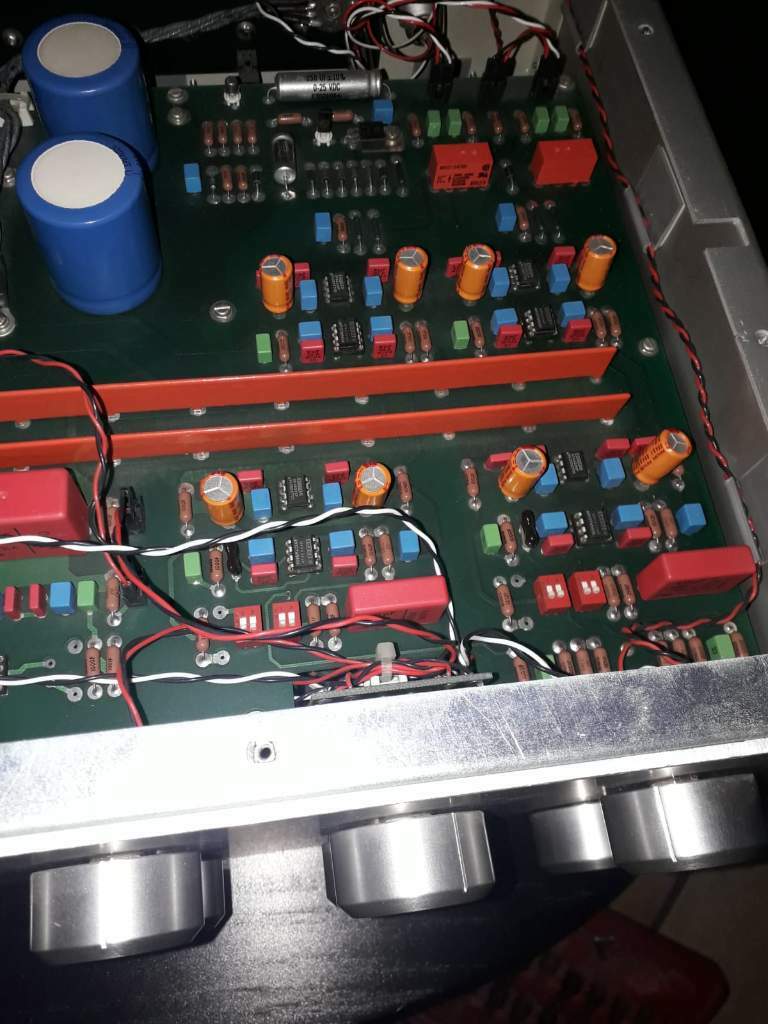
All input and output connections, input selector and tape monitor switches are pcb-mounted, the switch shafts connected to the front panel via extenders. The entire circuit is mounted on an upper printed circuit board, with the equalizer mounted on a lower board. Litz grounding wires are used to tie the various ground points to a central point, and a solid-copper, nickel-plated ground plate ties all the connector points together. The unit’s input impedance is very high: 1 M-ohm (megohm). According to Levinson and Tom Colangelo, chief design engineer at Cello, one of the limiting factors in preamplifier design is the relatively low input impedance (10k-50k ohms) presented by various products on the market. According to them, most line-level units (CD players, processors, etc.) will not drive such low impedances without audible distortion; the addition of low-impedance balanced inputs compounds the problem. By designing for such a very high impedance, Levinson claims that the Palette Preamplifier presents essentially no load to line-level source components, with much better sonic results.
Levinson and Colangelo came upon this revelation quite by accident while copying analog master tapes onto DAT. The DAT copies were sonically inferior to the masters using conventional loading, so they upped the input loading to 1 M-ohm. This resulted in an immediate improvement, with the DAT copies “sounding virtually identical to the 30ips masters.”
To equalize or not: a sound philosophy
Mention the word “equalizer” to audiophiles and they’ll run screaming from the room. A dirty word, “equalizer,” conjuring up visions of those horrible things indigenous to Circuit City that sell for a cool $99.95. But not all equalizers are created equal. In fact, all recordings are equalized to some extent, because every microphone commercially available has an equalization curve built in. Most recording mixing consoles have EQ capability, and engineers regularly utilize outboard equalization (either in the analog or digital domains) for final mastering. It may come as a surprise to audio purists that the majority of their treasured recordings contain some degree of post-production EQ. So why is it such a heinous crime to use high-quality EQ in domestic playback situations? Because most audiophiles believe, as I used to do, that any manipulation of the frequency balance in the original source will seriously compromise the sonic and musical results.
Over the past several months, while preparing this review, I’ve had the opportunity to spend some time talking about music and sound with Mark Levinson, also an accomplished musician who specializes in the double bass and various esoteric stringed instruments from the Far East. Like other musicians I know who are into high-end audio (more than you might think), Levinson considers the areas of tonal accuracy and transparency to be of utmost importance. Until I had the opportunity of acquainting myself with the Palette, I would have considered the idea of putting an equalizer into my reference system totally nuts. But I’m certainly not above entertaining another philosophy, especially for improvements in the musical integrity of the recorded performance.
Levinson suggests that EQ is a useful tool in musical reproduction because it addresses the number-one obstacle: tonal-balance problems in the program material. We all recognize that recordings vary tremendously in sonic quality. But why? Well, of course, there are different halls and different performers. But there are also different microphones (with strong sonic colorations and frequency aberrations (footnote 3), and studio monitor systems (including amps, cables, and speakers) that vary significantly in tonal balance. As Levinson states, “one system might be up 8dB in the high frequencies where another is down 7dB. If a recording is optimized for one system, it may not sound ‘right’ on another. Since even a dB or two can make a big difference, such big disparities pose a formidable problem that cannot be overcome by changing cables, processors, and equipment. The only logical answer is to give home listeners a user-friendly and sonically transparent instrument with which to correct tonal imbalance.”
In short, he is proposing a new definition of the “purist preamp” (footnote 4); one which gets the listener closer to what the musicians themselves intended you to hear. The point is well taken, since no audio system can produce a natural sonic result with all recordings. Many recordings that initially sound “bad” on one system may sound much more natural on another. Levinson claims that Cello’s original goal was to offer a combination of two products with this unit: a very high quality preamplifier, and an equalizer “for those who refuse to compromise their music.”
A note of caution: Indiscriminate use of EQ can result in some bizarre sonic byproducts. Overzealous adjustment of the midband frequencies (500Hz and 2kHz) alters soundstage dimensionality, creating a too forward or distant perspective, depending on how far up or down the controls are adjusted. Careless use of the 5kHz and 20kHz controls will do similar damage to the natural harmonic structures of musical instruments and human voices. For that reason, the Palette is probably not the product for the sound freak who would use this feature to make a circus out of the music, cranking up the bass and treble and blowing the windows out of his listening room! But if you’re searching for ways to get closer to the real thing, the Palette, judiciously used, can help restore musical equilibrium to recordings that may not be compatible with a specific playback system.
Some of you reading this will consider any serious discussion of EQ in Stereophile to be heresy (footnote 5). Certainly what I’m discussing here requires one to totally rethink the basic premise of musical reproduction. It’s no secret that the various components, cables, speakers, etc. we use in home systems sound dramatically different. One of the most significant audible differences (forgetting the various mechanical designs) between two like components is the tonal balance, as Levinson suggests. This balance dictates a great deal of the way we psychoacoustically interpret such things as soundstage dimensionality and harmonic textures, just as we do with live music in the concert hall. The Palette enables its owner to render that balance more real-sounding.
Footnote 1: The Mark Levinson brand name is now owned by Madrigal Audio Laboratories. Readers should note that there is no connection between Mark Levinson products and Cello products.—Lewis Lipnick
Footnote 2: Lynn-Jane, my wife, actually finds the Palette rather attractive. She notes that its plain, self-effacing looks don’t call attention to the fact that this is just another expensive “audio toy for boys.”—Lewis Lipnick
Footnote 3: Prior to joining the National Symphony, I worked as a recording engineer. I would carefully choose specific microphones according to the various hall acoustics, musical material, and frequency range (ie, free-field vs spot miking, vocal vs instrumental, low- vs high-frequency propagators).—Lewis Lipnick
The real problem is when the listener is required to make a value judgment about correct frequency distribution in a situation where the original source is an unknown. How am I going to know when the tonal balance is correct unless I was present at the original recording session? Of course, it’s an impossible task in the absolute. But I’ve found that, with a little practice, one can reduce the level of the deleterious colorations present in some recordings, resulting in more honest musical recreations. It is helpful, however, to have some experience with live music. It’s analogous to asking someone who has never seen a fire truck to draw a picture of the real thing. The resulting piece of art will probably be interesting, but unlikely to be accurate.
Setup
The reference system I used for this review consisted of a Theta Data CD transport, Theta DS Pro Generation II and III D/A processors, Krell KSA-250 power amplifier, and B&W Matrix 800 loudspeakers. Mark Levinson No.26S and Krell KBL dual-mono preamplifiers (footnote 6) were used as references. Mark Levinson No.23.5, Boulder 500AE monoblock, and Cello Encore power amplifiers were substituted for the Krell at regular intervals during the five-month course of the review. A Rotel RCD-855 CD player and Krell SPB 64X D/A processor served as alternative sources. Digital interconnect between the CD transport and D/A processors was XLO interconnect and Type 4 digital cable, and Theta Digital interconnect and AT&T optical link (footnote 7).
Kimber KCAG (balanced and single-ended), Cello Strings (single-ended), and Acrotec 6N-A2010 (balanced and single-ended, manufactured by Nippon Mining Company in Japan) interconnects were used from the Theta D/A to the three different preamps. Cello Strings (balanced), Magnan Vi (balanced), Kimber KCAG (balanced and single-ended), AudioQuest Diamond (balanced), Madrigal HPC (balanced and single-ended), Purist Audio Design Maximus (fluid-filled, balanced), and Acrotec 6N-A2030 (balanced) interconnects were used between preamp and power amp (footnote 8).
My B&W Matrix 800 speakers were quad-wired with AudioQuest Sterling Hyperlitz (to midrange and tweeter drivers) and AudioQuest Clear (to each of the four woofers). All stock power cables—except the captive cables with the Theta Generation II D/A and Rotel 855—were replaced with Tiffany power cables, and all components were plugged into the six dedicated circuits I had installed in my listening room. Or so I thought…
A major faux pas
One thing you learn in the professional music business (I’ve been in the National Symphony for 21 years) is that artistic honesty and integrity are everything. Without it, you’re just a hack. Well, I confess: I screwed up. After finishing all my listening comparisons during the preparation of this review, I went through the snakepit of cables behind my two equipment cabinets and, to my chagrin, discovered that the Mark Levinson No.26S preamp had been plugged into a non-dedicated circuit via an el cheapo power cord, going through an Adcom ACE-515 AC Enhancer. With all due haste, I reconfigured the AC connection from the No.26S with the correct Tiffany cord, into a 15 amp dedicated circuit.
What a difference! The sound was more open, more dynamic, and more listenable, lending credibility to the argument that dedicated circuits and high-quality power cables really can make a difference. I started out with a new slate. To hell with the fact that I’d already spent hundreds of hours listening and comparing the Cello with the Mark Levinson, or that my NSO colleagues had given so much of their time to help me out. They were gracious enough, after hearing about my mistake, to give me another long listening session, along with their invaluable input. All the comments on the sound of the No.26S in the text refer to it used in the correct manner (footnote 9).
Musical & sonic results
As with other high-quality audio electronics I’ve reviewed, the first two weeks with the Palette Preamplifier were a lost cause. The overall presentation was somewhat like green wine: raw, acidic, and two-dimensional. It was certainly listenable, but a distracting upper-midrange glare made serious auditioning difficult for anything over a few minutes. After the two-week burn-in, the sound dramatically improved. The soundstage opened up, mids and highs took on a less hard but still crystalline clarity, and the low end tightened up and became more “tuneful.” Due to the unusual nature of this component, all critical listening was done with the EQ section bypassed (except where noted).
Of the various interconnects auditioned, Cello Strings and Acrotec 6N-A2030 balanced cables sounded the best from preamp to power amp, the latter being slightly more open and transparent. Both cables were extraordinary in retrieving much more spatial and harmonic information than any of the others. I also preferred single-ended Cello Strings and Acrotec interconnects between digital sources and the Palette input.
Perhaps the best way to describe the sound of the Palette Preamp is to tell you what it doesn’t do. It doesn’t get in the way of the music. We can all certainly hear the difference between the real thing and the facsimile. But what is the difference, and to what degree do the various electronic devices we use in our quest for sonic perfection do damage to the original source? It all boils down to the individual designer’s idea of what the final result should represent. Some are more into soundstage, some into dynamics, some into harmonic accuracy, and so on. But every once in a while a product comes along that subjectively bypasses this Designer Sound Syndrome. The Cello Palette proved to be such a product. Much like the B&W Matrix 800 speaker, its lack of any specific sonic statement brought me closer to the musical truth. By comparison, my Mark Levinson No.26S preamplifier sounded colored and artificial.
The Palette was very dynamic, clear, immediate, spacious, and open. Sound “exploded past me into space,” just as it does in the concert hall. But this hackneyed audiophile terminology doesn’t come close to describing the sound of such an extraordinary component. Anyone who plays an instrument in an ensemble, or sings in a chorus, knows the difference between performing and listening. One can certainly be involved as a listener, but the all-encompassing emotional high one gets from being physically part of the music-making cannot be described in words. That’s what the Palette achieved: a sense of total involvement with the performers, where the roles of listener and participant become one. There certainly has never been another such device, in my memory, that so successfully recreates the sense of “being there.”
I’m not saying that it sounded like live music. It didn’t. Nothing reproduced does. But the total lack of any electronic haze or grain, coupled with the uncanny ability to retrieve multiple layers of ambient information in good recordings, really projected the acoustics of the concert hall out into the listening room. The Palette redefined the term “transparency.” The finest nuances were always clearly heard, even in the most complex passages. Individual musical lines could be followed at all times, regardless of volume or number of instruments playing. Capable of reproducing the most delicate harmonic structures, the Palette uncovered a seemingly endless variety of musical colors that made all other preamps I’d heard sound dull and lifeless.
The relationship of music to the surrounding space, and the way in which all of the various musical components interact within this space, were recreated with more realism than I had ever thought possible. Hall dimensions surrounding the performers were remarkably well delineated, to the point where I could clearly perceive the physical boundaries of the recording venue. The first such product I’d heard to totally succeed in this respect, the Palette was capable of creating a holographic image far exceeding the room boundaries. The speakers seemed to disappear, the three-dimensional image floating in space with unbelievable realism. Esa-Pekka Salonen’s recording of Igor Stravinsky’s ballet Le Sacre du Printemps (Philharmonia Orchestra, Sony Classical SK 45796) was so much more rewarding when heard through the Cello preamp. (This is a wonderful recording, with very wide dynamic range and natural soundstage. Sony has captured all of the necessary ingredients for a thrilling musical and sonic experience.) From the beginning of Part Two (“The Sacrifice”) to the end, all of the intricate levels of dynamics and rhythms simultaneously going on were revealed with more clarity and dynamic impact than I thought was possible to capture on tape.
By comparison, the No.26S was actually more slam-dunk dynamic. It played louder (especially with a balanced signal from the Theta and Krell D/A processors), but with much less ability to track different dynamic levels simultaneously. In other words, the loudest instruments tended to obscure softer ones, making it more difficult to discern all of the musical information in complex passages. With the No.26S, my colleagues and I were more aware of there being an electronic device between the performers and our ears. The Cello, while not always as viscerally grabbing, was virtually invisible, allowing us to hear into the music, rather than at it.
The Palette’s most striking achievement, however, was the way it reproduced the personality of the music, musicians, and hall acoustics. Any performer—whether of classical, jazz, rock music, or anything in between—will tell you that the space in which they perform is as important as the musical material itself. Why do you think symphony musicians prefer Carnegie, or Boston Symphony Hall? A great hall enhances the artistic effort, and we all know what a bad hall can do. Every hall has its own special sound, which, good or not, definitely contributes to the final musical result.
The same principle applies to musicians. No two performers, even in a very fine ensemble, will interpret every note the same way. Nor will they have the same tonal concept or emotional attachment to the music. Multiply this a hundredfold and the result is the brilliant sonic spectacle of a live orchestra. Perhaps one violinist is playing upbow when all of his section mates are going downbow, or the first-chair oboe has a brighter-sounding reed than the second chair, or the fourth horn is playing a Lawson instrument while his three other colleagues use Alexanders.
All of this is what the Palette preamplifier reproduced, which I’ve heard no other do. No more generic-sounding concert halls, instruments, or musicians. A plethora of musical colors was uncovered, the Cello extracting so much more energy and immediacy out of those tired old recordings I’ve heard dozens of times. Sure, lots of preamps are dynamic, colorful, sonically engaging. But the way the Palette allowed the music’s humanity to speak for itself, conveying each performer’s finest shadings and nuances, was where it set a new standard. It became no longer possible for me to listen for just 10 or 15 minutes. I’d be embarrassed to tell you how many orchestra rehearsals I’ve almost missed because I was too enthralled with my audio system to check my watch. This is a whole new experience for me, rekindling the spirit of excitement within this burned-out audiophile. I can think of no other component (except for the fabulous B&W Matrix 800s) that has made this much of a difference in my quest for the ultimate.
Other listeners have had the same reaction as yours truly. Ed Kelly, who engineers all of our NSO radio broadcasts and archival recordings (footnote 10), has found the Cello Palette useful in the playback of his master tapes; the Cello revealed more spatial information and low-level harmonic textures than any of the other preamplifiers he’s heard. The Cello clearly recreated the space of the Kennedy Center Concert Hall (with all of its attendant dreadful acoustics) and the NSO’s characteristics far more honestly than the No.26S, which produces a more generic hall acoustic. The latter isn’t necessarily bad—in some ways it made the KC concert hall sound much better than it is—but it’s certainly not accurate. The Krell KBL fared somewhat better, retrieving more natural ambience and soundstage, but added an artificially dark coloration. Members of our musicians’ listening group came to the same conclusion, unanimously voting the Palette the most accurate by a large margin.
Footnote 6: My No.26 preamplifier was recently upgraded to a 26S. The original KBL stereo preamp I reviewed was sent on to Santa Fe for measurements (see Vol.15 No.4). For the past several months I’ve been auditioning a pair of dual-mono KBLs, which provide a significant improvement over single-unit stereo operation.—Lewis Lipnick
How can a component with such clarity and transparency avoid sounding sterile and analytical? I don’t know. When I reviewed the Krell KBL preamplifier last year in Stereophile, I came to the conclusion that it was “ruthlessly revealing” of all source components. In one sense this was a compliment, since it retrieved so much more information. However, it also raised questions about the KBL owner’s ability to enjoy the music emotionally. As I’ve mentioned before, live music isn’t always pleasant. Massed brass and string instruments can sound downright nasty when pushed too far, and the human voice can also sound mighty brittle. But the warm sound of human flesh plucking a harp or guitar, or the glorious sound of a full chorus singing pianissimo, can make your hair stand on end.
The fact that the Cello delivered all of this much more realistically suggests that it wasn’t doing anything at all, while the others were producing specific colorations that selectively filtered the original musical signals. There’s nothing wrong with a specific sonic signature, unless it begins to get in the way of the music. If I can’t hear the difference between the Vienna Grosser Musikvereinsaal and the Amsterdam Concertgebouw (as is the case with the No.26S), a significant element of the performance is, in my opinion, lost. Or if the trombone sections of the New York and London Philharmonic orchestras sound alike, you have to question a component’s tonal accuracy.
Another kettle of fish
Equalization certainly isn’t necessary with the Palette preamp, but it’s very effective when used with restraint. I’ve found that the majority of high-quality classical discs require no EQ. But some, due to either gross anomalies in the monitors and microphones used, or sheer engineering incompetence (I’ve certainly played my share of those sessions), sounded considerably better with careful EQ. Some pop discs, mastered by engineers who leaned heavily on the sonic Tabasco, can also be made to sound more believable with a little EQ touch up. Levinson points out, and I agree, that the zero EQ setting will probably differ from bypass by a small but audible amount. For that reason, I recommend that bypass mode be initially used before you start experimenting with the Palette’s EQ. Also, boosting or lowering any of the frequency controls will affect the overall volume of the equalized signal. It is imperative that the equalized signal be adjusted via the two input controls to match the bypass signal level.
What does this equalizer do to the music? It depends how you use it. As I noted earlier, if you view this component as simply a fancy tone control to add a bit of “zip” to your system, you’d be better off staying away. But I’ve discovered that boosting the 20kHz control by only half a dB or so can restore a surprisingly large amount of ambience to acoustically “dry” recordings produced with hypercardioid microphones. Conversely, decreasing the 120Hz control can eliminate some of the upper-midbass “roar” often created by widely spaced omnidirectional mikes. I don’t know what monitor speakers were used for final mastering of Jennifer Warnes’s Famous Blue Raincoat (Cypress CD661111-2), but I’ll bet they had an upper-midrange dip and a high-frequency peak, because there’s certainly been a substantial amount of compensatory EQ. By gently lowering the 500Hz and 2kHz bands by 0.5dB, I can get rid of a slightly hollow upper-midrange ring. It’s also possible to restore more of the harmonic color in Warnes’s voice by boosting the 20kHz control by just 0.5dB.
This slight adjustment opens up the sound and allows the ear to more easily follow many of the less obvious musical lines. Individual tracks laid down in the recording sessions are now clearly discernible, and even the amount of reverberation assigned to each track is apparent.
Careful adjustment of the six EQ bands can really bring the overall musical presentation into focus, particularly when there appear to be some distinct foreign colorations. For example, the performance of Franz Liszt’s Variations on the Figured Bass of the Cantata “Weinen, Klagen, Sorgen, Sagen” for organ (Marie-Claire Alain, organ; Erato ECD 88241) definitely benefits from a gentle drop at 120Hz (-0.5dB) and boosts at 5kHz (+0.5dB) and 20kHz (+1.0dB). It appears that Erato, in their usual form, opted for pairs of omnis in the Cathedral of Orleans, with a resultant upper-midbass rise and high-frequency dip. This adjustment opens up the soundstage, places the various ranks of the organ in proper perspective, and clearly delineates the swell organ behind the principal. (With the EQ, I can even hear the swell shades opening and closing!)
An even more dramatic improvement came with another Erato recording, one in which I performed (Shostakovich’s Symphony 7, Mstislav Rostropovich, National Symphony Orchestra, Erato 2292-45414-2). The use of several “mirror-image” pairs of widely angled B&K omnidirectional mikes created a blurred, washed-out image with an absolutely horrendous upper-midbass boom and midrange squawk. By severely cutting the 120Hz (-2dB) and 500Hz (-1.5dB) controls, and boosting the signal at 5kHz (+0.5dB) and 20kHz (1.0dB), I could make this atrocious recording of an excellent performance at least listenable. It’s important to note that this is the first equalizer I’ve heard that didn’t change the overall characteristic of the musical performance. All of the musical voices retained their harmonic identities, and in proper ratio to one another. Soundstage, however, was greatly affected by overdoing the mid- to upper-frequency adjustments. The whole orchestra ended up in my lap or was moved out into the next room when the 500Hz and 2kHz controls were cranked up or down too far. More than 2dB in either direction was treading on thin ice. A modicum of taste, therefore, is advised.
But just as many recordings don’t require additional EQ, such as the spectacular performance of Sir Granville Bantock’s Hebridean Symphony (Vernon Handley, Royal Philharmonic, Hyperion DCA66450) (footnote 11). The overall sonic impression can be more vivid and exciting with added EQ, but I found that any EQ got in the way of the music. The same was true of Antoine Brumel’s Mass for Twelve Voices (Paul van Nevel, Huelgas Ensemble, Sony SK 46348). All of my attempts to improve this gorgeous recording resulted in sonic and musical disaster. It needed no help; the wonderfully transparent Palette, without EQ, provided all that was necessary. Of course, these observations, valid in my case, may not necessarily work for you. That’s the major strength of the EQ argument: it’s now possible to musically optimize just about any recording, in any system.
Shortcomings
In spite of the Palette Preamplifier’s excellence, I had three major complaints and one minor quibble. The first complaint concerns the lack of absolute polarity switching capability. Many digital recordings suffer from reversed absolute phase, which can cause significant musical damage (especially obvious when played through this preamp). The Theta Pro processors have polarity switching but many similar products (such as the Krell 64X) do not. I feel it to be unacceptable for any high-quality line-level preamplifier to be offered nowadays without such a function.
My second gripe concerns volume linearity at the bottom of the scale. At very low levels (between zero and one) the right channel disappears. Levinson claims that an equally good-sounding volume pot linear down to zero level would be prohibitively costly. He also suggests that since the B&W 800s are so sensitive (4 ohms, 93dB/W) and the output of the Theta Pro D/A converter so high, the low-level problems I get with my system would not be of concern in other situations. He’s got a point, except for the fact that the problem does exist in my system. It should be remedied.
The Palette Preamplifier’s lack of channel-balance capability and stereo/mono switching is, in my opinion, a serious oversight. Interestingly, one can adjust the left and right input levels, but only when EQ is engaged. If the listener chooses to bypass this function, there is no ability to trim left and right balance. If all rooms were perfect, this wouldn’t be a problem. But in the real world, a balance control of some sort should be available at all times. The ability to sum both channels into a mono signal is very important, since it allows the listener to check for balance and phase coherence in the recorded material.
The fourth and least distracting problem involves the use of balanced three-pin Fischer terminators vs industry-standard XLRs. I’m not going to argue Cello’s claim that the Fischers sound better, since I don’t have any way to do a blind A/B comparison. But for the sake of the people who purchase Palettes, who will be forced to have their cables reterminated with Fischers (unless they also purchase Cello Strings), it would be helpful to maintain the industry standard and keep confusion to a minimum.
Conclusions
As Stereophile‘s Musician in Residence, my mandate is to evaluate those products that go the extra distance in the quest for musical honesty. Of all the reviews I’ve submitted, this one has been the most difficult to write. The closer something comes to the absolute, the less clear become the distinctions between real and reproduced, rendering conventional descriptions and comparisons irrelevant. At the same time, the review process has been more than the usual exercise in component evaluation. It has been a revelation. Although I certainly knew that a preamplifier could make a significant difference, the degree of change far exceeded my wildest expectations.
Similar to the B&W Matrix 800 loudspeaker, the Palette goes far beyond anything else I know of in closing the gap between live and electronically reproduced music. Setting a new standard for soundstage dimensionality, it gleans multiple layers of previously undetected spatial information from the recorded material. Much more than a preamp with equalizer, it is a refined musical reference tool. As Al Merz, one of my National Symphony colleagues, eloquently stated, “with this preamp you hear the musicians…the others give you someone’s idea of how they think the music should sound.”
The Cello Palette Preamplifier isn’t perfect. Addition of a polarity switch, a better matched, more linear volume control, and channel balance and stereo/mono switching capability, would all be nice. And the $6500 price tag is a bit steep. But it still sounds better than anything else I know of, in spite of the shortcomings and cost. This is not an audiophile product, in the strictest sense of the word; it addresses the finer points of musical reproduction usually ignored by the sound freaks. It has no detectable sonic signature, nor does it grab you by the throat, screaming, “I’m a preamplifier!” If you’re expecting a gut-busting, all-you-can-eat buffet of sonic fireworks, or a designer’s fantasies of how the music should be presented, look elsewhere.
In a nutshell, the Palette Preamplifier gives the listener a glimpse of what performers experience every day on stage: total immersion in the music. Should you shell out the bucks and buy one? Just like everything else in this world, it depends on your priorities, and the realization that even the best is imperfect. Would I put my money on the line for this preamp? Yes, indeed.
By Bruno Fazzini
Graphic Designer Massimo Piantini
Classification
Stereo Pre Amplifier: Solid state with separate power supply
Neutrality: In this respect, the Palette has to give way only to its sibling, the Encore, which is still slightly superior. All the other preamps in our ranking (and many of those on the market) must bow to its majesty.
The Palette is not enchanting , on the contrary, it is an unforgiving preamp.
It doesn’t sweeten to please the audiophile , it doesn’t smooth out to avoid sonic problems, it doesn’t emphasize the mid-frequency range to gain consensus, it doesn’t wink at lovers of velvety sound.
The Cello Palette (but even more so the Cello Encore), is unforgiving.
Timbre: It is disarmingly correct.
Once again only the Cello Encore managed to do better (not surprisingly it earned first place).
It’s pointless to discuss the absolute accuracy of the three main frequency ranges. Here, we can only speak of the “reproduction” of sonic reality, not its “representation.”
Micro Contrast: The extra-fine, impalpable grain, absolute smoothness, and supreme transparency allow micro contrast to achieve a result that only the best in this group have been able to offer. Excellent.
Stage reconstruction/Sonud Stage: The Palette does not allow you to perceive only two dimensions (horizontal and depth), but you have the sensation of listening in 3D.
The perspective planes appear sculpted and well-defined . This result is only possible thanks to the fact that, in terms of timbre, the preamp we tested does not give in to the slightest tonal relaxation.
This absolute neutrality contributes to the excellent result of the scenic reconstruction.
Dynamics: Few other preamps on the market have this innate vitality (the Cello Encore and, to some extent, the Viola Cadenza, the VTL 7.5, and a few other electronics).
Thanks to the absence of sonic softness and the expository rigor, the dynamics flow very smoothly , quickly, clearly, precisely, engagingly and lively.
The contours of the instruments acquire a precision unknown to the majority of preamps on the market, while only those we used as a reference can compete, each in its own way, with the Palette.
Musicality : It seems impossible that a preamp with the characteristics described above could also be musical.
Extreme rigor usually doesn’t go hand in hand with musicality. But in Palette, magic happens.
Here we are in the presence of a great preamp because it was created by a great designer capable of working some magic. And even though 40 years have passed, the magic hasn’t lost its effectiveness, because, as everyone knows, magic is immune to the ravages of time.
Quality/Price Ratio: Used –5– (1=below Parity, 2=Parity and from 3 =Favourable to 5= Very
Favorable)

The “Audio Pairings”
System : Product designed for systems between 30,000 and 50,000 euros. This wide range is due to the fact that this preamp is a true all-rounder and can be used in medium-level systems, but also and above all in high-end and very high-end systems , always supporting the combination with high-quality electronics and speakers.
The years on his shoulders do not seem to weigh down the sonic results expressed in the least.
The Cello Palette is a preamplifier, with the addition of a section dedicated to the equalization (which can be switched off) of the various frequency ranges.
This system is particularly useful for adapting the signal emission to the environment, especially for those speakers, and they are the majority, which do not have level regulators.
Sources : High-end streamers or CD players of undisputed quality, tonally neutral and dynamically capable of supporting the dynamic range of the preamp. With modern converters, the Palette will not be out of place at all, supporting the development of the signal received from the source.
In terms of analog, it is best to choose turntables that prioritize naturalness of emission, avoiding those that tend to emphasize the warmth area or those that make pastel shades their credo.
Therefore, rigid or semi-rigid chassis turntables are preferable to floating chassis ones. These cartridges are rich in a thousand sonic nuances.

Power amps : tube or solid state, your choice . The important thing is that the quality is top-notch . The Palette deserves the best.
His greatest gift, which is the ability to easily unravel even the most complicated dynamic passages , puts him in a position to demand partners of a very, very high level.
We obviously achieved excellent results with his Encore monoblocks , which provided an excellent electrical match. The Mark Levinson power amps from the same era were excellent, but they also performed well with other solid-state power amps that follow the same production path, albeit of a more modern design, such as the Violas .
All other solid-state power amplifiers should be tried , not because of the difficulty of matching, but to satisfy your personal tastes.
By using tube amps, this preamp is able to “shock them” , contrasting, livening up and oxygenating the signal whilst respecting the tonal characteristics of the paired power amp.
Our tests have provided excellent results with various tube amplifiers, from VTL to Audio Tekne.
Speakers: here too, the design quality must be uncompromising.
Objects of this magnitude deserve only top-quality products.
Of course, the speakers will have to be chosen based on the power amp , but in terms of timbre and dynamics, it will be the Palette that dictates the rules , making it preferable to choose modern speakers that do not undermine the dynamics of which this preamp is the prince, and that in terms of timbre do not give in too much to the flights of fancy that some speakers are afflicted by.
In any case, thanks to the existing equalization section it is always possible to put some excesses back in place.
In our test we had exciting results both with high efficiency and Monitor construction speakers such as the large JBL 4355 Evo and with more traditional speakers such as the Wilson Audio ones.
Cables: Neutral, neutral, neutral!
It may seem like a small thing, but it’s not always easy to find.
Using cables that are unsuitable for a specific timbre or for dynamic softness can ruin the magic that the Palette is capable of.
We have had excellent results with the Blue Moon Audio T.

For this “giant” of preamplification , in addition to the “Pairings” tab , we also conducted a prolonged listening test. With objects of this class, we couldn’t do without it.
We took the best performing components in our room and alternated them with the Cello.
Below are the conclusions and notes that emerged from these combinations.
Anticipating what is written below, I would say that it is an “object not to be missed”
Massimo Piantini
What should a preamplifier sound like that defies time , that stands the test of time and maintains its reputation among the most demanding and experienced audiophiles?
We at Blue Moon House tried to understand it , investigating in depth the sonic characteristics of this legendary machine.
The test partners
A preamplifier of this level had to be put in the best working conditions and inserted into audio chains with excellent quality components.
As comparison preamps we used a Conrad Johnson Premier Seven , a Convergent Audio T. and a Counterpoint SA 5000E for the tube amps. But since the Cello is a solid-state electronic we used a Viola Cadenza preamp , which obviously showed a certain sonic similarity with the Palette , a Burmester model 011 , as well as a three-chassis preamp (two separate power supplies as well as dual mono), the top of the range from Blue Moon Audio T.
As for the solid-state preamps used as comparisons, only those that do not concede anything to the “timbral digressions” provided by other electronics were chosen.

Listening
The Palette isn’t for everyone. Just as supercars need to be understood and driven , not all enthusiasts are Formula One drivers.
It’s easy to go astray with the Palette . A mismatch, an inappropriate pairing, or an inadequate pairing are enough to ruin the magic these electronics can deliver.
But if everything is kept under control and the pre of our test is put in the right conditions to express itself, then the result obtained will not be forgotten so easily.
But what is it about this no longer young pre-war vehicle that still makes it a special object today?
It’s the magic of a sound result superior to the multitude of preamplifiers that bewitch. The Palette isn’t bewitching ; on the contrary, it’s an unforgiving preamp. It doesn’t sweeten to please the audiophile , it doesn’t smooth out to avoid sonic issues, it doesn’t emphasize the midrange to gain acclaim, it doesn’t wink at lovers of soft, velvety sound.
As in any self-respecting work of art, the Palette reproduces reality , it does not re-propose it.
And if this seems like a small thing, a small and insignificant detail, I assure you it is not.
Some might think the Palette’s sound lacks character, lacks soul. But again, I say this isn’t the case. In fact, I believe this is precisely its great strength.
It is the strength of having the character to impose oneself with one’s own ideas and certainties regarding its mode of reproduction, which concedes nothing to the superfluous and which I find absolutely shareable.
Thanks to this rigorous neutrality and absolute respect for sonic reality, the Cello Palette infuses every playback with vital energy. This, thanks to the oxygenation that surrounds the piece being played, produces a remarkably solid and stable reconstruction of the acoustic scene. Above all, the scene approaches the three-dimensionality that only more complex multichannel systems can provide.

The perspective planes appear sculpted and well-defined . This result is only possible because the preamp we tested does not succumb to timbral relaxation. This absolute neutrality also contributes to the excellent soundstage reconstruction.
Thanks to the absence of sonic softness and the rigorous presentation, the dynamics flow smoothly , quickly, clearly, precisely, engagingly, and lively. The contours of the instruments acquire a precision unknown to most preamps on the market, while only the ones we used as references can compete, each in their own way, with the Palette.
I don’t even want to dwell on the transparency and fineness of the grain, as we’re so high, practically off the scale compared to the average of the competitors , while with the three reference solid-state preamps we played a thrilling match.
Other top-tier solid-state preamps like the Swiss-made Solution, CH Precision, and Dartzeel could probably deliver the same absolute results. For this reason, we at Blue Moon House would love to be able to make these comparisons. But above all, we’d like to understand whether a preamp designed in 1984 is still capable of competing with the current giants available to enthusiasts today.
So far, from what I can recall, listening to the aforementioned Swiss preamps hasn’t quite touched me as much as our Cello Palette. I say “our” because this machine is currently a permanent fixture in our Blue Moon House as our reference preamp.
In closing, I’d like to mention the Palette’s ability to equalize the signal across six frequency ranges. Purist audiophiles will say this is horrifying , but I disagree. Without delving into potential controversy, I’d like to quote an excerpt from a review that appeared a few years ago on Stereophile:
Not all equalizers are created equal. In fact, all recordings are equalized to some degree, because every commercially available microphone has a built-in equalization curve. Most recording mixing consoles have equalization capabilities, and engineers regularly use external equalization (both analog and digital) for final mastering.
It might come as a surprise to audio purists that most of their treasured recordings contain some degree of post-production equalization . So why is it such a heinous crime to use high-quality EQ in home playback situations?
Mark Levinson stated that Cello’s original goal was to offer a combination of two products with this unit: a very high-quality preamp and equalizer for those who refuse to compromise their music.
Conclusions
At this point, we can answer the initial question regarding the quality of electronics over 40 years old. The answer is that if an electronic device was designed with extraordinary engineering, as in the case of our Cello Palette, it still holds up well today compared to modern, much more expensive machines.
Personally, I wonder if it is possible to go a little further , if, in addition to choosing a top-level preamplifier, like the ones mentioned, there is another way to get even closer to the reality of the sound event.
Finally, I would say that the “non-pre” option could be an avenue worth exploring.
With the potential offered today by digital technology, new possibilities are opening up that must be carefully evaluated. We’re working on them.
But that’s another story.